

SIST EN 17353:2020+A1:2025
(Main + Amendment)Protective clothing - Enhanced visibility equipment for medium risk situations - Test methods and requirements
General Information
- Abstract
This document specifies requirements for enhanced visibility equipment in the form of garments, or devices, which are capable of visually signalling the user’s presence.
The enhanced visibility equipment is intended to provide conspicuity of the wearer in medium risk situations under any daylight conditions and/or under illumination by vehicles headlights or searchlights in the dark.
Performance requirements are included for colour and retroreflection as well as for the minimum areas and for the placement of the materials in protective equipment.
This document is not applicable to:
- high visibility equipment in high-risk situations, which is covered in EN ISO 20471 (for further information concerning risk situations, see Annex A);
- visibility equipment specifically intended for the head, hands and feet, e.g. helmets, gloves and shoes;
- equipment integrating active lighting, e.g. LEDs;
- visibility for low-risk situations.
- Status
- Published
- Publication Date
- 20-Aug-2025
- Technical Committee
- OVP - Personal protecting equipment
- Current Stage
- 6060 - National Implementation/Publication (Adopted Project)
- Start Date
- 14-Jul-2025
- Due Date
- 18-Sep-2025
- Completion Date
- 21-Aug-2025
- Directive
- 2016/425 - Regulation (EU) 2016/425 of the European Parliament and of the Council of 9 March 2016 on personal protective equipment and repealing Council Directive 89/686/EECOJ Ref: L, 16.6.2026 OJ Date: 16-Jun-2026

Overview
EN 17353:2020+A1:2025 - published by CEN - specifies test methods and requirements for enhanced visibility equipment intended to signal a wearer’s presence in medium risk situations. The standard covers garments and devices designed to provide conspicuity under any daylight conditions and/or when illuminated by vehicle headlights or searchlights at night. It sets performance requirements for colour, retroreflection, minimum material areas, and placement of visibility materials in protective clothing.
This edition incorporates Amendment 1 (2025) and supersedes EN 17353:2020.
Key topics and technical requirements
- Scope and exclusions
- Applies to enhanced visibility equipment for medium risk situations.
- Not applicable to high-risk high-visibility clothing (covered by EN ISO 20471), items for head/hands/feet (helmets, gloves, shoes), equipment with active lighting (LEDs), or low-risk visibility solutions.
- Types and design classes
- Defines product types (Type A, B subtypes, AB) with guidance on form factors such as free-hanging devices, limb devices, and torso-mounted equipment.
- Specifies minimum area and placement rules to ensure visibility from required angles.
- Material performance
- Requirements for fluorescent, non‑fluorescent, and combined-performance materials (fluorescent + retroreflective).
- Colour performance criteria for new materials and after ageing/exposure.
- Retroreflective photometric performance requirements and orientation sensitivity considerations.
- Durability and exposure tests
- Standardized test methods including: Xenon light ageing, abrasion, folding at low temperatures, temperature cycling, rainfall, water immersion, free-fall shocks, washing and dry cleaning.
- Procedures for sampling, conditioning and measurement (CIE and ISO-related methods referenced).
- Marking and manufacturer information
- Requirements for product labelling and the information that must be supplied to users.
Applications and who uses it
- Manufacturers and designers of safety apparel and visibility accessories - to design and certify medium‑risk visibility products.
- Testing laboratories - to perform standardised photometric, colourfastness and durability tests.
- Procurement and safety managers in construction, road maintenance, utilities, rail, and event management - to specify compliant enhanced visibility equipment.
- Regulators and conformity bodies - to assess product compliance and relate to PPE legislation.
Related standards
- EN ISO 20471 - high-visibility clothing for high-risk situations (explicitly excluded here).
- EN ISO 13688 - general protective clothing requirements.
- CIE and ISO references for photometry and colourimetry used by this standard.
EN 17353:2020+A1:2025 is essential for specifying and verifying enhanced visibility solutions where medium risk conspicuity is required, helping manufacturers and safety professionals ensure consistent, measurable performance in both daylight and dark conditions.
Relations
- Effective Date
- 09-Feb-2026
- Effective Date
- 28-Jan-2026
- Effective Date
- 28-Jan-2026
- Effective Date
- 28-Jan-2026
- Effective Date
- 28-Jan-2026
- Effective Date
- 28-Jan-2026
- Effective Date
- 28-Jan-2026
- Effective Date
- 28-Jan-2026
- Effective Date
- 28-Jan-2026
- Refers
SIST EN ISO 20471:2013 - High visibility clothing - Test methods and requirements (ISO 20471:2013) - Effective Date
- 28-Jan-2026
- Effective Date
- 28-Jan-2026
- Effective Date
- 28-Jan-2026
- Effective Date
- 28-Jan-2026
- Effective Date
- 28-Jan-2026
- Referred By
SIST EN 13356:2001 - Visibility accessories for non-professional use - Test methods and requirements - Effective Date
- 28-Jan-2026
Get Certified
Connect with accredited certification bodies for this standard

CIS Institut d.o.o.
Personal Protective Equipment (PPE) certification body. Notified Body NB-2890 for EU Regulation 2016/425 PPE.

Kiwa BDA Testing
Building and construction product certification.
Kmetijski inštitut Slovenije
Agricultural Institute of Slovenia. Soil testing, plant health, agricultural product analysis.
Sponsored listings
Frequently Asked Questions
SIST EN 17353:2020+A1:2025 is a standard published by the Slovenian Institute for Standardization (SIST). Its full title is "Protective clothing - Enhanced visibility equipment for medium risk situations - Test methods and requirements". This standard covers: This document specifies requirements for enhanced visibility equipment in the form of garments, or devices, which are capable of visually signalling the user’s presence. The enhanced visibility equipment is intended to provide conspicuity of the wearer in medium risk situations under any daylight conditions and/or under illumination by vehicles headlights or searchlights in the dark. Performance requirements are included for colour and retroreflection as well as for the minimum areas and for the placement of the materials in protective equipment. This document is not applicable to: - high visibility equipment in high-risk situations, which is covered in EN ISO 20471 (for further information concerning risk situations, see Annex A); - visibility equipment specifically intended for the head, hands and feet, e.g. helmets, gloves and shoes; - equipment integrating active lighting, e.g. LEDs; - visibility for low-risk situations.
This document specifies requirements for enhanced visibility equipment in the form of garments, or devices, which are capable of visually signalling the user’s presence. The enhanced visibility equipment is intended to provide conspicuity of the wearer in medium risk situations under any daylight conditions and/or under illumination by vehicles headlights or searchlights in the dark. Performance requirements are included for colour and retroreflection as well as for the minimum areas and for the placement of the materials in protective equipment. This document is not applicable to: - high visibility equipment in high-risk situations, which is covered in EN ISO 20471 (for further information concerning risk situations, see Annex A); - visibility equipment specifically intended for the head, hands and feet, e.g. helmets, gloves and shoes; - equipment integrating active lighting, e.g. LEDs; - visibility for low-risk situations.
SIST EN 17353:2020+A1:2025 is classified under the following ICS (International Classification for Standards) categories: 13.340.10 - Protective clothing. The ICS classification helps identify the subject area and facilitates finding related standards.
SIST EN 17353:2020+A1:2025 has the following relationships with other standards: It is inter standard links to SIST EN 60068-2-31:2008, SIST EN ISO 12947-2:2017, SIST EN ISO 13688:2013, SIST EN 20105-A02:1996, SIST EN ISO 105-B02:2014, SIST EN 20105-N01:1999, SIST EN ISO 105-X11:1999, SIST EN 13721:2023, SIST EN ISO 105-D01:2013, SIST EN ISO 20471:2013, SIST EN ISO 105-E04:2013, SIST EN ISO 105-A03:2019, SIST EN ISO 105-C06:2012, SIST EN ISO 105-X12:2016, SIST EN 13356:2001. Understanding these relationships helps ensure you are using the most current and applicable version of the standard.
SIST EN 17353:2020+A1:2025 is associated with the following European legislation: EU Directives/Regulations: 2016/425; Standardization Mandates: M/571, M/571 Amd 1. When a standard is cited in the Official Journal of the European Union, products manufactured in conformity with it benefit from a presumption of conformity with the essential requirements of the corresponding EU directive or regulation.
SIST EN 17353:2020+A1:2025 is available in PDF format for immediate download after purchase. The document can be added to your cart and obtained through the secure checkout process. Digital delivery ensures instant access to the complete standard document.
Standards Content (Sample)
SLOVENSKI STANDARD
01-september-2025
Varovalna obleka - Oprema z izboljšano vidljivostjo za razmere s srednjim
tveganjem - Preskusne metode in zahteve
Protective clothing - Enhanced visibility equipment for medium risk situations - Test
methods and requirements
Schutzkleidung - Ausstattung zur erhöhten Sichtbarkeit für mittlere Risikosituationen -
Prüfverfahren und Anforderungen
Habillement de protection - Équipement de visualisation améliorée pour des situations à
risque modéré - Méthodes d’essai et exigences
Ta slovenski standard je istoveten z: EN 17353:2020+A1:2025
ICS:
13.340.10 Varovalna obleka Protective clothing
2003-01.Slovenski inštitut za standardizacijo. Razmnoževanje celote ali delov tega standarda ni dovoljeno.
EN 17353:2020+A1
EUROPEAN STANDARD
NORME EUROPÉENNE
June 2025
EUROPÄISCHE NORM
ICS 13.340.10 Supersedes EN 17353:2020
English Version
Protective clothing - Enhanced visibility equipment for
medium risk situations - Test methods and requirements
Habillement de protection - Équipement de Schutzkleidung - Ausstattung zur erhöhten
visualisation améliorée pour des situations à risque Sichtbarkeit für mittlere Risikosituationen -
modéré - Méthodes d'essai et exigences Prüfverfahren und Anforderungen
This European Standard was approved by CEN on 5 July 2020 and includes Amendment 1 approved by CEN on 7 March 2025.
CEN members are bound to comply with the CEN/CENELEC Internal Regulations which stipulate the conditions for giving this
European Standard the status of a national standard without any alteration. Up-to-date lists and bibliographical references
concerning such national standards may be obtained on application to the CEN-CENELEC Management Centre or to any CEN
member.
This European Standard exists in three official versions (English, French, German). A version in any other language made by
translation under the responsibility of a CEN member into its own language and notified to the CEN-CENELEC Management
Centre has the same status as the official versions.
CEN members are the national standards bodies of Austria, Belgium, Bulgaria, Croatia, Cyprus, Czech Republic, Denmark, Estonia,
Finland, France, Germany, Greece, Hungary, Iceland, Ireland, Italy, Latvia, Lithuania, Luxembourg, Malta, Netherlands, Norway,
Poland, Portugal, Republic of North Macedonia, Romania, Serbia, Slovakia, Slovenia, Spain, Sweden, Switzerland, Türkiye and
United Kingdom.
EUROPEAN COMMITTEE FOR STANDARDIZATION
COMITÉ EUROPÉEN DE NORMALISATION
EUROPÄISCHES KOMITEE FÜR NORMUNG
CEN-CENELEC Management Centre: Rue de la Science 23, B-1040 Brussels
© 2025 CEN All rights of exploitation in any form and by any means reserved Ref. No. EN 17353:2020+A1:2025 E
worldwide for CEN national Members.
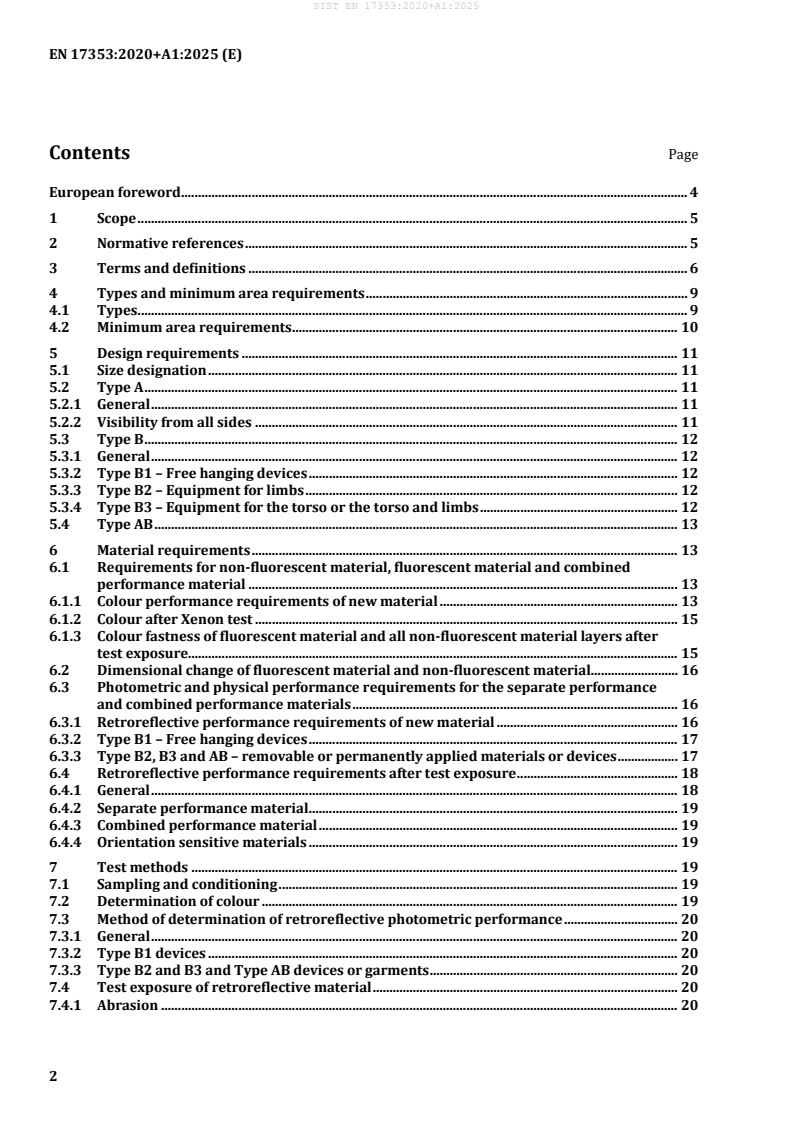
Contents Page
European foreword . 4
1 Scope . 5
2 Normative references . 5
3 Terms and definitions . 6
4 Types and minimum area requirements . 9
4.1 Types . 9
4.2 Minimum area requirements . 10
5 Design requirements . 11
5.1 Size designation . 11
5.2 Type A . 11
5.2.1 General . 11
5.2.2 Visibility from all sides . 11
5.3 Type B . 12
5.3.1 General . 12
5.3.2 Type B1 – Free hanging devices . 12
5.3.3 Type B2 – Equipment for limbs . 12
5.3.4 Type B3 – Equipment for the torso or the torso and limbs . 12
5.4 Type AB . 13
6 Material requirements . 13
6.1 Requirements for non-fluorescent material, fluorescent material and combined
performance material . 13
6.1.1 Colour performance requirements of new material . 13
6.1.2 Colour after Xenon test . 15
6.1.3 Colour fastness of fluorescent material and all non-fluorescent material layers after
test exposure. 15
6.2 Dimensional change of fluorescent material and non-fluorescent material. 16
6.3 Photometric and physical performance requirements for the separate performance
and combined performance materials . 16
6.3.1 Retroreflective performance requirements of new material . 16
6.3.2 Type B1 – Free hanging devices . 17
6.3.3 Type B2, B3 and AB – removable or permanently applied materials or devices . 17
6.4 Retroreflective performance requirements after test exposure . 18
6.4.1 General . 18
6.4.2 Separate performance material . 19
6.4.3 Combined performance material . 19
6.4.4 Orientation sensitive materials . 19
7 Test methods . 19
7.1 Sampling and conditioning . 19
7.2 Determination of colour . 19
7.3 Method of determination of retroreflective photometric performance . 20
7.3.1 General . 20
7.3.2 Type B1 devices . 20
7.3.3 Type B2 and B3 and Type AB devices or garments . 20
7.4 Test exposure of retroreflective material . 20
7.4.1 Abrasion . 20
7.4.2 Folding at cold temperatures . 21
7.4.3 Exposure to temperature variation . 21
7.4.4 Rainfall . 21
7.4.5 Free fall test . 21
7.4.6 Influence of water (water immersion). 21
7.5 Ageing . 21
7.5.1 General . 21
7.5.2 Washing . 22
7.5.3 Dry cleaning . 22
8 Marking . 22
9 Information supplied by the manufacturer . 23
Annex A (informative) Examples of garments or devices according to types and classes . 24
Annex B (informative) Examples of different types of equipment . 26
Annex C (informative) Examples on how to determine visibility from all sides for Type A
garments . 27
Annex D (informative) Possible designs for the placement of fluorescent material on
garments . 28
Annex E (informative) Examples of Type B2 and Type B3 garment. 29
Annex ZA (informative) Relationship between this European Standard and the essential
requirements of Regulation 2016/425 aimed to be covered . 31
Bibliography . 32
European foreword
This document (EN 17353:2020+A1:2025) has been prepared by Technical Committee CEN/TC 162
“Protective clothing including hand and arm protection and lifejackets”, the secretariat of which is held
by DIN.
This European Standard shall be given the status of a national standard, either by publication of an
identical text or by endorsement, at the latest by December 2025, and conflicting national standards
shall be withdrawn at the latest by December 2025.
Attention is drawn to the possibility that some of the elements of this document may be the subject of
patent rights. CEN shall not be held responsible for identifying any or all such patent rights.
This document supersedes !EN 17353:2020".
This document includes Amendment 1 approved by CEN on 7 March 2025.
The start and finish of text introduced or altered by amendment is indicated in the text by tags !".
!This document has been prepared under a standardization request addressed to CEN by the
European Commission. The Standing Committee of the EFTA States subsequently approves these
requests for its Member States.
For the relationship with EU Legislation, see informative Annex ZA, which is an integral part of this
document.
Any feedback and questions on this document should be directed to the users’ national standards body.
A complete listing of these bodies can be found on the CEN website."
According to the CEN-CENELEC Internal Regulations, the national standards organisations of the
following countries are bound to implement this European Standard: Austria, Belgium, Bulgaria,
Croatia, Cyprus, Czech Republic, Denmark, Estonia, Finland, France, Germany, Greece, Hungary, Iceland,
Ireland, Italy, Latvia, Lithuania, Luxembourg, Malta, Netherlands, Norway, Poland, Portugal, Republic of
North Macedonia, Romania, Serbia, Slovakia, Slovenia, Spain, Sweden, Switzerland, Türkiye and the
United Kingdom.
1 Scope
This document specifies requirements for enhanced visibility equipment in the form of garments, or
devices, which are capable of visually signalling the user’s presence.
The enhanced visibility equipment is intended to provide conspicuity of the wearer in medium risk
situations under any daylight conditions and/or under illumination by vehicles headlights or
searchlights in the dark.
Performance requirements are included for colour and retroreflection as well as for the minimum areas
and for the placement of the materials in protective equipment.
This document is not applicable to:
• high visibility equipment in high-risk situations, which is covered in EN ISO 20471 (for further
information concerning risk situations, see Annex A);
• visibility equipment specifically intended for the head, hands and feet, e.g. helmets, gloves and
shoes;
• equipment integrating active lighting, e.g. LEDs;
• visibility for low-risk situations.
2 Normative references
The following documents are referred to in the text in such a way that some or all of their content
constitutes requirements of this document. For dated references, only the edition cited applies. For
undated references, the latest edition of the referenced document (including any amendments) applies.
EN 20105-A02:1994, Textiles - Tests for colour fastness - Part A02: Grey scale for assessing change in
colour (ISO 105-A02:1993)
!EN ISO 105-A03:2019, Textiles - Tests for colour fastness - Part A03: Grey scale for assessing staining
(ISO 105-A03:2019)"
EN 20105-N01:1995, Textiles - Tests for colour fastness - Part N01: Colour fastness to bleaching:
Hypochlorite (ISO 105-N01:1993)
EN 60068-2-31:2008, Environmental testing - Part 2-31: Tests - Test Ec: Rough handling shocks, primarily
for equipment-type specimens (IEC 60068-2-31:2008)
EN ISO 105-B02:2014, Textiles - Tests for colour fastness - Part B02: Colour fastness to artificial light:
Xenon arc fading lamp test (ISO 105-B02:2014)
EN ISO 105-C06:2010, Textiles - Tests for colour fastness - Part C06: Colour fastness to domestic and
commercial laundering (ISO 105-C06:2010)
EN ISO 105-D01:2010, Textiles - Tests for colour fastness - Part D01: Colour fastness to dry cleaning using
perchloroethylene solvent (ISO 105-D01:2010)
EN ISO 105-E04:2013, Textiles - Tests for colour fastness - Part E04: Colour fastness to perspiration
(ISO 105-E04:2013)
EN ISO 105-X11:1996, Textiles - Tests for colour fastness - Part X11: Colour fastness to hot pressing
(ISO 105-X11:1994)
EN ISO 105-X12:2016, Textiles - Tests for colour fastness - Part X12: Colour fastness to rubbing (ISO 105-
X12:2016)
EN ISO 12947-2:2016, Textiles - Determination of the abrasion resistance of fabrics by the Martindale
method - Part 2: Determination of specimen breakdown (ISO 12947-2:2016)
1)
!EN ISO 13688:2013, Protective clothing - General requirements (ISO 13688:2013)"
EN ISO 20471:2013, High visibility clothing - Test methods and requirements (ISO 20471:2013, Corrected
version 2013-06-01)
ISO 4675:2017, Rubber- or plastics-coated fabrics - Low-temperature bend test
CIE 015:2018, Colorimetry
CIE 54.2:2001, Retroreflection - Definition and measurement
3 Terms and definitions
For the purposes of this document, the following terms and definitions apply.
ISO and IEC maintain terminological databases for use in standardization at the following addresses:
• IEC Electropedia: available at http://www.electropedia.org/
• ISO Online browsing platform: available at https://www.iso.org/obp/ui
3.1
combined-performance material
material intended to exhibit both fluorescent and retroreflective properties
Note 1 to entry: “Fluorescent material” is defined as “background material” in EN ISO 20471:2013.
[SOURCE: EN ISO 20471:2013, 3.6]
3.2
dark condition
light conditions similar to light outside after sunset and before sunrise
3.3
daylight
light conditions similar to light outside after sunrise and before sunset
3.4
enhanced-visibility equipment
clothing/garment or device, intended to provide conspicuity during daylight and/or dark conditions
and/or twilight
1)
As impacted by EN ISO 13688:2013/A1:2021 and EN ISO 13688:2013/A11:2021
3.5
family of devices
group of devices made with identical raw materials (manufacturer, article number, reflected colour,
product variation etc.) and identical manufacturing process as the base of model
3.6
flexible device
device that is capable of being bent
3.7
fluorescent material
material that emits electromagnetic radiation at visible wavelengths longer than those absorbed
Note 1 to entry: This term applies to daylight conditions.
Note 2 to entry: “Fluorescent material” is defined as “background material” in EN ISO 20471:2013.
[SOURCE: EN ISO 20471:2013, 3.2]
3.8
non-fluorescent material
material not intended to be highly conspicuous
3.9
optical active area
part of the retroreflective material which has not lost any of the original photometric properties during
conversion into a device
Note 1 to entry: This includes, but it is not limited to, loss due to welding lines, holes or printing.
3.10
orientation sensitive material
material having coefficients of retroreflection that differ by more than 15 % when measured at the two
rotation angles ß1 = 0° and ß2 = 90°
[SOURCE: EN ISO 20471:2013, 3.7]
3.11
retroreflective element
portion of retroreflective material (stripe, band or any shape meeting the design criteria of this
document)
3.12
retroreflective material
material which is a retroreflector, but which is not intended to comply with the requirements of this
document for fluorescent material
[SOURCE: EN ISO 20471:2013, 3.4]
3.13
rigid device
device that is not capable of being bent
EXAMPLE injection moulded prismatic materials
3.14
separate-performance material
material intended to exhibit either fluorescent or retroreflective properties but not both
Note 1 to entry: “Fluorescent material” is defined as “background material” in EN ISO 20471:2013.
[SOURCE: EN ISO 20471:2013, 3.5]
3.15
torso
thorax and abdomen or section of the torso to which the limbs and neck are attached
Note 1 to entry: See Figure 1.
!
Key
A torso
B limbs
NOTE The area of B above the dotted line is considered as upper arm.
Figure 1 — Torso and limbs
"
[SOURCE: EN ISO 20471:2013, 3.8 - modified]
3.16
twilight
period in the morning or, in the evening during which the sun is below the horizon, either from
daybreak to sunrise or from sunset to nightfall
4 Types and minimum area requirements
4.1 Types
The enhanced visibility equipment is grouped into three types based on the foreseeable conditions of
use:
— Type A
Equipment worn by users where the risk of not being seen exists only at daylight conditions. This
equipment uses only the fluorescent material as enhanced visibility component.
— Type B
Equipment worn by users where risk of not being seen exists only at dark conditions. This
equipment uses only the retroreflective material as enhanced visibility component.
Type B is subdivided in 3 levels, as below. The classification depends on the total area worn or on
placement of the device on user’s torso and limbs:
— Type B1 includes free hanging retroreflective devices only; these devices are designed for
movement recognition.
— Type B2 includes retroreflective devices or retroreflective material either temporarily or
permanently placed on limbs only; these products are designed for movement recognition. As a
minimum, the retroreflective material shall be positioned on the limbs as a separate removable
device or shall be incorporated into clothing design on a permanent basis as a retroreflective
element.
— Type B3 includes retroreflective material placed on torso or torso and limbs. These products
are designed for form recognition, or form and movement recognition. Type B3 items shall not
be a combination of permanently attached reflective material and removable reflective devices.
NOTE 1 Additional retroreflective or combined-performance materials can be incorporated into garments.
— Type AB
Equipment worn by users where risk of not being seen exists during daylight, twilight and dark
conditions. This equipment uses the fluorescent as well as the retroreflective and/or combined
performance materials as enhanced visibility components.
!There are two types of AB equipment. Both types cover the risk of not being seen during
daylight and dark conditions. Type AB2 is designed for movement recognition in dark conditions
and follows the requirements of Type A and B2. Type AB3 is intended for form recognition in dark
conditions and follows the requirements of Type A and Type B3."
Table 1 shows the different types.
Table 1 — Types
Type A Type B Type AB
Daylight Dark conditions Daylight, twilight and dark
conditions
Equipment using Equipment using retroreflective Equipment using fluorescent
material material and retroreflective or
fluorescent material
combined performance material
B1 (free hanging)
B2 (limbs) AB2
B3 (on torso or torso and limbs) AB3
NOTE 2 See Annex B for examples and drawings.
For each type, the relevant material requirements in Clause 6 shall be fulfilled in accordance to Clause 7.
4.2 Minimum area requirements
Each type shall have minimum areas of materials incorporated in the garment or equipment in
accordance with:
— Table 2 as required by Type B1 and Type B2!deleted text".
Table 2 — Minimum required areas of material in m for Types B1 and B2
a b
B1 B2
Retroreflective material 0,003 0,018
a
Total area of both sides of a single device.
b
If devices, the total area of two devices, measured flat
!Each type shall have minimum areas of materials incorporated in the garment or equipment in
accordance with:
— Table 3 as required by garment Type A, Type B3 and Type AB."
!
Table 3 — Minimum required areas of material in m for Types A, B3, AB2 and AB3
A B3 AB2 AB3 A B3 AB2 AB3
a a
Height of the user h ≤ 140 cm h > 140 cm
Fluorescent material 0,14 - 0,14 0,14 0,24 - 0,24 0,24
Retroreflective material - 0,06 0,018 0,06 - 0,08 0,018 0,08
Combined performance
- - - 0,14 - - - 0,24
material
a 1)
If the height range (interval figures as described in EN ISO 13688:2013 includes 140 cm (e.g. garment
designed for height range from 138 cm to 142 cm), then the requirements as stated in the column “h > 140”
apply.
"
Additional fluorescent, retroreflective or combined-performance materials may be incorporated into
garments.
NOTE The area of visibility material shown in Table 3 cannot be reduced below the minimum requirements
by the application of logos, lettering, labels, etc.
5 Design requirements
5.1 Size designation
The size designation for garments shall be in accordance with the requirements of
1)
!EN ISO 13688:2013 ".
5.2 Type A
5.2.1 General
Type A garments (including partial body protective clothing) shall in their design use at least the
minimum amount of fluorescent material according to Table 3.
NOTE 1 Protective clothing items are worn to cover one or more parts of the body, examples of partial body
protection are sleeves, aprons and chaps.
The areas shall be measured on the smallest garment size intended to be supplied, in each of the two
height ranges specified in Table 3, with all fasteners adjusted to the smallest configuration possible and
with the garment laying flat on a table.
Fluorescent material areas covered by any logos, lettering, labels etc., are not counted towards the total
area.
NOTE 2 Conspicuity is best achieved by having well defined areas of fluorescent material. Fragmented or highly
patterned areas are unsuitable.
5.2.2 Visibility from all sides
Type A garments shall be made up of fluorescent material on all sides to ensure 360° visibility (visibility
from all sides). For upper body garments fluorescent material shall be evenly distributed around the
torso and/or upper arms and/or limbs, if any.
For lower body garments, fluorescent material shall be evenly distributed around the legs.
Visibility from all sides shall be reached as follows:
— not less than 40 % of the minimum required amount of fluorescent material specified in Table 3 is
present on both the front and the back when laid flat, and
— not less than 10 % of the minimum required amount of fluorescent material specified in Table 3 is
present on both the right and left sides when laid flat on the back (respectively on the front).
Annexes C and D show examples of designs and how to measure visibility from all sides.
5.3 Type B
5.3.1 General
These garments or devices shall in their design use at least the minimum amount of retroreflective
material according to Table 2 or Table 3.
5.3.2 Type B1 – Free hanging devices
The devices shall be removable.
The total area of the devices in use shall meet the requirements in Table 2.
A Type B1 device shall be retroreflective from both sides.
2 2
Its optical active area shall be a minimum 15 cm per side. The total area shall be maximum 50 cm per
side. In order to achieve 360° visibility (visibility from all sides) at least two devices shall be used, these
shall be used on the left and the right side of the torso. This shall be specified in the user information.
The device shall be flat and its maximum thickness shall be 10 mm.
The means of attachment (string, ribbon, cord, spiral, etc.) shall be a minimum 10 cm, in length between
the points of attachment on the garment and that on the reflector to enable free movement of the device
around its vertical axis and allow a pendulum effect.
NOTE Consider additional requirements applicable for children’s products.
5.3.3 Type B2 – Equipment for limbs
The minimum area of retroreflective material shall fulfil the requirements in Table 2.
To ensure 360° visibility (visibility from all sides), one or more devices shall be applied to each upper
and/or each lower limb.
When retroreflective material is applied to a garment it shall also be positioned to achieve 360°
visibility (visibility from all sides). The material shall be placed on the limbs so as to ensure a minimum
width of 20 mm encircling each limb.
Any gap in the lengthwise continuity of the retroreflective material shall not be greater than 50 mm,
measured parallel to the direction of the material, and the total of such gaps shall not be greater than
50 mm around the limbs. Any offset not greater than the width of the material plus 5 mm is allowed.
Additionally, separate retroreflective elements may form part of an applied design in conjunction with
the above. The retroreflective elements shall have a minimum area of 25 cm each.
In the case of B2 garments covering upper and lower limbs, the retroreflective material can be applied
on the upper limbs only, on the lower limbs only or on both the upper and lower limbs. In the latter
case, the minimum amount of Table 2 shall be used for upper limbs and also for the lower limbs.
NOTE An example of a B2 garment is shown in Annex E.
5.3.4 Type B3 – Equipment for the torso or the torso and limbs
The minimum area of retroreflective material shall fulfil the requirements in Table 3. Garments and
devices shall be measured flat and in their smallest configuration.
Retroreflective material shall be placed on the torso so as to ensure a minimum width of 20 mm
encircling the torso. Alternatively, retroreflective materials may be placed to encircle the upper arms.
If a B3 garment covers limbs below the elbows or knees, then retroreflective material on the limbs is
required. In this case, Type B2 requirements (see 5.3.3) for the limbs shall be fulfilled whilst the
remainder of the material shall be placed on the torso. !It is not necessary for a minimum 20 mm
wide band to be applied on the limbs in this case, retroreflect
...