

oSIST prEN 18236:2025
(Main)Pulp, paper and board - Determination of the migration of polycyclic aromatic hydrocarbons (PAH) into food simulants
General Information
- Abstract
This document specifies a test method for the determination of the specific migration of polycyclic aromatic hydrocarbons (PAH) from paper, board and pulp into the food simulant isooctane. The amounts of polycyclic aromatic hydrocarbons (PAHs) are expressed in micrograms PAH per litre of solvent extract.
It is applicable for the determination of the 24 PAHs given in 6.3, Table 1. The test method is also applicable for the determination of further PAHs provided that a validation for every further analyte is carried out by the laboratory using this test method.
In general, this test method is applicable to the determination of PAHs in concentrations ranging from 2,5 µg/l to 100 µg/l for solvent extracts
- Status
- Not Published
- Public Enquiry End Date
- 14-Dec-2025
- Technical Committee
- VPK - Pulp, paper, board and products
- Current Stage
- 4020 - Public enquire (PE) (Adopted Project)
- Start Date
- 28-Oct-2025
- Due Date
- 17-Mar-2026
- Completion Date
- 15-Dec-2025

Overview
The European standard oSIST prEN 18236:2025:2025, developed by CEN/TC 172, specifies a test method for determining the migration of polycyclic aromatic hydrocarbons (PAHs) from pulp, paper, and board materials into food simulants. The method focuses on using isooctane as the food simulant solvent and analyzing PAH migration levels expressed in micrograms per liter (µg/l) of solvent extract. This standard is critical for ensuring the safety of food packaging materials by measuring contamination risks posed by PAHs, which are known environmental pollutants with potential health impacts.
Key Topics
Scope and Applicability
The method targets the detection of 24 specified PAHs listed in the document’s Table 1 but can be extended to others with proper laboratory validation. It is designed to measure PAHs in concentrations typically ranging from 2.5 µg/l to 100 µg/l.Test Principle
PAHs migrate from paper, board, or pulp samples into the isooctane simulant through solvent extraction. The analysis is performed using gas chromatography coupled with mass spectrometry (GC-MS), employing internal standards such as anthracene-d10 and perylene-d for accurate quantification.Sample Preparation and Handling
Samples are extracted according to EN 15519 methods, with careful avoidance of light exposure to prevent PAH degradation. Sample extracts must be stored appropriately and analyzed within 48 hours to ensure result integrity.Analytical Procedure
- Add internal standards to the isooctane extract for quantification.
- Employ GC-MS techniques under specified chromatographic and mass spectrometric conditions.
- Calibration is carried out using certified PAH standard solutions spanning the targeted concentration ranges.
- A blank value procedure is used to identify potential contamination or interference during analysis.
Interferences and Limitations
Potential interferences from organic acids, mineral oil hydrocarbons, and solvent residues are highlighted. The method requires brown glassware and dark storage to mitigate UV light impact on PAHs.
Applications
Food Contact Materials Safety
This test method is essential for manufacturers and testing laboratories to ensure pulp, paper, and board materials comply with regulatory requirements regarding PAH migration. It supports safety assessments in the packaging industry.Quality Control in Packaging Production
Routine use of oSIST prEN 18236:2025 enables quality assurance of raw materials and finished products to prevent PAH contamination, enhancing consumer safety.Regulatory Compliance
Helps demonstrate conformity with European food contact material regulations that restrict harmful chemical migration from packaging into food.Research and Development
Facilitates the development of safer packaging materials by allowing scientists to accurately measure PAH migration and optimize formulations or production processes.
Related Standards
- EN 15519 – Preparation of organic solvent extracts from paper and board for food contact testing.
- EN ISO 186 – Sampling to determine average quality for paper and board.
- EN ISO 7213 – Sampling of pulps for testing.
- EN ISO 4787 – Laboratory glassware volumetric capacity testing methods.
Referring to these complementary standards ensures comprehensive and standardized sampling, preparation, and analytical practices.
Keywords: oSIST prEN 18236:2025, polycyclic aromatic hydrocarbons, PAH migration, pulp paper board testing, food simulant isooctane, GC-MS analysis, food contact materials, packaging safety, European standard for PAHs, analytical method PAH detection.
Get Certified
Connect with accredited certification bodies for this standard

BSI Group
BSI (British Standards Institution) is the business standards company that helps organizations make excellence a habit.

Bureau Veritas
Bureau Veritas is a world leader in laboratory testing, inspection and certification services.

DNV
DNV is an independent assurance and risk management provider.
Sponsored listings
Frequently Asked Questions
oSIST prEN 18236:2025 is a draft published by the Slovenian Institute for Standardization (SIST). Its full title is "Pulp, paper and board - Determination of the migration of polycyclic aromatic hydrocarbons (PAH) into food simulants". This standard covers: This document specifies a test method for the determination of the specific migration of polycyclic aromatic hydrocarbons (PAH) from paper, board and pulp into the food simulant isooctane. The amounts of polycyclic aromatic hydrocarbons (PAHs) are expressed in micrograms PAH per litre of solvent extract. It is applicable for the determination of the 24 PAHs given in 6.3, Table 1. The test method is also applicable for the determination of further PAHs provided that a validation for every further analyte is carried out by the laboratory using this test method. In general, this test method is applicable to the determination of PAHs in concentrations ranging from 2,5 µg/l to 100 µg/l for solvent extracts
This document specifies a test method for the determination of the specific migration of polycyclic aromatic hydrocarbons (PAH) from paper, board and pulp into the food simulant isooctane. The amounts of polycyclic aromatic hydrocarbons (PAHs) are expressed in micrograms PAH per litre of solvent extract. It is applicable for the determination of the 24 PAHs given in 6.3, Table 1. The test method is also applicable for the determination of further PAHs provided that a validation for every further analyte is carried out by the laboratory using this test method. In general, this test method is applicable to the determination of PAHs in concentrations ranging from 2,5 µg/l to 100 µg/l for solvent extracts
oSIST prEN 18236:2025 is classified under the following ICS (International Classification for Standards) categories: 67.250 - Materials and articles in contact with foodstuffs; 85.060 - Paper and board. The ICS classification helps identify the subject area and facilitates finding related standards.
oSIST prEN 18236:2025 is available in PDF format for immediate download after purchase. The document can be added to your cart and obtained through the secure checkout process. Digital delivery ensures instant access to the complete standard document.
Standards Content (Sample)
SLOVENSKI STANDARD
01-december-2025
Celuloza, papir in karton - Ugotavljanje migracije policikličnih aromatskih
ogljikovodikov (PAH) v simulante živil
Pulp, paper and board - Determination of the migration of polycyclic aromatic
hydrocarbons (PAH) into food simulants
Faserstoff, Papier und Pappe - Bestimmung der Migration von polyzyklischen
aromatischen Kohlenwasserstoffen (PAK) in Lebensmittelsimulanzien
Pâtes, papier et carton - Détermination de la migration des hydrocarbures aromatiques
polycycliques (HAP) dans les simulants de denrées alimentaires
Ta slovenski standard je istoveten z: prEN 18236
ICS:
67.250 Materiali in predmeti v stiku z Materials and articles in
živili contact with foodstuffs
85.060 Papir, karton in lepenka Paper and board
2003-01.Slovenski inštitut za standardizacijo. Razmnoževanje celote ali delov tega standarda ni dovoljeno.
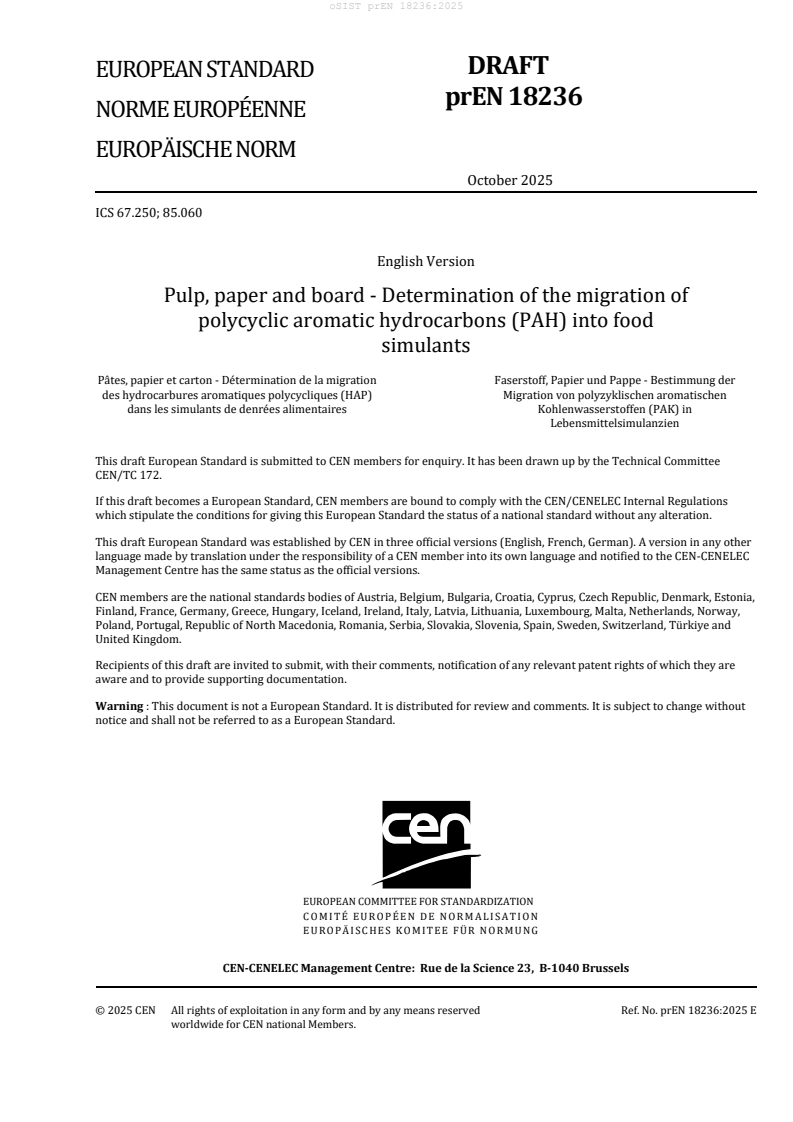
DRAFT
EUROPEAN STANDARD
NORME EUROPÉENNE
EUROPÄISCHE NORM
October 2025
ICS 67.250; 85.060
English Version
Pulp, paper and board - Determination of the migration of
polycyclic aromatic hydrocarbons (PAH) into food
simulants
Pâtes, papier et carton - Détermination de la migration Faserstoff, Papier und Pappe - Bestimmung der
des hydrocarbures aromatiques polycycliques (HAP) Migration von polyzyklischen aromatischen
dans les simulants de denrées alimentaires Kohlenwasserstoffen (PAK) in
Lebensmittelsimulanzien
This draft European Standard is submitted to CEN members for enquiry. It has been drawn up by the Technical Committee
CEN/TC 172.
If this draft becomes a European Standard, CEN members are bound to comply with the CEN/CENELEC Internal Regulations
which stipulate the conditions for giving this European Standard the status of a national standard without any alteration.
This draft European Standard was established by CEN in three official versions (English, French, German). A version in any other
language made by translation under the responsibility of a CEN member into its own language and notified to the CEN-CENELEC
Management Centre has the same status as the official versions.
CEN members are the national standards bodies of Austria, Belgium, Bulgaria, Croatia, Cyprus, Czech Republic, Denmark, Estonia,
Finland, France, Germany, Greece, Hungary, Iceland, Ireland, Italy, Latvia, Lithuania, Luxembourg, Malta, Netherlands, Norway,
Poland, Portugal, Republic of North Macedonia, Romania, Serbia, Slovakia, Slovenia, Spain, Sweden, Switzerland, Türkiye and
United Kingdom.
Recipients of this draft are invited to submit, with their comments, notification of any relevant patent rights of which they are
aware and to provide supporting documentation.
Warning : This document is not a European Standard. It is distributed for review and comments. It is subject to change without
notice and shall not be referred to as a European Standard.
EUROPEAN COMMITTEE FOR STANDARDIZATION
COMITÉ EUROPÉEN DE NORMALISATION
EUROPÄISCHES KOMITEE FÜR NORMUNG
CEN-CENELEC Management Centre: Rue de la Science 23, B-1040 Brussels
© 2025 CEN All rights of exploitation in any form and by any means reserved Ref. No. prEN 18236:2025 E
worldwide for CEN national Members.
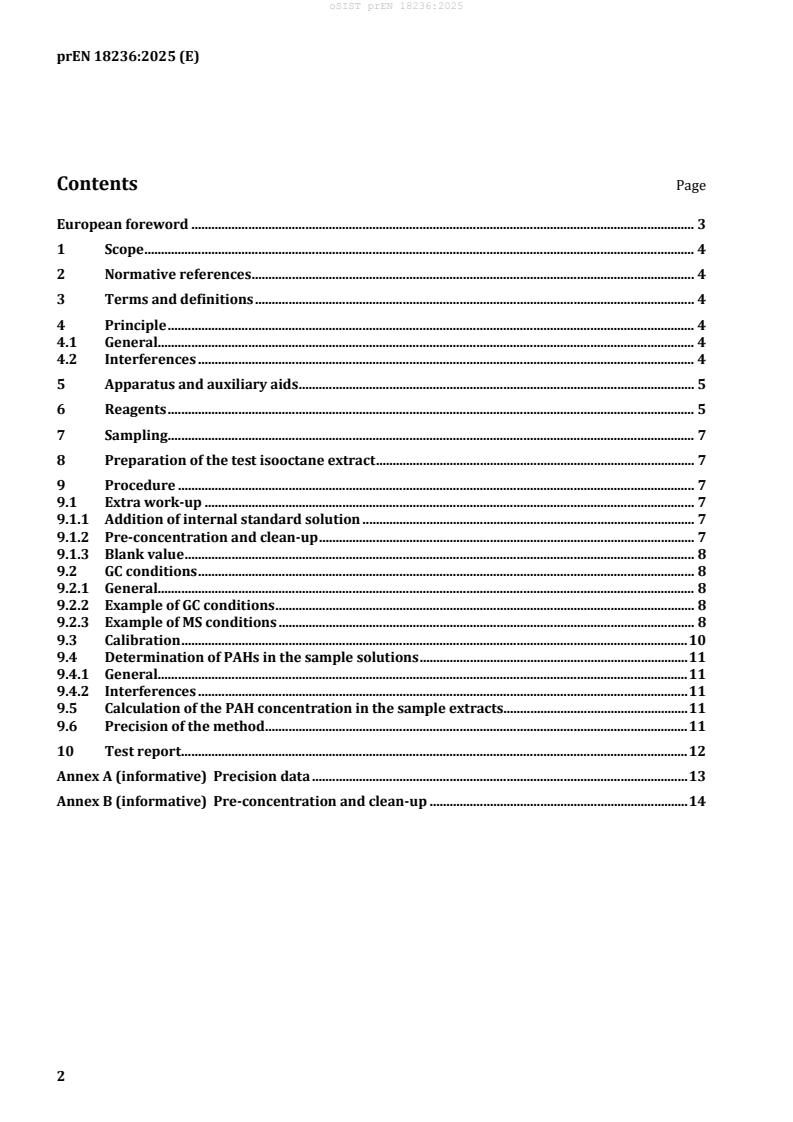
Contents Page
European foreword . 3
1 Scope . 4
2 Normative references . 4
3 Terms and definitions . 4
4 Principle . 4
4.1 General. 4
4.2 Interferences . 4
5 Apparatus and auxiliary aids . 5
6 Reagents . 5
7 Sampling . 7
8 Preparation of the test isooctane extract . 7
9 Procedure . 7
9.1 Extra work-up . 7
9.1.1 Addition of internal standard solution . 7
9.1.2 Pre-concentration and clean-up . 7
9.1.3 Blank value . 8
9.2 GC conditions . 8
9.2.1 General. 8
9.2.2 Example of GC conditions . 8
9.2.3 Example of MS conditions . 8
9.3 Calibration . 10
9.4 Determination of PAHs in the sample solutions . 11
9.4.1 General. 11
9.4.2 Interferences . 11
9.5 Calculation of the PAH concentration in the sample extracts. 11
9.6 Precision of the method . 11
10 Test report . 12
Annex A (informative) Precision data . 13
Annex B (informative) Pre-concentration and clean-up . 14
European foreword
This document (prEN 18236:2025) has been prepared by Technical Committee CEN/TC 172 “Pulp, paper
and board”, the secretariat of which is held by DIN.
This document is currently submitted to the CEN Enquiry.
1 Scope
This document specifies a test method for the determination of the specific migration of polycyclic
aromatic hydrocarbons (PAH) from paper, board and pulp into the food simulant isooctane. The amounts
of polycyclic aromatic hydrocarbons (PAHs) are expressed in micrograms PAH per litre of solvent extract.
It is applicable for the determination of the 24 PAHs given in 6.3, Table 1. The test method is also
applicable for the determination of further PAHs unless a validation for every further analyte is done by
the laboratory using this test method.
In general, this test method is applicable to the determination of PAHs in concentrations ranging from
2,5 µg/l to 100 µg/l for solvent extracts. Deviations from this range are possible.
2 Normative references
The following documents are referred to in the text in such a way that some or all of their content
constitutes requirements of this document. For dated references, only the edition cited applies. For
undated references, the latest edition of the referenced document (including any amendments) applies.
EN 15519, Paper and board intended to come into contact with foodstuffs — Preparation of an organic
solvent extract
EN ISO 186, Paper and board — Sampling to determine average quality (ISO 186)
EN ISO 4787, Laboratory glass and plastic ware — Volumetric instruments — Methods for testing of
capacity and for use (ISO 4787)
EN ISO 7213, Pulps — Sampling for testing (ISO 7213)
3 Terms and definitions
No terms and definitions are listed in this document.
ISO and IEC maintain terminology databases for use in standardization at the following addresses:
— ISO Online browsing platform: available at https://www.iso.org/obp/
— IEC Electropedia: available at https://www.electropedia.org/
4 Principle
4.1 General
A sample extract is prepared by means of an organic solvent (isooctane) according to EN 15519. The
determination of the analytes is performed by gas chromatography/mass spectrometry (GC-MS) using
anthracene-d and perylene-d as internal standards.
10 12
4.2 Interferences
— As PAHs are sensitive to UV light, it shall be ensured that the samples are protected from light at all
stages of treatment. This can be achieved by e.g. using brown glassware or intermediate storing of
the samples in the dark.
— Portions of organic acids and of phthalic- and fatty acid esters, the solvents from carbon-less copy
papers (e.g. diisopropylnaphtalene) and mineral oil hydrocarbons can interfere the analysis.
5 Apparatus and auxiliary aids
The usual laboratory apparatus and laboratory glassware, including brown glass, according to
EN ISO 4787, shall be used, in addition to the following:
5.1 Balance with a resolution of at least 0,000 1 g.
5.2 Gas chromatograph coupled to a mass spectrometer (GC-MS) (EI+).
6 Reagents
All reagents shall be of recognized analytical quality unless stated otherwise.
6.1 Operating gases for GC-MS, shall be of high purity and in accordance with manufacturer’s
specifications.
6.2 Isooctane, CAS Registry Number® (CAS RN® 540-84-1), with purity of 98,5 % or better.
6.3 Reference substances
Table 1 — List of reference substances
No. Substance Sum CAS RN® Concentration of the
formula ready-to-use solution
ng/µl
1 Naphthalene C H 91–20–3
10 8
2 Acenaphthylene C H 208–96–8
12 8
3 Acenaphthene C H 83–32–9
12 10
4 Fluorene C H 86–73–7
13 10
5 Phenanthrene C H 08–01–85
14 10
6 Anthracene C H 120–12–7
14 10
7 Fluoranthene C H 206–44–0
16 10
8 Pyrene C16H10 129–00–0
9 Benz[a]anthracene C18H 56–55–3
10 Chrysene C H 218–01–9
18 12
11 Benzo[b]fluoranthene C H 205–99–2
20 12
12 Benzo[k]fluoranthene C H 207–08–9
20 12
13 Benzo[a]pyrene C H 50–32–8
20 12
14 Dibenz[a,h]anthracene C H 53–70–3
22 14
15 Benzo[g,h,i]perylene C H 191–24–2
22 12
16 Indeno[1,2,3-cd]pyrene C H 193–39–5
22 12
1 ® ®
CAS Registry Number (CAS RN ) is a trademark American Chemical Society (ACS). This information is given for
the convenience of
...