

SIST EN 50090-6-2:2022
(Main)Home and Building Electronic Systems (HBES)- Part 6-2 IoT Semantic Ontology model description
General Information
- Abstract
This document defines the HBES Information Model and a corresponding data exchange format for the Home and Building HBES Open Communication System.
- Status
- Published
- Public Enquiry End Date
- 31-May-2020
- Publication Date
- 09-Jan-2022
- Technical Committee
- ELI - Electrical and communication installations
- Current Stage
- 6060 - National Implementation/Publication (Adopted Project)
- Start Date
- 13-Dec-2021
- Due Date
- 17-Feb-2022
- Completion Date
- 10-Jan-2022

Overview
SIST EN 50090-6-2:2022 specifies the HBES (Home and Building Electronic Systems) Information Model (KIM) and a corresponding data exchange format for the HBES Open Communication System. The standard provides a semantic ontology model description for IoT-enabled home and building automation, defining how devices, functions and data points are represented, related and exchanged to enable interoperable HBES solutions.
Key search terms: HBES, IoT Semantic Ontology, HBES Information Model, KIM, data exchange format, KNX, IoT Datapoint, Function Point.
Key topics and technical requirements
HBES Information Model (KIM)
- Ontology-based model of system-relevant HBES elements, including semantic dictionary entries and ontology IRIs/namespaces. KIM is managed by the KNX Association.
Data exchange format
- A corresponding format to represent and exchange the ontology-based HBES model across tools and services (Management Clients, IoT servers, third‑party APIs).
Core model components
- Location Model - describes building/space structure and requirements for location-related semantics.
- Installation Model - represents assemblies of devices and services in an installation (e.g., HVAC, lighting).
- Tag Model - classification mechanism (tags) for points, function points and application functions to support semantic lookup and integration.
Runtime and IoT integration concepts
- Datapoints / IoT Datapoints - logical inputs/outputs and IoT endpoints (e.g., fully qualified URLs) that map to Function Points.
- Function Point / Group Address - runtime state entities shared across datapoints; group communication concept retained for HBES.
- IoT 3rd Party API, Server and Client - standardized way to provide partial access to installations via endpoints.
Relations and semantics
- Model relations between location, installation and tag elements plus cardinality rules for tag usage and model interconnections.
Practical applications and users
Who benefits:
- System integrators and installers - consistent semantic descriptions to commission, document and maintain installations.
- Device manufacturers - standard model for exposing device datapoints, channels, and functional blocks.
- Software developers & platform providers - implement interoperable IoT 3rd Party APIs, management clients (MaC), gateways and analytics tools.
- BIM and building automation teams - map HBES semantics into Building Information Models (IFC referenced) for lifecycle workflows.
Real-world uses:
- Enabling semantic interoperability between KNX/HBES devices and cloud/third‑party services.
- Exporting/importing installation configurations (MaC projects, MaC catalog entries).
- Mapping sensors/actuators (sensors → FOI, actuators → actuation procedures) for consistent state reporting and control.
Related standards and references
- EN 50090-1:2011 - HBES standardization structure
- EN 50090-3-3 - HBES Interworking model and common HBES data types
- IFC / ISO 16739-1 - Industry Foundation Classes referenced for BIM interoperability
This standard is essential for anyone implementing semantic IoT solutions in home and building automation, providing the ontology and data format foundations for robust, interoperable HBES ecosystems.
Relations
- Effective Date
- 03-Feb-2026
- Effective Date
- 03-Feb-2026
- Effective Date
- 09-Feb-2026
- Effective Date
- 09-Feb-2026
- Effective Date
- 13-Feb-2024
Get Certified
Connect with accredited certification bodies for this standard

BSI Group
BSI (British Standards Institution) is the business standards company that helps organizations make excellence a habit.

NYCE
Mexican standards and certification body.
Sponsored listings
Frequently Asked Questions
SIST EN 50090-6-2:2022 is a standard published by the Slovenian Institute for Standardization (SIST). Its full title is "Home and Building Electronic Systems (HBES)- Part 6-2 IoT Semantic Ontology model description". This standard covers: This document defines the HBES Information Model and a corresponding data exchange format for the Home and Building HBES Open Communication System.
This document defines the HBES Information Model and a corresponding data exchange format for the Home and Building HBES Open Communication System.
SIST EN 50090-6-2:2022 is classified under the following ICS (International Classification for Standards) categories: 35.240.67 - IT applications in building and construction industry; 97.120 - Automatic controls for household use. The ICS classification helps identify the subject area and facilitates finding related standards.
SIST EN 50090-6-2:2022 has the following relationships with other standards: It is inter standard links to SIST EN 50090-1:2011, SIST EN 50090-3-3:2009, SIST EN 17082:2020, SIST EN 13321-1:2021, SIST EN 50090-6-2:2025. Understanding these relationships helps ensure you are using the most current and applicable version of the standard.
SIST EN 50090-6-2:2022 is available in PDF format for immediate download after purchase. The document can be added to your cart and obtained through the secure checkout process. Digital delivery ensures instant access to the complete standard document.
Standards Content (Sample)
SLOVENSKI STANDARD
01-februar-2022
Stanovanjski in stavbni elektronski sistemi (HBES) - 6-2. del: Semantični opis
ontološkega modela
Home and Building Electronic Systems (HBES)- Part 6-2 IoT Semantic Ontology model
description
Systèmes électroniques pour les foyers domestiques et les bâtiments (HBES) Partie 6-2:
Semantic Ontology Model Description pour l’internet des objets
Ta slovenski standard je istoveten z: EN 50090-6-2:2021
ICS:
35.240.67 Uporabniške rešitve IT v IT applications in building
gradbeništvu and construction industry
97.120 Avtomatske krmilne naprave Automatic controls for
za dom household use
2003-01.Slovenski inštitut za standardizacijo. Razmnoževanje celote ali delov tega standarda ni dovoljeno.
EUROPEAN STANDARD EN 50090-6-2
NORME EUROPÉENNE
EUROPÄISCHE NORM December 2021
ICS 97.120; 35.240.67
English Version
Home and Building Electronic Systems (HBES)- Part 6-2 IoT
Semantic Ontology model description
Systèmes électroniques pour les foyers domestiques et les Elektrische Systemtechnik für Heim und Gebäude (ESHG) -
bâtiments (HBES) - Partie 6-2: Description du modèle Teil 6-2: Beschreibung des IoT semantischen
ontologie sémantique loT Ontologiemodells
This European Standard was approved by CENELEC on 2021-09-20. CENELEC members are bound to comply with the CEN/CENELEC
Internal Regulations which stipulate the conditions for giving this European Standard the status of a national standard without any alteration.
Up-to-date lists and bibliographical references concerning such national standards may be obtained on application to the CEN-CENELEC
Management Centre or to any CENELEC member.
This European Standard exists in three official versions (English, French, German). A version in any other language made by translation
under the responsibility of a CENELEC member into its own language and notified to the CEN-CENELEC Management Centre has the
same status as the official versions.
CENELEC members are the national electrotechnical committees of Austria, Belgium, Bulgaria, Croatia, Cyprus, the Czech Republic,
Denmark, Estonia, Finland, France, Germany, Greece, Hungary, Iceland, Ireland, Italy, Latvia, Lithuania, Luxembourg, Malta, the
Netherlands, Norway, Poland, Portugal, Republic of North Macedonia, Romania, Serbia, Slovakia, Slovenia, Spain, Sweden, Switzerland,
Turkey and the United Kingdom.
European Committee for Electrotechnical Standardization
Comité Européen de Normalisation Electrotechnique
Europäisches Komitee für Elektrotechnische Normung
CEN-CENELEC Management Centre: Rue de la Science 23, B-1040 Brussels
© 2021 CENELEC All rights of exploitation in any form and by any means reserved worldwide for CENELEC Members.
Ref. No. EN 50090-6-2:2021 E
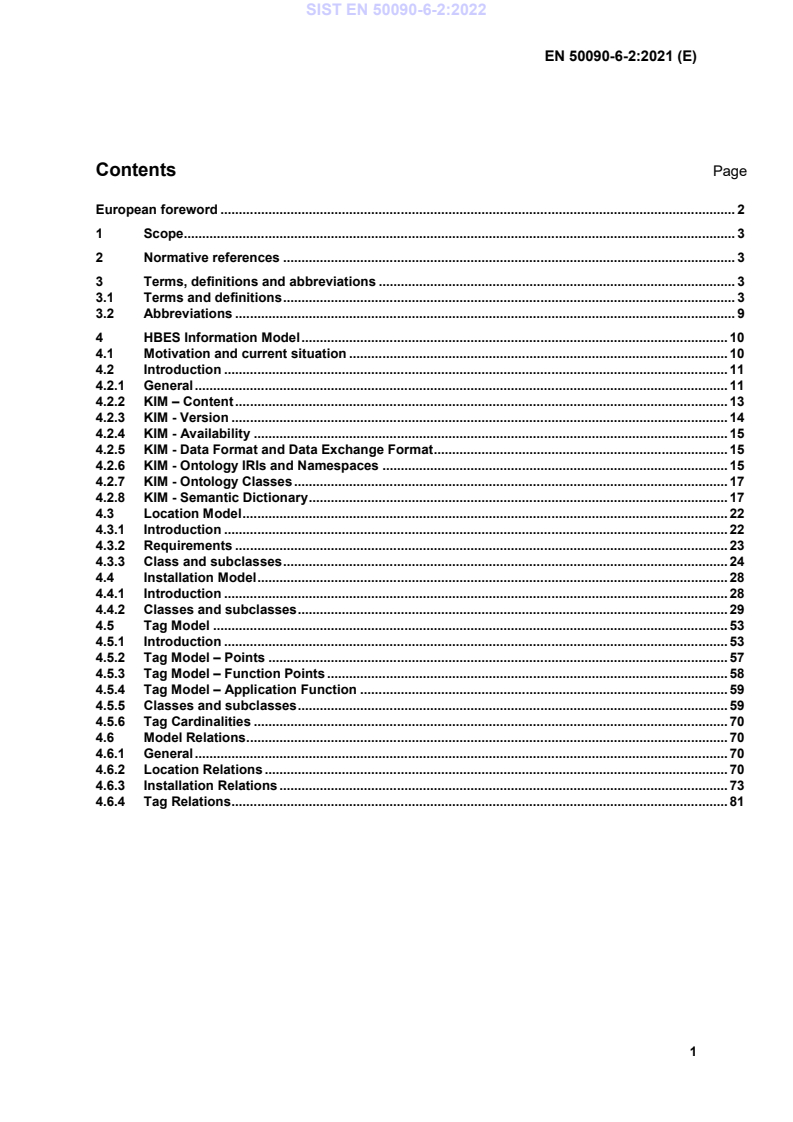
Contents Page
European foreword . 2
1 Scope. 3
2 Normative references . 3
3 Terms, definitions and abbreviations . 3
3.1 Terms and definitions . 3
3.2 Abbreviations . 9
4 HBES Information Model . 10
4.1 Motivation and current situation . 10
4.2 Introduction . 11
4.2.1 General . 11
4.2.2 KIM – Content . 13
4.2.3 KIM - Version . 14
4.2.4 KIM - Availability . 15
4.2.5 KIM - Data Format and Data Exchange Format . 15
4.2.6 KIM - Ontology IRIs and Namespaces . 15
4.2.7 KIM - Ontology Classes . 17
4.2.8 KIM - Semantic Dictionary . 17
4.3 Location Model . 22
4.3.1 Introduction . 22
4.3.2 Requirements . 23
4.3.3 Class and subclasses . 24
4.4 Installation Model . 28
4.4.1 Introduction . 28
4.4.2 Classes and subclasses . 29
4.5 Tag Model . 53
4.5.1 Introduction . 53
4.5.2 Tag Model – Points . 57
4.5.3 Tag Model – Function Points . 58
4.5.4 Tag Model – Application Function . 59
4.5.5 Classes and subclasses . 59
4.5.6 Tag Cardinalities . 70
4.6 Model Relations . 70
4.6.1 General . 70
4.6.2 Location Relations . 70
4.6.3 Installation Relations . 73
4.6.4 Tag Relations . 81
European foreword
This document (EN 50090-6-2:2021) has been prepared by CLC/TC 205 “Home and Building
Electronic Systems (HBES)”.
The following dates are fixed:
• latest date by which this document has to be (dop) 2022-09-20
implemented at national level by publication of
an identical national standard or by
endorsement
• latest date by which the national standards (dow) 2022-09-20
conflicting with this document have to be
withdrawn
Attention is drawn to the possibility that some of the elements of this document may be the subject of
patent rights. CENELEC shall not be held responsible for identifying any or all such patent rights.
Any feedback and questions on this document should be directed to the users’ national committee. A
complete listing of these bodies can be found on the CENELEC website.
1 Scope
This document defines the HBES Information Model and a corresponding data exchange format for
the Home and Building HBES Open Communication System.
2 Normative references
The following documents are referred to in the text in such a way that some or all of their content
constitutes requirements of this document. For dated references, only the edition cited applies. For
undated references, the latest edition of the referenced document (including any amendments)
applies.
EN 50090-1:2011, Home and Building Electronic Systems (HBES) - Part 1: Standardization structure
EN 50090-3-3, Home and Building Electronic Systems (HBES) - Part 3-3: Aspects of application -
HBES Interworking model and common HBES data types
3 Terms, definitions and abbreviations
3.1 Terms and definitions
For the purposes of this document, the terms and definitions given in EN 50090-1:2011 and the
following apply.
ISO and IEC maintain terminological databases for use in standardization at the following addresses:
— IEC Electropedia: available at https://www.electropedia.org/
— ISO Online browsing platform: available at https://www.iso.org/obp
3.1.1
actuator
point performing an actuation (executed by a specific procedure, with an expected result) that
changes an Installation state during Runtime
Note 1 to entry:
— The term Actuator can be mapped to sosa:Actuator in the SSN Ontology.
— The subject actuation can be mapped to sosa:Actuation in the SSN Ontology.
— The subject procedure can be mapped to sosa:Procedure in the SSN Ontology.
— The subject result can be mapped to sosa:Result in the SSN Ontology.
3.1.2
Application Function
uses a set of Functions to achieve the desired behaviour of a technical system, typically using a
combination of devices exchanging information via their input and output Datapoints
Note 1 to entry: An Application Function may be split into several Functional Blocks with their input and output
Datapoints that are logically connected to each other. The Functional Blocks may be located in one or more
devices.
EXAMPLE Application Functions examples are “direct electrical heating”, “electrical heating with
accumulators”, “warm water heating”, “fan coil air-conditioning” …
Note 2 to entry: The Application Function and Application are meant to be the same. Reason to introduce an
alias term is to use a clear (understandable) reference from Application/ Application Function to the
corresponding KIM class :ApplicationFunction or to the Function in the Management Client.
3.1.3
aspect
generally, a specific perspective on a system that contains things with different properties; a
referencing mechanism to organize KIM elements in a specific perspective
EXAMPLE A Function Point is an ex officio Aspect with an important specific perspective. It is a referencing
mechanism to organize together all to a Function Point interoperating Points (all GOs linked to a GA).
3.1.4
BIM
Building Information Model, a digital process to describe and document a building in all its life cycle
phases, from its planning, construction, operation up to its demolition
3.1.5
channel
collection of Datapoints of a device that are logically related to each other typically by association with
a hardware feature or a specific function of that device
Note 1 to entry: These Datapoints may be derived from one or more defined Functional Blocks or may be an
expansion above and beyond defined Functional Blocks or may be independent of a Functional Block if none is
defined for the function associated with the Channel. The concept of a Channel is well-understood by the market
participant, e.g. installers.
3.1.6
datapoint
represents a logical input entity of a device acting as recipient of Installation state data, whereas a
logical output of a device acts as source of Installation state data
Note 1 to entry: In case of implementation as a Group Object, state data is communicated with the use of
Function Points.
Note 2 to entry: The term Datapoint is the common term; to specifically denote a Datapoint available on an IoT
3rd Party API, the term IoT Datapoint is used.
3.1.7
device
physical element that is part of the network; it is a physical, concrete object that a customer can buy
3.1.8
endpoint
entry point to a service, a process, or a queue or topic destination in service-oriented architecture
3.1.9
Feature of Interest
abstraction of a real-world thing (phenomenon, equipment, person, event…) defined by its observable
or actuatable properties
Note 1 to entry: In colloquial terms, a FOI is a property carrier.
Note 2 to entry: A Sensor operates on a FOI with observable properties, an Actuator with actuatable properties.
Note 3 to entry: A FOI is not a “classification/type” tag itself; the “classification/ type” is accomplished with the
help of tags. Examples are defined in 4.5.1.4.
3.1.10
function
describes a part of the intended behaviour of a FB in a building context
3.1.11
Functional Block
consists of one or more Functions that belong together and that cannot be separated across two
devices but big enough that a device with only one such Functional Block could be marketed
Note 1 to entry: A Functional Block has a well-defined black box behaviour.
3.1.12
Function Point
runtime system state information of a specific Application Function
Note 1 to entry: Shared by at least two Datapoints.
Note 2 to entry: Has a unique identifier that addresses a group of controlled objects. This identifier is called a
Group Address.
EXAMPLE < Light Switch > in living room on/off, whereas the < … > is the Function Point name
3.1.13
Group Address
numerical identifier of a Function Point
3.1.14
Group Communication
communication model in which one sender communicates information to one and typically more
receivers
Note 1 to entry: In IoT, this can be realized by simple UDP communication or by using a message broker
system or other.
3.1.15
Group Object
foreseen for Group Communication using Group Address(es), may be accessed via point-to-point
communication without an assigned Group Address; with assigned Group Address, it becomes a
member of that Function Point represented by the Group Address
3.1.16
HBES Information Model
ontology based model of HBES System relevant parts, including additional semantic (dictionary)
information
Note 1 to entry: It is managed by the KNX Association, hence the abbreviation KIM.
3.1.17
Industry Foundation Classes
open standard to describe BIM data in a digital way
Note 1 to entry: IFC data and models are specified in ISO 16739-1.
3.1.18
installation
assembly of materials and components (devices) placed in position to provide a service
Note 1 to entry: An Installation is a deployed system (e.g. HVAC system or fire protection system) and consists
of equipment and Functions that are used for a particular purpose.
Note 2 to entry: In relation to this term created data correlates to the installation model, described in 4.2.
[SOURCE: ISO 6707-1:2020, modified – added "(devices)" and Notes to entry.]
3.1.19
IoT Datapoint
rd
represents an Endpoint at an IoT 3 Party API that:
a) corresponds to one or more Function Points, such as a state data representation of a discrete
state in a building context:
EXAMPLE 1 brightness → discrete state “brightness” is represented by the value 65 (percent)
rd
b) is a fully qualified URL e.g. provided by an IoT 3 Party Server
EXAMPLE 2 https://gateway.hbes.local/hbes/api/v1/datapoints/{Id}
3.1.20
IoT Function
rd
Party API that:
represents a Function at an IoT 3
— is as a collection of IoT Datapoints that fulfils a – by the user – intended behaviour
EXAMPLE “living room – rear light dimming”, “kitchen – floor heating”
Note 1 to entry: In a Mac, an IoT Function is instantiated data of a MaC Function in an Installation respectively
MaC project. The MaC Function itself may base on an Application Function.
3.1.21
rd
IoT 3 Party API
set of requirements and regulations through which partial access to an Installation can be gained by
offering a collection of Endpoints
3.1.22
rd
IoT 3 Party Client
rd
device or service interacting with the Installation from outside using the IoT 3 Party API
rd rd
Note 1 to entry: The IoT 3 Party Client connects to a single device that provides the IoT 3 Party API and can
use this single device to fully interact with the Installation, possibly depending on a specified authorization
mechanism.
EXAMPLE 1 A mobile phone (from inside the network, or from an Internet connection) with typically short
period connections.
rd
EXAMPLE 2 A weather service permanently feeding in its weather information using the IoT 3 Party API.
3.1.23
rd
IoT 3 Party Server
rd
device that implements the IoT 3 Party API
Note 1 to entry: This can be a dedicated device; this can be a function of a device that supports other HBES
IoT and non HBES functionalities; it may be located within the local LAN of the IoT installation or outside.
3.1.24
MaC Catalog Entry
created management client data correlating to the product model, described in 4.2
3.1.25
MaC Function
Application Function created by the MaC and assigned to a building structure element, grouping
several Group Addresses
3.1.26
MaC Project
project created by a MaC documenting the Configuration of an Installation
3.1.27
Management Client
means to configure and commission Devices as well as to plan, design and diagnose an entire
Installation
Note 1 to entry: The MaC is used to configure and commission Devices, as well as to plan, design and
diagnose an entire Installation. As a final step the MaC writes specific configuration data such as Device
parameters to the Devices.
3.1.28
ontology
conceptual descriptions of things that have a real-world commonality sharing the knowledge of a
domain, mainly expressed with OWL
Note 1 to entry: Ontologies are a structured way to describe the meaning of data in ontology classes and
should not be mixed up with common data model structures.
3.1.29
Object Property
in OWL a built-in concept that connects pairs of individuals, an object property expression
represents the (entire) relationship between the pairs of individuals
3.1.30
OWL
OWL 2 Web Ontology Language, informally OWL 2, specified by the World Wide Web Consortium
(W3C), mainly serialized with XML syntax for RDF (RDF/XML)
Note 1 to entry: In this specification the abbreviation OWL is always an explicit reference to OWL 2.
3.1.31
point
represents an interface to data in the system
Note 1 to entry: This document uses the term Point as an umbrella for data that can be accessed from outside
of the Device, for instance to interact with other Points from other Devices. Consequently, term Point is a generic
superset of the term Datapoint (which describes more precisely the technics how the “data” in the system are
structured and/or coded).
3.1.32
Point API
simple RESTful (CoAP or HTTP) application programming interface designed for, but not limited to,
constrained class 2 devices [RFC7228] supporting device individualization, device linking and
accessing device runtime data (e.g. Functional Block or Channel Datapoints)
3.1.33
Quality Kind
represents a certain combination of observable or actuatable properties, available as predefined parts
of the Semantic Dictionary or created individually during Configuration; the latter is the case when a
Quality Kind with the intended combination of properties respectively tags is not (yet) part of the
dictionary
Note 1 to entry: A QK is not a “classification/type” tag itself; the “classification/ type” is accomplished with the
help of tags. Examples are defined in 4.5.1.4.
3.1.34
RDF
Resource Description Framework, as specified by the https://www.w3.org/RDF/
Note 1 to entry: RDF is a framework to represent information in the web by using triples. The information can
be serialized and stored in many formats such as the TURTLE or JSON(-LD) format. The general RDF concept
description can be found under https://www.w3.org/TR/rdf11-concepts/
3.1.35
runtime
process-to-process communication of data between devices, opposing to Configuration
Note 1 to entry: This concerns mainly the communication of Datapoint values (control and status information).
3.1.36
Semantic Export
project exported by the MaC reflecting an Installation in a linked data format
Note 1 to entry: The exported data is:
— structured according to the KIM, such as using Object Properties defined in KIM;
— annotated with additional semantic information from the Semantic Dictionary;
— referencing concepts of external Ontologies.
3.1.37
semantic dictionary
set of standardized terms allowing to annotate required parts of an Installation
Note 1 to entry: For details, see 4.2.8.
3.1.38
sensor
point performing an observation (executed by a specific procedure, triggered by a stimulus),
responding a result as an Installation state during Runtime
Note 1 to entry:
— The term Sensor can be mapped to sosa:Sensor in the SSN Ontology.
— The subject observation can be mapped to sosa:Observation in the SSN Ontology.
— The subject stimulus can be mapped to ssn:Stimulus in the SSN Ontology.
— The subject procedure can be mapped to sosa:Procedure in the SSN Ontology.
— The subject result can be mapped to sosa:Result in the SSN Ontology.
3.1.39
tag
kind of annotation term used to extend available data with (in most cases) well known standardized
information from a dictionary (in contrast to user defined, arbitrary term)
Note 1 to entry: A Tag is a concept-less term, without an integration in a broader concept such as the concept
of a Datapoint (used in an Application Function), it has a limited semantic meaning.
EXAMPLE Term “flow” has a weak meaning on its own, but if you relate it in a FOI with the other term
“water” this expresses at least that you observe/ actuate the water flow.
In this specification a Tag is almost exclusively a term from the Semantic Dictionary.
3.1.40
thing description
semantic metadata model to describe (abstract or physical) things, as specified by the thing
description https://www.w3.org/TR/wot-thing-description/ and thing Ontology
https://www.w3.org/2019/wot/td
Note 1 to entry: TD relevant relations are described in the clause of Semantic Export.
3.2 Abbreviations
For the purposes of this document, the following abbreviations apply.
DHWC Domestic Hot Water Controller
FOI Function of Interest
BOC Boiler Controller
BUC Burner Controller
FTC Flow Temperature Controller
GA Group Address
GO Group Object
FB Functional Block
FP Function Point
HBES Home and Building Electronic Systems
HDTRT Heat Demand Transformer Room Temperature
HFDM Heat Flow Demand Manager
HIRC Heating Individual Room Controller
HPM Heat Producer Manager
HVA Heating Valve Actuator
HZC Heating Zone Controller
IFC Industry Foundation Classes
IOO Info On off
IO Input Output
IoT Internet of Things
KIM HBES Information Model managed by KNX Association
KNXA KNX Association
MaC Management Client
OP Object Property
QK Quality Kind
RSM Room Setpoint Manager
RTC Room Temperature Controller
RTS Room Temperature Sensor
SOO Switch on/off
TD Thing Description
4 HBES Information Model
4.1 Motivation and current situation
The current HBES model/ data information is based on XML, is managed by the KNX Association and
has its corresponding versioning. Project/ product data exported by existing HBES management
clients are in line with this XML schema.
The HBES Management clients use the XML schema mainly to define the corresponding data
structures to store/export project and product data. Consequently, the XML schema is always updated
when new versions of the HBES management clients are published, and new project and/or product
features demand a change of the data structures.
Though XML itself is a well-known and widespread format it has its drawbacks as regards:
— sharing model/project data information with external clients that use this data need to be
synchronized when a new XML schema version is announced;
— describing, expressing, mapping and sharing (semantic) information in the IoT domain.
The aim and motivation is to define a HBES Information Model and a corresponding data exchange
format:
— The model expresses only the current - by external clients requested – information.
— The model can be also easily updated.
— The exported data uses a widely used data exchange format, which should also be readable by
humans, meaning it is text based.
This model and data exchange format is more stable, compared to the frequent HBES management
client evolution.
— The HBES Information Model will be available as ontology in one or more formats, such as turtle
files.
— The data exported by HBES management clients will be available as linked data, such as JSON-
LD files.
The HBES IoT protocol suite shall support semantic information, both for runtime as well as for
configuration.
This information shall be brought to the system components in a data driven way, by the HBES
management clients software and possible other sources. It shall thus build on the information
rd
provided by the HBES management clients user, to avoid having to be entered again in the 3 Party
Client configuration.
The semantic information shall comply with the HBES standard and be available as public
information. Technically this information will be available as linked data, expressed with triples.
The use of semantics itself allows to formalize, restrict, and verify the usage of HBES subjects to
describe entities, relationships, and tags (entities have some relationship predicate to some other
entities— essentially a directed edge in a graph).
This simple (triple) structure enables the succinct and elegant composition of large, interconnected
structures of facility (building) subsystems.
The KIM shall be able express relations in an Installation to support the following use cases to
request/ query data.
— How is a building structured with floors, rooms and other?
— Where is an equipment (e.g. a Device) installed in a location (assembly place)?
— Which overall functionality is hosted on a Device?
— Which interface (e.g. a Point) is provided by a functionality or Device (Channel, FB)?
— Which Application Function affects which building structure elements, such as a room?
— What does an Application Function or Point observe or actuate upon in the real world (key word
→ feature of interest with substance, phenomenon and equipment)?
— In which operational domain or for which trades does an Application Function operate (key word
→ assignments of trades for Application Functions)?
— Which Points belong to an Application Function and what is the purpose of the Point (key word →
tag information: Logical Input/ Logical Output, Set Value or Parameter Point).
— Which phase feeds the load (e.g. Light Fixture/ Luminaire, Motor)?
— What are the setpoint and current temperature values in a specific location (room, zone) / a list of
locations?
— What is the current operation mode of primary systems (heating, cooling, ventilation, hot water
supply) in general or in location x?
— What is the identifier of a specific heating circuit (= connection from heating source to heating
sink) and in which heating circuit is a radiator located?
NOTE Heating Circuit = It is possible to express that n Points have a Locality “Circuit” and a “Phenomenon”
Heat assigned, they are distributed over several Devices and located within several locations, operating on
several Application Functions, finally grouped as an Aspect.
— What is the power consumption of a specific Device containing Points operating on a Luminaire /
Air Conditioner / Fridge?
— Which Function Points control a specific Luminaire / Heating Circuit (see above) …?
— What is the current operation time of a certain Luminaires? As a note, a Client can then compare
this time to the maintenance threshold operation time, not expressed in KIM.
— Which functional information as expressed by the Tag Information is represented by or
associated with a Point?
For examples, see 4.4.2.5.2 or 4.5.1.4.
4.2 Introduction
4.2.1 General
The HBES System is designed for direct exchange of information (i.e. communication) between
networked devices controlling applications in and around buildings respectively locations (see 3.1).
Figure 1 — HBES System elements
To describe the entire HBES System several models are needed to reflect the different aspects of it:
1. Product model
— to model products with their type/applicative behaviour, their configuration, their catalog
information, independent from an actual usage in an Installation;
— mainly makes use of the Device and Tag Model from this document.
Model data are also colloquially called (not instantiated) catalog data.
EXAMPLE 1 device model aspect → memory footprint for configuration parameters and Datapoints
2. System model
— to model elements and dependencies of the physical processes, see words
“Communication”, (networked) “Devices” and “Application” described in above Figure 1;
— mainly makes use of Device and Application Function Model from this document. Also uses
some parts of the Installation Model such as Points.
EXAMPLE 2 topology model aspect → the physical network configuration of a device
3. Installation model
— to model elements and dependencies correlating to instantiated data of a real- world
Installation, uses as (input) the product model, behaves according to (and respecting) the
system model.
— Mainly makes use of Location, Application Function and Tag Model from this document.
Model data are also called colloquially instance data.
EXAMPLE 3 location model aspect → The actual spatial building structure of an Installation which is
independent from the HBES System. The same Installation would technically operate/ communicate also in
a different building, regardless if original goal is met.
As a note, this document mainly addresses the installation model, the Aspect of an Installation
documented in a Project from a Management Client, with instantiated HBES Devices or Functions etc.
4.2.2 KIM – Content
The KIM content builds upon HBES definitions but also upon other work:
— it is extended with Tags from Haystack, where applicable;
— it is inspired by W3C concepts to reflect the KIM class :Point or :Equipment and their
relationships;
— it reuses the location concepts from IFC.
Components
The KIM is technically built on several sources of information, HBES relevant definitions and - as
described above - from externally related content, the latter is detailed in 4.2.6.
The HBES relevant definitions themselves are structured in two logical parts, the HBES System and
Semantic Dictionary. This separation is needed to express a static (versioned) HBES System related
KIM Ontology part which is not altered when adding or updating content of the Semantic Dictionary
part. This behaviour is also expressed with the different used namespaces. For details of this
structure please refer to 4.2.8.
KIM = HBES Domain Model (consisting of external content + HBES System) and a related
Semantic Dictionary
This principle is shown also in Figure 2.
Figure 2 — Main KIM sources
As specified in 3.1, the KIM is an Ontology, in an Ontology for each aspect an own Ontology class is
specified. A class in an Ontology is also called a concept.
EXAMPLE Ontology class/concept :Room reflects the Aspect of “available rooms in an installation”. The
Aspect of “points from devices” is represented by the Ontology class/concept :Point.
HBES System:
— defines the concept framework;
— consists of the aforementioned system, installation and product model, but is not built directly
from it, like a merged combination of the models;
— is used from the Semantic Dictionary;
— reflects the static part of the KIM, the concepts are a fixed part of the KIM;
— relate/ map specific KIM concepts to other Ontologies, for this see 4.2.6;
Semantic Dictionary:
— defines the concept framework data;
— expresses semantic terms, for the general definition see 3.1, for details see 4.2.8;
— reflects the dynamic part of the KIM, the content can be extended/ updated.
Figure 3 depicts for both above-described parts the main Ontology classes of the KIM.
— :Aspect a specific view to/aspect of the system, definition see 3.1
— :Equipment represents tangible hardware such as cabinets, devices, and other
— :ApplicationProgram same meaning as Application Program, definition see 3.1
— :Point interface to interact with Datapoints - mainly provided by devices
— :Functionality grouping of Points as part of an Application Program resp. Device
— :ApplicationFunction structural element to express an intended Application
— :Location root element of structural building concepts
— :Tag root element of most Semantic Dictionary terms
Figure 3 — Main KIM Ontology classes
4.2.3 KIM - Version
To distinguish updates to the KIM it needs an explicit versioning information. The only requirement of
a new/ updated (KIM) Ontology is that the Ontology Version IRI shall be different.
The KIM Ontology versioning follows the W3C recommendations for OWL versioning (see
https://www.w3.org/TR/owl2-syntax/#Versioning_of_OWL_2_Ontologies). Common practice is to
construct the IRI with the version identifier, a human readable text and an additional timestamp.
The KIM Ontology IRI including its versioning identifier is defined in 4.2.6.
4.2.4 KIM - Availability
It is expected that the KIM Ontology IRI below allows to retrieve the most recent Ontology as an
electronic file by using the IRI as an URL.
To get a specific KIM Ontology version the corresponding KIM Ontology version IRI shall be used
instead as an URL.
— https://schema.knx.org/2020/ontology returns the most recent KIM Ontology version, as a full
ontology including all specified Ontology parts such as the location concept, HBES System
concept or semantic dictionaries from KNX and any KNX manufacturer (see table below);
— https://schema.knx.org/2020/ontology/v1 returns the version v1 of the KIM Ontology, using the
same Ontology IRI as specified above, extended with the required version (here "v1").
4.2.5 KIM - Data Format and Data Exchange Format
The KIM is available in a linked data format, such as TURTLE or RDF/XML.
The KIM exchanges its data as part and with the support of the Semantic Export.
The Semantic Export uses a widely used data exchange format, which should be readable also by
humans and is thus text based. It is available as linked data, such as JSON-LD.
4.2.6 KIM - Ontology IRIs and Namespaces
The KIM Ontology IRI is defined according to the following (simplified) principle.
{scheme} + “://” + {authority} + “/” + {path} + “/” + {version} +"#"
With the above given {scheme} and {authority} part the KIM Ontology IRI is defined as
“https://schema.knx.org/2020/ontology”.
The {path} is a string describing separate KIM concepts which also uses an own namespace, for this
see below table.
The {version} shall be a string of “v” concatenated with a non-zero leading decimal number, such as
“v2” or “v249”. Consequently, this versioning approach allows to number only main Ontology versions.
A requirement to the KIM is also to translate relevant KIM concepts to other (external) Ontologies for
an easy semantical mapping. To fulfil this requirement, the OWL class/sub class relation or an explicit
reference is mainly used (there are also other options). The main principles are explained hereafter,
they are also applicable for the other concepts.
1. KIM location concepts having the same conceptual meaning as specific IFC location concepts,
this is expressed by using the owl:sameAs reference.
This reference does not define a corresponding OWL (sub)class mapping to the corresponding
IFC concept, it only expresses that IFC concepts can be mapped/translated to their semantic
HBES counterpart concepts.
— The HBES concepts themselves do not necessarily need to express all data of the IFC
concept. On the other hand, if an HBES concept requires information that is not (directly or
indirectly) required for the corresponding IFC concept, a translation from IFC to HBES
cannot be done due to missing information.
2. KIM Datapoint type concepts are subclasses of JSON schema concept, such as
dic-tag:dpt.1.x is subclass of jsonschema:BooleanScheme.
This expresses that an HBES Datapoint type (DPT) can be mapped/translated to its semantic
counterpart concept JSON data scheme (type).
— If you have an HBES DPT, it is also a JSON type. The HBES DPT inherits from JSON type
but can add additional things. Therefore, an HBES shall at least require the information that
is also required by a JSON type.
The following Table 1 expresses the names spaces used in KIM, their IRIs and their Ontology
reference.
Table 1 — KIM name spaces, corresponding IRIs and Ontology reference
Ontology Namespace
a
Comment
IRI
Name Identifier in KIM
OPs and OWL classes to express
https://www.w3.org/2019/wot/json
JSON schema
jsonSchema:
-schema#
JSON type/ format and data
http://qudt.org/schema/qudt/
qudt: OWL (SI) unit class for FPs and
Datapoints
QUDT
http://qudt.org/vocab/unit/ Individuals to express (SI) units
qudt-unit:
Individuals to express quantity
http://qudt.org/vocab/quantitykind/
qudt-quantity:
tags
OPs and OWL classes to express
VCARD vcard: http://www.w3.org/2006/vcard/ns#
geo addresses
DCTERMS http://purl.org/dc/terms OPs for description/title
dcterms:
HTTP http://www.w3.org/2011/http# OPs for an URL authority part
http:
https://schema.knx.org/2020/ontol HBES location concepts
loc:
ogy/loc{/version}#
{path} = /loc
HBES System concepts
http://schema.knx.org/2020/ontolo
knx:
gy/knx{/version}#
{path} = /knx
HBES Semantic Dictionary
http://schema.knx.org/2020/ontolo content, expressing concepts
dic:
gy/dictionaries/dic{/version}# that do not include individuals.
See 4.2.8.4.
{path} = dictionaries/dic
HBES Semantic Dictionary
b
KIM content, expressing concepts
dic-tag:
http://schema.knx.org/2020/ontolo
that include individuals. See
gy/dictionaries/dic-tag{/version}#
4.2.8.4.
{path} = dictionaries/dic-tag
The Ontology IRI is used to
https://schema.knx.org/2020/o
- provide the full Ontology, see
ntology
4.2.4.
Example
Example Semantic Dictionary content
abb:
reflecting content of a KNX
http://gira.de/2022/dictionaries/iotf
gira:
unctions{/version}# manufacturer. See 4.2.8.3.3.
…
a
The IRIs do not necessarily need to be dereferenced as an URL to access any content explanation on a web
site. To retrieve the KIM content, please refer to the 2.2.3.
b
If not expressed with an explicit namespace identifier, for readability all KIM Ontology classes refer to the
namespace :knx in this document.
4.2.7 KIM - Ontology Classes
As explained in 4.2.2 all KIM content including the HBES System aspects are modeled as Ontology
classes. The following Class/Subclass structure is defined in the KIM.
— owl:Thing
— jsonSchema:DataScheme
— knx:Thing
▪ …
▪ knx:Point
▪ …
▪ knx:Location
▪ …
— qudt:Unit
— vcard:Address
All Ontology classes related to HBES reside under the node knx:Thing, the node has no specific
semantical meaning.
The reason to introduce it is to clearly separate HBES Ontology concepts from other used (external)
Ontologies (structurally and UI related). This is because some HBES Ontology concepts need to be
related also to other Ontologies, see 4.2.6 below.
The nodes knx:Thing, qudt:Unit, vcard:Address and jsonSchema:DataScheme shall not be disjoint,
otherwise a Datapoint as part of knx:Thing cannot be a subclass of jsonSchema:BooleanSchema.
Root classes of a specific concept in an Ontology - such as all to the HBES System related first
Ontology subclasses under the node knx:Thing - are nearly in all cases disjoint; in the KIM they are.
NOTE Disjoint mathematically means, two classes are disjoint if the intersection of the respective sets they
describe is empty. Logically or OWL related, membership of one of two disjoint classes implies no membership of
the other.
4.2.8 KIM - Semantic Dictionary
4.2.8.1 General
As stated in 4.2, required HBES System Aspects are expressed in the KIM with Ontology classes.
The semantical understanding and meaning of all these Aspects expressed as an Ontology shall be
guaranteed across different domains and especially across humans, who (pre/post-) process this
information.
To achieve this, a dictionary with semantically predefined terms is needed. The dictionary fulfils two
major tasks.
1. It hosts terms to annotate the above-mentioned Aspects, each term describes specific domain
information.
2. It can be extended with new terms or allows to update existing terms, both while not changing or
affecting the HBES System part of the KIM (which would demand to release on any update or
change a new KIM version). The mechanism of updating the dictionary is described in 4.2.8.5
4.2.8.2 Dictionary Structure
— While terms in a lexicon are structured in alphabetic order, terms in the Semantic Dictionary are:
— structured according to their purpose and not alphabetically;
— if applicable, structured in a taxonomy, each taxonomy section reflects a different domain of
interest (such as the section of all protocols or the section of all trades and similar);
SIST EN 50090
...