

SIST EN 1457-2:2012
(Main)Chimneys - Clay ceramic flue liners - Part 2: Flue liners operating under wet conditions - Requirements and test methods
General Information
- Abstract
This European Standard is a product standard for clay/ceramic flue liners operating under wet conditions with solid walls or walls with vertical perforations for use in the construction of multiwall chimneys and flue pipes which serve to convey products of combustion from fireplaces or heating appliances to the outside atmosphere by negative or positive pressure. It includes the flue liners used for domestic and industrial chimneys which are not structurally independent (free-standing). This European Standard specifies the performance requirements for factory made flue liners and chimney fittings. Testing including thermal testing with or without insulation, marking and inspection are covered by this standard. Flue liners that are specified to this standard will meet the requirements of EN 1457-1 with the same working temperature, pressure, designation and soot fire resistance.
- Status
- Published
- Public Enquiry End Date
- 09-Mar-2009
- Publication Date
- 11-Apr-2012
- Technical Committee
- POZ - Požarna varnost
- Current Stage
- 6060 - National Implementation/Publication (Adopted Project)
- Start Date
- 10-Feb-2012
- Due Date
- 16-Apr-2012
- Completion Date
- 12-Apr-2012
- Directive
- 305/2011 - Regulation (eu) No 305/2011 of the European Parliament and of the Council of 9 march 2011 laying down harmonised conditions for the marketing of construction products and repealing council directive 89/106/eecOJ Ref: C 259 OJ Date: 08-Aug-2014
89/106/EEC - Construction productsOJ Ref: C 176 OJ Date: 19-Jun-2012



Overview
EN 1457-2:2012 - "Chimneys - Clay/ceramic flue liners - Part 2: Flue liners operating under wet conditions - Requirements and test methods" is a European product standard published by CEN. It defines performance, testing, marking and inspection requirements for factory-made clay/ceramic flue liners intended for wet-operation chimneys (solid walls or vertical perforations) used in multiwall chimneys and flue pipes that convey combustion products under negative or positive pressure. The standard applies to domestic and industrial chimneys that are not structurally independent.
Key Topics and Requirements
- Scope and applicability: Covers clay/ceramic flue liners operating under wet conditions for conveying combustion gases.
- Performance requirements: Specifies mechanical, thermal and durability performance expected of flue liners.
- Test methods: Prescribes detailed tests including:
- Thermal testing (with and without insulation) and thermal shock resistance
- Gas tightness / leakage measurements before and after tests
- Proof load (mechanical strength) for straight and curved liners
- Corrosion resistance, freeze/thaw durability
- Water absorption and bulk density
- Abrasion resistance
- Condensate resistance and flow resistance (indirect methods)
- Measurement of friction coefficient and other geometric/tolerance checks
- Tolerances and geometry: Defines dimensional tolerances, straightness, squareness and joint geometry requirements.
- Conformity assessment: Includes provisions for initial type testing, factory production control and sampling (AQL), plus marking and labelling requirements.
- Regulatory linkage: Annex ZA addresses clauses relevant to the EU Construction Products Directive and CE marking / attestation of conformity.
Practical Applications and Who Uses It
- Manufacturers of clay/ceramic flue liners use EN 1457-2:2012 to design, test and certify products for wet-operation chimneys.
- Testing laboratories and notified bodies apply the prescribed test methods for product type testing and factory production control.
- Chimney system designers, specifiers, architects and engineers rely on the standard to select appropriate flue liners for buildings where condensate or wet flue gases are expected.
- Installers and building inspectors use the standard’s marking and performance criteria to verify compliance on-site.
- Regulators and certification bodies refer to Annex ZA for CE marking and conformity procedures.
Related Standards
- EN 1457-1: General requirements for clay/ceramic flue liners - flue liners specified to EN 1457-2 are expected to meet EN 1457-1 for the same working temperature, pressure, designation and soot fire resistance.
- EU Construction Products Directive (referenced in Annex ZA) - for CE marking and product attestation.
Keywords: EN 1457-2:2012, clay/ceramic flue liners, wet conditions, chimney flue liners, test methods, thermal testing, condensate resistance, CEN, soot fire resistance, CE marking.
Relations
- Replaces
SIST EN 1457:1999/A1:2003 - Chimneys - Clay/ceramic flue liners - Requirements and test methods - Effective Date
- 01-May-2012
- Effective Date
- 01-May-2012
- Replaces
SIST EN 1457:1999/AC:2006 - Chimneys - Clay/Ceramic Flue Liners - Requirements and test methods - Effective Date
- 01-May-2012
- Effective Date
- 01-May-2012
- Effective Date
- 25-Aug-2026
- Effective Date
- 22-Jul-2026
- Effective Date
- 28-Jan-2026
- Effective Date
- 28-Jan-2026
- Effective Date
- 28-Jan-2026
- Effective Date
- 28-Jan-2026
- Effective Date
- 28-Jan-2026
- Effective Date
- 28-Jan-2026
- Effective Date
- 28-Jan-2026
- Effective Date
- 28-Jan-2026
- Effective Date
- 28-Jan-2026
Get Certified
Connect with accredited certification bodies for this standard

DIBt (Deutsches Institut für Bautechnik)
German Institute for Building Technology.
DIN CERTCO
DIN Group product certification.

Aboma Certification B.V.
Specialized in construction, metal, and transport sectors.
Sponsored listings
Frequently Asked Questions
SIST EN 1457-2:2012 is a standard published by the Slovenian Institute for Standardization (SIST). Its full title is "Chimneys - Clay ceramic flue liners - Part 2: Flue liners operating under wet conditions - Requirements and test methods". This standard covers: This European Standard is a product standard for clay/ceramic flue liners operating under wet conditions with solid walls or walls with vertical perforations for use in the construction of multiwall chimneys and flue pipes which serve to convey products of combustion from fireplaces or heating appliances to the outside atmosphere by negative or positive pressure. It includes the flue liners used for domestic and industrial chimneys which are not structurally independent (free-standing). This European Standard specifies the performance requirements for factory made flue liners and chimney fittings. Testing including thermal testing with or without insulation, marking and inspection are covered by this standard. Flue liners that are specified to this standard will meet the requirements of EN 1457-1 with the same working temperature, pressure, designation and soot fire resistance.
This European Standard is a product standard for clay/ceramic flue liners operating under wet conditions with solid walls or walls with vertical perforations for use in the construction of multiwall chimneys and flue pipes which serve to convey products of combustion from fireplaces or heating appliances to the outside atmosphere by negative or positive pressure. It includes the flue liners used for domestic and industrial chimneys which are not structurally independent (free-standing). This European Standard specifies the performance requirements for factory made flue liners and chimney fittings. Testing including thermal testing with or without insulation, marking and inspection are covered by this standard. Flue liners that are specified to this standard will meet the requirements of EN 1457-1 with the same working temperature, pressure, designation and soot fire resistance.
SIST EN 1457-2:2012 is classified under the following ICS (International Classification for Standards) categories: 91.060.40 - Chimneys, shafts, ducts. The ICS classification helps identify the subject area and facilitates finding related standards.
SIST EN 1457-2:2012 has the following relationships with other standards: It is inter standard links to SIST EN 1457:1999/A1:2003, SIST EN 1457:1999/A1:2003/AC:2007, SIST EN 1457:1999/AC:2006, SIST EN 1457:1999, SIST ISO 2859-1:2003, SIST EN 312:2011, SIST EN 1443:2003, SIST EN ISO 7500-1:2018, SIST EN 14297:2004, SIST EN ISO 6946:2017, SIST EN 196-1:1995, SIST EN 13384-1:2003+A2:2008, SIST EN 10088-1:2024, SIST EN 15287-2:2008, SIST EN 15287-1:2008+A1:2010. Understanding these relationships helps ensure you are using the most current and applicable version of the standard.
SIST EN 1457-2:2012 is associated with the following European legislation: EU Directives/Regulations: 305/2011, 89/106/EEC; Standardization Mandates: M/105. When a standard is cited in the Official Journal of the European Union, products manufactured in conformity with it benefit from a presumption of conformity with the essential requirements of the corresponding EU directive or regulation.
SIST EN 1457-2:2012 is available in PDF format for immediate download after purchase. The document can be added to your cart and obtained through the secure checkout process. Digital delivery ensures instant access to the complete standard document.
Standards Content (Sample)
2003-01.Slovenski inštitut za standardizacijo. Razmnoževanje celote ali delov tega standarda ni dovoljeno.Abgasanlagen - Keramik-Innenrohre - Teil 2: Innenrohre für Nassbetrieb - Anforderungen und PrüfungenConduits de fumée - Conduits intérieurs en terre cuite/céramique - Partie 2 : Exigences et méthodes d'essai pour utilisation en conditions humidesChimneys - Clay ceramic flue liners - Part 2: Flue liners operating under wet conditions - Requirements and test methods91.060.40Dimniki, jaški, kanaliChimneys, shafts, ductsICS:Ta slovenski standard je istoveten z:EN 1457-2:2012SIST EN 1457-2:2012en,fr,de01-maj-2012SIST EN 1457-2:2012SLOVENSKI
STANDARDSIST EN 1457:1999/A1:2003/AC:2007SIST EN 1457:1999/AC:2006SIST EN 1457:1999SIST EN 1457:1999/A1:20031DGRPHãþD
EUROPEAN STANDARD NORME EUROPÉENNE EUROPÄISCHE NORM
EN 1457-2
January 2012 ICS 91.060.40 Supersedes EN 1457:1999English Version
Chimneys - Clay/ceramic flue liners - Part 2: Flue liners operating under wet conditions - Requirements and test methods
Conduits de fumée - Conduits intérieurs en terre cuite/céramique - Partie 2: Exigences et méthodes d'essai pour utilisation en conditions humides
Abgasanlagen - Keramik-Innenrohre - Teil 2: Innenrohre für den Nassbetrieb - Anforderungen und Prüfungen This European Standard was approved by CEN on 16 December 2011.
CEN members are bound to comply with the CEN/CENELEC Internal Regulations which stipulate the conditions for giving this European Standard the status of a national standard without any alteration. Up-to-date lists and bibliographical references concerning such national standards may be obtained on application to the CEN-CENELEC Management Centre or to any CEN member.
This European Standard exists in three official versions (English, French, German). A version in any other language made by translation under the responsibility of a CEN member into its own language and notified to the CEN-CENELEC Management Centre has the same status as the official versions.
CEN members are the national standards bodies of Austria, Belgium, Bulgaria, Croatia, Cyprus, Czech Republic, Denmark, Estonia, Finland, France, Germany, Greece, Hungary, Iceland, Ireland, Italy, Latvia, Lithuania, Luxembourg, Malta, Netherlands, Norway, Poland, Portugal, Romania, Slovakia, Slovenia, Spain, Sweden, Switzerland, Turkey and United Kingdom.
EUROPEAN COMMITTEE FOR STANDARDIZATION
COMITÉ EUROPÉEN DE NORMALISATION EUROPÄISCHES KOMITEE FÜR NORMUNG
Management Centre:
Avenue Marnix 17,
B-1000 Brussels © 2012 CEN All rights of exploitation in any form and by any means reserved worldwide for CEN national Members. Ref. No. EN 1457-2:2012: ESIST EN 1457-2:2012
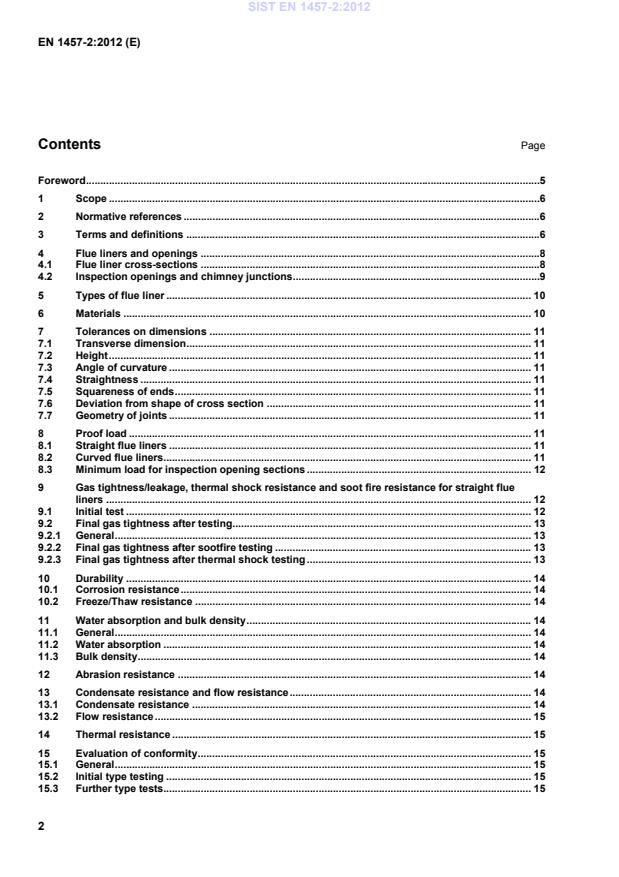
Sampling procedures for an AQL of 10 % and inspection level S2 . 36A.1Acceptability determination . 36A.2Normal inspection . 36A.3Normal to reduced inspection . 37A.4Reduced to normal inspection . 38A.5Tightened inspection . 38A.6Tightened to normal inspection . 38A.7Discontinuation of inspection . 39SIST EN 1457-2:2012
Thermal resistance . 40B.1Method 1: simplified calculation for flue liners without cavities . 40B.2Method 2: thermal resistance of flue liners with or without cavities . 40B.3Method Approximate thermal resistance values . 45Annex C (normative)
Measurement of the coefficient of friction of chimneys . 47Annex ZA (informative)
Clauses of this European Standard addressing the provisions of the EU Construction Products Directive . 49ZA.1Scope and relevant characteristics . 49ZA.2Procedure of attestation of conformity of clay/ceramic flue liners and fittings . 50ZA.3CE Marking and labelling . 52Bibliography . 55 SIST EN 1457-2:2012
Clay/ceramic flue liners — Part 1: Flue liners operating under dry conditions — Requirements and test methods; EN 1457-2, Chimney — Clay/ceramic flue liners — Part 2: Flue liners operating under wet conditions — Requirements and test methods. The main changes with respect to the previous edition are:
EN 1457 has been split in 2 parts: EN 1457-2 is a product standard for clay/ceramic flue liners operating under wet conditions. According to the CEN/CENELEC Internal Regulations, the national standards organizations of the following countries are bound to implement this European Standard: Austria, Belgium, Bulgaria, Croatia, Cyprus, Czech Republic, Denmark, Estonia, Finland, France, Germany, Greece, Hungary, Iceland, Ireland, Italy, Latvia, Lithuania, Luxembourg, Malta, Netherlands, Norway, Poland, Portugal, Romania, Slovakia, Slovenia, Spain, Sweden, Switzerland Turkey and the United Kingdom.
EN 1443:2003, Chimneys — General requirements EN 10088-1, Stainless steels — Part 1: List of stainless steels EN 13384-1:2002+A2:2008, Chimneys — Thermal and fluid dynamic calculation methods — Part 1: Chimneys serving one appliance EN 14297:2004, Chimneys — Freeze-thaw resistance test method for chimney products EN ISO 6946, Building components and building elements — Thermal resistance and thermal transmittance — Calculation method (ISO 6946) EN ISO 7500-1, Metallic materials — Verification of static uniaxial testing machines — Part 1: Tension/compression testing machines — Verification and calibration of the force-measuring system (ISO 7500-1) ISO 2859-1, Sampling procedures for inspection by attributes — Part 1: Sampling schemes indexed by acceptance quality limit (AQL) for lot-by-lot inspection 3 Terms and definitions For the purposes of this document, the terms and definitions given in EN 1443:2003 and the following apply. 3.1 nominal size numerical designation of size which is a convenient round number equal to or approximately equal to either: a) the internal diameter of circular flue liners; b) the internal width of square flue liners; c) the internal width and breadth of the cross section of rectangular flue liners NOTE The nominal length is expressed in millimetres. SIST EN 1457-2:2012
Key 1 internal height Figure 1 — Internal height 3.3 nominal angle of curvature angle subtended by a curved flue liner at the centre of the curve NOTE 1 The nominal angle is expressed in degrees. NOTE 2 See Figure 2.
Key 1 angle of curvature 2 curved flue liner Figure 2 — Angle of curvature 3.4 wet operating condition condition when the chimney is designed to operate normally with the temperature of the inner surface of the flue liner at and below the water dew point SIST EN 1457-2:2012
a) Square b) Rectangular c) Circular d) Wall with vertical perforations Figure 3 — Examples of cross-section configuration SIST EN 1457-2:2012
a) Rebated b) Spigot & socket c) Sleeve d) Tapered Figure 4 — Joint configuration 4.2 Inspection openings and chimney junctions Inspection openings are used for inspection and cleaning of the inner liners of chimneys and for soot removal and shall meet the requirements of flue liners as appropriate. All inspection openings shall have a door.
The inspection opening shall have a door with a separate humidity barrier or have two sheets. Chimney junctions are used to connect flues from heat appliances to chimneys. Chimney junctions are purpose-made tee-pieces or inner liner sections with an opening to which branches are fitted. The branch angles can be 45° to 95° (α in Figure 5). At the position of junctions, the outer walls have corresponding openings. Chimney junctions should have the same cross-sectional area as the flue liner. Reductions and expansions are acceptable provided that the resistance to the exhaust gases is not increased.
Figure 5 — Examples of inspection openings and chimney junctions SIST EN 1457-2:2012
class class class Pa m3 s-1 m-2·10-3 A3 N2 600 Negative Yes (G) 20 3 A3 N1 600 Negative Yes (G) 40 2 A3 P1 600 Positive Yes (G) 200 0,006 A4 N2 600 Negative No (O) 20 3 A4 N1 600 Negative No (O) 40 2 A4 P1 600 Positive No (O) 200 0,006 B3 N2 400 Negative Yes (G) 20 3 B3 N1 400 Negative Yes (G) 40 2 B3 P1 400 Positive Yes (G) 200 0,006 B4 N2 400 Negative No (O) 20 3 B4 N1 400 Negative No (O) 40 2 B4 P1 400 Positive No (O) 200 0,006 C4 N2 300 Negative No (O) 20 3 C4 N1 300 Negative No (O) 40 2 C4 P1 300 Positive No (O) 200 0,006 D4 N2 200 Negative No (O) 20 3 D4 N1 200 Negative No (O) 40 2 D4 P1 200 Positive No (O) 200 0,006
6 Materials Flue liners shall be manufactured from suitable clay/ceramic material which, when fired, meet the performance requirements given in this standard. Flue liners may be unglazed or glazed on the interior and/or exterior. When glazed, they need not be glazed on the jointing surfaces. SIST EN 1457-2:2012
For chimneys with area greater than 0,04 m2 the following equation shall be used: F = χ⋅H·G/100 where F is the minimum load in kilonewtons; χ is the safety factor = 5; H is the height of chimney in metres; G is the weight per metre in kilograms per metre. 9 Gas tightness/leakage, thermal shock resistance and soot fire resistance for straight flue liners 9.1 Initial test Prior to thermal testing a test flue constructed in accordance with 16.8.3 with N1 and N2 liners shall have a leakage rate not greater than 2 m3 s-1 m-2 × 10⁻³ of internal surface area tested at a differential pressure of (40 ± 2) Pa when tested as described in 16.8.5. Prior to thermal testing a test flue constructed in accordance with 16.8.3 with P1 liners shall have a leakage rate not greater than 0,006 m3. s-1 m-2. 10-3 of internal surface area tested at a differential pressure of (200 ± 10) Pa when tested as described in 16.8.5. Where chimney fittings are fired in a plant alongside straight flue liners using the same material and firing process, the gas tightness/leakage, thermal shock resistance and soot fire resistance shall be deemed to be that of straight flue liners when tested in accordance with 16.8.3. If the chimney fittings are not normally fired alongside straight flue liners, straight flue liners or short lengths of straight flue liner shall be made for test purposes using the same material and firing process as for chimney fittings shall be tested for complying with 9.2.1. SIST EN 1457-2:2012
Pa m3 s-1 m-2·10-3 A3 N2 1 000 20 3 A3N1 1 000 40 2 A3 P1 1 000 200 0,006 A4 N2 700 20 3 A4N1 700 40 2 A4 P1 700 200 0,006 B3 N2 1 000 20 3 B3 N1 1 000 40 2 B3 P1 1000 200 0,006 B4 N2 500 20 3 B4 N1 500 40 2 B4 P1 500 200 0,006 C4 N2 350 20 3 C4 N1 350 40 2 C4 P1 350 200 0,006 D4 N2 250 20 3 D4 N1 250 40 2 D4 P1 250 200 0,006 SIST EN 1457-2:2012
>5 ≤10 WD > 10 ≤ 20 SIST EN 1457-2:2012
14 Thermal resistance The values of thermal resistance of flue liners shall be declared by the manufacturer for a flue temperature of 200 °C. The reference calculation method for flue liners without cavities shall be as given in B.1, and the reference calculation method for flue liners with cavities shall be as given in B.2. Materials used in products shall not release any dangerous substances in excess of the maximum permitted levels specified in a relevant European standard for the material, or permitted in the national regulations of the member state of destination. 15 Evaluation of conformity 15.1 General The compliance of the clay/ceramic flue liners under wet conditions with the requirements of this standard and with the declared values (including classes) shall be demonstrated by: initial type testing; factory production control by the manufacturer, including product assessment. 15.2 Initial type testing All characteristics are subject to Initial type testing. It is also recommended to make reference to the use of historical data. “Tests previously performed on the same products in accordance with the provisions of this standard (same characteristic(s), test method, sampling procedure, system of attestation of conformity, etc.) may be taken into account". Type tests relating to material composition shall be performed initially together with factory production control tests as given in Table 4. One test shall be carried out for each requirement. The thermal testing shall be carried out on one size of flue liner for each geometrical configuration e.g. circular, square, rectangular. For circular flue liners the size to be tested shall be 200 mm ± 50 mm internal diameter. For other geometrical configurations the flue liner shall have an equivalent cross-sectional area range. 15.3 Further type tests Type tests shall be performed when a change is made either in material composition, processing technique or the design or method of manufacture of the flue liner, but they may be performed more frequently by incorporation into a plan for monitoring the consistency of manufacture (see Table 4). SIST EN 1457-2:2012
Relevant requirement clauses Item Factory production control 15.4 a Initial type tests 15.2 and 15.3 Straight flue liners 7.1, 7.2, 7.4, 7.5, 7.6, 11 8.1, 9.2, 10, 12, and 13 Flue liner bends 7.1, 7.3, 11 8.2, 10 Opening section 7.1, 7.2, 11 8.3 a The tests carried out during FPC are intended to verify that the performance requirements assessed through the initial type testing are maintained.
16 Test methods 16.1 Size The maximum and minimum diameters of a clay/ceramic flue liner shall be those calculated from the tolerances given in 7.1. If direct measurement is to be carried out, two measurements should be taken at the observed maximum and minimum diameters. The test also may be carried out by using two gauges whose diameters are set at the minimum and maximum diameters. The minimum gauges should be able to be turned through 360° within the ends of the flue liner. The maximum gauge should not be able to enter the flue liner when tested through a rotation of 360°. For square and rectangular flue liners, the internal cross-section dimensions shall be measured between the mid-points of opposite sides of the flue liners. 16.2 Height The maximum and minimum internal height of a clay/ceramic flue finer shall be those calculated from the tolerances given in 7.2. If direct measurement is to be carried out, two measurements should be taken at the observed maximum and minimum heights. SIST EN 1457-2:2012
Key H nominal height of the flue liner, in millimetres L test length, in millimetres D deviation from straightness, in millimetres H - L = 150 mm Figure 6 — Deviation from straightness 16.5 Squareness of ends The test gauge as shown in Figure 7 with one arm set at a slope of 30 mm/m to the other shall be provided with two pairs of supports at (50 ± 5) mm centres. The end support shall be positioned so that there is a recess of (30 ± 5) mm from the inside of the angled arm. The slope of the supports shall be such as to provide a clearance of at least 5 mm under the test gauge. The angled arm shall be of such a length as to span the outside diameter/width of the flue liner. The gauge shall be placed on the end of the flue liner, at the line of the longest external measurement of the flue liner. The slope of the end shall be checked against that of the gauge. SIST EN 1457-2:2012
Key 1 30 mm/m slope a) Longitudinal section of gauge b) Cross section of gauge
c) Liner passing test d) Liner failing test Figure 7 — Squareness test for ends 16.6 Deviation from shape of cross-section The test gauge shall be constituted of two arms, as shown in Figure 8, with one arm set at an angle of (90 ± 0,5)° to the other and both arms of the test gauge of such a length as to span the outside width of the flue liner under test. SIST EN 1457-2:2012
Key X1 deviation from shape X2 deviation from square Figure 8 — Squareness test for angles and flatness of walls The gauge shall be placed against two adjoining walls of square or rectangular straight flue liners and the distances x1 and x2 measured between the inner edge of the test gauge and the outside of the flue liner, excluding the rounded external corners, to an accuracy of ± 0,5 mm. The percentage deviation from flatness shall be calculated as: 11100Lxx× (1) The percentage deviation from squareness shall be calculated as: 2100Lxx2× (2) where x1 is the deviation from flatness of the wall, in millimetres; x2 is the deviation from squareness of the wall, in millimetres; Lxl is the manufacturer's stated nominal internal length of the wall;
against which x1 is measured, in millimetres; Lx2 is the manufacturer’s stated nomin
...