


SIST EN 15624:2009+A1:2010
(Main)Railway applications - Braking - Empty-loaded changeover devices
Railway applications - Braking - Empty-loaded changeover devices
This European Standard is applicable to empty-loaded changeover devices designed to automatically sense when the load of a railway vehicle reaches a defined value (changeover mass), which represents the point at which the vehicle is classed as “loaded” and thereby requires the brake force to be adjusted accordingly to achieve the required brake performance. This European Standard also covers manually operated empty-loaded changeover devices and the associated changeover plates.
This European Standard specifies the requirements for the design, dimensions, manufacture and testing of empty-loaded changeover devices.
Bahnanwendungen - Bremse - Leer-beladen-Umstellvorrichtungen
Diese Europäische Norm gilt für Leer-Beladen-Umstelleinrichtungen, die so beschaffen sind, dass sie auto-matisch den Beladungszustand abtasten, wenn die Last eines Eisenbahnfahrzeuges einen bestimmten Wert (Umstellmasse oder auch „Umstellgewicht“ genannt), erreicht. Wird das Fahrzeug als Beladen eingestuft, wird die Bremskraft entsprechend angepasst, um die geforderte Bremswirkung zu erzielen. Diese Europäische Norm gilt ebenfalls für handbetätigte Umstelleinrichtungen und die zugehörigen Schildlager.
Diese Europäische Norm legt die Anforderungen an die Konstruktion, die Abmessungen, die Herstellung und Prüfung von Leer-Beladen-Umstelleinrichtungen fest.
Applications ferroviaires - Freinage - Dispositifs de changement de régime Vide-Chargé
La présente Norme européenne est applicable aux dispositifs de changement de régime Vide-Chargé destinés
à détecter automatiquement le moment où la charge d’un véhicule ferroviaire atteint une valeur définie (masse de
changement de régime) ; cette valeur représente le moment où le véhicule est classé comme «chargé» et de ce fait
nécessite un ajustement de la force de freinage pour obtenir les performances requises de freinage. La présente
Norme européenne couvre également les dispositifs de changement de régime Vide-Chargé à commande manuelle
et les plaques de commutation associées.
La présente Norme européenne spécifie les exigences relatives à la conception, aux dimensions, à la fabrication et
aux essais des dispositifs changement de régime Vide-Chargé.
Železniške naprave - Zavore - Avtomatsko menjalo "naloženo-prazno"
Ta evropski standard velja za avtomatska menjala »naloženo-prazno«, ki samodejno zaznajo, ko obremenitev železniškega vozila doseže opredeljeno vrednost (menjalna masa), ki predstavlja točko, pri kateri je vozilo razvrščeno kot »naloženo«, zato je treba silo zaviranja temu primerno prilagoditi, da je zaviranje ustrezno. Ta evropski standard zajema tudi ročna menjala »naloženo-prazno« in povezane menjalne plošče. Ta evropski standard določa zahteve za načrtovanje, mere, izdelavo in preskušanje menjal »naloženo-prazno«.
General Information
- Status
- Withdrawn
- Publication Date
- 10-Nov-2010
- Withdrawal Date
- 17-Feb-2021
- Technical Committee
- IŽNP - Reilway applications
- Current Stage
- 9900 - Withdrawal (Adopted Project)
- Start Date
- 18-Feb-2021
- Due Date
- 13-Mar-2021
- Completion Date
- 18-Feb-2021
Relations
- Effective Date
- 17-Feb-2021
- Effective Date
- 01-Dec-2010
- Consolidates
SIST EN 15624:2009/kprA1:2010 - Railway applications - Braking - Empty-loaded changeover devices - Effective Date
- 01-Dec-2010
- Effective Date
- 15-Jul-2018

Frequently Asked Questions
SIST EN 15624:2009+A1:2010 is a standard published by the Slovenian Institute for Standardization (SIST). Its full title is "Railway applications - Braking - Empty-loaded changeover devices". This standard covers: This European Standard is applicable to empty-loaded changeover devices designed to automatically sense when the load of a railway vehicle reaches a defined value (changeover mass), which represents the point at which the vehicle is classed as “loaded” and thereby requires the brake force to be adjusted accordingly to achieve the required brake performance. This European Standard also covers manually operated empty-loaded changeover devices and the associated changeover plates. This European Standard specifies the requirements for the design, dimensions, manufacture and testing of empty-loaded changeover devices.
This European Standard is applicable to empty-loaded changeover devices designed to automatically sense when the load of a railway vehicle reaches a defined value (changeover mass), which represents the point at which the vehicle is classed as “loaded” and thereby requires the brake force to be adjusted accordingly to achieve the required brake performance. This European Standard also covers manually operated empty-loaded changeover devices and the associated changeover plates. This European Standard specifies the requirements for the design, dimensions, manufacture and testing of empty-loaded changeover devices.
SIST EN 15624:2009+A1:2010 is classified under the following ICS (International Classification for Standards) categories: 45.040 - Materials and components for railway engineering. The ICS classification helps identify the subject area and facilitates finding related standards.
SIST EN 15624:2009+A1:2010 has the following relationships with other standards: It is inter standard links to SIST EN 15624:2021, SIST EN 15624:2009, SIST EN 15624:2009/kprA1:2010, SIST EN 15624:2021. Understanding these relationships helps ensure you are using the most current and applicable version of the standard.
SIST EN 15624:2009+A1:2010 is associated with the following European legislation: EU Directives/Regulations: 2008/57/EC; Standardization Mandates: M/334. When a standard is cited in the Official Journal of the European Union, products manufactured in conformity with it benefit from a presumption of conformity with the essential requirements of the corresponding EU directive or regulation.
SIST EN 15624:2009+A1:2010 is available in PDF format for immediate download after purchase. The document can be added to your cart and obtained through the secure checkout process. Digital delivery ensures instant access to the complete standard document.
Standards Content (Sample)
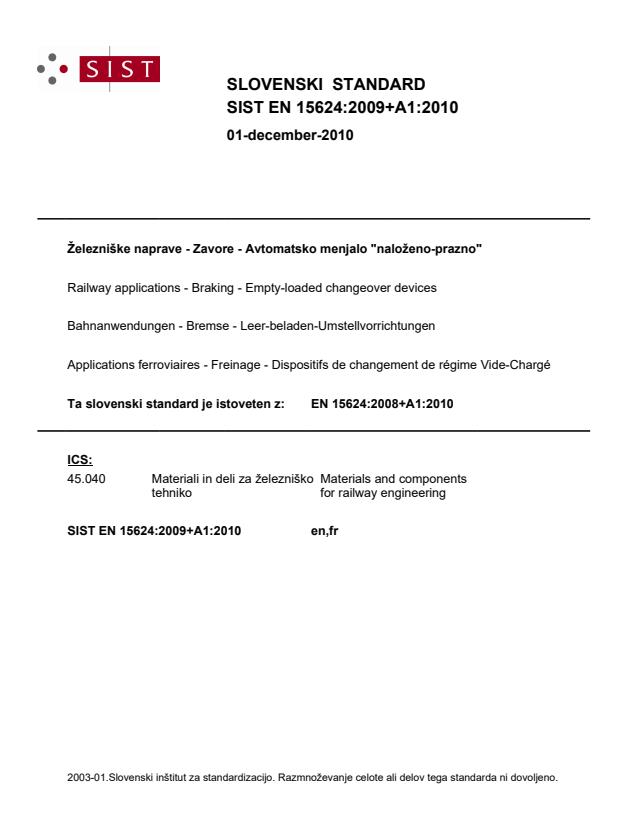
2003-01.Slovenski inštitut za standardizacijo. Razmnoževanje celote ali delov tega standarda ni dovoljeno.Železniške naprave - Zavore - Avtomatsko menjalo "naloženo-prazno"Bahnanwendungen - Bremse - Leer-beladen-UmstellvorrichtungenApplications ferroviaires - Freinage - Dispositifs de changement de régime Vide-ChargéRailway applications - Braking - Empty-loaded changeover devices45.040Materiali in deli za železniško tehnikoMaterials and components for railway engineeringICS:Ta slovenski standard je istoveten z:EN 15624:2008+A1:2010SIST EN 15624:2009+A1:2010en,fr01-december-2010SIST EN 15624:2009+A1:2010SLOVENSKI
STANDARD
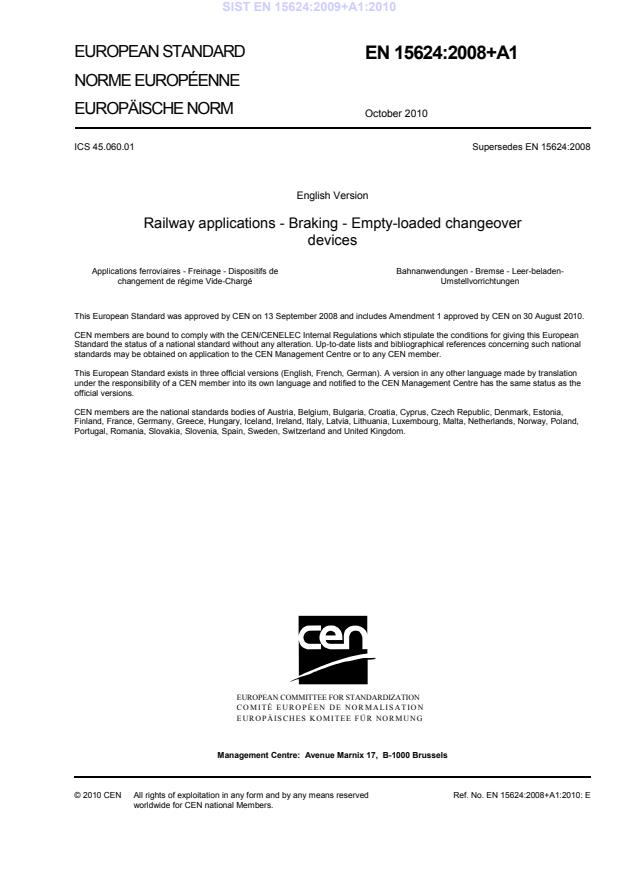
EUROPEAN STANDARD NORME EUROPÉENNE EUROPÄISCHE NORM
EN 15624:2008+A1
October 2010 ICS 45.060.01 Supersedes EN 15624:2008English Version
Railway applications - Braking - Empty-loaded changeover devices
Applications ferroviaires - Freinage - Dispositifs de changement de régime Vide-Chargé
Bahnanwendungen - Bremse - Leer-beladen-Umstellvorrichtungen This European Standard was approved by CEN on 13 September 2008 and includes Amendment 1 approved by CEN on 30 August 2010.
CEN members are bound to comply with the CEN/CENELEC Internal Regulations which stipulate the conditions for giving this European Standard the status of a national standard without any alteration. Up-to-date lists and bibliographical references concerning such national standards may be obtained on application to the CEN Management Centre or to any CEN member.
This European Standard exists in three official versions (English, French, German). A version in any other language made by translation under the responsibility of a CEN member into its own language and notified to the CEN Management Centre has the same status as the official versions.
CEN members are the national standards bodies of Austria, Belgium, Bulgaria, Croatia, Cyprus, Czech Republic, Denmark, Estonia, Finland, France, Germany, Greece, Hungary, Iceland, Ireland, Italy, Latvia, Lithuania, Luxembourg, Malta, Netherlands, Norway, Poland, Portugal, Romania, Slovakia, Slovenia, Spain, Sweden, Switzerland and United Kingdom.
EUROPEAN COMMITTEE FOR STANDARDIZATION
COMITÉ EUROPÉEN DE NORMALISATION EUROPÄISCHES KOMITEE FÜR NORMUNG
Management Centre:
Avenue Marnix 17,
B-1000 Brussels © 2010 CEN All rights of exploitation in any form and by any means reserved worldwide for CEN national Members. Ref. No. EN 15624:2008+A1:2010: ESIST EN 15624:2009+A1:2010
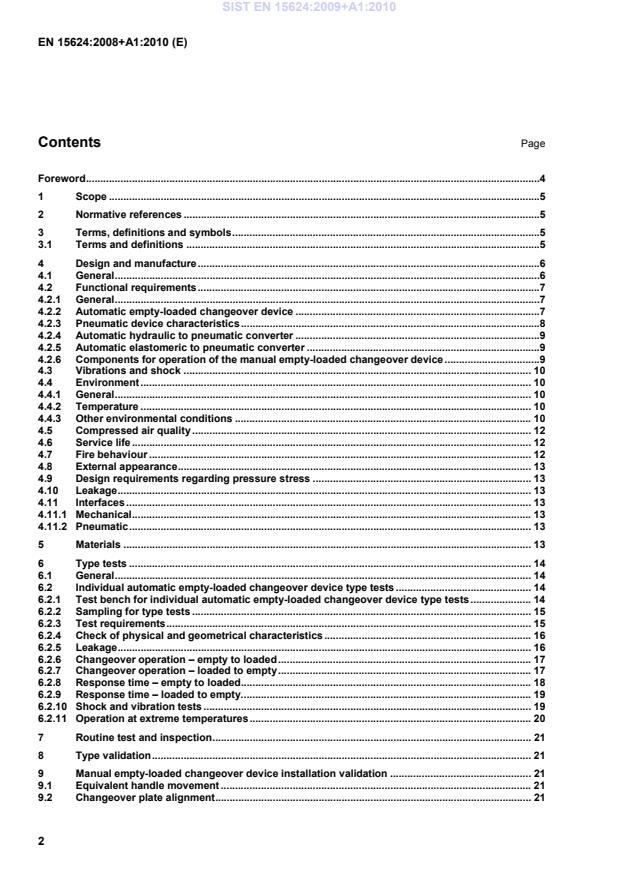
Assessment of an empty-loaded changeover device when fitted to a vehicle . 24A.1 Vehicle assessment – Testing set up . 24A.2 Design acceptance testing set up . 24A.3 Single vehicle static testing . 24A.3.1 Vehicle requirements . 24A.3.2 Test procedures . 24A.4 Running tests . 25A.4.1 General . 25A.4.2 Pneumatic empty-loaded changeover device – Air consumption . 25A.4.3 Pneumatic empty-loaded changeover device – Output signal variation . 26Annex B (informative)
Examples of manual empty-loaded changeover device handles and changeover plates . 27Annex C (informative)
Test bench diagram . 29Annex ZA (informative)
!!!!Relationship between this European Standard and the Essential Requirements of EU Directive 2008/57/EC of the European Parliament and of the Council of 17 June 2008 on the interoperability of the rail system within the Community (Recast)"""" . 30Bibliography . 32 SIST EN 15624:2009+A1:2010
70 °C without any deviation from the technical requirements specified in this European Standard; at – 40 °C ≤ environmental temperature < – 25 °C without deviation from the main technical requirements specified in this European Standard but without affecting the function of the empty-loaded changeover device. Deviations from the technical requirement when testing at extremes are defined in 6.2.11. The purchaser can specify a higher or lower temperature limit values if operational constraints demand it. In this case the temperature limit values used in the extreme temperature tests of 6.2.11 shall be changed accordingly. 4.4.3 Other environmental conditions 4.4.3.1 General The following environmental conditions shall be considered in the design of the empty-loaded changeover device. SIST EN 15624:2009+A1:2010
4.5 Compressed air quality It shall be possible to operate the empty-loaded changeover device without restrictions with at least the compressed air quality according to the following classes defined by ISO 8573-1:2001: class 4 – for the maximum particle size and the maximum concentration of solid contaminants; class 4 – for the water dew point; class 4 – for the maximum total (droplets, aerosols and vapours) oil concentration. The empty-loaded changeover device shall be capable of operating in an air supply system that is not fitted with an air dryer, or when the air dryer is out of order. The air system should therefore include some means of preventing water collecting within the empty-loaded changeover device and hence freezing of the water in conditions below 0 °C. 4.6 Service life No specific requirements for the empty-loaded changeover device to attain a particular service life are contained in this European Standard. Any testing to establish the service life of an empty-loaded changeover device shall be conducted as part of the product development. NOTE The service life of the empty-loaded changeover device is a function of the environment/operating conditions in which the empty-loaded changeover device will function, and the requirements for the empty-loaded changeover device to achieve a serviceable life in accordance with the maintenance requirements of the vehicle to which it is fitted. 4.7 Fire behaviour The materials used in the manufacture of the empty-loaded changeover device shall prevent the emission of fumes or gases that are harmful and dangerous to the environment, particularly in the event of fire. The assembled empty-loaded changeover device shall limit fire ignition, propagation and the production of smoke in the event of fire on primary ignition from a source of 7 kW for 3 min. SIST EN 15624:2009+A1:2010
X
X
Extreme temperatures 6.2.11
X
X
...
Questions, Comments and Discussion
Ask us and Technical Secretary will try to provide an answer. You can facilitate discussion about the standard in here.
Loading comments...