

SIST-V ETSI/EG 202 745 V1.1.1:2009
(Main)Human Factors (HF) - Guidelines on the provision of ICT services to young children
- Abstract
There exist many guideline documents for the design of ICT products and services, for example ETSI Guide EG 202 116 Guidelines for ICT products and services; 'Design for All', is aimed at designers and provides advice on human factors aspects when designing ICT devices. STF 266 is currently producing an ETSI guide on Guidelines for the design and deployment of ICT products and services used by children. However, the market is moving to push services targetted at the under 12s. This specialised group of users have specific needs which need to be taken into consideration. There as yet do not exist any guidance documents on how this can sensitivly be done. This new work will produce guidance for service providers who are considering providing information services targeted at the under 12s as to how best to do this so that the services produced are acceptable to parents, teachers and child agencies.
- Status
- Published
- Publication Date
- 08-Mar-2009
- Technical Committee
- SPN - Services and Protocols for Networks
- Current Stage
- 6060 - National Implementation/Publication (Adopted Project)
- Start Date
- 20-Feb-2009
- Due Date
- 27-Apr-2009
- Completion Date
- 09-Mar-2009
Buy Documents


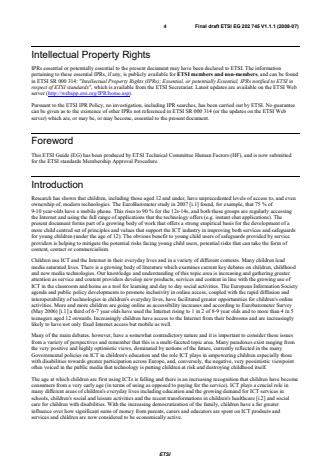
ETSI EG 202 745 V1.1.1 (2008-07) - Human Factors (HF); Guidelines on the provision of ICT services to young children


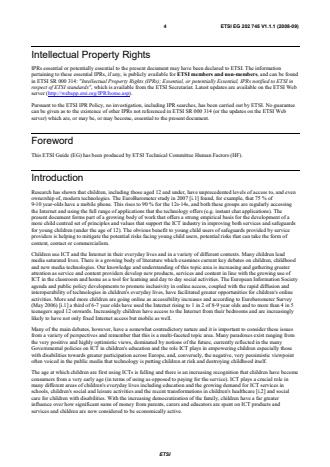
ETSI EG 202 745 V1.1.1 (2008-09) - Human Factors (HF); Guidelines on the provision of ICT services to young children



SIST-V ETSI/EG 202 745 V1.1.1:2009 is the Slovene version of ETSI EG 202 745 V1.1.1, a Human Factors guide from the European Telecommunications Standards Institute (ETSI). It gives high-level guidelines for the provision of ICT services to young children, with a focus on children under 12 and on the service and content providers who design, run, support and explain those services.
What does SIST-V ETSI/EG 202 745 V1.1.1:2009 specify?
SIST-V ETSI/EG 202 745 V1.1.1:2009 specifies voluntary guidelines for service and content providers who deploy and provision ICT services used by young children, even when the children are not the purchasers. The guide is meant to help providers make services more acceptable to children, parents, teachers and child agencies.
The document is organized into:
- Clause 1, Scope
- Clause 2, References
- Clause 3, Definitions and abbreviations
- Clause 4, The European Context
- Clause 5, The Guidelines, with ten guidance topics
- Clause 6, Conclusion
- Annex A, Bibliography
Annex A collects the background references used by the guide. The main body is therefore a principles document, not a technical test specification.
What are the key requirements of SIST-V ETSI/EG 202 745 V1.1.1:2009?
SIST-V ETSI/EG 202 745 V1.1.1:2009 is built around rights-based, child-centred guidance rather than mandatory technical rules. In practice, the document asks providers to think about safeguarding, inclusion, communication, partnerships and ongoing improvement together.
Rights framework and context
Clause 4.2 grounds the guide in the United Nations Convention on the Rights of the Child (UNCRC) and its four core principles: non-discrimination, best interests of the child, the right to life, survival and development, and respect for the views of the child. It also uses a provision-prevention-participation-protection framework. For providers, that means services should both give access and reduce harm, while also listening to children.
Proactive safeguarding
Clause 5.1 says safeguarding should be proactive. The guide points to content moderation, ways to report abuse, follow-up action, and information or advice for customers. It also highlights trust topics such as reliability, security, privacy and integrity, which matter because children may share personal information or face harmful content online.
Child-centred and inclusive design
Clause 5.2 promotes a child-centred approach, including safer by design, inclusive design and Design for All. It specifically calls out children with disabilities and services that need to adapt to different ages and capabilities. In practice, providers need to think about accessibility and usability from the start, not as an afterthought.
Stakeholder cooperation
Clause 5.3 asks for wide engagement with stakeholders such as governments, NGOs, parents, children, educators, law enforcement agencies and industry partners. It also points to relevant self-regulatory frameworks. For a provider, this means safeguarding is a shared task and needs coordination, not isolated policy writing.
Clear information and service conditions
Clauses 5.5 and 5.6 focus on responsible use and clear service conditions. The guide wants age-appropriate information on how to use the service, how to get help, how to report abuse, how to cancel, and how to contact law enforcement. It also stresses plain language so children and families can understand what the service does and what the rules are.
Research, training and continuous improvement
Clauses 5.7 to 5.10 call for research into how children actually use ICT services, use of new technology to improve child-friendly features, professional development for staff, and continuous improvement. This matters because the guide treats safeguarding as an ongoing process that should change as services, risks and user behaviour change.
What terms does SIST-V ETSI/EG 202 745 V1.1.1:2009 define?
- guidelines - high level principles for recommendations to the ICT industry.
- ICT industry - hardware and software developers, manufacturers, service and content providers, and content producers.
- HF - Human Factors, the ETSI subject area for human-centred design guidance.
- ICT - Information and Communications Technology.
- UNCRC - United Nations Convention on the Rights of the Child, the rights framework used in the guide.
- CEOP - Child Exploitation and Online Protection centre, named as one of the safeguarding stakeholders.
- GSMA - GSM Association, cited in the guide as an industry body behind safer-use initiatives.
Who uses SIST-V ETSI/EG 202 745 V1.1.1:2009?
SIST-V ETSI/EG 202 745 V1.1.1:2009 is mainly used by service and content providers, product designers and manufacturers, and organizations running fixed, mobile, internet or interactive services for children. It is also relevant to educators, parents and carers, governments, NGOs, child protection bodies and law enforcement when they are shaping policy, training, reporting routes or service expectations.
In practice, these users would apply the guide when designing services, writing service conditions, setting safeguarding policies, training staff, planning customer support, and working with partners on child safety.
Which standards are used with SIST-V ETSI/EG 202 745 V1.1.1:2009?
SIST-V ETSI/EG 202 745 V1.1.1:2009 cites several related ETSI documents that help frame child-focused ICT guidance:
- ETSI EG 202 116 V1.2.1 - provides general “Design for All” guidance, which supports the inclusive design ideas in clause 5.2.
- ETSI TR 102 133 - covers access to ICT by young people and supports the wider background on children’s access.
- ETSI EG 202 423 - gives guidelines for the design and deployment of ICT products and services used by children, making it a close companion guide.
What does the SIST-V ETSI/EG 202 745 V1.1.1:2009 document contain?
SIST-V ETSI/EG 202 745 V1.1.1:2009 contains contextual discussion, a rights-based framework, ten guidance topics in clause 5, and a bibliography in Annex A. The body includes figures showing the contextual framework, the children’s rights model, the stakeholder map, and a cycle of continuous improvement. It is a policy-and-practice guide for design, service operation, safeguarding, training and service review rather than a test method or certification standard.
Buy Documents
ETSI EG 202 745 V1.1.1 (2008-07) - Human Factors (HF); Guidelines on the provision of ICT services to young children
ETSI EG 202 745 V1.1.1 (2008-09) - Human Factors (HF); Guidelines on the provision of ICT services to young children
Get Certified
Connect with accredited certification bodies for this standard

BSI Group
BSI (British Standards Institution) is the business standards company that helps organizations make excellence a habit.

NYCE
Mexican standards and certification body.
Sponsored listings
Frequently Asked Questions
SIST-V ETSI/EG 202 745 V1.1.1:2009 is a standard published by the Slovenian Institute for Standardization (SIST). Its full title is "Human Factors (HF) - Guidelines on the provision of ICT services to young children". This standard covers: There exist many guideline documents for the design of ICT products and services, for example ETSI Guide EG 202 116 Guidelines for ICT products and services; 'Design for All', is aimed at designers and provides advice on human factors aspects when designing ICT devices. STF 266 is currently producing an ETSI guide on Guidelines for the design and deployment of ICT products and services used by children. However, the market is moving to push services targetted at the under 12s. This specialised group of users have specific needs which need to be taken into consideration. There as yet do not exist any guidance documents on how this can sensitivly be done. This new work will produce guidance for service providers who are considering providing information services targeted at the under 12s as to how best to do this so that the services produced are acceptable to parents, teachers and child agencies.
There exist many guideline documents for the design of ICT products and services, for example ETSI Guide EG 202 116 Guidelines for ICT products and services; 'Design for All', is aimed at designers and provides advice on human factors aspects when designing ICT devices. STF 266 is currently producing an ETSI guide on Guidelines for the design and deployment of ICT products and services used by children. However, the market is moving to push services targetted at the under 12s. This specialised group of users have specific needs which need to be taken into consideration. There as yet do not exist any guidance documents on how this can sensitivly be done. This new work will produce guidance for service providers who are considering providing information services targeted at the under 12s as to how best to do this so that the services produced are acceptable to parents, teachers and child agencies.
SIST-V ETSI/EG 202 745 V1.1.1:2009 is classified under the following ICS (International Classification for Standards) categories: 35.020 - Information technology (IT) in general. The ICS classification helps identify the subject area and facilitates finding related standards.
SIST-V ETSI/EG 202 745 V1.1.1:2009 is available in PDF format for immediate download after purchase. The document can be added to your cart and obtained through the secure checkout process. Digital delivery ensures instant access to the complete standard document.
Standards Content (Sample)
Contents
- Introduction
- 5 Final draft ETSI EG 202 745 V1.1.1 (2008-07)
- 6 Final draft ETSI EG 202 745 V1.1.1 (2008-07)
- 1 Scope
- 2 References
- 2.1 Normative references
- 2.2 Informative references
- 7 Final draft ETSI EG 202 745 V1.1.1 (2008-07)
- 3 Definitions and abbreviations
- 3.1 Definitions
- 3.2 Abbreviations
- 8 Final draft ETSI EG 202 745 V1.1.1 (2008-07)
- 4 The European Context
- 4.1 The Contextual framework
- 4.2 United Nations Convention on the Rights of the Child
- 9 Final draft ETSI EG 202 745 V1.1.1 (2008-07)
- 10 Final draft ETSI EG 202 745 V1.1.1 (2008-07)
- 5 The Guidelines
- 5.1 Proactively safeguard children
- 11 Final draft ETSI EG 202 745 V1.1.1 (2008-07)
- 5.2 Adopt a child centred approach
- 5.3 Engage widely with stakeholders
- 12 Final draft ETSI EG 202 745 V1.1.1 (2008-07)
- 5.4 Work in partnership with children and families
- 13 Final draft ETSI EG 202 745 V1.1.1 (2008-07)
- 5.5 Promote responsible use
- 5.6 Clearly explain service conditions
- 14 Final draft ETSI EG 202 745 V1.1.1 (2008-07)
- 5.7 Understand how children use ICT services
- 5.8 Exploit technology innovation
- 5.9 Embrace professional development
- 15 Final draft ETSI EG 202 745 V1.1.1 (2008-07)
- 5.10 Seek Continuous improvement
- 6 Conclusion
- 16 Final draft ETSI EG 202 745 V1.1.1 (2008-07)
- 17 Final draft ETSI EG 202 745 V1.1.1 (2008-07)
- Bibliography
- 18 Final draft ETSI EG 202 745 V1.1.1 (2008-07)
Introduction
Research has shown that children, including those aged 12 and under, have unprecedented levels of access to, and even ownership of, modern technologies. The EuroBarometer study in 2007 [i.1] found, for example, that 75 % of 9-10 year-olds have a mobile phone. This rises to 90 % for the 12s-14s, and both these groups are regularly accessing the Internet and using the full range of applications that the technology offers (e.g. instant chat applications). The present document forms part of a growing body of work that offers a strong empirical basis for the development of a more child centred set of principles and values that support the ICT industry in improving both services and safeguards for young children (under the age of 12). The obvious benefit to young child users of safeguards provided by service providers is helping to mitigate the potential risks facing young child users, potential risks that can take the form of content, contact or commercialism.
Children use ICT and the Internet in their everyday lives and in a variety of different contexts. Many children lead media saturated lives. There is a growing body of literature which examines current key debates on children, childhood and new media technologies. Our knowledge and understanding of this topic area is increasing and gathering greater attention as service and content providers develop new products, services and content in line with the growing use of ICT in the classroom and home as a tool for learning and day to day social activities. The European Information Society agenda and public policy developments to promote inclusivity in online access, coupled with the rapid diffusion and interoperability of technologies in children's everyday lives, have facilitated greater opportunities for children's online activities. More and more children are going online as accessibility increases and according to Eurobarometer Survey (May 2006) [i.1] a third of 6-7 year olds have used the Internet rising to 1 in 2 of 8-9 year olds and to more than 4 in 5 teenagers aged 12 onwards. Increasingly children have access to the Internet from their bedrooms and are increasingly likely to have not only fixed Internet access but mobile as well. Many of the main debates, however, have a somewhat contradictory nature and it is important to consider these issues from a variety of perspectives and remember that this is a multi-faceted topic area. Many paradoxes exist ranging from the very positive and highly optimistic views, dominated by notions of the future, currently reflected in the many Governmental policies on ICT in children's education and the role ICT plays in empowering children especially those with disabilities towards greater participation across Europe, and, conversely, the negative, very pessimistic viewpoint often voiced in the public media that technology is putting children at risk and destroying childhood itself. The age at which children are first using ICTs is falling and there is an increasing recognition that children have become consumers from a very early age (in terms of using as opposed to paying for the service). ICT plays a crucial role in many different areas of children's everyday lives including education and the growing demand for ICT services in schools, children's social and leisure activities and the recent transformations in children's healthcare [i.2] and social care for children with disabilities. With the increasing democratization of the family, children have a far greater influence over how significant sums of money from parents, carers and educators are spent on ICT products and services and children are now considered to be economically active. ETSI
5 Final draft ETSI EG 202 745 V1.1.1 (2008-07)
Whilst the participation of children in the European information society is now well established, the providers of services that are used by children under 12 face specific, yet varied and changing challenges in meeting their needs and the rights and needs of children under 12 should, therefore, be given additional consideration, where relevant, by service and content providers including special consideration for children with disabilities. Much of the previous research in this area has focused on teenagers but, as already established [i.1], the age at which children are using ICTs is decreasing yet young children remain largely ignored in research. There has been little previous work in this area which gives consideration to children under the age of 12.
The present document looks at ICT services provision, from the viewpoint of promoting children's participation and simultaneously advancing the safeguarding of young children in a systematic and integrated manner. The recommendations are underpinned by the United Nations Convention of the Rights of the Child (UNCRC) [i.3] and by the high level principles gained from adopting an integrated approach to safeguarding children. The guidelines have been created in the context of other excellent related industry-led initiatives. Quality in service delivery is a continuous process, and these guidelines propose principles to be considered by service and content providers wishing to create maintain and develop services which offer the best experience for children and their families.
Parts of the ICT industry have already made significant contributions to safeguarding children through self-regulation and developing new policies. For example, in 2007 the GSM Association created a European Framework for Safer Mobile Use by Younger Teenagers and Children [i.4] and in 2008 they launched a Mobile Alliance Against Child Sexual Abuse Content [i.6]. Also in 2008 internet service providers, mobile operators and social networking providers launched TeachToday [i.5] a European resource to support teachers to equip and empower young people to better understand ICT and use it responsibly. The present document acknowledges that priorities associated with aspects of safeguarding children are politically and socially constructed and culturally specific, the safeguarding of children using ICT products and services requires a holistic and integrated approach. The mounting legislation, guidance and regulatory frameworks in this area, as well as differing social and cultural contexts, have resulted in differing legal frameworks across Europe which require detailed understanding. The intention of the guide is to provide high level principles regarding some of the issues relating to safeguarding young children. Effective safeguarding of children in the ICT environment requires action by a wide range of stakeholders, including standards developers, manufacturers, designers, service and content providers, policy developers, national administrations, parents/carers, child protection NGOs, CEOP and educators and, indeed children themselves. Safeguarding is an ongoing process not a single event and all stakeholders have a role to play in the safeguarding of young children in the European Information society. The details of how these recommendations are implemented in practice are for industry to lead. The recommendations outline safeguarding actions which may be considered by industry on a voluntary basis, in accordance with its commercial needs. However, any safeguards provided by service providers will have the benefit of helping young children as they take their first or early steps online. This is all the more important in the context that many parents and carers, children's closest form of support, are challenged by new technology and are not sure of their ability to "parent" in this space. In order to build on the strengths of what has already been established and developed within industry as a whole, a coordinated approach needs to be adopted. This will provide better safeguards for young children and allow the industry and others to share best practice. The present document examines how service and content providers may consider adopting a more child centred approach and puts forward a number of principles and values which may facilitate such enhancements. It stresses the significance of understanding and promoting the rights of the child and argues that putting children at the centre of things supports improved quality in service provision for them. Effective collaboration is essential in adopting a joined up approach to safeguarding children and promoting children's well-being, and in the context of rapid and sometimes unexpected developments in information technologies and their use, improvement should be continuous. Finally it is critical that parents and children become aware of the potential risks of using ICT services, but also the actions that have been taken by industry to address them. The present document provides advice on a cross-industry basis, covering fixed and mobile services, ISPs and on-line service and content providers. Of necessity this broad scope means that the recommendations take the form of high-level common themes which may be interpreted and adopted in different ways and applied and modified to fit different sectors and markets as appropriate. These generic high-level principles can be adapted by industry to their environments as a basis for specific developments. The document takes as a starting point the UN charter on the rights of children and comprises of a range of proactive responses of industry to safeguarding children, including non-technical approaches to issues for adopting a more child centred approach in relation to ICT products and services. The documents acknowledges that the issues may be different depending upon whether services were designed with children in mind, or whether children are using services that were not originally intended for use by children and includes the issue of services being misused in a way that harms children, including misuse by children themselves.
ETSI
6 Final draft ETSI EG 202 745 V1.1.1 (2008-07)
1 Scope
The present document provides guidelines for service and content providers who are deploying and provisioning ICT services that are being used, although not necessarily purchased, by young children less than 12 years of age. ETSI Guides provide recommendations that may be adopted by industry stakeholders on a voluntary basis, in accordance with their commercial needs and these guidelines are without prejudice to existing EU legal and regulatory framework and do not advocate any changes to these frameworks.
2 References
References are either specific (identified by date of publication and/or edition number or version number) or non-specific.
- For a specific reference, subsequent revisions do not apply.
- Non-specific reference may be made only to a complete document or a part thereof and only in the following cases:
- if it is accepted that it will be possible to use all future changes of the referenced document for the purposes of the referring document;
- for informative references.
Referenced documents which are not found to be publicly available in the expected location might be found at http://docbox.etsi.org/Reference.
For online referenced documents, information sufficient to identify and locate the source shall be provided. Preferably, the primary source of the referenced document should be cited, in order to ensure traceability. Furthermore, the reference should, as far as possible, remain valid for the expected life of the document. The reference shall include the method of access to the referenced document and the full network address, with the same punctuation and use of upper case and lower case letters.
NOTE: While any hyperlinks included in this clause were valid at the time of publication ETSI cannot guarantee their long term validity.
2.1 Normative references
The following referenced documents are indispensable for the application of the present document. For dated references, only the edition cited applies. For non-specific references, the latest edition of the referenced document (including any amendments) applies.
Not applicable.
2.2 Informative references
The following referenced documents are not essential to the use of the ETSI deliverable but they assist the user with regard to a particular subject area. For non-specific references, the latest version of the referenced document (including any amendments) applies.
[i.1] Eurobarometer May (2006).
NOTE: Available at: http://europa.eu.int/information_society/activities/sip/eurobarometer/index_en.htm [i.2] ICT for Health and i2010: "Transforming the European health care Landscape - Towards a strategy for ICT for Health", European Commission Information Society and Media. NOTE: Available at: http://www.ehealtheurope.net/img/document_library0282/ICT_for_Health_i2010.pdf ETSI
7 Final draft ETSI EG 202 745 V1.1.1 (2008-07)
[i.3] United Nations Convention on the Rights of the Child (UNCRC). NOTE: Available at: http://www.unicef.org.uk/publications/pub_detail.asp?pub_id=133. [i.4] European Framework for Safer Mobile Use by Younger Teenagers and Children. NOTE: Available at: www.gsmworld.com/gsmeurope/documents/eur.pdf. [i.5] TeachToday: "making sense of technology".
NOTE: Available at: www.teachtoday.eu.
[i.6] Mobile Alliance Against Child Sexual Abuse Content.
NOTE: Available at: http://www.gsmworld.com/using/public_policy/mobile_alliance.shtml. [i.7] Parton, N (2006) Safeguarding Childhood Basingstoke: Palgrave. [i.8] Utting, Sir William (1997) People, Like Us: The report of the review of safeguards for children living away from home HMSO: London.
[i.9] S. Livingstone and M. Bober (2004): "UK Children Go Online Surveying the experiences of young people and their parents".
NOTE: Available at: http://www.lse.ac.uk/collections/children-go-online/UKCGO_Final_report.pdf. [i.10] Prensky, M. (2001): "Digital Natives, Digital Immigrants Part 1" in On the Horizon Vol. 9 No. 5 pp. 1-6.
[i.11] ETSI EG 202 116 V1.2.1 (2002-09): "Human Factors (HF); Guidelines for ICT products and services; "Design for All"".
[i.12] Good practice guidance for the providers of services of social networking and other user interactive services 2008: - The Home Office.
NOTE: Available at: http://police.homeoffice.gov.uk/publications/operational-policing/social-networkingguidance. [i.13] Byron, T. (2008): "Safer Children in a Digital World The Report of the Byron Review". NOTE: Available at: http://www.dfes.gov.uk/byronreview.
3 Definitions and abbreviations
3.1 Definitions
For the purposes of the present document, the following terms and definitions apply:
guidelines: high level principles for recommendations to the ICT industry ICT industry: industry that encompasses hardware and software developers, manufacturers, service and content providers and content producers
3.2 Abbreviations
For the purposes of the present document, the following abbreviations apply:
CEOP Child Exploitation and Online Protection (centre) EU European Union GSM Global System Mobile GSMA GSM Association (global trade association of mobile phone operators) HF Human Factors ETSI
8 Final draft ETSI EG 202 745 V1.1.1 (2008-07)
ICT Information and Communications Technology UNCRC United Nations Convention on the Rights of the Child
...
Contents
- Introduction
- 5 ETSI EG 202 745 V1.1.1 (2008-09)
- 6 ETSI EG 202 745 V1.1.1 (2008-09)
- 1 Scope
- 2 References
- 2.1 Normative references
- 2.2 Informative references
- 7 ETSI EG 202 745 V1.1.1 (2008-09)
- 3 Definitions and abbreviations
- 3.1 Definitions
- 3.2 Abbreviations
- 8 ETSI EG 202 745 V1.1.1 (2008-09)
- 4 The European Context
- 4.1 The Contextual framework
- 4.2 United Nations Convention on the Rights of the Child
- 9 ETSI EG 202 745 V1.1.1 (2008-09)
- 10 ETSI EG 202 745 V1.1.1 (2008-09)
- 5 The Guidelines
- 5.1 Proactively safeguard children
- 11 ETSI EG 202 745 V1.1.1 (2008-09)
- 5.2 Adopt a child centred approach
- 5.3 Engage widely with stakeholders
- 12 ETSI EG 202 745 V1.1.1 (2008-09)
- 5.4 Work in partnership with children and families
- 13 ETSI EG 202 745 V1.1.1 (2008-09)
- 5.5 Promote responsible use
- 5.6 Clearly explain service conditions
- 14 ETSI EG 202 745 V1.1.1 (2008-09)
- 5.7 Understand how children use ICT services
- 5.8 Exploit technology innovation
- 5.9 Embrace professional development
- 15 ETSI EG 202 745 V1.1.1 (2008-09)
- 5.10 Seek Continuous improvement
- 6 Conclusion
- 16 ETSI EG 202 745 V1.1.1 (2008-09)
- 17 ETSI EG 202 745 V1.1.1 (2008-09)
- Bibliography
- 18 ETSI EG 202 745 V1.1.1 (2008-09)
Introduction
Research has shown that children, including those aged 12 and under, have unprecedented levels of access to, and even ownership of, modern technologies. The EuroBarometer study in 2007 [i.1] found, for example, that 75 % of 9-10 year-olds have a mobile phone. This rises to 90 % for the 12s-14s, and both these groups are regularly accessing the Internet and using the full range of applications that the technology offers (e.g. instant chat applications). The present document forms part of a growing body of work that offers a strong empirical basis for the development of a more child centred set of principles and values that support the ICT industry in improving both services and safeguards for young children (under the age of 12). The obvious benefit to young child users of safeguards provided by service providers is helping to mitigate the potential risks facing young child users, potential risks that can take the form of content, contact or commercialism.
Children use ICT and the Internet in their everyday lives and in a variety of different contexts. Many children lead media saturated lives. There is a growing body of literature which examines current key debates on children, childhood and new media technologies. Our knowledge and understanding of this topic area is increasing and gathering greater attention as service and content providers develop new products, services and content in line with the growing use of ICT in the classroom and home as a tool for learning and day to day social activities. The European Information Society agenda and public policy developments to promote inclusivity in online access, coupled with the rapid diffusion and interoperability of technologies in children's everyday lives, have facilitated greater opportunities for children's online activities. More and more children are going online as accessibility increases and according to Eurobarometer Survey (May 2006) [i.1] a third of 6-7 year olds have used the Internet rising to 1 in 2 of 8-9 year olds and to more than 4 in 5 teenagers aged 12 onwards. Increasingly children have access to the Internet from their bedrooms and are increasingly likely to have not only fixed Internet access but mobile as well. Many of the main debates, however, have a somewhat contradictory nature and it is important to consider these issues from a variety of perspectives and remember that this is a multi-faceted topic area. Many paradoxes exist ranging from the very positive and highly optimistic views, dominated by notions of the future, currently reflected in the many Governmental policies on ICT in children's education and the role ICT plays in empowering children especially those with disabilities towards greater participation across Europe, and, conversely, the negative, very pessimistic viewpoint often voiced in the public media that technology is putting children at risk and destroying childhood itself. The age at which children are first using ICTs is falling and there is an increasing recognition that children have become consumers from a very early age (in terms of using as opposed to paying for the service). ICT plays a crucial role in many different areas of children's everyday lives including education and the growing demand for ICT services in schools, children's social and leisure activities and the recent transformations in children's healthcare [i.2] and social care for children with disabilities. With the increasing democratization of the family, children have a far greater influence over how significant sums of money from parents, carers and educators are spent on ICT products and services and children are now considered to be economically active. ETSI
5 ETSI EG 202 745 V1.1.1 (2008-09)
Whilst the participation of children in the European information society is now well established, the providers of services that are used by children under 12 face specific, yet varied and changing challenges in meeting their needs and the rights and needs of children under 12 should, therefore, be given additional consideration, where relevant, by service and content providers including special consideration for children with disabilities. Much of the previous research in this area has focused on teenagers but, as already established [i.1], the age at which children are using ICTs is decreasing yet young children remain largely ignored in research. There has been little previous work in this area which gives consideration to children under the age of 12.
The present document looks at ICT services provision, from the viewpoint of promoting children's participation and simultaneously advancing the safeguarding of young children in a systematic and integrated manner. The recommendations are underpinned by the United Nations Convention of the Rights of the Child (UNCRC) [i.3] and by the high level principles gained from adopting an integrated approach to safeguarding children. The guidelines have been created in the context of other excellent related industry-led initiatives. Quality in service delivery is a continuous process, and these guidelines propose principles to be considered by service and content providers wishing to create maintain and develop services which offer the best experience for children and their families.
Parts of the ICT industry have already made significant contributions to safeguarding children through self-regulation and developing new policies. For example, in 2007 the GSM Association created a European Framework for Safer Mobile Use by Younger Teenagers and Children [i.4] and in 2008 they launched a Mobile Alliance Against Child Sexual Abuse Content [i.6]. Also in 2008 internet service providers, mobile operators and social networking providers launched TeachToday [i.5] a European resource to support teachers to equip and empower young people to better understand ICT and use it responsibly. The present document acknowledges that priorities associated with aspects of safeguarding children are politically and socially constructed and culturally specific, the safeguarding of children using ICT products and services requires a holistic and integrated approach. The mounting legislation, guidance and regulatory frameworks in this area, as well as differing social and cultural contexts, have resulted in differing legal frameworks across Europe which require detailed understanding. The intention of the guide is to provide high level principles regarding some of the issues relating to safeguarding young children. Effective safeguarding of children in the ICT environment requires action by a wide range of stakeholders, including standards developers, manufacturers, designers, service and content providers, policy developers, national administrations, parents/carers, child protection NGOs, CEOP and educators and, indeed children themselves. Safeguarding is an ongoing process not a single event and all stakeholders have a role to play in the safeguarding of young children in the European Information society. The details of how these recommendations are implemented in practice are for industry to lead. The recommendations outline safeguarding actions which may be considered by industry on a voluntary basis, in accordance with its commercial needs. However, any safeguards provided by service providers will have the benefit of helping young children as they take their first or early steps online. This is all the more important in the context that many parents and carers, children's closest form of support, are challenged by new technology and are not sure of their ability to "parent" in this space. In order to build on the strengths of what has already been established and developed within industry as a whole, a coordinated approach needs to be adopted. This will provide better safeguards for young children and allow the industry and others to share best practice. The present document examines how service and content providers may consider adopting a more child centred approach and puts forward a number of principles and values which may facilitate such enhancements. It stresses the significance of understanding and promoting the rights of the child and argues that putting children at the centre of things supports improved quality in service provision for them. Effective collaboration is essential in adopting a joined up approach to safeguarding children and promoting children's well-being, and in the context of rapid and sometimes unexpected developments in information technologies and their use, improvement should be continuous. Finally it is critical that parents and children become aware of the potential risks of using ICT services, but also the actions that have been taken by industry to address them. The present document provides advice on a cross-industry basis, covering fixed and mobile services, ISPs and on-line service and content providers. Of necessity this broad scope means that the recommendations take the form of high-level common themes which may be interpreted and adopted in different ways and applied and modified to fit different sectors and markets as appropriate. These generic high-level principles can be adapted by industry to their environments as a basis for specific developments. The document takes as a starting point the UN charter on the rights of children and comprises of a range of proactive responses of industry to safeguarding children, including non-technical approaches to issues for adopting a more child centred approach in relation to ICT products and services. The documents acknowledges that the issues may be different depending upon whether services were designed with children in mind, or whether children are using services that were not originally intended for use by children and includes the issue of services being misused in a way that harms children, including misuse by children themselves.
ETSI
6 ETSI EG 202 745 V1.1.1 (2008-09)
1 Scope
The present document provides guidelines for service and content providers who are deploying and provisioning ICT services that are being used, although not necessarily purchased, by young children less than 12 years of age. ETSI Guides provide recommendations that may be adopted by industry stakeholders on a voluntary basis, in accordance with their commercial needs and these guidelines are without prejudice to existing EU legal and regulatory framework and do not advocate any changes to these frameworks.
2 References
References are either specific (identified by date of publication and/or edition number or version number) or non-specific.
- For a specific reference, subsequent revisions do not apply.
- Non-specific reference may be made only to a complete document or a part thereof and only in the following cases:
- if it is accepted that it will be possible to use all future changes of the referenced document for the purposes of the referring document;
- for informative references.
Referenced documents which are not found to be publicly available in the expected location might be found at http://docbox.etsi.org/Reference.
For online referenced documents, information sufficient to identify and locate the source shall be provided. Preferably, the primary source of the referenced document should be cited, in order to ensure traceability. Furthermore, the reference should, as far as possible, remain valid for the expected life of the document. The reference shall include the method of access to the referenced document and the full network address, with the same punctuation and use of upper case and lower case letters.
NOTE: While any hyperlinks included in this clause were valid at the time of publication ETSI cannot guarantee their long term validity.
2.1 Normative references
The following referenced documents are indispensable for the application of the present document. For dated references, only the edition cited applies. For non-specific references, the latest edition of the referenced document (including any amendments) applies.
Not applicable.
2.2 Informative references
The following referenced documents are not essential to the use of the ETSI deliverable but they assist the user with regard to a particular subject area. For non-specific references, the latest version of the referenced document (including any amendments) applies.
[i.1] Eurobarometer May (2006).
NOTE: Available at: http://europa.eu.int/information_society/activities/sip/eurobarometer/index_en.htm [i.2] ICT for Health and i2010: "Transforming the European health care Landscape - Towards a strategy for ICT for Health", European Commission Information Society and Media. NOTE: Available at: http://www.ehealtheurope.net/img/document_library0282/ICT_for_Health_i2010.pdf ETSI
7 ETSI EG 202 745 V1.1.1 (2008-09)
[i.3] United Nations Convention on the Rights of the Child (UNCRC). NOTE: Available at: http://www.unicef.org.uk/publications/pub_detail.asp?pub_id=133. [i.4] European Framework for Safer Mobile Use by Younger Teenagers and Children. NOTE: Available at: www.gsmworld.com/gsmeurope/documents/eur.pdf. [i.5] TeachToday: "making sense of technology".
NOTE: Available at: www.teachtoday.eu.
[i.6] Mobile Alliance Against Child Sexual Abuse Content.
NOTE: Available at: http://www.gsmworld.com/using/public_policy/mobile_alliance.shtml. [i.7] Parton, N (2006) Safeguarding Childhood Basingstoke: Palgrave. [i.8] Utting, Sir William (1997) People, Like Us: The report of the review of safeguards for children living away from home HMSO: London.
[i.9] S. Livingstone and M. Bober (2004): "UK Children Go Online Surveying the experiences of young people and their parents".
NOTE: Available at: http://www.lse.ac.uk/collections/children-go-online/UKCGO_Final_report.pdf. [i.10] Prensky, M. (2001): "Digital Natives, Digital Immigrants Part 1" in On the Horizon Vol. 9 No. 5 pp. 1-6.
[i.11] ETSI EG 202 116 V1.2.1 (2002-09): "Human Factors (HF); Guidelines for ICT products and services; "Design for All"".
[i.12] Good practice guidance for the providers of services of social networking and other user interactive services 2008: - The Home Office.
NOTE: Available at: http://police.homeoffice.gov.uk/publications/operational-policing/social-networkingguidance. [i.13] Byron, T. (2008): "Safer Children in a Digital World The Report of the Byron Review". NOTE: Available at: http://www.dfes.gov.uk/byronreview.
3 Definitions and abbreviations
3.1 Definitions
For the purposes of the present document, the following terms and definitions apply:
guidelines: high level principles for recommendations to the ICT industry ICT industry: industry that encompasses hardware and software developers, manufacturers, service and content providers and content producers
3.2 Abbreviations
For the purposes of the present document, the following abbreviations apply:
CEOP Child Exploitation and Online Protection (centre) EU European Union GSM Global System Mobile GSMA GSM Association (global trade association of mobile phone operators) HF Human Factors ETSI
8 ETSI EG 202 745 V1.1.1 (2008-09)
ICT Information and Communications Technology UNCRC United Nations Convention on the Rights of the Child
...
Contents
- Introduction
- 5 ETSI EG 202 745 V1.1.1 (2008-09)
- 6 ETSI EG 202 745 V1.1.1 (2008-09)
- 1 Scope
- 2 References
- 2.1 Normative references
- 2.2 Informative references
- 7 ETSI EG 202 745 V1.1.1 (2008-09)
- 3 Definitions and abbreviations
- 3.1 Definitions
- 3.2 Abbreviations
- 8 ETSI EG 202 745 V1.1.1 (2008-09)
- 4 The European Context
- 4.1 The Contextual framework
- 4.2 United Nations Convention on the Rights of the Child
- 9 ETSI EG 202 745 V1.1.1 (2008-09)
- 10 ETSI EG 202 745 V1.1.1 (2008-09)
- 5 The Guidelines
- 5.1 Proactively safeguard children
- 11 ETSI EG 202 745 V1.1.1 (2008-09)
- 5.2 Adopt a child centred approach
- 5.3 Engage widely with stakeholders
- 12 ETSI EG 202 745 V1.1.1 (2008-09)
- 5.4 Work in partnership with children and families
- 13 ETSI EG 202 745 V1.1.1 (2008-09)
- 5.5 Promote responsible use
- 5.6 Clearly explain service conditions
- 14 ETSI EG 202 745 V1.1.1 (2008-09)
- 5.7 Understand how children use ICT services
- 5.8 Exploit technology innovation
- 5.9 Embrace professional development
- 15 ETSI EG 202 745 V1.1.1 (2008-09)
- 5.10 Seek Continuous improvement
- 6 Conclusion
- 16 ETSI EG 202 745 V1.1.1 (2008-09)
- 17 ETSI EG 202 745 V1.1.1 (2008-09)
- Bibliography
- 18 ETSI EG 202 745 V1.1.1 (2008-09)
Introduction
Research has shown that children, including those aged 12 and under, have unprecedented levels of access to, and even ownership of, modern technologies. The EuroBarometer study in 2007 [i.1] found, for example, that 75 % of 9-10 year-olds have a mobile phone. This rises to 90 % for the 12s-14s, and both these groups are regularly accessing the Internet and using the full range of applications that the technology offers (e.g. instant chat applications). The present document forms part of a growing body of work that offers a strong empirical basis for the development of a more child centred set of principles and values that support the ICT industry in improving both services and safeguards for young children (under the age of 12). The obvious benefit to young child users of safeguards provided by service providers is helping to mitigate the potential risks facing young child users, potential risks that can take the form of content, contact or commercialism.
Children use ICT and the Internet in their everyday lives and in a variety of different contexts. Many children lead media saturated lives. There is a growing body of literature which examines current key debates on children, childhood and new media technologies. Our knowledge and understanding of this topic area is increasing and gathering greater attention as service and content providers develop new products, services and content in line with the growing use of ICT in the classroom and home as a tool for learning and day to day social activities. The European Information Society agenda and public policy developments to promote inclusivity in online access, coupled with the rapid diffusion and interoperability of technologies in children's everyday lives, have facilitated greater opportunities for children's online activities. More and more children are going online as accessibility increases and according to Eurobarometer Survey (May 2006) [i.1] a third of 6-7 year olds have used the Internet rising to 1 in 2 of 8-9 year olds and to more than 4 in 5 teenagers aged 12 onwards. Increasingly children have access to the Internet from their bedrooms and are increasingly likely to have not only fixed Internet access but mobile as well. Many of the main debates, however, have a somewhat contradictory nature and it is important to consider these issues from a variety of perspectives and remember that this is a multi-faceted topic area. Many paradoxes exist ranging from the very positive and highly optimistic views, dominated by notions of the future, currently reflected in the many Governmental policies on ICT in children's education and the role ICT plays in empowering children especially those with disabilities towards greater participation across Europe, and, conversely, the negative, very pessimistic viewpoint often voiced in the public media that technology is putting children at risk and destroying childhood itself. The age at which children are first using ICTs is falling and there is an increasing recognition that children have become consumers from a very early age (in terms of using as opposed to paying for the service). ICT plays a crucial role in many different areas of children's everyday lives including education and the growing demand for ICT services in schools, children's social and leisure activities and the recent transformations in children's healthcare [i.2] and social care for children with disabilities. With the increasing democratization of the family, children have a far greater influence over how significant sums of money from parents, carers and educators are spent on ICT products and services and children are now considered to be economically active. ETSI
SIST-V ETSI/EG 202 745 V1.1.1:2009
5 ETSI EG 202 745 V1.1.1 (2008-09)
Whilst the participation of children in the European information society is now well established, the providers of services that are used by children under 12 face specific, yet varied and changing challenges in meeting their needs and the rights and needs of children under 12 should, therefore, be given additional consideration, where relevant, by service and content providers including special consideration for children with disabilities. Much of the previous research in this area has focused on teenagers but, as already established [i.1], the age at which children are using ICTs is decreasing yet young children remain largely ignored in research. There has been little previous work in this area which gives consideration to children under the age of 12.
The present document looks at ICT services provision, from the viewpoint of promoting children's participation and simultaneously advancing the safeguarding of young children in a systematic and integrated manner. The recommendations are underpinned by the United Nations Convention of the Rights of the Child (UNCRC) [i.3] and by the high level principles gained from adopting an integrated approach to safeguarding children. The guidelines have been created in the context of other excellent related industry-led initiatives. Quality in service delivery is a continuous process, and these guidelines propose principles to be considered by service and content providers wishing to create maintain and develop services which offer the best experience for children and their families.
Parts of the ICT industry have already made significant contributions to safeguarding children through self-regulation and developing new policies. For example, in 2007 the GSM Association created a European Framework for Safer Mobile Use by Younger Teenagers and Children [i.4] and in 2008 they launched a Mobile Alliance Against Child Sexual Abuse Content [i.6]. Also in 2008 internet service providers, mobile operators and social networking providers launched TeachToday [i.5] a European resource to support teachers to equip and empower young people to better understand ICT and use it responsibly. The present document acknowledges that priorities associated with aspects of safeguarding children are politically and socially constructed and culturally specific, the safeguarding of children using ICT products and services requires a holistic and integrated approach. The mounting legislation, guidance and regulatory frameworks in this area, as well as differing social and cultural contexts, have resulted in differing legal frameworks across Europe which require detailed understanding. The intention of the guide is to provide high level principles regarding some of the issues relating to safeguarding young children. Effective safeguarding of children in the ICT environment requires action by a wide range of stakeholders, including standards developers, manufacturers, designers, service and content providers, policy developers, national administrations, parents/carers, child protection NGOs, CEOP and educators and, indeed children themselves. Safeguarding is an ongoing process not a single event and all stakeholders have a role to play in the safeguarding of young children in the European Information society. The details of how these recommendations are implemented in practice are for industry to lead. The recommendations outline safeguarding actions which may be considered by industry on a voluntary basis, in accordance with its commercial needs. However, any safeguards provided by service providers will have the benefit of helping young children as they take their first or early steps online. This is all the more important in the context that many parents and carers, children's closest form of support, are challenged by new technology and are not sure of their ability to "parent" in this space. In order to build on the strengths of what has already been established and developed within industry as a whole, a coordinated approach needs to be adopted. This will provide better safeguards for young children and allow the industry and others to share best practice. The present document examines how service and content providers may consider adopting a more child centred approach and puts forward a number of principles and values which may facilitate such enhancements. It stresses the significance of understanding and promoting the rights of the child and argues that putting children at the centre of things supports improved quality in service provision for them. Effective collaboration is essential in adopting a joined up approach to safeguarding children and promoting children's well-being, and in the context of rapid and sometimes unexpected developments in information technologies and their use, improvement should be continuous. Finally it is critical that parents and children become aware of the potential risks of using ICT services, but also the actions that have been taken by industry to address them. The present document provides advice on a cross-industry basis, covering fixed and mobile services, ISPs and on-line service and content providers. Of necessity this broad scope means that the recommendations take the form of high-level common themes which may be interpreted and adopted in different ways and applied and modified to fit different sectors and markets as appropriate. These generic high-level principles can be adapted by industry to their environments as a basis for specific developments. The document takes as a starting point the UN charter on the rights of children and comprises of a range of proactive responses of industry to safeguarding children, including non-technical approaches to issues for adopting a more child centred approach in relation to ICT products and services. The documents acknowledges that the issues may be different depending upon whether services were designed with children in mind, or whether children are using services that were not originally intended for use by children and includes the issue of services being misused in a way that harms children, including misuse by children themselves.
ETSI
SIST-V ETSI/EG 202 745 V1.1.1:2009
6 ETSI EG 202 745 V1.1.1 (2008-09)
1 Scope
The present document provides guidelines for service and content providers who are deploying and provisioning ICT services that are being used, although not necessarily purchased, by young children less than 12 years of age. ETSI Guides provide recommendations that may be adopted by industry stakeholders on a voluntary basis, in accordance with their commercial needs and these guidelines are without prejudice to existing EU legal and regulatory framework and do not advocate any changes to these frameworks.
2 References
References are either specific (identified by date of publication and/or edition number or version number) or non-specific.
- For a specific reference, subsequent revisions do not apply.
- Non-specific reference may be made only to a complete document or a part thereof and only in the following cases:
- if it is accepted that it will be possible to use all future changes of the referenced document for the purposes of the referring document;
- for informative references.
Referenced documents which are not found to be publicly available in the expected location might be found at http://docbox.etsi.org/Reference.
For online referenced documents, information sufficient to identify and locate the source shall be provided. Preferably, the primary source of the referenced document should be cited, in order to ensure traceability. Furthermore, the reference should, as far as possible, remain valid for the expected life of the document. The reference shall include the method of access to the referenced document and the full network address, with the same punctuation and use of upper case and lower case letters.
NOTE: While any hyperlinks included in this clause were valid at the time of publication ETSI cannot guarantee their long term validity.
2.1 Normative references
The following referenced documents are indispensable for the application of the present document. For dated references, only the edition cited applies. For non-specific references, the latest edition of the referenced document (including any amendments) applies.
Not applicable.
2.2 Informative references
The following referenced documents are not essential to the use of the ETSI deliverable but they assist the user with regard to a particular subject area. For non-specific references, the latest version of the referenced document (including any amendments) applies.
[i.1] Eurobarometer May (2006).
NOTE: Available at: http://europa.eu.int/information_society/activities/sip/eurobarometer/index_en.htm [i.2] ICT for Health and i2010: "Transforming the European health care Landscape - Towards a strategy for ICT for Health", European Commission Information Society and Media. NOTE: Available at: http://www.ehealtheurope.net/img/document_library0282/ICT_for_Health_i2010.pdf ETSI
SIST-V ETSI/EG 202 745 V1.1.1:2009
7 ETSI EG 202 745 V1.1.1 (2008-09)
[i.3] United Nations Convention on the Rights of the Child (UNCRC). NOTE: Available at: http://www.unicef.org.uk/publications/pub_detail.asp?pub_id=133. [i.4] European Framework for Safer Mobile Use by Younger Teenagers and Children. NOTE: Available at: www.gsmworld.com/gsmeurope/documents/eur.pdf. [i.5] TeachToday: "making sense of technology".
NOTE: Available at: www.teachtoday.eu.
[i.6] Mobile Alliance Against Child Sexual Abuse Content.
NOTE: Available at: http://www.gsmworld.com/using/public_policy/mobile_alliance.shtml. [i.7] Parton, N (2006) Safeguarding Childhood Basingstoke: Palgrave. [i.8] Utting, Sir William (1997) People, Like Us: The report of the review of safeguards for children living away from home HMSO: London.
[i.9] S. Livingstone and M. Bober (2004): "UK Children Go Online Surveying the experiences of young people and their parents".
NOTE: Available at: http://www.lse.ac.uk/collections/children-go-online/UKCGO_Final_report.pdf. [i.10] Prensky, M. (2001): "Digital Natives, Digital Immigrants Part 1" in On the Horizon Vol. 9 No. 5 pp. 1-6.
[i.11] ETSI EG 202 116 V1.2.1 (2002-09): "Human Factors (HF); Guidelines for ICT products and services; "Design for All"".
[i.12] Good practice guidance for the providers of services of social networking and other user interactive services 2008: - The Home Office.
NOTE: Available at: http://police.homeoffice.gov.uk/publications/operational-policing/social-networkingguidance. [i.13] Byron, T. (2008): "Safer Children in a Digital World The Report of the Byron Review". NOTE: Available at: http://www.dfes.gov.uk/byronreview.
3 Definitions and abbreviations
3.1 Definitions
For the purposes of the present document, the following terms and definitions apply:
guidelines: high level principles for recommendations to the ICT industry ICT industry: industry that encompasses hardware and software developers, manufacturers, service and content providers and content producers
3.2 Abbreviations
For the purposes of the present document, the following abbreviations apply:
CEOP Child Exploitation and Online Protection (centre) EU European Union GSM Global System Mobile GSMA GSM Association (global trade association of mobile phone operators) HF Human Factors ETSI
SIST-V ETSI/EG 202 745 V1.1.1:2009
8 ETSI EG 202 745 V1.1.1 (2008-09)
ICT Information and Communications Technology UNCRC United Nations Convention on the Rights of the Child
...