

oSIST prEN 15466-2:2006
Primers for cold and hot applied joint sealants - Part 2: Test method for the determination of resistance against alkali
General Information
- Abstract
This European Standard describes a method for determining the resistance against alkali of primers for cold and hot applied joint sealants.
- Status
- Not Published
- Technical Committee
- CES - Roads
- Current Stage
- 98 - Abandoned project (Adopted Project)
- Start Date
- 21-Mar-2014
- Due Date
- 26-Mar-2014
- Completion Date
- 21-Mar-2014

Overview
oSIST prEN 15466-2:2006 - Primers for Cold and Hot Applied Joint Sealants - Part 2: Test Method for the Determination of Resistance Against Alkali is a European Standard developed by the Slovenski inštitut za standardizacijo (SIST). This standard specifies a laboratory test method for evaluating the alkali resistance of primers used with cold and hot applied joint sealants in construction, specifically covering sealants for road and building joints. Resistance to alkali is a key property, as joint primers are frequently exposed to alkaline environments, such as concrete surfaces and road structures.
The scope of this standard ensures that only primers exhibiting sufficient durability and performance in alkaline conditions are specified and used, promoting long-term reliability and safety in construction and infrastructure projects.
Key Topics
- Alkali Resistance Testing: Describes a standardized process to assess how primers withstand exposure to alkaline solutions, simulating real-world conditions found in concrete and road construction.
- Test Principle: Involves immersing primer-coated glass plates in both distilled water and a potassium hydroxide solution, followed by evaluations of physical changes, such as hardness, bubbling, turbidity, or peeling after immersion.
- Evaluation Criteria: The method specifies visual inspection and comparison of painted surfaces for signs of chemical attack or degradation in both wet and dry conditions.
- Reporting Requirements: Outlines essential information to include in the test report, such as product identification, batch data, and a summary of test observations and results.
Applications
Applying this standard provides significant practical value across several fields:
- Construction and Civil Engineering: Ensures that joint primers used in concrete structures, bridges, roads, and runways perform reliably in the high-alkali conditions typical of cement-based materials.
- Quality Assurance: Enables manufacturers and laboratories to consistently test and verify that primer products meet the minimum performance requirements for alkali resistance, reducing maintenance and repair needs.
- Specification Compliance: Assists specifiers, procurement managers, and regulators in selecting suitable materials for public infrastructure projects by referencing standardized testing criteria.
- Research & Development: Supports product development for improved primer formulations that offer enhanced durability and longer service life under harsh environmental exposures.
Related Standards
- prEN 15466-1: Test method for the determination of appearance and composition of primers.
- prEN 15466-3: Test method for the determination of drying behavior and solids content.
- EN ISO 291: Plastics - Standard atmospheres for conditioning and/or testing, referenced for conditioning procedures.
- prEN 14188-4: Specifications for primers for cold and hot applied joint sealants.
These related standards form a comprehensive framework for the assessment, specification, and quality control of primers used with joint sealants in construction.
By following oSIST prEN 15466-2:2006, stakeholders in the construction and road-building sectors can ensure the selection and use of primers that consistently resist alkaline degradation, resulting in improved performance, reduced lifecycle costs, and higher durability of joint sealing systems. Use of this standard helps align projects with European best practices and regulatory requirements, supporting both safety and quality in built environments.
Get Certified
Connect with accredited certification bodies for this standard

DIBt (Deutsches Institut für Bautechnik)
German Institute for Building Technology.
DIN CERTCO
DIN Group product certification.
Zavod za gradbeništvo Slovenije (ZAG) - Inšpekcija
ZAG inspection body for construction products, structures, and materials.
Sponsored listings
Frequently Asked Questions
oSIST prEN 15466-2:2006 is a draft published by the Slovenian Institute for Standardization (SIST). Its full title is "Primers for cold and hot applied joint sealants - Part 2: Test method for the determination of resistance against alkali". This standard covers: This European Standard describes a method for determining the resistance against alkali of primers for cold and hot applied joint sealants.
This European Standard describes a method for determining the resistance against alkali of primers for cold and hot applied joint sealants.
oSIST prEN 15466-2:2006 is classified under the following ICS (International Classification for Standards) categories: 91.100.50 - Binders. Sealing materials; 93.080.20 - Road construction materials. The ICS classification helps identify the subject area and facilitates finding related standards.
oSIST prEN 15466-2:2006 is available in PDF format for immediate download after purchase. The document can be added to your cart and obtained through the secure checkout process. Digital delivery ensures instant access to the complete standard document.
Standards Content (Sample)
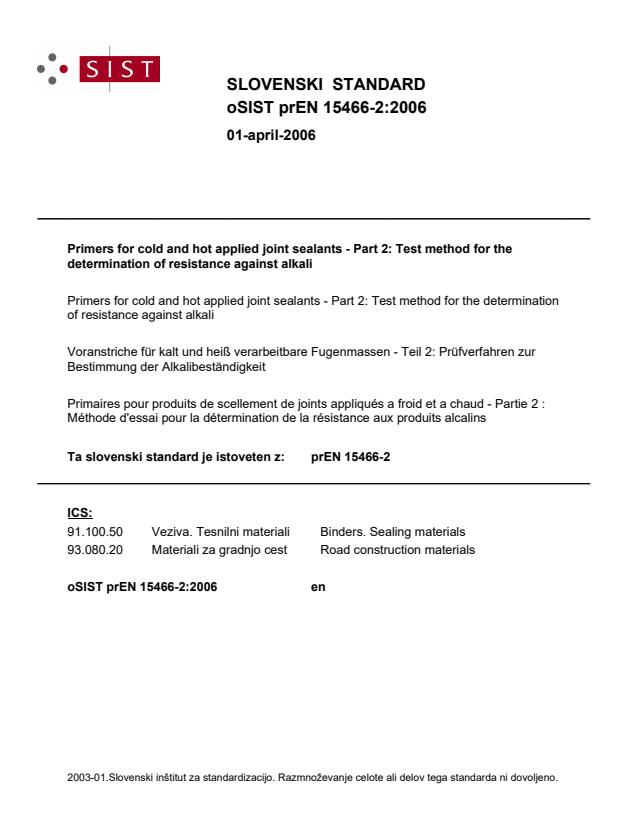
SLOVENSKI STANDARD
01-april-2006
Primers for cold and hot applied joint sealants - Part 2: Test method for the
determination of resistance against alkali
Primers for cold and hot applied joint sealants - Part 2: Test method for the determination
of resistance against alkali
Voranstriche für kalt und heiß verarbeitbare Fugenmassen - Teil 2: Prüfverfahren zur
Bestimmung der Alkalibeständigkeit
Primaires pour produits de scellement de joints appliqués a froid et a chaud - Partie 2 :
Méthode d'essai pour la détermination de la résistance aux produits alcalins
Ta slovenski standard je istoveten z: prEN 15466-2
ICS:
91.100.50 Veziva. Tesnilni materiali Binders. Sealing materials
93.080.20 Materiali za gradnjo cest Road construction materials
2003-01.Slovenski inštitut za standardizacijo. Razmnoževanje celote ali delov tega standarda ni dovoljeno.
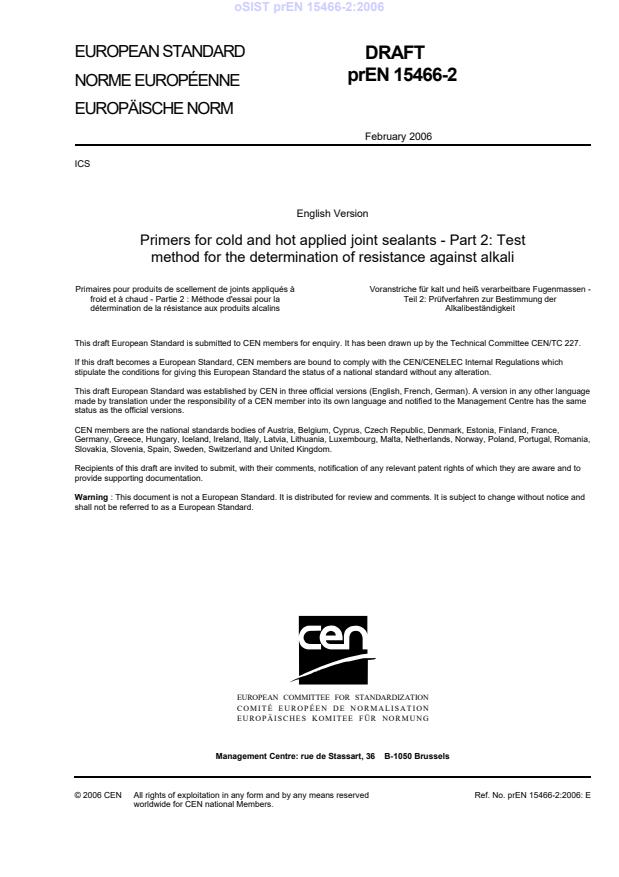
EUROPEAN STANDARD
DRAFT
NORME EUROPÉENNE
EUROPÄISCHE NORM
February 2006
ICS
English Version
Primers for cold and hot applied joint sealants - Part 2: Test
method for the determination of resistance against alkali
Primaires pour produits de scellement de joints appliqués à Voranstriche für kalt und heiß verarbeitbare Fugenmassen -
froid et à chaud - Partie 2 : Méthode d'essai pour la Teil 2: Prüfverfahren zur Bestimmung der
détermination de la résistance aux produits alcalins Alkalibeständigkeit
This draft European Standard is submitted to CEN members for enquiry. It has been drawn up by the Technical Committee CEN/TC 227.
If this draft becomes a European Standard, CEN members are bound to comply with the CEN/CENELEC Internal Regulations which
stipulate the conditions for giving this European Standard the status of a national standard without any alteration.
This draft European Standard was established by CEN in three official versions (English, French, German). A version in any other language
made by translation under the responsibility of a CEN member into its own language and notified to the Management Centre has the same
status as the official versions.
CEN members are the national standards bodies of Austria, Belgium, Cyprus, Czech Republic, Denmark, Estonia, Finland, France,
Germany, Greece, Hungary, Iceland, Ireland, Italy, Latvia, Lithuania, Luxembourg, Malta, Netherlands, Norway, Poland, Portugal, Romania,
Slovakia, Slovenia, Spain, Sweden, Switzerland and United Kingdom.
Recipients of this draft are invited to submit, with their comments, notification of any relevant patent rights of which they are aware and to
provide supporting documentation.
Warning : This document is not a European Standard. It is distributed for review and comments. It is subject to change without notice and
shall not be referred to as a European Standard.
EUROPEAN COMMITTEE FOR STANDARDIZATION
COMITÉ EUROPÉEN DE NORMALISATION
EUROPÄISCHES KOMITEE FÜR NORMUNG
Management Centre: rue de Stassart, 36 B-1050 Brussels
© 2006 CEN All rights of exploitation in any form and by any means reserved Ref. No. prEN 15466-2:2006: E
worldwide for CEN national Members.
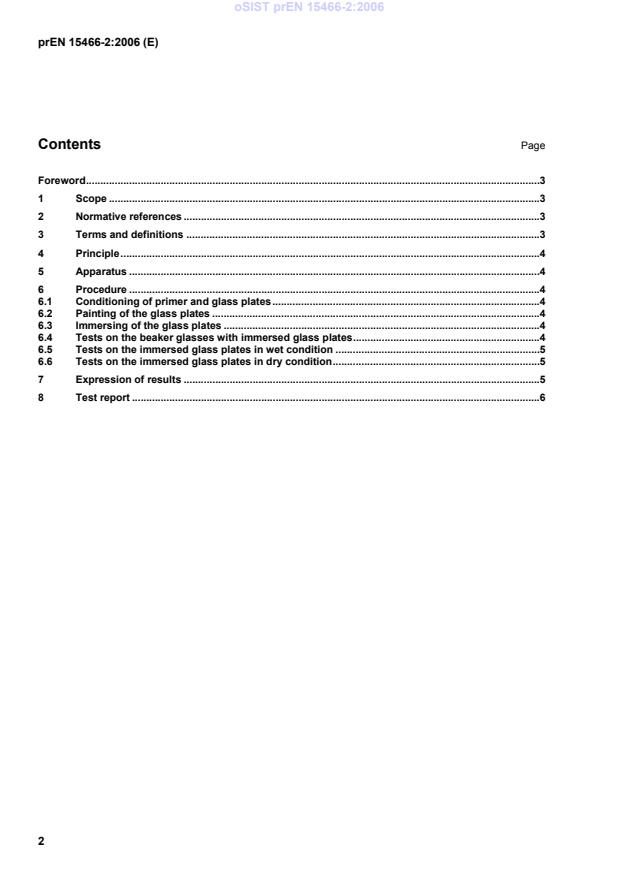
Contents Page
Foreword.3
1 Scope.3
2 Normative references.3
3 Terms and definitions .3
4 Principle.4
5 Apparatus.4
6 Procedure.4
6.1 Conditioning of primer and glass plates.4
6.2 Painting of the glass plates .4
6.3 Immersing of the glass plates .4
6.4 Tests on the beaker glasses with immersed glass plates.4
6.5 Tests on the immersed glass plates in wet condition .5
6.6 Tests on the immersed glass plates in dry condition.5
7 Expression of results.5
8 Test report.6
Foreword
This document (prEN 15466-2:2006) has been prepared by Technical Committee CEN/TC 227 “Road
materials”, the secretariat of which is held by DIN.
This document is currently submitted to the CEN Enquiry.
This European Standard is one of a series of standards as listed below:
prEN 15466-1, Primers for cold and hot applied joint sealants — Part 1: Test method for the determination
of appearance and composition
...