


oSIST prEN IEC 62541-20:2024
(Main)OPC unified architecture - Part 20: File transfer
OPC unified architecture - Part 20: File transfer
IEC 62541-20:2025 defines an Information Model. The Information Model describes the basic infrastructure to model file transfers.
NOTE In the previous version, File Transfer was in IEC 62541‑5:2020, Annex C.
OPC Unified Architecture – Teil 20: Dateiübertragung
Architecture unifiée OPC - Partie 20: Transfert de fichiers
IEC 62541-20: 2025 définit un Modèle d'information. Le Modèle d'information décrit l'infrastructure de base pour modéliser les transferts de fichiers.
NOTE Dans la version précédente, le Transfert de fichiers figurait dans l'IEC 62541‑5:2020, Annexe C.
Enotna arhitektura OPC - 20. del: Prenos datotek
General Information
- Status
- Not Published
- Public Enquiry End Date
- 30-Mar-2024
- Technical Committee
- MOV - Measuring equipment for electromagnetic quantities
- Current Stage
- 4020 - Public enquire (PE) (Adopted Project)
- Start Date
- 30-Jan-2024
- Due Date
- 18-Jun-2024
- Completion Date
- 05-Apr-2024
Overview
The oSIST prEN IEC 62541-20:2024 standard defines the OPC Unified Architecture (OPC UA) Information Model specifically for file transfer operations within industrial and IT systems. It provides a structured framework to represent files and file systems seamlessly in OPC UA, supporting secure, efficient, and reliable file handling in automation and enterprise environments. This standard replaces the earlier approach to file transfer from IEC 62541-5:2020, Annex C, reflecting evolving requirements for file interaction and transfer protocols.
Key to this model is the FileType ObjectType, which represents individual files with methods for controlled access to file operations, maintaining concurrency safety, and mitigating message size constraints typical in OPC UA communications. Additionally, the model supports comprehensive file system representation via FileDirectoryType, enabling manipulation of directories and files.
oSIST prEN IEC 62541-20:2024 targets industrial process measurement and control (ICS 25.040.40) as well as IT solutions in industry (ICS 35.240.50), emphasizing integration and interoperability within enterprise systems.
Key Topics
FileType ObjectType
- Represents files as objects with defined lifecycle independent from physical storage.
- Methods include Open, Close, Read, Write, GetPosition, and SetPosition to facilitate precise file operations.
- Supports partial file access to address OPC UA message size and security concerns such as denial-of-service attacks.
FileDirectoryType and FileSystem Modeling
- Defines file directories and entire or partial file systems within the OPC UA AddressSpace.
- Allows creation, deletion, and movement of files and directories through standardized methods.
- The root directory is represented by a FileDirectoryType instance with the BrowseName "FileSystem".
TemporaryFileTransferType
- Designed for use cases involving transient files such as configuration files or firmware updates.
- Includes handshake mechanisms for preparing files for read or write operations.
- Enforces a state machine for managing file transfer sequences securely and deterministically.
Security and Performance Considerations
- The model addresses concurrency issues inherent in byte string array access.
- Limits message sizes during file access to enhance system stability.
- Provides a robust infrastructure to ensure file transfer integrity over industrial networks.
Applications
Industrial Automation Systems
The standard facilitates file exchanges between machine controllers, HMIs, and supervisory systems, essential for firmware updates, configuration file management, and logging.Enterprise IT Integration
Streamlines file handling across diverse IT applications and industrial enterprise systems, supporting smooth data exchange and interoperability.Remote Maintenance and Diagnostics
Enables secure file transfer protocols for remote troubleshooting and software patching without compromising system availability.Firmware and Software Deployment
Supports reliable delivery of firmware binaries for devices and control systems, ensuring transactional safety and integrity during updates.Data Logging and Analysis
Allows controlled access to log files and historical data repositories, enabling analysts to retrieve chunks of data safely and efficiently.
Related Standards
IEC 62541-1: OPC Unified Architecture – Overview and Concepts
Provides foundational OPC UA principles, terminology, and architectural concepts applied in file transfer modeling.IEC 62541-3: OPC Unified Architecture – Address Space Model
Defines the general structure of the OPC UA information model, on which the file transfer objects and types are based.IEC 62541-4: OPC Unified Architecture – Services
Details the services for communication and method invocation used by the FileType and FileDirectoryType methods.IEC 62541-5: OPC Unified Architecture – Information Model
Outlines structures and semantics of OPC UA information models; earlier versions contained file transfer annexes.
By implementing oSIST prEN IEC 62541-20:2024, organizations can achieve standardized, secure, and interoperable file transfer capabilities within OPC UA environments, enhancing automation integration and industrial data workflows. This ensures resilience against security threats and supports efficient file management in complex control and industrial IT systems.

Frequently Asked Questions
oSIST prEN IEC 62541-20:2024 is a draft published by the Slovenian Institute for Standardization (SIST). Its full title is "OPC unified architecture - Part 20: File transfer". This standard covers: IEC 62541-20:2025 defines an Information Model. The Information Model describes the basic infrastructure to model file transfers. NOTE In the previous version, File Transfer was in IEC 62541‑5:2020, Annex C.
IEC 62541-20:2025 defines an Information Model. The Information Model describes the basic infrastructure to model file transfers. NOTE In the previous version, File Transfer was in IEC 62541‑5:2020, Annex C.
oSIST prEN IEC 62541-20:2024 is classified under the following ICS (International Classification for Standards) categories: 25.040 - Industrial automation systems; 25.040.40 - Industrial process measurement and control; 35.240.50 - IT applications in industry. The ICS classification helps identify the subject area and facilitates finding related standards.
oSIST prEN IEC 62541-20:2024 is available in PDF format for immediate download after purchase. The document can be added to your cart and obtained through the secure checkout process. Digital delivery ensures instant access to the complete standard document.
Standards Content (Sample)
SLOVENSKI STANDARD
01-marec-2024
Enotna arhitektura OPC - 20. del: Prenos datotek
OPC unified architecture - Part 20: File transfer
Ta slovenski standard je istoveten z: prEN IEC 62541-20:2024
ICS:
25.040.40 Merjenje in krmiljenje Industrial process
industrijskih postopkov measurement and control
35.240.50 Uporabniške rešitve IT v IT applications in industry
industriji
2003-01.Slovenski inštitut za standardizacijo. Razmnoževanje celote ali delov tega standarda ni dovoljeno.
65E/1045/CDV
COMMITTEE DRAFT FOR VOTE (CDV)
PROJECT NUMBER:
IEC 62541-20 ED1
DATE OF CIRCULATION: CLOSING DATE FOR VOTING:
2024-01-26 2024-04-19
SUPERSEDES DOCUMENTS:
65E/955/NP, 65E/1015/RVN
IEC SC 65E : DEVICES AND INTEGRATION IN ENTERPRISE SYSTEMS
SECRETARIAT: SECRETARY:
United States of America Mr Donald (Bob) Lattimer
OF INTEREST TO THE FOLLOWING COMMITTEES: PROPOSED HORIZONTAL STANDARD:
Other TC/SCs are requested to indicate their interest, if any,
in this CDV to the secretary.
FUNCTIONS CONCERNED:
EMC ENVIRONMENT QUALITY ASSURANCE SAFETY
SUBMITTED FOR CENELEC PARALLEL VOTING NOT SUBMITTED FOR CENELEC PARALLEL VOTING
Attention IEC-CENELEC parallel voting
The attention of IEC National Committees, members of
CENELEC, is drawn to the fact that this Committee Draft for
Vote (CDV) is submitted for parallel voting.
The CENELEC members are invited to vote through the
CENELEC online voting system.
This document is still under study and subject to change. It should not be used for reference purposes.
Recipients of this document are invited to submit, with their comments, notification of any relevant patent rights of which
they are aware and to provide supporting documentation.
Recipients of this document are invited to submit, with their comments, notification of any relevant “In Some Countries”
clauses to be included should this proposal proceed. Recipients are reminded that the CDV stage is the final stage for
submitting ISC clauses. (SEE AC/22/2007 OR NEW GUIDANCE DOC).
TITLE:
OPC Unified Architecture – Part 20: File Transfer
PROPOSED STABILITY DATE: 2026
NOTE FROM TC/SC OFFICERS:
electronic file, to make a copy and to print out the content for the sole purpose of preparing National Committee positions.
You may not copy or "mirror" the file or printed version of the document, or any part of it, for any other purpose without
permission in writing from IEC.
IEC CDV 62541-20 © IEC 2023
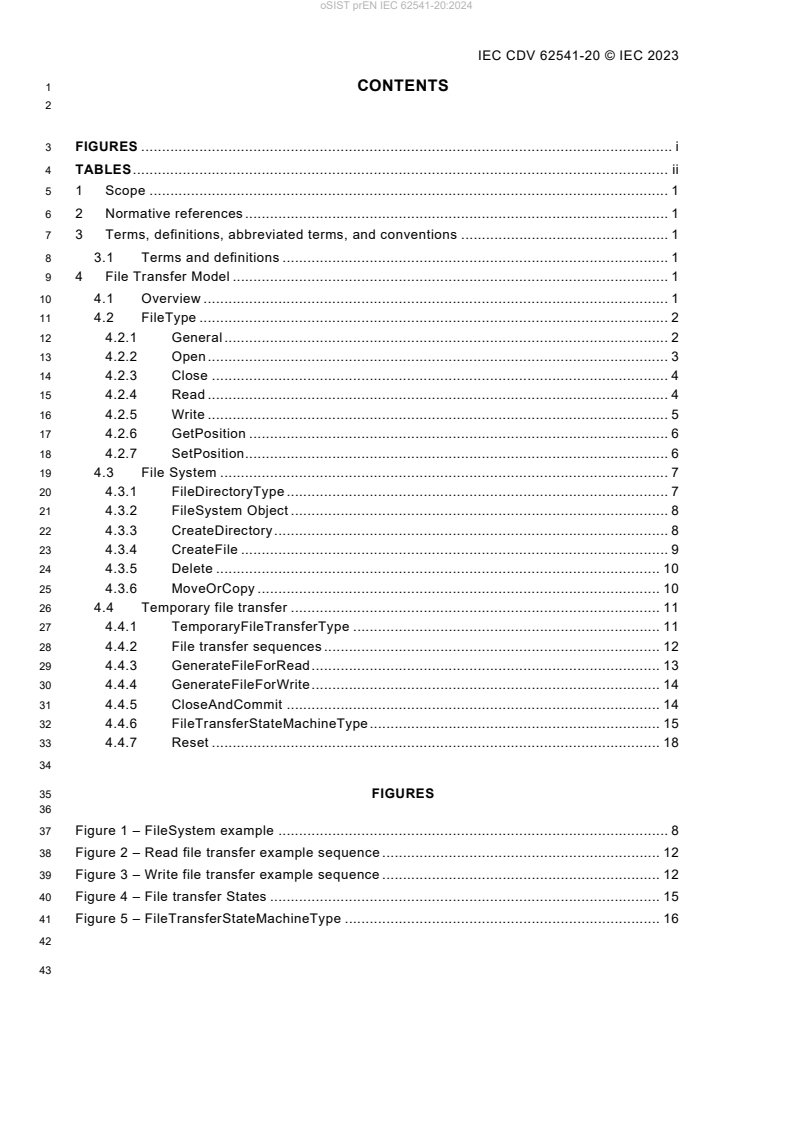
1 CONTENTS
3 FIGURES . i
4 TABLES . ii
5 1 Scope . 1
6 2 Normative references . 1
7 3 Terms, definitions, abbreviated terms, and conventions . 1
8 3.1 Terms and definitions . 1
9 4 File Transfer Model . 1
10 4.1 Overview . 1
11 4.2 FileType . 2
12 4.2.1 General . 2
13 4.2.2 Open . 3
14 4.2.3 Close . 4
15 4.2.4 Read . 4
16 4.2.5 Write . 5
17 4.2.6 GetPosition . 6
18 4.2.7 SetPosition . 6
19 4.3 File System . 7
20 4.3.1 FileDirectoryType . 7
21 4.3.2 FileSystem Object . 8
22 4.3.3 CreateDirectory . 8
23 4.3.4 CreateFile . 9
24 4.3.5 Delete . 10
25 4.3.6 MoveOrCopy . 10
26 4.4 Temporary file transfer . 11
27 4.4.1 TemporaryFileTransferType . 11
28 4.4.2 File transfer sequences . 12
29 4.4.3 GenerateFileForRead . 13
30 4.4.4 GenerateFileForWrite . 14
31 4.4.5 CloseAndCommit . 14
32 4.4.6 FileTransferStateMachineType . 15
33 4.4.7 Reset . 18
35 FIGURES
37 Figure 1 – FileSystem example . 8
38 Figure 2 – Read file transfer example sequence . 12
39 Figure 3 – Write file transfer example sequence . 12
40 Figure 4 – File transfer States . 15
41 Figure 5 – FileTransferStateMachineType . 16
IEC CDV 62541-20 © IEC 2023 ii
44 TABLES
46 Table 1 – FileType. 2
47 Table 2 – Open Method AddressSpace definition . 4
48 Table 3 – Close Method AddressSpace definition . 4
49 Table 4 – Read Method AddressSpace definition . 5
50 Table 5 – Write Method AddressSpace definition . 6
51 Table 6 – GetPosition Method AddressSpace definition . 6
52 Table 7 – SetPosition Method AddressSpace definition . 7
53 Table 8 – FileDirectoryType . 7
54 Table 9 – CreateDirectory Method AddressSpace definition . 9
55 Table 10 – CreateFile Method AddressSpace definition . 9
56 Table 11 – Delete Method AddressSpace definition . 10
57 Table 12 – MoveOrCopy Method AddressSpace definition . 11
58 Table 13 – TemporaryFileTransferType . 11
59 Table 14 – GenerateFileForRead Method AddressSpace definition . 13
60 Table 15 – GenerateFileForWrite Method AddressSpace definition . 14
61 Table 16 – CloseAndCommit Method AddressSpace definition . 15
62 Table 17 – FileTransferStateMachineType. 16
63 Table 18 – FileTransferStateMachineType Attribute values for child Nodes . 17
64 Table 19 – FileTransferStateMachineType Additional References . 17
65 Table 20 – Reset Method AddressSpace definition . 18
iii IEC CDV 62541-20 © IEC 2023
67 INTERNATIONAL ELECTROTECHNICAL COMMISSION
68 ____________
70 OPC UNIFIED ARCHITECTURE –
72 Part 20: File Transfer
74 FOREWORD
75 1) The International Electrotechnical Commission (IEC) is a worldwide organization for standardization comprising all national
76 electrotechnical committees (IEC National Committees). The object of IEC is to promote international co-operation on all
77 questions concerning standardization in the electrical and electronic fields. To this end and in addition to other activities,
78 IEC publishes International Standards, Technical Specifications, Technical Reports, Publicly Available Specifications (PAS)
79 and Guides (hereafter referred to as “IEC Publication(s)”). Their preparation is entrusted to technical committees; any IEC
80 National Committee interested in the subject dealt with may participate in this preparatory work. International, governmental
81 and non-governmental organizations liaising with the IEC also participate in this preparation. IEC collaborates closely with
82 the International Organization for Standardization (ISO) in accordance with conditions determined by agreement between
83 the two organizations.
84 2) The formal decisions or agreements of IEC on technical matters express, as nearly as possible, an international consensus
85 of opinion on the relevant subjects since each technical committee has representation from all interested IEC National
86 Committees.
87 3) IEC Publications have the form of recommendations for international use and are accepted by IEC National Committees in
88 that sense. While all reasonable efforts are made to ensure that the technical content of IEC Publications is accurate, IEC
89 cannot be held responsible for the way in which they are used or for any misinterpretation by any end user.
90 4) In order to promote international uniformity, IEC National Committees undertake to apply IEC Publications transparently to
91 the maximum extent possible in their national and regional publications. Any divergence between any IEC Publication and
92 the corresponding national or regional publication shall be clearly indicated in the latter.
93 5) IEC itself does not provide any attestation of conformity. Independent certification bodies provide conformity assessment
94 services and, in some areas, access to IEC marks of conformity. IEC is not responsible for any services carried out by
95 independent certification bodies.
96 6) All users should ensure that they have the latest edition of this publication.
97 7) No liability shall attach to IEC or its directors, employees, servants or agents including individual experts and members of
98 its technical committees and IEC National Committees for any personal injury, property damage or other damage of any
99 nature whatsoever, whether direct or indirect, or for costs (including legal fees) and expenses arising out of the publication,
100 use of, or reliance upon, this IEC Publication or any other IEC Publications.
101 8) Attention is drawn to the Normative references cited in this publication. Use of the referenced publications is indispensable
102 for the correct application of this publication.
103 9) Attention is drawn to the possibility that some of the elements of this IEC Publication may be the subject of patent rights.
104 IEC shall not be held responsible for identifying any or all such patent rights.
105 The main task of IEC technical committees is to prepare International Standards. However, a technical
106 committee may propose the publication of a technical report when it has collected data of a different
107 kind from that which is normally published as an International Standard, for example "state of the art".
108 International Standard IEC 62541-20 has been prepared by subcommittee 65E: Devices and integration
109 in enterprise systems, of IEC technical committee 65: Industrial-process measurement, control and
110 automation.
111 The text of this international standard is based on the following documents:
CDV Report on voting
65E/XX/CDV 65E/XX/RVC
113 Full information on the voting for the approval of this international standard can be found in the report
114 on voting indicated in the above table.
115 This publication has been drafted in accordance with the ISO/IEC Directives, Part 2.
116 Throughout this document and the other Parts of the series, certain document conventions are used:
IEC CDV 62541-20 © IEC 2023 iv
117 Italics are used to denote a defined term or definition that appears in the “Terms and definition” clause
118 in one of the parts of the series.
119 Italics are also used to denote the name of a service input or output parameter or the name of a structure
120 or element of a structure that are usually defined in tables.
121 The italicized terms and names are also often written in camel-case (the practice of writing compound
122 words or phrases in which the elements are joined without spaces, with each element's initial letter
123 capitalized within the compound). For example, the defined term is AddressSpace instead of Address
124 Space. This makes it easier to understand that there is a single definition for AddressSpace, not
125 separate definitions for Address and Space.
126 A list of all parts of the IEC 62541 series is included in IEC 62541-1 clause 4 Structure of the OPC UA
127 series and published under the general title OPC Unified Architecture, can be found on the IEC website.
128 The committee has decided that the contents of this publication will remain unchanged until the stability
129 date indicated on the IEC web site under "http://webstore.iec.ch" in the data related to the specific
130 publication. At this date, the publication will be
131 • reconfirmed,
132 • withdrawn,
133 • replaced by a revised edition, or
134 • amended.
136 A bilingual version of this publication may be issued at a later date.
IMPORTANT – The 'colour inside' logo on the cover page of this publication indicates
that it contains colours which are considered to be useful for the correct understanding
of its contents. Users should therefore print this document using a colour printer.
IEC CDV 62541-20 © IEC 2023 1
142 OPC Unified Architecture Specification
144 Part 20: File Transfer
148 1 Scope
149 This part of the OPC Unified Architecture defines an Information Model. The Information Model
150 describes the basic infrastructure to model file transfers.
151 Note: In the previous version, File Transfer was in IEC 62541-5, Annex C
152 2 Normative references
153 The following documents, in whole or in part, are normatively referenced in this document and
154 are indispensable for its application. For dated references, only the edition cited applies. For
155 undated references, the latest edition of the referenced document (including any amendments
156 and errata) applies.
157 IEC 62541-1, OPC Unified Architecture – Part 1: Overview and Concepts
158 IEC 62541-3, OPC Unified Architecture – Part 3: Address Space Model
159 IEC 62541-4, OPC Unified Architecture – Part 4: Services
160 IEC 62541-5, OPC Unified Architecture – Part 5: Information Model
162 3 Terms, definitions, abbreviated terms, and conventions
163 3.1 Terms and definitions
164 For the purposes of this document, the terms and definitions given in IEC 62541-1, IEC 62541-
165 3 and IEC 62541-5 apply.
167 4 File Transfer Model
168 4.1 Overview
169 This document describes an information model for file transfer. Files could be modelled in OPC
170 UA as simple Variables using ByteStrings. However, the overall message size in OPC UA is
171 limited due to resources and security issues (denial of service attacks). Only accessing parts
172 of the array can lead to concurrency issues if one client is reading the array while others are
173 manipulating it. Therefore, the ObjectType FileType is defined representing a file with Methods
174 to access the file. The life-cycle of a file stored on a hard disk and an instance of the FileType
175 representing the file in an OPC UA AddressSpace can be independent.
176 In addition to representing individual files this document also defines a way to represent a whole
177 file system or a part of a file system. This can be done using the FileDirectoryType in
178 combination with the FileType. The FileDirectoryType provides Methods to create, delete, and
179 move files and directories. The root of a file system or part of a file system is represented by
180 an instance of the FileDirectoryType with the BrowseName FileSystem. All directories below
181 the root directory are represented by instances of the FileDirectoryType or a subtype. All files
182 below the root directory are represented by instances of the FileType or a subtype.
2 IEC CDV 62541-20 © IEC 2023
183 In different situations like transfer of configuration files or firmware update, the files are
184 temporary, and an additional handshake is necessary to create the file for reading or to apply
185 the file after writing it to the server. This use case is covered by the TemporaryFileTransferType
186 defined in this document.
187 4.2 FileType
188 4.2.1 General
189 This ObjectType defines a type for files. It is formally defined in Table 1.
190 Table 1 – FileType
Attribute Value
BrowseName FileType
IsAbstract False
Modelling
References NodeClass BrowseName DataType TypeDefinition
Rule
Subtype of the BaseObjectType defined in IEC 62541-5
HasProperty Variable Size UInt64 PropertyType Mandatory
HasProperty Variable Writable Boolean PropertyType Mandatory
HasProperty Variable UserWritable Boolean PropertyType Mandatory
HasProperty Variable OpenCount UInt16 PropertyType Mandatory
HasProperty Variable MimeType String PropertyType Optional
HasComponent Method Open Defined in 4.2.2 Mandatory
HasComponent Method Close Defined in 4.2.3 Mandatory
HasComponent Method Read Defined in 4.2.4 Mandatory
HasComponent Method Write Defined in 4.2.5 Mandatory
HasComponent Method GetPosition Defined in 4.2.6 Mandatory
HasComponent Method SetPosition Defined in 4.2.7 Mandatory
HasProperty Variable MaxByteStringLength UInt32 PropertyType Optional
HasProperty Variable LastModifiedTime DateTime PropertyType Optional
Conformance Units
Base Info FileType Base
192 Size defines the size of the file in Bytes. When a file is opened for write, the size might not be
193 accurate. If the Server can not accurately determine the size of the file, the Size Property shall
194 be returned to a Client with a StatusCode of Bad_NotSupported.
195 Writable indicates whether the file is writable. It does not take any user access rights into
196 account, i.e., although the file is writable this may be restricted to a certain user / user group.
197 The Property does not consider whether the file is currently opened for writing by another client
198 and thus currently locked and not writable by others.
199 UserWritable indicates whether the file is writable taking user access rights into account. The
200 Property does not consider whether the file is currently opened for writing by another client and
201 thus currently locked and not writable by others.
202 OpenCount indicates the number of currently valid file handles on the file.
203 The optional Property MimeType contains the media type of the file based on RFC 2046.
204 Note that all Methods on a file require a fileHandle, which is returned in the Open Method.
205 The optional MaxByteStringLength Property indicates the maximum number of bytes of the read
206 and write buffers. If this Property is not present then the maximum size is defined by the
207 MaxByteStringLength Property of the ServerCapabilitiesType defined in IEC 62541-5.
208 The optional LastModifiedTime Property indicates the time the file was last modified. The
209 Property shall be updated whenever the Server detects that the file has changed.
IEC CDV 62541-20 © IEC 2023 3
210 4.2.2 Open
211 Open is used to open a file represented by an Object of FileType. When a client opens a file it
212 gets a file handle that is valid while the session is open. Clients shall use the Close Method to
213 release the handle when they do not need access to the file anymore. Clients can open the
214 same file several times for read. A request to open for writing shall return Bad_NotWritable
215 when the file is already opened. A request to open for reading shall return Bad_NotReadable
216 when the file is already opened for writing.
217 Signature
218 Open(
219 [in] Byte mode
220 [out] UInt32 fileHandle
221 );
Argument Description
mode Indicates whether the file should be opened only for read operations or for read and
write operations and where the initial position is set.
The mode is an 8-bit unsigned integer used as bit mask with the structure defined in the
following table:
Field Bit Description
Read 0 The file is opened for reading. If this bit is not set the
Read Method cannot be executed.
Write 1 The file is opened for writing. If this bit is not set the
Write Method cannot be executed.
EraseExisting 2 This bit can only be set if the file is opened for writing
(Write bit is set). The existing content of the file is
erased and an empty file is provided.
Append 3 When the Append bit is set the file is opened at end
of the file, otherwise at begin of the file. The
SetPosition Method can be used to change the
position.
Reserved 4:7 Reserved for future use. Shall always be zero.
fileHandle A handle for the file used in other method calls indicating not the file (this is done by the
Object of the Method call) but the access request and thus the position in the file. The
fileHandle is generated by the server and is unique for the Session. Clients cannot
transfer the fileHandle to another Session but need to get a new fileHandle by calling
the Open Method.
224 Method Result Codes (defined in Call Service)
Result Code Description
Bad_NotReadable See IEC 62541-4 for a general description. File might be locked and thus not readable.
Bad_NotWritable See IEC 62541-4 for a general description.
Bad_InvalidState See IEC 62541-4 for a general description. The file is locked and thus not writable.
Bad_InvalidArgument See IEC 62541-4 for a general description. Mode setting is invalid.
Bad_NotFound See IEC 62541-4 for a general description.
Bad_UnexpectedError See IEC 62541-4 for a general description.
4 IEC CDV 62541-20 © IEC 2023
226 Table 2 specifies the AddressSpace representation for the Open Method.
227 Table 2 – Open Method AddressSpace definition
Attribute Value
BrowseName Open
References NodeClass BrowseName DataType TypeDefinition ModellingRul
e
HasProperty Variable InputArguments Argument[] PropertyType Mandatory
HasProperty Variable OutputArguments Argument[] PropertyType Mandatory
Conformance Units
Base Info FileType Base
229 4.2.3 Close
230 Close is used to close a file represented by a FileType. When a client closes a file, the handle
231 becomes invalid.
232 Signature
233 Close(
234 [in] UInt32 fileHandle
235 );
Argument Description
fileHandle A handle indicating the access request and thus indirectly the position inside the file.
238 Method Result Codes (defined in Call Service)
Result Code Description
Bad_InvalidArgument See IEC 62541-4 for a general description. Invalid file handle in call.
240 Table 3 specifies the AddressSpace representation for the Close Method.
241 Table 3 – Close Method AddressSpace definition
Attribute Value
BrowseName Close
References NodeClass BrowseName DataType TypeDefinition ModellingRule
HasProperty Variable InputArguments Argument[] PropertyType Mandatory
Conformance Units
Base Info FileType Base
243 4.2.4 Read
244 Read is used to read a part of the file starting from the current file position. The file position is
245 advanced by the number of bytes read.
246 Signature
247 Read(
248 [in] UInt32 fileHandle
249 [in] Int32 length
250 [out] ByteString data
251 );
IEC CDV 62541-20 © IEC 2023 5
Argument Description
fileHandle A handle indicating the access request and thus indirectly the position inside the file.
Length Defines the length in bytes that should be returned in data, starting from the current
position of the file handle. If the end of file is reached all data until the end of the file is
returned. The Server is allowed to return less data than specified length.
Only positive values are allowed.
Data Contains the returned data of the file. If the ByteString is empty it indicates that the end
of the file is reached.
254 Method Result Codes (defined in Call Service)
Result Code Description
Bad_InvalidArgument See IEC 62541-4 Invalid file handle in call or non-positive length.
Bad_UnexpectedError See IEC 62541-4 for a general description.
Bad_InvalidState See IEC 62541-4 for a general description. File was not opened for read access.
256 Table 4 specifies the AddressSpace representation for the Read Method.
257 Table 4 – Read Method AddressSpace definition
Attribute Value
BrowseName Read
References NodeClass BrowseName DataType TypeDefinition ModellingRule
HasProperty Variable InputArguments Argument[] PropertyType Mandatory
HasProperty Variable OutputArguments Argument[] PropertyType Mandatory
Conformance Units
Base Info FileType Base
259 4.2.5 Write
260 Write is used to write a part of the file starting from the current file position. The file position is
261 advance
...
Questions, Comments and Discussion
Ask us and Technical Secretary will try to provide an answer. You can facilitate discussion about the standard in here.
Loading comments...