

oSIST prEN 3197:2025
(Main)Aerospace series - Design and installation of aircraft electrical and optical interconnection systems
General Information
- Abstract
This document provides instructions on the methods to be used when designing, selecting, manufacturing, installing, repairing or modifying the aircraft electrical and optical interconnection networks, also called Electrical Wiring Interconnection System (EWIS), and Optical fibre Interconnection Systems (OFIS), subject to the following limitations:
- It is recognized that the installation practices contained in this document do not necessarily represent the full requirements for a safe and satisfactory electrical and fibre optic interconnection system.
- In the event of a conflict between the text of this document and the references cited herein, the text of this document takes precedence. However, nothing written in this document overrides the specific requirements of a Design Authority, the Airworthiness Requirements, applicable laws or any regulation from the regulatory authorities, unless a specific exemption has been obtained.
This document lists the main relevant European Standards related to EWIS and OFIS in Annex A.
- Status
- Not Published
- Public Enquiry End Date
- 09-Dec-2025
- Technical Committee
- I13 - Imaginarni 13
- Current Stage
- 4020 - Public enquire (PE) (Adopted Project)
- Start Date
- 21-Oct-2025
- Due Date
- 10-Mar-2026
- Completion Date
- 10-Dec-2025

Overview
prEN 3197 (2025) - Aerospace series: Design and installation of aircraft electrical and optical interconnection systems - is a CEN draft European standard that updates and will supersede EN 3197:2010. It provides guidance and requirements for the design, selection, manufacture, installation, repair and modification of aircraft Electrical Wiring Interconnection Systems (EWIS) and Optical Fibre Interconnection Systems (OFIS). The standard covers architecture, parts and materials, hazards, testing, maintenance considerations and systems integration for electrical and fibre-optic networks in aerospace platforms.
Important limitations:
- Installation practices herein are not the sole requirements for a safe EWIS/OFIS.
- Where conflicts arise, the text of this document takes precedence over cited references - but it does not override Design Authority requirements, airworthiness regulations or law unless a specific exemption is granted.
Key topics and technical requirements
prEN 3197 organizes detailed technical guidance and requirements, including:
- EWIS and OFIS architecture: routing categories, segregation, grounding/earthing strategy (IT/TN networks), electrical distribution and communications.
- Design rules: service life, maintenance interfaces, composite-structure considerations and design priority.
- Parts, materials and processes: component and process qualification, environmental directives, and test methods.
- Hazard management: smoke/fire hazards, arcing events, corona effects, clearance and creepage, and fretting corrosion mitigation.
- Reliability and safety analysis: Failure Mode Effects and Analysis (FMEA) guidance and mitigation measures.
- Grounding, bonding and shielding: electrical return strategies, bonding practices and shield termination.
- Component selection: cables (electrical and fibre), connectors, protective devices (circuit breakers, arc-fault protection), switching devices, and special cable types.
- Installation and maintenance: routing rules for fuel tanks, cabin harnesses, EFCS, and requirements for repair/modification.
The standard also lists the main related European standards in Annex A and specifies normative references.
Practical applications and who uses this standard
prEN 3197 is aimed at professionals responsible for electrical and optical interconnections in aircraft:
- Aerospace design engineers and system architects
- Wiring harness designers and manufacturers
- Installation technicians and maintenance, repair & overhaul (MRO) organizations
- OEMs and subcontractors for avionics and electrical systems
- Certification and compliance teams, and regulators (for harmonized guidance)
Typical uses include EWIS/OFIS system design, component selection, installation planning, safety analyses (FMEA), maintenance planning, and preparation for certification reviews.
Related standards
- prEN 3197 will supersede EN 3197:2010 and references a set of European standards listed in its Annex A (see the standard for the full normative list).
Keywords: prEN 3197, EWIS, OFIS, aircraft wiring, optical fibre interconnection, grounding, bonding, shielding, FMEA, aerospace standard.
Relations
- Effective Date
- 26-Feb-2025
Get Certified
Connect with accredited certification bodies for this standard

BUREAU VERITAS Certification Germany
Bureau Veritas certification in Germany.

Element Materials Technology
Materials testing and product certification.

AQMS Ltd.
AQMS provides ISO certification to SMEs across the UK.
Sponsored listings
Frequently Asked Questions
oSIST prEN 3197:2025 is a draft published by the Slovenian Institute for Standardization (SIST). Its full title is "Aerospace series - Design and installation of aircraft electrical and optical interconnection systems". This standard covers: This document provides instructions on the methods to be used when designing, selecting, manufacturing, installing, repairing or modifying the aircraft electrical and optical interconnection networks, also called Electrical Wiring Interconnection System (EWIS), and Optical fibre Interconnection Systems (OFIS), subject to the following limitations: - It is recognized that the installation practices contained in this document do not necessarily represent the full requirements for a safe and satisfactory electrical and fibre optic interconnection system. - In the event of a conflict between the text of this document and the references cited herein, the text of this document takes precedence. However, nothing written in this document overrides the specific requirements of a Design Authority, the Airworthiness Requirements, applicable laws or any regulation from the regulatory authorities, unless a specific exemption has been obtained. This document lists the main relevant European Standards related to EWIS and OFIS in Annex A.
This document provides instructions on the methods to be used when designing, selecting, manufacturing, installing, repairing or modifying the aircraft electrical and optical interconnection networks, also called Electrical Wiring Interconnection System (EWIS), and Optical fibre Interconnection Systems (OFIS), subject to the following limitations: - It is recognized that the installation practices contained in this document do not necessarily represent the full requirements for a safe and satisfactory electrical and fibre optic interconnection system. - In the event of a conflict between the text of this document and the references cited herein, the text of this document takes precedence. However, nothing written in this document overrides the specific requirements of a Design Authority, the Airworthiness Requirements, applicable laws or any regulation from the regulatory authorities, unless a specific exemption has been obtained. This document lists the main relevant European Standards related to EWIS and OFIS in Annex A.
oSIST prEN 3197:2025 is classified under the following ICS (International Classification for Standards) categories: 49.060 - Aerospace electric equipment and systems; 49.090 - On-board equipment and instruments. The ICS classification helps identify the subject area and facilitates finding related standards.
oSIST prEN 3197:2025 has the following relationships with other standards: It is inter standard links to SIST EN 3197:2011. Understanding these relationships helps ensure you are using the most current and applicable version of the standard.
oSIST prEN 3197:2025 is available in PDF format for immediate download after purchase. The document can be added to your cart and obtained through the secure checkout process. Digital delivery ensures instant access to the complete standard document.
Standards Content (Sample)
SLOVENSKI STANDARD
01-december-2025
Aeronavtika - Načrtovanje in vgradnja letalskih električnih in optičnih sistemov za
medsebojno povezovanje
Aerospace series - Design and installation of aircraft electrical and optical
interconnection systems
Luft- und Raumfahrt - Konstruktion und Installation elektrischer und optischer
Verkabelung in Luftfahrzeugen
Série Aérospatiale - Conception et installation des organes de raccordements
électriques et à fibres optiques sur avions
Ta slovenski standard je istoveten z: prEN 3197
ICS:
49.060 Letalska in vesoljska Aerospace electric
električna oprema in sistemi equipment and systems
49.090 Oprema in instrumenti v On-board equipment and
zračnih in vesoljskih plovilih instruments
2003-01.Slovenski inštitut za standardizacijo. Razmnoževanje celote ali delov tega standarda ni dovoljeno.
DRAFT
EUROPEAN STANDARD
NORME EUROPÉENNE
EUROPÄISCHE NORM
September 2025
ICS 49.060; 49.090 Will supersede EN 3197:2010
English Version
Aerospace series - Design and installation of aircraft
electrical and optical interconnection systems
Série Aérospatiale - Conception et installation des Luft- und Raumfahrt - Konstruktion und Installation
organes de raccordements électriques et à fibres elektrischer und optischer Verkabelung in
optiques sur avions Luftfahrzeugen
This draft European Standard is submitted to CEN members for enquiry. It has been drawn up by the Technical Committee ASD-
STAN.
If this draft becomes a European Standard, CEN members are bound to comply with the CEN/CENELEC Internal Regulations
which stipulate the conditions for giving this European Standard the status of a national standard without any alteration.
This draft European Standard was established by CEN in three official versions (English, French, German). A version in any other
language made by translation under the responsibility of a CEN member into its own language and notified to the CEN-CENELEC
Management Centre has the same status as the official versions.
CEN members are the national standards bodies of Austria, Belgium, Bulgaria, Croatia, Cyprus, Czech Republic, Denmark, Estonia,
Finland, France, Germany, Greece, Hungary, Iceland, Ireland, Italy, Latvia, Lithuania, Luxembourg, Malta, Netherlands, Norway,
Poland, Portugal, Republic of North Macedonia, Romania, Serbia, Slovakia, Slovenia, Spain, Sweden, Switzerland, Türkiye and
United Kingdom.
Recipients of this draft are invited to submit, with their comments, notification of any relevant patent rights of which they are
aware and to provide supporting documentation.
Warning : This document is not a European Standard. It is distributed for review and comments. It is subject to change without
notice and shall not be referred to as a European Standard.
EUROPEAN COMMITTEE FOR STANDARDIZATION
COMITÉ EUROPÉEN DE NORMALISATION
EUROPÄISCHES KOMITEE FÜR NORMUNG
CEN-CENELEC Management Centre: Rue de la Science 23, B-1040 Brussels
© 2025 CEN All rights of exploitation in any form and by any means reserved Ref. No. prEN 3197:2025 E
worldwide for CEN national Members.
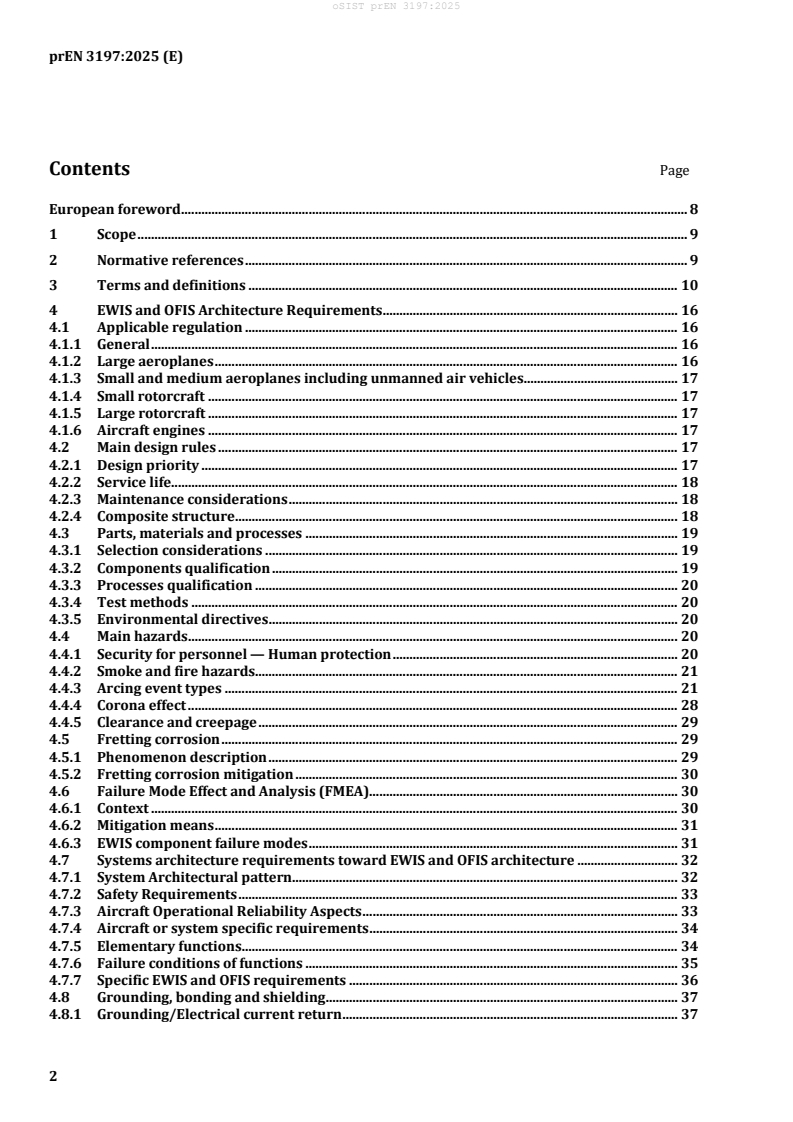
Contents Page
European foreword . 8
1 Scope . 9
2 Normative references . 9
3 Terms and definitions . 10
4 EWIS and OFIS Architecture Requirements . 16
4.1 Applicable regulation . 16
4.1.1 General . 16
4.1.2 Large aeroplanes . 16
4.1.3 Small and medium aeroplanes including unmanned air vehicles. 17
4.1.4 Small rotorcraft . 17
4.1.5 Large rotorcraft . 17
4.1.6 Aircraft engines . 17
4.2 Main design rules . 17
4.2.1 Design priority . 17
4.2.2 Service life . 18
4.2.3 Maintenance considerations . 18
4.2.4 Composite structure . 18
4.3 Parts, materials and processes . 19
4.3.1 Selection considerations . 19
4.3.2 Components qualification . 19
4.3.3 Processes qualification . 20
4.3.4 Test methods . 20
4.3.5 Environmental directives . 20
4.4 Main hazards . 20
4.4.1 Security for personnel — Human protection . 20
4.4.2 Smoke and fire hazards. 21
4.4.3 Arcing event types . 21
4.4.4 Corona effect . 28
4.4.5 Clearance and creepage . 29
4.5 Fretting corrosion . 29
4.5.1 Phenomenon description . 29
4.5.2 Fretting corrosion mitigation . 30
4.6 Failure Mode Effect and Analysis (FMEA). 30
4.6.1 Context . 30
4.6.2 Mitigation means . 31
4.6.3 EWIS component failure modes . 31
4.7 Systems architecture requirements toward EWIS and OFIS architecture . 32
4.7.1 System Architectural pattern. 32
4.7.2 Safety Requirements . 33
4.7.3 Aircraft Operational Reliability Aspects . 33
4.7.4 Aircraft or system specific requirements . 34
4.7.5 Elementary functions . 34
4.7.6 Failure conditions of functions . 35
4.7.7 Specific EWIS and OFIS requirements . 36
4.8 Grounding, bonding and shielding . 37
4.8.1 Grounding/Electrical current return . 37
4.8.2 Bonding . 38
4.8.3 Shielding/Shield bonding . 40
5 EWIS and OFIS architecture segregation . 40
5.1 Purpose . 40
5.2 Route categories . 41
5.3 Electrical generation . 42
5.4 Earthing Networks/Grounding strategy (IT/TN network) . 42
5.5 Electrical distribution and communication . 43
5.5.1 Purpose . 43
5.5.2 Power supplies and data . 43
5.5.3 Essential routes . 44
5.5.4 Cabin related harnesses . 44
5.5.5 Electrical Flight Control System (EFCS) . 44
5.5.6 Fuel tank wiring . 45
5.5.7 Signal and other low power sensitive circuit . 45
5.5.8 Electro-explosive subsystems . 45
5.6 Grounding, bonding and shielding . 45
5.6.1 Grounding/Electrical current return . 45
5.6.2 Bonding . 46
5.6.3 Shielding . 46
5.7 Specific Hazard — Particular risk architectural constraint . 46
6 Components selection . 47
6.1 Applicable regulation . 47
6.2 General requirements . 47
6.2.1 Commonality . 47
6.2.2 Environment . 47
6.2.3 Maintenance, repair or modification. 48
6.2.4 Materials . 48
6.2.5 Voltage and current ratings . 49
6.3 Electrical and fibre optic cables . 49
6.3.1 General requirements . 49
6.3.2 Type of cable . 50
6.3.3 Electrical cables design . 50
6.3.4 Fireproof and fire-resistant cable (EN 2346, EN 4608) . 51
6.3.5 Fibre optic cables . 52
6.3.6 Special cable types . 53
6.4 Connectors . 54
6.4.1 Types of connectors . 54
6.4.2 Construction . 54
6.4.3 Mating and un-mating operation . 56
6.4.4 Fibre optic termini . 56
6.4.5 Cable outlet accessories . 56
6.4.6 Contact and connection voltage and current capacity . 56
6.5 Circuit protective devices . 57
6.5.1 Type of protective devices . 57
6.5.2 Electrical protection . 57
6.5.3 Circuit Breaker . 59
6.5.4 Arc Fault Circuit Interrupter . 60
6.5.5 Arc fault circuit breaker (EN 4838) . 60
6.5.6 Remote control circuit breaker . 60
6.5.7 Solid state circuit breaker . 60
6.5.8 Residual current device (RCD) . 60
6.5.9 Fuse . 60
6.6 Switching devices . 61
6.6.1 Type of switching devices . 61
6.6.2 Electrical switching . 61
6.6.3 Relays, micro-contactors and contactors . 62
6.7 Terminal junction systems . 63
6.7.1 Type of terminal junction systems. 63
6.7.2 Design . 64
6.7.3 Other types of modules . 64
6.8 Terminal contacts . 64
6.8.1 Type of terminal contacts. 64
6.8.2 Material and plating . 65
6.8.3 Sizing . 65
6.9 Terminal lugs . 65
6.9.1 Type of terminal lugs . 65
6.9.2 Design . 65
6.9.3 Sizing . 65
6.10 Splices . 67
6.10.1 Type of splices . 67
6.10.2 Design . 67
6.10.3 In line splice . 67
6.10.4 Gauge splice adaptation . 67
6.10.5 Sealed splice . 67
6.10.6 Screened cable splice . 67
6.10.7 Quick disconnect splice . 67
6.10.8 Closed end-splice . 68
6.10.9 Splices for fibre optic cables . 68
6.11 Solder sleeves . 68
6.11.1 Type of solder sleeves . 68
6.11.2 Design . 68
6.12 Feedthrough (pressure Bung housing assemblies) . 69
6.12.1 Type of feedthrough . 69
6.12.2 Design . 69
6.13 Clamp . 69
6.13.1 Type of clamp. 69
6.13.2 Design of “V” clamps . 70
6.13.3 Design of “P” clamps . 70
6.13.4 Selection of “Ω” clips . 70
6.14 Protective parts . 70
6.15 Identification parts . 70
6.16 Installation components . 71
6.16.1 Type of cable ties selection . 71
6.16.2 Plastic cable ties (EN 4056) . 71
6.16.3 Metallic cable ties . 71
6.16.4 Lacing tapes . 71
6.16.5 Lacing sheath . 72
6.16.6 Raceways and cable tray. 72
6.17 Separator . 72
6.18 Junction boxes . 73
6.19 Type of junction boxes . 73
7 Installation requirements . 73
7.1 Purpose . 73
7.2 Zone categories . 74
7.2.1 Zoning description . 74
7.2.2 Pressurized zones . 75
7.2.3 Un-pressurized zones . 75
7.2.4 Fluid ingress zones . 75
7.2.5 SWAMP zones . 75
7.2.6 Undercarriage bays . 76
7.2.7 Vibration zones . 76
7.2.8 Fuel tank and fuel vapour zones . 76
7.2.9 Hydraulic zones . 76
7.2.10 Hot zones . 76
7.2.11 EMI/EMH sensitives zones . 76
7.2.12 Fire zones . 77
7.2.13 Weapons systems and defensive aids systems . 77
7.3 Installation of wires, cables and bundles . 77
7.3.1 Separation Principle . 77
7.3.2 Mechanical separation: general principle . 78
7.3.3 Separation from sharp edge . 79
7.3.4 Electrical separation: general principle . 80
7.3.5 Separation by physical distances versus separation by barrier . 80
7.3.6 Harness geometry and morphology . 85
7.3.7 Conduit, sleeve and over-braiding . 96
7.3.8 Attachment to aircraft structure . 99
7.3.9 Supports . 101
7.3.10 Cable tie . 105
7.3.11 Tape . 105
7.3.12 Spare provision . 106
7.4 Installation of connection element and feedthrough . 107
7.4.1 Protection of connection . 107
7.4.2 Torquing and locking of standard electrical and fibre optic items . 108
7.4.3 Connectors and accessories . 108
7.4.4 Terminals . 113
7.4.5 Splices . 115
7.4.6 Splice installation . 115
7.4.7 Thermocouple connexion . 116
7.4.8 Feedthrough and pressure seal . 116
7.5 Equipment installation . 117
7.5.1 Positioning of electrical equipment in the aircraft considering environmental
constraints . 117
7.5.2 Installation of non-coded equipment . 118
7.5.3 Panels and Boxes . 118
7.6 Grounding (current return), bonding and shielding requirements. 119
7.6.1 Bonding and grounding . 119
7.6.2 Shielding . 119
7.6.3 HIRF . 119
7.6.4 Compass deviation . 119
7.6.5 Ignition . 120
7.7 Component manufacturing . 120
7.7.1 Cable . 120
7.7.2 Fibre optic terminations (Termini) . 120
7.7.3 Shrinkable sleeve . 121
7.7.4 Inspection — User control tests for terminals and splices (electrical) . 122
7.7.5 Solder sleeve termination installation . 123
8 EWIS high voltage . 123
8.1 High voltage AC. and DC. networks . 123
8.2 Electrical arc damage . 123
8.2.1 Arc fault strategy mitigation . 123
8.2.2 Thermal sizing . 124
8.3 Laplace forces . 124
8.3.1 Phenomenon description . 124
8.3.2 Laplace forces mitigation . 125
8.4 Partial discharge . 126
8.4.1 Phenomenon description . 126
8.4.2 Partial Discharge mitigation . 126
8.5 Space charge. 126
8.5.1 Phenomenon description . 126
8.5.2 Space charge mitigation . 127
8.6 Skin effect . 127
8.6.1 Phenomenon description . 127
8.6.2 Skin effect mitigation . 127
9 Identification . 127
9.1 General . 127
9.2 Component manufacturer marking — Part number . 128
9.2.1 Component manufacturer identification . 128
9.2.2 Alternate manufacturer identification . 128
9.2.3 Identification intervals . 128
9.2.4 Types of wire manufacturer markings . 128
9.3 Cable and wire identification . 129
9.3.1 Airframe manufacturer identification. 129
9.3.2 Identification intervals . 130
9.3.3 Types of airframe manufacturer markings . 130
9.4 FIN Identification (Functional identification number) . 130
9.5 Harness identification . 131
9.6 Route identification . 131
9.7 Phase identification . 132
9.8 Positioning of flag datum markers . 132
9.9 Other specific cases . 132
9.9.1 Fuel tank . 132
9.9.2 Visible identification of critical design configuration limitations . 132
9.10 High voltage . 133
9.11 Identification of user EWIS and OFIS modification or repair — Operators
identification coding . 133
10 Modification and repairs by supplementary type certification applicants (STC) . 134
10.1 Preliminaries . 134
10.2 Inspection/replacement/repair/modification, eventually implementation, and
finally approval . 134
10.2.1 Repair data package . 134
10.2.2 Type design data package . 134
10.2.3 Installation . 134
10.3 All EWIS and OFIS components identification . 135
10.4 Unused systems . 135
Annex A (informative) Main standards and ASD-STAN Technical Reports per family of
products . 136
A.1 Quality and general standards . 136
A.2 Wires and cables . 137
A.3 fibre optic cables, connectors and termini . 139
A.4 Connectors, contacts and termini . 140
A.5 Protective devices . 142
A.6 Switching devices. 143
A.7 Terminal junctions . 143
A.8 Terminal lugs and in-line splice .
...