

SIST EN 3745-510:2026
(Main)Aerospace series - Fibres and cables, optical, aircraft use - Test methods - Part 510: Bending test
General Information
- Abstract
This document specifies a method of determining the attenuation variation of an optical cable during mechanical bending under load at the maximum and minimum operating temperatures.
- Status
- Published
- Public Enquiry End Date
- 14-May-2024
- Publication Date
- 22-Dec-2025
- Technical Committee
- I13 - Imaginarni 13
- Current Stage
- 6060 - National Implementation/Publication (Adopted Project)
- Start Date
- 18-Dec-2025
- Due Date
- 22-Feb-2026
- Completion Date
- 23-Dec-2025

Overview
SIST EN 3745-510:2026 is a European standard developed by CEN as part of the Aerospace series, specifically focused on optical fibres and cables for aircraft use. This standard defines the bending test methods to evaluate variations in attenuation of optical cables under mechanical bending while subjected to both maximum and minimum operating temperatures. It aims to ensure the reliability and performance of optical cables used in harsh aerospace environments, where mechanical stresses and temperature extremes can affect optical signal integrity.
The standard supersedes EN 3745-510:2017 and incorporates significant editorial improvements for clarity and updates in test procedures to harmonize specimen preparation and test parameters.
Key Topics
- Purpose: Specifies test methods to measure attenuation variation during bending of aircraft-grade optical cables under load.
- Scope: Applies to optical cables used in aerospace applications; crucial for assessing cable durability and signal quality under mechanical stress.
- Test Methods:
- Method A: Rolling the cable specimen on a fixed mandrel with a defined mass, repeated for a set number of turns, measuring attenuation after bending and after a stabilization period.
- Method B: Wrapping the cable around two mandrels with a specified separation distance and load, measuring attenuation variation after bending.
- Test Conditions:
- Loads applied to ensure contact between cable and mandrel.
- Maximum and minimum operating temperatures considered for realistic performance assessment.
- Measurement Techniques: Attenuation is measured following EN 3745-301, method C using Light Launch and Detection Systems (LLS and LDS).
- Visual Examination: Conducted post-test as per EN 3745-201 to detect any physical cable damage or defects induced by bending.
- Key Test Parameters:
- Number and length of specimens
- Mandrel diameter(s)
- Number of loops or turns
- Load mass applied
- Maximum permissible attenuation variation
- Measurement wavelength(s)
Applications
- Aerospace Industry: Ensures the performance and safety of fiber optic cables used in aircraft systems, including communication, navigation, and data links where maintaining signal integrity is critical.
- Aircraft Wiring and Cabling Manufacturers: Provides standard testing protocols to validate cable designs against bending stresses encountered during installation and operation.
- Quality Assurance and Compliance: Facilitates certification and conformity assessment to meet aerospace regulatory requirements for optical cable reliability.
- Research and Development: Supports development of advanced fiber optic cables optimized for aerospace conditions by enabling standardized durability tests.
- Maintenance and Inspection: Assists in assessing cable degradation and performance after exposure to mechanical bending in service conditions.
Related Standards
- EN 3745-301: Aerospace series - Fibres and cables, optical, aircraft use - Test methods - Part 301: Attenuation measurement
- EN 3745-201: Aerospace series - Fibres and cables, optical, aircraft use - Test methods - Part 201: Visual examination
- EN 2591-100: Aerospace series - Elements of electrical and optical connection - Test methods - Part 100: General
- EN 3745-100: Aerospace series - General test methods for fibres and cables optical for aircraft use
Keywords: SIST EN 3745-510:2026, aerospace fiber optic cables, bending test, optical cable attenuation, aircraft cable testing, mechanical bending, optical fiber attenuation, cable bending under load, aerospace cabling standards, aviation fiber optic reliability, CEN aerospace standards, optical cable test methods, fiber optic cable durability, aircraft optical cables testing.
Relations
- Effective Date
- 28-Jan-2026
- Effective Date
- 28-Jan-2026
- Effective Date
- 28-Jan-2026
- Effective Date
- 28-Jan-2026
- Effective Date
- 28-Jan-2026
- Effective Date
- 28-Jan-2026
- Effective Date
- 28-Jan-2026
- Effective Date
- 28-Jan-2026
- Effective Date
- 28-Jan-2026
- Effective Date
- 28-Jan-2026
- Effective Date
- 28-Jan-2026
- Effective Date
- 28-Jan-2026
- Effective Date
- 28-Jan-2026
- Effective Date
- 28-Jan-2026
- Effective Date
- 28-Jan-2026
Get Certified
Connect with accredited certification bodies for this standard

BUREAU VERITAS Certification Germany
Bureau Veritas certification in Germany.

Element Materials Technology
Materials testing and product certification.

ANCE
Mexican certification and testing association.
Sponsored listings
Frequently Asked Questions
SIST EN 3745-510:2026 is a standard published by the Slovenian Institute for Standardization (SIST). Its full title is "Aerospace series - Fibres and cables, optical, aircraft use - Test methods - Part 510: Bending test". This standard covers: This document specifies a method of determining the attenuation variation of an optical cable during mechanical bending under load at the maximum and minimum operating temperatures.
This document specifies a method of determining the attenuation variation of an optical cable during mechanical bending under load at the maximum and minimum operating temperatures.
SIST EN 3745-510:2026 is classified under the following ICS (International Classification for Standards) categories: 33.180.10 - Fibres and cables; 49.060 - Aerospace electric equipment and systems; 49.090 - On-board equipment and instruments. The ICS classification helps identify the subject area and facilitates finding related standards.
SIST EN 3745-510:2026 has the following relationships with other standards: It is inter standard links to SIST EN 2591-100:2024, SIST EN 3745-301:2012, SIST EN 3745-201:2004, SIST EN 4641-102:2009, SIST EN 4641-202:2019, SIST EN 4641-401:2024, SIST EN 4641-103:2025, SIST EN 4641-106:2019, SIST EN 4641-200:2019, SIST EN 4641-301:2024, SIST EN 4641-101:2015, SIST EN 4532:2009, SIST EN 4641-301:2011, SIST EN 4641-102:2025, SIST EN 4641-100:2015. Understanding these relationships helps ensure you are using the most current and applicable version of the standard.
SIST EN 3745-510:2026 is available in PDF format for immediate download after purchase. The document can be added to your cart and obtained through the secure checkout process. Digital delivery ensures instant access to the complete standard document.
Standards Content (Sample)
SLOVENSKI STANDARD
01-februar-2026
Aeronavtika - Optična vlakna in kabli za uporabo v zračnih plovilih - Preskusne
metode - 510. del: Upogibni preskus
Aerospace series - Fibres and cables, optical, aircraft use - Test methods - Part 510:
Bending test
Luft- und Raumfahrt - Faseroptische Leitungen für Luftfahrzeuge - Prüfverfahren - Teil
510: Biegetest
Série aérospatiale - Fibres et câbles optiques à usage aéronautique - Méthodes d'essais
- Partie 510: Essai de courbure
Ta slovenski standard je istoveten z: EN 3745-510:2025
ICS:
33.180.10 (Optična) vlakna in kabli Fibres and cables
49.060 Letalska in vesoljska Aerospace electric
električna oprema in sistemi equipment and systems
2003-01.Slovenski inštitut za standardizacijo. Razmnoževanje celote ali delov tega standarda ni dovoljeno.
EN 3745-510
EUROPEAN STANDARD
NORME EUROPÉENNE
December 2025
EUROPÄISCHE NORM
ICS 49.090 Supersedes EN 3745-510:2017
English Version
Aerospace series - Fibres and cables, optical, aircraft use -
Test methods - Part 510: Bending test
Série aérospatiale - Fibres et câbles optiques à usage Luft- und Raumfahrt - Faseroptische Leitungen für
aéronautique - Méthodes d'essais - Partie 510 : Essai Luftfahrzeuge - Prüfverfahren - Teil 510: Biegeprüfung
de courbure
This European Standard was approved by CEN on 5 October 2025.
CEN members are bound to comply with the CEN/CENELEC Internal Regulations which stipulate the conditions for giving this
European Standard the status of a national standard without any alteration. Up-to-date lists and bibliographical references
concerning such national standards may be obtained on application to the CEN-CENELEC Management Centre or to any CEN
member.
This European Standard exists in three official versions (English, French, German). A version in any other language made by
translation under the responsibility of a CEN member into its own language and notified to the CEN-CENELEC Management
Centre has the same status as the official versions.
CEN members are the national standards bodies of Austria, Belgium, Bulgaria, Croatia, Cyprus, Czech Republic, Denmark, Estonia,
Finland, France, Germany, Greece, Hungary, Iceland, Ireland, Italy, Latvia, Lithuania, Luxembourg, Malta, Netherlands, Norway,
Poland, Portugal, Republic of North Macedonia, Romania, Serbia, Slovakia, Slovenia, Spain, Sweden, Switzerland, Türkiye and
United Kingdom.
EUROPEAN COMMITTEE FOR STANDARDIZATION
COMITÉ EUROPÉEN DE NORMALISATION
EUROPÄISCHES KOMITEE FÜR NORMUNG
CEN-CENELEC Management Centre: Rue de la Science 23, B-1040 Brussels
© 2025 CEN All rights of exploitation in any form and by any means reserved Ref. No. EN 3745-510:2025 E
worldwide for CEN national Members.
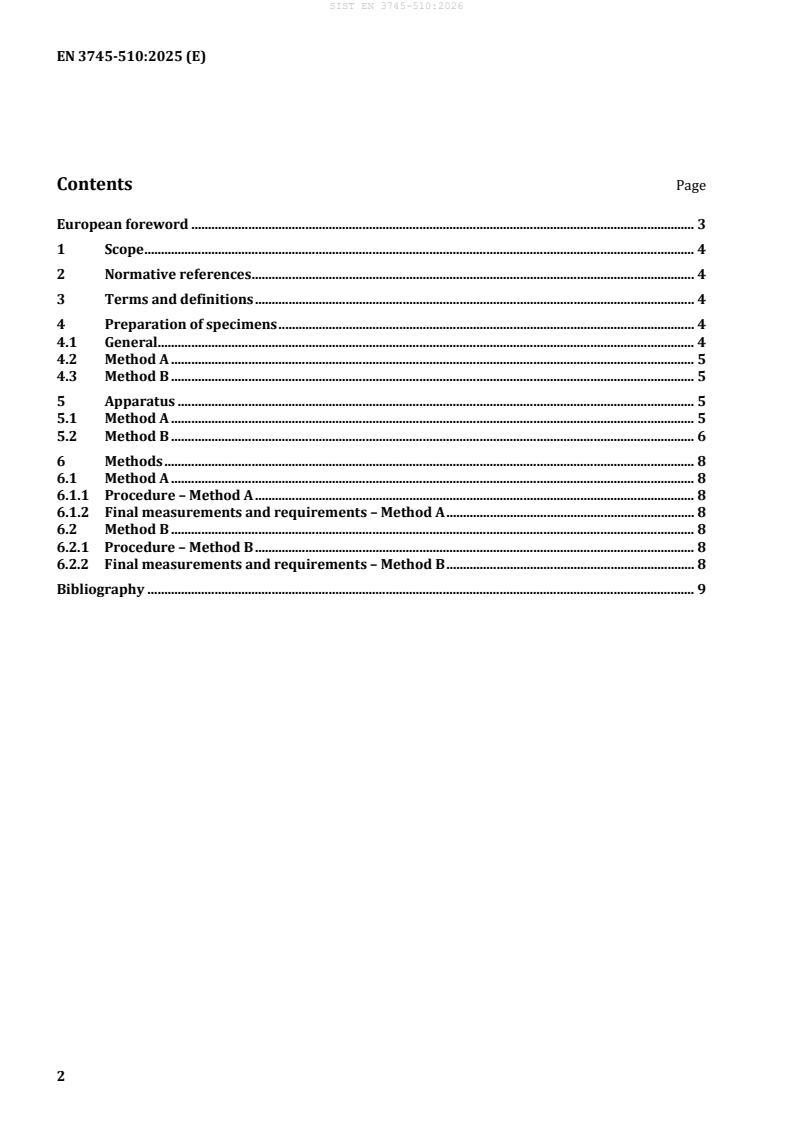
Contents Page
European foreword . 3
1 Scope . 4
2 Normative references . 4
3 Terms and definitions . 4
4 Preparation of specimens . 4
4.1 General. 4
4.2 Method A . 5
4.3 Method B . 5
5 Apparatus . 5
5.1 Method A . 5
5.2 Method B . 6
6 Methods . 8
6.1 Method A . 8
6.1.1 Procedure – Method A . 8
6.1.2 Final measurements and requirements – Method A . 8
6.2 Method B . 8
6.2.1 Procedure – Method B . 8
6.2.2 Final measurements and requirements – Method B . 8
Bibliography . 9
European foreword
This document (EN 3745-510:2025) has been prepared by ASD-STAN.
After enquiries and votes carried out in accordance with the rules of this Association, this document has
received the approval of the National Associations and the Official Services of the member countries of
ASD-STAN, prior to its presentation to CEN.
This document shall be given the status of a national standard, either by publication of an identical text
or by endorsement, at the latest by June 2026, and conflicting national standards shall be withdrawn at
the latest by June 2026.
Attention is drawn to the possibility that some of the elements of this document may be the subject of
patent rig
...