

SIST EN 13074-2:2019
(Main)Bitumen and bituminous binders - Recovery of binder from bituminous emulsion or cut-back or fluxed bituminous binders - Part 2: Stabilization after recovery by evaporation
General Information
- Abstract
This European Standard specifies a method for the stabilisation at 85 °C for 24 h of a binder after recovery from a bituminous emulsion or from a cut-back or fluxed bitumen for further testing.
It applies to all types of bituminous emulsions, modified with polymers or non-modified, and as well as to all types of cut-back and fluxed bitumen, both modified with polymers and non-modified.
The recovery test method is specified in EN 13074-1.
WARNING - The use of this document may involve hazardous materials, operations and equipment. This document does not purport to address all of the safety problems associated with its use. The hazards associated with the use of this method have been assessed using cut-back bitumen containing 10 % kerosene and 90 % 160/220 penetration grade bitumen and were found low enough to be acceptable. However it is the responsibility of the user of this document to establish appropriate safety and health practices and determine the applicability of regulatory limitations prior to use.
- Status
- Published
- Public Enquiry End Date
- 19-Dec-2017
- Publication Date
- 18-Mar-2019
- Technical Committee
- VLA - Water proofing
- Current Stage
- 6060 - National Implementation/Publication (Adopted Project)
- Start Date
- 22-Feb-2019
- Due Date
- 29-Apr-2019
- Completion Date
- 19-Mar-2019


Overview
EN 13074-2:2019 - Bitumen and bituminous binders - Part 2: Stabilization after recovery by evaporation - is a CEN standard that specifies the laboratory method for stabilising a binder recovered from a bituminous emulsion or from cut‑back or fluxed bitumen. The method prepares a stabilised binder for subsequent physical or performance testing by removing most volatiles through controlled heating at 85 °C for 24 h in a ventilated oven.
Key topics and technical requirements
- Scope: Applies to all bituminous emulsions and cut‑back/fluxed bitumens, both polymer‑modified and non‑modified. The binder recovery procedure is described in EN 13074-1.
- Stabilisation conditions: Heat a thin layer of recovered binder at (85 ± 2) °C for (24 ± 1) h in a ventilated oven with forced air circulation and exhaust.
- Apparatus essentials:
- Ventilated oven capable of maintaining the required temperature and having minimum internal clearances (shelves and walls) to ensure air circulation.
- Flat metallic plates (min. surface area 0.04 m², thickness ≥ 2 mm, edge height ≤ 20 mm). Plate spacing and oven loading rules ensure reproducible evaporation.
- Spatula/palette knife, 500 ml low‑form beaker, and an oven for reheating samples prior to testing.
- Handling and storage:
- Remove stabilised binder promptly without additional heat and combine in a single beaker.
- Store in a sealed container at < 28 °C for no longer than one week if testing is deferred.
- Preparation for further testing:
- Reheat in an oven using controlled temperatures: (130 ± 15) °C for unmodified binders and (165 ± 15) °C for polymer‑modified binders (maximum reheating time 30 minutes).
- Mix/homogenise during heating (glass rod), avoid air entrainment. For some polymer‑modified binders that risk gelling, lower reheating temperatures are allowed provided they are at least 60 °C above the estimated Ring and Ball softening point.
- Reporting: Test report must record material identification, reheating temperature/time, treatment history, deviations, and reference to EN 13074-2:2019.
Applications and users
- Quality control and verification in asphalt and bitumen laboratories
- Road authorities and construction contractors validating binder properties after recovery from emulsions or fluxed products
- Bitumen suppliers and polymer modifier manufacturers ensuring consistent sample preparation for specification testing
- Research laboratories studying the effects of volatiles and modifiers on binder behaviour
Related standards
- EN 13074-1 - Recovery of binder by evaporation (required preceding method)
- EN 12594 - Preparation of test samples for bituminous binders
- EN 1427 - Ring and Ball softening point (referenced for reheating guidance)
WARNING: The method may involve hazardous materials (e.g., solvents in cut‑backs). Users must establish appropriate safety and health practices and check regulatory limits before use.
Relations
- Effective Date
- 01-Apr-2019
- Effective Date
- 28-Jan-2026
- Effective Date
- 28-Jan-2026
- Effective Date
- 28-Jan-2026
- Effective Date
- 28-Jan-2026
- Effective Date
- 28-Jan-2026
- Effective Date
- 28-Jan-2026
- Effective Date
- 28-Jan-2026
- Effective Date
- 28-Jan-2026
- Effective Date
- 28-Jan-2026
- Effective Date
- 28-Jan-2026
Get Certified
Connect with accredited certification bodies for this standard

DIBt (Deutsches Institut für Bautechnik)
German Institute for Building Technology.
DIN CERTCO
DIN Group product certification.

Element Materials Technology
Materials testing and product certification.
Sponsored listings
Frequently Asked Questions
SIST EN 13074-2:2019 is a standard published by the Slovenian Institute for Standardization (SIST). Its full title is "Bitumen and bituminous binders - Recovery of binder from bituminous emulsion or cut-back or fluxed bituminous binders - Part 2: Stabilization after recovery by evaporation". This standard covers: This European Standard specifies a method for the stabilisation at 85 °C for 24 h of a binder after recovery from a bituminous emulsion or from a cut-back or fluxed bitumen for further testing. It applies to all types of bituminous emulsions, modified with polymers or non-modified, and as well as to all types of cut-back and fluxed bitumen, both modified with polymers and non-modified. The recovery test method is specified in EN 13074-1. WARNING - The use of this document may involve hazardous materials, operations and equipment. This document does not purport to address all of the safety problems associated with its use. The hazards associated with the use of this method have been assessed using cut-back bitumen containing 10 % kerosene and 90 % 160/220 penetration grade bitumen and were found low enough to be acceptable. However it is the responsibility of the user of this document to establish appropriate safety and health practices and determine the applicability of regulatory limitations prior to use.
This European Standard specifies a method for the stabilisation at 85 °C for 24 h of a binder after recovery from a bituminous emulsion or from a cut-back or fluxed bitumen for further testing. It applies to all types of bituminous emulsions, modified with polymers or non-modified, and as well as to all types of cut-back and fluxed bitumen, both modified with polymers and non-modified. The recovery test method is specified in EN 13074-1. WARNING - The use of this document may involve hazardous materials, operations and equipment. This document does not purport to address all of the safety problems associated with its use. The hazards associated with the use of this method have been assessed using cut-back bitumen containing 10 % kerosene and 90 % 160/220 penetration grade bitumen and were found low enough to be acceptable. However it is the responsibility of the user of this document to establish appropriate safety and health practices and determine the applicability of regulatory limitations prior to use.
SIST EN 13074-2:2019 is classified under the following ICS (International Classification for Standards) categories: 75.140 - Waxes, bituminous materials and other petroleum products; 91.100.50 - Binders. Sealing materials. The ICS classification helps identify the subject area and facilitates finding related standards.
SIST EN 13074-2:2019 has the following relationships with other standards: It is inter standard links to SIST EN 13074-2:2011, SIST EN 12594:2025, SIST EN 15323:2007, SIST EN 13808:2005, SIST EN 12594:2007, SIST EN 13589:2008, SIST EN 13074-1:2011, SIST EN 13074-1:2019, SIST EN 14769:2023, SIST EN 14733:2005+A1:2011, SIST EN 12594:2014. Understanding these relationships helps ensure you are using the most current and applicable version of the standard.
SIST EN 13074-2:2019 is associated with the following European legislation: Standardization Mandates: M/124. When a standard is cited in the Official Journal of the European Union, products manufactured in conformity with it benefit from a presumption of conformity with the essential requirements of the corresponding EU directive or regulation.
SIST EN 13074-2:2019 is available in PDF format for immediate download after purchase. The document can be added to your cart and obtained through the secure checkout process. Digital delivery ensures instant access to the complete standard document.
Standards Content (Sample)
2003-01.Slovenski inštitut za standardizacijo. Razmnoževanje celote ali delov tega standarda ni dovoljeno.Bitumen in bitumenska veziva - Ponovna pridobitev veziva iz bitumenskih emulzij ali rezanih ali fluksiranih bitumenskih veziv - 2. del: Stabilizacija po ponovni pridobitvi z izhlapevanjemBitumen und bitumenhaltige Bindemittel - Rückgewinnung des Bindemittels aus Bitumenemulsion oder verschnittenen oder gefluxten Bitumen - Teil 2: Stabilisierung nach Rückgewinnung durch VerdunstungBitumes et liants bitumineux - Récupération du liant d'une émulsion bitumineuse ou d'un bitume fluidifié ou fluxé - Partie 2 : Stabilisation aprés récupération par évaporationBitumen and bituminous binders - Recovery of binder from bituminous emulsion or cut-back or fluxed bituminous binders - Part 2: Stabilization after recovery by evaporation91.100.50Veziva. Tesnilni materialiBinders. Sealing materials75.140Voski, bitumni in drugi naftni proizvodiWaxes, bituminous materials and other petroleum productsICS:Ta slovenski standard je istoveten z:EN 13074-2:2019SIST EN 13074-2:2019en,fr,de01-april-2019SIST EN 13074-2:2019SLOVENSKI
STANDARDSIST EN 13074-2:20111DGRPHãþD
EUROPEAN STANDARD NORME EUROPÉENNE EUROPÄISCHE NORM
EN 13074-2
February
t r s { ICS
{ sä s r rä w r Supersedes EN
s u r y væ tã t r s sEnglish Version
Bitumen and bituminous binders æ Recovery of binder from bituminous emulsion or cutæback or fluxed bituminous binders æ Part
tã Stabilization after recovery by evaporation Bitumes et liants bitumineux æ Récupération du liant d 5une émulsion bitumineuse ou d 5un bitume fluidifié oufluxé æ Partie
t ã Stabilisation aprés récupération par évaporation
Bitumen und bitumenhaltige Bindemittel æ Rückgewinnung des Bindemittels aus Bitumenemulsion oder verschnittenen oder gefluxten Bitumen æ Teil
tã Stabilisierung nach Rückgewinnung durch Verdunstung This European Standard was approved by CEN on
s { November
t r s zä
egulations which stipulate the conditions for giving this European Standard the status of a national standard without any alterationä Upætoædate lists and bibliographical references concerning such national standards may be obtained on application to the CENæCENELEC Management Centre or to any CEN memberä
translation under the responsibility of a CEN member into its own language and notified to the CENæCENELEC Management Centre has the same status as the official versionsä
CEN members are the national standards bodies of Austriaá Belgiumá Bulgariaá Croatiaá Cyprusá Czech Republicá Denmarká Estoniaá Finlandá Former Yugoslav Republic of Macedoniaá Franceá Germanyá Greeceá Hungaryá Icelandá Irelandá Italyá Latviaá Lithuaniaá Luxembourgá Maltaá Netherlandsá Norwayá Polandá Portugalá Romaniaá Serbiaá Slovakiaá Sloveniaá Spainá Swedená Switzerlandá Turkey and United Kingdomä
EUROPEAN COMMITTEE FOR STANDARDIZATION COMITÉ EUROPÉEN DE NORMALISATION EUROPÄISCHES KOMITEE FÜR NORMUNG
CEN-CENELEC Management Centre:
Rue de la Science 23,
B-1040 Brussels
t r s { CEN All rights of exploitation in any form and by any means reserved worldwide for CEN national Membersä Refä Noä EN
s u r y væ tã t r s { ESIST EN 13074-2:2019
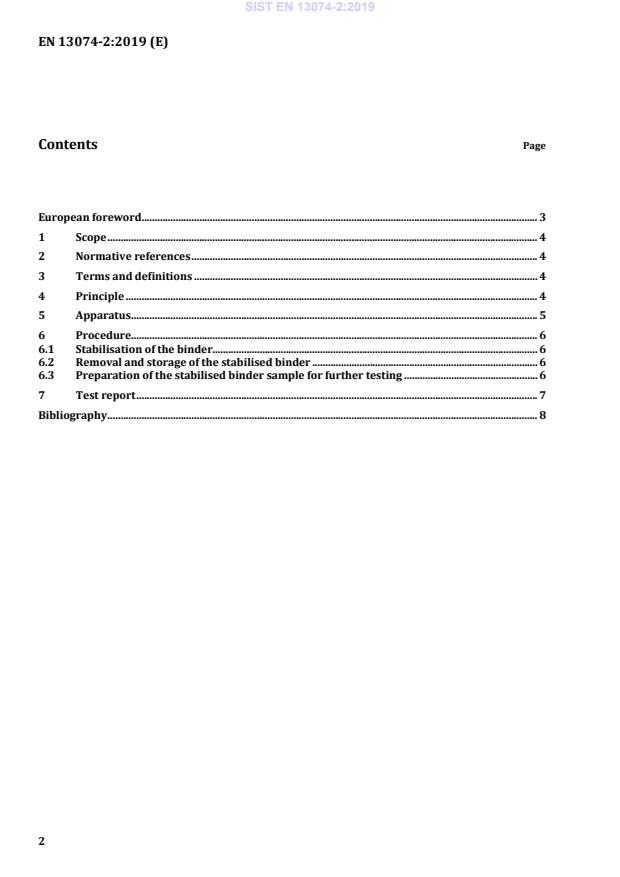
European foreword . 3 1 Scope . 4 2 Normative references . 4 3 Terms and definitions . 4 4 Principle . 4 5 Apparatus . 5 6 Procedure. 6 6.1 Stabilisation of the binder. 6 6.2 Removal and storage of the stabilised binder . 6 6.3 Preparation of the stabilised binder sample for further testing . 6 7 Test report . 7 Bibliography . 8
...