

SIST EN 1427:2026
(Main)Bitumens and bituminous binders - Determination of the softening point - Ring and Ball method
- Abstract
This document specifies a method for the determination of the softening point of bitumens and bituminous binders in the range of 28 °C to 150 °C.
The method described is also applicable to bituminous binders that have been recovered from bituminous mixes, e.g. by extraction according to EN 12697-3 [1].
WARNING — The use of this document can involve hazardous materials, operations and equipment. This document does not purport to address all of the safety problems associated with its use. It is the responsibility of the user of this document to establish appropriate safety and health practices and to determine the applicability of regulatory limitations prior to use.
- Status
- Published
- Public Enquiry End Date
- 28-May-2024
- Publication Date
- 17-Jun-2026
- Technical Committee
- VLA - Water proofing
- Current Stage
- 6060 - National Implementation/Publication (Adopted Project)
- Start Date
- 10-Jun-2026
- Due Date
- 15-Aug-2026
- Completion Date
- 18-Jun-2026

SIST EN 1427:2026 is a CEN European Standard for determining the softening point of bitumens and bituminous binders by the Ring and Ball method. It covers the 28 °C to 150 °C range and also applies to binders recovered from bituminous mixes, so it is useful for testing both fresh binders and reclaimed material. The document is intended for laboratories, quality control staff, engineers and buyers who need one common test method and comparable results.
What does SIST EN 1427:2026 specify?
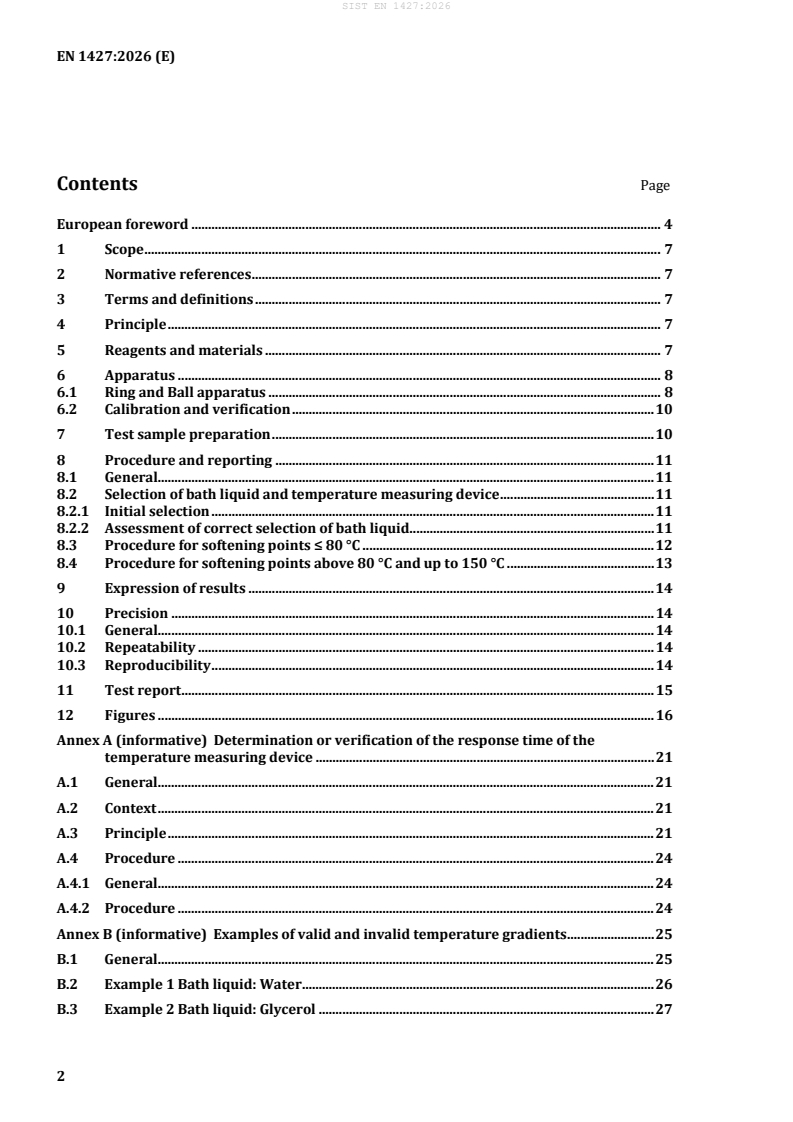
SIST EN 1427:2026 specifies a test method, the required materials and apparatus, the sample preparation steps, the temperature program, the way to express results, and the precision data for the softening point test. The document is organized into 12 clauses and 4 informative annexes, followed by a bibliography.
The core structure is practical: Clause 4 explains the test principle, Clauses 5 and 6 cover reagents and equipment, Clause 7 covers sample preparation, Clause 8 gives the operating procedure and reporting, Clause 9 covers how to state the result, Clause 10 gives precision, and Clause 11 gives the test report content. Clause 12 collects the figures for the apparatus.
| Annex | What it covers |
|---|---|
| Annex A | Determination or verification of the response time of the temperature measuring device |
| Annex B | Examples of valid and invalid temperature gradients |
| Annex C | Examples of even temperature distribution and experiences on beaker-stirrer combinations |
| Annex D | Trials on silicone oil as an alternative to glycerol as bath liquid |
The scope also carries a safety warning. SIST EN 1427:2026 notes that the method can involve hazardous materials, operations and equipment, so users need their own safety practices and must check regulatory limits before use.
What are the key requirements of SIST EN 1427:2026?
SIST EN 1427:2026 is built around a controlled Ring and Ball test, and the details matter because the result depends on apparatus geometry, bath medium, heating rate, and the way the end point is detected.
Test principle, Clause 4 - Two horizontal discs of bituminous binder are cast in brass rings, heated in a liquid bath, and each supports a steel ball. The softening point is the mean temperature at which the two balls fall a fixed distance. In practice, both specimens have to be prepared and watched under the same conditions so the two readings can be averaged.
Materials and bath liquids, Clause 5 - The document permits water for lower softening points and glycerol for higher ones, and it requires specified analytical grade reagents and grade 3 water from EN ISO 3696:1995. It also uses a release agent on the pouring plate to stop the binder sticking. This matters because contamination, trapped air, or the wrong bath liquid can shift the result.
Apparatus, Clause 6 - SIST EN 1427:2026 allows manual, semi-automatic and automatic Ring and Ball apparatus, but the equipment combination has to be the one stated by the manufacturer and the assembly has to meet the dimensional and functional requirements. The beaker, rings, balls, ring holder, stirrer and temperature measuring device are all specified so the bath is heated evenly and the ball drop is detected consistently. For automated equipment, the result has to match the manual method within the method precision.
Temperature measuring device, Clause 6.1.7 and Annex A - The standard now focuses on thermometer or sensor-and-reading-unit performance, including range, readability, error limit and response time. Annex A explains how to determine or verify the response time against the required dynamic behavior. In practice, this is important because the test heats continuously, so a slow sensor can bias the reading, especially above 100 °C.
Calibration and verification, Clause 6.2 - All equipment has to be calibrated or verified at least once a year unless the document says otherwise, and the operations have to be recorded. The clause also points to internal quality control by using a binder control sample and a control chart. This helps a laboratory spot drift before it affects reported softening points.
Sample preparation, Clause 7 - Sampling follows EN 58 and test sample preparation follows EN 12594. The binder is heated, poured into warmed rings on a release-agent-coated plate, cooled, trimmed flush, and tested within 4 h from pouring. For modified binders, enough material should be prepared to allow repetition if needed. This limits aging and handling effects before the test starts.
Procedure and acceptance of results, Clause 8 - Water is used for results up to 80 °C, with an initial bath temperature of 5 °C, and glycerol is used above 80 °C up to 150 °C, with an initial bath temperature of 40 °C. The bath must heat at 5 °C/min, and the method sets acceptable ranges for the minute-by-minute rise and for the overall rise. The standard also gives a decision rule around 80 °C to avoid switching-bath ambiguity and sets repeat-test rules when the two specimens disagree too much or the binder film breaks.
Expression of results, Clause 9 - Results are reported as the arithmetic mean of the two readings, to the nearest 0.2 °C for softening points at or below 80 °C and to the nearest 0.5 °C above 80 °C. This keeps reporting consistent across laboratories.
What terms does SIST EN 1427:2026 define?
SIST EN 1427:2026 uses a small set of terms that are central to the method and to reading the results correctly.
- Softening point - The temperature at which the material reaches a specified consistency under the standardized Ring and Ball conditions.
- Ring and Ball apparatus - The test assembly that holds the binder in brass rings, supports the steel balls, and allows controlled heating in a liquid bath.
- Bath liquid - The liquid medium used to heat the specimens during the test, namely water or glycerol depending on the temperature range.
- Response time - The time characteristic used to judge whether a temperature measuring device reacts quickly enough for this dynamic test.
- Repeatability - The closeness of two results obtained by the same operator on the same material under the same conditions.
- Reproducibility - The closeness of results obtained by different operators in different laboratories on the same material.
- Modified binders - Bituminous binders whose behavior can differ enough that the standard gives separate repeat-test conditions.
Who uses SIST EN 1427:2026?
SIST EN 1427:2026 is used by testing laboratories, asphalt and bitumen producers, road material laboratories, and quality assurance teams. It is also relevant to purchasers and specifiers who need a defined softening point test for acceptance, comparison or product control.
In practice, users apply it when they need to compare binder grades, check production consistency, test reclaimed binders from mixes, or verify that laboratory equipment gives results aligned with the method. It is also relevant when a lab sets up automated Ring and Ball equipment or checks the performance of temperature sensors used in the test.
What changed in SIST EN 1427:2026 from the previous edition?
SIST EN 1427:2026 supersedes EN 1427:2015, and the foreword lists several technical changes.
The main changes include:
- the scope was extended to recovered bituminous binders;
- the safety warning about mercury thermometers and electronic temperature devices was moved into Clause 6;
- the water-quality wording was rephrased;
- a note on silicone oil as an alternative bath liquid was added, with a new Annex D;
- the apparatus clauses were clarified, including the ring holder, beaker, stirrer and the removal of mercury reference thermometers;
- a response-time requirement for alternative temperature measuring devices was introduced, with supporting guidance in new Annex A;
- calibration and verification requirements were expanded;
- sample preparation and the procedure were updated and rearranged for readability;
- the initial glycerol temperature changed from 30 °C to 40 °C;
- figures were moved into Clause 12;
- Annex B was updated, and new Annexes C and D were added.
Which standards are used with SIST EN 1427:2026?
SIST EN 1427:2026 relies on several named standards that support sampling, sample preparation, terminology and water quality.
| Standard | What it contributes |
|---|---|
| EN 58 | Sampling bituminous binders |
| EN 12594 | Preparation of test samples |
| EN 12597 | Terminology for bitumens and bituminous binders |
| EN ISO 3696:1995 | Grade 3 water for analytical laboratory use |
| EN 12697-3 | Example method for recovering binder from bituminous mixes by extraction |
Annex A also refers to ASTM E644 for the temperature-step principle used to characterize response time, and the bibliography identifies ASTM D36/D36M as a related softening point method.
What does the SIST EN 1427:2026 document contain?
SIST EN 1427:2026 contains the full test method, equipment descriptions, sample preparation steps, result expression rules, and precision data. It also includes figures for the ring, pouring plate, ball centring guide, ring holder, assembly and bottom plate, so laboratories can check the geometry of their equipment against the standard.
The annexes add practical support rather than extra requirements. Annex A explains how to verify temperature-measuring-device response time, Annex B shows acceptable and unacceptable heating gradients, Annex C discusses bath mixing and beaker-stirrer combinations, and Annex D summarizes silicone oil trials. The document also includes a precision table for different binder types and bath liquids, which is used when comparing results between operators and laboratories.
Relations
- Effective Date
- 01-Jul-2026
- Effective Date
- 03-Jun-2026
- Effective Date
- 03-Jun-2026
- Effective Date
- 03-Jun-2026
- Effective Date
- 27-May-2026
- Effective Date
- 27-May-2026
- Effective Date
- 27-May-2026
- Effective Date
- 27-May-2026
- Effective Date
- 27-May-2026
- Referred By
SIST EN 13108-1:2006 - Bituminous mixtures - Material specifications - Part 1: Asphalt Concrete - Effective Date
- 27-May-2026
- Referred By
SIST EN 13108-20:2016 - Bituminous mixtures - Material specifications - Part 20: Type Testing - Effective Date
- 27-May-2026
- Referred By
SIST EN 13108-1:2016 - Bituminous mixtures - Material specifications - Part 1: Asphalt Concrete - Effective Date
- 27-May-2026
- Effective Date
- 27-May-2026
- Referred By
SIST EN 13108-6:2006 - Bituminous mixtures - Material specifications - Part 6: Mastic Asphalt - Effective Date
- 27-May-2026
- Referred By
SIST EN 13301:2010 - Bitumen and bituminous binders - Determination of staining tendency of bitumen - Effective Date
- 27-May-2026
Get Certified
Connect with accredited certification bodies for this standard

DIBt (Deutsches Institut für Bautechnik)
German Institute for Building Technology.
DIN CERTCO
DIN Group product certification.

Element Materials Technology
Materials testing and product certification.
Sponsored listings
Frequently Asked Questions
SIST EN 1427:2026 is a standard published by the Slovenian Institute for Standardization (SIST). Its full title is "Bitumens and bituminous binders - Determination of the softening point - Ring and Ball method". This standard covers: This document specifies a method for the determination of the softening point of bitumens and bituminous binders in the range of 28 °C to 150 °C. The method described is also applicable to bituminous binders that have been recovered from bituminous mixes, e.g. by extraction according to EN 12697-3 [1]. WARNING — The use of this document can involve hazardous materials, operations and equipment. This document does not purport to address all of the safety problems associated with its use. It is the responsibility of the user of this document to establish appropriate safety and health practices and to determine the applicability of regulatory limitations prior to use.
This document specifies a method for the determination of the softening point of bitumens and bituminous binders in the range of 28 °C to 150 °C. The method described is also applicable to bituminous binders that have been recovered from bituminous mixes, e.g. by extraction according to EN 12697-3 [1]. WARNING — The use of this document can involve hazardous materials, operations and equipment. This document does not purport to address all of the safety problems associated with its use. It is the responsibility of the user of this document to establish appropriate safety and health practices and to determine the applicability of regulatory limitations prior to use.
SIST EN 1427:2026 is classified under the following ICS (International Classification for Standards) categories: 75.140 - Waxes, bituminous materials and other petroleum products; 91.100.50 - Binders. Sealing materials. The ICS classification helps identify the subject area and facilitates finding related standards.
SIST EN 1427:2026 has the following relationships with other standards: It is inter standard links to SIST EN 1427:2015, SIST EN 58:2012, SIST EN ISO 3696:1998, SIST EN 12597:2025, SIST EN 13808:2005, SIST EN 12607-3:2014, SIST EN 14783:2006, SIST EN 14260:2003, SIST EN 14770:2012, SIST EN 13108-1:2006, SIST EN 13108-20:2016, SIST EN 13108-1:2016, SIST EN 508-1:2021, SIST EN 13108-6:2006, SIST EN 13301:2010. Understanding these relationships helps ensure you are using the most current and applicable version of the standard.
SIST EN 1427:2026 is available in PDF format for immediate download after purchase. The document can be added to your cart and obtained through the secure checkout process. Digital delivery ensures instant access to the complete standard document.
Standards Content (Sample)
SLOVENSKI STANDARD
01-julij-2026
Nadomešča:
SIST EN 1427:2015
Bitumni in bitumenska veziva - Določanje zmehčišča - Metoda prstana in kroglice
Bitumens and bituminous binders - Determination of the softening point - Ring and Ball
method
Bitumen und bitumenhaltige Bindemittel - Bestimmung des Erweichungspunktes - Ring-
und Kugel-Verfahren
Bitumes et liants bitumineux - Détermination du point de ramollissement - Méthode Bille
et Anneau
Ta slovenski standard je istoveten z: EN 1427:2026
ICS:
75.140 Voski, bitumni in drugi naftni Waxes, bituminous materials
proizvodi and other petroleum products
91.100.50 Veziva. Tesnilni materiali Binders. Sealing materials
2003-01.Slovenski inštitut za standardizacijo. Razmnoževanje celote ali delov tega standarda ni dovoljeno.
EN 1427
EUROPEAN STANDARD
NORME EUROPÉENNE
May 2026
EUROPÄISCHE NORM
ICS 75.140; 91.100.50 Supersedes EN 1427:2015
English Version
Bitumens and bituminous binders - Determination of the
softening point - Ring and Ball method
Bitumes et liants bitumineux - Détermination du point Bitumen und bitumenhaltige Bindemittel -
de ramollissement - Méthode Bille et Anneau Bestimmung des Erweichungspunktes - Ring- und
Kugel-Verfahren
This European Standard was approved by CEN on 13 April 2026.
CEN members are bound to comply with the CEN/CENELEC Internal Regulations which stipulate the conditions for giving this
European Standard the status of a national standard without any alteration. Up-to-date lists and bibliographical references
concerning such national standards may be obtained on application to the CEN-CENELEC Management Centre or to any CEN
member.
This European Standard exists in three official versions (English, French, German). A version in any other language made by
translation under the responsibility of a CEN member into its own language and notified to the CEN-CENELEC Management
Centre has the same status as the official versions.
CEN members are the national standards bodies of Austria, Belgium, Bulgaria, Croatia, Cyprus, Czech Republic, Denmark, Estonia,
Finland, France, Germany, Greece, Hungary, Iceland, Ireland, Italy, Latvia, Lithuania, Luxembourg, Malta, Netherlands, Norway,
Poland, Portugal, Republic of North Macedonia, Romania, Serbia, Slovakia, Slovenia, Spain, Sweden, Switzerland, Türkiye and
United Kingdom.
EUROPEAN COMMITTEE FOR STANDARDIZATION
COMITÉ EUROPÉEN DE NORMALISATION
EUROPÄISCHES KOMITEE FÜR NORMUNG
CEN-CENELEC Management Centre: Rue de la Science 23, B-1040 Brussels
© 2026 CEN All rights of exploitation in any form and by any means reserved Ref. No. EN 1427:2026 E
worldwide for CEN national Members.
Contents Page
European foreword . 4
1 Scope . 7
2 Normative references . 7
3 Terms and definitions . 7
4 Principle . 7
5 Reagents and materials . 7
6 Apparatus . 8
6.1 Ring and Ball apparatus . 8
6.2 Calibration and verification . 10
7 Test sample preparation . 10
8 Procedure and reporting . 11
8.1 General. 11
8.2 Selection of bath liquid and temperature measuring device . 11
8.2.1 Initial selection . 11
8.2.2 Assessment of correct selection of bath liquid. 11
8.3 Procedure for softening points ≤ 80 °C . 12
8.4 Procedure for softening points above 80 °C and up to 150 °C . 13
9 Expression of results . 14
10 Precision . 14
10.1 General. 14
10.2 Repeatability . 14
10.3 Reproducibility . 14
11 Test report . 15
12 Figures . 16
Annex A (informative) Determination or verification of the response time of the
temperature measuring device . 21
A.1 General. 21
A.2 Context . 21
A.3 Principle . 21
A.4 Procedure . 24
A.4.1 General. 24
A.4.2 Procedure . 24
Annex B (informative) Examples of valid and invalid temperature gradients . 25
B.1 General. 25
B.2 Example 1 Bath liquid: Water . 26
B.3 Example 2 Bath liquid: Glycerol . 27
Annex C (informative) Examples of even temperature distribution and experiences on
beaker - stirrer combinations . 29
C.1 Uneven temperature distribution due to layering of glycerol . 29
C.2 Examples of beaker - stirrer combinations . 29
Annex D (informative) Trials on silicone oil as alternative to glycerol as bath liquid . 31
D.1 General . 31
D.2 Verification of influence of silicone oil on the test sample . 31
D.3 Verification of speed of stirring on test results . 31
Bibliography . 33
European foreword
This document (EN 1427:2026) has been prepared by Technical Committee CEN/TC 336 “Bitumens and
bituminous binders”, the secretariat of which is held by AFNOR.
This European Standard shall be given the status of a national standard, either by publication of an
identical text or by endorsement, at the latest by November 2026 and conflicting national standards shall
be withdrawn at the latest by November 2026.
Attention is drawn to the possibility that some of the elements of this document may be the subject of
patent rights. CEN shall not be held responsible for identifying any or all such patent rights.
This document supersedes EN 1427:2015.
— the Foreword has been updated;
— Clause 1, Scope, extends the application of the method to recovered bituminous binders;
— in Clause 1, Scope, the technical warning regarding mercury thermometers and electronic
temperature devices has been moved to 6.1.7;
— in 5.2.1, the requirement on water quality was rephrased;
— in 5.2.2, a note, informing on investigations made on the use of silicone oil as alternative bath liquid
to glycerol and referring to the new Annex D, has been added;
— in 5.3, the Note 2 was moved to standard text;
— in Clause 6, the drafting was aligned to be consistent with recently revised test method standards;
— in 6.1, the requirement on equipment combination has been better defined;
— in 6.1.5, the description of the ring holder and assembly has been clarified (the dimensions shown in
Figures 4 and 6 are mandatory whilst the shape is exemplary) and the note has been turned into
standard text;
— in 6.1.6, the description of the beaker has been updated;
— in 6.1.7:
— the requirement for the use of mercury reference thermometers was removed;
— the description of the temperature measuring device has been aligned to be consistent with the
drafting in EN 1426;
— for alternative temperature measuring devices to mercury thermometers, a response time
specification has been introduced based on a study carried out by the French metrological
institute LNE; the determination of temperature response time used in the study is explained in
the new informative Annex A;
— in 6.1.8, the description of the stirrer has been updated to be understood as magnetic stirrer with hot
plate, and the reference to any manufacturer has been deleted;
— in 6.1.9, the note was deleted;
— in 6.2, the calibration and verification requirements have been developed and aligned with recently
revised test method standards;
— Clause 7, now called “Test sample preparation”, has been updated;
— Clause 8 has been rearranged for better readability (subclauses renumbering) and the position of the
temperature measuring device has been better defined;
— subclause 8.1, "General" has been added;
— in 8.2.1, the initial temperature for measurements in glycerol was changed from 30 °C to 40 °C;
— subclause 8.2.2 was reworded and indents were renumbered;
— in 8.3, the wording with regard to the beaker was revised and subclauses were renumbered;
— in 8.3.2 and 8.4.2, the wording with regard to the assembling of the apparatus was aligned;
— in 8.3.6, the wording was revised;
— in 8.3.7 and 8.4.7, the wording was improved;
— in 8.4.6, the timing for the heating up was adjusted in line with the new initial temperature, and the
wording was revised;
— in Clause 10, Table 1 now refers to polymer modified or oxidised bitumens, and information on
background and information on interlaboratory tests have been updated;
— all figures have been moved to the new Clause 12 “Figures”;
— in Figure 3, the wording “precision” was replaced by “tolerance”;
— in Figure 5, the diameter dimensions of the beaker have been adapted and the drawing has been
updated to reflect current testing conditions;
— former Annex A (normative) "Characteristics of thermometers" has been replaced by the new
Annex A (informative) "Determination or verification of the response time of the temperature
measuring device";
— in Annex B (informative), Tables B.2 and B.3 have been updated to reflect the new initial temperature
of 40 °C;
— a new Annex C (informative) "Examples of even temperature distribution and experiences on
beaker - stirrer combinations" has been added;
— a new Annex D (informative) "Trials on silicone oil as alternative to glycerol as bath liquid" has been
added;
— the document has been editorially revised.
Any feedback and questions on this document should be directed to the users’ national standards body.
A complete listing of these bodies can be found on the CEN website.
According to the CEN-CENELEC Internal Regulations, the national standards organizations of the
following countries are bound to implement this European Standard: Austria, Belgium, Bulgaria, Croatia,
Cyprus, Czech Republic, Denmark, Estonia, Finland, France, Germany, Greece, Hungary, Iceland, Ireland,
Italy, Latvia, Lithuania, Luxembourg, Malta, Netherlands, Norway, Poland, Portugal, Republic of North
Macedonia, Romania, Serbia, Slovakia, Slovenia, Spain, Sweden, Switzerland, Türkiye and the United
Kingdom.
1 Scope
This document specifies a method for the determination of the softening point of bitumens and
bituminous binders in the range of 28 °C to 150 °C.
The method described is also applicable to bituminous binders that have been recovered from
bituminous mixes, e.g. by extraction according to EN 12697-3 [1].
WARNING — The use of this document can involve hazardous materials, operations and equipment. This
document does not purport to address all of the safety problems associated with its use. It is the
responsibility of the user of this document to establish appropriate safety and health practices and to
determine the applicability of regulatory limitations prior to use.
2 Normative references
The following documents are referred to in the text in such a way that some or all of their content
constitutes requirements of this document. For dated references, only the edition cited applies. For
undated references, the latest edition of the referenced document (including any amendments) applies.
EN 58, Bitumen and bituminous binders — Sampling bituminous binders
EN 12594, Bitumens and bituminous binders — Preparation of test samples
EN 12597, Bitumens and bituminous binders —Terminology
EN ISO 3696:1995, Water for analytical laboratory use — Specification and test methods (ISO 3696:1987)
3 Terms and definitions
For the purposes of this document, the terms and definitions given in EN 12597 and the following apply.
ISO and IEC maintain terminology databases for use in standardization at the following addresses:
— ISO Online browsing platform: available at https://www.iso.org/obp
— IEC Electropedia: available at https://www.electropedia.org
3.1
softening point
temperature at which material under standardized test conditions attains a specific consistency
4 Principle
Two horizontal discs of bituminous binder, cast in shouldered brass rings are heated at a controlled rate
in a liquid bath whilst each supports a steel ball. The softening point is reported as the mean of the
temperatures at which the two discs soften enough to allow each ball, enveloped in bituminous binder,
to fall a distance of (25,0 ± 0,4) mm.
5 Reagents and materials
5.1 Reagents
Only reagents of specified analytical grade and water conforming to grade 3 of EN ISO 3696:1995 shall
be used, unless otherwise specified.
5.2 Bath liquid
5.2.1 Water
The use of distilled or deionized water, which is freshly boiled and cooled, is essential to avoid trapping
air bubbles on the surface of the test sample, which can affect the results.
5.2.2 Glycerol, with a density of (1 250 ± 10) kg/m at 20 °C and with a minimum 99 % mass fraction
purity.
WARNING — Glycerol has a flash point of 160 °C, measured according to EN ISO 2592 [2]. In
temperatures above 100 °C, as glycerol can contain water due to hygroscopic properties, it is likely to
splash on the heating elements and ignite.
NOTE Silicone oil was tested as an alternative for glycerol. Available data are summarized in Annex D and can
be used for further development of this document.
5.3 Release agent, consisting of a mixture of glycerol and dextrin or mineral talc, or another
commercially available release agent.
To prevent the bituminous binder from adhering to the pouring plate when casting discs, the surface of
the metal pouring plate shall be thinly coated with the release agent just before use. Instead of a release
agent, other materials, e.g. baking paper, can be used.
NOTE Applying the release agent coating is easier when the plate is warmed to approximately 40 °C.
6 Apparatus
6.1 Ring and Ball apparatus
The usual laboratory apparatus and glassware, together with the Ring and Ball apparatus including the
following, shall be used.
The Ring and Ball apparatus may be either manual, semi-automatic or automatic.
The definite combination of stirrer, beaker, bath liquid, and assembly shall be given in the equipment’s
handbook. Only these combinations shall be used.
The Ring and Ball apparatus device shall include the following elements.
6.1.1 Two rings, made from brass, square-shouldered, and having dimensions in accordance with
Figure 1.
6.1.2 Pouring plate, made from metal, having a flat and smooth surface, with dimensions of
(50 ± 5) mm × (75 ± 5) mm and a thickness between 1,5 mm and 2,0 mm with the edges turned down
(see Figure 2).
6.1.3 Two balls, made from stainless steel, each having a diameter of (9,50 ± 0,05) mm and a mass of
(3,50 ± 0,05) g.
6.1.4 Two ball centring guides, made from brass, for centring the balls (6.1.3), one for each
ring (6.1.1). Figure 3 shows an example of a ball centring guide.
6.1.5 Ring holder and assembly, stainless steel or brass, with a holder (A) to support the two
rings (6.1.1) in a horizontal position, conforming to the dimensions shown in Figure 4, supported in the
assembly shown in Figure 5. The underside of the shouldered rings in the ring holder shall be
(25,0 ± 0,4) mm above the upper surface of the bottom plate (B), the dimensions of which are shown in
Figure 6. The upper edge of the rings shall be (50 ± 3) mm below the surface of the bath liquid (5.2).
The shapes of the ring holder and the bottom plate may differ from the examples given in Figure 4 and
Figure 5.
When using a semi-automatic or automatic apparatus, the principle for the end testing detection may be
the ball triggering the interruption of a ray of light at a distance of (25,0 ± 0,4) mm below the underside
of the ring, rather than the ball touching the bottom plate. In those cases, for construction purposes, the
bottom plate may have a larger distance to the underside of the shoulder rings than (25,0 ± 0,4) mm. All
other parameters on the ring holder and assembly shall be applied as stated above.
6.1.6 Beaker, made from heat resistant glass, with an outside diameter between 85 mm and 110 mm,
with a height of at least 120 mm as shown in Figure 5, and capable of holding a volume of at least 600 ml
of bath liquid (5.2). The beaker shall allow the correct placement of ring holder assembly as well as an
even temperature distribution within the bath liquid in combination with the stirrer used.
6.1.7 Temperature measuring device specifications
For determination in water (5.2.1), the temperature measuring device, being either a thermometer or
combining sensor and reading unit, shall:
— have a measuring range covering at least 0 °C to 90 °C;
— be readable to the nearest 0,2 °C or less;
— have a maximum permissible error of 0,2 °C or better;
— have a response time (τ) at 63,2 % to a temperature step of 39 °C not exceeding 3,3 s.
For determination in glycerol (5.2.2), the temperature measuring device, being either a thermometer or
combining sensor and reading unit, shall:
— have a measuring range covering at least 40 °C to 155 °C;
— be readable to the nearest 0,5 °C or less;
— have a maximum permissible error of 0,5 °C or better;
— have a response time (τ) at 63,2 % to a temperature step of 39 °C not exceeding 3,3 s.
The applicability of the response time (τ) specification as well as a method for determining or verifying
the response time (τ) for temperature measuring devices is described in Annex A. Other procedures can
be used, provided the results demonstrate correlation.
The change from solid stem mercury thermometers as references to electronic temperature devices has
revealed that the temperature definition in the mercury thermometer has not been precise enough to
make a correct, unbiased transfer to electronic devices. As the condition can have changed from previous
practice to current testing equipment, attention is drawn to the risk of a possible bias for softening points
Ring and Ball above 100 °C. Below approximately 100 °C, the difference in temperature readings between
electronic and solid stem mercury thermometer is acceptable compared to the repeatability of this test
method.
6.1.8 Stirrer, magnetic stirrer used with hot plate, with suitably coated stirring bar of length
approximately 40 mm and diameter 8 mm to ensure uniform heat distribution throughout the bath and
to avoid turbulent flow throughout the bath. The stirrer shall be placed so that it does not disturb the
samples when the test is in operation.
Under the same conditions, depending on the beaker dimensions, magnetic stirrers with other
dimensions may be used. The rotation speed of the stirring bar shall be approximately 100 r/min.
A propeller stirrer which operates smoothly may also be used provided the temperature distribution in
the beaker is even and similar to the one achieved with a magnetic stirrer and does not disturb the sample
when test is in operation by turbulence.
NOTE Information on temperature distribution and experiences with beaker-stirrer combinations is given in
Annex C.
The blade of the propeller stirrer should preferably be placed at a level between the bottom plate of the
assembly and the bottom of the beaker (see Figure 5).
WARNING — If the propeller stirrer is electrically driven, ensure that it is safely earthed.
6.1.9 Semi-automatic or automatic equipment
Instead of the manual Ring and Ball apparatus described above, a semi-automatic or automatic Ring and
Ball apparatus may be used after it has been calibrated and if it complies with 6.1.1 to 6.1.8 (if not stated
otherwise above). The results obtained shall be the same as with the manual method and shall be within
the precision of the manual method.
6.2 Calibration and verification
All equipment shall be calibrated or verified at least once a year, if not stated otherwise in this document.
All these operations shall be recorded.
It can be useful to have sufficient quantity of a binder sample standard, divided into several smaller units
during one operation. Each month, the Softening Point Ring and Ball of this binder should be measured
in order to check if a bias has occurred in the measuring chain, using a control chart. It is important for
these standard samples to be stored carefully in order to reduce any influences on test result, e.g. through
ageing.
NOTE Such procedures are usually part of the laboratory quality control or quality management plans.
7 Test sample preparation
The laboratory sample shall be taken in accordance with EN 58 and the test sample shall be prepared in
accordance with EN 12594.
For modified binders, the quantity of the test sample shall be adjusted to fill four rings in case the test has
to be repeated (see 8.3.7 and 8.4.7).
Heat the two rings (6.1.1) to a temperature of not more than 100 °C above the expected softening point
and place them on the pouring plate treated with the release agent (5.3). The pouring plate (6.1.2) shall
not be heated.
Do not use too much of the release agent to avoid the transfer of particles to the bath liquid (5.2) as these
can interfere with the test end detections of an automatic device, e.g. ray of light.
Pour a slight excess of the heated bituminous binder into each of the rings (6.1.1), then allow the
specimens to cool in ambient air for at least 30 min. For materials that are soft at room temperature, cool
the test sample for at least 30 min at an air temperature at least 10 °C below the expected softening point.
No more than 4 h shall elapse until completion of the test from the time the test samples are poured.
When the test samples have cooled, cleanly cut away (trim) the excess bituminous binder with a warmed
knife or blade, so that each test sample is flush and level with the top of its ring (6.1.1). Cut the excess of
bituminous binder immediately before placing the rings in the assembly. In this way any surface
contamination is avoided.
8 Procedure and reporting
8.1 General
The appropriate temperature measuring device shall be suspended in the assembly as shown in Figure 5
so that the bottom of the temperature measuring part is level with the bottom of the rings and the
temperature measuring device is centred between the rings, but not touching the rings or the ring holder.
For the method described in which increasing temperatures are read during the test procedure,
documented corrections should be determined in advance and applied to the observed readings.
8.2 Selection of bath liquid and temperature measuring device
8.2.1 Initial selection
Select the appropriate bath liquid (5.2) and temperature measuring device (6.1.7) for the expected
softening point, as follows:
a) For softening points between 28 °C and 80 °C, use water (5.2.1) and suitable temperature measuring
device (6.1.7). The initial bath temperature shall be (5 ± 1) °C.
b) For softening points above 80 °C and up to 150 °C, use glycerol (5.2.2) and a suitable temperature
measuring device (6.1.7). The initial bath temperature shall be (40 ± 1) °C.
For reference purposes, all softening points of 80 °C or less shall be determined in a water bath. Softening
points above 80 °C and up to 150 °C shall be determined in a glycerol bath.
8.2.2 Assessment of correct selection of bath liquid
8.2.2.1 The softening point of given bitumens or bituminous binders determined in a water bath is
approximately 4 °C lower than the softening point of the same binder determined in a glycerol bath.
Consequently, changing the bath liquid (5.2) from water to glycerol for determinations above 80 °C can
create discontinuity and lead to ambiguity. For example, a binder with a softening point of 78 °C
determined in water can be expected to give a value of 82 °C if determined in glycerol. It is therefore
recommended to specify protocols for tests displaying results around 80 °C. Such protocols are specified
in 8.2.2.2 to 8.2.2.5. In 8.2.2.2 to 8.2.2.5 “softening point results” refer to the mean or corrected mean of
the two test temperatures determined in accordance with 8.3.7 or 8.4.7, respectively.
8.2.2.2 For softening point results from 28 °C to 80 °C determined in a water bath, report the result
obtained.
8.2.2.3 For softening point results above 80 °C determined in a water bath, reject the result as invalid
and repeat the determination in a glycerol bath.
8.2.2.4 For softening point results of 84 °C and below determined in a glycerol bath, repeat the
determination in a water bath. If the result determined in a water bath is 80 °C or lower, report this result,
otherwise report the result obtained in the glycerol bath.
8.2.2.5 For softening point results above 84 °C determined in a glycerol bath, report the result
obtained.
8.3 Procedure for softening points ≤ 80 °C
8.3.1 The bath liquid (5.2) sh
...