


kSIST FprEN ISO 10993-6:2025
(Main)Biological evaluation of medical devices - Part 6: Tests for local effects after implantation (ISO/FDIS 10993-6:2025)
Biological evaluation of medical devices - Part 6: Tests for local effects after implantation (ISO/FDIS 10993-6:2025)
This document specifies requirements for implantation test methods for preclinical assessment of the local effects after implantation of medical devices or materials intended for use in medical devices. This document is applicable to the evaluation of local tissue responses from medical devices that are intended to be used where skin or mucosal tissue is breached, when required.
This document is applicable to medical device or materials that require implantation evaluation and can be solid or non-solid (such as porous materials, liquids, gels, pastes, powders, and particulates), absorbable, degradable, non- absorbable, or can be tissue-engineered medical products (TEMPs).
These implantation tests are not intended to evaluate or determine the performance of the test sample in terms of mechanical loading or functional performance. This document also does not provide guidance on methods and study design to satisfy requirements for systemic toxicity, carcinogenicity, teratogenicity or mutagenicity. However, the study designs can be modified to also assess other biological effects.
Biologische Beurteilung von Medizinprodukten - Teil 6: Prüfungen auf lokale Effekte nach Implantationen (ISO/FDIS 10993-6:2025)
Dieses Dokument legt Anforderungen für Implantationsprüfverfahren fest zur vorklinischen Beurteilung lokaler Effekte nach der Implantation von Medizinprodukten oder von Materialien, die zur Verwendung in Medizinprodukten vorgesehen sind. Um lokale Gewebereaktionen auf Medizinprodukte zu bewerten, die für einen Einsatz vorgesehen sind, bei dem die Haut oder Schleimhaut unterbrochen wird, ist dieses Dokument bei Bedarf anwendbar.
Dieses Dokument ist anwendbar auf Medizinprodukte oder Materialien, die eine Implantationsprüfung erfordern und die fest oder nicht fest (beispielsweise poröse Materialien, Flüssigkeiten, Gels, Pasten, Puder und Partikel) sein können, die resorbierbar, abbaufähig oder nicht resorbierbar sein können oder die durch Tissue Engineering hergestellte medizinische Produkte (TEMPs) sein können.
Diese Implantationsprüfungen sind nicht dazu vorgesehen, die Leistung des Prüfmusters im Sinne der mechanischen Belastbarkeit oder funktionellen Leistung zu bewerten oder zu ermitteln. Dieses Dokument stellt auch keinen Leitfaden zu Verfahren oder zum Studienaufbau bereit, um Anforderungen bezüglich systemischer Toxizität, Karzinogenität, Teratogenität oder Mutagenität zu erfüllen. Die Studienaufbauten können jedoch modifiziert werden, um auch andere biologische Effekte zu bewerten.
Évaluation biologique des dispositifs médicaux - Partie 6: Essais concernant les effets locaux après implantation (ISO/FDIS 10993-6:2025)
Le présent document spécifie les exigences relatives aux méthodes d'essai d'implantation pour l'évaluation préclinique des effets locaux après l'implantation de dispositifs médicaux ou de matériaux destinés à être utilisés dans des dispositifs médicaux. Le présent document s'applique à l'évaluation des réponses tissulaires locales à des dispositifs médicaux destinés à être utilisés en cas de lésion de la peau ou des muqueuses, si nécessaire.
Le présent document s'applique aux dispositifs médicaux/matériaux qui nécessitent une évaluation de l'implantation et qui peuvent être solides ou non solides (tels que des matériaux poreux, des liquides, des gels, des pâtes, des poudres et des particules), absorbables, dégradables ou non absorbables, ou qui peuvent être des produits médicaux issus de l’ingénierie tissulaire (TEMPs).
Ces essais d'implantation ne sont pas destinés à évaluer ou à déterminer la performance de l'échantillon d'essai en termes de charge mécanique ou de performance fonctionnelle. Le présent document ne fournit pas non plus de recommandations sur les méthodes et la conception des études permettant de satisfaire aux exigences relatives à la toxicité systémique, à la cancérogénicité, à la tératogénicité ou à la mutagénicité. Cependant, les conceptions d’étude peuvent être modifiées afin d'évaluer d'autres effets biologiques.
Biološko ovrednotenje medicinskih pripomočkov - 6. del: Preskusi, povezani z lokalnimi učinki po implantaciji (ISO/FDIS 10993-6:2025)
General Information
- Status
- Not Published
- Public Enquiry End Date
- 30-Jul-2024
- Technical Committee
- VAZ - Healthcare
- Current Stage
- 5020 - Formal vote (FV) (Adopted Project)
- Start Date
- 04-Nov-2025
- Due Date
- 23-Dec-2025
- Completion Date
- 05-Nov-2025
Relations
- Effective Date
- 28-Jan-2023
Overview
kSIST FprEN ISO 10993-6:2025 - Biological evaluation of medical devices – Part 6: Tests for local effects after implantation – is an internationally recognized standard developed by CEN and ISO. This standard specifies requirements for preclinical assessment of the local tissue response following implantation of medical devices, or materials intended for use in such devices. The standard is a critical component within the ISO 10993 series and forms an essential part of the biological evaluation process for devices that are intended to breach skin or mucosal tissue.
kSIST FprEN ISO 10993-6:2025 is relevant for a range of medical devices and materials, including both solid and non-solid items (such as porous structures, gels, powders, and particulates), as well as absorbable, degradable, non-absorbable, or tissue-engineered medical products (TEMPs).
Key Topics
Purpose of Implantation Tests: The standard outlines methodologies for implanting test samples of medical device materials into appropriate animal models to evaluate local biological effects, focusing on tissue response rather than mechanical performance or systemic toxicity.
Sample and Control Material Selection: Emphasis is given to preparing test and control samples, ensuring these match the intended end-use state of the device (e.g., sterilized, processed, and finished as per ISO 10993-12 requirements).
Animal Model Selection: Guidance on choosing relevant animal species and implant sites to appropriately reflect the device's clinical application, minimizing animal use, and adhering to animal welfare requirements (per ISO 10993-2).
Evaluation Procedures: The document sets out standardized processes for macroscopic and microscopic assessment of tissue responses, including implant retrieval, histological sampling, and comparison with established control materials.
Test Periods: Details are provided for determining appropriate test durations, differentiating between short-term and long-term study timeframes, and tailoring intervals to the degradation profiles of absorbable materials.
Reporting Requirements: Comprehensive test reports are mandated, including details on sample preparation, animal models, implant sites, test periods, retrieval procedures, and evaluation findings.
Applications
The practical value of kSIST FprEN ISO 10993-6:2025 lies in its ability to help manufacturers and regulatory authorities:
- Verify Biocompatibility: Assess local tissue compatibility of novel medical device materials, especially where the device will contact breached tissue.
- Support Regulatory Submissions: Generate scientifically valid data to meet European and international regulatory requirements for medical device approval.
- Guide Product Development: Inform design and material selection to minimize adverse local tissue responses, enabling safer and more effective products.
- Evaluate a Wide Range of Devices: Applicable to surgical implants, resorbable scaffolds, dental materials, drug-device combination products, and tissue-engineered solutions.
- Reduce Animal Testing: By integrating endpoints (for example, combining local effects and systemic toxicity studies), the standard supports ethical research through reduction, refinement, and replacement strategies.
Related Standards
Implementing kSIST FprEN ISO 10993-6:2025 effectively involves consideration of other key standards in medical device biological evaluation:
- ISO 10993-1: Biological evaluation of medical devices – Part 1: Risk management and general testing strategy.
- ISO 10993-2: Animal welfare requirements during testing.
- ISO 10993-4: Selection of tests for interactions with blood.
- ISO 10993-11: Tests for systemic toxicity.
- ISO 10993-12: Sample preparation and reference materials.
- ISO 10993-16: Toxicokinetic study design for degradation products and leachables.
These related standards outline the broader framework for conducting robust biocompatibility assessments, ensuring comprehensive safety data for regulatory compliance.
By following kSIST FprEN ISO 10993-6:2025, organizations can ensure thorough and consistent evaluation of implantable medical devices, achieving both market access and patient safety objectives through standardized methods and scientifically sound risk assessments.


Get Certified
Connect with accredited certification bodies for this standard

BSI Group
BSI (British Standards Institution) is the business standards company that helps organizations make excellence a habit.

TÜV Rheinland
TÜV Rheinland is a leading international provider of technical services.

TÜV SÜD
TÜV SÜD is a trusted partner of choice for safety, security and sustainability solutions.
Sponsored listings
Frequently Asked Questions
kSIST FprEN ISO 10993-6:2025 is a draft published by the Slovenian Institute for Standardization (SIST). Its full title is "Biological evaluation of medical devices - Part 6: Tests for local effects after implantation (ISO/FDIS 10993-6:2025)". This standard covers: This document specifies requirements for implantation test methods for preclinical assessment of the local effects after implantation of medical devices or materials intended for use in medical devices. This document is applicable to the evaluation of local tissue responses from medical devices that are intended to be used where skin or mucosal tissue is breached, when required. This document is applicable to medical device or materials that require implantation evaluation and can be solid or non-solid (such as porous materials, liquids, gels, pastes, powders, and particulates), absorbable, degradable, non- absorbable, or can be tissue-engineered medical products (TEMPs). These implantation tests are not intended to evaluate or determine the performance of the test sample in terms of mechanical loading or functional performance. This document also does not provide guidance on methods and study design to satisfy requirements for systemic toxicity, carcinogenicity, teratogenicity or mutagenicity. However, the study designs can be modified to also assess other biological effects.
This document specifies requirements for implantation test methods for preclinical assessment of the local effects after implantation of medical devices or materials intended for use in medical devices. This document is applicable to the evaluation of local tissue responses from medical devices that are intended to be used where skin or mucosal tissue is breached, when required. This document is applicable to medical device or materials that require implantation evaluation and can be solid or non-solid (such as porous materials, liquids, gels, pastes, powders, and particulates), absorbable, degradable, non- absorbable, or can be tissue-engineered medical products (TEMPs). These implantation tests are not intended to evaluate or determine the performance of the test sample in terms of mechanical loading or functional performance. This document also does not provide guidance on methods and study design to satisfy requirements for systemic toxicity, carcinogenicity, teratogenicity or mutagenicity. However, the study designs can be modified to also assess other biological effects.
kSIST FprEN ISO 10993-6:2025 is classified under the following ICS (International Classification for Standards) categories: 11.100.20 - Biological evaluation of medical devices. The ICS classification helps identify the subject area and facilitates finding related standards.
kSIST FprEN ISO 10993-6:2025 has the following relationships with other standards: It is inter standard links to SIST EN ISO 10993-6:2017. Understanding these relationships helps ensure you are using the most current and applicable version of the standard.
kSIST FprEN ISO 10993-6:2025 is associated with the following European legislation: EU Directives/Regulations: 2017/745; Standardization Mandates: M/575, M/575 AMD 2. When a standard is cited in the Official Journal of the European Union, products manufactured in conformity with it benefit from a presumption of conformity with the essential requirements of the corresponding EU directive or regulation.
kSIST FprEN ISO 10993-6:2025 is available in PDF format for immediate download after purchase. The document can be added to your cart and obtained through the secure checkout process. Digital delivery ensures instant access to the complete standard document.
Standards Content (Sample)
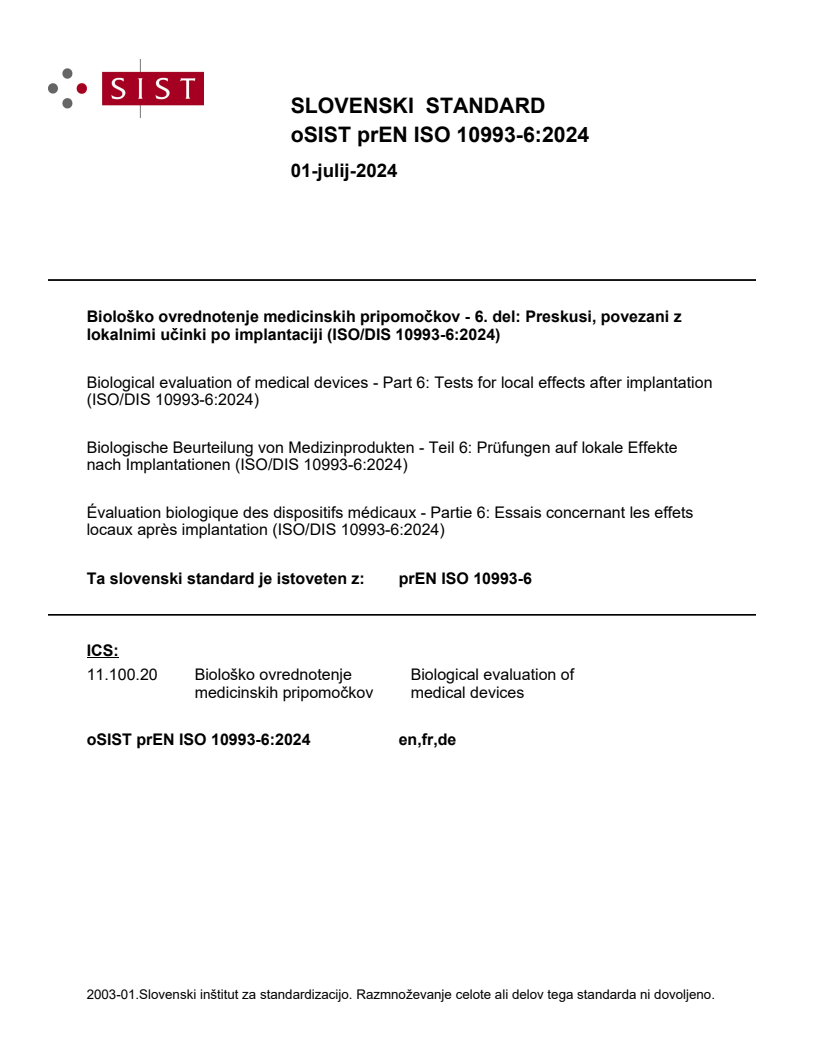
SLOVENSKI STANDARD
oSIST prEN ISO 10993-6:2024
01-julij-2024
Biološko ovrednotenje medicinskih pripomočkov - 6. del: Preskusi, povezani z
lokalnimi učinki po implantaciji (ISO/DIS 10993-6:2024)
Biological evaluation of medical devices - Part 6: Tests for local effects after implantation
(ISO/DIS 10993-6:2024)
Biologische Beurteilung von Medizinprodukten - Teil 6: Prüfungen auf lokale Effekte
nach Implantationen (ISO/DIS 10993-6:2024)
Évaluation biologique des dispositifs médicaux - Partie 6: Essais concernant les effets
locaux après implantation (ISO/DIS 10993-6:2024)
Ta slovenski standard je istoveten z: prEN ISO 10993-6
ICS:
11.100.20 Biološko ovrednotenje Biological evaluation of
medicinskih pripomočkov medical devices
oSIST prEN ISO 10993-6:2024 en,fr,de
2003-01.Slovenski inštitut za standardizacijo. Razmnoževanje celote ali delov tega standarda ni dovoljeno.
oSIST prEN ISO 10993-6:2024
oSIST prEN ISO 10993-6:2024
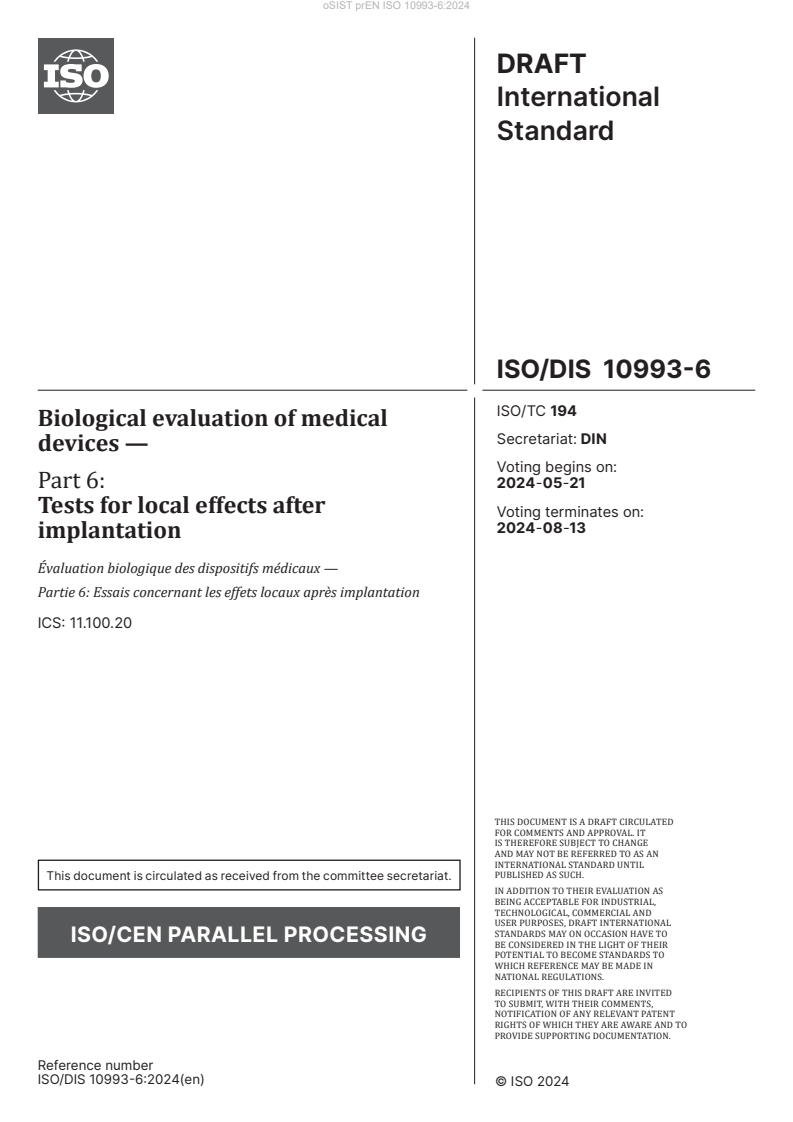
DRAFT
International
Standard
ISO/DIS 10993-6
ISO/TC 194
Biological evaluation of medical
Secretariat: DIN
devices —
Voting begins on:
Part 6: 2024-05-21
Tests for local effects after
Voting terminates on:
2024-08-13
implantation
Évaluation biologique des dispositifs médicaux —
Partie 6: Essais concernant les effets locaux après implantation
ICS: 11.100.20
THIS DOCUMENT IS A DRAFT CIRCULATED
FOR COMMENTS AND APPROVAL. IT
IS THEREFORE SUBJECT TO CHANGE
AND MAY NOT BE REFERRED TO AS AN
INTERNATIONAL STANDARD UNTIL
PUBLISHED AS SUCH.
This document is circulated as received from the committee secretariat.
IN ADDITION TO THEIR EVALUATION AS
BEING ACCEPTABLE FOR INDUSTRIAL,
TECHNOLOGICAL, COMMERCIAL AND
USER PURPOSES, DRAFT INTERNATIONAL
STANDARDS MAY ON OCCASION HAVE TO
ISO/CEN PARALLEL PROCESSING
BE CONSIDERED IN THE LIGHT OF THEIR
POTENTIAL TO BECOME STANDARDS TO
WHICH REFERENCE MAY BE MADE IN
NATIONAL REGULATIONS.
RECIPIENTS OF THIS DRAFT ARE INVITED
TO SUBMIT, WITH THEIR COMMENTS,
NOTIFICATION OF ANY RELEVANT PATENT
RIGHTS OF WHICH THEY ARE AWARE AND TO
PROVIDE SUPPORTING DOCUMENTATION.
Reference number
ISO/DIS 10993-6:2024(en)
oSIST prEN ISO 10993-6:2024
DRAFT
ISO/DIS 10993-6:2024(en)
International
Standard
ISO/DIS 10993-6
ISO/TC 194
Biological evaluation of medical
Secretariat: DIN
devices —
Voting begins on:
Part 6:
Tests for local effects after
Voting terminates on:
implantation
Évaluation biologique des dispositifs médicaux —
Partie 6: Essais concernant les effets locaux après implantation
ICS: 11.100.20
THIS DOCUMENT IS A DRAFT CIRCULATED
FOR COMMENTS AND APPROVAL. IT
IS THEREFORE SUBJECT TO CHANGE
AND MAY NOT BE REFERRED TO AS AN
INTERNATIONAL STANDARD UNTIL
PUBLISHED AS SUCH.
This document is circulated as received from the committee secretariat.
IN ADDITION TO THEIR EVALUATION AS
BEING ACCEPTABLE FOR INDUSTRIAL,
© ISO 2024
TECHNOLOGICAL, COMMERCIAL AND
USER PURPOSES, DRAFT INTERNATIONAL
All rights reserved. Unless otherwise specified, or required in the context of its implementation, no part of this publication may
STANDARDS MAY ON OCCASION HAVE TO
ISO/CEN PARALLEL PROCESSING
be reproduced or utilized otherwise in any form or by any means, electronic or mechanical, including photocopying, or posting on
BE CONSIDERED IN THE LIGHT OF THEIR
the internet or an intranet, without prior written permission. Permission can be requested from either ISO at the address below
POTENTIAL TO BECOME STANDARDS TO
WHICH REFERENCE MAY BE MADE IN
or ISO’s member body in the country of the requester.
NATIONAL REGULATIONS.
ISO copyright office
RECIPIENTS OF THIS DRAFT ARE INVITED
CP 401 • Ch. de Blandonnet 8
TO SUBMIT, WITH THEIR COMMENTS,
CH-1214 Vernier, Geneva
NOTIFICATION OF ANY RELEVANT PATENT
Phone: +41 22 749 01 11
RIGHTS OF WHICH THEY ARE AWARE AND TO
PROVIDE SUPPORTING DOCUMENTATION.
Email: copyright@iso.org
Website: www.iso.org
Published in Switzerland Reference number
ISO/DIS 10993-6:2024(en)
ii
oSIST prEN ISO 10993-6:2024
ISO/DIS 10993-6:2024(en)
Contents Page
Foreword .iv
Introduction .v
1 Scope . 1
2 Normative references . 1
3 Terms and definitions . 1
4 Common provisions for implantation test methods . 2
4.1 General .2
4.2 Preparation of samples for implantation .3
4.3 Selection of control materials .4
5 General aspects and requirements for implantation test . 4
5.1 Tissue and implantation site .4
5.2 Animal model .5
5.3 Test periods .6
5.4 Surgery and testing conditions .7
5.5 Evaluation .8
5.5.1 General .8
5.5.2 Macroscopic assessment .8
5.5.3 Implant retrieval and tissue sample collection .9
5.5.4 Microscopic assessment .10
5.5.5 Evaluation of responses .10
6 Test report .11
6.1 General .11
6.2 Test laboratory .11
6.3 Implant samples .11
6.4 Animals and implantation .11
6.5 Retrieval and histological procedure .11
6.6 Macroscopic and microscopic evaluation . 12
6.7 Final evaluation . 12
Annex A (normative) Test methods for implantation in subcutaneous tissue .13
Annex B (normative) Test method for implantation in muscle .15
Annex C (normative) Test method for implantation in bone . 17
Annex D (normative) Test method for implantation in brain tissue .20
Annex E (normative) Test methods for devices contacting peripheral nerve tissue .25
Annex F (informative) Examples of scoring systems used to support the evaluation of local
biological effects after implantation .29
Annex G (informative) Microscopic evaluation of tissue responses to implanted materials .33
Annex ZA (informative) Relationship between this European Standard the General Safety and
Performance Requirements of Regulation (EU) 2017/745 aimed to be covered .38
Bibliography . 41
iii
oSIST prEN ISO 10993-6:2024
ISO/DIS 10993-6:2024(en)
Foreword
ISO (the International Organization for Standardization) is a worldwide federation of national standards
bodies (ISO member bodies). The work of preparing International Standards is normally carried out through
ISO technical committees. Each member body interested in a subject for which a technical committee
has been established has the right to be represented on that committee. International organizations,
governmental and non-governmental, in liaison with ISO, also take part in the work. ISO collaborates closely
with the International Electrotechnical Commission (IEC) on all matters of electrotechnical standardization.
The procedures used to develop this document and those intended for its further maintenance are described
in the ISO/IEC Directives, Part 1. In particular, the different approval criteria needed for the different types
of ISO documents should be noted. This document was drafted in accordance with the editorial rules of the
ISO/IEC Directives, Part 2 (see www.iso.org/directives).
Attention is drawn to the possibility that some of the elements of this document may be the subject of patent
rights. ISO shall not be held responsible for identifying any or all such patent rights. Details of any patent
rights identified during the development of the document will be in the Introduction and/or on the ISO list of
patent declarations received (see www.iso.org/patents).
Any trade name used in this document is information given for the convenience of users and does not
constitute an endorsement.
For an explanation of the voluntary nature of standards, the meaning of ISO specific terms and expressions
related to conformity assessment, as well as information about ISO's adherence to the World Trade
Organization (WTO) principles in the Technical Barriers to Trade (TBT), see www.iso.org/iso/foreword.html.
This document was prepared by Technical Committee ISO/TC 194, Biological and clinical evaluation of medical
devices, in collaboration with the European Committee for Standardization (CEN) Technical Committee
CEN/TC 206, Biocompatibility of medical and dental materials and devices, in accordance with the Agreement
on technical cooperation between ISO and CEN (Vienna Agreement).
This fourth edition cancels and replaces the third edition (ISO 10993-6:2016), which has been technically
revised.
The main changes are as follows:
— Informative elements of the scope have been moved to a new introduction clause;
— New definitions for “comparative material”, “coupon”, “euthanasia”, “local effect”, “location marker” and
“steady- state” have been added to clause 3;
— New paragraph on the use of smaller compositionally representative samples or coupons has been added
to 4.2.2;
— New 4.3 “Selection of control materials” has been added;
— Clause 4 and Clause 5 have been revised;
— New Annex E “Test methods for devices contacting peripheral nerve tissue” and Annex G “Microscopic
evaluation of tissue responses to implanted materials” have been added;
— The old Annex E was moved to Annex F;
— Updated entries in the bibliography;
— Document has been revised editorially.
A list of all parts in the ISO 10993 series can be found on the ISO website.
Any feedback or questions on this document should be directed to the user’s national standards body. A
complete listing of these bodies can be found at www.iso.org/members.html.
iv
oSIST prEN ISO 10993-6:2024
ISO/DIS 10993-6:2024(en)
Introduction
The objective of the implantation test methods is to characterize the local tissue response after implantation of a
medical device/material including final integration, degradation, or absorption in an appropriate animal model.
The test sample is implanted into an anatomical site appropriate for the evaluation of the local effects of the
medical device (or portion of) in an animal.
The medical device material local effects are evaluated by a comparison of the tissue response caused by
a test sample to that caused by control materials used in medical devices whose clinical acceptability and
biocompatibility characteristics have been established.
Long-term animal studies designed to evaluate local biological effects might provide insight into some effects
(such as systemic toxicity, carcinogenicity, teratogenicity or mutagenicity). Careful study design can include
other relevant endpoints to reduce the number of animals used while accomplishing all study objectives. For
example, a systemic toxicity study that is designed to incorporate the methods and outcomes of implantation
testing might satisfy the requirements of this document and ISO 10993-11, when the requirements of both
standards are fulfilled.
v
oSIST prEN ISO 10993-6:2024
oSIST prEN ISO 10993-6:2024
DRAFT International Standard ISO/DIS 10993-6:2024(en)
Biological evaluation of medical devices —
Part 6:
Tests for local effects after implantation
1 Scope
This document specifies requirements for implantation test methods for preclinical assessment of the local
effects after implantation of materials intended for use in medical devices. In order to evaluate local tissue
responses from medical devices that are intended to be used where skin or mucosal tissue is breached, this
document is applicable when required.
This document applies to medical device/materials that require implantation evaluation and can be solid or
non-solid (such as porous materials, liquids, gels, pastes, powders, and particulates), absorbable/degradable
or non- absorbable, or can be tissue-engineered medical products (TEMPs).
These implantation tests are not intended to evaluate or determine the performance of the test sample in
terms of mechanical loading or functional performance. This document also does not provide guidance on
methods and study design to satisfy requirements for systemic toxicity, carcinogenicity, teratogenicity or
mutagenicity. However, the study designs can be modified to also assess other biocompatibility effects.
2 Normative references
The following documents are referred to in the text in such a way that some or all of their content constitutes
requirements of this document. For dated references, only the edition cited applies. For undated references,
the latest edition of the referenced document (including any amendments) applies.
ISO 10993-1, Biological evaluation of medical devices — Part 1: Evaluation and testing within a risk
management process
ISO 10993-2, Biological evaluation of medical devices — Part 2: Animal welfare requirements
ISO 10993-4, Biological evaluation of medical devices — Part 4: Selection of tests for interactions with blood
ISO 10993-12:2021, Biological evaluation of medical devices — Part 12: Sample preparation and reference
materials
ISO 10993-16, Biological evaluation of medical devices — Part 16: Toxicokinetic study design for degradation
products and leachables
3 Terms and definitions
For the purposes of this document, the terms and definitions given in ISO 10993-1, ISO 10993-2, ISO 10993-12,
ISO 10993-16 and the following apply.
ISO and IEC maintain terminological databases for use in standardization at the following addresses:
— ISO Online browsing platform: available at https:// www .iso .org/ obp
— IEC Electropedia: available at https:// www .electropedia .org/
oSIST prEN ISO 10993-6:2024
ISO/DIS 10993-6:2024(en)
3.1
absorb
action of a non-endogenous (foreign) material or substance, or its decomposition products passing through
or being assimilated by cells and/or tissue over time
3.2
comparative control
medical device with a history of safe clinical use that may be used as a point of comparison for a new medical
device seeking regulatory approval
3.3
coupon
smaller compositionally representative sample of a more complex and/or larger device that contains all the
materials, surface finishes, and processing as the final, finished device
3.4
degradation
decomposition of a material
[SOURCE: ISO 10993-9:2019, 3.1]
3.5
degradation product
intermediate or final substance which results from the physical, metabolic, and/or chemical decomposition
of a material or substance
[SOURCE: ISO/TS 37137-1:2021, 3.2, modified – agent has been replaced by substance.]
3.6
degrade
physically, metabolically, and/or chemically decompose a material or substance
[SOURCE: ISO/TS 37137-1:2021, 3.3]
3.7
euthanasia
humane killing of an animal by a method causing a minimum of physical and mental suffering
[SOURCE: ISO 10993-2:2022, 3.5]
3.8
local effects
tissue response to an implanted test sample that can be seen with gross pathology and histopathology at the
site of test sample administration or implantation
3.9
location marker
inert, non-absorbable material used to mark the location in tissue of an implanted material
3.10
steady-state
biologically stable condition wherein change in the test system’s cellular activity/morphology/features is
not detected over a period of time
4 Common provisions for implantation test methods
4.1 General
Prior to choosing to pursue implantation studies, consideration to the appropriate method and approach
to implantation studies should be given to ensure that the data collected covers the concerns for biological
reactivity. Evaluation of the type of data needed and the best way of collecting it to comply with the ISO 10993
oSIST prEN ISO 10993-6:2024
ISO/DIS 10993-6:2024(en)
series general framework of not doing animal testing unless this data cannot be obtained by other means,
should be performed. It is important that the study be planned in sufficient detail such that all relevant
information can be extracted from the use of each animal and each study (see ISO 10993-2, ISO 10993-11
and ISO 10993-16).
All animal studies shall be performed in a facility approved by a nationally recognized organization and
in accordance with all appropriate regulations dealing with laboratory animal welfare to comply with the
requirements of ISO 10993-2. These studies shall be performed under good laboratory practices or other
recognized, quality assurance systems.
The provisions of this clause shall apply to the test methods specified in Annex A, Annex B, Annex C, Annex D,
and Annex E.
4.2 Preparation of samples for implantation
4.2.1 Test sample and control article should be in a final finished state as described in ISO 10993-12. The
implant size and shape shall be documented and justified. For certain devices, clinically relevant dosing can
be considered. A justification should be provided to demonstrate mimicking a clinically relevant dose in the
implantation study.
Test samples for various implant sites are described in Annex A, Annex B, Annex C, Annex D and
Annex E. Physical properties (such as form, density, hardness, surface porosity and texture), geometrical
characteristics (form, shape and size), and composition can influence the character of the tissue response
to the test material and shall be recorded and taken into account when the response is characterized.
Control articles should be matched as closely as reasonably possible for physical properties and geometrical
characteristics. Otherwise, a well characterized material with a well characterized response can be used,
such as High Density Polyethylene (HDPE).
Additional control articles may be included in the study to help interpret tissue reactions (e.g., in case of
combination drugs, an additional control such as a placebo device (without drug) should be considered).
4.2.2 Each implant shall be manufactured, processed, cleaned of contaminants, and sterilized by the
method intended for the final product and this shall be confirmed in the study documentation. After final
preparation and sterilization, the implant samples shall be handled aseptically and in such a way as to
ensure that they are not damaged or contaminated in any way prior to or during implantation.
The use of smaller test sample or test coupons that are consistent with the requirements as described in
ISO 10993-12 may be relevant if the medical device to be tested cannot be tested as is, due to size or complex
geometry. The test samples or test coupons shall contain all tissue-contacting materials and surface finishes
as in the final, finished medical device. For medical devices comprising two or more different materials,
implanted test articles should be of similar composition, surface finish, and include each individual material
to the final product. Alternatively, with multiple materials it may be necessary to implant each material
and its relevant surface finish as separate coupons. The potential for synergies and interactions of different
materials in the final product shall be considered in the choice of test sample.
NOTE Refer to the respective annexes for guidance on the number of test and control samples for each material
and implantation period.
4.2.3 For materials used as scaffolds for tissue-engineered medical products, it may be appropriate not
to use the final preparation pre-populated with cells and/or proteins, as the immune reaction of the animal
to human cellular/protein components of such products and the reaction of the cells to the animal may
interfere with the resulting local tissue response, making it difficult to interpret.
Note Implantation in an immune-deficient animal, e.g., athymic rodent, can be an option to avoid the xenograft
responses, if justified.
4.2.4 For multicomponent material device designed to be cured prior to placement, the components
shall be mixed before use and allowed to set before implantation. However, materials that are designed to
polymerize in situ (e.g., bone cements, many dental materials, tissue sealants and glues) shall be introduced
oSIST prEN ISO 10993-6:2024
ISO/DIS 10993-6:2024(en)
in a manner such that in situ polymerization occurs. The procedure used shall be justified and documented.
When relevant vertical standards exist, refer to those as guidance for biological specific evaluation (e.g.,
ISO 15798, ISO 11979-5, ISO 7405).
4.2.6 Evaluation shall be performed by comparing the tissue reaction to that of a similar material whose
clinical acceptability and biocompatibility characteristics have been established.
NOTE For further guidance, see ISO 10993-12.
4.2.7 The geometrical and physical characteristics such as shape, and especially the surface condition
(including porosity and texture) of the article control(s), should be as similar to that of the implant test
samples as is practical, with any deviations being explained and justified.
4.3 Selection of control materials
The process of implanting any material in tissue induces some degree of cellular response. In the evaluation
of material local effects after implantation, the choice of comparative control samples is important in
determining the acceptability of the observed tissue reaction to the test sample. The comparative control
chosen should be similar in form and shape characteristics, which can greatly affect its tissue reaction. For
example, reference materials as specified in ISO 10993-12:2021, Annex A can provide a good control for solid,
smooth, non-absorbable materials. Conversely, the reaction could be likely different if it is used to compare
against a non-absorbable/degradable hernia mesh due to the differing physical form characteristics. Ideally,
a commercially available material should be used as a control so the tissue reaction is similar to what has
been clinically proven. For non-absorbable medical devices/materials, a stable non-absorbable comparative
material shall be used as a comparative control (see Annex A, Annex B, Annex C, Annex D, and Annex E).
Since absorbable materials encounter changing tissue responses as degradation proceeds at rates that differ
based on composition, processing, and sterilization techniques, similar absorbable comparative controls
should be considered.
For absorbable medical devices/materials, an absorbable medical device/material should be used as a
comparative control. The absorption rate of the control material/medical device should be similar to the test
material/medical device (see ISO/TS 37137-1). Alternatively, a non-absorbable comparative control can be
used, if justified (e.g., there are no clinically relevant absorbable controls). If a comparative control is used,
typically reference materials as specified in ISO 10993-12:2021, Annex A are also implanted into the animal
for comparison and serving as a procedural control yielding a total of 3 separate articles included in the
study. For novel materials/medical devices, if a commercially available comparator material/medical device
does not exist, the choice of a control that is as close as possible is preferred. The nature of any adverse
inflammatory response or high reactivity rating or similar histopathological evaluation conclusion should
be discussed in the context of the control article chosen. The choice of control shall be documented and
justified. If no control or a sham control is used, this also shall be documented and justified.
5 General aspects and requirements for implantation test
5.1 Tissue and implantation site
5.1.1 The test sample shall be implanted into the tissues most relevant to the intended clinical use of
the material. The justification for the choice of sample numbers, tissue, implantation sites and test period
shall be documented. Test methods for various implantation sites are given in Annex A, Annex B, Annex C,
Annex D, and Annex E. If other implantation sites are chosen, the general scientific principles behind the
test methods described in Annex A, Annex B, Annex C, Annex D, and Annex E shall still be adhered to and a
justification be provided for selecting an anatomical location that does not align with the use of the device.
NOTE For some devices, there are vertical standards prescribing specific implant studies to evaluate local tissue
responses, e.g., intraocular lens implant (see ISO 11979-5) and dental usage tests (see ISO 7405). These studies can be
used to satisfy the requirements in ISO 10993-6.
oSIST prEN ISO 10993-6:2024
ISO/DIS 10993-6:2024(en)
5.1.2 For absorbable materials, the implantation site shall be marked in a manner suitable for identification
of the site at the end of the designated time periods. The use of a non-invasive permanent skin marker and/
or a template marking the placement of the sample is recommended for short-term study intervals only. This
method of marking is of limited utility since topical marker can come off as skin exfoliates. Additionally, in
many laboratory animals, the loose highly mobile skin limits the precision of marking site deeper than skin.
In most circumstances, a location marker comprised of an appropriate non-absorbable control article (e.g.,
HDPE 1 mm by 2 mm by 5 mm, polypropylene suture, gold band, clips) may be used to identify the location of
the implant site. These location markers can be removed without inducing artefacts to the test article-tissue
interface prior to histology processing.
5.1.3 A sham surgical procedure might be used to evaluate the impact of the procedure on the tissue
involved; in these cases, the specific justification shall be provided. If a sham surgical procedure is
performed, the same implantation procedure that is used for the test or control should be used for the sham
procedure.
5.2 Animal model
5.2.1 All aspects of animal care and accommodation shall be in accordance with ISO 10993-2.
5.2.2 Animals are used to evaluate local effects following implantation and are described as animal
models in the context of this document. In general, small laboratory animals such as mice, rats, guinea pigs,
or rabbits are preferred. The use of larger animals such as dogs, sheep, goats, or pigs may be justified based
upon special scientific considerations of the material under study, or if needed to accommodate implant size,
with whole device testing.
5.2.3 Select an animal species in line with the principles set out in ISO 10993-2, giving due consideration
to the size of the implant test samples the number of implants per animal, the intended duration of the test in
relation to the expected lifespan of the animals, as well as potential species' differences regarding biological
response. The number of animals and implant sites within should be the minimum to account for site to site
and animal to animal variability.
5.2.4 For short-term testing, animals such as rodents or rabbits are commonly used. For long-term
testing, animals such as rodents, rabbits, dogs, sheep, goats, pigs, and other animals with a relatively long
life expectancy are suitable.
5.2.5 Before starting an animal study with degradable materials, relevant information from in vitro
degradation studies should be considered for estimating relevant retrieval timing. For absorbable materials,
a pilot study in rodents may be considered to determine the expected rate of degradation before embarking
on studies in larger animals.
NOTE Guidance regarding in vitro degradation characterization can be found in ISO 13781 and ASTM F1635 for
[23] [25]
hydrolysable polymeric constructs and in ASTM F3268 for absorbable metallic constructs. General guidance
regarding the linkage of in vitro observations with the determination of relevant in vivo retrieval intervals can be
found in ISO/TS 17137:2021 (see Figure 2 and 5.1, 5.3, 5.4, and 5.6). Additional, guidance on selection of implantation
[24]
time points for absorbable materials can be found in ISO/TS 37137-1:2021, 8.7 and ASTM F1983, 8.3.1 .
5.2.6 The samples of test and control materials shall be implanted under the same conditions in animals of
the same species and of the same age, sex, and strain in corresponding anatomical sites. The number and size
of implants inserted into an animal depends on the size of the species and the anatomical location. Whenever
possible, the control and the test samples should be implanted into the same animal unless systemic toxicity
endpoints are also evaluated in the study. In cases where both implant and systemic toxicity endpoints are
assessed, control and test samples should be implanted into separate animals. Guidance on evaluation for
systemic toxicity can be found in ISO 10993-11.
5.2.7 However, when a neuroimplantation study (see Annex D and Annex E) is conducted or when the local
effects after implantation are investigated as part of a systemic toxicity study by implantation, control and
oSIST prEN ISO 10993-6:2024
ISO/DIS 10993-6:2024(en)
test samples shall not be placed in the same animal. Histological assessments should follow best practices
for processing and analysis of central nervous system tissues (see Annex D) or peripheral nervous tissues
(see Annex E and [59]).
5.3 Test periods
5.3.1 The test period shall be determined by the likely clinical exposure time or be continued until or
beyond when a steady-state with respect to the biological response has been reached. The time points
selected shall be explained and justified.
5.3.2 The local biological response to implanted materials depends both on the properties of the materials
and on the response to the associated trauma of surgery. The tissue configuration in the vicinity of an implant
changes with the time elapsed after surgery. During the first two weeks after implantation, the reaction
due to the surgical procedure itself may be difficult to distinguish from the tissue reaction evoked by the
implant. The time to reach a steady-state may be tissue- and device design-dependent. A justification for the
time point selected for assessment in a specific tissue (i.e., muscle, bone) shall be documented. In muscle and
connective tissue, depending on the species, the design of the device, and the severity of the surgical trauma,
a steady-state can be seen in the tissue-device/material interface (including the microscopic maturation of
immature fibrous tissue and associated remodeling) after 9 weeks to 12 weeks. Implantation in bone tissue
may need longer observation periods before a steady-state is reached.
5.3.3 For non-absorbable materials, the short-term responses are normally assessed from 1 week up to
4 weeks and the long-term responses in tests exceeding 12 weeks.
5.3.4 For absorbable materials, the test period shall be related to the estimated degradation time of
the test product at a clinically relevant implantation site. When determining the time points for sample
evaluation, an estimation of the degradation time shall be made. This can be accomplished in vitro by real-
time or accelerated degradation studies or in certain circumstances by mathematical modelling. In general,
study duration should extend up to or beyond the point of complete absorption. The evaluation period for
absorbable materials will depend in part on the degradation rate of the materials. Study intervals should
span a significant portion of the degradation time frame for the implant, and shall include, as a minimum,
the following time points:
a) Early time frame (where there is no or minimal degradation) — For absorbable materials, usually a
study interval of between 1 week and 4 weeks post-implantation should be used to assess the early
tissue response.
If a device completely absorbs within 4 weeks of implantation, a short-term implant study may be
considered as an evaluation point; additional durations may be omitted from the implantation studies.
b) Mid time frame (when degradation is taking place) — Subsequent study intervals for absorbable devices
should be guided by the degradation profile of the specific absorbable material. The target interval
should allow assessment of histological response when the tissue response is expected to be most
pronounced (e.g., substantial structural disruption and/or fragmentation of the device is most likely to
occur). Implants with longer-term degradation profiles may require multiple assessment time points,
with intervals targeted in accordance with the expected pattern of degradation.
When a device with multiple materials with differing absorption rates is implanted, implant intervals
reflecting the degradation profile of those components should be included.
c) Late time frame (when the implant is essentially absorbed) — This interval is targeted to observe when
minimal amounts of the absorbable component remain at the implant site.
Gross and microscopic evaluation after complete implant absorption is highly desirable. However, in the
absence of complete absorption, the overall data collected should be sufficient to allow characterization
of the local effects after implantation if:
— the affected tissue’s response, structure, and function have achieved an acceptable steady-state
condition, and
oSIST prEN ISO 10993-6:2024
ISO/DIS 10993-6:2024(en)
— the absorbable material and/or its degradation products are in a state of limited visually-light-
microscopy presence.
NOTE In vivo degradation can occur over a long period of time, sometimes more than one year. Additional
animals to extend the observation period (intervals “to-be-determined” group) can be beneficial if the
implant has not been completely absorbed within the expected investigational time period.
In those situations when the material is not fully absorbed within the late time frame, an appropriate
scientific justification can be included for ending the study and the estimated percentage (%) of
remaining absorbable material should be reported.
Long-term studies that span a significant portion of the degradation time frame for the implant are
recommended. Implantation of in vitro pre-degraded material (for instance, up to 50 % weight loss or
50 % loss of mechanical strength) may be considered on a case-by-case basis in order to more rapidly
observe late stage events after implantation. However, these studies do not replace studies that
characterize the real-time in vivo degradation profile of the absorbable device.
5.3.5 Characterization of an absorbable device’s degradation process may not be applicable to the
evaluation of the local effects of the same absorbable material when used in combination: with a drug as
carrier for drug release, a scaffold for tissue-engineered medical products, or a surface coating for non-
absorbable implants. Since combinations of devices with drugs and/or cells can introduce new issues, the
appropriate regulatory authorities should be consulted regarding study designs for absorbable combination
products.
5.3.6 Although this document does not address the issues of systemic toxicity given in ISO 10993-11, it is
recommended that the information required to meet this document can be obtained from an appropriately
designed systemic toxicity studies using implantation.
5.3.7 For long-term studies, examples of generally accepted observation periods for non-absorbable
materials are given in Table 1. Animals should be humanely sacrificed at each time point, in line with
ISO 10993-2. Serial harvest under general anaesthesia with recovery may be acceptable under special
circumstances, which shall be documented and justified.
Table 1 — Possible test periods for long-term implantation of materials
a
Implantation period in weeks
Species
13 26 52 78 104
Mice X X X — —
Rats X X X — —
Guinea pigs X X X — —
Rabbits X X X X X
Dogs X X X X X
Sheep X X X X X
Goats X X X X X
Pigs X X X X X
a
These implantation periods are commonly used; however, other periods may be applicable
based on the specific characteristics of the test material. Depending on the intended use of the test
material, not all implantation periods may be necessary.
5.4 Surgery and testing conditions
5.4.1 Surgery shall be performed under general anaesthesia. If another type of anaesthesia is used,
this shall be justified and shall be in compliance with ISO 10993-2. The specific insertion or implantation
procedures for subcutaneous, intramuscular, bone, or neural implantation are described in Annex A,
Annex B, Annex C, Annex D, and Annex E respectively.
oSIST prEN ISO 10993-6:2024
ISO/DIS 10993-6:2024(en)
5.4.2 The number of implants per animal and the number of animals per observation period are described
in Annex A, Annex B, Annex C, Annex D, and Annex E. If other implantation sites are chosen, the general
scientific principles behind the test methods described in Annex A, Annex B, Annex C, Annex D, and Annex E
shall still be adhered to and a justification be provided for establishing the number of implants per animal
and the number of animals per observation period. A sufficient number of test and control samples shall be
implanted to ensure that the final number of samples to be evaluated will give valid results.
5.4.3 The surgical technique can profoundly influence the result of any implantation procedure. Surgery
shall be carried out under aseptic conditions and in a manner that minimizes trauma at the implant site.
Remove the hair from the surgical area by clipping, shaving, or other mechanical means. Disinfect the
exposed area of skin with an appropriate antiseptic. Ensure that the implants or wound surfaces do not
come in contact with the hair. After surgery close the wound using either sutures or wound clips, taking
precautions to maintain aseptic conditions. Use of antibiotics should be justified.
5.4.4 The health of the animals shall be monitored, observed and recorded at regular intervals daily
during the study. Following surgery, each animal shall be observed at a minimum daily during the test
period, and observed for any development of clinical signs that may necessitate veterinary intervention and/
or early euthanasia. Any abnormal findings shall be recorded and discussed for their potential influence on
the results obtained and described in the test reports.
5.4.5 Body-weight measurements should be taken at study-relevant intervals. The use of post-operative
analgesics shall be in line with the requirements of ISO 10993-2.
5.4.6 At the end of the experimental period, euthanize the animals according to current acceptable
methods of euthanasia (see [60]), in line with the principles set out in ISO
...
Questions, Comments and Discussion
Ask us and Technical Secretary will try to provide an answer. You can facilitate discussion about the standard in here.
Loading comments...