

SIST EN 301 721 V2.2.1:2026
(Main)Satellite Earth Stations and Systems (SES) - Mobile Earth Stations (MES) providing Low Bit Rate Data Communications (LBRDC) using Low Earth Orbiting (LEO) satellites operating below 1 GHz frequency band - Harmonised Standard for access to radio spectrum
- Abstract
The present document specifies technical characteristics and methods of measurements for Mobile Earth Stations (MES) providing Low Bit Rate Data Communications (LBRDC) using Low Earth Orbit (LEO) satellites and which have the following characteristics:
- the MES as covered by the present document are a Based MES (BMES), a Vehicle mounted MES (VMES), or a Portable MES (PMES);
- the MESs operate through satellites in Low Earth Orbit (LEO) as part of a network providing Low Bit Rate Data Communications (LBRDC);
- these radio equipment are designed to operate in all or any part of the frequency bands given in table 1.
- The MESs have to be part of a satellite network and controlled and monitored by a Network Control Facility (NCF). The specification of the NCF is outside the scope of the present document.
NOTE 1: The acronyms "MSS" and "mss" refer to mobile satellite service (See list of abbreviations). Capital letters "MSS" refer to Primary MSS service. Lower case "mss" refers to secondary MSS service.
The present document is intended to cover the provisions of article 3.2 of Directive 2014/53/EU [i.3] (RE Directive).
NOTE 2: The relationship between the present document and essential requirements of article 3.2 of the Directive 2014/53 [i.3] is given in Annex A.
- Status
- Published
- Public Enquiry End Date
- 27-Sep-2026
- Publication Date
- 05-Oct-2026
- Technical Committee
- MOC - Mobile Communications
- Current Stage
- 6060 - National Implementation/Publication (Adopted Project)
- Start Date
- 05-Oct-2026
- Due Date
- 10-Dec-2026
- Completion Date
- 06-Oct-2026
Buy Documents
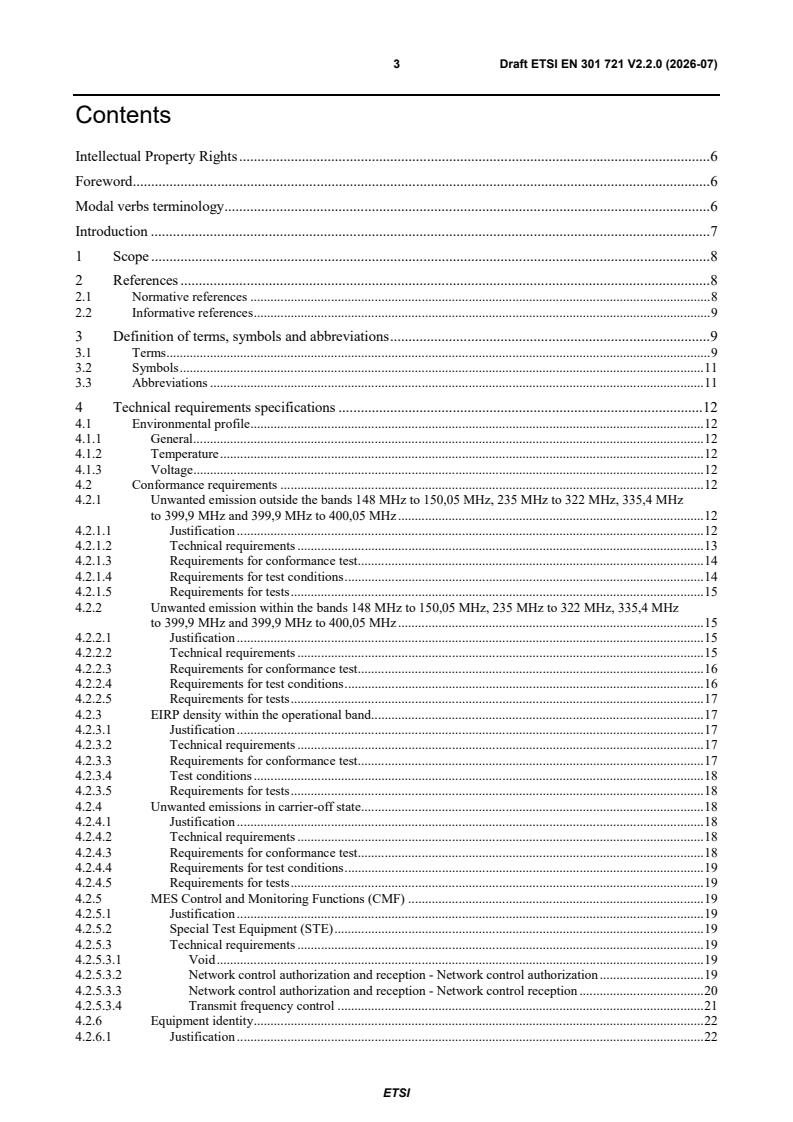
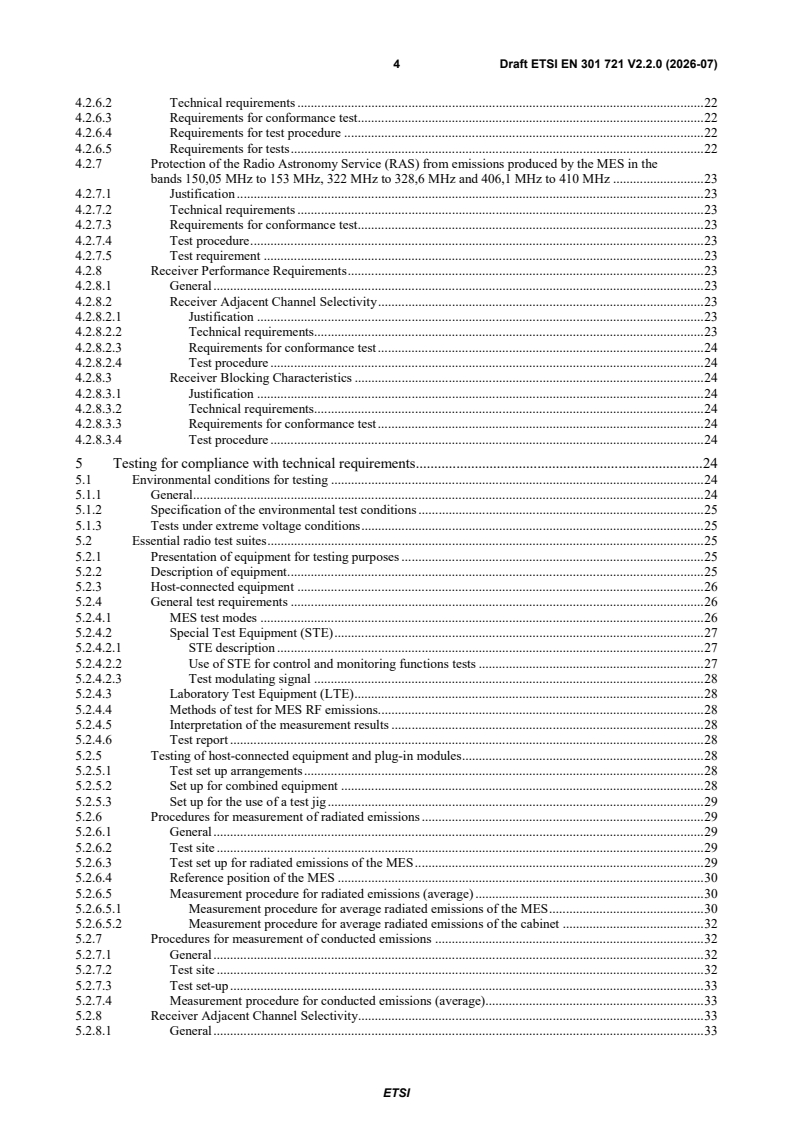
ETSI EN 301 721 V2.2.0 (2026-07) - Satellite Earth Stations and Systems (SES); Mobile Earth Stations (MES) providing Low Bit Rate Data Communications (LBRDC) using Low Earth Orbiting (LEO) satellites operating below 1 GHz frequency band; Harmonised Standard for access to radio spectrum
ETSI EN 301 721 V2.2.1 (2026-09) - Satellite Earth Stations and Systems (SES); Mobile Earth Stations (MES) providing Low Bit Rate Data Communications (LBRDC) using Low Earth Orbiting (LEO) satellites operating below 1 GHz frequency band; Harmonised Standard for access to radio spectrum

SIST EN 301 721 V2.2.1:2026 is the Slovenian identical adoption of ETSI EN 301 721 V2.2.1, published by SIST. It is a Harmonised Standard for Mobile Earth Stations (MES) that provide Low Bit Rate Data Communications (LBRDC) with Low Earth Orbit (LEO) satellites operating below 1 GHz.
The standard specifies technical characteristics and measurement methods for BMES, VMES and PMES, with a focus on radio-spectrum access and conformity with Directive 2014/53/EU (RED) Article 3.2. In practice, it is used to design, test and assess satellite terminals that are controlled and monitored by a Network Control Facility (NCF).
What does SIST EN 301 721 V2.2.1:2026 specify?
SIST EN 301 721 V2.2.1:2026 sets the technical requirements and measurement methods for MES used in LBRDC networks with LEO satellites. It applies to based, vehicle-mounted and portable terminals that operate in the listed transmit and receive frequency ranges and that rely on network control.
The scope also makes clear that the NCF itself is outside the standard, and that the document is not about installation of the MES. That matters because the standard is aimed at the radio equipment and its test methods, not the wider network design or site installation.
The document is organized into five clauses and five informative annexes.
| Annex | What it covers |
|---|---|
| Annex A | Relationship between the standard and the essential requirements of Directive 2014/53/EU |
| Annex B | Maximum measurement uncertainty |
| Annex C | Vibration |
| Annex D | Bibliography |
| Annex E | Change history |
What are the key requirements of SIST EN 301 721 V2.2.1:2026?
SIST EN 301 721 V2.2.1:2026 combines environmental limits, RF emission limits, control functions and receiver performance checks. For a manufacturer or test lab, the main task is to show that the MES behaves correctly in normal use and stays within the specified emission and reception limits under the defined test conditions.
Environmental operation
Clause 4.1 requires compliance across the intended environmental profile, including temperature and supply voltage. The temperature range is tied to cold and dry-heat test conditions from IEC 60068-2-1 and IEC 60068-2-2, and the voltage range must be stated for the intended use. In practice, this means the equipment description must define the electrical limits and the tests must cover those limits.
Unwanted emissions and EIRP density
Clauses 4.2.1, 4.2.2 and 4.2.3 control unwanted emissions outside and within the operational bands, and the EIRP density in the operational band. The limits are given separately for FDMA and DS-SSMA cases, and some limits depend on whether the bit rate is up to 2,4 kbps or above 2,4 kbps. This matters because the correct limit depends on the signal type and operating band, so the test plan has to match the terminal design.
Carrier-off emissions
Clause 4.2.4 limits unwanted emissions when the MES is powered on but not transmitting. The intent is to protect other services from leakage or spurious output while the terminal is idle. In practice, a terminal cannot only pass in active transmission mode - it also has to stay quiet in carrier-off state.
Control and Monitoring Functions
Clause 4.2.5 is central to the standard. It requires the MES to start in a controlled non-transmitting state after power-on, to stop transmitting when it loses the network control channel, to respond to transmission disable and enable commands from the NCF, and to set its transmit frequency according to the NCF command so that the nominated bandwidth stays inside the authorized operational band. For users, this means the terminal must not transmit freely on its own and must obey network control.
Equipment identity
Clause 4.2.6 requires each MES to carry a unique MES Identification Code (MIC) that the user cannot alter through any accessible procedure. This supports traceability and helps identify equipment that could cause uncontrolled transmissions. In practice, the device must be able to prove its identity when commanded by the network.
Protection of the Radio Astronomy Service
Clause 4.2.7 requires means to suppress transmission to protect radio astronomy observations in the adjacent protected bands. The suppression itself is handled through the transmission-disable behavior in the CMF requirements. This links spectrum protection to the same control mechanism used for network safety.
Receiver performance
Clause 4.2.8 covers receiver adjacent channel selectivity and receiver blocking characteristics. The receiver must keep SNR degradation within the stated limits when an adjacent-channel signal or a blocking CW interferer is present. For a buyer or test lab, this shows that the MES is not only checked for emissions, but also for its ability to keep receiving when the band is crowded.
What terms does SIST EN 301 721 V2.2.1:2026 define?
- Carrier-off state - the radio state in which the MES is powered but not actually transmitting a carrier.
- Control and Monitoring Function (CMF) - the functions that let the NCF authorize, enable, disable and control MES transmission.
- Equivalent Isotropically Radiated Power (EIRP) - transmitter power multiplied by antenna gain, expressed as if the signal were radiated equally in all directions.
- Network Control Facility (NCF) - the network-side control point that sends the control messages and commands used by the MES.
- Nominated bandwidth - the bandwidth allocated to the MES transmission for its intended use, wide enough to include the relevant spectral elements and frequency stability.
- Portable MES (PMES) - an MES intended to be portable, powered by a standalone battery and generally self-contained.
- Vehicle Mounted MES (VMES) - an MES intended to be installed on a vehicle.
Who uses SIST EN 301 721 V2.2.1:2026?
SIST EN 301 721 V2.2.1:2026 is used by MES manufacturers, satellite network operators, test laboratories and conformity assessors working under the RED. It is also relevant to quality and compliance teams that need to define test configurations, prepare technical documentation and verify that the equipment obeys network control.
It is especially useful where the MES must be validated for spectrum access, controlled transmission, emission limits and receiver robustness in LBRDC services using LEO satellites.
What changed in SIST EN 301 721 V2.2.1:2026 from the previous edition?
SIST EN 301 721 V2.2.1:2026 is based on ETSI EN 300 721 (V2.1.1) from 2016. The change history records later revisions leading to V2.2.1, including revisions to meet RED requirements, alignment of radiated test-site references, updates to the preferred test site and the OATS reference, and editorial revisions.
Which standards are used with SIST EN 301 721 V2.2.1:2026?
- IEC 60068-2-1 (2025) - supplies the cold test method used for the temperature requirement.
- IEC 60068-2-2 (2025) - supplies the dry-heat test method used for the temperature requirement.
- CISPR 16-1-5:2014+AMD1:2016 CSV - defines antenna calibration sites and reference test sites used in radiated measurements.
- Directive 2014/53/EU - the RED legal framework that the harmonised standard supports.
- Commission Implementing Decision C(2015) 5376 - the standardisation request under which the harmonised standard was prepared.
- Recommendation ITU-R M.1039-1 - provides sharing context for mobile service and non-GSO satellite earth stations below 1 GHz.
- ETSI EN 300 721 (V2.1.1) (2016) - the earlier related ETSI standard named as the basis for this document.
- IEC 60068-2-64:2008+AMD1:2019 CSV - supports the vibration recommendations in Annex C.
What does the SIST EN 301 721 V2.2.1:2026 document contain?
The document contains the scope, references, definitions, technical requirements and test methods for MES used with LEO satellites below 1 GHz. It gives frequency-band-specific emission limits, control-and-monitoring procedures, identity checks and receiver performance tests.
It also includes detailed test arrangements and procedures for radiated and conducted emissions, host-connected equipment, test modes, special test equipment (STE), and measurement interpretation. Annex B adds measurement uncertainty guidance, and Annex C adds vibration guidance for design.
Buy Documents
ETSI EN 301 721 V2.2.0 (2026-07) - Satellite Earth Stations and Systems (SES); Mobile Earth Stations (MES) providing Low Bit Rate Data Communications (LBRDC) using Low Earth Orbiting (LEO) satellites operating below 1 GHz frequency band; Harmonised Standard for access to radio spectrum
ETSI EN 301 721 V2.2.1 (2026-09) - Satellite Earth Stations and Systems (SES); Mobile Earth Stations (MES) providing Low Bit Rate Data Communications (LBRDC) using Low Earth Orbiting (LEO) satellites operating below 1 GHz frequency band; Harmonised Standard for access to radio spectrum
Get Certified
Connect with accredited certification bodies for this standard

ANCE
Mexican certification and testing association.

Intertek Slovenia
Intertek testing, inspection, and certification services in Slovenia.

LNE (Laboratoire National de Métrologie et d'Essais)
French national laboratory for metrology and testing.
Sponsored listings
Frequently Asked Questions
SIST EN 301 721 V2.2.1:2026 is a standard published by the Slovenian Institute for Standardization (SIST). Its full title is "Satellite Earth Stations and Systems (SES) - Mobile Earth Stations (MES) providing Low Bit Rate Data Communications (LBRDC) using Low Earth Orbiting (LEO) satellites operating below 1 GHz frequency band - Harmonised Standard for access to radio spectrum". This standard covers: The present document specifies technical characteristics and methods of measurements for Mobile Earth Stations (MES) providing Low Bit Rate Data Communications (LBRDC) using Low Earth Orbit (LEO) satellites and which have the following characteristics: - the MES as covered by the present document are a Based MES (BMES), a Vehicle mounted MES (VMES), or a Portable MES (PMES); - the MESs operate through satellites in Low Earth Orbit (LEO) as part of a network providing Low Bit Rate Data Communications (LBRDC); - these radio equipment are designed to operate in all or any part of the frequency bands given in table 1. - The MESs have to be part of a satellite network and controlled and monitored by a Network Control Facility (NCF). The specification of the NCF is outside the scope of the present document. NOTE 1: The acronyms "MSS" and "mss" refer to mobile satellite service (See list of abbreviations). Capital letters "MSS" refer to Primary MSS service. Lower case "mss" refers to secondary MSS service. The present document is intended to cover the provisions of article 3.2 of Directive 2014/53/EU [i.3] (RE Directive). NOTE 2: The relationship between the present document and essential requirements of article 3.2 of the Directive 2014/53 [i.3] is given in Annex A.
The present document specifies technical characteristics and methods of measurements for Mobile Earth Stations (MES) providing Low Bit Rate Data Communications (LBRDC) using Low Earth Orbit (LEO) satellites and which have the following characteristics: - the MES as covered by the present document are a Based MES (BMES), a Vehicle mounted MES (VMES), or a Portable MES (PMES); - the MESs operate through satellites in Low Earth Orbit (LEO) as part of a network providing Low Bit Rate Data Communications (LBRDC); - these radio equipment are designed to operate in all or any part of the frequency bands given in table 1. - The MESs have to be part of a satellite network and controlled and monitored by a Network Control Facility (NCF). The specification of the NCF is outside the scope of the present document. NOTE 1: The acronyms "MSS" and "mss" refer to mobile satellite service (See list of abbreviations). Capital letters "MSS" refer to Primary MSS service. Lower case "mss" refers to secondary MSS service. The present document is intended to cover the provisions of article 3.2 of Directive 2014/53/EU [i.3] (RE Directive). NOTE 2: The relationship between the present document and essential requirements of article 3.2 of the Directive 2014/53 [i.3] is given in Annex A.
SIST EN 301 721 V2.2.1:2026 is classified under the following ICS (International Classification for Standards) categories: 33.060.30 - Radio relay and fixed satellite communications systems. The ICS classification helps identify the subject area and facilitates finding related standards.
SIST EN 301 721 V2.2.1:2026 is available in PDF format for immediate download after purchase. The document can be added to your cart and obtained through the secure checkout process. Digital delivery ensures instant access to the complete standard document.
Standards Content (Sample)
Contents
- Introduction
- 8 Draft ETSI EN 301 721 V2.2.0 (2026-07)
- 1 Scope
- 2 References
- 2.1 Normative references
- 9 Draft ETSI EN 301 721 V2.2.0 (2026-07)
- 2.2 Informative references
- 3 Definition of terms, symbols and abbreviations
- 3.1 Terms
- 10 Draft ETSI EN 301 721 V2.2.0 (2026-07)
- 11 Draft ETSI EN 301 721 V2.2.0 (2026-07)
- 3.2 Symbols
- 3.3 Abbreviations
- 12 Draft ETSI EN 301 721 V2.2.0 (2026-07)
- 4 Technical requirements specifications
- 4.1 Environmental profile
- 4.2 Conformance requirements
- 13 Draft ETSI EN 301 721 V2.2.0 (2026-07)
- 14 Draft ETSI EN 301 721 V2.2.0 (2026-07)
- 15 Draft ETSI EN 301 721 V2.2.0 (2026-07)
- 16 Draft ETSI EN 301 721 V2.2.0 (2026-07)
- 17 Draft ETSI EN 301 721 V2.2.0 (2026-07)
- 18 Draft ETSI EN 301 721 V2.2.0 (2026-07)
- 19 Draft ETSI EN 301 721 V2.2.0 (2026-07)
- 20 Draft ETSI EN 301 721 V2.2.0 (2026-07)
- 21 Draft ETSI EN 301 721 V2.2.0 (2026-07)
- 22 Draft ETSI EN 301 721 V2.2.0 (2026-07)
- 1 A network control channel shall be activated with the MES
- 3 The test shall be repeated for the other transmit
- 23 Draft ETSI EN 301 721 V2.2.0 (2026-07)
- 24 Draft ETSI EN 301 721 V2.2.0 (2026-07)
- 5 Testing for compliance with technical requirements
- 5.1 Environmental conditions for testing
- 25 Draft ETSI EN 301 721 V2.2.0 (2026-07)
- 5.2 Essential radio test suites
- 26 Draft ETSI EN 301 721 V2.2.0 (2026-07)
- 27 Draft ETSI EN 301 721 V2.2.0 (2026-07)
- 28 Draft ETSI EN 301 721 V2.2.0 (2026-07)
- 29 Draft ETSI EN 301 721 V2.2.0 (2026-07)
- 30 Draft ETSI EN 301 721 V2.2.0 (2026-07)
- 31 Draft ETSI EN 301 721 V2.2.0 (2026-07)
- 32 Draft ETSI EN 301 721 V2.2.0 (2026-07)
- 33 Draft ETSI EN 301 721 V2.2.0 (2026-07)
- 34 Draft ETSI EN 301 721 V2.2.0 (2026-07)
- 35 Draft ETSI EN 301 721 V2.2.0 (2026-07)
- 36 Draft ETSI EN 301 721 V2.2.0 (2026-07)
- 1 Unwanted emission outside the bands 148 MHz 3.2 4.2.1 U
- 2 Unwanted emission within the bands 148 MHz 3.2 4.2.2 U
- 3 EIRP density within the operational band 3.2 4.2.3 U
- 4 Unwanted emissions in carrier-off state 3.2 4.2.4 U
- 5 Network control authorization 3.2 4.2.5.3.2 U
- 6 Transmission disable/enable 3.2 4.2.5.3.3.1 U
- 7 Transmit frequency control 3.2 4.2.5.3.4 U
- 8 Equipment identity 3.2 4.2.6 U
- 9 Protection of the Radio Astronomy Service 3.2 4.2.7 U
- 10 Receiver Adjacent Channel Selectivity 3.2 4.2.8.2 U
- 11 Receiver Blocking Characteristics 3.2 4.2.8.3 U
- 12 Receiver co-channel rejection 3.2 4.2.8 U
- 13 Single signal selectivity - receiver adjacent 3.2 4.2.8 U
- 14 Receiver radio-frequency intermodulation 3.2 Not relevant Receiver radio-frequency
- 37 Draft ETSI EN 301 721 V2.2.0 (2026-07)
- 15 Receiver sensitivity 3.2 Not relevant There is no causal relationship
- 16 Single signal selectivity - receiver adjacent 3.2 4.2.8 U
- 17 Receiver spurious response rejection 3.2 Not relevant Frequencies other than the image
- 18 Receiver multiple signal selectivity - receiver 3.2 4.2.8 U
- 19 Receiver dynamic range 3.2 Not relevant Receiver dynamic range has no
- 20 Reciprocal mixing 3.2 Not relevant The parameter is excluded for the
- 21 Desensitization 3.2 Not relevant As desensitization is a receiver
- 38 Draft ETSI EN 301 721 V2.2.0 (2026-07)
- 39 Draft ETSI EN 301 721 V2.2.0 (2026-07)
- 40 Draft ETSI EN 301 721 V2.2.0 (2026-07)
- 5 Hz to 20 Hz
- 20 Hz to 500 Hz
- 41 Draft ETSI EN 301 721 V2.2.0 (2026-07)
- Bibliography
- 42 Draft ETSI EN 301 721 V2.2.0 (2026-07)
- 43 Draft ETSI EN 301 721 V2.2.0 (2026-07)
Introduction
The present document is based on ETSI EN 300 721 [i.5].
The present document does not contain any requirement, recommendation, or information about the installation of the MESs.
ETSI
8 Draft ETSI EN 301 721 V2.2.0 (2026-07)
1 Scope
The present document specifies technical characteristics and methods of measurements for Mobile Earth Stations (MES) providing Low Bit Rate Data Communications (LBRDC) using Low Earth Orbit (LEO) satellites and which have the following characteristics:
- the MES as covered by the present document are a Based MES (BMES), a Vehicle mounted MES (VMES), or a Portable MES (PMES); - the MESs operate through satellites in Low Earth Orbit (LEO) as part of a network providing Low Bit Rate Data Communications (LBRDC); - these radio equipment are designed to operate in all or any part of the frequency bands given in table 1. - The MESs have to be part of a satellite network and controlled and monitored by a Network Control Facility (NCF). The specification of the NCF is outside the scope of the present document. Table 1: Frequency ranges in Transmit and Receive frequencies MES Transmit frequencies and Service allocations MES Receive frequencies and Service allocations (MHz) (MHz) 148 to 149,9 MSS 137 to 137,025 MSS 149,9 to 150,05 MSS 137,025 to 137,175 mss 235 to 322 MSS 137,175 to 137,825 MSS 335,4 to 399,9 MSS 137,825 to 138 mss 399,9 to 400,05 MSS 235 to 322 MSS 335,4 to 399,9 MSS 400,15 to 401 MSS
NOTE 1: The acronyms "MSS" and "mss" refer to mobile satellite service (See list of abbreviations). Capital letters "MSS" refer to Primary MSS service. Lower case "mss" refers to secondary MSS service. The present document is intended to cover the provisions of article 3.2 of Directive 2014/53/EU [i.3] (RE Directive). NOTE 2: The relationship between the present document and essential requirements of article 3.2 of the Directive 2014/53 [i.3] is given in Annex A.
2 References
2.1 Normative references
References are either specific (identified by date of publication and/or edition number or version number) or non-specific. For specific references, only the cited version applies. For non-specific references, the latest version of the referenced document (including any amendments) applies.
Referenced documents which are not found to be publicly available in the expected location might be found in the ETSI docbox.
NOTE: While any hyperlinks included in this clause were valid at the time of publication, ETSI cannot guarantee their long-term validity.
The following referenced documents are necessary for the application of the present document. [1] Void.
[2] IEC Publication 60068-2-1 (2025): "Environmental testing - Part 2: Tests. Tests A: Cold". [3] IEC Publication 60068-2-2 (2025): "Environmental testing - Part 2: Tests. Tests B: Dry heat". [4] Void.
ETSI
9 Draft ETSI EN 301 721 V2.2.0 (2026-07)
[5] Void.
[6] CISPR 16-1-5:2014+AMD1:2016 CSV: "Specification for radio disturbance and immunity measuring apparatus and methods - Part 1-5: Radio disturbance and immunity measuring apparatus - Antenna calibration sites and reference test sites for 5 MHz to 18 GHz".
2.2 Informative references
References are either specific (identified by date of publication and/or edition number or version number) or non-specific. For specific references, only the cited version applies. For non-specific references, the latest version of the referenced document (including any amendments) applies.
NOTE: While any hyperlinks included in this clause were valid at the time of publication, ETSI cannot guarantee their long-term validity.
The following referenced documents may be useful in implementing an ETSI deliverable or add to the reader's understanding, but are not required for conformance to the present document. [i.1] Void.
[i.2] Commission Implementing Decision C(2015) 5376 of 4.8.2015 on a standardisation request to the European Committee for Electrotechnical Standardisation and to the European Telecommunications Standards Institute as regards radio equipment in support of Directive 2014/53/EU of the European Parliament and of the Council.
[i.3] Directive 2014/53/EU of the European Parliament and of the Council of 16 April 2014 on the harmonisation of the laws of the Member States relating to the making available on the market of radio equipment and repealing Directive 1999/5/EC.
[i.4] Recommendation ITU-R M.1039-1: Co-frequency sharing between stations in the mobile service below 1 GHz and FDMA non-geostationary-satellite orbit (non-GSO) mobile earth stations. [i.5] ETSI EN 300 721 (V2.1.1) (2016): "Satellite Earth Stations and Systems (SES); Mobile Earth Stations (MES) providing Low Bit Rate Data Communications (LBRDC) using Low Earth Orbiting (LEO) satellites operating below 1 GHz".
[i.6] IEC 60068-2-64:2008+AMD1:2019 CSV: "Environmental testing - Part 2-64: Tests - Test Fh:
Vibration, broadband random and guidance".
3 Definition of terms, symbols and abbreviations
3.1 Terms
For the purposes of the present document, the following terms apply:
BMES (Based MES): MES intended to be installed in a fixed location, and which is powered either by DC or AC power supply carrier-off state: radio state in which the MES does not actually transmit a carrier carrier-on state: state in which the MES is transmitting a carrier conducted measurement: measurement of emissions from an antenna port of the MES made by direct wired connection to the port control channel: channel used to transmit a signal from the satellite containing control information used to command the MES either to enable or disable its transmission environmental profile: range of environmental conditions under which equipment within the scope of the present document is required to comply with the provisions of the present document ETSI
10 Draft ETSI EN 301 721 V2.2.0 (2026-07)
Equivalent Isotropically Radiated Power (EIRP): product of transmitter power and antenna gain, equivalent to an isotropic source radiating uniformly in all directions host-connected: MES for which connection to or integration with host equipment is necessary to provide functionality host equipment: equipment which has a complete user functionality when not connected to the MES, and to which the MES provides additional functionality, and to which connection is necessary for the MES to provide functionality in-band signals: signals which are located in the occupied bandwidth Installable Equipment (IE), Internally Mounted Equipment (IME) And Externally Mounted Equipment (EME):
equipment which is intended to be installed either internally or externally to the MES (usually in a vehicle) NOTE: An IE consists of one or several interconnected modules. The IE is composed of modules intended to be externally mounted as defined for the intended use of the MES and defined as Externally Mounted Equipment (EME) and the remaining modules(s) as Internally Mounted Equipment (IME). Laboratory Test Equipment (LTE): logical grouping that contains the standard test equipment Low bit rate data communications: in the present document, bit rates up to 15 kbps MSS band: continuous range of frequencies allocated by the ITU to the MSS (Mobile Satellite Service) narrow-band system: a system in which the nominal carrier frequency spacing for MESs in the Earth-to-space direction is less than 300 kHz NCF control message: message, normally originating from a network, to a specified terminal or set of terminals of the network which indicates to the terminal or set of terminals that it/they should carry out some specific action or should enter or maintain some specific state NOTE: For test purposes NCF control messages may originate from Special Test Equipment (STE). network control channel: channel by which an MES receives general control information from the NCF nominated bandwidth: bandwidth of the MES radio frequency transmission nominated for the intended use of the MES and which meets the following conditions of notes 1 and 2 below. NOTE 1: The nominated bandwidth is wide enough to encompass all spectral elements of the transmission which have a level greater than the specified unwanted emissions limits. The nominated bandwidth is also wide enough to take account of the transmit carrier frequency stability. This definition is chosen to allow flexibility regarding adjacent channel interference levels which will be taken into account by operational procedures depending on the exact transponder carrier assignment situation.The nominated bandwidth is within the MSS transmit frequency band within which the MES operates. NOTE 2: For FDMA/DCAA [i.4] systems with a bit rate up to 2,4 kbps the Nominated Bandwidth does not exceed 25 kHz. For FDMA/DCAA systems with a bit rate up above 2,4 kbps the Nominated Bandwidth does not exceed 50 kHz.
occupied Bandwidth: for a digital modulation scheme - the width of the signal spectrum 10 dB below the maximum inband density Portable MES (PMES): MES intended to be portable, and powered by a stand alone battery, and generally intended to be self-contained and free standing NOTE: A PMES would normally consist of a single module, but may consist of several interconnected modules. In some cases different specifications apply to PMES and this is specified in the present document radiated measurement: measurement of an actual radiated field Special Test Equipment (STE): equipment which permits control of the MES so that the tests required by the present document can be performed test load: substantially non-reactive, non-radiating power attenuator which is capable of safely dissipating the power from the transmitter(s) unwanted emissions: emissions falling outside the nominated bandwidth in the carrier-on state ETSI
11 Draft ETSI EN 301 721 V2.2.0 (2026-07)
Vehicle Mounted MES (VMES): MES intended to be installed on a vehicle wideband system: in the context of the present document, it refers to a system in which the nominal carrier frequency spacing for MESs in the Earth-to-space direction is equal to or greater than 300 kHz
3.2 Symbols
Void.
3.3 Abbreviations
For the purposes of the present document, the following abbreviations apply:
AC Alternating Current ASD Acceleration Spectral Density BE Lower Band Edge of the operating band L BER Bit Error Rate BE Upper Band Edge of the operating band U BMES Base MES BW Wanted signalOccupied Bandwidth CMF Control and Monitoring Function CW Continuous Wave dB deciBel dBm deciBel with respect to miliwatt dBpW deciBel with respect to pico Watt DC Direct Current DCAA Dynamic Channel Activity Assignment DS-SSMA Direct Sequence Spread Spectrum Multiple Access EIRP Equivalent Isotropically Radiated Power EMC Electro-Magnetic Compatibility EME Externally Mounted Equipment EUT Equipment Under Test FDMA Frequency Division Multiple Access GHz Gigahertz IE Installable Equipment IEC International Electrotechnical Commission/Committee IME Internally Mounted Equipment kbp kilo bits per second kbps kilobits per second kHz kilo Hertz LBRDC Low Bit Rate Data Communications LEO Low Earth Orbit LTE Laboratory Test Equipment MES Mobile Earth Station MHz Megahertz MIC MES Identification Code MSS Mobile satellite service NOTE: Primary status as defined in Article 1 of the ITU Radio Regulations. mss Mobile satellite service NOTE: Secondary status as defined in Article 1 of the ITU Radio Regulations. NCF Network Control Facility OATS Open Area Test Site PMES Portable MES ppm parts per million R&TTE Former Radio Directive RAS Radio Astronomy Service RE Radio Equipment ETSI
12 Draft ETSI EN 301 721 V2.2.0 (2026-07)
RED Radio Equipment Directive RF Radio Frequency RR Radio Regulations SNR Signal to Noise Ratio STE Special Test Equipment U/C Unconditional/Conditional VMES Vehicle Mounted MES
4 Technical requirements specifications
4.1 Environmental profile
4.1.1 General
The technical requirements of the present document apply under the environmental profile for operation of the equipment, which shall be in accordance with its intended use, but as a minimum, shall be that specified in the test conditions contained in the present document. The equipment shall comply with all the technical requirements of the present document at all times when operating within the boundary limits of the operational environmental profile defined by its intended use.The environmental profile for operation of the equipment shall include the ranges of temperature and supply voltage.
4.1.2 Temperature
The MES shall fulfil all the requirements in the full temperature ranges of:
-10 °C to +55 °C; taken from IEC publications 60068-2-1 [2] and 60068-2-2 [3].
For MESs expected to operate in an environment outside this temperature range the definition of the intended use shall indicate the necessary actions to ensure proper operation.
4.1.3 Voltage
The nominal, lower and the higher extreme voltages shall be indicated for the intended use of the MES. The MES shall fulfil all the requirements in the full voltage range between the extreme voltages, for which the equipment was designed.
Table 2: Void
4.2 Conformance requirements
4.2.1 Unwanted emission outside the bands 148 MHz to 150,05 MHz, 235 MHz to 322 MHz, 335,4 MHz to 399,9 MHz and 399,9 MHz to 400,05 MHz
4.2.1.1 Justification
To establish unwanted emission limits to protect other terrestrial services, space radio communications services and the radio astronomy service from emissions caused by MESs outside the bands 148 MHz to 150,05 MHz, 235 MHz to 322 MHz, 335,4 MHz to 399,9 MHz and 399,9 MHz to 400,05 MHz.
ETSI
13 Draft ETSI EN 301 721 V2.2.0 (2026-07)
4.2.1.2 Technical requirements
The unwanted emissions from the MES outside the uplink bands 148 MHz to 150,05 MHz, 235 MHz to 322 MHz, 335,4 MHz to 399,9 MHz and 399,9 MHz to 400,05 MHz, within which the MES is designed to operate, shall not exceed the limits shown in tables 3, 4 and 5.
Table 3A: Unwanted emissions outside the operational band 148 MHz to 150,05 MHz, 235 MHz to 322 MHz, 335,4 MHz to 399,9 MHz and 399,9 MHz to 400,05 MHz for FDMA MESs with a bit rate up to 2,4 kbps Maximum EIRP density Frequency (dBpW) Measurement (MHz) FDMA Bandwidth 0,1 to 148 54 100 kHz 150,05 to 235 54 100 kHz 322 to 335,4 54 100 kHz 400,05 to 1 000 54 100 kHz 1 000 to 1 559 60 1 MHz 1 559 to 1 626,5 50 1 MHz 1 626,5 to 12 750 60 1 MHz
Table 3B: Unwanted emissions outside the operational band 148 MHz to 150,05 MHz, 235 MHz to 322 MHz, 335,4 MHz to 399,9 MHz and 399,9 MHz to 400,05 MHz for FDMA MESs with a bit rate above 2,4 kbps Maximum EIRP density Frequency (dBpW) Measurement (MHz) FDMA Bandwidth 0,1 to 147,900 54 100 kHz 147,9 to 147,950 54 to 85 (note 1) 100 kHz 147,950 to 148 85 (note 2) 100 kHz 150,05 to 150,100 85 (note 2) 100 kHz 150,100 to 150,150 85 to 54 (note 1) 100 kHz 150,150 to 235 54 100 kHz 322 to 335,4 54 100 kHz 400,05 to 1 000 54 100 kHz 1 000 to 1 559 60 1 MHz 1 559 to 1 626,5 50 1 MHz 1 626,5 to 12 750 60 1 MHz NOTE 1: Linearly interpolated in dBpW vs. frequency.
NOTE 2: The measurement bandwidth is not permitted to overlapthe operational band at any time during the measurement.
Table 4: Unwanted emissions for DS-SSMA MESs outside the operational band 148 MHz to 150,05 MHz Maximum EIRP density Frequency (dBpW) Measurement (MHz) DS-SSMA bandwidth 0,1 to 146 54 100 kHz 146 to 147,5 70 100 kHz 147,5 to 148 70 to 105 (see note) 100 kHz 150,05 to 151,15 70 100 kHz 151,15 to 1 000 54 100 kHz 1 000 to 1 559 60 1 MHz 1 559 to 1 626,5 50 1 MHz 1 626,5 to 12 750 60 1 MHz NOTE: Linearly interpolated in dBpW vs. frequency.
ETSI
14 Draft ETSI EN 301 721 V2.2.0 (2026-07)
Table 5: Unwanted emissions for DS-SSMA MESs outside the operational bands 235 MHz to 322 MHz, 335,4 MHz to 399,9 MHz and 399,9 MHz to 400,05 MHz Frequency Maximum EIRP density Measuring bandwidth (MHz) (dBpW) 0,1 to 30 54 100 kHz 30 to 235 54 100 kHz 322 to 335,4 54 100 kHz 400,05 to 1 000 54 100 kHz 1 000 to 1 559 60 1 MHz 1 559 to 1 626,5 50 1 MHz 1 626,5 to 12 750 60 1 MHz
In tables 3, 4 and 5, whenever a change of limit between adjacent frequency bands occurs, the lower of the two limits shall apply at the transition frequency.
The technical requirements apply for the full range of environmental conditions corresponding to the type of equipment as specified in clause 5.1.2 (see clause 5.2.2).
4.2.1.3 Requirements for conformance test
This test shall be carried out for two MES frequencies, the minimum and the maximum MES transmit frequencies for which the MES is designed to operate, as specified for the intended use of the MES. The environmental test conditions are given in clause 5.1.2.
For each test, the MES shall be set to transmit (carrier-on state) on one of the specified transmitting frequencies to be tested at its maximum power for that transmit frequency, by means of the STE provided within the EUT as for the intended use of the MES.
When a handover function in the MES (to allow change of frequency channel during a transmission) is used, this function shall be disabled.
The transmitted carrier shall be modulated by a pseudorandom bit sequence generated by the MES or by the STE. For a MES operational in short burst mode, this sequence will be of length compatible with the maximum burst length duration or the transmitted carrier shall be modulated by a test signal at maximum rate as specified in clause 5.2.4.2.3. In the test equipment, the spectrum analyser noise floor shall be at least 6 dB below the limits given in tables 3, 4 and 5. The measurements are performed with the radiated or with the conducted method according to the cases defined in clause 5.2.4.4.
For measurements of radiated unwanted emissions, clause 5.2.6 applies. For measurements of conducted unwanted emissions, clause 5.2.7 applies.
4.2.1.4 Requirements for test conditions
The spectrum analyser shall be set in sweep mode and shall be operated under the following conditions:
- frequency sweep: as required for frequency range to be assessed;
- resolution bandwidth: measurement bandwidth specified in tables 3, 4 and 5;
- video bandwidth: equal to the measurement bandwidth;
- averaging: yes;
- peak hold: no.
The measurement time shall be such that the difference of the measured levels, averaged over subsequent measurement samples, is less than 1 dB. A measurement time of 100 ms shall be used when the measured values comply with the limits.
ETSI
15 Draft ETSI EN 301 721 V2.2.0 (2026-07)
For a MES operating in a non-continuous carrier mode, the measurement shall be performed over the active part of the transmitted bursts. The total sample time used for measurement shall be not less than 40 % of the duration of the active part of the transmitted burst. The measurement shall be made over the random part of the burst, excluding any preambles and synchronization sequences. These measurements can be performed with the MES operating in continuous mode when the MES is capable of such operation.
4.2.1.5 Requirements for tests
For measurements of radiated unwanted emissions of the MES, the measured values shall not exceed the limits given in tables 3, 4 and 5.
For measurements of conducted unwanted emissions of the MES, the measured values plus the maximum antenna gain (or the antenna gain at the frequency of the measured spurious emission – in accordance with clause 5.2.2) shall in no case exceed the limits given in tables 3, 4 and 5.
Verification:
By measurement of unwanted emissions generated by an operating MES. All RF tests in this clause shall be carried out at environmental conditions as specified in clause 5.1.2. All tests in the carrier-on state shall be undertaken with the transmitter operating at full power and with the maximum transmit burst rate where applicable.
...
Contents
- Introduction
- 8 ETSI EN 301 721 V2.2.1 (2026-09)
- 1 Scope
- 2 References
- 2.1 Normative references
- 9 ETSI EN 301 721 V2.2.1 (2026-09)
- 2.2 Informative references
- 3 Definition of terms, symbols and abbreviations
- 3.1 Terms
- 10 ETSI EN 301 721 V2.2.1 (2026-09)
- 11 ETSI EN 301 721 V2.2.1 (2026-09)
- 3.2 Symbols
- 3.3 Abbreviations
- 12 ETSI EN 301 721 V2.2.1 (2026-09)
- 4 Technical requirements specifications
- 4.1 Environmental profile
- 13 ETSI EN 301 721 V2.2.1 (2026-09)
- 4.2 Conformance requirements
- 14 ETSI EN 301 721 V2.2.1 (2026-09)
- 15 ETSI EN 301 721 V2.2.1 (2026-09)
- 16 ETSI EN 301 721 V2.2.1 (2026-09)
- 17 ETSI EN 301 721 V2.2.1 (2026-09)
- 18 ETSI EN 301 721 V2.2.1 (2026-09)
- 19 ETSI EN 301 721 V2.2.1 (2026-09)
- 20 ETSI EN 301 721 V2.2.1 (2026-09)
- 21 ETSI EN 301 721 V2.2.1 (2026-09)
- 22 ETSI EN 301 721 V2.2.1 (2026-09)
- 1 A network control channel shall be activated with the MES
- 3 The test shall be repeated for the other transmit
- 23 ETSI EN 301 721 V2.2.1 (2026-09)
- 24 ETSI EN 301 721 V2.2.1 (2026-09)
- 25 ETSI EN 301 721 V2.2.1 (2026-09)
- 5 Testing for compliance with technical requirements
- 5.1 Environmental conditions for testing
- 5.2 Essential radio test suites
- 26 ETSI EN 301 721 V2.2.1 (2026-09)
- 27 ETSI EN 301 721 V2.2.1 (2026-09)
- 28 ETSI EN 301 721 V2.2.1 (2026-09)
- 29 ETSI EN 301 721 V2.2.1 (2026-09)
- 30 ETSI EN 301 721 V2.2.1 (2026-09)
- 31 ETSI EN 301 721 V2.2.1 (2026-09)
- 32 ETSI EN 301 721 V2.2.1 (2026-09)
- 33 ETSI EN 301 721 V2.2.1 (2026-09)
- 34 ETSI EN 301 721 V2.2.1 (2026-09)
- 35 ETSI EN 301 721 V2.2.1 (2026-09)
- 36 ETSI EN 301 721 V2.2.1 (2026-09)
- 37 ETSI EN 301 721 V2.2.1 (2026-09)
- 1 Unwanted emission outside the bands 3.2 4.2.1 U
- 2 Unwanted emission within the bands 3.2 4.2.2 U
- 3 EIRP density within the operational band 3.2 4.2.3 U
- 4 Unwanted emissions in carrier-off state 3.2 4.2.4 U
- 5 Network control authorization 3.2 4.2.5.3.2 U
- 6 Transmission disable/enable 3.2 4.2.5.3.3.1 U
- 7 Transmit frequency control 3.2 4.2.5.3.4 U
- 8 Equipment identity 3.2 4.2.6 U
- 9 Protection of the Radio Astronomy 3.2 4.2.7 U
- 10 Receiver Adjacent Channel Selectivity 3.2 4.2.8.2 U
- 11 Receiver Blocking Characteristics 3.2 4.2.8.3 U
- 12 Receiver co-channel rejection 3.2 4.2.8 U
- 13 Single signal selectivity - receiver 3.2 4.2.8 U
- 38 ETSI EN 301 721 V2.2.1 (2026-09)
- 14 Receiver radio-frequency intermodulation 3.2 Not relevant Receiver radio-frequency
- 15 Receiver sensitivity 3.2 Not relevant There is no causal relationship
- 16 Single signal selectivity - receiver 3.2 4.2.8 U
- 17 Receiver spurious response rejection 3.2 Not relevant Frequencies other than the
- 18 Receiver multiple signal selectivity - 3.2 4.2.8 U
- 19 Receiver dynamic range 3.2 Not relevant Receiver dynamic range has
- 39 ETSI EN 301 721 V2.2.1 (2026-09)
- 20 Reciprocal mixing 3.2 Not relevant The parameter is excluded for
- 21 Desensitization 3.2 Not relevant As desensitization is a
- 22 Receiver unwanted emissions in the 3.2 Not relevant Frequencies other than the
- 40 ETSI EN 301 721 V2.2.1 (2026-09)
- 41 ETSI EN 301 721 V2.2.1 (2026-09)
- 5 Hz to 20 Hz
- 20 Hz to 500 Hz
- 42 ETSI EN 301 721 V2.2.1 (2026-09)
- Bibliography
- 43 ETSI EN 301 721 V2.2.1 (2026-09)
- 44 ETSI EN 301 721 V2.2.1 (2026-09)
Introduction
The present document is based on ETSI EN 300 721 [i.5].
The present document does not contain any requirement, recommendation, or information about the installation of the MESs.
ETSI
8 ETSI EN 301 721 V2.2.1 (2026-09)
1 Scope
The present document specifies technical characteristics and methods of measurements for Mobile Earth Stations (MES) providing Low Bit Rate Data Communications (LBRDC) using Low Earth Orbit (LEO) satellites and which have the following characteristics:
- the MES as covered by the present document are a Based MES (BMES), a Vehicle mounted MES (VMES), or a Portable MES (PMES); - the MESs operate through satellites in Low Earth Orbit (LEO) as part of a network providing Low Bit Rate Data Communications (LBRDC); - these radio equipment are designed to operate in all or any part of the frequency bands given in table 1. - The MESs have to be part of a satellite network and controlled and monitored by a Network Control Facility (NCF). The specification of the NCF is outside the scope of the present document. Table 1: Frequency ranges in Transmit and Receive frequencies MES Transmit frequencies and Service allocations MES Receive frequencies and Service allocations (MHz) (MHz) 148 to 149,9 MSS 137 to 137,025 MSS 149,9 to 150,05 MSS 137,025 to 137,175 mss 235 to 322 MSS 137,175 to 137,825 MSS 335,4 to 399,9 MSS 137,825 to 138 mss 399,9 to 400,05 MSS 235 to 322 MSS 335,4 to 399,9 MSS 400,15 to 401 MSS
NOTE 1: The acronyms "MSS" and "mss" refer to mobile satellite service (See list of abbreviations). Capital letters "MSS" refer to Primary MSS service. Lower case "mss" refers to secondary MSS service. The present document is intended to cover the provisions of article 3.2 of Directive 2014/53/EU [i.3] (RE Directive). NOTE 2: The relationship between the present document and essential requirements of article 3.2 of the Directive 2014/53 [i.3] is given in Annex A.
2 References
2.1 Normative references
References are either specific (identified by date of publication and/or edition number or version number) or non-specific. For specific references, only the cited version applies. For non-specific references, the latest version of the referenced document (including any amendments) applies.
Referenced documents which are not found to be publicly available in the expected location might be found in the ETSI docbox.
NOTE: While any hyperlinks included in this clause were valid at the time of publication, ETSI cannot guarantee their long-term validity.
The following referenced documents are necessary for the application of the present document. [1] Void.
[2] IEC Publication 60068-2-1 (2025): "Environmental testing - Part 2: Tests. Tests A: Cold". [3] IEC Publication 60068-2-2 (2025): "Environmental testing - Part 2: Tests. Tests B: Dry heat". ETSI
9 ETSI EN 301 721 V2.2.1 (2026-09)
[4] Void.
[5] Void.
[6] CISPR 16-1-5:2014+AMD1:2016 CSV: "Specification for radio disturbance and immunity measuring apparatus and methods - Part 1-5: Radio disturbance and immunity measuring apparatus - Antenna calibration sites and reference test sites for 5 MHz to 18 GHz".
2.2 Informative references
References are either specific (identified by date of publication and/or edition number or version number) or non-specific. For specific references, only the cited version applies. For non-specific references, the latest version of the referenced document (including any amendments) applies.
NOTE: While any hyperlinks included in this clause were valid at the time of publication, ETSI cannot guarantee their long-term validity.
The following referenced documents may be useful in implementing an ETSI deliverable or add to the reader's understanding, but are not required for conformance to the present document. [i.1] Void.
[i.2] Commission Implementing Decision C(2015) 5376 of 4.8.2015 on a standardisation request to the European Committee for Electrotechnical Standardisation and to the European Telecommunications Standards Institute as regards radio equipment in support of Directive 2014/53/EU of the European Parliament and of the Council.
[i.3] Directive 2014/53/EU of the European Parliament and of the Council of 16 April 2014 on the harmonisation of the laws of the Member States relating to the making available on the market of radio equipment and repealing Directive 1999/5/EC.
[i.4] Recommendation ITU-R M.1039-1: Co-frequency sharing between stations in the mobile service below 1 GHz and FDMA non-geostationary-satellite orbit (non-GSO) mobile earth stations. [i.5] ETSI EN 300 721 (V2.1.1) (2016): "Satellite Earth Stations and Systems (SES); Mobile Earth Stations (MES) providing Low Bit Rate Data Communications (LBRDC) using Low Earth Orbiting (LEO) satellites operating below 1 GHz".
[i.6] IEC 60068-2-64:2008+AMD1:2019 CSV: "Environmental testing - Part 2-64: Tests - Test Fh:
Vibration, broadband random and guidance".
3 Definition of terms, symbols and abbreviations
3.1 Terms
For the purposes of the present document, the following terms apply:
BMES (Based MES): MES intended to be installed in a fixed location, and which is powered either by DC or AC power supply carrier-off state: radio state in which the MES does not actually transmit a carrier carrier-on state: state in which the MES is transmitting a carrier conducted measurement: measurement of emissions from an antenna port of the MES made by direct wired connection to the port control channel: channel used to transmit a signal from the satellite containing control information used to command the MES either to enable or disable its transmission ETSI
10 ETSI EN 301 721 V2.2.1 (2026-09)
environmental profile: range of environmental conditions under which equipment within the scope of the present document is required to comply with the provisions of the present document Equivalent Isotropically Radiated Power (EIRP): product of transmitter power and antenna gain, equivalent to an isotropic source radiating uniformly in all directions host-connected: MES for which connection to or integration with host equipment is necessary to provide functionality host equipment: equipment which has a complete user functionality when not connected to the MES, and to which the MES provides additional functionality, and to which connection is necessary for the MES to provide functionality in-band signals: signals which are located in the occupied bandwidth Installable Equipment (IE), Internally Mounted Equipment (IME) And Externally Mounted Equipment (EME):
equipment which is intended to be installed either internally or externally to the MES (usually in a vehicle) NOTE: An IE consists of one or several interconnected modules. The IE is composed of modules intended to be externally mounted as defined for the intended use of the MES and defined as Externally Mounted Equipment (EME) and the remaining modules(s) as Internally Mounted Equipment (IME). Laboratory Test Equipment (LTE): logical grouping that contains the standard test equipment Low bit rate data communications: in the present document, bit rates up to 15 kbps MSS band: continuous range of frequencies allocated by the ITU to the MSS (Mobile Satellite Service) narrow-band system: a system in which the nominal carrier frequency spacing for MESs in the Earth-to-space direction is less than 300 kHz NCF control message: message, normally originating from a network, to a specified terminal or set of terminals of the network which indicates to the terminal or set of terminals that it/they should carry out some specific action or should enter or maintain some specific state NOTE: For test purposes NCF control messages may originate from Special Test Equipment (STE). network control channel: channel by which an MES receives general control information from the NCF nominated bandwidth: bandwidth of the MES radio frequency transmission nominated for the intended use of the MES and which meets the following conditions of notes 1 and 2 below. NOTE 1: The nominated bandwidth is wide enough to encompass all spectral elements of the transmission which have a level greater than the specified unwanted emissions limits. The nominated bandwidth is also wide enough to take account of the transmit carrier frequency stability. This definition is chosen to allow flexibility regarding adjacent channel interference levels which will be taken into account by operational procedures depending on the exact transponder carrier assignment situation. The nominated bandwidth is within the MSS transmit frequency band within which the MES operates. NOTE 2: For FDMA/DCAA [i.4] systems with a bit rate up to 2,4 kbps the Nominated Bandwidth does not exceed 25 kHz. For FDMA/DCAA systems with a bit rate up above 2,4 kbps the Nominated Bandwidth does not exceed 50 kHz.
occupied Bandwidth: for a digital modulation scheme - the width of the signal spectrum 10 dB below the maximum inband density Portable MES (PMES): MES intended to be portable, and powered by a stand alone battery, and generally intended to be self-contained and free standing NOTE: A PMES would normally consist of a single module, but may consist of several interconnected modules. In some cases different specifications apply to PMES and this is specified in the present document radiated measurement: measurement of an actual radiated field Special Test Equipment (STE): equipment which permits control of the MES so that the tests required by the present document can be performed ETSI
11 ETSI EN 301 721 V2.2.1 (2026-09)
test load: substantially non-reactive, non-radiating power attenuator which is capable of safely dissipating the power from the transmitter(s) unwanted emissions: emissions falling outside the nominated bandwidth in the carrier-on state Vehicle Mounted MES (VMES): MES intended to be installed on a vehicle wideband system: in the context of the present document, it refers to a system in which the nominal carrier frequency spacing for MESs in the Earth-to-space direction is equal to or greater than 300 kHz
3.2 Symbols
Void.
3.3 Abbreviations
For the purposes of the present document, the following abbreviations apply:
AC Alternating Current ASD Acceleration Spectral Density BE Lower Band Edge of the operating band L BER Bit Error Rate BE Upper Band Edge of the operating band U BMES Base MES BW Wanted signal Occupied Bandwidth CMF Control and Monitoring Function CW Continuous Wave dB deciBel dBm deciBel with respect to milliwatt dBpW deciBel with respect to pico Watt DC Direct Current DCAA Dynamic Channel Activity Assignment DS-SSMA Direct Sequence Spread Spectrum Multiple Access EIRP Equivalent Isotropically Radiated Power EMC Electro-Magnetic Compatibility EME Externally Mounted Equipment EUT Equipment Under Test FDMA Frequency Division Multiple Access GHz Gigahertz IE Installable Equipment IEC International Electrotechnical Commission/Committee IME Internally Mounted Equipment kbp kilo bits per second kbps kilobits per second kHz kilo Hertz LBRDC Low Bit Rate Data Communications LEO Low Earth Orbit LTE Laboratory Test Equipment MES Mobile Earth Station MHz Megahertz MIC MES Identification Code MSS Mobile satellite service NOTE: Primary status as defined in Article 1 of the ITU Radio Regulations. mss Mobile satellite service NOTE: Secondary status as defined in Article 1 of the ITU Radio Regulations. NCF Network Control Facility OATS Open Area Test Site ETSI
12 ETSI EN 301 721 V2.2.1 (2026-09)
PMES Portable MES ppm parts per million R&TTE Former Radio Directive RAS Radio Astronomy Service RE Radio Equipment RED Radio Equipment Directive RF Radio Frequency RR Radio Regulations SNR Signal to Noise Ratio STE Special Test Equipment U/C Unconditional/Conditional VMES Vehicle Mounted MES
4 Technical requirements specifications
4.1 Environmental profile
4.1.1 General
The technical requirements of the present document apply under the environmental profile for operation of the equipment, which shall be in accordance with its intended use, but as a minimum, shall be that specified in the test conditions contained in the present document. The equipment shall comply with all the technical requirements of the present document at all times when operating within the boundary limits of the operational environmental profile defined by its intended use. The environmental profile for operation of the equipment shall include the ranges of temperature and supply voltage.
4.1.2 Temperature
The MES shall fulfil all the requirements in the full temperature ranges of:
-10 °C to +55 °C; taken from IEC publications 60068-2-1 [2] and 60068-2-2 [3].
For MESs expected to operate in an environment outside this temperature range the definition of the intended use shall indicate the necessary actions to ensure proper operation.
4.1.3 Voltage
The nominal, lower and the higher extreme voltages shall be indicated for the intended use of the MES. The MES shall fulfil all the requirements in the full voltage range between the extreme voltages, for which the equipment was designed.
Table 2: Void ETSI
13 ETSI EN 301 721 V2.2.1 (2026-09)
4.2 Conformance requirements
4.2.1 Unwanted emission outside the bands 148 MHz to 150,05 MHz, 235 MHz to 322 MHz, 335,4 MHz to 399,9 MHz and 399,9 MHz to 400,05 MHz
4.2.1.1 Justification
To establish unwanted emission limits to protect other terrestrial services, space radio communications services and the radio astronomy service from emissions caused by MESs outside the bands 148 MHz to 150,05 MHz, 235 MHz to 322 MHz, 335,4 MHz to 399,9 MHz and 399,9 MHz to 400,05 MHz.
4.2.1.2 Technical requirements
The unwanted emissions from the MES outside the uplink bands 148 MHz to 150,05 MHz, 235 MHz to 322 MHz, 335,4 MHz to 399,9 MHz and 399,9 MHz to 400,05 MHz, within which the MES is designed to operate, shall not exceed the limits shown in tables 3, 4 and 5.
Table 3A: Unwanted emissions outside the operational band 148 MHz to 150,05 MHz, 235 MHz to 322 MHz, 335,4 MHz to 399,9 MHz and 399,9 MHz to 400,05 MHz for FDMA MESs with a bit rate up to 2,4 kbps Maximum EIRP density Frequency (dBpW) Measurement (MHz) FDMA Bandwidth 0,1 to 148 54 100 kHz 150,05 to 235 54 100 kHz 322 to 335,4 54 100 kHz 400,05 to 1 000 54 100 kHz 1 000 to 1 559 60 1 MHz 1 559 to 1 626,5 50 1 MHz 1 626,5 to 12 750 60 1 MHz
Table 3B: Unwanted emissions outside the operational band 148 MHz to 150,05 MHz, 235 MHz to 322 MHz, 335,4 MHz to 399,9 MHz and 399,9 MHz to 400,05 MHz for FDMA MESs with a bit rate above 2,4 kbps Maximum EIRP density Frequency (dBpW) Measurement (MHz) FDMA Bandwidth 0,1 to 147,900 54 100 kHz 147,9 to 147,950 54 to 85 (note 1) 100 kHz 147,950 to 148 85 (note 2) 100 kHz 150,05 to 150,100 85 (note 2) 100 kHz 150,100 to 150,150 85 to 54 (note 1) 100 kHz 150,150 to 235 54 100 kHz 322 to 335,4 54 100 kHz 400,05 to 1 000 54 100 kHz 1 000 to 1 559 60 1 MHz 1 559 to 1 626,5 50 1 MHz 1 626,5 to 12 750 60 1 MHz NOTE 1: Linearly interpolated in dBpW vs. frequency.
NOTE 2: The measurement bandwidth is not permitted to overlap the operational band at any time during the measurement.
ETSI
14 ETSI EN 301 721 V2.2.1 (2026-09)
Table 4: Unwanted emissions for DS-SSMA MESs outside the operational band 148 MHz to 150,05 MHz Maximum EIRP density Frequency (dBpW) Measurement (MHz) DS-SSMA bandwidth 0,1 to 146 54 100 kHz 146 to 147,5 70 100 kHz 147,5 to 148 70 to 105 (see note) 100 kHz 150,05 to 151,15 70 100 kHz 151,15 to 1 000 54 100 kHz 1 000 to 1 559 60 1 MHz 1 559 to 1 626,5 50 1 MHz 1 626,5 to 12 750 60 1 MHz NOTE: Linearly interpolated in dBpW vs. frequency.
Table 5: Unwanted emissions for DS-SSMA MESs outside the operational bands 235 MHz to 322 MHz, 335,4 MHz to 399,9 MHz and 399,9 MHz to 400,05 MHz Frequency Maximum EIRP density Measuring bandwidth (MHz) (dBpW) 0,1 to 30 54 100 kHz 30 to 235 54 100 kHz 322 to 335,4 54 100 kHz 400,05 to 1 000 54 100 kHz 1 000 to 1 559 60 1 MHz 1 559 to 1 626,5 50 1 MHz 1 626,5 to 12 750 60 1 MHz
In tables 3, 4 and 5, whenever a change of limit between adjacent frequency bands occurs, the lower of the two limits shall apply at the transition frequency.
The technical requirements apply for the full range of environmental conditions corresponding to the type of equipment as specified in clause 5.1.2 (see clause 5.2.2).
4.2.1.3 Requirements for conformance test
This test shall be carried out for two MES frequencies, the minimum and the maximum MES transmit frequencies for which the MES is designed to operate, as specified for the intended use of the MES. The environmental test conditions are given in clause 5.1.2.
For each test, the MES shall be set to transmit (carrier-on state) on one of the specified transmitting frequencies to be tested at its maximum power for that transmit frequency, by means of the STE provided within the EUT as for the intended use of the MES.
When a handover function in the MES (to allow change of frequency channel during a transmission) is used, this function shall be disabled.
The transmitted carrier shall be modulated by a pseudorandom bit sequence generated by the MES or by the STE. For a MES operational in short burst mode, this sequence will be of length compatible with the maximum burst length duration or the transmitted carrier shall be modulated by a test signal at maximum rate as specified in clause 5.2.4.2.3. In the test equipment, the spectrum analyser noise floor shall be at least 6 dB below the limits given in tables 3, 4 and 5. The measurements are performed with the radiated or with the conducted method according to the cases defined in clause 5.2.4.4.
For measurements of radiated unwanted emissions, clause 5.2.6 applies. For measurements of conducted unwanted emissions, clause 5.2.7 applies. ETSI
15 ETSI EN 301 721 V2.2.1 (2026-09)
4.2.1.4 Requirements for test conditions
The spectrum analyser shall be set in sweep mode and shall be operated under the following conditions:
- frequency sweep: as required for frequency range to be assessed;
- resolution bandwidth: measurement bandwidth specified in tables 3, 4 and 5;
- video bandwidth: equal to the measurement bandwidth;
- averaging: yes;
- peak hold: no.
The measurement time shall be such that the difference of the measured levels, averaged over subsequent measurement samples, is less than 1 dB. A measurement time of 100 ms shall be used when the measured values comply with the limits.
For a MES operating in a non-continuous carrier mode, the measurement shall be performed over the active part of the transmitted bursts. The total sample time used for measurement shall be not less than 40 % of the duration of the active part of the transmitted burst. The measurement shall be made over the random part of the burst, excluding any preambles and synchronization sequences. These measurements can be performed with the MES operating in continuous mode when the MES is capable of such operation.
4.2.1.5 Requirements for tests
For measurements of radiated unwanted emissions of the MES, the measured values shall not exceed the limits given in tables 3, 4 and 5.
For measurements of conducted unwanted emissions of the MES, the measured values plus the maximum antenna gain (or the antenna gain at the frequency of the measured spurious emission – in accordance with clause 5.2.2) shall in no case exceed the limits given in tables 3, 4 and 5.
Verification:
By measurement of unwanted emissions generated by an operating MES. All RF tests in this clause shall be carried out at environmental conditions as specified in clause 5.1.2. All tests in the carrier-on state shall be undertaken with the transmitter operating at full power and with the maximum transmit burst rate where applicable.
To enable the performance tests to be carried out, the use of Special Test Equipment (STE), supplied within the EUT, will be used.
...
Contents
- Introduction
- 8 ETSI EN 301 721 V2.2.1 (2026-09)
- 1 Scope
- 2 References
- 2.1 Normative references
- 9 ETSI EN 301 721 V2.2.1 (2026-09)
- 2.2 Informative references
- 3 Definition of terms, symbols and abbreviations
- 3.1 Terms
- 10 ETSI EN 301 721 V2.2.1 (2026-09)
- 11 ETSI EN 301 721 V2.2.1 (2026-09)
- 3.2 Symbols
- 3.3 Abbreviations
- 12 ETSI EN 301 721 V2.2.1 (2026-09)
- 4 Technical requirements specifications
- 4.1 Environmental profile
- 13 ETSI EN 301 721 V2.2.1 (2026-09)
- 4.2 Conformance requirements
- 14 ETSI EN 301 721 V2.2.1 (2026-09)
- 15 ETSI EN 301 721 V2.2.1 (2026-09)
- 16 ETSI EN 301 721 V2.2.1 (2026-09)
- 17 ETSI EN 301 721 V2.2.1 (2026-09)
- 18 ETSI EN 301 721 V2.2.1 (2026-09)
- 19 ETSI EN 301 721 V2.2.1 (2026-09)
- 20 ETSI EN 301 721 V2.2.1 (2026-09)
- 21 ETSI EN 301 721 V2.2.1 (2026-09)
- 22 ETSI EN 301 721 V2.2.1 (2026-09)
- 1 A network control channel shall be activated with the MES
- 3 The test shall be repeated for the other transmit
- 23 ETSI EN 301 721 V2.2.1 (2026-09)
- 24 ETSI EN 301 721 V2.2.1 (2026-09)
- 25 ETSI EN 301 721 V2.2.1 (2026-09)
- 5 Testing for compliance with technical requirements
- 5.1 Environmental conditions for testing
- 5.2 Essential radio test suites
- 26 ETSI EN 301 721 V2.2.1 (2026-09)
- 27 ETSI EN 301 721 V2.2.1 (2026-09)
- 28 ETSI EN 301 721 V2.2.1 (2026-09)
- 29 ETSI EN 301 721 V2.2.1 (2026-09)
- 30 ETSI EN 301 721 V2.2.1 (2026-09)
- 31 ETSI EN 301 721 V2.2.1 (2026-09)
- 32 ETSI EN 301 721 V2.2.1 (2026-09)
- 33 ETSI EN 301 721 V2.2.1 (2026-09)
- 34 ETSI EN 301 721 V2.2.1 (2026-09)
- 35 ETSI EN 301 721 V2.2.1 (2026-09)
- 36 ETSI EN 301 721 V2.2.1 (2026-09)
- 37 ETSI EN 301 721 V2.2.1 (2026-09)
- 1 Unwanted emission outside the bands 3.2 4.2.1 U
- 2 Unwanted emission within the bands 3.2 4.2.2 U
- 3 EIRP density within the operational band 3.2 4.2.3 U
- 4 Unwanted emissions in carrier-off state 3.2 4.2.4 U
- 5 Network control authorization 3.2 4.2.5.3.2 U
- 6 Transmission disable/enable 3.2 4.2.5.3.3.1 U
- 7 Transmit frequency control 3.2 4.2.5.3.4 U
- 8 Equipment identity 3.2 4.2.6 U
- 9 Protection of the Radio Astronomy 3.2 4.2.7 U
- 10 Receiver Adjacent Channel Selectivity 3.2 4.2.8.2 U
- 11 Receiver Blocking Characteristics 3.2 4.2.8.3 U
- 12 Receiver co-channel rejection 3.2 4.2.8 U
- 13 Single signal selectivity - receiver 3.2 4.2.8 U
- 38 ETSI EN 301 721 V2.2.1 (2026-09)
- 14 Receiver radio-frequency intermodulation 3.2 Not relevant Receiver radio-frequency
- 15 Receiver sensitivity 3.2 Not relevant There is no causal relationship
- 16 Single signal selectivity - receiver 3.2 4.2.8 U
- 17 Receiver spurious response rejection 3.2 Not relevant Frequencies other than the
- 18 Receiver multiple signal selectivity - 3.2 4.2.8 U
- 19 Receiver dynamic range 3.2 Not relevant Receiver dynamic range has
- 39 ETSI EN 301 721 V2.2.1 (2026-09)
- 20 Reciprocal mixing 3.2 Not relevant The parameter is excluded for
- 21 Desensitization 3.2 Not relevant As desensitization is a
- 22 Receiver unwanted emissions in the 3.2 Not relevant Frequencies other than the
- 40 ETSI EN 301 721 V2.2.1 (2026-09)
- 41 ETSI EN 301 721 V2.2.1 (2026-09)
- 5 Hz to 20 Hz
- 20 Hz to 500 Hz
- 42 ETSI EN 301 721 V2.2.1 (2026-09)
- Bibliography
- 43 ETSI EN 301 721 V2.2.1 (2026-09)
- 44 ETSI EN 301 721 V2.2.1 (2026-09)
Introduction
The present document is based on ETSI EN 300 721 [i.5].
The present document does not contain any requirement, recommendation, or information about the installation of the MESs.
ETSI
SIST EN 301 721 V2.2.1:2026
8 ETSI EN 301 721 V2.2.1 (2026-09)
1 Scope
The present document specifies technical characteristics and methods of measurements for Mobile Earth Stations (MES) providing Low Bit Rate Data Communications (LBRDC) using Low Earth Orbit (LEO) satellites and which have the following characteristics:
- the MES as covered by the present document are a Based MES (BMES), a Vehicle mounted MES (VMES), or a Portable MES (PMES); - the MESs operate through satellites in Low Earth Orbit (LEO) as part of a network providing Low Bit Rate Data Communications (LBRDC); - these radio equipment are designed to operate in all or any part of the frequency bands given in table 1. - The MESs have to be part of a satellite network and controlled and monitored by a Network Control Facility (NCF). The specification of the NCF is outside the scope of the present document. Table 1: Frequency ranges in Transmit and Receive frequencies MES Transmit frequencies and Service allocations MES Receive frequencies and Service allocations (MHz) (MHz) 148 to 149,9 MSS 137 to 137,025 MSS 149,9 to 150,05 MSS 137,025 to 137,175 mss 235 to 322 MSS 137,175 to 137,825 MSS 335,4 to 399,9 MSS 137,825 to 138 mss 399,9 to 400,05 MSS 235 to 322 MSS 335,4 to 399,9 MSS 400,15 to 401 MSS
NOTE 1: The acronyms "MSS" and "mss" refer to mobile satellite service (See list of abbreviations). Capital letters "MSS" refer to Primary MSS service. Lower case "mss" refers to secondary MSS service. The present document is intended to cover the provisions of article 3.2 of Directive 2014/53/EU [i.3] (RE Directive). NOTE 2: The relationship between the present document and essential requirements of article 3.2 of the Directive 2014/53 [i.3] is given in Annex A.
2 References
2.1 Normative references
References are either specific (identified by date of publication and/or edition number or version number) or non-specific. For specific references, only the cited version applies. For non-specific references, the latest version of the referenced document (including any amendments) applies.
Referenced documents which are not found to be publicly available in the expected location might be found in the ETSI docbox.
NOTE: While any hyperlinks included in this clause were valid at the time of publication, ETSI cannot guarantee their long-term validity.
The following referenced documents are necessary for the application of the present document. [1] Void.
[2] IEC Publication 60068-2-1 (2025): "Environmental testing - Part 2: Tests. Tests A: Cold". [3] IEC Publication 60068-2-2 (2025): "Environmental testing - Part 2: Tests. Tests B: Dry heat". ETSI
SIST EN 301 721 V2.2.1:2026
9 ETSI EN 301 721 V2.2.1 (2026-09)
[4] Void.
[5] Void.
[6] CISPR 16-1-5:2014+AMD1:2016 CSV: "Specification for radio disturbance and immunity measuring apparatus and methods - Part 1-5: Radio disturbance and immunity measuring apparatus - Antenna calibration sites and reference test sites for 5 MHz to 18 GHz".
2.2 Informative references
References are either specific (identified by date of publication and/or edition number or version number) or non-specific. For specific references, only the cited version applies. For non-specific references, the latest version of the referenced document (including any amendments) applies.
NOTE: While any hyperlinks included in this clause were valid at the time of publication, ETSI cannot guarantee their long-term validity.
The following referenced documents may be useful in implementing an ETSI deliverable or add to the reader's understanding, but are not required for conformance to the present document. [i.1] Void.
[i.2] Commission Implementing Decision C(2015) 5376 of 4.8.2015 on a standardisation request to the European Committee for Electrotechnical Standardisation and to the European Telecommunications Standards Institute as regards radio equipment in support of Directive 2014/53/EU of the European Parliament and of the Council.
[i.3] Directive 2014/53/EU of the European Parliament and of the Council of 16 April 2014 on the harmonisation of the laws of the Member States relating to the making available on the market of radio equipment and repealing Directive 1999/5/EC.
[i.4] Recommendation ITU-R M.1039-1: Co-frequency sharing between stations in the mobile service below 1 GHz and FDMA non-geostationary-satellite orbit (non-GSO) mobile earth stations. [i.5] ETSI EN 300 721 (V2.1.1) (2016): "Satellite Earth Stations and Systems (SES); Mobile Earth Stations (MES) providing Low Bit Rate Data Communications (LBRDC) using Low Earth Orbiting (LEO) satellites operating below 1 GHz".
[i.6] IEC 60068-2-64:2008+AMD1:2019 CSV: "Environmental testing - Part 2-64: Tests - Test Fh:
Vibration, broadband random and guidance".
3 Definition of terms, symbols and abbreviations
3.1 Terms
For the purposes of the present document, the following terms apply:
BMES (Based MES): MES intended to be installed in a fixed location, and which is powered either by DC or AC power supply carrier-off state: radio state in which the MES does not actually transmit a carrier carrier-on state: state in which the MES is transmitting a carrier conducted measurement: measurement of emissions from an antenna port of the MES made by direct wired connection to the port control channel: channel used to transmit a signal from the satellite containing control information used to command the MES either to enable or disable its transmission ETSI
SIST EN 301 721 V2.2.1:2026
10 ETSI EN 301 721 V2.2.1 (2026-09)
environmental profile: range of environmental conditions under which equipment within the scope of the present document is required to comply with the provisions of the present document Equivalent Isotropically Radiated Power (EIRP): product of transmitter power and antenna gain, equivalent to an isotropic source radiating uniformly in all directions host-connected: MES for which connection to or integration with host equipment is necessary to provide functionality host equipment: equipment which has a complete user functionality when not connected to the MES, and to which the MES provides additional functionality, and to which connection is necessary for the MES to provide functionality in-band signals: signals which are located in the occupied bandwidth Installable Equipment (IE), Internally Mounted Equipment (IME) And Externally Mounted Equipment (EME):
equipment which is intended to be installed either internally or externally to the MES (usually in a vehicle) NOTE: An IE consists of one or several interconnected modules. The IE is composed of modules intended to be externally mounted as defined for the intended use of the MES and defined as Externally Mounted Equipment (EME) and the remaining modules(s) as Internally Mounted Equipment (IME). Laboratory Test Equipment (LTE): logical grouping that contains the standard test equipment Low bit rate data communications: in the present document, bit rates up to 15 kbps MSS band: continuous range of frequencies allocated by the ITU to the MSS (Mobile Satellite Service) narrow-band system: a system in which the nominal carrier frequency spacing for MESs in the Earth-to-space direction is less than 300 kHz NCF control message: message, normally originating from a network, to a specified terminal or set of terminals of the network which indicates to the terminal or set of terminals that it/they should carry out some specific action or should enter or maintain some specific state NOTE: For test purposes NCF control messages may originate from Special Test Equipment (STE). network control channel: channel by which an MES receives general control information from the NCF nominated bandwidth: bandwidth of the MES radio frequency transmission nominated for the intended use of the MES and which meets the following conditions of notes 1 and 2 below. NOTE 1: The nominated bandwidth is wide enough to encompass all spectral elements of the transmission which have a level greater than the specified unwanted emissions limits. The nominated bandwidth is also wide enough to take account of the transmit carrier frequency stability. This definition is chosen to allow flexibility regarding adjacent channel interference levels which will be taken into account by operational procedures depending on the exact transponder carrier assignment situation. The nominated bandwidth is within the MSS transmit frequency band within which the MES operates. NOTE 2: For FDMA/DCAA [i.4] systems with a bit rate up to 2,4 kbps the Nominated Bandwidth does not exceed 25 kHz. For FDMA/DCAA systems with a bit rate up above 2,4 kbps the Nominated Bandwidth does not exceed 50 kHz.
occupied Bandwidth: for a digital modulation scheme - the width of the signal spectrum 10 dB below the maximum inband density Portable MES (PMES): MES intended to be portable, and powered by a stand alone battery, and generally intended to be self-contained and free standing NOTE: A PMES would normally consist of a single module, but may consist of several interconnected modules. In some cases different specifications apply to PMES and this is specified in the present document radiated measurement: measurement of an actual radiated field Special Test Equipment (STE): equipment which permits control of the MES so that the tests required by the present document can be performed ETSI
SIST EN 301 721 V2.2.1:2026
11 ETSI EN 301 721 V2.2.1 (2026-09)
test load: substantially non-reactive, non-radiating power attenuator which is capable of safely dissipating the power from the transmitter(s) unwanted emissions: emissions falling outside the nominated bandwidth in the carrier-on state Vehicle Mounted MES (VMES): MES intended to be installed on a vehicle wideband system: in the context of the present document, it refers to a system in which the nominal carrier frequency spacing for MESs in the Earth-to-space direction is equal to or greater than 300 kHz
3.2 Symbols
Void.
3.3 Abbreviations
For the purposes of the present document, the following abbreviations apply:
AC Alternating Current ASD Acceleration Spectral Density BE Lower Band Edge of the operating band L BER Bit Error Rate BE Upper Band Edge of the operating band U BMES Base MES BW Wanted signal Occupied Bandwidth CMF Control and Monitoring Function CW Continuous Wave dB deciBel dBm deciBel with respect to milliwatt dBpW deciBel with respect to pico Watt DC Direct Current DCAA Dynamic Channel Activity Assignment DS-SSMA Direct Sequence Spread Spectrum Multiple Access EIRP Equivalent Isotropically Radiated Power EMC Electro-Magnetic Compatibility EME Externally Mounted Equipment EUT Equipment Under Test FDMA Frequency Division Multiple Access GHz Gigahertz IE Installable Equipment IEC International Electrotechnical Commission/Committee IME Internally Mounted Equipment kbp kilo bits per second kbps kilobits per second kHz kilo Hertz LBRDC Low Bit Rate Data Communications LEO Low Earth Orbit LTE Laboratory Test Equipment MES Mobile Earth Station MHz Megahertz MIC MES Identification Code MSS Mobile satellite service NOTE: Primary status as defined in Article 1 of the ITU Radio Regulations. mss Mobile satellite service NOTE: Secondary status as defined in Article 1 of the ITU Radio Regulations. NCF Network Control Facility OATS Open Area Test Site ETSI
SIST EN 301 721 V2.2.1:2026
12 ETSI EN 301 721 V2.2.1 (2026-09)
PMES Portable MES ppm parts per million R&TTE Former Radio Directive RAS Radio Astronomy Service RE Radio Equipment RED Radio Equipment Directive RF Radio Frequency RR Radio Regulations SNR Signal to Noise Ratio STE Special Test Equipment U/C Unconditional/Conditional VMES Vehicle Mounted MES
4 Technical requirements specifications
4.1 Environmental profile
4.1.1 General
The technical requirements of the present document apply under the environmental profile for operation of the equipment, which shall be in accordance with its intended use, but as a minimum, shall be that specified in the test conditions contained in the present document. The equipment shall comply with all the technical requirements of the present document at all times when operating within the boundary limits of the operational environmental profile defined by its intended use. The environmental profile for operation of the equipment shall include the ranges of temperature and supply voltage.
4.1.2 Temperature
The MES shall fulfil all the requirements in the full temperature ranges of:
-10 °C to +55 °C; taken from IEC publications 60068-2-1 [2] and 60068-2-2 [3].
For MESs expected to operate in an environment outside this temperature range the definition of the intended use shall indicate the necessary actions to ensure proper operation.
4.1.3 Voltage
The nominal, lower and the higher extreme voltages shall be indicated for the intended use of the MES. The MES shall fulfil all the requirements in the full voltage range between the extreme voltages, for which the equipment was designed.
Table 2: Void ETSI
SIST EN 301 721 V2.2.1:2026
13 ETSI EN 301 721 V2.2.1 (2026-09)
4.2 Conformance requirements
4.2.1 Unwanted emission outside the bands 148 MHz to 150,05 MHz, 235 MHz to 322 MHz, 335,4 MHz to 399,9 MHz and 399,9 MHz to 400,05 MHz
4.2.1.1 Justification
To establish unwanted emission limits to protect other terrestrial services, space radio communications services and the radio astronomy service from emissions caused by MESs outside the bands 148 MHz to 150,05 MHz, 235 MHz to 322 MHz, 335,4 MHz to 399,9 MHz and 399,9 MHz to 400,05 MHz.
4.2.1.2 Technical requirements
The unwanted emissions from the MES outside the uplink bands 148 MHz to 150,05 MHz, 235 MHz to 322 MHz, 335,4 MHz to 399,9 MHz and 399,9 MHz to 400,05 MHz, within which the MES is designed to operate, shall not exceed the limits shown in tables 3, 4 and 5.
Table 3A: Unwanted emissions outside the operational band 148 MHz to 150,05 MHz, 235 MHz to 322 MHz, 335,4 MHz to 399,9 MHz and 399,9 MHz to 400,05 MHz for FDMA MESs with a bit rate up to 2,4 kbps Maximum EIRP density Frequency (dBpW) Measurement (MHz) FDMA Bandwidth 0,1 to 148 54 100 kHz 150,05 to 235 54 100 kHz 322 to 335,4 54 100 kHz 400,05 to 1 000 54 100 kHz 1 000 to 1 559 60 1 MHz 1 559 to 1 626,5 50 1 MHz 1 626,5 to 12 750 60 1 MHz
Table 3B: Unwanted emissions outside the operational band 148 MHz to 150,05 MHz, 235 MHz to 322 MHz, 335,4 MHz to 399,9 MHz and 399,9 MHz to 400,05 MHz for FDMA MESs with a bit rate above 2,4 kbps Maximum EIRP density Frequency (dBpW) Measurement (MHz) FDMA Bandwidth 0,1 to 147,900 54 100 kHz 147,9 to 147,950 54 to 85 (note 1) 100 kHz 147,950 to 148 85 (note 2) 100 kHz 150,05 to 150,100 85 (note 2) 100 kHz 150,100 to 150,150 85 to 54 (note 1) 100 kHz 150,150 to 235 54 100 kHz 322 to 335,4 54 100 kHz 400,05 to 1 000 54 100 kHz 1 000 to 1 559 60 1 MHz 1 559 to 1 626,5 50 1 MHz 1 626,5 to 12 750 60 1 MHz NOTE 1: Linearly interpolated in dBpW vs. frequency.
NOTE 2: The measurement bandwidth is not permitted to overlap the operational band at any time during the measurement.
ETSI
SIST EN 301 721 V2.2.1:2026
14 ETSI EN 301 721 V2.2.1 (2026-09)
Table 4: Unwanted emissions for DS-SSMA MESs outside the operational band 148 MHz to 150,05 MHz Maximum EIRP density Frequency (dBpW) Measurement (MHz) DS-SSMA bandwidth 0,1 to 146 54 100 kHz 146 to 147,5 70 100 kHz 147,5 to 148 70 to 105 (see note) 100 kHz 150,05 to 151,15 70 100 kHz 151,15 to 1 000 54 100 kHz 1 000 to 1 559 60 1 MHz 1 559 to 1 626,5 50 1 MHz 1 626,5 to 12 750 60 1 MHz NOTE: Linearly interpolated in dBpW vs. frequency.
Table 5: Unwanted emissions for DS-SSMA MESs outside the operational bands 235 MHz to 322 MHz, 335,4 MHz to 399,9 MHz and 399,9 MHz to 400,05 MHz Frequency Maximum EIRP density Measuring bandwidth (MHz) (dBpW) 0,1 to 30 54 100 kHz 30 to 235 54 100 kHz 322 to 335,4 54 100 kHz 400,05 to 1 000 54 100 kHz 1 000 to 1 559 60 1 MHz 1 559 to 1 626,5 50 1 MHz 1 626,5 to 12 750 60 1 MHz
In tables 3, 4 and 5, whenever a change of limit between adjacent frequency bands occurs, the lower of the two limits shall apply at the transition frequency.
The technical requirements apply for the full range of environmental conditions corresponding to the type of equipment as specified in clause 5.1.2 (see clause 5.2.2).
4.2.1.3 Requirements for conformance test
This test shall be carried out for two MES frequencies, the minimum and the maximum MES transmit frequencies for which the MES is designed to operate, as specified for the intended use of the MES. The environmental test conditions are given in clause 5.1.2.
For each test, the MES shall be set to transmit (carrier-on state) on one of the specified transmitting frequencies to be tested at its maximum power for that transmit frequency, by means of the STE provided within the EUT as for the intended use of the MES.
When a handover function in the MES (to allow change of frequency channel during a transmission) is used, this function shall be disabled.
The transmitted carrier shall be modulated by a pseudorandom bit sequence generated by the MES or by the STE. For a MES operational in short burst mode, this sequence will be of length compatible with the maximum burst length duration or the transmitted carrier shall be modulated by a test signal at maximum rate as specified in clause 5.2.4.2.3. In the test equipment, the spectrum analyser noise floor shall be at least 6 dB below the limits given in tables 3, 4 and 5. The measurements are performed with the radiated or with the conducted method according to the cases defined in clause 5.2.4.4.
For measurements of radiated unwanted emissions, clause 5.2.6 applies. For measurements of conducted unwanted emissions, clause 5.2.7 applies. ETSI
SIST EN 301 721 V2.2.1:2026
15 ETSI EN 301 721 V2.2.1 (2026-09)
4.2.1.4 Requirements for test conditions
The spectrum analyser shall be set in sweep mode and shall be operated under the following conditions:
- frequency sweep: as required for frequency range to be assessed;
- resolution bandwidth: measurement bandwidth specified in tables 3, 4 and 5;
- video bandwidth: equal to the measurement bandwidth;
- averaging: yes;
- peak hold: no.
The measurement time shall be such that the difference of the measured levels, averaged over subsequent measurement samples, is less than 1 dB. A measurement time of 100 ms shall be used when the measured values comply with the limits.
For a MES operating in a non-continuous carrier mode, the measurement shall be performed over the active part of the transmitted bursts. The total sample time used for measurement shall be not less than 40 % of the duration of the active part of the transmitted burst. The measurement shall be made over the random part of the burst, excluding any preambles and synchronization sequences. These measurements can be performed with the MES operating in continuous mode when the MES is capable of such operation.
4.2.1.5 Requirements for tests
For measurements of radiated unwanted emissions of the MES, the measured values shall not exceed the limits given in tables 3, 4 and 5.
For measurements of conducted unwanted emissions of the MES, the measured values plus the maximum antenna gain (or the antenna gain at the frequency of the measured spurious emission – in accordance with clause 5.2.2) shall in no case exceed the limits given in tables 3, 4 and 5.
Verification:
...