

SIST EN 13676:2002
(Main)Polymer coated paper and board intended for food contact - Detection of pinholes
General Information
- Abstract
This European Standard specifies a procedure for the detection and estimation of pinholes in polymeric layers
on paper and board.
It is applicable to all kinds of polymeric coated paper and board.
- Status
- Published
- Publication Date
- 30-Apr-2002
- Technical Committee
- VPK - Pulp, paper, board and products
- Current Stage
- 6060 - National Implementation/Publication (Adopted Project)
- Start Date
- 01-May-2002
- Due Date
- 01-May-2002
- Completion Date
- 01-May-2002


Overview
SIST EN 13676:2002 is a European Standard developed by CEN (European Committee for Standardization) that establishes a method for the detection and estimation of pinholes in polymer-coated paper and board intended for food contact. Pinholes are small openings or defects in the polymeric layer that may compromise the protective barrier, potentially leading to contamination of food products. This standard is applicable to all types of polymer-coated paper and board, ensuring quality and safety when these materials come into direct contact with foodstuffs.
Key Topics
- Pinholes in Polymer Coating: Pinholes are defined as small intentional or unintentional holes or openings in the polymeric layer that may allow the transfer of substances under test conditions. Their presence can undermine the barrier properties of the coating, affecting food safety.
- Detection Procedure: The standard specifies a controlled laboratory method for detecting pinholes using a colored solution and specialized equipment. The method is designed to be reproducible and applicable across various types of coated paper and board.
- Test Reporting: Ensures comprehensive documentation of test results, including sample information, testing details, results per square decimeter, and any deviations from the standard procedure.
- Applicability to Food Contact Materials: The detection method is relevant for any polymer-coated paper or board product designed for direct food contact to ensure compliance with regulatory and quality requirements.
Applications
- Food Packaging Manufacturers: Ensuring the integrity of polymer-coated paper and board used in food packaging, such as cartons, trays, and wraps, by routinely checking for pinholes. This helps maintain food safety and minimize the risk of contamination.
- Quality Control in Production: As a critical part of quality control protocols, this standard allows manufacturers to evaluate batch consistency and monitor production processes for defects in the polymer layer.
- Regulatory Compliance: Supports manufacturers and suppliers in meeting European regulations for materials intended to come into contact with food, helping demonstrate due diligence and product safety.
- Product Development: Useful during the development of new food packaging materials by providing a standardized approach for assessing the effectiveness of different polymer coatings as barriers.
- Third-Party Testing and Certification: Laboratories and certification bodies can use this standard as a reference method when verifying supplier claims or conducting independent assessments of food contact materials.
Related Standards
- ENV 1186-1: Materials and articles in contact with foodstuffs - Plastics - Guide to the selection of conditions and test methods for overall migration.
- EN 20535: Paper and board - Determination of water absorptiveness - Cobb method.
- EN ISO 186: Paper and board - Sampling to determine average quality.
These standards, in conjunction with SIST EN 13676:2002, form a comprehensive framework for assessing the safety and suitability of polymer-coated paper and board for contact with food. Adhering to these guidelines helps ensure product durability, compliance, and consumer safety in the food packaging industry.
Keywords: SIST EN 13676:2002, polymer-coated paper, polymer-coated board, pinhole detection, food contact materials, food packaging standards, material testing, CEN, food safety, pinholes in packaging, European standard, quality control.
Relations
- Effective Date
- 28-Jan-2026
- Effective Date
- 28-Jan-2026
- Effective Date
- 28-Jan-2026
Get Certified
Connect with accredited certification bodies for this standard

BSI Group
BSI (British Standards Institution) is the business standards company that helps organizations make excellence a habit.

Bureau Veritas
Bureau Veritas is a world leader in laboratory testing, inspection and certification services.

DNV
DNV is an independent assurance and risk management provider.
Sponsored listings
Frequently Asked Questions
SIST EN 13676:2002 is a standard published by the Slovenian Institute for Standardization (SIST). Its full title is "Polymer coated paper and board intended for food contact - Detection of pinholes". This standard covers: This European Standard specifies a procedure for the detection and estimation of pinholes in polymeric layers on paper and board. It is applicable to all kinds of polymeric coated paper and board.
This European Standard specifies a procedure for the detection and estimation of pinholes in polymeric layers on paper and board. It is applicable to all kinds of polymeric coated paper and board.
SIST EN 13676:2002 is classified under the following ICS (International Classification for Standards) categories: 67.250 - Materials and articles in contact with foodstuffs; 85.060 - Paper and board. The ICS classification helps identify the subject area and facilitates finding related standards.
SIST EN 13676:2002 has the following relationships with other standards: It is inter standard links to SIST EN ISO 186:2003, SIST EN ISO 535:2023, SIST EN 1186-1:2002. Understanding these relationships helps ensure you are using the most current and applicable version of the standard.
SIST EN 13676:2002 is available in PDF format for immediate download after purchase. The document can be added to your cart and obtained through the secure checkout process. Digital delivery ensures instant access to the complete standard document.
Standards Content (Sample)
2003-01.Slovenski inštitut za standardizacijo. Razmnoževanje celote ali delov tega standarda ni dovoljeno.S polimeri oslojen papir, karton ali lepenka, namenjeni neposrednemu stiku z živili – Ugotavljanje neoslojenih mestKunststoff beschichtetes Papier und Pappe vorgesehen für den Kontakt mit Lebensmitteln - Auffinden von NadellöchernPapiers et cartons enduits de polymeres destinés a entrer en contact avec les denrées alimentaires - Détection des trous d'épinglePolymer coated paper and board intended for food contact - Detection of pinholes85.060Papir, karton in lepenkaPaper and board67.250Materiali in predmeti v stiku z živiliMaterials and articles in contact with foodstuffsICS:Ta slovenski standard je istoveten z:EN 13676:2001SIST EN 13676:2002en01-maj-2002SIST EN 13676:2002SLOVENSKI
STANDARD
EUROPEAN STANDARDNORME EUROPÉENNEEUROPÄISCHE NORMEN 13676April 2001ICS 55.040; 67.250English versionPolymer coated paper and board intended for food contact -Detection of pinholesPapiers et cartons enduits de polymères destinés à entreren contact avec les denrées alimentaires - Détection destrous d'épingleKunststoff beschichtetes Papier und Pappe vorgesehen fürden Kontakt mit Lebensmitteln - Auffinden vonNadellöchernThis European Standard was approved by CEN on 19 February 2001.CEN members are bound to comply with the CEN/CENELEC Internal Regulations which stipulate the conditions for giving this EuropeanStandard the status of a national standard without any alteration. Up-to-date lists and bibliographical references concerning such nationalstandards may be obtained on application to the Management Centre or to any CEN member.This European Standard exists in three official versions (English, French, German). A version in any other language made by translationunder the responsibility of a CEN member into its own language and notified to the Management Centre has the same status as the officialversions.CEN members are the national standards bodies of Austria, Belgium, Czech Republic, Denmark, Finland, France, Germany, Greece,Iceland, Ireland, Italy, Luxembourg, Netherlands, Norway, Portugal, Spain, Sweden, Switzerland and United Kingdom.EUROPEAN COMMITTEE FOR STANDARDIZATIONCOMITÉ EUROPÉEN DE NORMALISATIONEUROPÄISCHES KOMITEE FÜR NORMUNGManagement Centre: rue de Stassart, 36
B-1050 Brussels© 2001 CENAll rights of exploitation in any form and by any means reservedworldwide for CEN national Members.Ref. No. EN 13676:2001 ESIST EN 13676:2002
Page 2EN 13676:2001ContentsPageForeword . 3Introduction. 41Scope
...............................................................42Normative References
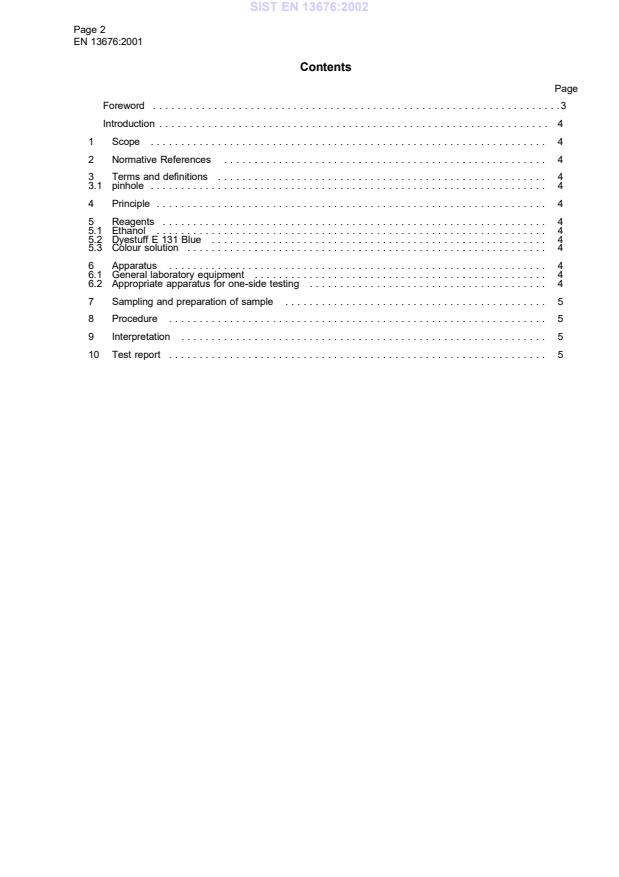
....................................................43Terms and definitions .....................................................43.1pinhole................................................................44Principle ...............................................................45Reagents ..............................................................45.1Ethanol ...............................................................45.2Dyestuff E 131 Blue .......................................................45.3Colour solution ...........................................................46Apparatus ..............................................................46.1General laboratory equipment ................................................46.2Appropriate apparatus for one-side testing .......................................47Sampling and preparation of sample ...........................................58Procedure ..............................................................59Interpretation ............................................................510Test report ..............................................................5SIST EN 13676:2002
Page 3EN 13676 : 2001ForewordThis European Standard has been prepared by Technical Committee CEN/TC 172 "Pulp, paper and board", theSecretariat of which is held by DIN.This European Standard shall be given the status of a national standard, either by publication of an identical text orby endorsement, at the latest by October 2001, and conflicting national standards shall be withdrawn at the latestby October 2001.According to the CEN/CENELEC Internal Regulations, the national standards organizations of the followingcountries are bound to implement this European Standard: Austria, Belgium, Czech Re
...