

oSIST prEN 17383:2025
(Main)Road traffic noise reducing devices - Sustainability of construction works - Environmental product declarations - Product Category Rules for road traffic noise reducing devices
- Abstract
This document complements the core rules for the product category of construction products as defined in EN 15804:2012+A2:2019/AC:2021and is intended to be used as a c-PCR in conjunction with that standard.
This document is applicable to RTNRDs in the context of a civil engineering works.
It specifies the parameters to be reported, what EPD types (and life cycle stages) to be covered, what rules to be followed to generate Life Cycle Inventories (LCI) and conduct Life Cycle Impact Assessment (LCIA) and the data quality to be used in the development of EPDs.
The text of EN 15804:2012+A2:2019/AC:2021 applies, with the following addition:
- gives guidance on declared units;
- specifies the system boundaries;
- provides guidance/specific rules for the determination of the reference service life;
- gives guidance on the establishment of default scenarios.
- Status
- Not Published
- Public Enquiry End Date
- 14-Dec-2025
- Technical Committee
- OCE - Road equipment
- Current Stage
- 4020 - Public enquire (PE) (Adopted Project)
- Start Date
- 09-Oct-2025
- Due Date
- 26-Feb-2026
- Completion Date
- 04-Feb-2026

oSIST prEN 17383:2025 is a CEN draft European Standard for Environmental Product Declarations (EPD) for road traffic noise reducing devices (RTNRDs). It acts as a complementary Product Category Rules (c-PCR) document to EN 15804 and tells manufacturers how to report life cycle data, declared units, system boundaries, and data quality for RTNRDs used in civil engineering works. Designers, procuring entities, and other users can use it to prepare and read RTNRD EPDs on a common basis.
What does oSIST prEN 17383:2025 specify?
oSIST prEN 17383:2025 specifies product category rules for RTNRDs within the framework of EN 15804:2012+A2:2019/AC:2021. It is written for RTNRDs used in civil engineering works and focuses on how to build an EPD, not on how to design the product itself.
The document is organized into clauses 1 to 9 and five annexes. The annexes separate mandatory guidance from supporting material, so readers can see which parts are normative and which are informative.
| Annex | What it covers |
|---|---|
| Annex A | Requirements and guidance on the reference service life |
| Annex B | Waste |
| Annex C | Impact categories, indicators, methodologies and characterization factors |
| Annex D | End of life formulae |
| Annex E | Data quality assessment schemes for generic and specific data |
oSIST prEN 17383:2025 adds RTNRD-specific guidance to the common EN 15804 rules. In practice, that means it tells the user what to declare, what to calculate, and which scenarios to use for transport, installation, use, end of life, and benefits beyond the system boundary.
What are the key requirements of oSIST prEN 17383:2025?
Core EPD rules and comparability
oSIST prEN 17383:2025 uses EN 15804 as its base and adds RTNRD-specific rules in clauses 5 and 6. Clause 5.3 emphasizes that EPD comparison depends on the same LCA background data, the same reference service life, and clear product-level scenarios. In practice, a buyer or designer should treat EPD comparisons carefully if the inputs or scenarios differ.
Clause 5.2 and clause 6 organize the EPD by life cycle stages and information modules. The document covers product stage, construction stage, use stage, end-of-life stage, and Module D. That structure matters because the reader can see where the main impacts come from and which stages are included in the declared results.
Declared units and RTNRD types
Clause 6.3.3 gives declared units by RTNRD type. For noise barrier kits, cladding kits, and acoustic elements, the declared unit is a representative 1 m of the surface exposed to traffic. For added devices, the declared unit is a representative 1 m in length.
This matters because RTNRDs are often sold and specified by surface or length rather than by mass alone. Where acoustic and structural elements are distinct, oSIST prEN 17383:2025 requires separate assessment of Environmental Impact Indicators for each element, then normalization to the declared unit.
Reference service life and durability
Clause 6.3.4 and Annex A link the reference service life (RSL) to declared durability and reference in-use conditions. oSIST prEN 17383:2025 states that the RSL shall be declared together with the reference in-use conditions.
For RTNRD types such as noise barriers, cladding, and covers, the structural element often governs the RSL, while acoustic elements may need replacement during that period. For acoustic elements and added devices, the RSL can follow the declared product durability. This affects maintenance and replacement assumptions in the EPD.
System boundaries and life cycle modules
Clause 6.3.5 sets the system boundary rules for A1-A3, A4-A5, B1-B7, C1-C4, and D. The product stage includes the main constituent materials and accessories needed to achieve declared performance. The construction stage includes installation operations, ancillary materials, packaging, and a 1 % flat-rate allowance for losses.
The use stage includes maintenance that is part of normal operation, while accidental damage and vandalism are excluded from maintenance scenarios. Operational energy and water use are generally not relevant, but the document notes cases where they can apply, such as lighting, photovoltaic modules, or green walls. Module D is used when recovered materials or energy leave the system boundary and can produce positive or negative results.
Data quality, scenarios, and exclusions
Clause 6.3.8 and clause 6.3.9 set the data-quality and scenario rules. Module A3 shall use primary information, A1 and A2 may use supplier EPDs or LCI data, and downstream modules use scenarios. Materials and energy flows below 3 % of the total are excluded.
The transport scenario in A4 uses a representative 300 km road-transport case and requires the vehicle type, weight category, emissions standard, capacity utilization, and empty returns to be reported. Installation in A5 shall reflect a realistic crew and equipment set-up, including traffic safety measures, while the construction of foundations or other works is handled separately.
EPD content, project report, verification
Clauses 7, 8 and 9 cover the content of the EPD, the project report, and verification and validity. These clauses matter because they define what must be documented to make the EPD traceable and checkable by third parties.
What terms does oSIST prEN 17383:2025 define?
- road traffic noise reducing device (RTNRD) - a device designed to reduce the propagation of traffic noise away from the road environment.
- acoustic element - the part of the device whose main function is to provide the acoustic performance.
- structural element - the part whose main function is to support or hold the acoustic elements in place.
- added device - an added component that changes the acoustic characteristic of the original noise-reducing device.
- reference service life (RSL) - the service life expected under specific in-use conditions, based on reference service life data and the actual conditions of use.
- roadside exposure - the conditions experienced by the device when installed alongside a road.
- environmental product declaration (EPD) - a declaration that provides quantified environmental data using predetermined parameters and, where relevant, additional environmental information.
Who uses oSIST prEN 17383:2025?
oSIST prEN 17383:2025 is aimed at manufacturers of RTNRDs who prepare EPDs and need to report environmental performance with EN 15804-compatible rules. It is also used by designers calculating LCA for a project, by procuring entities writing tender specifications, and by third parties operating infrastructure rating systems.
Private developers using RTNRDs on their own land can also use the document when they want to compare solutions or present sustainability information. In practice, the document helps users document impacts, compare product options, and align product data with civil engineering sustainability assessments.
What changed in oSIST prEN 17383:2025 from the previous edition?
oSIST prEN 17383:2025 will supersede EN 17383:2024.
Which standards are used with oSIST prEN 17383:2025?
| Standard | What it contributes |
|---|---|
| EN 15804:2012+A2:2019/AC:2021 | Core rules for EPDs of construction products; the base standard that this c-PCR complements |
| EN 17472:2021 | Context for assessing the sustainability of civil engineering works |
| EN 14389:2023 | Procedures for assessing long term performance of RTNRDs |
| ISO 21930:2017 | Source for the definition of RSL and EPD terminology |
| EN ISO 14044:2006 | Source for the definition of LCA |
| EN 16485:2014 | Material-specific c-PCR for wood and wood-based products |
| EN 16757:2017 | Material-specific c-PCR for concrete and concrete elements |
| EN 17074:2019 | Material-specific c-PCR for flat glass products |
| EN 16783:2024 | Material-specific c-PCR for insulating materials used in cassette panels |
What does the oSIST prEN 17383:2025 document contain?
oSIST prEN 17383:2025 contains the framework for RTNRD EPDs, including the scope, terms, abbreviations, and the RTNRD-specific additions to EN 15804. It also contains guidance on declared units, reference service life, system boundaries, transport and installation scenarios, maintenance, repair, replacement, and end-of-life treatment.
The document includes a figure on EPD types by life cycle stages and examples of RTNRD configurations such as noise barriers, cladding, covers, added devices, and acoustic elements. Annex C provides the impact categories, indicators, methodologies, and characterization factors used in the EPD calculation, while Annex D gives end-of-life formulae. Annex E supports data quality assessment for generic and specific data.
Relations
- Effective Date
- 19-Jun-2024
Get Certified
Connect with accredited certification bodies for this standard

Zavod za gradbeništvo Slovenije (ZAG) - Inšpekcija
ZAG inspection body for construction products, structures, and materials.
Sponsored listings
Frequently Asked Questions
oSIST prEN 17383:2025 is a draft published by the Slovenian Institute for Standardization (SIST). Its full title is "Road traffic noise reducing devices - Sustainability of construction works - Environmental product declarations - Product Category Rules for road traffic noise reducing devices". This standard covers: This document complements the core rules for the product category of construction products as defined in EN 15804:2012+A2:2019/AC:2021and is intended to be used as a c-PCR in conjunction with that standard. This document is applicable to RTNRDs in the context of a civil engineering works. It specifies the parameters to be reported, what EPD types (and life cycle stages) to be covered, what rules to be followed to generate Life Cycle Inventories (LCI) and conduct Life Cycle Impact Assessment (LCIA) and the data quality to be used in the development of EPDs. The text of EN 15804:2012+A2:2019/AC:2021 applies, with the following addition: - gives guidance on declared units; - specifies the system boundaries; - provides guidance/specific rules for the determination of the reference service life; - gives guidance on the establishment of default scenarios.
This document complements the core rules for the product category of construction products as defined in EN 15804:2012+A2:2019/AC:2021and is intended to be used as a c-PCR in conjunction with that standard. This document is applicable to RTNRDs in the context of a civil engineering works. It specifies the parameters to be reported, what EPD types (and life cycle stages) to be covered, what rules to be followed to generate Life Cycle Inventories (LCI) and conduct Life Cycle Impact Assessment (LCIA) and the data quality to be used in the development of EPDs. The text of EN 15804:2012+A2:2019/AC:2021 applies, with the following addition: - gives guidance on declared units; - specifies the system boundaries; - provides guidance/specific rules for the determination of the reference service life; - gives guidance on the establishment of default scenarios.
oSIST prEN 17383:2025 is classified under the following ICS (International Classification for Standards) categories: 93.080.30 - Road equipment and installations. The ICS classification helps identify the subject area and facilitates finding related standards.
oSIST prEN 17383:2025 has the following relationships with other standards: It is inter standard links to SIST EN 17383:2024. Understanding these relationships helps ensure you are using the most current and applicable version of the standard.
oSIST prEN 17383:2025 is available in PDF format for immediate download after purchase. The document can be added to your cart and obtained through the secure checkout process. Digital delivery ensures instant access to the complete standard document.
Standards Content (Sample)
SLOVENSKI STANDARD
01-december-2025
Protihrupne ovire za cestni promet - Trajnostnost gradbenih objektov - Okoljske
deklaracije za proizvode - Pravila za kategorije proizvodov za protihrupne ovire za
cestni promet
Road traffic noise reducing devices - Sustainability of construction works - Environmental
product declarations - Product Category Rules for road traffic noise reducing devices
Lärmschutzvorrichtungen an Straßen - Nachhaltigkeit von Bauwerken -
Umweltproduktdeklarationen - Produktkategorieregeln für Lärmschutzvorrichtungen an
Straßen
Dispositifs de réduction du bruit du trafic routier - Contribution des ouvrages de
construction au développement durable - Déclarations environnementales de produits -
Règles de catégorie de produits pour les dispositifs de réduction du bruit du trafic routier
Ta slovenski standard je istoveten z: prEN 17383
ICS:
93.080.30 Cestna oprema in pomožne Road equipment and
naprave installations
2003-01.Slovenski inštitut za standardizacijo. Razmnoževanje celote ali delov tega standarda ni dovoljeno.
DRAFT
EUROPEAN STANDARD
prEN 17383
NORME EUROPÉENNE
EUROPÄISCHE NORM
September 2025
ICS 93.080.30 Will supersede EN 17383:2024
English Version
Road traffic noise reducing devices - Sustainability of
construction works - Environmental product declarations -
Product Category Rules for road traffic noise reducing
devices
Dispositifs de réduction du bruit du trafic routier - Lärmschutzvorrichtungen an Straßen - Nachhaltigkeit
Contribution des ouvrages de construction au von Bauwerken - Umweltproduktdeklarationen -
développement durable - Déclarations Produktkategorieregeln für Lärmschutzvorrichtungen
environnementales de produits - Règles de catégorie an Straßen
de produits pour les dispositifs de réduction du bruit
du trafic routier
This draft European Standard is submitted to CEN members for enquiry. It has been drawn up by the Technical Committee
CEN/TC 226.
If this draft becomes a European Standard, CEN members are bound to comply with the CEN/CENELEC Internal Regulations
which stipulate the conditions for giving this European Standard the status of a national standard without any alteration.
This draft European Standard was established by CEN in three official versions (English, French, German). A version in any other
language made by translation under the responsibility of a CEN member into its own language and notified to the CEN-CENELEC
Management Centre has the same status as the official versions.
CEN members are the national standards bodies of Austria, Belgium, Bulgaria, Croatia, Cyprus, Czech Republic, Denmark, Estonia,
Finland, France, Germany, Greece, Hungary, Iceland, Ireland, Italy, Latvia, Lithuania, Luxembourg, Malta, Netherlands, Norway,
Poland, Portugal, Republic of North Macedonia, Romania, Serbia, Slovakia, Slovenia, Spain, Sweden, Switzerland, Türkiye and
United Kingdom.
Recipients of this draft are invited to submit, with their comments, notification of any relevant patent rights of which they are
aware and to provide supporting documentation.
Warning : This document is not a European Standard. It is distributed for review and comments. It is subject to change without
notice and shall not be referred to as a European Standard.
EUROPEAN COMMITTEE FOR STANDARDIZATION
COMITÉ EUROPÉEN DE NORMALISATION
EUROPÄISCHES KOMITEE FÜR NORMUNG
CEN-CENELEC Management Centre: Rue de la Science 23, B-1040 Brussels
© 2025 CEN All rights of exploitation in any form and by any means reserved Ref. No. prEN 17383:2025 E
worldwide for CEN national Members.
prEN 17383:2025 (E)
Contents Page
European foreword . 3
Introduction . 4
1 Scope . 5
2 Normative references . 5
3 Terms and definitions . 5
4 Abbreviations . 7
5 General aspects . 7
5.1 Objectives of this complementary PCR . 7
5.2 Types of EPD with respect to life cycle stages covered . 7
5.3 Comparability of EPD for construction products . 8
5.4 Additional environmental information . 9
5.5 Ownership, responsibility and liability for EPD . 9
5.6 Communication formats . 9
6 Product Category Rules for LCA . 9
6.1 Product category . 9
6.2 Life cycle stages and their information modules to be included . 9
6.3 Calculation rules for the LCA . 10
6.4 Inventory analysis . 19
6.5 Impact assessment . 19
7 Content of the EPD . 19
8 Project report . 19
9 Verification and validity of an EPD . 19
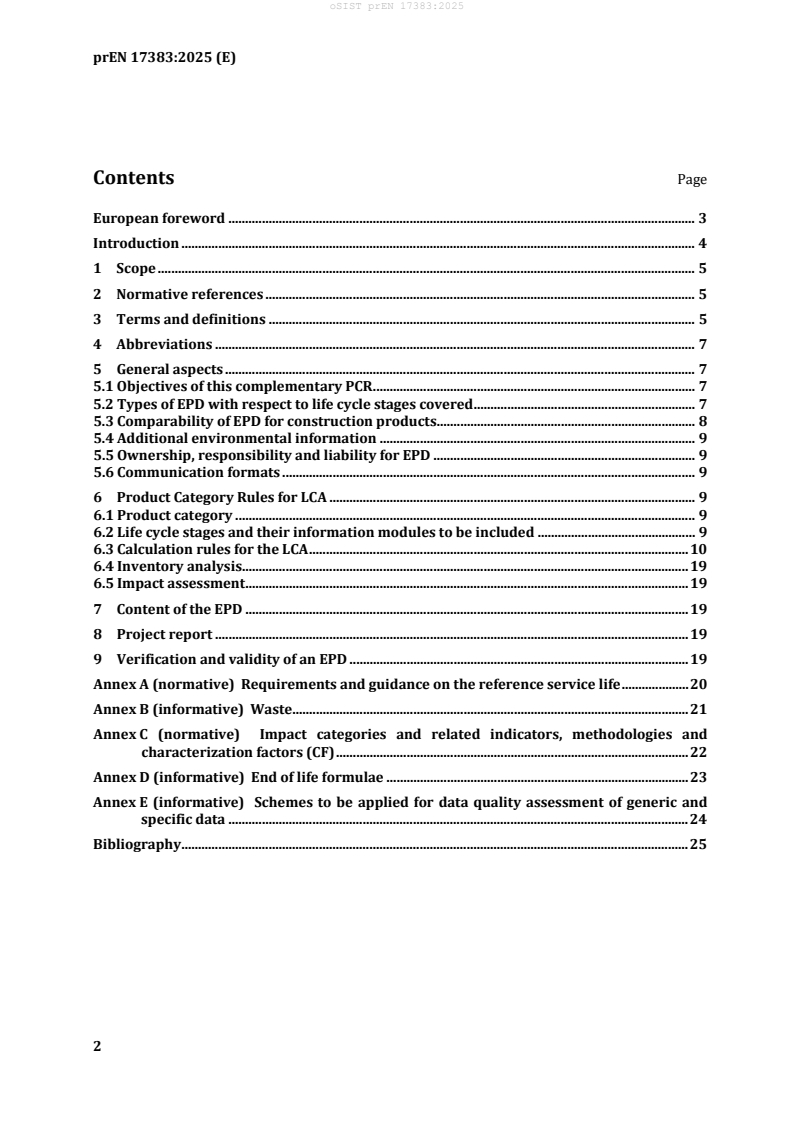
Annex A (normative) Requirements and guidance on the reference service life . 20
Annex B (informative) Waste . 21
Annex C (normative) Impact categories and related indicators, methodologies and
characterization factors (CF) . 22
Annex D (informative) End of life formulae . 23
Annex E (informative) Schemes to be applied for data quality assessment of generic and
specific data . 24
Bibliography . 25
prEN 17383:2025 (E)
European foreword
This document (prEN 17383:2025) has been prepared by Technical Committee CEN/TC 226 “Road
equipment”, the secretariat of which is held by AFNOR.
This document is currently submitted to the CEN Enquiry.
This document will supersede EN 17383:2024.
prEN 17383:2025 includes the following significant technical changes with respect to EN 17383:2024:
— …
— …
prEN 17383:2025 (E)
Introduction
When placing a construction product on the European market the manufacturer can be expected to
present a Declaration of Performance (DoP) with reference to the Basic Work Requirements (BWRs) as
listed in the CPR (Construction Product Regulation EU 3110/2024).
The performance declared with reference to BWR 8 (Sustainable use of natural resources of construction
works) corresponds to the Environmental Product Declaration (EPD) as referred to in
EN 15804:2012+A2:2019, which provides core rules for all construction products and services.
CPR in fact provides the list of the predetermined environmental essential characteristics in Annex II. In
Article 15 of CPR it is also indicated how the environmental essential characteristics must be
progressively covered by the declaration of performance and conformity.
This document provides specific rules for Environmental Product Declarations (EPDs) specifically for
road traffic noise reducing devices (RTNRDs).
It is intended as a supporting standard for the manufacturer to declare the performance of RTNRDs in
the context of the assessment of the sustainability of civil engineering works as in EN 17472:2021.
This document presents Environmental Impact Indicators the RTNRD manufacturers will provide to
declare the performance of RTNRDs with reference to BWR8 and to allow better understanding on how
their product can be considered “sustainable”.
This document is also intended to help manufacturers to identify the materials and product stages with
the most important impact on different sustainability aspects.
Besides manufacturers the following users of this document are foreseen:
— designers when calculating the Life Cycle Assessment (LCA) of the product used;
— third parties implementing infrastructure rating systems to determine how the project of the
construction work has incorporated sustainability;
— procuring entities using the Environmental Impact Indicators in tender specifications to promote
more sustainable solutions and innovations;
— private developers using RTNRDs on their own land like those used on public roads;
Declared Environmental Impact Indicators will be provided according to the valid standards at the time
of product placing on the market.
Besides the standards mentioned in this document, many other c-PCRs (Product Category Rules) have
been published within the Environmental Product Declaration (EPD) schemes but not formally adopted
as European Standards (EN). Instead, they provide sector-specific rules for assessing environmental
impacts and creating EPDs, following the framework set by EN 15804.
prEN 17383:2025 (E)
1 Scope
This document complements the core rules for the product category of construction products as defined
in EN 15804:2012+A2:2019 and is intended to be used as a c-PCR in conjunction with that standard.
This document applies for RTNRDs in the context of a civil engineering works.
It defines the parameters to be reported, what EPD types (and life cycle stages) to be covered, what rules
to be followed to generate Life Cycle Inventories (LCI) and conduct Life Cycle Impact Assessment (LCIA)
and the data quality to be used in the development of EPDs.
In addition to the common parts of EN 15804:2012+A2:2019, this document for RTNRD
— gives guidance on declared units;
— defines the system boundaries;
— provides guidance/specific rules for the determination of the reference service life;
— gives guidance on the establishment of default scenarios.
2 Normative references
The following documents are referred to in the text in such a way that some or all of their content
constitutes requirements of this document. For dated references, only the edition cited applies. For
undated references, the latest edition of the referenced document (including any amendments) applies.
EN 15804:2012+A2:2019, Sustainability of construction works - Environmental product declarations -
Core rules for the product category of construction products
3 Terms and definitions
For the purposes of this document, the terms and definitions given in EN 15804:2012+A2:2019 and the
following apply.
ISO and IEC maintain terminology databases for use in standardization at the following addresses:
— IEC Electropedia: available at https://www.electropedia.org/
— ISO Online browsing platform: available at https://www.iso.org/obp
3.1
road traffic noise reducing device
RTNRD
device that is designed to reduce the propagation of traffic noise away from the road environment
Note 1 to entry: The RTNRD may comprise acoustic elements (3.2) only or both structural (3.3) and acoustic
elements.
Note 2 to entry: Applications of RTNRD include noise barriers (3.5), claddings (3.6), covers (3.7) and added devices
(3.8).
As impacted by EN 15804:2012+A2:2019/AC:2021.
prEN 17383:2025 (E)
3.2
acoustic element
element whose primary function is to provide the acoustic characteristic of the device
3.3
structural element
element whose primary function is to support or hold in place acoustic elements
3.4
self-supporting acoustic element
acoustic element including its own structural element to support itself
3.5
noise barrier
noise reducing device which obstructs the direct transmission of airborne sound emanating from road
traffic
3.6
cladding
noise reducing device which is attached to a wall or other structure and reduces the amount of sound
reflected
3.7
cover
noise reducing device which either spans or overhangs the road
3.8
added device
added component that influences the acoustic characteristic of the original noise-reducing device
Note 1 to entry: The added device is acting primarily on the diffracted energy.
3.9
reference service life
RSL
service life that a building or an assembled system (part of works) would be expected to have in a set of
specific in-use conditions, determined from reference service life data after taking into account any
differences from the reference in use conditions
[SOURCE: ISO 21930:2017]
3.10
roadside exposure
conditions experienced by the noise reducing device installed alongside a road
3.11
life cycle assessment
LCA
compilation and evaluation of the inputs, outputs and the potential environmental impacts of a product
system throughout its life cycle
[SOURCE: EN ISO 14044:2006]
prEN 17383:2025 (E)
3.12
environmental product declaration
EPD
environmental declaration providing quantified environmental data using predetermined parameters
and, where relevant, additional environmental information
[SOURCE: ISO 21930:2017]
4 Abbreviations
For the purposes of this document, the abbreviations given in EN 15804:2012+A2:2019 and the
following apply.
EPD environmental product declaration
c-PCR complementary Product Category Rules
LCA life cycle assessment
PCR Product Category Rules
RTNRD road traffic noise reducing device
RSL reference service life
5 General aspects
5.1 Objectives of this complementary PCR
The objective of this cPCR is to provide common rules specific to RTNRDs for the application of
EN 15804:2012+A2:2019, which provides core rules for the wider product category of “construction
products”.
5.2 Types of EPD with respect to life cycle stages covered
EN 15804:2012+A2:2019 shall apply.
prEN 17383:2025 (E)
Key
1 replacement of components, parts or systems
2 only possible if the conditions to exclude the declaration of modules C1-C4 and module D are met
SOURCE: EN 15804:2012+A2:2019/AC:2021
Figure 1 — Types of EPD with respect to life cycle stages covered and life cycle stages and
modules for the building assessment
5.3 Comparability of EPD for construction products
In addition to the text of EN 15804:2012+A2:2019:
The design of an RTNRD shall comply with many requirements (acoustic, architectural, safety,
maintainability, etc). Environmental sustainability (EPD) is an additional criterium.
Comparability of EPDs is then an important issue for manufacturers and other users of the standard. For
comparability of EPDs of RTNRD products it is necessary to:
— check that environmental performance of all products/processes are calculated on the basis of the
same LCA background data
— be sure on reference surface life of a product.
— clarify the relevant product level scenarios.
prEN 17383:2025 (E)
Relevant is the use of an EU central LCA database for EPD calculations. Since this database is not available
comparability is limited.
EXAMPLE If two similar competing steel post and metallic cassette acoustic panels, with similar material
quantities, are compared, any difference in the LCA values reported in the corresponding EPDs might result from
differences in the input data or scenarios used in the LCA calculation rather than a real difference in carbon
footprint or other indicators. However, EPDs might provide useful information for the evaluation of different
solutions such as (non-exhaustive list):
— Choosing between a concrete, steel or wooden cassette acoustic panel.
— Evaluating the effect on carbon footprint of different sound insulating categories of panels.
— Choosing between RTNRDS with different reference service life.
NOTE 2 In general, by far the greatest contribution to the carbon footprint of an RTNRDS results from the
contribution of its constituent material types and the quantities used of these materials in the construction of the
RTNRDS. The selection of products based on EPDs is likely to result in a generalized reduction in the quantities of
materials used in RTNRDS.
5.4 Additional environmental information
EN 15804:2012+A2:2019 shall apply.
5.5 Ownership, responsibility and liability for EPD
EN 15804:2012+A2:2019 shall apply.
5.6 Communication formats
EN 15804:2012+A2:2019 shall apply.
6 Product Category Rules for LCA
6.1 Product category
The product category referred to in this document includes all RTNRDs construction products for use in
construction works for circulation areas.
6.2 Life cycle stages and their information modules to be included
6.2.1 General
In addition to the text of EN 15804:2012+A2:2019:
The RTNRDs category includes various types of raw materials, source locations, transport methods, as
well as maintenance, construction, and deconstruction systems. However, EPDs for RTNRDs can be
comparable if appropriate information modules are included to ensure equivalent LCAs.
6.2.2 A1-A3, Product stage, information modules
EN 15804:2012+A2:2019 shall apply.
6.2.3 A4-A5, Construction process stage, information modules
In addition to the text of EN 15804:2012+A2:2019:
Delivery distances from factory to construction site can vary significantly so a representative mean
delivery distance may be considered. The delivery transport distance used in the LCA shall be reported
in the EPD and the resulting values for A4 may, if appropriate, be used to calculate LCA transport values
prEN 17383:2025 (E)
per km which can then be used to calculate the transport LCA for different delivery distances for different
projects. All different modes of transport used in the LCA shall be reported along with the corresponding
distance for each transport mode.
The installation of the product may vary significantly depending on the product type and the installation
site. Information modules shall be provided with reasonable assumptions regarding the equipment used
and manpower for the installation process. Installation manual prepared by the manufacturer can
provide useful information in this sense.
6.2.4 B1-B5, Use stage, information modules
In addition to the text of EN 15804:2012+A2:2019:
RTNRDs manufacturers shall provide a maintenance manual. For the scope of the LCA any contributions
resulting from accidental damage, wear or damage resulting from events outside of the normal
operational wear and tear of the installed system shall be excluded. However, any contributions resulting
from the normal operation of the RTNRDs, excluding external, unforeseen factors, shall be accounted for.
6.2.5 B6-B7, Use stage, information modules
EN 15804:2012+A2:2019 shall apply.
6.2.6 C1-C4 End-of-life stage, information modules
EN 15804:2012+A2:2019 shall apply.
6.2.7 D, Benefits and loads beyond the system boundary, information module
EN 15804:2012+A2:2019 shall apply.
6.3 Calculation rules for the LCA
6.3.1 Functional or declared unit
In addition to the text of EN 15804:2012+A2:2019:
The primary purpose of defining a functional and/or a declared unit in LCA studies is to provide a
reference by which the information on the environmental performance of the product is normalized to
produce data expressed on a common basis. This allows comparison with other products systems which
have been assessed to fulfil the same functional or declared unit.
The declared unit is generally physical quantity, often related to the product’s mass or volume.
The functional unit is a performance-related measure, designed to compare products or systems based
on the service they provide, rather than just their quantity. The functional unit is closely connected to
the use stage of the LCA and definition of the service life of the product. RTNRD function during the
reference service life is that of providing road traffic noise abatement at receiver positions. The level of
performance expected depends on the site conditions and on the design choices.
A functional unit could be defined based on the noise reduction achieved by a specific surface area of
RTNRD.
Nevertheless, current procurement practices for RTNRD are generally based on predetermined surface
area required to achieve the specified noise abatement level according to design speci
...