

SIST EN 1793-2:2026
(Main)Road traffic noise reducing devices - Test method for determining the acoustic performance - Part 2: Intrinsic characteristics - Airborne sound insulation under diffuse sound field conditions
General Information
- Abstract
This document specifies the laboratory method for measuring the airborne sound insulation performance of road traffic noise reducing devices in reverberant conditions. It covers the assessment of the intrinsic performance of barriers that can reasonably be assembled inside the testing facility described in EN ISO 10140-2 and EN ISO 10140-4.
This method is not intended for the determination of the intrinsic characteristics of airborne sound insulation of noise reducing devices to be installed on roads in non-reverberant conditions.
- Status
- Published
- Public Enquiry End Date
- 14-Nov-2023
- Publication Date
- 11-Jan-2026
- Technical Committee
- OCE - Road equipment
- Current Stage
- 6060 - National Implementation/Publication (Adopted Project)
- Start Date
- 06-Jan-2026
- Due Date
- 13-Mar-2026
- Completion Date
- 12-Jan-2026

Overview
SIST EN 1793-2:2026 is a European Standard developed by CEN for assessing the acoustic performance of road traffic noise reducing devices. Specifically, this standard specifies a laboratory test method for measuring the airborne sound insulation properties of such devices under diffuse sound field conditions. The method evaluates the intrinsic airborne sound insulation of noise reducing barriers and devices intended for installation in environments characterized by reverberant conditions, such as tunnels, trenches, or roads with partial coverings. The test procedure outlined is closely aligned with facilities and practices described in EN ISO 10140-2 and EN ISO 10140-4. This standard supersedes EN 1793-2:2018 and introduces updates related to measurement uncertainty and reporting.
Key Topics
- Laboratory Measurement Methods: Clearly defines procedures for assembling test specimens, conducting acoustic measurements, and reporting the results for noise barriers.
- Diffuse Sound Field Conditions: Focuses on testing in reverberant conditions, as experienced in environments with significant reflection of sound waves, such as covered or enclosed roadways.
- Intrinsic Performance Assessment: Details how to measure the intrinsic characteristics of airborne sound insulation-independent of the installation site or external factors.
- Single-number Rating (DLR): Introduces a quantitative value for airborne sound insulation, calculated from 100 Hz to 5 kHz, enabling easy product comparison.
- Measurement Uncertainty: Stipulates mandatory declaration of measurement uncertainty and reporting of standard and expanded uncertainties in accordance with ISO/IEC Guide 98-3.
- Comprehensive Reporting Requirements: Specifies detailed documentation, including product identification, mounting descriptions, acoustic test results, and uncertainty statements.
Applications
SIST EN 1793-2:2026 is essential for:
- Manufacturers of Road Traffic Noise Barriers: Enables precise evaluation and certification of the airborne sound insulating properties of their products before market release or tendering.
- Laboratories and Testing Facilities: Provides standardized methods and reporting templates for acoustic performance measurement according to European requirements.
- Road and Highway Authorities: Supports the selection and approval of suitable noise reducing devices for reverberant environments-notably, tunnels, trenches, and partially covered roads where conventional field testing is impractical or insufficient.
- Acoustic Consultants and Designers: Allows for the comparison, specification, and optimization of noise reduction solutions for infrastructure projects to ensure compliance with current noise management legislation.
- Quality Control and Regulatory Compliance: Facilitates harmonized product declarations for public procurement and regulatory approvals across EU member states.
Related Standards
To provide comprehensive acoustic assessment and ensure consistency, SIST EN 1793-2:2026 should be used in conjunction with:
- EN ISO 10140-2:2021 – Laboratory measurement of sound insulation of building elements.
- EN ISO 10140-4:2021 – Laboratory measurement procedures and requirements.
- EN 1793-1:2025 – Sound absorption under diffuse sound field conditions.
- EN 1793-3:2025 – Normalized traffic noise spectrum.
- EN 1793-6:2025 – Airborne sound insulation under direct sound field conditions.
- EN ISO 12999-1:2020 – Application of measurement uncertainties in building acoustics.
- ISO/IEC Guide 98-3:2008 – Expression of measurement uncertainty.
These related standards ensure that road traffic noise reducing devices are tested and reported consistently, aiding in effective noise control and infrastructure sound performance optimization throughout Europe.
Relations
- Effective Date
- 01-Feb-2026
- Effective Date
- 28-Jan-2026
- Effective Date
- 28-Jan-2026
- Effective Date
- 28-Jan-2026
- Effective Date
- 28-Jan-2026
- Effective Date
- 28-Jan-2026
- Effective Date
- 28-Jan-2026
- Effective Date
- 28-Jan-2026
Get Certified
Connect with accredited certification bodies for this standard

BSMI (Bureau of Standards, Metrology and Inspection)
Taiwan's standards and inspection authority.
Zavod za gradbeništvo Slovenije (ZAG) - Inšpekcija
ZAG inspection body for construction products, structures, and materials.
Sponsored listings
Frequently Asked Questions
SIST EN 1793-2:2026 is a standard published by the Slovenian Institute for Standardization (SIST). Its full title is "Road traffic noise reducing devices - Test method for determining the acoustic performance - Part 2: Intrinsic characteristics - Airborne sound insulation under diffuse sound field conditions". This standard covers: This document specifies the laboratory method for measuring the airborne sound insulation performance of road traffic noise reducing devices in reverberant conditions. It covers the assessment of the intrinsic performance of barriers that can reasonably be assembled inside the testing facility described in EN ISO 10140-2 and EN ISO 10140-4. This method is not intended for the determination of the intrinsic characteristics of airborne sound insulation of noise reducing devices to be installed on roads in non-reverberant conditions.
This document specifies the laboratory method for measuring the airborne sound insulation performance of road traffic noise reducing devices in reverberant conditions. It covers the assessment of the intrinsic performance of barriers that can reasonably be assembled inside the testing facility described in EN ISO 10140-2 and EN ISO 10140-4. This method is not intended for the determination of the intrinsic characteristics of airborne sound insulation of noise reducing devices to be installed on roads in non-reverberant conditions.
SIST EN 1793-2:2026 is classified under the following ICS (International Classification for Standards) categories: 17.140.30 - Noise emitted by means of transport; 93.080.30 - Road equipment and installations. The ICS classification helps identify the subject area and facilitates finding related standards.
SIST EN 1793-2:2026 has the following relationships with other standards: It is inter standard links to SIST EN 1793-2:2018, SIST EN 1793-3:2026, SIST EN ISO 10140-1:2021, SIST EN ISO 10140-4:2021, SIST EN ISO 10140-2:2021, SIST EN 15498:2008, SIST EN 14388:2015, SIST EN 1520:2011. Understanding these relationships helps ensure you are using the most current and applicable version of the standard.
SIST EN 1793-2:2026 is available in PDF format for immediate download after purchase. The document can be added to your cart and obtained through the secure checkout process. Digital delivery ensures instant access to the complete standard document.
Standards Content (Sample)
SLOVENSKI STANDARD
01-februar-2026
Nadomešča:
SIST EN 1793-2:2018
Protihrupne ovire za cestni promet - Preskusna metoda za ugotavljanje akustičnih
lastnosti - 2. del: Bistvene značilnosti - Izolacija pred zvokom v zraku pri
razpršenem zvočnem polju
Road traffic noise reducing devices - Test method for determining the acoustic
performance - Part 2: Intrinsic characteristics - Airborne sound insulation under diffuse
sound field conditions
Lärmschutzvorrichtungen an Straßen - Prüfverfahren zur Bestimmung der akustischen
Eigenschaften - Teil 2: Produktspezifische Merkmale - Luftschalldämmung unter den
Bedingungen eines diffusen Schallfeldes
Dispositifs de réduction du bruit du trafic routier - Méthode d'essai pour la détermination
de la performance acoustique - Partie 2: Caractéristiques intrinsèques - Isolation au bruit
aérien dans des conditions de champ acoustique diffus
Ta slovenski standard je istoveten z: EN 1793-2:2025
ICS:
17.140.30 Emisija hrupa transportnih Noise emitted by means of
sredstev transport
93.080.30 Cestna oprema in pomožne Road equipment and
naprave installations
2003-01.Slovenski inštitut za standardizacijo. Razmnoževanje celote ali delov tega standarda ni dovoljeno.
EN 1793-2
EUROPEAN STANDARD
NORME EUROPÉENNE
December 2025
EUROPÄISCHE NORM
ICS 17.140.30; 93.080.30 Supersedes EN 1793-2:2018
English Version
Road traffic noise reducing devices - Test method for
determining the acoustic performance - Part 2: Intrinsic
characteristics - Airborne sound insulation under diffuse
sound field conditions
Dispositifs de réduction du bruit du trafic routier - Lärmschutzvorrichtungen an Straßen - Prüfverfahren
Méthode d'essai pour la détermination de la zur Bestimmung der akustischen Eigenschaften - Teil
performance acoustique - Partie 2: Caractéristiques 2: Produktspezifische Merkmale - Luftschalldämmung
intrinsèques - Isolation au bruit aérien dans des unter den Bedingungen eines diffusen Schallfeldes
conditions de champ acoustique diffus
This European Standard was approved by CEN on 17 November 2025.
CEN members are bound to comply with the CEN/CENELEC Internal Regulations which stipulate the conditions for giving this
European Standard the status of a national standard without any alteration. Up-to-date lists and bibliographical references
concerning such national standards may be obtained on application to the CEN-CENELEC Management Centre or to any CEN
member.
This European Standard exists in three official versions (English, French, German). A version in any other language made by
translation under the responsibility of a CEN member into its own language and notified to the CEN-CENELEC Management
Centre has the same status as the official versions.
CEN members are the national standards bodies of Austria, Belgium, Bulgaria, Croatia, Cyprus, Czech Republic, Denmark, Estonia,
Finland, France, Germany, Greece, Hungary, Iceland, Ireland, Italy, Latvia, Lithuania, Luxembourg, Malta, Netherlands, Norway,
Poland, Portugal, Republic of North Macedonia, Romania, Serbia, Slovakia, Slovenia, Spain, Sweden, Switzerland, Türkiye and
United Kingdom.
EUROPEAN COMMITTEE FOR STANDARDIZATION
COMITÉ EUROPÉEN DE NORMALISATION
EUROPÄISCHES KOMITEE FÜR NORMUNG
CEN-CENELEC Management Centre: Rue de la Science 23, B-1040 Brussels
© 2025 CEN All rights of exploitation in any form and by any means reserved Ref. No. EN 1793-2:2025 E
worldwide for CEN national Members.
Contents Page
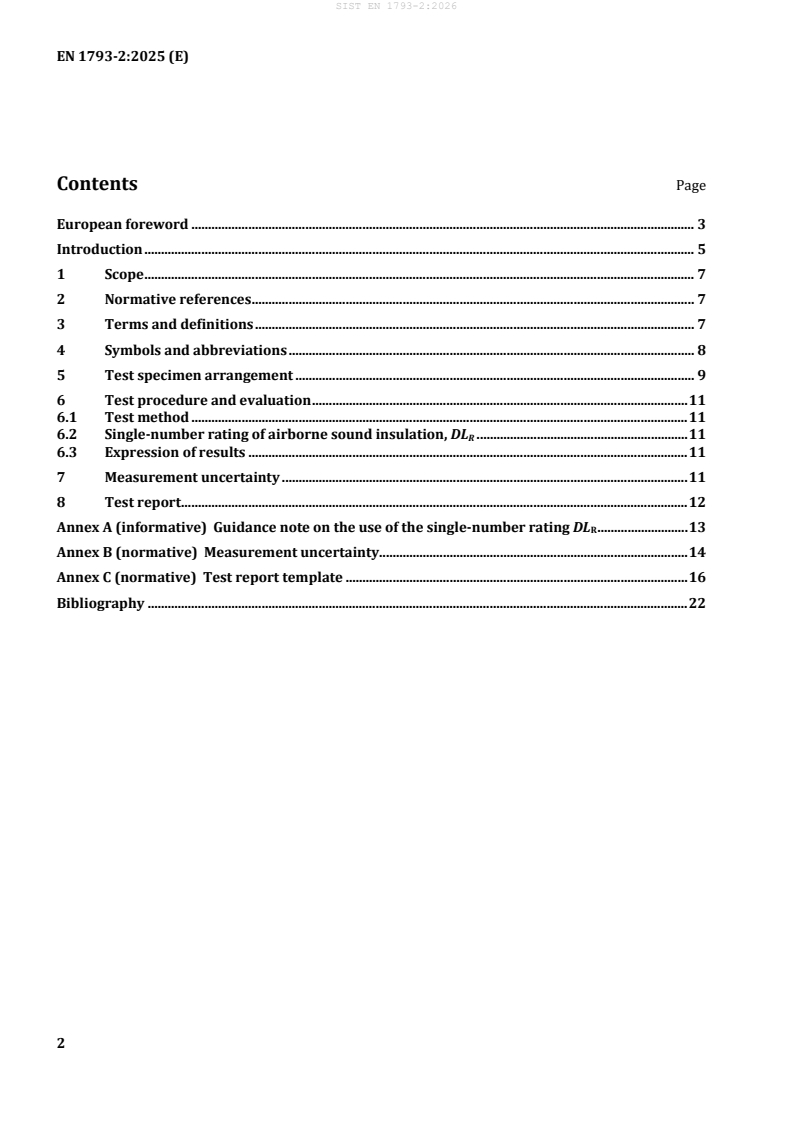
European foreword . 3
Introduction . 5
1 Scope . 7
2 Normative references . 7
3 Terms and definitions . 7
4 Symbols and abbreviations . 8
5 Test specimen arrangement . 9
6 Test procedure and evaluation . 11
6.1 Test method . 11
6.2 Single-number rating of airborne sound insulation, DL . 11
R
6.3 Expression of results . 11
7 Measurement uncertainty . 11
8 Test report . 12
Annex A (informative) Guidance note on the use of the single-number rating DL . 13
R
Annex B (normative) Measurement uncertainty. 14
Annex C (normative) Test report template . 16
Bibliography . 22
European foreword
This document (EN 1793-2:2025) has been prepared by Technical Committee CEN/TC 226 “Road
equipment”, the secretariat of which is held by AFNOR.
This European Standard shall be given the status of a national standard, either by publication of an
identical text or by endorsement, at the latest by June 2026, and conflicting national standards shall be
withdrawn at the latest by June 2026.
Attention is drawn to the possibility that some of the elements of this document may be the subject of
patent rights. CEN shall not be held responsible for identifying any or all such patent rights.
This document supersedes EN 1793-2:2018.
— the title has been slightly changed;
— the declaration of measurement uncertainty and the related confidence level is now mandatory;
— the categories of single-number rating have been removed. Prior Annex A has been deleted. The
performance of the noise reducing device is, from now on, only to be reported in terms of the
numeric values of the single-number rating;
— an annex with the values of the standard deviation of reproducibility and repeatability has been
added; this makes possible the declaration of the measurement uncertainty and the related
confidence level, which is now mandatory (Annex B);
— a detailed example has been added, including the declaration of the uncertainty (Annex C).
The EN 1793 series, under the general title Road traffic noise reducing devices — Test method for
determining the acoustic performance, consists of the following parts:
— Part 1: Intrinsic characteristics — Sound absorption under diffuse sound field conditions;
— Part 2: Intrinsic characteristics — Airborne sound insulation under diffuse sound field conditions;
— Part 3: Normalized traffic noise spectrum;
— Part 4: Intrinsic characteristics — Intrinsic sound diffraction;
— Part 5: Intrinsic characteristics — Sound absorption under direct sound field conditions;
— Part 6: Intrinsic characteristics — Airborne sound insulation under direct sound field conditions.
Any feedback and questions on this document should be directed to the users’ national standards body.
A complete listing of these bodies can be found on the CEN website.
According to the CEN-CENELEC Internal Regulations, the national standards organisations of the
following countries are bound to implement this European Standard: Austria, Belgium, Bulgaria,
Croatia, Cyprus, Czech Republic, Denmark, Estonia, Finland, France, Germany, Greece, Hungary, Iceland,
Ireland, Italy, Latvia, Lithuania, Luxembourg, Malta, Netherlands, Norway, Poland, Portugal, Republic of
North Macedonia, Romania, Serbia, Slovakia, Slovenia, Spain, Sweden, Switzerland, Türkiye and the
United Kingdom.
Introduction
Noise reducing devices alongside roads should provide adequate sound insulation so that sound
transmitted through the road traffic noise reducing devices is not significant compared with the sound
diffracted over the top. This document specifies a test method for qualifying the intrinsic airborne
sound insulation performance for noise reducing devices designed for roads in reverberant conditions,
e.g. inside tunnels or deep trenches or under covers.
The measurement results of this method for airborne sound insulation are comparable but not identical
with the results of the test method EN 1793-6:2025 [5], mainly because the present method uses a
diffuse sound field, while the other method assumes a directional sound field. Research studies suggest
that good correlation exists between field data, measured according to EN 1793-6:2025 and laboratory
data, measured according to the method described in the present document [1], [2], [3], [4].
This document does not apply to the determination of the insertion loss (extrinsic performance), which
additionally depends on factors which are not related to the product itself; e.g. the dimensions of the
barrier and quality of installation work and site factors such as ground impedance, site geometry, etc.
The test is designed to allow the intrinsic airborne sound insulation performance of the road traffic
noise reducing device to be measured; the resulting rating should aid the selection of devices for
reverberant roadside applications.
For the purpose of this document, reverberant conditions are defined based on the geometric envelope,
e, across the road formed by the barriers, trench sides or buildings (the envelope does not include the
road surface) as shown by the dashed lines in Figure 1. Conditions are defined as being reverberant
when the percentage of open space in the envelope is less than or equal to 25 %, i.e. reverberant
conditions occur when w/e ≤ 0,25, where e = (w+h +h ).
1 2
This method may be used to qualify noise reducing devices for other applications, e.g. to be installed
near industrial sites. In this case, the single-number ratings can preferably be calculated using an
appropriate spectrum.
a) Partial cover on both sides of the road; b) Partial cover on one side of the road;
geometric envelope, e = w+h +h geometric envelope, e = w+h ; h = 0
1 2 1 2
c) Deep trench; d) Tall barriers or buildings;
geometric envelope, e = w+h +h geometric envelope, e = w+h +h
1 2 1 2
Key
r road surface
w width of open space
h developed length of the construction, e.g. cover, trench side, barrier or building
h developed length of the construction, e.g. cover, trench side, barrier or building
NOTE Figure 1 is not to scale.
Figure 1 — Sketch of the reverberant condition check in four cases
1 Scope
This document specifies the laboratory method for measuring the airborne sound insulation
performance of road traffic noise reducing devices in reverberant conditions. It covers the assessment
of the intrinsic performance of barriers that can reasonably be assembled inside the testing facility
described in EN ISO 10140-2 and EN ISO 10140-4.
This method is not intended for the determination of the intrinsic characteristics of airborne sound
insulation of noise reducing devices to be installed on roads in non-reverberant conditions.
2 Normative references
The following documents are referred to in the text in such a way that some or all of their content
constitutes requirements of this document. For dated references, only the edition cited applies. For
undated references, the latest edition of the referenced document (including any amendments) applies.
EN 1793-3:2025, Road traffic noise reducing devices — Test method for determining the acoustic
performance — Part 3: Normalized traffic noise spectrum
EN ISO 10140-1:2021, Acoustics — Laboratory measurement of sound insulation of building elements —
Part 1: Application rules for specific products (ISO 10140-1:2021)
EN ISO 10140-2:2021, Acoustics — Laboratory measurement of sound insulation of building elements —
Part 2: Measurement of airborne sound insulation (ISO 10140-2:2021)
EN ISO 10140-4:2021, Acoustics — Laboratory measurement of sound insulation of building elements —
Part 4: Measurement procedures and requirements (ISO 10140-4:2021)
ISO/IEC Guide 98-3:2008, Uncertainty of measurement — Part 3: Guide to the expression of uncertainty
in measurement (GUM:1995)
3 Terms and definitions
For the purposes of this document, the following terms and definitions apply.
3.1
road traffic noise reducing device
RTNRD
device designed to reduce the propagation of traffic noise away from the road environment
Note 1 to entry: An RTNRD can comprise acoustic elements (3.2) only or both structural (3.3) and acoustic
elements.
Note 2 to entry: Applications of RTNRDs include noise barriers (3.5), claddings (3.6), covers (3.7) and added
devices (3.8).
3.2
acoustic element
element whose primary function is to provide the acoustic performance of the device
3.3
structural element
element whose primary function is to support or hold in place the parts of the RTNRD
3.4
self-supporting acoustic element
acoustic element including its own structural element to support itself
3.5
noise barrier
road traffic noise reducing device which obstructs the direct transmission of airborne sound emanating
from road traffic
3.6
cladding
road traffic noise reducing device which is attached to a wall or other structure and reduces the amount
of sound reflected
3.7
cover
road traffic noise reducing device which either spans or overhangs the road
3.8
added device
additional component that influences the acoustic performance of the original road traffic noise
reducing device
Note 1 to entry: The added device is acting primarily on the diffracted sound energy.
4 Symbols and abbreviations
For the purposes of this document, the symbols in Table 1 apply.
Table 1 — Symbols and abbreviations
Symbol or abbreviation Designation Unit
DL Single-number rating of airborne sound insulation performance dB
R
expressed as a difference of A weighted sound pressure levels
R Sound reduction index in the i-th one-third octave band dB
i
k Coverage factor -
p
i Index of the i-th one-third octave frequency band, between 100 Hz -
and 5 kHz
L Relative A-weighted sound pressure level of the normalized traffic dB
i
noise spectrum in the i-th one-third octave band (see EN 1793-3)
s Standard deviation of repeatability -
r
s Standard deviation of reproducibility -
R
u Standard uncertainty -
U Expanded uncertainty -
5 Test specimen arrangement
The test specimen arrangement shall be as described in EN ISO 10140-1:2021, EN ISO 10140-2:2021
and EN ISO 10140-4:2021 for partitions with the following modifications:
The test specimen shall be mounted in the test opening and assembled in the same manner as the
manufactured device is used in practice with the same connections and seals between component parts.
The edge supports shall not overlap the test specimen by more than 70 mm and shall be sealed to
prevent the leakage of sound.
Where posts are employed in construction, at least one post shall be included in the test specimen with
acoustic elements attached on both sides. The length of the acoustic elements on one side of the post
shall be ≥ 2 m (see Figure 2). The side that would face the traffic shall face the source room.
The test specimen, excluding the plinth for levelling, shall have a visible area not less than 9,5 m .
The test specimen surface area to be used in calculations shall be the total surface area of the test
specimen excluding the plinth for levelling and the overlap surface of the edge supports.
Key
1 sealing materials 5 bricked up plinth for levelling (if necessary)
2 acoustic elements (sealed as in practice) 6 post (sealed as in practice)
3 post 7 sealing materials to prevent edge leakage
4 L ≥ 2 m
Figure 2 — Mounting conditions for test specimen
6 Test procedure and evaluation
6.1 Test method
The sound reduction indices R in each one-third octave band in the range 100 Hz to 5 kHz shall be
i
determined using the method described in EN ISO 10140-2:2021.
6.2 Single-number rating of airborne sound insulation, DLR
A single-number rating shall be derived to indicate the performance of the product. The individual
sound reduction indices shall be weighted according to the normalized traffic noise spectrum defined in
EN 1793-3:2025.
The single-number rating of airborne sound insulation DL , in decibels, is given by:
R
0,1 L
−01, R
i
i
10 10
...