

oSIST prEN 868-10:2026
(Main)Packaging for terminally sterilized medical devices - Part 10: Adhesive coated nonwoven materials of polyolefins - Requirements and test methods
General Information
- Abstract
This document specifies test methods and values for sealable adhesive coated nonwoven materials of polyolefins, manufactured from nonwovens specified in EN 868-9 used for single-use sterile barrier systems and/or packaging systems for terminally sterilized medical devices.
Other than the general requirements as specified in EN ISO 11607-1 and EN ISO 11607-2, this part of EN 868 series specifies materials, test methods and values that are specific to the products covered by this document.
- Status
- Not Published
- Public Enquiry End Date
- 30-Mar-2026
- Technical Committee
- VAZ - Healthcare
- Current Stage
- 4020 - Public enquire (PE) (Adopted Project)
- Start Date
- 23-Jan-2026
- Due Date
- 12-Jun-2026
- Completion Date
- 07-Apr-2026

Overview
oSIST prEN 868-10:2026: Packaging for Terminally Sterilized Medical Devices – Adhesive Coated Nonwoven Polyolefin Materials is a European standard developed by CEN. This document establishes key requirements and test methods for sealable, adhesive-coated nonwoven polyolefin materials used in single-use sterile barrier systems or packaging systems for terminally sterilized medical devices. It builds on the foundational requirements in EN ISO 11607-1 and EN ISO 11607-2, with additional criteria specific to the materials and performance attributes addressed in this part of the EN 868 series.
Complying with this standard ensures packaging materials maintain sterility and integrity across the sterilization process and subsequent handling. It also introduces environmental considerations relating to materials and processes, supporting both patient safety and environmental stewardship in healthcare packaging.
Key Topics
Material Requirements:
- Use of high-purity, continuous filament polyolefin nonwovens
- Materials must not release substances that could pose health risks
- Non-reactivity and barrier properties before, during, and after sterilization
Performance Characteristics:
- Mass per unit area, tensile strength, tearing resistance, delamination, bursting strength
- Air permeance and resistance to water penetration
- Adhesive coating must be continuous, regular, and as specified by the manufacturer
Testing Methods:
- Sample conditioning and preparation
- Standardized laboratory techniques for physical strength and seal integrity
- Reference to established test methods, such as EN ISO and ASTM standards
Sterilization Compatibility:
- Evaluation of the effects of intended sterilization processes on material properties
- Compatibility assessment to ensure maintenance of sterility post-sterilization
Labelling and Information:
- Clear, durable labelling for traceability and regulatory compliance
- Documentation of batch numbers, mass, dimensions, and storage conditions
Environmental Considerations:
- Recommendations for minimizing material usage, using recyclable and possibly recycled materials
- Guidance for life-cycle management, including end-of-life treatment and environmental labelling
Applications
This standard is essential for:
- Medical Device Manufacturers: Ensuring packaging materials for terminally sterilized products consistently meet strict safety and performance standards.
- Sterile Barrier System Designers: Selecting appropriate, adhesive-coated nonwoven polyolefin materials that are compatible with various sterilization methods (e.g., steam, irradiation).
- Quality Assurance Teams: Verifying compliance through standardized test methods for strength, seal integrity, and barrier properties.
- Regulatory Compliance: Demonstrating adherence to European and international requirements for packaging materials, an important aspect during product approval and audits.
- Healthcare Facilities and Industrial Sterilizers: Assuring the safe delivery and storage of sterile instruments and devices by using packaging with proven performance under routine sterilization and handling conditions.
Related Standards
EN ISO 11607-1 & EN ISO 11607-2: General requirements and validation for packaging of terminally sterilized medical devices
EN 868 series:
- Part 2: Sterilization wrap
- Part 3: Paper for bags, pouches, and reels
- Part 4: Paper bags
- Part 5: Sealable pouches and reels
- Part 9: Uncoated nonwoven polyolefin materials (reference for nonwovens used as substrates in Part 10)
Other Referenced Standards:
- EN ISO 536 (Determination of grammage)
- ISO 811 (Water penetration resistance)
- EN ISO 1924-2 (Tensile properties)
- EN ISO 1974 (Tearing resistance)
- EN ISO 2758 (Bursting strength)
- ASTM F88/F88M (Seal strength)
- EN ISO 14021 & 14025 (Environmental declarations)
Keywords: terminally sterilized medical device packaging, adhesive coated nonwoven polyolefins, sterile barrier systems, EN 868-10, packaging requirements, test methods, healthcare packaging standards, medical device sterilization, CEN, environmental considerations in medical packaging
Relations
- Effective Date
- 13-Nov-2024
Get Certified
Connect with accredited certification bodies for this standard

BSI Group
BSI (British Standards Institution) is the business standards company that helps organizations make excellence a habit.

TÜV Rheinland
TÜV Rheinland is a leading international provider of technical services.

TÜV SÜD
TÜV SÜD is a trusted partner of choice for safety, security and sustainability solutions.
Sponsored listings
Frequently Asked Questions
oSIST prEN 868-10:2026 is a draft published by the Slovenian Institute for Standardization (SIST). Its full title is "Packaging for terminally sterilized medical devices - Part 10: Adhesive coated nonwoven materials of polyolefins - Requirements and test methods". This standard covers: This document specifies test methods and values for sealable adhesive coated nonwoven materials of polyolefins, manufactured from nonwovens specified in EN 868-9 used for single-use sterile barrier systems and/or packaging systems for terminally sterilized medical devices. Other than the general requirements as specified in EN ISO 11607-1 and EN ISO 11607-2, this part of EN 868 series specifies materials, test methods and values that are specific to the products covered by this document.
This document specifies test methods and values for sealable adhesive coated nonwoven materials of polyolefins, manufactured from nonwovens specified in EN 868-9 used for single-use sterile barrier systems and/or packaging systems for terminally sterilized medical devices. Other than the general requirements as specified in EN ISO 11607-1 and EN ISO 11607-2, this part of EN 868 series specifies materials, test methods and values that are specific to the products covered by this document.
oSIST prEN 868-10:2026 is classified under the following ICS (International Classification for Standards) categories: 11.080.30 - Sterilized packaging. The ICS classification helps identify the subject area and facilitates finding related standards.
oSIST prEN 868-10:2026 has the following relationships with other standards: It is inter standard links to SIST EN 868-10:2019. Understanding these relationships helps ensure you are using the most current and applicable version of the standard.
oSIST prEN 868-10:2026 is available in PDF format for immediate download after purchase. The document can be added to your cart and obtained through the secure checkout process. Digital delivery ensures instant access to the complete standard document.
Standards Content (Sample)
SLOVENSKI STANDARD
01-marec-2026
Embalaža za končno sterilizirane medicinske pripomočke - 10. del: Netkani
materiali iz poliolefinov, oplemeniteni z lepilom - Zahteve in preskusne metode
Packaging for terminally sterilized medical devices - Part 10: Adhesive coated nonwoven
materials of polyolefins - Requirements and test methods
Verpackungen für in der Endverpackung zu sterilisierende Medizinprodukte - Teil 10:
Klebemittelbeschichtete Faservliesmaterialien aus Polyolefinen - Anforderungen und
Prüfverfahren
Emballages des dispositifs médicaux stérilisés au stade terminal - Partie 10 : Matériaux
non tissés à base de polyoléfines enduits d’adhésif - Exigences et méthodes d’essai
Ta slovenski standard je istoveten z: prEN 868-10
ICS:
11.080.30 Sterilizirana embalaža Sterilized packaging
2003-01.Slovenski inštitut za standardizacijo. Razmnoževanje celote ali delov tega standarda ni dovoljeno.
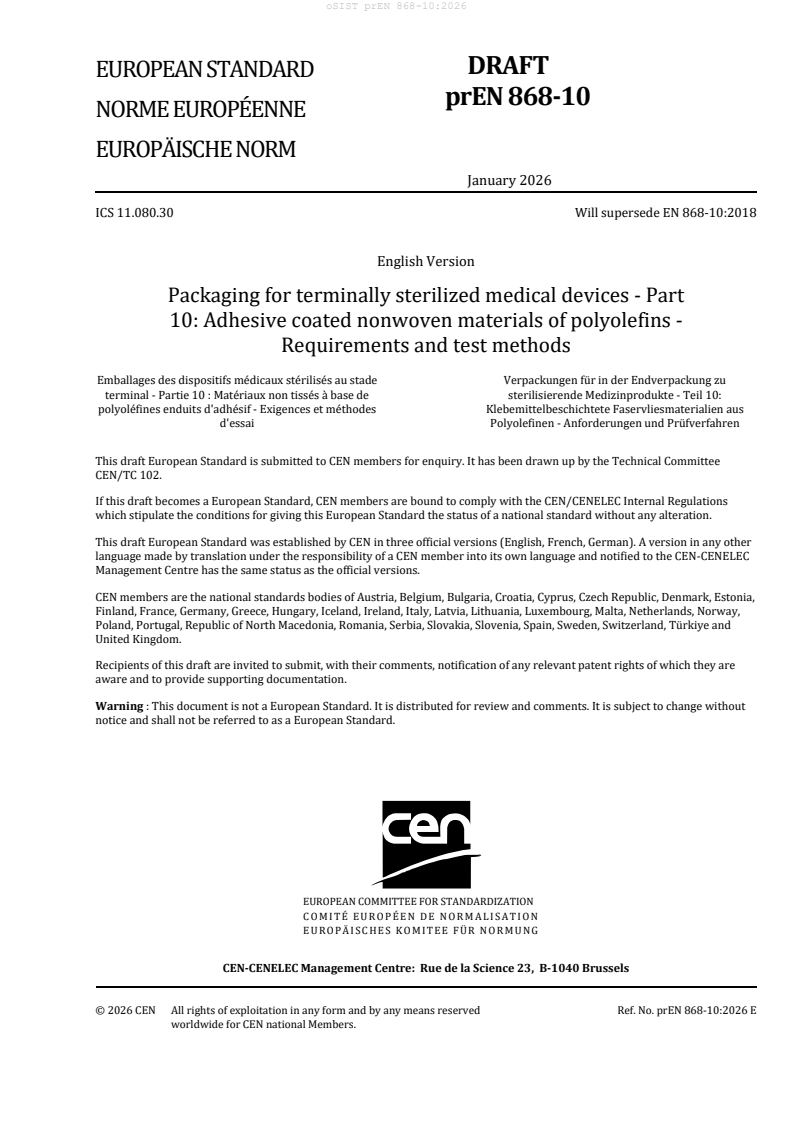
DRAFT
EUROPEAN STANDARD
prEN 868-10
NORME EUROPÉENNE
EUROPÄISCHE NORM
January 2026
ICS 11.080.30 Will supersede EN 868-10:2018
English Version
Packaging for terminally sterilized medical devices - Part
10: Adhesive coated nonwoven materials of polyolefins -
Requirements and test methods
Emballages des dispositifs médicaux stérilisés au stade Verpackungen für in der Endverpackung zu
terminal - Partie 10 : Matériaux non tissés à base de sterilisierende Medizinprodukte - Teil 10:
polyoléfines enduits d'adhésif - Exigences et méthodes Klebemittelbeschichtete Faservliesmaterialien aus
d'essai Polyolefinen - Anforderungen und Prüfverfahren
This draft European Standard is submitted to CEN members for enquiry. It has been drawn up by the Technical Committee
CEN/TC 102.
If this draft becomes a European Standard, CEN members are bound to comply with the CEN/CENELEC Internal Regulations
which stipulate the conditions for giving this European Standard the status of a national standard without any alteration.
This draft European Standard was established by CEN in three official versions (English, French, German). A version in any other
language made by translation under the responsibility of a CEN member into its own language and notified to the CEN-CENELEC
Management Centre has the same status as the official versions.
CEN members are the national standards bodies of Austria, Belgium, Bulgaria, Croatia, Cyprus, Czech Republic, Denmark, Estonia,
Finland, France, Germany, Greece, Hungary, Iceland, Ireland, Italy, Latvia, Lithuania, Luxembourg, Malta, Netherlands, Norway,
Poland, Portugal, Republic of North Macedonia, Romania, Serbia, Slovakia, Slovenia, Spain, Sweden, Switzerland, Türkiye and
United Kingdom.
Recipients of this draft are invited to submit, with their comments, notification of any relevant patent rights of which they are
aware and to provide supporting documentation.
Warning : This document is not a European Standard. It is distributed for review and comments. It is subject to change without
notice and shall not be referred to as a European Standard.
EUROPEAN COMMITTEE FOR STANDARDIZATION
COMITÉ EUROPÉEN DE NORMALISATION
EUROPÄISCHES KOMITEE FÜR NORMUNG
CEN-CENELEC Management Centre: Rue de la Science 23, B-1040 Brussels
© 2026 CEN All rights of exploitation in any form and by any means reserved Ref. No. prEN 868-10:2026 E
worldwide for CEN national Members.
prEN 868-10:2026 (E)
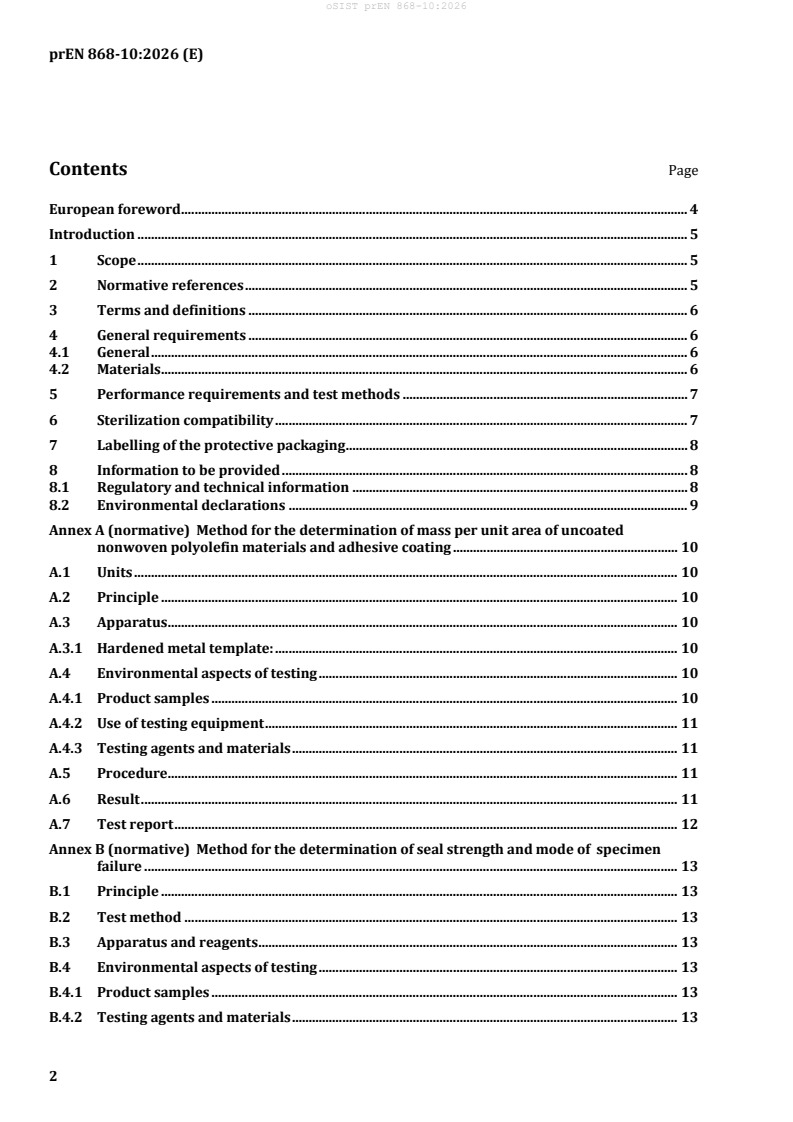
Contents Page
European foreword . 4
Introduction . 5
1 Scope . 5
2 Normative references . 5
3 Terms and definitions . 6
4 General requirements . 6
4.1 General . 6
4.2 Materials . 6
5 Performance requirements and test methods . 7
6 Sterilization compatibility . 7
7 Labelling of the protective packaging . 8
8 Information to be provided . 8
8.1 Regulatory and technical information . 8
8.2 Environmental declarations . 9
Annex A (normative) Method for the determination of mass per unit area of uncoated
nonwoven polyolefin materials and adhesive coating . 10
A.1 Units . 10
A.2 Principle . 10
A.3 Apparatus . 10
A.3.1 Hardened metal template: . 10
A.4 Environmental aspects of testing . 10
A.4.1 Product samples . 10
A.4.2 Use of testing equipment . 11
A.4.3 Testing agents and materials . 11
A.5 Procedure. 11
A.6 Result . 11
A.7 Test report . 12
Annex B (normative) Method for the determination of seal strength and mode of specimen
failure . 13
B.1 Principle . 13
B.2 Test method . 13
B.3 Apparatus and reagents . 13
B.4 Environmental aspects of testing . 13
B.4.1 Product samples . 13
B.4.2 Testing agents and materials . 13
prEN 868-10:2026 (E)
B.4.3 Use and cleaning of testing equipment . 13
B.5 Preparation of test-specimen . 14
B.6 Procedure . 14
B.7 Test report . 14
Annex C (informative) Environmental aspects . 16
C.1 General . 16
C.2 Environmental aspects of materials . 16
C.2.1 Minimizing material amounts used for SBS . 16
C.2.2 Using recyclable materials . 16
C.2.3 Using recycled materials . 16
C.2.4 Using materials from renewable resources . 17
C.2.5 Minimizing the use of energy and emission of greenhouse gases of purchased
materials . 17
C.3 Environmental aspects of production . 17
C.4 Environmental aspects of transport packaging of packaging materials and
preformed sterile barrier systems . 17
C.4.1 Appropriate types of packaging . 17
C.4.2 Reusing or recycling packaging material . 17
C.5 Environmental aspects at the end of life . 18
C.5.1 Designing for recyclability . 18
C.5.2 Ensuring a high rate of collection . 18
C.6 Environmental aspects of transportation . 18
Bibliography . 19
prEN 868-10:2026 (E)
European foreword
This document (prEN 868-10:2026) has been prepared by Technical Committee CEN/TC 102 “Sterilizers
and associated equipment for processing of medical devices”, the secretariat of which is held by DIN.
This document is currently submitted to the CEN Enquiry.
This document will supersede EN 868-10:2018.
prEN 868-10:2026 includes the following significant technical changes with respect to EN 868-10:2018:
Clause 4 “General requirements” was slightly revised for clarity and aligned with the other parts of the
EN 868 series, and a statement was added clarifying when acceptance criteria apply.
Clause 6 “Environmental declarations” was added and aligned with the other parts of EN 868 series.
a) The list of major changes was moved to the foreword, thus the Annex with “Details of significant
technical changes between this European Standard and the previous edition” (former Annex A)
was deleted.
b) New Clause “Environmental aspects for testing” was added to each test method in Annexes A to
B.
c) New Annex C regarding environmental aspects was added.
EN 868 series consists of the following parts, under the general title Packaging for terminally sterilized
medical devices:
— Part 2: Sterilization wrap — Requirements and test methods;
— Part 3: Paper for use in the manufacture of paper bags (specified in EN 868-4) and in the manufacture
of pouches and reels (specified in EN 868-5) — Requirements and test methods;
— Part 4: Paper bags — Requirements and test methods;
— Part 5: Sealable pouches and reels constructed of porous materials and plastic film— Requirements and
test methods;
— Part 6: Paper for low temperature sterilization processes — Requirements and test methods;
— Part 7: Adhesive coated paper for low temperature sterilization processes — Requirements and test
methods;
— Part 8: Re-usable sterilization containers for large steam sterilizers — Requirements and test methods;
— Part 9: Uncoated nonwoven materials of polyolefins — Requirements and test methods;
— Part 10: Adhesive coated nonwoven materials of polyolefins — Requirements and test methods.
prEN 868-10:2026 (E)
Introduction
The EN ISO 11607 series of standards consists of two parts under the general title “Packaging for
terminally sterilized medical devices”. EN ISO 11607-1 specifies general requirements and test methods
for materials, preformed sterile barrier systems, sterile barrier systems and packaging systems that are
intended to maintain sterility of terminally sterilized medical devices to the point of use. EN ISO 11607-2
specifies validation requirements for forming, sealing and assembly processes.
General requirements for all types of sterile barrier systems are provided by EN ISO 11607-1 and EN
ISO 11607-2 [2].
The EN 868 series of standards have been developed mainly for materials and sterile barrier systems
used in health care facilities sterilization processes. Materials complying with part 10 of the EN 868 series
can also be used for industrial sterilization. The EN 868 series of standards can be used to demonstrate
compliance with one or more of the requirements specified in EN ISO 11607-1.
Considering CEN guide 4 [5] and the CEN environmental checklists, this revision has been complemented
with a new annex with guidance to encourage users to also include environmental aspects when applying
the EN 868 series of standards with the objective to minimize the environmental impact. Environmental
aspects have also been included into the description of test methods with the same objective.
1 Scope
This document specifies test methods and values for sealable adhesive coated nonwoven materials of
polyolefins, manufactured from nonwovens specified in EN 868-9 used for single-use sterile barrier
systems and/or packaging systems for terminally sterilized medical devices.
Other than the general requirements as specified in EN ISO 11607-1 and EN ISO 11607-2, this part of
EN 868 series specifies materials, test methods and values that are specific to the products covered by
this document.
2 Normative references
The following documents are referred to in the text in such a way that some or all of their content
constitutes requirements of this document. For dated references, only the edition cited applies. For
undated references, the latest edition of the referenced document (including any amendments) applies.
EN ISO 536, Paper and board - Determination of grammage (ISO 536)
ISO 811, Textiles — Determination of resistance to water penetration — Hydrostatic pressure test
EN ISO 1924-2, Paper and board - Determination of tensile properties - Part 2: Constant rate of elongation
method (20 mm/min) (ISO 1924-2)
EN ISO 1974, Paper - Determination of tearing resistance - Elmendorf method (ISO 1974)
EN ISO 2758, Paper - Determination of bursting strength (ISO 2758)
EN ISO 14021, Environmental labels and declarations - Self-declared environmental claims (Type II
environmental labelling) (ISO 14021)
EN ISO 14025, Environmental labels and declarations - Type III environmental declarations - Principles and
procedures (ISO 14025)
ISO 5636-3, Paper and board — Determination of air permeance (medium range) — Part 3: Bendtsen
method
prEN 868-10:2026 (E)
ISO 6588-2, Paper, board and pulps — Determination of pH of aqueous extracts — Part 2: Hot extraction
ISO 8601-1, Date and time — Representations for information interchange — Part 1: Basic rules
ASTM D2724, Standard Test Methods for Bonded, Fused, and Laminated Apparel Fabrics
ASTM F88/F88M:2023, Standard Test Method for Seal Strength of Flexible Barrier Materials
3 Terms and definitions
For the purposes of this document, the terms and definitions given in EN ISO 11607-1 apply.
ISO and IEC maintain terminology databases for use in standardization at the following addresses:
— IEC Electropedia: available at https://www.electropedia.org/
— ISO Online browsing platform: available at https://www.iso.org/obp
4 General requirements
4.1 General
4.1.1 For any material, preformed sterile barrier system or sterile barrier system, the requirements of
EN ISO 11607-1 shall apply.
NOTE When additional materials are used inside the sterile barrier system in order to ease the organization,
drying or aseptic presentation (e.g. inner wrap, indicators, packing lists, mats, instrument organizer sets, tray liners
or an additional envelope around the medical device) then other requirements, including the determination of the
acceptability of these materials during validation activities, can apply.
4.1.2 This part of EN 868 series only introduces performance requirements and test methods that are
specific to the products covered by this part of EN 868 series but does not add or modify the general
requirements specified in EN ISO 11607-1.
NOTE This document introduces test methods in Annex A and Annex B.
4.1.3 As such, the particular requirements in 4.3 can be used to demonstrate compliance with one or
more but not all of the requirements of EN ISO 11607-1.
NOTE Conformity with this document does not automatically mean conformity with EN ISO 11607-1.
4.1.4 A confirmation of compliance to this document shall contain a statement of whether
EN ISO 11607-1 is covered.
4.2 Materials
4.2.1 The coated material shall be translucent or opaque and made of continuous filaments of
polyolefins of a high level of purity and shall not release any substances in such quantities as could
constitute a health risk.
NOTE Attention is drawn to EN ISO 10993-1.
4.2.2 The coated material shall not react with, contaminate, transfer to, or adversely affect the product
packed in it, before, during or after sterilization.
prEN 868-10:2026 (E)
4.2.3 Unless otherwise specified in the test methods, test samples shall be conditioned at (23 ± 1) °C
and (50 ± 2) % relative humidity for a minimum of 24 h. The conditioning time may be reduced for
polyolefin materials if demonstrated as appropriate.
5 Performance requirements and test methods
5.1 No colour shall leach out of the material. Compliance shall be tested by visual examination of a hot
extract prepared in accordance with the method given in ISO 6588-2 modified to test temperature of
(60 ± 5) °C.
5.2 The average mass of 1 m of the conditioned material when tested in accordance with EN ISO 536
shall be within ± 15 % of the nominal value stated by the manufacturer.
5.3 The tensile strength of the conditioned material shall be not less than 4,8 kN/m in the machine
direction and not less than 5,0 kN/m in the cross direction when tested in accordance with
EN ISO 1924-2.
5.4 The internal tearing resistance of the conditioned material shall be not less than 1 000 mN in both
machine and cross directions when tested in accordance with EN ISO 1974.
5.5 If the nature of the material allows a delamination to be initiated, the delamination strength of the
conditioned material shall be not less than 1 N/25,4 mm when tested in accordance with ASTM D2724.
5.6 The bursting strength of the conditioned material shall be not less than 575 kPa when tested in
accordance with EN ISO 2758.
5.7 The air permeance of the conditioned material shall be not less than 0,3 µm/Pa ⋅ s at an air pressure
of 1,47 kPa when tested in accordance with ISO 5636-3. For materials solely used for irradiation
sterilization, this requirement may be excluded.
5.8 The resistance to water penetration of the conditioned material shall be determined using the
hydrostatic head test based on ISO 811. Test results and test conditions shall be documented.
5.9 The mass per unit of the seal adhesive coating shall be within ± 2 g/m of t
...