

kSIST FprEN 868-10:2026
(Main)Packaging for terminally sterilized medical devices - Part 10: Adhesive coated nonwoven materials of polyolefins - Requirements and test methods
- Abstract
This document specifies test methods and values for sealable adhesive coated nonwoven materials of polyolefins, manufactured from nonwovens specified in EN 868-9 used for single-use sterile barrier systems and/or packaging systems for terminally sterilized medical devices.
Other than the general requirements as specified in EN ISO 11607-1 and EN ISO 11607-2, this part of EN 868 series specifies materials, test methods and values that are specific to the products covered by this document.
- Status
- Not Published
- Public Enquiry End Date
- 30-Mar-2026
- Technical Committee
- VAZ - Healthcare
- Current Stage
- 5020 - Formal vote (FV) (Adopted Project)
- Start Date
- 06-Oct-2026
- Due Date
- 24-Nov-2026
- Completion Date
- 06-Oct-2026

kSIST FprEN 868-10:2026 is a SIST draft European standard from CEN for adhesive coated nonwoven materials of polyolefins used in single-use sterile barrier systems and packaging systems for terminally sterilized medical devices. It specifies product-specific test methods, performance values, labelling, and information to be provided for materials made from nonwovens covered by EN 868-9. For manufacturers, test laboratories, and users in medical-device packaging, it shows what to verify to judge whether a material is suitable for sterile packaging applications.
What does kSIST FprEN 868-10:2026 specify?
kSIST FprEN 868-10:2026 specifies the material-specific requirements for sealable adhesive coated nonwoven materials of polyolefins. It sits alongside the general requirements of EN ISO 11607-1 and EN ISO 11607-2 and adds the product-specific test methods and values for this material family.
The document is organized into:
- Clause 1 Scope
- Clause 2 Normative references
- Clause 3 Terms and definitions
- Clause 4 General requirements
- Clause 5 Performance requirements and test methods
- Clause 6 Sterilization compatibility
- Clause 7 Labelling of the protective packaging
- Clause 8 Information to be provided
- Annex A and Annex B as normative test methods
- Annex C as informative environmental guidance
| Annex | What it covers |
|---|---|
| Annex A | Mass per unit area of uncoated nonwoven polyolefin materials and adhesive coating |
| Annex B | Seal strength and mode of specimen failure |
| Annex C | Environmental aspects across materials, production, transport, end of life, and transportation |
What are the key requirements of kSIST FprEN 868-10:2026?
kSIST FprEN 868-10:2026 keeps the general framework of EN ISO 11607-1, then adds requirements that are specific to adhesive coated nonwoven polyolefins. In practice, the standard tells a manufacturer what properties to declare, how to test them, and what information to provide with the product.
Material and sample condition requirements
Clause 4 requires the coated material to be translucent or opaque, made of continuous filaments of high-purity polyolefins, and not to release substances at levels that could create a health risk. It also requires the material not to react with, contaminate, transfer to, or adversely affect the packed product before, during, or after sterilization. Samples are conditioned at 23 °C and 50 % relative humidity unless the test method states otherwise; this matters because test results must reflect a controlled state rather than random storage conditions.
Performance requirements for the material
Clause 5 sets the main performance checks. The material must show no colour leaching on visual examination of a hot extract, must stay within the declared nominal mass per unit area, and must meet minimum tensile strength, tearing resistance, bursting strength, and seal-related performance. It also sets an air permeance limit, requires water-penetration resistance to be determined and documented, and requires the adhesive coating mass to stay within the declared tolerance.
In practice, these requirements help users compare material batches and confirm that a supplied product is consistent with the manufacturer’s declared data. They also provide the evidence needed for incoming inspection, qualification, and routine quality control.
Sealability and coating integrity
Clause 5 requires the seal strength of the coated material to be above the stated minimum when tested by Annex B, and the coating must be continuous and regular with no uncoated areas or coating-pattern gaps that could create channels in a seal. This matters because a sterile barrier system depends on the integrity of the seal path, not only on the base material itself.
Sterilization compatibility
Clause 6 requires the sterilization processes used with the packaging materials to be defined, and the compatibility of the material with those processes to be evaluated according to EN ISO 11607-1. The evaluation must consider the intended sterilization process or processes and the intended number of cycles. In practice, this means the user must link the material choice to the actual sterilization route and check that the material still performs after exposure.
Labelling and user information
Clause 7 requires protective packaging to be legibly and durably labelled. For deliveries to health care facilities, the label must include identification, quantity, supplier details, date of manufacture, lot number, nominal mass per square metre, size information, and any specific storage conditions. For industrial applications, the customer and supplier should agree the label content.
Clause 8 requires sealing instructions with recommended process parameters, including temperature, pressure, and time or speed. It also requires environmental labels and declarations, where applicable, to follow EN ISO 14021 or EN ISO 14025, and asks for end-of-life treatment recommendations. If recyclability is assessed, the method, product reference, standards used, and overall results must be given.
What terms does kSIST FprEN 868-10:2026 define?
kSIST FprEN FprEN 868-10:2026 relies on the terms and definitions from EN ISO 11607-1. The following terms are central to using the standard correctly:
- Sterile barrier system (SBS) - The packaging system that maintains sterility up to the point of use.
- Packaging system - The full set of packaging components used to protect the medical device during storage, transport, and sterilization.
- Preformed sterile barrier system - A pre-made sterile barrier package that is later filled or used in a packaging process.
- Protective packaging - Packaging intended to protect the sterile barrier system during distribution and handling.
- Seal strength - The force needed to separate a seal, used here to judge seal performance.
- Delamination - Separation within the material structure, which can indicate a weak or unsuitable bonded structure.
- Sterilization compatibility - The ability of the material to withstand the intended sterilization process without losing required performance.
Who uses kSIST FprEN 868-10:2026?
kSIST FprEN FprEN 868-10:2026 is used by manufacturers and suppliers of sterile packaging materials, by test laboratories that measure the properties named in the standard, and by quality and regulatory teams that need objective acceptance criteria. It is also relevant to health care facilities and industrial sterilization users that specify or purchase packaging materials for terminal sterilization.
In practice, these users apply the document when qualifying a material, checking batch consistency, validating sealing, setting label content, or documenting compatibility with a sterilization process. It is especially relevant where the material is used in single-use sterile barrier systems.
What changed in kSIST FprEN FprEN 868-10:2026 from the previous edition?
kSIST FprEN FprEN 868-10:2026 supersedes EN 868-10:2018. The foreword states that Clause 4 was revised for clarity and aligned with the other parts of the EN 868 series, and that a statement was added to clarify when acceptance criteria apply. It also states that environmental declarations were added and aligned with the rest of the series, that environmental aspects were added to the test-method annexes, that a new Annex C was added, and that the former annex listing technical changes was deleted and its content moved to the foreword.
Which standards are used with kSIST FprEN 868-10:2026?
The standard draws on a set of companion standards for general requirements, testing, and environmental declarations:
| Referenced document | What it contributes |
|---|---|
| EN ISO 11607-1 | General requirements for materials, sterile barrier systems, and packaging systems |
| EN ISO 11607-2 | Validation requirements for forming, sealing, and assembly processes |
| EN 868-9 | The nonwoven polyolefin materials used as the base material family |
| EN ISO 536 | Grammage determination for the coated material |
| ISO 811 | Hydrostatic pressure test for water penetration resistance |
| EN ISO 1924-2 | Tensile strength testing |
| EN ISO 1974 | Tearing resistance testing |
| EN ISO 2758 | Bursting strength testing |
| ISO 5636-3 | Air permeance testing |
| ISO 6588-2 | Hot extraction method used for colour leaching check |
| ASTM D2724 | Delamination-strength test method |
| ASTM F88/F88M:2023 | Seal strength test method for flexible barrier materials |
| EN ISO 14021 and EN ISO 14025 | Environmental labels and declarations |
| ISO 8601-1 | Date format for labelling |
| EN ISO 10993-1 | Biological evaluation reference noted in the material requirements |
| ISO 20417 | Manufacturer information reference noted for supplied medical-device accessory information |
What does the kSIST FprEN 868-10:2026 document contain?
kSIST FprEN FprEN 868-10:2026 contains the product scope, the referenced test standards, and the terms used for this material family. It then sets the core material and performance requirements, including conditioning, visual checks, strength properties, air and water resistance, coating mass, and seal performance.
The annexes provide the practical methods behind the requirements. Annex A gives the sample preparation, extraction, calculation, and reporting for adhesive coating mass per unit area. Annex B gives the seal-strength procedure, specimen preparation, pulling conditions, failure inspection, and reporting details. Annex C gives environmental guidance for materials, production, transport packaging, end of life, and transportation, so users can factor environmental considerations into packaging decisions without losing sight of sterility and patient safety.
Relations
- Effective Date
- 13-Nov-2024
Get Certified
Connect with accredited certification bodies for this standard

BSI Group
BSI (British Standards Institution) is the business standards company that helps organizations make excellence a habit.

TÜV Rheinland
TÜV Rheinland is a leading international provider of technical services.

TÜV SÜD
TÜV SÜD is a trusted partner of choice for safety, security and sustainability solutions.
Sponsored listings
Frequently Asked Questions
kSIST FprEN 868-10:2026 is a draft published by the Slovenian Institute for Standardization (SIST). Its full title is "Packaging for terminally sterilized medical devices - Part 10: Adhesive coated nonwoven materials of polyolefins - Requirements and test methods". This standard covers: This document specifies test methods and values for sealable adhesive coated nonwoven materials of polyolefins, manufactured from nonwovens specified in EN 868-9 used for single-use sterile barrier systems and/or packaging systems for terminally sterilized medical devices. Other than the general requirements as specified in EN ISO 11607-1 and EN ISO 11607-2, this part of EN 868 series specifies materials, test methods and values that are specific to the products covered by this document.
This document specifies test methods and values for sealable adhesive coated nonwoven materials of polyolefins, manufactured from nonwovens specified in EN 868-9 used for single-use sterile barrier systems and/or packaging systems for terminally sterilized medical devices. Other than the general requirements as specified in EN ISO 11607-1 and EN ISO 11607-2, this part of EN 868 series specifies materials, test methods and values that are specific to the products covered by this document.
kSIST FprEN 868-10:2026 is classified under the following ICS (International Classification for Standards) categories: 11.080.30 - Sterilized packaging. The ICS classification helps identify the subject area and facilitates finding related standards.
kSIST FprEN 868-10:2026 has the following relationships with other standards: It is inter standard links to SIST EN 868-10:2019. Understanding these relationships helps ensure you are using the most current and applicable version of the standard.
kSIST FprEN 868-10:2026 is available in PDF format for immediate download after purchase. The document can be added to your cart and obtained through the secure checkout process. Digital delivery ensures instant access to the complete standard document.
Standards Content (Sample)
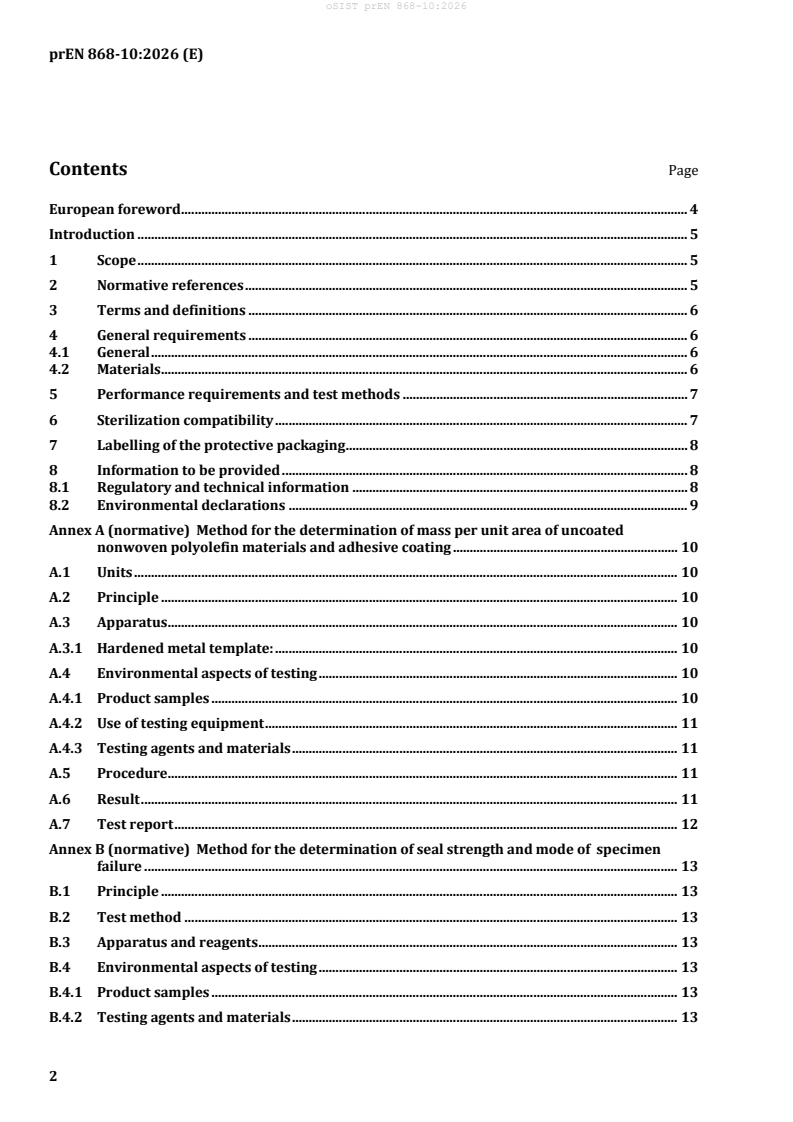
Contents
- Introduction
- 1 Scope
- 2 Normative references
- 3 Terms and definitions
- 4 General requirements
- 4.1 General
- 4.2 Materials
- 5 Performance requirements and test methods
- 5.10 The seal strength of the coated material shall be greater than 1,2 N/15 mm when tested in
- 6 Sterilization compatibility
- 7 Labelling of the protective packaging
- 8 Information to be provided
- 8.1 Regulatory and technical information
- 8.2 Environmental declarations
- Annex A
- Annex B
- Annex C
- Bibliography
Introduction
The EN ISO 11607 series of standards consists of two parts under the general title “Packaging for terminally sterilized medical devices”. EN ISO 11607-1 specifies general requirements and test methods for materials, preformed sterile barrier systems, sterile barrier systems and packaging systems that are intended to maintain sterility of terminally sterilized medical devices to the point of use. EN ISO 11607-2 specifies validation requirements for forming, sealing and assembly processes. General requirements for all types of sterile barrier systems are provided by EN ISO 11607-1 and EN ISO 11607-2 [2].
The EN 868 series of standards have been developed mainly for materials and sterile barrier systems used in health care facilities sterilization processes. Materials complying with part 10 of the EN 868 series can also be used for industrial sterilization. The EN 868 series of standards can be used to demonstrate compliance with one or more of the requirements specified in EN ISO 11607-1. Considering CEN guide 4 [5] and the CEN environmental checklists, this revision has been complemented with a new annex with guidance to encourage users to also include environmental aspects when applying the EN 868 series of standards with the objective to minimize the environmental impact. Environmental aspects have also been included into the description of test methods with the same objective.
1 Scope
This document specifies test methods and values for sealable adhesive coated nonwoven materials of polyolefins, manufactured from nonwovens specified in EN 868-9 used for single-use sterile barrier systems and/or packaging systems for terminally sterilized medical devices. Other than the general requirements as specified in EN ISO 11607-1 and EN ISO 11607-2, this part of EN 868 series specifies materials, test methods and values that are specific to the products covered by this document.
2 Normative references
The following documents are referred to in the text in such a way that some or all of their content constitutes requirements of this document. For dated references, only the edition cited applies. For undated references, the latest edition of the referenced document (including any amendments) applies. EN ISO 536, Paper and board - Determination of grammage (ISO 536) ISO 811, Textiles — Determination of resistance to water penetration — Hydrostatic pressure test EN ISO 1924-2, Paper and board - Determination of tensile properties - Part 2: Constant rate of elongation method (20 mm/min) (ISO 1924-2) EN ISO 1974, Paper - Determination of tearing resistance - Elmendorf method (ISO 1974) EN ISO 2758, Paper - Determination of bursting strength (ISO 2758) EN ISO 14021, Environmental labels and declarations - Self-declared environmental claims (Type II environmental labelling) (ISO 14021) EN ISO 14025, Environmental labels and declarations - Type III environmental declarations - Principles and procedures (ISO 14025) ISO 5636-3, Paper and board — Determination of air permeance (medium range) — Part 3: Bendtsen method
oSIST prEN 868-10:2026 prEN 868-10:2026 (E) ISO 6588-2, Paper, board and pulps — Determination of pH of aqueous extracts — Part 2: Hot extraction ISO 8601-1, Date and time — Representations for information interchange — Part 1: Basic rules ASTM D2724, Standard Test Methods for Bonded, Fused, and Laminated Apparel Fabrics ASTM F88/F88M:2023, Standard Test Method for Seal Strength of Flexible Barrier Materials
3 Terms and definitions
For the purposes of this document, the terms and definitions given in EN ISO 11607-1 apply. ISO and IEC maintain terminology databases for use in standardization at the following addresses:
- IEC Electropedia: available at https://www.electropedia.org/
- ISO Online browsing platform: available at https://www.iso.org/obp
4 General requirements
4.1 General
4.1.1 For any material, preformed sterile barrier system or sterile barrier system, the requirements of EN ISO 11607-1 shall apply.
NOTE When additional materials are used inside the sterile barrier system in order to ease the organization, drying or aseptic presentation (e.g. inner wrap, indicators, packing lists, mats, instrument organizer sets, tray liners or an additional envelope around the medical device) then other requirements, including the determination of the acceptability of these materials during validation activities, can apply. 4.1.2 This part of EN 868 series only introduces performance requirements and test methods that are specific to the products covered by this part of EN 868 series but does not add or modify the general requirements specified in EN ISO 11607-1.
NOTE This document introduces test methods in Annex A and Annex B. 4.1.3 As such, the particular requirements in 4.3 can be used to demonstrate compliance with one or more but not all of the requirements of EN ISO 11607-1.
NOTE Conformity with this document does not automatically mean conformity with EN ISO 11607-1.
4.1.4 A confirmation of compliance to this document shall contain a statement of whether
EN ISO 11607-1 is covered.
4.2 Materials
4.2.1 The coated material shall be translucent or opaque and made of continuous filaments of
polyolefins of a high level of purity and shall not release any substances in such quantities as could constitute a health risk.
NOTE Attention is drawn to EN ISO 10993-1.
4.2.2 The coated material shall not react with, contaminate, transfer to, or adversely affect the product packed in it, before, during or after sterilization.
oSIST prEN 868-10:2026 prEN 868-10:2026 (E) 4.2.3 Unless otherwise specified in the test methods, test samples shall be conditioned at (23 ± 1) °C and (50 ± 2) % relative humidity for a minimum of 24 h. The conditioning time may be reduced for polyolefin materials if demonstrated as appropriate.
5 Performance requirements and test methods
5.1 No colour shall leach out of the material. Compliance shall be tested by visual examination of a hot extract prepared in accordance with the method given in ISO 6588-2 modified to test temperature of (60 ± 5) °C.
5.2 The average mass of 1 m of the conditioned material when tested in accordance with EN ISO 536 shall be within ± 15 % of the nominal value stated by the manufacturer. 5.3 The tensile strength of the conditioned material shall be not less than 4,8 kN/m in the machine direction and not less than 5,0 kN/m in the cross direction when tested in accordance with EN ISO 1924-2.
5.4 The internal tearing resistance of the conditioned material shall be not less than 1 000 mN in both machine and cross directions when tested in accordance with EN ISO 1974. 5.5 If the nature of the material allows a delamination to be initiated, the delamination strength of the conditioned material shall be not less than 1 N/25,4 mm when tested in accordance with ASTM D2724. 5.6 The bursting strength of the conditioned material shall be not less than 575 kPa when tested in accordance with EN ISO 2758.
5.7 The air permeance of the conditioned material shall be not less than 0,3 µm/Pa ⋅ s at an air pressure of 1,47 kPa when tested in accordance with ISO 5636-3. For materials solely used for irradiation sterilization, this requirement may be excluded.
5.8 The resistance to water penetration of the conditioned material shall be determined using the hydrostatic head test based on ISO 811. Test results and test conditions shall be documented.
5.9 The mass per unit of the seal adhesive coating shall be within ± 2 g/m of that stated by the manufacturer. Compliance shall be tested in accordance with the method given in Annex A.
5.10 The seal strength of the coated material shall be greater than 1,2 N/15 mm when tested in
accordance with Annex B. Report whether the tail was supported or unsupported, see B.5. 5.11 The coating shall be continuous and regular with no uncoated areas or discontinuity in the coating pattern which could provide gaps or channels in a seal.
NOTE The test method for the determination of the continuity of the coating depends on the applied coating system.
6 Sterilization compatibility
6.1 The sterilization processes applicable to the packaging materials under the scope of this document shall be defined.
6.2 The sterilization compatibility of the packaging materials shall be evaluated following the requirements of EN ISO 11607-1. The effects shall be evaluated considering the intended sterilization process(es) and intended number of cycles.
oSIST prEN 868-10:2026 prEN 868-10:2026 (E) NOTE Sterilization processes generally have an effect on material properties, therefore evaluation of sterilization compatibility involves a risk-based assessment considering the characteristics of the material and its application to define the properties to be evaluated, which typically include material strength properties relevant for maintenance of sterility after sterilization.
7 Labelling of the protective packaging
7.1 The protective packaging shall be legibly and durably labelled. 7.2 For industrial applications, the customer and the supplier should agree on the required label information.
7.3 For deliveries to health care facilities, the label shall include at least the following information:
a) reference, stock or catalogue number; b) quantity; c) the manufacturer's or supplier's name or trade name, and address; d) date of manufacture in accordance with ISO 8601-1;
e) lot number ; f) nominal mass in grams per square metre; g) nominal sheet size in millimetres or nominal width of rolls in millimetres and length in metres; h) any specific storage conditions, if applicable.
8 Information to be provided
8.1 Regulatory and technical information
8.1.1 Information should be provided pertinent to the use of the material in sterile barrier systems considering the requirements of EN ISO 11607-1:2020.
...