

oSIST prEN 17070:2016
(Main)Industrial valves - Minimum performance requirements
General Information
- Abstract
This European Standard defines the minimum performance requirements which apply to industrial valves. It specifies test procedures and acceptance criteria for each performance requirement of this European standard.
Valves for specific use, where such a performance requirements already exists are excluded from this standard:
a) valves to be used in water supply pipe system in accordance with EN 1074 (all parts);
b) valves to be used in gas distribution system with pressure lower than 16 bar in accordance with EN 13774;
c) control valves in accordance with EN 1349;
d) safety devices in accordance with EN ISO 4126 (all parts).
- Status
- Not Published
- Public Enquiry End Date
- 04-Jan-2017
- Technical Committee
- TLP - Pressure vessels
- Current Stage
- 98 - Abandoned project (Adopted Project)
- Start Date
- 14-May-2024
- Due Date
- 19-May-2024
- Completion Date
- 14-May-2024

Overview
The European Standard oSIST prEN 17070:2016:2016 specifies the minimum performance requirements for industrial valves. Developed by CEN Technical Committee CEN/TC 69, this standard outlines mandatory test procedures and acceptance criteria to ensure industrial valves meet essential quality and safety standards. It applies to a wide range of valves used in various industrial applications, excluding valves for specific uses already covered by other dedicated standards, such as water supply systems, gas distribution systems below 16 bar, control valves, and safety devices.
This document is crucial for manufacturers, testing laboratories, and end-users aiming to assure product reliability, operational endurance, and leakage integrity of industrial valves.
Key Topics
Scope and Exclusions
Defines the coverage of the standard, excluding valves designed under other European standards such as EN 1074 for water supply or EN ISO 4126 for safety devices.Minimum Performance Requirements
Establishes strict criteria for valve performance, focusing on two main tests:- Seat Tightness (P12): Ensures valves limit leakage to maximum allowable rates at manufacture and during operation under specified pressures.
- Endurance Tests: Verify valve functionality and leakage control after repeated opening and closing cycles, simulating real-world use.
Cycle Testing Procedures
Detailed test protocols describe the cycling of valves under pressure conditions, testing both isolating valves and check valves across various sizes and pressure classes. Times, pressures, fluid types, and the exact sequence of opening and closing are defined to replicate operational conditions effectively.Acceptance Criteria
Leakage rates after endurance and seat tightness tests are clearly quantified for different valve seat types (resilient or metallic) and valve designs. The standard also mandates no visual damage to check valves after testing.Test Rig Descriptions
Illustrative guidelines for equipment setups support consistent testing, including the components and test fluid management necessary to conduct endurance and leak-tightness evaluations.
Applications
Industrial Manufacturing
Ensures that valves produced meet minimum functional and safety performance standards before entering the market.Quality Control and Certification
Testing for endurance and leakage rates according to oSIST prEN 17070:2016 helps manufacturers obtain certifications that demonstrate compliance with European regulations.Engineering and Design
Valve designers can use the minimum performance thresholds and test methods to guide product development that meets or exceeds standardized durability and sealing requirements.Procurement and Inspection
Buyers and facility managers referencing oSIST prEN 17070:2016 requirements can specify valves that assure compliance, durability, and reduced risk of leakage or failure in critical industrial processes.
Related Standards
EN 1074 (Water Supply Valves):
Governs valves used in water supply pipe systems and is excluded from oSIST prEN 17070:2016 scope.EN 13774 (Gas Distribution Valves):
Applies to gas valves operating at pressures below 16 bar.EN 1349 (Control Valves):
Defines requirements for control valves distinct from general industrial valves.EN ISO 4126 (Safety Devices):
Covers valves functioning as safety devices, excluded from this standard.EN 736 (Valves Terminology):
Parts 1-3 provide the terms and definitions referenced throughout oSIST prEN 17070:2016.EN 12266-1 (Metallic Valves Testing):
Describes mandatory pressure test procedures and acceptance criteria invoked in oSIST prEN 17070:2016 for seat and shell tightness testing.
Keywords: industrial valves, valve performance requirements, valve testing, seat tightness, endurance test, leakage rate, valve standards, CEN, oSIST prEN 17070:2016, industrial valve certification, valve cycle testing, resilient seated valves, metal seated valves, check valves endurance, European valve standard.
Get Certified
Connect with accredited certification bodies for this standard

Institut za varilstvo d.o.o. (Welding Institute)
Slovenia's leading welding institute since 1952. ISO 3834, EN 1090, pressure equipment certification, NDT personnel, welder qualification. Only IIW Au
Sponsored listings
Frequently Asked Questions
oSIST prEN 17070:2016 is a draft published by the Slovenian Institute for Standardization (SIST). Its full title is "Industrial valves - Minimum performance requirements". This standard covers: This European Standard defines the minimum performance requirements which apply to industrial valves. It specifies test procedures and acceptance criteria for each performance requirement of this European standard. Valves for specific use, where such a performance requirements already exists are excluded from this standard: a) valves to be used in water supply pipe system in accordance with EN 1074 (all parts); b) valves to be used in gas distribution system with pressure lower than 16 bar in accordance with EN 13774; c) control valves in accordance with EN 1349; d) safety devices in accordance with EN ISO 4126 (all parts).
This European Standard defines the minimum performance requirements which apply to industrial valves. It specifies test procedures and acceptance criteria for each performance requirement of this European standard. Valves for specific use, where such a performance requirements already exists are excluded from this standard: a) valves to be used in water supply pipe system in accordance with EN 1074 (all parts); b) valves to be used in gas distribution system with pressure lower than 16 bar in accordance with EN 13774; c) control valves in accordance with EN 1349; d) safety devices in accordance with EN ISO 4126 (all parts).
oSIST prEN 17070:2016 is classified under the following ICS (International Classification for Standards) categories: 23.060.01 - Valves in general. The ICS classification helps identify the subject area and facilitates finding related standards.
oSIST prEN 17070:2016 is available in PDF format for immediate download after purchase. The document can be added to your cart and obtained through the secure checkout process. Digital delivery ensures instant access to the complete standard document.
Standards Content (Sample)
SLOVENSKI STANDARD
01-december-2016
Industrijski ventili - Minimalne zahtevane lastnosti
Industrial valves - Minimum performance requirements
Industriearmaturen - Mindestleistungsanforderungen
Robinetterie industrielle - Exigences minimales de performance
Ta slovenski standard je istoveten z: prEN 17070
ICS:
23.060.01 Ventili na splošno Valves in general
2003-01.Slovenski inštitut za standardizacijo. Razmnoževanje celote ali delov tega standarda ni dovoljeno.
DRAFT
EUROPEAN STANDARD
NORME EUROPÉENNE
EUROPÄISCHE NORM
December 2016
ICS 23.060.01
English Version
Industrial valves - Minimum performance requirements
Robinetterie industrielle - Exigences minimales de Industriearmaturen - Mindestleistungsanforderungen
performance
This draft European Standard is submitted to CEN members for enquiry. It has been drawn up by the Technical Committee
CEN/TC 69.
If this draft becomes a European Standard, CEN members are bound to comply with the CEN/CENELEC Internal Regulations
which stipulate the conditions for giving this European Standard the status of a national standard without any alteration.
This draft European Standard was established by CEN in three official versions (English, French, German). A version in any other
language made by translation under the responsibility of a CEN member into its own language and notified to the CEN-CENELEC
Management Centre has the same status as the official versions.
CEN members are the national standards bodies of Austria, Belgium, Bulgaria, Croatia, Cyprus, Czech Republic, Denmark, Estonia,
Finland, Former Yugoslav Republic of Macedonia, France, Germany, Greece, Hungary, Iceland, Ireland, Italy, Latvia, Lithuania,
Luxembourg, Malta, Netherlands, Norway, Poland, Portugal, Romania, Slovakia, Slovenia, Spain, Sweden, Switzerland, Turkey and
United Kingdom.
Recipients of this draft are invited to submit, with their comments, notification of any relevant patent rights of which they are
aware and to provide supporting documentation.
Warning : This document is not a European Standard. It is distributed for review and comments. It is subject to change without
notice and shall not be referred to as a European Standard.
EUROPEAN COMMITTEE FOR STANDARDIZATION
COMITÉ EUROPÉEN DE NORMALISATION
EUROPÄISCHES KOMITEE FÜR NORMUNG
CEN-CENELEC Management Centre: Avenue Marnix 17, B-1000 Brussels
© 2016 CEN All rights of exploitation in any form and by any means reserved Ref. No. prEN 17070:2016 E
worldwide for CEN national Members.
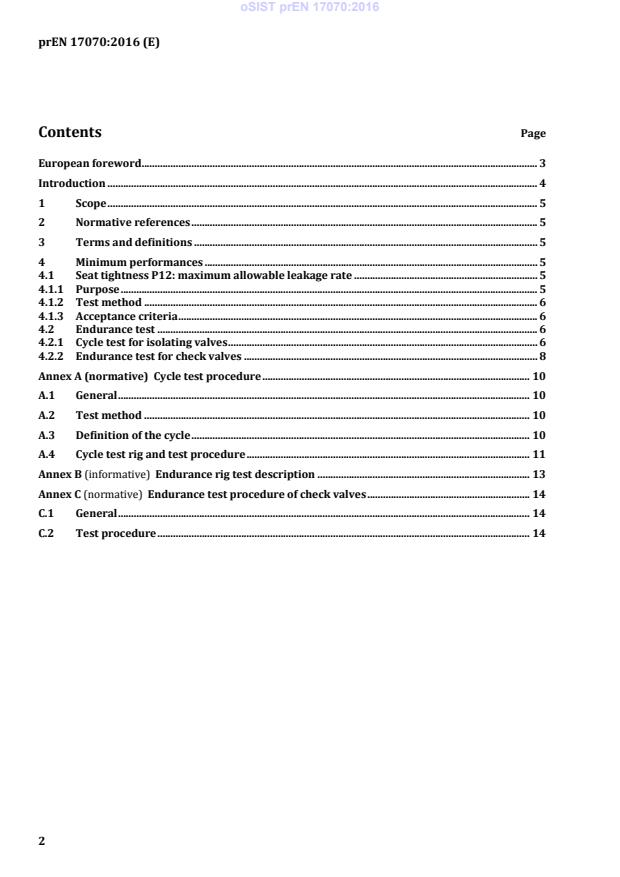
Contents Page
European foreword . 3
Introduction . 4
1 Scope . 5
2 Normative references . 5
3 Terms and definitions . 5
4 Minimum performances . 5
4.1 Seat tightness P12: maximum allowable leakage rate . 5
4.1.1 Purpose . 5
4.1.2 Test method . 6
4.1.3 Acceptance criteria . 6
4.2 Endurance test . 6
4.2.1 Cycle test for isolating valves . 6
4.2.2 Endurance test for check valves . 8
Annex A (normative) Cycle test procedure . 10
A.1 General . 10
A.2 Test method . 10
A.3 Definition of the cycle . 10
A.4 Cycle test rig and test procedure . 11
Annex B (informative) Endurance rig test description . 13
Annex C (normative) Endurance test procedure of check valves . 14
C.1 General . 14
C.2 Test procedure . 14
European foreword
This document (prEN 17070:2016) has been prepared by Technical Committee CEN/TC 69 “Industrial
valves”, the secretariat of which is held by AFNOR.
This document is currently submitted to the CEN Enquiry.
Introduction
The purpose of this document is to define the minimal performances required for industrial valves.
1 Scope
This European Standard defines the minimum performance requirements which apply to industrial
valves. It specifies test procedures and acceptance criteria for each performance requirement of this
European Standard.
Valves for specific use, where such a performance requirements already exists are excluded from this
standard:
a) valves to be used in water supply pipe system in accordance with EN 1074 (all parts);
b) valves to be used in gas distribution system with pressure lower than 16 bar in accordance with
EN 13774;
c) control valves in accordance with EN 1349;
d) safety devices in accordance with EN ISO 4126 (all parts).
2 Normative references
The following documents, in whole or in part, are normatively referenced in this document and are
indispensable for its application. For dated references, only the edition cited applies. For undated
references, the latest edition of the referenced document (including any amendments) applies.
EN 736-1, Valves — Terminology — Part 1: Definition of types of valves
EN 736-2, Valves — Terminology — Part 2: Definition of components of valves
EN 736-3, Valves — Terminology — Part 3: Definition of terms
EN 12266-1:2012, Industrial valves — Testing of metallic valves — Part 1: Pressure tests, test procedures
and acceptance criteria — Mandatory requirements
3 Terms and definitions
For the purposes of this document, the terms and definitions given in EN 736-1, EN 736-2 and EN 736-3
and the following apply.
3.1
cycle
movement of the obturator from the fully opened to the fully closed position and return
4 Minimum performances
4.1 Seat tightness P12: maximum allowable leakage rate
4.1.1 Purpose
The test shall confirm the capability of the seat(s) to conform to the maximum allowable leakage rate
given in Table 1:
a) at the time of manufacture;
b) in the direction(s) for which the valve is designed.
4.1.2 Test method
The test procedure, the test pressure and the test duration of test reference P12 defined in
EN 12266-1:2012, A.4 shall be applied.
4.1.3 Acceptance criteria
The maximum allowable leakage rate is given in Table 1:
Table 1 — Maximum allowable leakage rate
Resilient seated valves Metal seated valves Metal seated check
including check valves except check valves valves
Rate A Rate B Rate G
4.2 Endurance test
4.2.1 Cycle test for isolating valves
4.2.1.1 Purpose
The test shall confirm the capacity of a valves range to keep the maximum allowable leakage rate after a
number of cycles given in Table 2 to
...