

SIST EN ISO 29461-3:2024
(Main)Air filter intake systems for rotary machinery - Test methods - Part 3: Mechanical integrity of filter elements (ISO 29461-3:2024)
General Information
- Abstract
This document specifies methods to determine the mechanical integrity of filters under defined conditions that can be encountered in abnormal operating environments. It describes the test methods for filter elements, independent of any ageing procedures like pulsing, loading, temperature cycles, wet conditions or others.
The test procedure is intended for filters operating in the range of 0,24 m3/s (850 m3/h) up to 2,36 m3/s (8 500 m3/h). Filter elements with a lower efficiency than ISO T5 (ePM10) according to ISO 29461-1 are excluded.
To ensure the comparability of the test results, only new filter elements or those loaded up to 625 Pa or maximum 800 Pa according to ISO 29461-1 are tested.
This document does not describe a standardized method to measure the fractional or gravimetric efficiency. The efficiency of the filter element can be tested according to ISO 29461-1.
The performance results obtained according to this document cannot be quantitatively applied (by themselves) to predict performance in real use.
- Status
- Published
- Public Enquiry End Date
- 23-Jul-2023
- Publication Date
- 15-Aug-2024
- Technical Committee
- I13 - Imaginarni 13
- Current Stage
- 6060 - National Implementation/Publication (Adopted Project)
- Start Date
- 05-Aug-2024
- Due Date
- 10-Oct-2024
- Completion Date
- 16-Aug-2024

Overview
EN ISO 29461-3:2024 - Air intake filter systems for rotary machinery: Test methods - Part 3: Mechanical integrity of filter elements specifies standardized test methods to assess the mechanical integrity of air filter elements under defined abnormal operating conditions. Published by CEN/ISO in 2024, the document targets filters used on rotary machinery with volumetric flows from 0.24 m3/s (850 m3/h) up to 2.36 m3/s (8 500 m3/h). Tests are applied to new elements or elements loaded up to 625 Pa (max 800 Pa) per ISO 29461-1. Filters with efficiency lower than ISO T5 (ePM10) are excluded.
Key topics and technical requirements
- Scope and exclusions
- Mechanical integrity testing only; excludes standardized efficiency measurement (see ISO 29461-1 for efficiency tests).
- Not intended to predict in-service performance quantitatively by itself.
- Test rig and instrumentation
- Requirements for test duct, flow measurement, differential pressure sensors, camera/visual inspection, dust feeder and fogging (water spray) nozzles, coarse/final filter mats, and environmental control (temperature, relative humidity).
- Test materials
- Defined test dust and water specifications; coarse filter elements and loading conditions.
- Qualification and calibration
- Rig qualification tests (pressure system, pressure-drop reference and empty duct) to ensure repeatable, comparable results.
- Procedure and evaluation
- Loading procedure, determination of initial dust/water concentrations, continuous monitoring.
- Fail/pass criteria include release of parts, pressure-drop decrease, and visual inspection (upstream/downstream).
- Final verification may include a concluding test in accordance with ISO 29461-1.
- Ancillary content
- Annex A: normative wet burst testing method.
- Annex B: informative example test report and reporting requirements.
Applications and practical value
- Design validation of filter elements for resistance to mechanical failures (tearing, collapse, element release) under abnormal dust/wet exposures.
- Quality control and production testing for filter manufacturers to demonstrate mechanical robustness.
- Component acceptance testing for engine OEMs and suppliers specifying filters for rotary machinery (compressors, gas/steam turbines, large engines).
- Third‑party test labs and certification bodies using a harmonized method to compare mechanical integrity performance.
- Helps procurement and maintenance engineers define minimum mechanical integrity requirements for filters used in harsh or abnormal operating environments.
Who should use this standard
- Filter manufacturers and R&D teams
- Engine and rotary machinery OEMs
- Independent testing laboratories and conformity assessment bodies
- Maintenance, reliability and procurement professionals specifying intake filtration
Related standards
- ISO 29461-1: test methods for fractional and gravimetric efficiency and baseline performance (referenced for efficiency and loading limits).
- Other parts of the ISO 29461 series for comprehensive air intake filter system assessment.
Keywords: EN ISO 29461-3:2024, air intake filter systems, mechanical integrity, filter elements, test methods, rotary machinery, ISO 29461-1, filter testing.
Relations
- Effective Date
- 28-Jan-2026
- Effective Date
- 28-Jan-2026
Get Certified
Connect with accredited certification bodies for this standard

IMQ S.p.A. (Certification)
Italian electrical product certification.

SLG Prüf- und Zertifizierungs GmbH
German testing and certification body.

UL Solutions
Global safety science company with testing, inspection and certification.
Sponsored listings
Frequently Asked Questions
SIST EN ISO 29461-3:2024 is a standard published by the Slovenian Institute for Standardization (SIST). Its full title is "Air filter intake systems for rotary machinery - Test methods - Part 3: Mechanical integrity of filter elements (ISO 29461-3:2024)". This standard covers: This document specifies methods to determine the mechanical integrity of filters under defined conditions that can be encountered in abnormal operating environments. It describes the test methods for filter elements, independent of any ageing procedures like pulsing, loading, temperature cycles, wet conditions or others. The test procedure is intended for filters operating in the range of 0,24 m3/s (850 m3/h) up to 2,36 m3/s (8 500 m3/h). Filter elements with a lower efficiency than ISO T5 (ePM10) according to ISO 29461-1 are excluded. To ensure the comparability of the test results, only new filter elements or those loaded up to 625 Pa or maximum 800 Pa according to ISO 29461-1 are tested. This document does not describe a standardized method to measure the fractional or gravimetric efficiency. The efficiency of the filter element can be tested according to ISO 29461-1. The performance results obtained according to this document cannot be quantitatively applied (by themselves) to predict performance in real use.
This document specifies methods to determine the mechanical integrity of filters under defined conditions that can be encountered in abnormal operating environments. It describes the test methods for filter elements, independent of any ageing procedures like pulsing, loading, temperature cycles, wet conditions or others. The test procedure is intended for filters operating in the range of 0,24 m3/s (850 m3/h) up to 2,36 m3/s (8 500 m3/h). Filter elements with a lower efficiency than ISO T5 (ePM10) according to ISO 29461-1 are excluded. To ensure the comparability of the test results, only new filter elements or those loaded up to 625 Pa or maximum 800 Pa according to ISO 29461-1 are tested. This document does not describe a standardized method to measure the fractional or gravimetric efficiency. The efficiency of the filter element can be tested according to ISO 29461-1. The performance results obtained according to this document cannot be quantitatively applied (by themselves) to predict performance in real use.
SIST EN ISO 29461-3:2024 is classified under the following ICS (International Classification for Standards) categories: 29.160.99 - Other standards related to rotating machinery. The ICS classification helps identify the subject area and facilitates finding related standards.
SIST EN ISO 29461-3:2024 has the following relationships with other standards: It is inter standard links to SIST-V CEN/CLC Guide 29:2024, SIST EN ISO 23581:2024. Understanding these relationships helps ensure you are using the most current and applicable version of the standard.
SIST EN ISO 29461-3:2024 is available in PDF format for immediate download after purchase. The document can be added to your cart and obtained through the secure checkout process. Digital delivery ensures instant access to the complete standard document.
Standards Content (Sample)
SLOVENSKI STANDARD
01-september-2024
Zračni filtrski sistemi rotacijskih strojev - Preskusne metode - 3. del: Mehanska
celovitost filtrskih elementov (ISO 29461-3:2024)
Air filter intake systems for rotary machinery - Test methods - Part 3: Mechanical integrity
of filter elements (ISO 29461-3:2024)
Ansaugfiltersysteme von Rotationsmaschinen - Prüfverfahren - Teil 3: Mechanische
Unversehrtheit der Filterelemente (ISO 29461-3:2024)
Systèmes de filtration d'air d'admission pour machines tournantes - Méthodes d'essai -
Partie 3: Intégrité mécanique des éléments filtrants (ISO 29461-3:2024)
Ta slovenski standard je istoveten z: EN ISO 29461-3:2024
ICS:
29.160.99 Drugi standardi v zvezi z Other standards related to
rotacijskimi stroji rotating machinery
2003-01.Slovenski inštitut za standardizacijo. Razmnoževanje celote ali delov tega standarda ni dovoljeno.
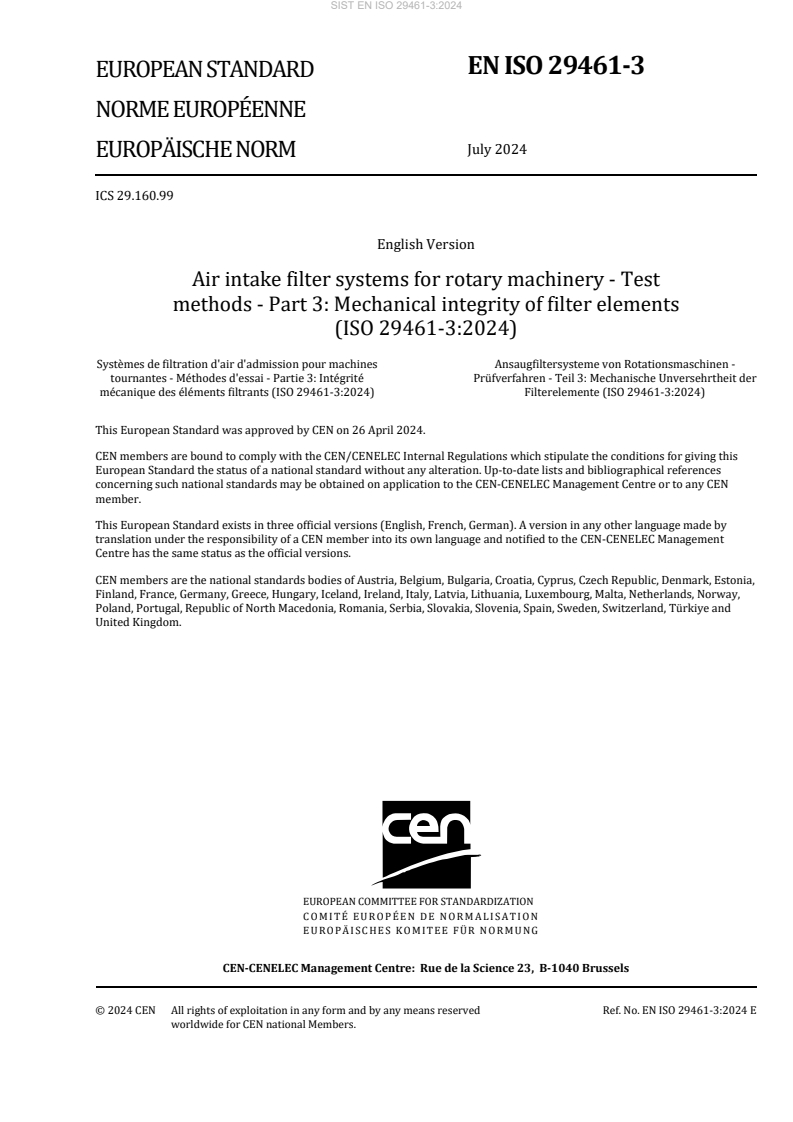
EN ISO 29461-3
EUROPEAN STANDARD
NORME EUROPÉENNE
July 2024
EUROPÄISCHE NORM
ICS 29.160.99
English Version
Air intake filter systems for rotary machinery - Test
methods - Part 3: Mechanical integrity of filter elements
(ISO 29461-3:2024)
Systèmes de filtration d'air d'admission pour machines Ansaugfiltersysteme von Rotationsmaschinen -
tournantes - Méthodes d'essai - Partie 3: Intégrité Prüfverfahren - Teil 3: Mechanische Unversehrtheit der
mécanique des éléments filtrants (ISO 29461-3:2024) Filterelemente (ISO 29461-3:2024)
This European Standard was approved by CEN on 26 April 2024.
CEN members are bound to comply with the CEN/CENELEC Internal Regulations which stipulate the conditions for giving this
European Standard the status of a national standard without any alteration. Up-to-date lists and bibliographical references
concerning such national standards may be obtained on application to the CEN-CENELEC Management Centre or to any CEN
member.
This European Standard exists in three official versions (English, French, German). A version in any other language made by
translation under the responsibility of a CEN member into its own language and notified to the CEN-CENELEC Management
Centre has the same status as the official versions.
CEN members are the national standards bodies of Austria, Belgium, Bulgaria, Croatia, Cyprus, Czech Republic, Denmark, Estonia,
Finland, France, Germany, Greece, Hungary, Iceland, Ireland, Italy, Latvia, Lithuania, Luxembourg, Malta, Netherlands, Norway,
Poland, Portugal, Republic of North Macedonia, Romania, Serbia, Slovakia, Slovenia, Spain, Sweden, Switzerland, Türkiye and
United Kingdom.
EUROPEAN COMMITTEE FOR STANDARDIZATION
COMITÉ EUROPÉEN DE NORMALISATION
EUROPÄISCHES KOMITEE FÜR NORMUNG
CEN-CENELEC Management Centre: Rue de la Science 23, B-1040 Brussels
© 2024 CEN All rights of exploitation in any form and by any means reserved Ref. No. EN ISO 29461-3:2024 E
worldwide for CEN national Members.
Contents Page
European foreword . 3
European foreword
This document (EN ISO 29461-3:2024) has been prepared by Technical Committee ISO/TC 142
"Cleaning equipment for air and other gases" in collaboration with Technical Committee CEN/TC 195
“Cleaning equipment for air and other gases” the secretariat of which is held by UNI.
This European Standard shall be given the status of a national standard, either by publication of an
identical text or by endorsement, at the latest by January 2025, and conflicting national standards shall
be withdrawn at the latest by January 2025.
Attention is drawn to the possibility that some of the elements of this document may be the subject of
patent rights. CEN shall not be held responsible for identifying any or all such patent rights.
Any feedback and questions on this document should be directed to the users’ national standards
body/national committee. A complete listing of these bodies can be found on the CEN website.
According to the CEN-CENELEC Internal Regulations, the national standards organizations of the
following countries are bound to implement this European Standard: Austria, Belgium, Bulgaria,
Croatia, Cyprus, Czech Republic, Denmark, Estonia, Finland, France, Germany, Greece, Hungary, Iceland,
Ireland, Italy, Latvia, Lithuania, Luxembourg, Malta, Netherlands, Norway, Poland, Portugal, Republic of
North Macedonia, Romania, Serbia, Slovakia, Slovenia, Spain, Sweden, Switzerland, Türkiye and the
United Kingdom.
Endorsement notice
The text of ISO 29461-3:2024 has been approved by CEN as EN ISO 29461-3:2024 without any
modification.
International
Standard
ISO 29461-3
First edition
Air intake filter systems for rotary
2024-07
machinery — Test methods —
Part 3:
Mechanical integrity of filter
elements
Systèmes de filtration d'air d'admission pour machines
tournantes — Méthodes d'essai —
Partie 3: Intégrité mécanique des éléments filtrants
Reference number
ISO 29461-3:2024(en) © ISO 2024
ISO 29461-3:2024(en)
© ISO 2024
All rights reserved. Unless otherwise specified, or required in the context of its implementation, no part of this publication may
be reproduced or utilized otherwise in any form or by any means, electronic or mechanical, including photocopying, or posting on
the internet or an intranet, without prior written permission. Permission can be requested from either ISO at the address below
or ISO’s member body in the country of the requester.
ISO copyright office
CP 401 • Ch. de Blandonnet 8
CH-1214 Vernier, Geneva
Phone: +41 22 749 01 11
Email: copyright@iso.org
Website: www.iso.org
Published in Switzerland
ii
ISO 29461-3:2024(en)
Contents Page
Foreword .v
Introduction .vi
1 Scope . 1
2 Normative references . 1
3 Terms and definitions . 1
3.1 Test parameter .2
3.2 Filter to be tested .2
3.3 Test duration .3
3.4 Test materials .3
4 Test rig, conditions and equipment . 3
4.1 Test conditions .3
4.2 Test rig – General requirements .3
4.3 Camera .4
4.4 Differential pressure measurement .4
4.5 Flow measurement .4
4.6 Dust feeder .5
4.7 Water spraying nozzles (fogging nozzles) . .5
4.8 Final filter/coarse filter mat or grid .6
4.9 Temperature, relative humidity .6
5 Qualification of test rig and apparatus . 6
5.1 Pressure system test .6
5.2 Test rig — Pressure drop of test duct with no test device installed .6
5.3 Test rig — Pressure drop reference test .6
5.4 Summary of qualification requirements and schedule .6
6 Test materials . 7
6.1 Test dust .7
6.2 Water .7
6.3 Coarse filter .7
7 Test procedure . 7
7.1 General .7
7.2 Test result evaluation .8
7.2.1 General .8
7.2.2 Measurement of pressure drop .8
7.2.3 Visual inspection of filter .8
7.2.4 Visual inspection downstream of the test device .8
7.2.5 Final test in accordance with ISO 29461-1 .8
7.3 Test preparation .9
7.4 Determination of the initial loading concentration of test dust and water.9
7.5 Loading procedure .10
7.6 Fail/pass criteria .11
7.6.1 General .11
7.6.2 Release of parts .11
7.6.3 Pressure drop decrease .11
7.6.4 Visual inspection during test .11
7.6.5 Final test in accordance with ISO 29461-1 .11
8 Reporting results .12
8.1 General and descriptive information . 12
8.2 Test data and results . 13
8.3 Concluding statement .14
Annex A (normative) Wet burst testing.15
Annex B (informative) Test report example .16
iii
ISO 29461-3:2024(en)
Bibliography .20
iv
ISO 29461-3:2024(en)
Foreword
ISO (the International Organization for Standardization) is a worldwide federation of national standards
bodies (ISO member bodies). The work of preparing International Standards is normally carried out through
ISO technical committees. Each member body interested in a subject for which a technical committee
has been established has the right to be represented on that committee. International organizations,
governmental and non-governmental, in liaison with ISO, also take part in the work. ISO collaborates closely
with the International Electrotechnical Commission (IEC) on all matters of electrotechnical standardization.
The procedures used to develop this document and those intended for its further maintenance are described
in the ISO/IEC Directives, Part 1. In particular, the different approval criteria needed for the different types
of ISO document should be noted. This document was drafted in accordance with the editorial rules of the
ISO/IEC Directives, Part 2 (see www.iso.org/directives).
ISO draws attention to the possibility that the implementation of this document may involve the use of (a)
patent(s). ISO takes no position concerning the evidence, validity or applicability of any claimed patent
rights in respect thereof. As of the date of publication of this document, ISO had not received notice of (a)
patent(s) which may be required to implement this document. However, implementers are cautioned that
this may not represent the latest information, which may be obtained from the patent database available at
www.iso.org/patents. ISO shall not be held responsible for identifying any or all such patent rights.
Any trade name used in this document is information given for the convenience of users and does not
constitute an endorsement.
For an explanation of the voluntary nature of standards, the meaning of ISO specific terms and expressions
related to conformity assessment, as well as information about ISO's adherence to the World Trade
Organization (WTO) principles in the Technical Barriers to Trade (TBT), see www.iso.org/iso/foreword.html.
This document was prepared by Technical Committee ISO/TC 142, Cleaning equipment for air and other gases,
in collaboration with the European Committee for Standardization (CEN) Technical Committee CEN/TC 195,
Cleaning equipment for air and other gases, in accordance with the Agreement on technical cooperation
between ISO and CEN (Vienna Agreement).
A list of all parts in the ISO 29461 series can be found on the ISO website.
Any feedback or questions on this document should be directed to the user’s national standards body. A
complete listing of these bodies can be found at www.iso.org/members.html.
v
ISO 29461-3:2024(en)
Introduction
In rotating machinery applications, the filtering system, typically a set of filter elements arranged in a
suitable manner, is an important part of the whole turbine/compressor system. The development of turbine
machinery used for energy production or others has led to more sophisticated equipment and therefore,
the importance of effective protection of these systems has become more important in the recent years. It
is known that particulate contamination can deteriorate a turbine power system quite substantially if not
taken care of.
This process is often described as “erosion”, “fouling” and “hot corrosion” where salt and other corrosive
particles are known as potential problems. Other particulate matters can also cause significant reduction of
efficiency of the systems. It is important to understand that air filter devices in such systems are located in
various environmental conditions. The range of climate and particulate contamination is very wide, ranging
from deserts to humid rain forests to arctic environments. The requirements on these filter systems are
obviously different depending on where they are operated.
This document has based the performance of the air intake filter systems not only upon heavy dust
collection but also particulate efficiency in a size range that is considered to be the problematic field for
these applications. Both ultra-fine and fine particles, as well as larger particles should be considered when
evaluating turbine fouling. In typical outdoor air, ultra-fine and fine particles in the size range from 0,01 µm
to 1 µm are contributing to > 99 % of the number concentration and to > 90 % of the surface contamination.
The majority of the mass normally results from larger particles (> 1,0 µm).
Turbo-machinery filters comprise a wide range of products, ranging from filters preventing from coarse
particles to filters for very fine and even sub-micrometre particles. The range of products varies from
self-cleaning to depth and surface loading systems. The filters and the systems have to withstand a wide
temperature and humidity range, very low to very high dust concentration and mechanical stress. The
shape of products existing today can be of many different types and have different functions such as droplet
separators, coalescing products, filter pads, metal filters, inertial filters, filter cells, bag filters, panel filters,
self-cleanable and depth loading filter cartridges or pleated media surface filter elements.
The ISO 29461 series provides a way to compare these products in a standardized way and defines
the criteria important for air filter intake systems for rotary machinery performance protection. The
performance of products in this broad range needs to be compared according to a standardized procedure.
Comparing different filters and filter types needs to be done with respect to the overall conditions they
finally operate in.
If a filter or a filter system is meant to operate in an extreme, very dusty environment, the real particulate
efficiency of this filter cannot be predicted since the dust loading of the filter becomes important.
In an ideal filtration process, each particle would be permanently arrested at its first contact with a media
fibre, but incoming particles can impact on a captured particle and detach it into the air stream. Fibres or
particles from the filter itself can also be released, due to mechanical forces.
Another worst-case scenario in abnormal operating environments which leads to unusual high-pressure
drops is the burst or damage of the filter element accompanied with a sudden release of parts of the filter
element or high amounts of dust captured.
This document specifies a method and procedure to test the mechanical integrity (“burst test”) of individual
filter elements up to an abnormal final test pressure drop of maximum 6 250 Pa. Any other customer
defined final pressure drop up to a higher pressure drop shall be reported as variation from the standard.
Nevertheless, it is within the ability of the user to define the maximum possible value (lower or higher) for
a certain application and to define the burst strength requirements for this test procedure. As the pressure
drops under typical operating conditions are on a much lower level, it is not intended to specify a final
pressure drop for any application within this procedure.
For multi-stage systems which use a number of components (e.g. equipment for cleaning, filters), each filter
element needs to be tested separately.
vi
ISO 29461-3:2024(en)
In general, it is possible to use this procedure also after any previous ageing procedure if it is clearly
described as a variation from the standard test procedure. An ageing procedure is defined as an appropriate
customer defined durability test which can affect the stability of media, adhesives, construction and the like,
and is important for the evaluation at its real application. Test results of filter elements after different ageing
procedures cannot be quantitively compared.
Examples of conditioning are:
— climatic conditioning at high or low temperatures and/or defined relative humidity levels;
— wet conditions with water droplets or condensing water over a defined time period;
— any kind of dust loading and pulsing procedure over a certain duration or number of pulses;
— operation at real conditions, etc.
The “burst test” itself is considered as an independent procedure to evaluate the integrity of a filter element
to resist a defined high pressure drop without collapsing, losing or releasing any parts of its construction
into the downstream while keeping its filtration efficiency.
The test procedure does not include methods for the direct measurement of the performance of entire
systems as installed (e.g. systems with use of multiple stages of coarse and fine filter elements).
Note For example, can a damaged, vertically installed pulse-jet filter perform differently in real operation
conditions compared to what can be detected by a horizontal, non-pulsing test as described in this document.
vii
International Standard ISO 29461-3:2024(en)
Air intake filter systems for rotary machinery — Test
methods —
Part 3:
Mechanical integrity of filter elements
1 Scope
This document specifies methods to determine the mechanical integrity of filters under defined conditions
that can be encountered in abnormal operating environments. It describes the test methods for filter elements,
independent of any ageing procedures like pulsing, loading, temperature cycles, wet conditions or others.
3 3 3
The test procedure is intended for filters operating in the range of 0,24 m /s (850 m /h) up to 2,36 m /s
(8 500 m /h). Filter elements with a lower efficiency than ISO T5 (ePM ) according to ISO 29461-1 are
excluded.
To ensure the comparability of the test results, only new filter elements or those loaded up to 625 Pa or
maximum 800 Pa according to ISO 29461-1 are tested.
This document does not describe a standardized method to measure the fractional or gravimetric efficiency.
The efficiency of the filter element can be tested according to ISO 29461-1.
The performance results obtained according to this document cannot be quantitatively applied (by
themselves) to predict performance in real use.
2 Normative references
The following documents are referred to in the text in such a way that some or all of their content constitutes
requirements of this document. For dated references, only the edition cited applies. For undated references,
the latest edition of the referenced document (including any amendments) applies.
ISO 5167 (all parts), Measurement of fluid flow by means of pressure differential devices inserted in circular
cross-section conduit running full
ISO 12103-1, Road vehicles — Test dust for filter evaluation — Part 1: Arizona test dust
ISO 16890-2:2022, Air filters for general ventilation — Part 2: Measurement of fractional efficiency and air flow
resistance
ISO 29461-1, Air intake filter systems for rotary machinery — Test methods — Part 1: Static filter elements
3 Terms and definitions
For the purposes of this document, the terms and definitions given in ISO 29461-1 and the following apply.
ISO and IEC maintain terminology databases for use in standardization at the following addresses:
— ISO Online browsing platform: available at https:// www .iso .org/ obp
— IEC Electropedia: available at https:// www .electropedia .org/
ISO 29461-3:2024(en)
3.1 Test parameter
3.1.1
air flow rate
volume of air flowing through the filter per unit time
[SOURCE: ISO 29464:2017, 3.1.24]
3.1.2
test air flow rate
volumetric air flow rate used for testing
[SOURCE: ISO 29464:2017, 3.3.2]
3.1.3
resistance to air flow
difference in absolute (static) pressure between two points in a system
Note 1 to entry: Resistance to air flow is measured in Pa.
[SOURCE: ISO 29464:2017, 3.1.36]
3.1.4
initial pressure drop
pressure drop of the clean filter operating at the test air flow rate
[SOURCE: ISO 29464:2017, 3.3.17]
3.1.5
initial test pressure drop
pressure drop of the filter element operating at the test air flow rate at start of the test
3.1.6
final pressure drop
maximum test pressure drop of the filter specified by the requestor of the test
3.1.7
final test pressure drop
maximum operating pressure drop of the filter to terminate the test as recommended at rated air flow
3.1.8
leakage
damage of the structure of a filter element, which allows particles to pass through the filter element without
passing through the filter medium
3.2 Filter to be tested
3.2.1
test device
filter element (3.2.2) being subjected to performance testing
[SOURCE: ISO 29464:2017, 3.1.38]
3.2.2
filter element
structure made of the filtering material, its supports and its interfaces with the filter housing
[SOURCE: ISO 29464:2017, 3.2.77]
ISO 29461-3:2024(en)
3.2.3
static filter
air filter that will be removed (exchanged) after it has reached its final test pressure drop and that is not
cleaned with jet pulses or other means in order to fully, or partially, retrieve its initial performance (pressure
drop and efficiency)
[SOURCE: ISO 29464:2017, 3.3.12]
3.3 Test duration
3.3.1
test duration
time between starting a test and achieving a terminal condition (e.g. pressure drop)
3.4 Test materials
3.4.1
water fog
water droplets and fog generated by water spray device
3.4.2
test dust
synthetic dust used for the loading up to the final pressure drop
4 Test rig, conditions and equipment
4.1 Test conditions
Room air or outdoor air can be used as a test air source. Relative humidity of supply air (before water
spraying nozzles) shall be in the range of > 30 % during the tests. The air temperature shall be in the range
of 25 °C ± 10 °C. Other conditions may be used upon customer request.
4.2 Test rig – General requirements
The test rig shall be operated in negative pressure air flow configuration. The duct material shall be
electrically conductive and electrically grounded and shall have a smooth interior finish and be sufficiently
rigid to maintain its shape at the operating pressure (designed to withstand the negative pressure of at
least 6 500 Pa). Parts of the test duct can be made in glass or plastic material to see the filter and equipment.
Provision of windows to allow monitoring of the test progress is desirable. At least the upstream side of
the filter element under test shall be observable from outside the test rig through a window as a camera is
polluted very fast by the high dust/water concentration.
Test rigs according to ISO 16890-2 can be used for static filter elements, but it is recommended to use a larger
test rig designed for pulse cleaning tests, because of its optimized construction for higher pressure drop,
more powerful ventilators, higher dust feeding possibilities and the option to simulate ageing procedures
like pulsing and/or wet conditioning prior to the burst test procedure.
The test rig (see Figure 1) dimensions shall be large enough to prevent the outside of the filter elements (e.g.
V-bank filter) from touching the test rig walls. Hence, if the elements would be deformed during the test, the
test rig shall not be an additional support for the test device.
The test rig section where the filter is installed should preferably have inner dimensions of ≥ 50 mm
larger than the nominal face dimensions of the test device, especially for V-bank filter elements. For a
600 mm × 600 mm filter element, a test rig section of minimum 650 mm × 650 mm can be used.
ISO 29461-3:2024(en)
Key
1 fogging nozzles 4 camera
2 dust injection 5 coarse filter/grid
3 test device 6 final filter
Figure 1 — Schematic diagram of the test rig (only main sections)
It is recommended but optional to install water collecting grooves or drains at the bottom side upstream
(and downstream) of the tested filter. The fogging nozzles can be either before or after or at the same
position as the dust injection position.
4.3 Camera
In the test rig downstream side of the filter element, a camera shall be installed in a suitable manner for
the visual observation of the test device during the whole test procedure. A special position or type of the
camera is not compulsory, but the test laboratory shall ensure that it is possible to observe the complete
filter element during the test in an appropriate quality. It is recommended to:
— position the camera in such a way that it shows the area below the installed filter element to visualize
any water breakthroughs or detached parts;
— install an adequate light source in the test duct on the upstream side and the downstream side of the
filter element;
— use a second optional camera, for example outside of the test rig pointed at the side of the filter, if the
filter design prevents an appropriate observation of the downstream side;
— use a third optional camera to look at the coarse filter/grid to see structural failures and filter pieces
captured by the grid.
4.4 Differential pressure measurement
Measurements of pressure drop shall be taken between measuring points located in the duct wall upstream
and downstream of the test device. Each measuring point shall comprise minimum three interconnected
static taps distributed around the periphery of the duct cross section. If a static tap on the bottom side is
used, the laboratory should make sure that it will not be blocked by water. More details can be found for
example in ISO 16890-2.
The pressure measuring equipment and data recording used shall be capable of measuring pressure
differences with an accuracy of ±3 % of the measured value at least every minute to get a continuous reading
of the pressure drop curve versus time/dust load.
4.5 Flow measurement
Flow measurement shall be made by standardized or calibrated flow measuring devices in accordance
with the ISO 5167 series. Examples of standardized or calibrated flow measuring devices are orifice plates,
ISO 29461-3:2024(en)
nozzles, Venturi tubes. The uncertainty of measurement shall not exceed 5 % of the measured value at 95 %
confidence level.
4.6 Dust feeder
The dust injection nozzle(s) or tube(s) is (are) located as shown in Figure 2.
Any commercial dust feeder which is designed for air filter loading tests (e.g. ISO 16890-3 and ISO 5011) can
be chosen. The purpose of the dust feeder is to supply the synthetic dust to the filter under test at a constant
rate over the test period. These dust feeders disperse the dust with compressed air through a dust injection
nozzle into the test rig through the dust feed tube. All tubing, nozzles and the like, that are in direct contact
with the dust during the operation should be electrically conductive and grounded.
3 3
The dust feeder shall be able to produce a mass concentration between 100 mg/m and 600 mg/m at the
rated air flow. If necessary, more than one dust feeder or dust nozzles can be used.
Averaged over an interval of 5 min, the feeder shall be able to produce an upstream dust mass concentration
within ±20 % over the testing time (4 h).
It is recommended to place the dust feeder with dust reservoir on a scale to get a continuous recording of
the dust fed (e.g. in intervals of 1 min to 5 min). It shall be possible to record the mass of dust fed versus time
with at least ±10 g accuracy.
a) Single nozzle positioning b) Double nozzle positioning c) Positioning for four nozzles
Figure 2 — Positioning of feeding nozzles
4.7 Water spraying nozzles (fogging nozzles)
The fogging nozzle(s) are located and positioned as described in Figure 2.
3 3
One or two-substance nozzle(s) capable of producing in total 10 g/min to 160 g/min (= 0,6 g/m at 1 000 m /h
3 3
to 1,2 g/m at 8 000 m /h) mass flow of water (droplets) are recommended to be used (similar range like
ISO 29461-2). The quantity can be adjusted by the compressed air pressure and number of nozzles used (e.g.
one to four nozzles). Examples of nozzles are described in ISO 29461-2, but it is not intended to specify a
certain manufacturer or type.
An exact definition of the water aerosol (amount and size distribution) is not necessary for this document as
it is only needed to accelerate the increase of pressure drop.
The water spraying system shall have a constant mass flow with a tolerance of ±20 % of the selected flow
during the complete test (4 h). It is recommended to place the water reservoir on a scale to get a continuous
recording of the water fed. Alternatively a constant water flow rate within ±20 % over testing time should
be validated in preliminary tests. It shall be possible to record the mass flow of water fed versus time with
at least ±20 g accuracy.
ISO 29461-3:2024(en)
Exact amount of water and droplet size at filter position also depends on air flow rate, temperature and
relative humidity of inlet air. It is not intended to restrict this test method to a full climatic conditioned test rig.
The water mass flow shall be 4 ± 0,5 times greater than the dust mass flow to ensure a sufficient mix of dust
and water in the test air.
NOTE A noticeable amount of the injected water will evaporate and increase the relative humidity. This is
neglected because of the reasons detailed in 4.7.
4.8 Final filter/coarse filter mat or grid
A final filter is recommended to capture any loading dust that passes through the test device during the dust
loading procedure. It should be installed after the test device. It is recommended to use a filter of filter class
T8 or higher according to ISO 29461-1. To be able to detect released parts or components of the test sample
in the downstream area by visual inspection, a fine grid (maximum 3 mm open mesh size) or a flat shaped
coarse particle filter mat shall be installed after the test device upstream of the optional final filter.
4.9 Temperature, relative humidity
The temperature measurement device shall be accurate to within ±1 °C (1,8 °F). The relative humidity
measurement device shall be accurate to within ±2 %. The temperature and relative humidity measurement
devices shall be calibrated yearly.
5 Qualification of test rig and apparatus
5.1 Pressure system test
The requirements specified in ISO 16890-2:2022, 8.2.1 shall be met.
5.2 Test rig — Pressure drop of test duct with no test device installed
The requirements specified in ISO 16890-2:2022, 8.2.12 shall be met.
5.3 Test rig — Pressure drop reference test
A perforated plate (or other object) with known pressure drop values at a minimum of four measured air
flow rate data points shall be used as a reference. The data points shall be in the range of 1 700 m /h to
5 000 m /h.
The measured resistance to air flow across the reference shall be within ±5 % of the reference value. If the
resistance to air flow deviates by more than ±5 %, system maintenance shall be performed to restore the
resistance to air flow to within ±5 % of the reference value.
5.4 Summary of qualification requirements and schedule
The test rig and apparatus qualification requirements are shown in Table 1. System qualification testing
shall take place every two years or sooner if any change is made to the system that may alter performance,
such as changing a major component of the system.
ISO 29461-3:2024(en)
Table 1 — Summary of qualification requirements and schedule
Items Subclause Requirements Frequency
Every two years or after
Pressure system test 5.1 No change in Pa
system changes
Pressure drop of duct with
5.2 < 5 Pa Quarterly
no filter installed
Pressure drop reference
5.3 within 5 % of the reference value Monthly
test
6 Test materials
6.1 Test dust
ISO 12103-1 Fine (A2) ATD (Arizona test dust) or another dust with comparable characteristics and
properties shall be used for the test procedure.
The loading test dust “fine” is defined in ISO 12103-1, and consists of natural occurring silica particles.
6.2 Water
Normal tap water with a PH value in the range of 6 to 8 and a recommended hardness of < 2,5 mmol/l may
be used for the test.
6.3 Coarse filter
A fine grid (maximum 3 mm open mesh size) or a flat shaped coarse particle filter mat shall be installed after
the test device, upstream of the optional final filter. This filter is intended to detect by visual inspection
released parts/components of the test sample in the downstream area. Pleated filter elements should not be
used as it is difficult to detect small released parts.
7 Test procedure
7.1 General
The test device shall be tested for initial efficiency in accordance with ISO 29461-1 in new state (a discharging
procedure according to the ISO 16890 series is not necessary) prior to the dust loading procedure or any
conditioning, regardless of whether the filter model has been previously tested with another filter sample.
This procedure shall be used for new filter elements or after a test in accordance with ISO 29461-1 with
a loading up to 625 Pa (maximum 800 Pa). Any other prior ageing procedure shall be clearly described as
variation in the test report. Preconditioning of filter elements for “wet burst” test shall be made according to
Annex A.
After the initial efficiency test according to ISO 29461-1, the test procedure continues with the test
preparation described in 7.3 and the loading procedure described in 7.5.
The dust loading is conducted at rated air flow up to a standard pressure drop of 6 250 Pa, if not specified to
another value and clearly indicated in the test report.
In order to prevent noticeable different loading times, which can result in completely different mechanical
stress on the element, the dust loading concentration shall be adjusted depending on the pressure drop
increase rather than the dust loading behaviour of the filter element (e.g. dependent on media area or dust
holding capacity), see 7.4.
Recommended test duration time is 3 h to 4 h (loading time inclusive holding time at maximum pressure
drop), but can be exceeded based on the performance of the test sample.
ISO 29461-3:2024(en)
7.2 Test result evaluation
7.2.1 General
The main target is an objective evaluation if a filter element meets the pass criteria of a laboratory mechanical
integrity test (“burst test”) up to a maximum defined pressure drop (standard 6 250 Pa).
This evaluation comprises four parts as defined in the following subclauses.
7.2.2 Measurement of pressure drop
The pressure drop measurement of the test sample shall be performed to detect a
...