

oSIST prEN IEC 60947-1:2026
(Main)Low-voltage switchgear and controlgear - Part 1: General rules
General Information
- Abstract
- Status
- Not Published
- Public Enquiry End Date
- 31-Mar-2026
- Technical Committee
- SKA - Switchgear and control gear
- Current Stage
- 4020 - Public enquire (PE) (Adopted Project)
- Start Date
- 27-Jan-2026
- Due Date
- 16-Jun-2026
- Completion Date
- 26-Mar-2026

Overview
oSIST prEN IEC 60947-1:2026 - Low-voltage switchgear and controlgear - Part 1: General rules - is a foundational international standard developed by CLC, aligning with IEC requirements for low-voltage electrical switchgear and controlgear. This document outlines the essential rules, terms, definitions, and performance requirements that apply broadly to the full family of low-voltage switchgear and related products, serving as a crucial reference for manufacturers, engineers, installers, and regulatory bodies.
The standard establishes the general framework for safety, functionality, and reliability in the design, construction, testing, and operation of low-voltage switchgear and controlgear. It ensures compatibility and interoperability within electrical systems in industrial, commercial, and residential installations.
Key Topics
oSIST prEN IEC 60947-1:2026 introduces and standardizes several critical aspects, including:
- General Terms and Definitions: Clarifies terminology related to switching devices, their parts, operations, and safety.
- Classification and Characteristics: Defines equipment types, rated values (voltages, currents, frequencies), and utilization categories.
- Product Information: Specifies requirements for product marking, documentation, installation, operation, and maintenance instructions.
- Service Conditions: Details normal operating, mounting, transport, and storage conditions.
- Constructional and Performance Requirements:
- Materials and construction principles
- Electrical clearances and creepage distances
- Requirements for protective earthing and degrees of protection (including IP codes)
- Fault, abnormal, and environmental conditions
- Testing Requirements:
- Type, routine, special, and sampling tests for ensuring compliance
- Performance tests under load, overload, and short-circuit scenarios
- Tests for electromagnetic compatibility (EMC), safety, and embedded software
- Annexes and Special Considerations: Addresses specific aspects such as requirements for aluminum conductors, digital inputs/outputs, environmental testing, and overload relays.
Applications
oSIST prEN IEC 60947-1:2026 is vital for a wide range of applications to support safety, reliability, and efficiency in low-voltage power distribution and automation. Key applications include:
- Industrial and Commercial Electrical Panels: Guides the design and assembly of switchgear and controlgear assemblies for factories, data centers, and office buildings.
- Renewable Energy Systems: Ensures compatibility and safety in photovoltaic and wind installations, particularly regarding environmental categories and electrical performance.
- Building Management Systems: Supports integrated control systems for lighting, HVAC, and access control.
- OEM Equipment: Provides manufacturers with unified requirements for low-voltage devices embedded in machinery or electrical products.
- Safe Integration: Facilitates safe connection and operation alongside other international standards for system integration and coordination.
Related Standards
The general rules of oSIST prEN IEC 60947-1:2026 are complemented by other parts in the IEC 60947 series, including:
- IEC 60947-2: Low-voltage circuit breakers
- IEC 60947-3: Switches, disconnectors, switch-disconnectors, and fuse-combination units
- IEC 60947-4: Contactors and motor starters
- IEC 60947-5: Control circuit devices and switching elements
Additional standards for electrical installation and equipment safety, such as IEC 61439 (low-voltage switchgear assemblies) and IEC 60204-1 (safety of machinery - electrical equipment), are often used in conjunction with IEC 60947-1 to ensure comprehensive compliance and best practices.
By adhering to oSIST prEN IEC 60947-1:2026, stakeholders ensure that low-voltage switchgear and controlgear meet international expectations for safety, performance, and interoperability, supporting efficient and reliable electrical systems worldwide.
Relations
- Effective Date
- 22-Sep-2026
- Effective Date
- 04-Nov-2025
- Effective Date
- 10-Dec-2024
- Revises
SIST EN IEC 60947-1:2021/oprAA:2024 - Low-voltage switchgear and controlgear - Part 1: General rules - Effective Date
- 05-Dec-2023
- Effective Date
- 05-Dec-2023
- Effective Date
- 29-Nov-2022
Get Certified
Connect with accredited certification bodies for this standard

IMQ S.p.A. (Certification)
Italian electrical product certification.

SLG Prüf- und Zertifizierungs GmbH
German testing and certification body.

UL Solutions
Global safety science company with testing, inspection and certification.
Sponsored listings
Frequently Asked Questions
oSIST prEN IEC 60947-1:2026 is a draft published by the Slovenian Institute for Standardization (SIST). Its full title is "Low-voltage switchgear and controlgear - Part 1: General rules". This standard covers: Low-voltage switchgear and controlgear - Part 1: General rules
Low-voltage switchgear and controlgear - Part 1: General rules
oSIST prEN IEC 60947-1:2026 is classified under the following ICS (International Classification for Standards) categories: 29.130.20 - Low voltage switchgear and controlgear. The ICS classification helps identify the subject area and facilitates finding related standards.
oSIST prEN IEC 60947-1:2026 has the following relationships with other standards: It is inter standard links to kSIST FprEN IEC 60947-5-3:2026, oSIST prEN IEC 60947-1:2026/oprAA:2026, SIST EN IEC 60947-1:2021/AC:2024, SIST EN IEC 60947-1:2021/oprAA:2024, SIST EN IEC 60947-1:2021/AC:2023, SIST EN IEC 60947-1:2021. Understanding these relationships helps ensure you are using the most current and applicable version of the standard.
oSIST prEN IEC 60947-1:2026 is associated with the following European legislation: EU Directives/Regulations: 2014/30/EU, 2014/35/EU; Standardization Mandates: M/511, M/552. When a standard is cited in the Official Journal of the European Union, products manufactured in conformity with it benefit from a presumption of conformity with the essential requirements of the corresponding EU directive or regulation.
oSIST prEN IEC 60947-1:2026 is available in PDF format for immediate download after purchase. The document can be added to your cart and obtained through the secure checkout process. Digital delivery ensures instant access to the complete standard document.
Standards Content (Sample)
SLOVENSKI STANDARD
01-marec-2026
Nizkonapetostne stikalne in krmilne naprave - 1. del: Splošna pravila
Low-voltage switchgear and controlgear - Part 1: General rules
Niederspannungsschaltgeräte - Teil 1: Allgemeine Festlegungen
Appareillage à basse tension - Partie 1: Règles générales
Ta slovenski standard je istoveten z: prEN IEC 60947-1:2026
ICS:
29.130.20 Nizkonapetostne stikalne in Low voltage switchgear and
krmilne naprave controlgear
2003-01.Slovenski inštitut za standardizacijo. Razmnoževanje celote ali delov tega standarda ni dovoljeno.
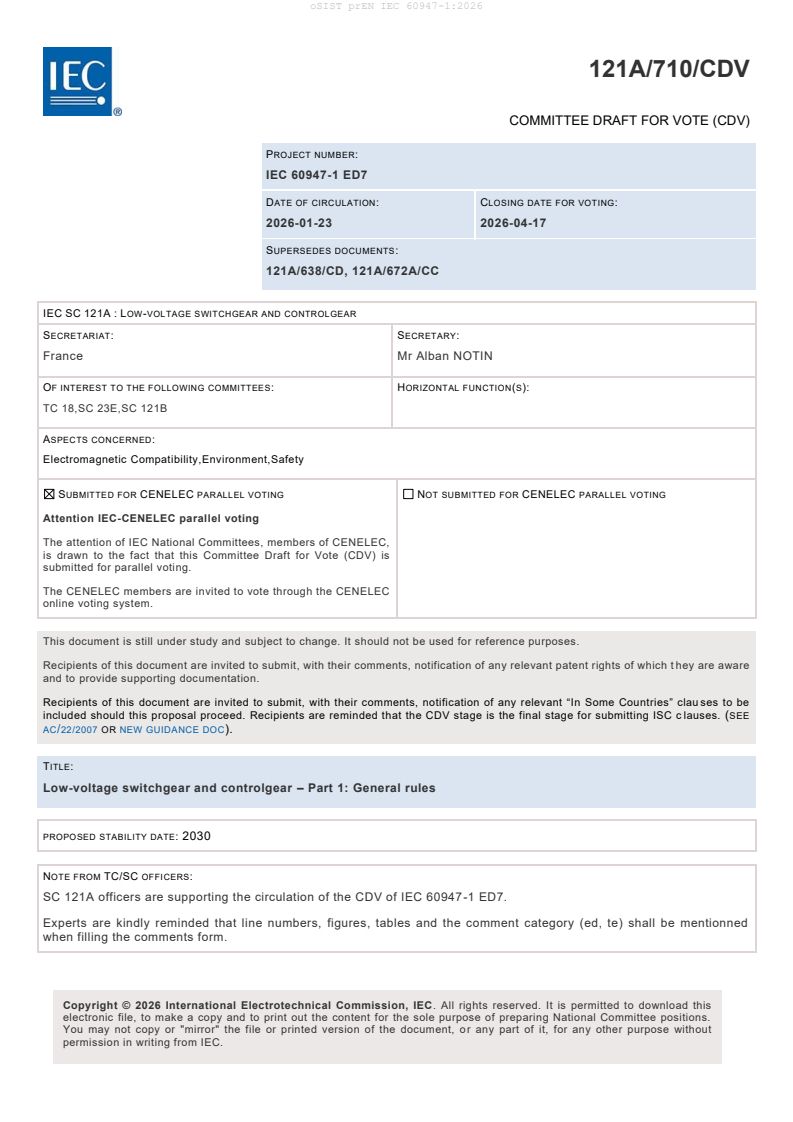
121A/710/CDV
COMMITTEE DRAFT FOR VOTE (CDV)
PROJECT NUMBER:
IEC 60947-1 ED7
DATE OF CIRCULATION: CLOSING DATE FOR VOTING:
2026-01-23 2026-04-17
SUPERSEDES DOCUMENTS:
121A/638/CD, 121A/672A/CC
IEC SC 121A : LOW-VOLTAGE SWITCHGEAR AND CONTROLGEAR
SECRETARIAT: SECRETARY:
France Mr Alban NOTIN
OF INTEREST TO THE FOLLOWING COMMITTEES: HORIZONTAL FUNCTION(S):
TC 18,SC 23E,SC 121B
ASPECTS CONCERNED:
Electromagnetic Compatibility,Environment,Safety
SUBMITTED FOR CENELEC PARALLEL VOTING NOT SUBMITTED FOR CENELEC PARALLEL VOTING
Attention IEC-CENELEC parallel voting
The attention of IEC National Committees, members of CENELEC,
is drawn to the fact that this Committee Draft for Vote (CDV) is
submitted for parallel voting.
The CENELEC members are invited to vote through the CENELEC
online voting system.
This document is still under study and subject to change. It should not be used for reference purposes.
Recipients of this document are invited to submit, with their comments, notification of any relevant patent rights of which t hey are aware
and to provide supporting documentation.
Recipients of this document are invited to submit, with their comments, notification of any relevant “In Some Countries” clau ses to be
included should this proposal proceed. Recipients are reminded that the CDV stage is the final stage for submitting ISC c lauses. (SEE
AC/22/2007 OR NEW GUIDANCE DOC).
TITLE:
Low-voltage switchgear and controlgear – Part 1: General rules
PROPOSED STABILITY DATE: 2030
NOTE FROM TC/SC OFFICERS:
SC 121A officers are supporting the circulation of the CDV of IEC 60947-1 ED7.
Experts are kindly reminded that line numbers, figures, tables and the comment category (ed, te) shall be mentionned
when filling the comments form.
electronic file, to make a copy and to print out the content for the sole purpose of preparing National Committee positions.
You may not copy or "mirror" the file or printed version of the document, or any part of it, for any other purpose without
permission in writing from IEC.
IEC CDV 60947-1 © IEC 2026
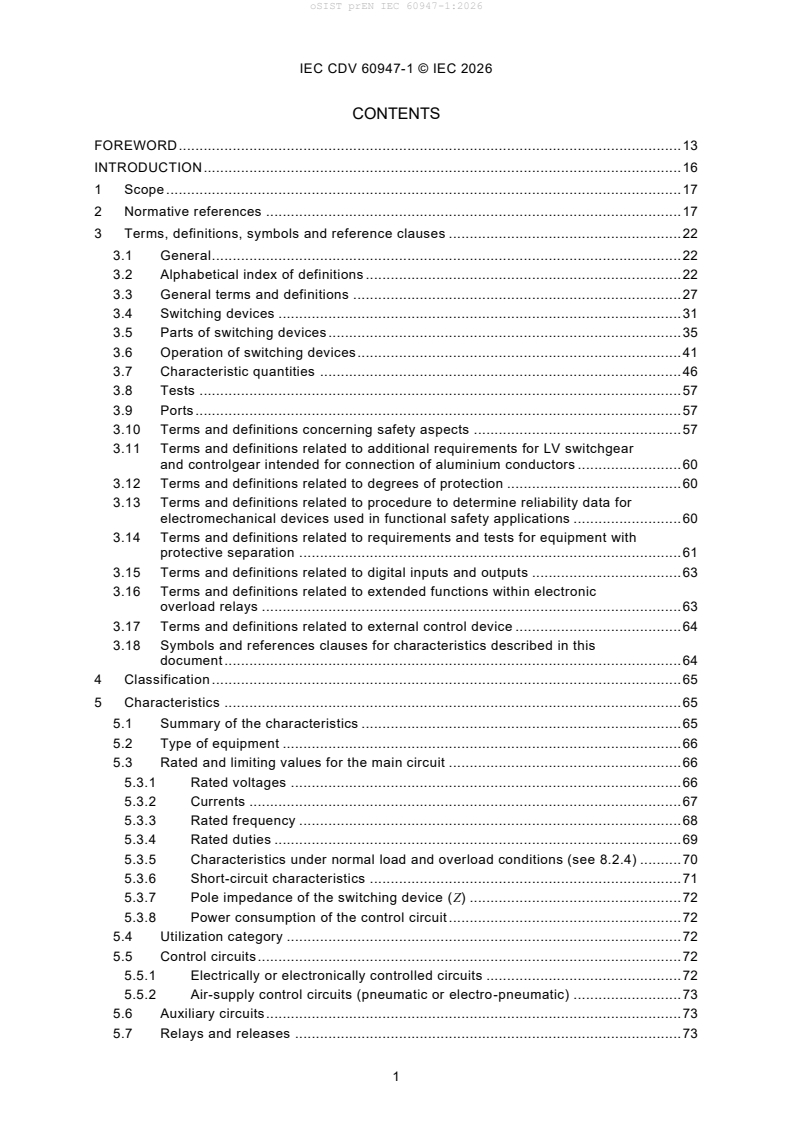
CONTENTS
FOREWORD . 13
INTRODUCTION . 16
1 Scope . 17
2 Normative references . 17
3 Terms, definitions, symbols and reference clauses . 22
3.1 General . 22
3.2 Alphabetical index of definitions . 22
3.3 General terms and definitions . 27
3.4 Switching devices . 31
3.5 Parts of switching devices . 35
3.6 Operation of switching devices . 41
3.7 Characteristic quantities . 46
3.8 Tests . 57
3.9 Ports . 57
3.10 Terms and definitions concerning safety aspects . 57
3.11 Terms and definitions related to additional requirements for LV switchgear
and controlgear intended for connection of aluminium conductors . 60
3.12 Terms and definitions related to degrees of protection . 60
3.13 Terms and definitions related to procedure to determine reliability data for
electromechanical devices used in functional safety applications . 60
3.14 Terms and definitions related to requirements and tests for equipment with
protective separation . 61
3.15 Terms and definitions related to digital inputs and outputs . 63
3.16 Terms and definitions related to extended functions within electronic
overload relays . 63
3.17 Terms and definitions related to external control device . 64
3.18 Symbols and references clauses for characteristics described in this
document . 64
4 Classification . 65
5 Characteristics . 65
5.1 Summary of the characteristics . 65
5.2 Type of equipment . 66
5.3 Rated and limiting values for the main circuit . 66
5.3.1 Rated voltages . 66
5.3.2 Currents . 67
5.3.3 Rated frequency . 68
5.3.4 Rated duties . 69
5.3.5 Characteristics under normal load and overload conditions (see 8.2.4) . 70
5.3.6 Short-circuit characteristics . 71
5.3.7 Pole impedance of the switching device (Z) . 72
5.3.8 Power consumption of the control circuit . 72
5.4 Utilization category . 72
5.5 Control circuits . 72
5.5.1 Electrically or electronically controlled circuits . 72
5.5.2 Air-supply control circuits (pneumatic or electro-pneumatic) . 73
5.6 Auxiliary circuits . 73
5.7 Relays and releases . 73
IEC CDV 60947-1 © IEC 2026
5.8 Co-ordination with short-circuit protective devices (SCPD) . 73
5.9 Security . 74
6 Product information . 74
6.1 Nature of information . 74
6.2 Marking . 76
6.3 Instructions for installation, operation and maintenance, decommissioning
and dismantling. 77
6.4 Environmental information . 78
6.5 Instructions for products intended to be reused, repaired or upgraded . 78
6.6 Information provided in electronic format . 78
7 Normal service, mounting and transport conditions . 79
7.1 Normal service conditions . 79
7.1.1 Ambient air temperature . 79
7.1.2 Altitude . 80
7.1.3 Atmospheric conditions . 80
7.1.4 Shock and vibration . 81
7.1.5 Other environmental categories . 81
7.2 Conditions during transport and storage . 81
7.3 Mounting . 81
8 Constructional and performance requirements . 81
8.1 Constructional requirements . 81
8.1.1 General . 81
8.1.2 Materials . 82
8.1.3 Current-carrying parts and their connections . 84
8.1.4 Clearances and creepage distances . 84
8.1.5 Actuator . 85
8.1.6 Indication of the contact position . 86
8.1.7 Additional requirements for equipment suitable for isolation . 86
8.1.8 Terminals . 88
8.1.9 Additional requirements for equipment provided with a neutral or mid-
point pole . 89
8.1.10 Provisions for protective earthing . 90
8.1.11 Dedicated enclosures for equipment . 91
8.1.12 Degrees of protection of enclosed equipment . 92
8.1.13 Conduit pull-out, torque and bending with metallic conduits . 92
8.1.14 Limited energy source . 92
8.1.15 Stored charge energy circuit . 93
8.1.16 Fault and abnormal conditions . 93
8.1.17 Short-circuit and overload protection of ports . 94
8.1.18 Use of voltage transient limiting device . 94
8.1.19 Requirements for equipment with artificial optical radiation . 94
8.1.20 Energy efficiency . 95
8.1.21 Environmental aspects. 95
8.2 Performance requirements . 95
8.2.1 Operating conditions . 95
8.2.2 Temperature-rise . 96
8.2.3 Dielectric properties . 98
8.2.4 Ability to make, carry and break currents under no-load, normal load
and overload conditions . 101
IEC CDV 60947-1 © IEC 2026
8.2.5 Ability to make, carry and break short-circuit currents . 102
8.2.6 Pole impedance . 103
8.2.7 Control circuit power consumption . 103
8.2.8 Leakage currents of equipment suitable for isolation . 103
8.2.9 Other environmental categories . 103
8.3 Electromagnetic compatibility (EMC) . 104
8.3.1 General . 104
8.3.2 Immunity . 104
8.3.3 Emission . 104
8.4 Embedded software . 105
8.5 Security . 105
9 Tests . 105
9.1 Kinds of test . 105
9.1.1 General . 105
9.1.2 Type tests . 106
9.1.3 Routine tests . 106
9.1.4 Sampling tests . 106
9.1.5 Special tests . 107
9.1.6 Verification of product able to be reused, repaired and upgraded . 107
9.2 Compliance with constructional requirements . 107
9.2.1 General . 107
9.2.2 Test of materials to abnormal heat and fire . 107
9.2.3 Equipment marking . 107
9.2.4 Enclosures for equipment . 108
9.2.5 Mechanical and electrical properties of terminals . 108
9.2.6 Verification of the effectiveness of indication of the main contact
position of equipment suitable for isolation . 111
9.2.7 Limited energy source test . 113
9.2.8 Stored charge energy test . 113
9.2.9 Conduit pull-out test, torque test and bending test with metallic conduits . 114
9.2.10 Test of earth continuity for protective earth . 114
9.2.11 Fault and abnormal conditions tests . 115
9.2.12 Wire flexing test . 116
9.2.13 Artificial optical radiation test . 117
9.2.14 Cemented joints test (type test) . 117
9.3 Performance . 117
9.3.1 Test sequences . 117
9.3.2 General test conditions . 117
9.3.3 Performance under no-load, normal load and overload conditions . 120
9.3.4 Performance under short-circuit conditions . 133
9.4 Tests for EMC . 139
9.4.1 General . 139
9.4.2 Immunity . 139
9.4.3 Emission . 140
9.5 Embedded software . 140
9.6 Security . 140
Annex A (informative) Harmonisation of utilization categories for low-voltage
switchgear and controlgear . 175
IEC CDV 60947-1 © IEC 2026
Annex B (normative) Additional requirements for LV switchgear and controlgear
intended for connection of aluminium conductors . 179
B.1 General . 179
B.2 Classification . 179
B.3 Characteristics . 179
B.4 Product information . 179
B.4.1 Nature of information . 179
B.4.2 Marking . 180
B.4.3 Instructions for installation, operation and maintenance,
decommissioning and dismantling . 180
B.5 Normal service, mounting and transport conditions . 180
B.6 Constructional and performance requirements . 180
B.7 Type tests . 181
B.7.1 General . 181
B.7.2 Current cycling test. 181
B.7.3 Climatic test. 186
B.7.4 Mechanical properties of terminals . 187
B.7.5 Test for insertability of unprepared round aluminium conductors having
the maximum cross-section . 187
Annex C (normative) Degrees of protection . 190
C.1 General . 190
C.2 Object . 190
C.3 Definitions. 190
C.4 Designation . 190
C.5 Degrees of protection against access to hazardous parts and against ingress
of solid foreign objects indicated by the first characteristic numeral . 190
C.6 Degrees of protection against ingress of water indicated by the second
characteristic numeral . 190
C.7 Degrees of protection against access to hazardous parts indicated by the
additional letter . 191
C.8 Supplementary letters . 191
C.9 Examples of designations with IP Code . 191
C.10 Marking . 191
C.11 General requirements for tests . 191
C.12 Tests for protection against access to hazardous parts indicated by the first
characteristic numeral . 192
C.13 Tests for protection against ingress of solid foreign objects indicated by the
first characteristic numeral . 192
C.13.1 Dust test for first characteristic numerals 5 and 6 . 192
C.13.5.2 Acceptance conditions for first characteristic numeral 5 . 192
C.14 Tests for protection against water indicated by second characteristic
numeral . 193
C.14.1 Test means . 193
C.14.2 Test conditions . 193
C.14.3 Acceptance conditions . 193
C.15 Tests for protection against access to hazardous parts indicated by
additional letter . 193
C.16 Summary of responsibilities of relevant technical committees . 193
Annex D (informative) Examples of clamping units and relationship between clamping
unit and connecting device . 197
D.1 Clamping unit in a connecting device . 197
IEC CDV 60947-1 © IEC 2026
D.2 Structure of a PCB terminal block . 197
D.3 Examples of clamping units . 198
Annex E (informative) Description of a method for adjusting the load circuit . 206
Annex F (informative) Determination of short-circuit power factor or time-constant . 208
F.1 Determination of short-circuit power factor . 208
F.1.1 Method I – Determination from DC component . 208
F.1.2 Method II – Determination with pilot generator . 208
F.2 Determination of short-circuit time-constant (oscillographic method) . 209
Annex G (informative) Measurement of creepage distances and clearances . 210
G.1 Basic principles . 210
G.2 Use of ribs . 210
Annex H (informative) Correlation between the nominal voltage of the supply system
and the rated impulse withstand voltage of equipment . 217
Annex I (vacant) . 219
Annex J (informative) Specific information in the product documentation or possible
test optimisation when it has no adverse effect on the test results . 220
Annex K (normative) Procedure to determine reliability data for electromechanical
devices used in functional safety applications . 221
K.1 General . 221
K.1.1 Object . 221
K.1.2 General requirements . 221
K.2 Method based on durability test results . 222
K.2.1 General method . 222
K.2.2 Test requirements . 222
K.2.3 Number of samples . 222
K.2.4 Characterization of a failure mode . 222
K.2.5 Weibull modelling . 222
K.2.6 Useful life and upper limit of failure rate . 224
K.2.7 Reliability data . 225
K.3 Data information . 226
K.4 Example. 226
K.4.1 Test results. 226
K.4.2 Weibull distribution and median rank regression . 227
K.4.3 Useful life and failure rate . 227
Annex L (normative) Terminal marking and distinctive number . 229
L.1 General . 229
L.2 Terminal marking of impedances (alphanumerical) . 229
L.2.1 Coils . 229
L.2.2 Electromagnetic releases . 230
L.2.3 Interlocking electromagnets . 230
L.2.4 Indicating light devices . 231
L.3 Terminal marking of contact elements for switching devices with two
positions (numerical) . 231
L.3.1 Contact elements for main circuits (main contact elements) . 231
L.3.2 Contact elements for auxiliary circuit (auxiliary contact elements) . 231
L.4 Terminal marking of overload protection devices . 233
L.5 Distinctive number . 234
L.6 Marking of terminals for external associated electronic circuit components,
contacts and complete devices . 234
IEC CDV 60947-1 © IEC 2026
L.6.1 Marking of terminals for external associated electronic circuit
components and contacts . 234
L.6.2 Marking of terminals for external complete devices . 238
Annex M (normative) Flammability test . 240
M.1 Hot wire ignition test (HWI) . 240
M.1.1 Test sample . 240
M.1.2 Description of test apparatus . 240
M.1.3 Conditioning . 241
M.1.4 Test procedure . 241
M.2 Arc ignition test (AI) . 241
M.2.1 Test sample . 241
M.2.2 Description of test apparatus . 241
M.2.3 Conditioning . 242
M.2.4 Test procedure . 242
M.3 HWI and AI requirements . 243
Annex N (normative) Requirements and tests for equipment with protective separation . 245
N.1 General . 245
N.2 Requirements . 245
N.2.1 General . 245
N.2.2 Dielectric requirements . 245
N.2.3 Construction requirements . 246
N.3 Tests . 246
N.3.1 General . 246
N.3.2 Dielectric tests . 246
N.3.3 Test method for implementing protective impedance . 247
N.3.4 Touch current measurement . 248
N.3.5 Examples of constructional measures . 249
Annex O (vacant) . 251
Annex P (informative) Terminal lugs for low voltage switchgear and controlgear
connected to copper conductors . 252
Annex Q (normative) Tests for environmental categories . 253
Q.1 General . 253
Q.2 Environmental categories . 253
Q.3 Tests . 254
Q.3.1 General test conditions . 254
Q.3.2 Test sequences . 254
Annex R (normative) Application of the metal foil for dielectric testing on accessible
parts during operation or adjustment . 263
R.1 General . 263
R.2 Object . 263
R.3 Definition of zones . 264
R.3.1 General . 264
R.3.2 Application of metal foil on accessible parts during normal operation or
adjustment . 264
Annex S (normative) Digital inputs and outputs . 272
S.1 General . 272
S.2 Functional requirements . 272
S.2.1 Rated values and operating ranges . 272
S.2.2 Digital I/Os . 273
IEC CDV 60947-1 © IEC 2026
S.3 Verification of input/output requirements . 282
S.3.1 General . 282
S.3.2 Verification of digital inputs . 283
S.3.3 Verification of digital outputs . 283
S.3.4 Behaviour of the equipment . 284
S.4 General information to be provided in the product documentation . 285
S.4.1 Information on digital inputs (current sinking). 285
S.4.2 Information on digital outputs for alternating currents (current sourcing) . 285
S.4.3 Information on digital outputs for direct current (current sourcing) . 286
S.5 Digital input standard operating range equations. 286
Annex T (normative) Extended functions within electronic overload relays . 288
T.1 Object . 288
T.1.1 General . 288
T.1.2 Ground/earth fault detection function . 288
T.2 Classification of electronic overload relays . 288
T.3 Types of relays with ground/earth fault detection function . 288
T.4 Performance requirements . 289
T.4.1 Limits of operation of ground/earth fault electronic overload relays . 289
T.4.2 Limits of operation of ground/earth fault current sensing electronic
relays Type CII(-A and -B) . 289
T.4.3 Limits of operation of voltage asymmetry relays . 289
T.4.4 Limits of operation of phase reversal relays . 289
T.4.5 Limits of operation of current imbalance relays . 289
T.4.6 Limits of operation of over-voltage relays and releases . 290
T.5 Tests . 290
T.5.1 Limits of operation of ground/earth fault current sensing electronic
relays Types CI and CII (-A and -B) . 290
T.5.2 Verification of inhibit function of ground/earth fault current sensing
electronic relays Type CII (-A and -B) . 290
T.5.3 Current asymmetry relays . 291
T.5.4 Voltage asymmetry relays . 291
T.5.5 Phase reversal relays . 291
T.5.6 Over-voltage relays . 291
T.6 Routine and sampling tests . 291
Annex U (informative) Examples of control circuit configurations . 293
U.1 External control device. 293
U.1.1 Diagrammatic representation of an external control device . 293
U.1.2 Parameters of an external control device . 293
U.2 Control circuit configurations . 293
U.2.1 Equipment with external control supply . 293
U.2.2 Equipment with several external control supplies . 294
U.2.3 Equipment with bus interface (can be combined with other circuit
configurations) . 294
Annex V (vacant) . 295
Annex W (normative) Determination of critical DC load current in DC devices . 296
W.1 General . 296
W.2 Determination of critical DC load current . 296
Annex X (normative) Co-ordination between circuit-breaker, MPSD or CPS and
another short-circuit protective device associated in the same circuit . 298
IEC CDV 60947-1 © IEC 2026
X.1 General . 298
X.2 Object . 298
X.3 General requirements for the co-ordination of a circuit-breaker, MPSD or
CPS (C ) with another SCPD (C ) . 299
1 2
X.3.1 General considerations . 299
X.3.2 Take-over current (I ) . 299
B
X.3.3 Behaviour of C in association with another SCPD . 299
X.4 Type and characteristics of the associated SCPD . 299
X.5 Verification of selectivity . 300
X.5.1 General . 300
X.5.2 Consideration of selectivity by desk study . 300
X.5.3 Selectivity determined by test . 301
X.6 Verification of combined short-circuit protection . 302
X.6.1 Determination of the take-over current . 302
X.6.2 Verification of combined short-circuit protection . 302
X.6.3 Tests for verification of combined short-circuit protection . 303
X.6.4 Results to be obtained . 304
Annex Y (normative) Additional requirements for low-voltage switchgear and
controlgear - equipment or devices incorporating a built-in communication
interface complying with IEC 61131-9 . 311
Y.1 General . 311
Y.2 Characteristics . 311
Y.2.1 Rated and limiting values for SDCI . 311
Y.3 Product information . 311
Y.4 Constructional and performance requirements .
...