

SIST EN 17415-2:2021
(Main)District cooling pipes - Bonded single pipe systems for directly buried cold water networks - Part 2: Factory made fitting assemblies of steel or plastic service pipe, polyurethane thermal insulation and a casing of polyethylene
General Information
- Abstract
This document specifies requirements, design and test methods for factory made thermally insulated bonded fitting assemblies for directly buried district cooling distribution systems, comprising a service fitting from DN 15 to DN 1200, rigid polyurethane foam insulation and a casing of polyethylene.
The fitting assembly can also include the following additional elements: measuring wires, spacers and diffusion barriers.
This document covers the following fitting assemblies: bend, tee, reducer, cap and anchor.
This document applies only to insulated fitting assemblies, for continuous operation with water at various temperatures (1 to 30) °C and a maximum operation pressure of 25 bar.
The design is based on an expected service life with continuous operation of a minimum 50 years.
NOTE An expected service life of 50 years presupposes that treated water is used.
- Status
- Published
- Public Enquiry End Date
- 30-Sep-2020
- Publication Date
- 12-Sep-2021
- Technical Committee
- I13 - Imaginarni 13
- Current Stage
- 6060 - National Implementation/Publication (Adopted Project)
- Start Date
- 09-Sep-2021
- Due Date
- 14-Nov-2021
- Completion Date
- 13-Sep-2021


Overview
EN 17415-2:2021 is a CEN European standard for district cooling pipes that specifies requirements, design and test methods for factory-made, thermally insulated bonded single pipe fitting assemblies intended for directly buried cold water networks. It covers fittings manufactured with a steel or plastic service pipe, rigid polyurethane (PUR) foam thermal insulation, and an outer polyethylene (PE) casing. The standard targets service pipe sizes from DN 15 to DN 1200, continuous operation temperature range 1 °C to 30 °C, a maximum operating pressure of 25 bar, and a design life of minimum 50 years (assuming treated water).
Key topics and technical requirements
- Scope of fittings: Defines covered fitting assemblies - bend, tee, reducer, cap and anchor - and optional elements such as measuring wires, spacers and diffusion barriers.
- Materials & traceability: Material certification (e.g., steel per EN 10204) and traceability requirements for service pipe components.
- Thermal insulation and casing: Requirements for rigid polyurethane (PUR) foam insulation and polyethylene casing suitable for direct burial.
- Design limits: Operational temperature and pressure limits (1–30 °C, max 25 bar) and expected service life (≥50 years).
- Testing & quality assurance: Specifies test methods, specimen requirements and acceptance criteria for service pipe parts, fittings, casing and PUR insulation; includes surveillance system provisions and marking/traceability rules.
- Inspection guidance & welding procedures: Informative annexes provide inspection/testing guidelines, casing welding procedures and material recycling/waste treatment considerations.
- Safety & market comparability: Ensures consistent quality, safety in use and clearer product comparison across suppliers.
Practical applications
EN 17415-2:2021 is used when designing, manufacturing, procuring or installing factory-made insulated fitting assemblies for district cooling distribution systems. Typical applications include:
- Urban district cooling networks serving commercial or mixed-use developments
- Prefabricated buried cooling distribution mains and branches
- Infrastructure projects requiring long-term, low-temperature water distribution with thermal protection
Who should use this standard
- Pipe and fitting manufacturers (design & production of factory-made assemblies)
- District cooling system designers and engineers
- Utilities and network operators specifying procurement requirements
- Contractors and installers for buried pipeline systems
- Testing and inspection bodies performing conformity and surveillance testing
- Specifiers and procurement teams seeking lifecycle and safety criteria
Related standards
- EN 17415-1 (factory-made pipe assemblies)
- EN 17415-3 (valve assemblies - related part)
- EN 17248 (terms and definitions)
- EN 14419 (surveillance systems) and other referenced EN/ISO welding and NDT standards cited in EN 17415-2:2021
Keywords: EN 17415-2:2021, district cooling pipes, bonded single pipe systems, factory made fitting assemblies, polyurethane thermal insulation, polyethylene casing, DN 15–DN 1200, 25 bar, 50 years.
Relations
- Effective Date
- 28-Jan-2026
- Effective Date
- 28-Jan-2026
- Effective Date
- 28-Jan-2026
- Effective Date
- 28-Jan-2026
- Effective Date
- 28-Jan-2026
- Effective Date
- 28-Jan-2026
- Effective Date
- 28-Jan-2026
- Effective Date
- 28-Jan-2026
- Effective Date
- 28-Jan-2026
- Effective Date
- 28-Jan-2026
- Effective Date
- 28-Jan-2026
- Effective Date
- 28-Jan-2026
- Effective Date
- 28-Jan-2026
- Effective Date
- 28-Jan-2026
- Effective Date
- 28-Jan-2026
Get Certified
Connect with accredited certification bodies for this standard

Institut za varilstvo d.o.o. (Welding Institute)
Slovenia's leading welding institute since 1952. ISO 3834, EN 1090, pressure equipment certification, NDT personnel, welder qualification. Only IIW Au
Sponsored listings
Frequently Asked Questions
SIST EN 17415-2:2021 is a standard published by the Slovenian Institute for Standardization (SIST). Its full title is "District cooling pipes - Bonded single pipe systems for directly buried cold water networks - Part 2: Factory made fitting assemblies of steel or plastic service pipe, polyurethane thermal insulation and a casing of polyethylene". This standard covers: This document specifies requirements, design and test methods for factory made thermally insulated bonded fitting assemblies for directly buried district cooling distribution systems, comprising a service fitting from DN 15 to DN 1200, rigid polyurethane foam insulation and a casing of polyethylene. The fitting assembly can also include the following additional elements: measuring wires, spacers and diffusion barriers. This document covers the following fitting assemblies: bend, tee, reducer, cap and anchor. This document applies only to insulated fitting assemblies, for continuous operation with water at various temperatures (1 to 30) °C and a maximum operation pressure of 25 bar. The design is based on an expected service life with continuous operation of a minimum 50 years. NOTE An expected service life of 50 years presupposes that treated water is used.
This document specifies requirements, design and test methods for factory made thermally insulated bonded fitting assemblies for directly buried district cooling distribution systems, comprising a service fitting from DN 15 to DN 1200, rigid polyurethane foam insulation and a casing of polyethylene. The fitting assembly can also include the following additional elements: measuring wires, spacers and diffusion barriers. This document covers the following fitting assemblies: bend, tee, reducer, cap and anchor. This document applies only to insulated fitting assemblies, for continuous operation with water at various temperatures (1 to 30) °C and a maximum operation pressure of 25 bar. The design is based on an expected service life with continuous operation of a minimum 50 years. NOTE An expected service life of 50 years presupposes that treated water is used.
SIST EN 17415-2:2021 is classified under the following ICS (International Classification for Standards) categories: 23.040.99 - Other pipeline components. The ICS classification helps identify the subject area and facilitates finding related standards.
SIST EN 17415-2:2021 has the following relationships with other standards: It is inter standard links to SIST EN ISO 17638:2017, SIST EN 12814-1:2026, SIST EN ISO 8501-1:2007, SIST EN ISO 5579:2014, SIST EN 12201-3:2024, SIST EN ISO 11666:2018, SIST EN ISO 17636-2:2023, SIST EN ISO 9934-1:2017, SIST EN 10253-2:2021+A1:2026, SIST EN ISO 17636-1:2023, SIST EN ISO 17640:2019, SIST EN ISO 5817:2023, SIST EN 12201-5:2024, SIST EN ISO 17637:2017, SIST EN 17415-1:2020. Understanding these relationships helps ensure you are using the most current and applicable version of the standard.
SIST EN 17415-2:2021 is available in PDF format for immediate download after purchase. The document can be added to your cart and obtained through the secure checkout process. Digital delivery ensures instant access to the complete standard document.
Standards Content (Sample)
SLOVENSKI STANDARD
01-november-2021
Cevi za daljinsko hlajenje - Spojeni enocevni sistemi za neposredno vkopana
hladnovodna omrežja - 2. del: Tovarniško izdelana armatura iz jeklene ali plastične
delovne cevi, poliuretanske toplotne izolacije in polietilenskega plašča
District cooling pipes - Bonded single pipe systems for directly buried cold water
networks - Part 2: Factory made fitting assemblies of steel or plastic service pipe,
polyurethane thermal insulation and a casing of polyethylene
Fernkühlungsrohre - Werkmäßig gedämmte Verbundmantelrohrsysteme für direkt
erdverlegte Fernkältenetze - Teil 2: Werkmäßig gedämmte Verbund-Formstücke
bestehend aus Stahl-oder Plastik-Mediumrohr, Polyurethan-Wärmedämmung und
Außenmantel aus Polyethylen
Réseaux d’eau glacée - Systèmes bloqués de tuyaux pour les réseaux d'eau glacée
enterrés directement - Partie 2 : Assemblages de raccords manufacturés pour tubes de
service en acier ou en plastique, isolation thermique en polyuréthane et tube de
protection en polyéthylène
Ta slovenski standard je istoveten z: EN 17415-2:2021
ICS:
23.040.99 Drugi sestavni deli za Other pipeline components
cevovode
2003-01.Slovenski inštitut za standardizacijo. Razmnoževanje celote ali delov tega standarda ni dovoljeno.
EN 17415-2
EUROPEAN STANDARD
NORME EUROPÉENNE
September 2021
EUROPÄISCHE NORM
ICS 23.040.99
English Version
District cooling pipes - Bonded single pipe systems for
directly buried cold water networks - Part 2: Factory made
fitting assemblies of steel or plastic service pipe,
polyurethane thermal insulation and a casing of
polyethylene
Réseaux d'eau glacée - Systèmes bloqués de tuyaux Fernkälterohre - Einzelrohr-Verbundsysteme für
pour les réseaux d'eau glacée enterrés directement - direkt erdverlegte Fernkältenetze - Teil 2: Werkmäßig
Partie 2 : Assemblages de raccords manufacturés pour gefertigte Verbundformstücke, bestehend aus Stahl-
tubes de service en acier ou en plastique, isolation oder Kunststoff-Mediumrohr, einer Wärmedämmung
thermique en polyuréthane et tube de protection en aus Polyurethan und einer Ummantelung aus
polyéthylène Polyethylen
This European Standard was approved by CEN on 18 July 2021.
CEN members are bound to comply with the CEN/CENELEC Internal Regulations which stipulate the conditions for giving this
European Standard the status of a national standard without any alteration. Up-to-date lists and bibliographical references
concerning such national standards may be obtained on application to the CEN-CENELEC Management Centre or to any CEN
member.
This European Standard exists in three official versions (English, French, German). A version in any other language made by
translation under the responsibility of a CEN member into its own language and notified to the CEN-CENELEC Management
Centre has the same status as the official versions.
CEN members are the national standards bodies of Austria, Belgium, Bulgaria, Croatia, Cyprus, Czech Republic, Denmark, Estonia,
Finland, France, Germany, Greece, Hungary, Iceland, Ireland, Italy, Latvia, Lithuania, Luxembourg, Malta, Netherlands, Norway,
Poland, Portugal, Republic of North Macedonia, Romania, Serbia, Slovakia, Slovenia, Spain, Sweden, Switzerland, Turkey and
United Kingdom.
EUROPEAN COMMITTEE FOR STANDARDIZATION
COMITÉ EUROPÉEN DE NORMALISATION
EUROPÄISCHES KOMITEE FÜR NORMUNG
CEN-CENELEC Management Centre: Rue de la Science 23, B-1040 Brussels
© 2021 CEN All rights of exploitation in any form and by any means reserved Ref. No. EN 17415-2:2021 E
worldwide for CEN national Members.
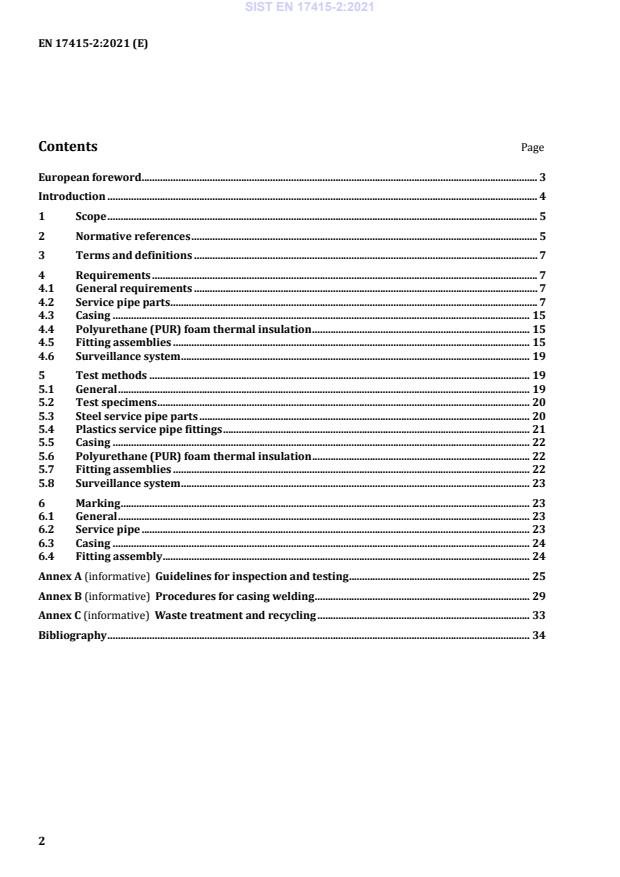
Contents Page
European foreword . 3
Introduction . 4
1 Scope . 5
2 Normative references . 5
3 Terms and definitions . 7
4 Requirements . 7
4.1 General requirements . 7
4.2 Service pipe parts . 7
4.3 Casing . 15
4.4 Polyurethane (PUR) foam thermal insulation . 15
4.5 Fitting assemblies . 15
4.6 Surveillance system . 19
5 Test methods . 19
5.1 General . 19
5.2 Test specimens . 20
5.3 Steel service pipe parts . 20
5.4 Plastics service pipe fittings . 21
5.5 Casing . 22
5.6 Polyurethane (PUR) foam thermal insulation . 22
5.7 Fitting assemblies . 22
5.8 Surveillance system . 23
6 Marking . 23
6.1 General . 23
6.2 Service pipe . 23
6.3 Casing . 24
6.4 Fitting assembly . 24
Annex A (informative) Guidelines for inspection and testing . 25
Annex B (informative) Procedures for casing welding . 29
Annex C (informative) Waste treatment and recycling . 33
Bibliography . 34
European foreword
This document (EN 17415-2:2021) has been prepared by Technical Committee CEN/TC 107 “Prefabricated
district heating and district cooling pipe system”, the secretariat of which is held by DS.
This European Standard shall be given the status of a national standard, either by publication of an identical
text or by endorsement, at the latest by March 2022, and conflicting national standards shall be withdrawn
at the latest by March 2022.
Attention is drawn to the possibility that some of the elements of this document may be the subject of patent
rights. CEN shall not be held responsible for identifying any or all such patent rights.
Any feedback and questions on this document should be directed to the users’ national standards body. A
complete listing of these bodies can be found on the CEN website.
According to the CEN-CENELEC Internal Regulations, the national standards organisations of the following
countries are bound to implement this European Standard: Austria, Belgium, Bulgaria, Croatia, Cyprus, Czech
Republic, Denmark, Estonia, Finland, France, Germany, Greece, Hungary, Iceland, Ireland, Italy, Latvia,
Lithuania, Luxembourg, Malta, Netherlands, Norway, Poland, Portugal, Republic of North Macedonia,
Romania, Serbia, Slovakia, Slovenia, Spain, Sweden, Switzerland, Turkey and the United Kingdom.
Introduction
Factory made bonded single pipe systems for directly buried district cooling networks are of common
technical usage. In order to ensure quality including product-related service life, to ensure safety in use,
economical energy usage and to facilitate comparability in the market, CEN/TC 107 decided to set up
standards for these products.
This document is one of a series of standards which form several parts of EN 17415, District cooling pipes –
Bonded single pipe systems for directly buried cold water networks:
— Part 1: Factory made pipe assembly of steel or plastic service pipe, polyurethane thermal insulation and a
casing of polyethylene;
— Part 2: Factory made fitting assemblies of steel or plastic service pipe, polyurethane thermal insulation and
a casing of polyethylene (this document);
— Part 3: Factory made steel valve assembly for steel or plastic service pipe, polyurethane thermal insulation
and a casing of polyethylene.
The other standards from CEN/TC 107 covering this subject are:
— EN 17414-1, District cooling pipes — Factory made flexible pipe systems — Part 1: Classification, general
requirements and test methods;
— EN 17414-2, District cooling pipes — Factory made flexible pipe systems — Part 2: Bonded system with
plastic service pipes; requirements and test methods;
— EN 17414-3, District cooling pipes — Factory made flexible pipe systems — Part 3: Non bonded system
with plastic service pipes; requirements and test methods;
— EN XXXXX-1 , District cooling pipes — Design and installation of thermal insulated bonded single and twin
pipe systems for directly buried cold water networks — Part 1: Design;
, District cooling pipes — Design and installation of thermal insulated bonded single and twin
— EN XXXXX-2
pipe systems for directly buried cold water networks — Part 2: Installation;
— EN 489-1, District heating pipes — Bonded single and twin pipe systems for buried hot water networks —
Part 1: Joint casing assemblies and thermal insulation for hot water networks in accordance with
EN 13941-1;
— EN 14419, District heating pipes — Bonded single and twin pipe systems for directly buried hot water
networks — Surveillance systems.
Waste management and recycling of materials is dealt with in Annex C.
Under development.
1 Scope
This document specifies requirements, design and test methods for factory made thermally insulated
bonded fitting assemblies for directly buried district cooling distribution systems, comprising a service
fitting from DN 15 to DN 1200, rigid polyurethane foam insulation and a casing of polyethylene.
The fitting assembly can also include the following additional elements: measuring wires, spacers and
diffusion barriers.
This document covers the following fitting assemblies: bend, tee, reducer, cap and anchor.
This document applies only to insulated fitting assemblies, for continuous operation with water at various
temperatures (1 to 30) °C and a maximum operation pressure of 25 bar.
The design is based on an expected service life with continuous operation of a minimum 50 years.
NOTE An expected service life of 50 years presupposes that treated water is used.
2 Normative references
The following documents are referred to in the text in such a way that some or all of their content constitutes
requirements of this document. For dated references, only the edition cited applies. For undated references,
the latest edition of the referenced document (including any amendments) applies.
EN 10204, Metallic products - Types of inspection documents
EN 10253-2, Butt-welding pipe fittings - Part 2: Non alloy and ferritic alloy steels with specific inspection
requirements
EN 12201-2, Plastics piping systems for water supply, and for drainage and sewerage under pressure —
Polyethylene (PE) — Part 2: Pipes
EN 12201-3, Plastics piping systems for water supply, and for drainage and sewerage under pressure —
Polyethylene (PE) — Part 3: Fittings
EN 12201-5, Plastics piping systems for water supply, and for drainage and sewerage under pressure -
Polyethylene (PE) - Part 5: Fitness for purpose of the system
EN 12814-1, Testing of welded joints of thermoplastics semi-finished products - Part 1: Bend test
EN 13018, Non-destructive testing - Visual testing - General principles
EN 13067, Plastics welding personnel - Qualification of welders - Thermoplastics welded assemblies
EN 13941-1, District heating pipes - Design and installation of thermal insulated bonded single and twin pipe
systems for directly buried hot water networks - Part 1: Design
EN 13941-2, District heating pipes - Design and installation of thermal insulated bonded single and twin pipe
systems for directly buried hot water networks - Part 2: Installation
EN 14419, District heating pipes - Bonded single and twin pipe systems for buried hot water networks -
Surveillance systems
EN 14870-1, Petroleum and natural gas industries - Induction bends, fittings and flanges for pipeline
transportation systems - Part 1: Induction bends (ISO 15590-1)
EN 17248, District heating and district cooling pipe systems - Terms and definitions
EN 17415-1:2020, District cooling pipes - Bonded single pipe systems for directly buried cold water networks -
Part 1: Factory made pipe assembly of steel or plastic service pipe, polyurethane thermal insulation and a
casing of polyethylene
EN ISO 3452-1, Non-destructive testing - Penetrant testing - Part 1: General principles (ISO 3452-1)
EN ISO 5579, Non-destructive testing - Radiographic testing of metallic materials using film and X- or gamma
rays - Basic rules (ISO 5579)
EN ISO 5817, Welding - Fusion-welded joints in steel, nickel, titanium and their alloys (beam welding excluded)
- Quality levels for imperfections (ISO 5817)
EN ISO 8501-1, Preparation of steel substrates before application of paints and related products - Visual
assessment of surface cleanliness - Part 1: Rust grades and preparation grades of uncoated steel substrates and
of steel substrates after overall removal of previous coatings (ISO 8501-1)
EN ISO 9606-1, Qualification testing of welders - Fusion welding - Part 1: Steels (ISO 9606-1)
EN ISO 9692-1:2013, Welding and allied processes - Types of joint preparation - Part 1: Manual metal arc
welding, gas-shielded metal arc welding, gas welding, TIG welding and beam welding of steels
(ISO 9692-1:2013)
EN ISO 9934-1, Non-destructive testing - Magnetic particle testing - Part 1: General principles (ISO 9934-1)
EN ISO 10675-1, Non-destructive testing of welds - Acceptance levels for radiographic testing - Part 1: Steel,
nickel, titanium and their alloys (ISO 10675-1)
EN ISO 11666, Non-destructive testing of welds - Ultrasonic testing - Acceptance levels (ISO 11666)
EN ISO 14732, Welding personnel - Qualification testing of welding operators and weld setters for mechanized
and automatic welding of metallic materials (ISO 14732)
EN ISO 15607, Specification and qualification of welding procedures for metallic materials - General rules
(ISO 15607)
EN ISO 16810, Non-destructive testing - Ultrasonic testing - General principles (ISO 16810)
EN ISO 17636-1, Non-destructive testing of welds - Radiographic testing - Part 1: X- and gamma-ray techniques
with film (ISO 17636-1)
EN ISO 17636-2, Non-destructive testing of welds - Radiographic testing - Part 2: X- and gamma-ray techniques
with digital detectors (ISO 17636-2)
EN ISO 17637, Non-destructive testing of welds - Visual testing of fusion-welded joints (ISO 17637)
EN ISO 17638, Non-destructive testing of welds - Magnetic particle testing (ISO 17638)
EN ISO 17640, Non-destructive testing of welds - Ultrasonic testing - Techniques, testing levels, and assessment
(ISO 17640)
EN ISO 23277, Non-destructive testing of welds - Penetrant testing - Acceptance levels (ISO 23277)
EN ISO 23278, Non-destructive testing of welds - Magnetic particle testing - Acceptance levels (ISO 23278)
3 Terms and definitions
For the purposes of this document the terms and definitions given in EN 17248 and EN 17415-1 apply.
ISO and IEC maintain terminological databases for use in standardization at the following addresses:
— IEC Electropedia: available at https://www.electropedia.org/
— ISO Online browsing platform: available at https://www.iso.org/obp
4 Requirements
4.1 General requirements
Unless otherwise specified, the requirements shall be valid for each single measurement.
For information on suitable guidelines for inspection of factory made fitting assemblies, see Annex A.
4.2 Service pipe parts
4.2.1 Steel service pipe parts
4.2.1.1 General
The material of the fitting steel parts shall be certified in accordance with EN 10204. If traceability on
material is required by the end user it shall be specified at the time of ordering. Corresponding material
certificates shall be delivered to the end user if specified at the time of ordering.
4.2.1.2 Specification
The fitting steel material shall be in accordance with the steel grade specification in EN 17415-1.
All steel pipes and components used for manufacturing of pipe assemblies under the scope of this document
shall as a minimum be delivered to the manufacturer with an inspection certificate 3.1 according to
EN 10204. The inspection certificate shall on request be passed on to the client who orders the fitting
assemblies.
In case a material related inspection certificate 3.1 according to EN 10204 is required by the client who
orders the fitting assemblies, this request shall be given whilst placing the order with the manufacturer of
the fitting assemblies.
NOTE Any later request for provision of such documentation could be too late and possibly can't be met by the
manufacturer, since the manufacturer needs to organize the assignment of 3.1 certificates to pipes and part of pipes
before starting the production.
4.2.1.3 Wall thickness and diameter
All components shall be designed for a minimum operating pressure of 16 bar.
If the fitting assemblies are intended to be used in situations with pressures higher than 16 bar, extra
calculations will be necessary.
The minimum nominal wall thickness of all components shall prior to processing be at least the same as for
the service pipes in accordance with EN 17415-1.
The nominal diameter, the outside diameter, the tolerances on the diameter of the pipe ends and the wall
thickness shall be the same as for the service pipes in accordance with EN 17415-1.
Subject to design considerations other wall thicknesses than those given in EN 17415-1 may be used, but in
no case shall these be less than the minima indicated in EN 17415-1.
All components shall be designed in accordance with EN 13941-1 for the actions and stresses that normally
occur during the service life of the fitting assembly (or of the component).
4.2.1.4 Bends
4.2.1.4.1 Butt welding bends
The dimensions shall be in accordance with EN 10253-2 with the exception that the bend radius shall
be ≥ 1,5 times the outer diameter.
4.2.1.4.2 Cold formed bends
Cold formed bends shall be produced from seamless pipe or longitudinal welded pipes. At cold formed bends
made of longitudinal welded pipes the weld bead shall be welded to factor V = 1 (calculation stress = 100 %).
After bending, the minimum wall thickness of the bent pipe shall be not less than 85 % of the wall thickness
of the straight pipe (see EN 17415-1).
The maximum ovality in the bent area shall not exceed 6 %.
The formula for the calculation of the ovality is:
D − D
( )
s max s min
o ×100 (1)
D
s
where
o is the ovality, in %;
D is the maximum outside diameter;
s max
D is the minimum outside diameter in the same cross section in the bended area;
s min
D is the specified outside diameter.
s
There shall be no folding in the bent area. Waves may be accepted, when the maximum height between
trough and crest of the wave does not exceed 25 % of the nominal wall thickness of the bent pipe.
4.2.1.4.3 Hot-formed bends
For hot-formed bends manufactured from straight pipes by means of inductive heating (induction bends), no
heat treatment is necessary as far as this method is applied with unalloyed or low-alloyed steel with
[Mo] < 0,65 %. Hot-formed bends shall be supplied in conformity with EN 14870-1.
If for the bending other heating methods are applied, heat treatment following the bending of the pipes is
required.
If a hot-formed bend has to be made from line pipe, this shall be specified to the pipe manufacturer at the
time of ordering so that the pipe manufacturer can take this into account when selecting the (chemical)
composition of the pipe material and the welding filler material.
It is recommended to determine per batch, diameter, wall thickness and bend radius, through mechanical
testing, that the bends comply with the applicable material specifications. It is customary that a
representative bend or an (additional) section of a bend of adequate length will be manufactured during the
production process and that 10 % of the bends will be tested.
=
4.2.1.4.4 Tolerances of bending angles
The deviation from the nominal bending angle shall not exceed the tolerances given in Table 1.
Table 1 — Deviations from nominal bending angle
Nominal diameter Deviation
of service pipe
≤ DN 200 ± 2,0 °
> DN 200 ± 1,0 °
4.2.1.5 T-pieces
4.2.1.5.1 Forged T-pieces
The wall thickness t and t (see EN 10253-2) shall be at least the same as those for the straight pipes
(see EN 17415-1). All other dimensions shall be in accordance with EN 10253-2.
4.2.1.5.2 Welded T-pieces
Welded T-pieces shall be manufactured by drawing a collar on which the branch pipe is welded or by
welding the branch pipe directly to the main pipe. The wall thickness of the collar shall be at least the same
as that for the branch pipe (see EN 17415-1). The collar shall be drawn opposite the welding seam in the
main pipe. When using branch pipe directly welded to the main pipe, compensating (reinforcement) plates
may be used according to EN 13941-1 requirements.
4.2.1.5.3 Tolerances of angles between branch pipes and main pipes
The branch pipes shall be perpendicular to the main pipes within a tolerance of ± 2,0 °.
4.2.1.6 Reducers
Reducers shall be in accordance with EN 10253-2, except for the wall thicknesses t and t1 (see EN 10253-2)
which shall be at least the same as for the straight pipes (see EN 17415-1) to be welded to the fittings.
4.2.1.7 Anchors
The anchors shall be marked with the information concerning maximum loads for which the construction
was designed and calculated. The lifetime of the system shall not be influenced by the anchors construction.
4.2.1.8 Caps
Caps (dished ends) shall be in accordance with EN 10253-2 and comply with the requirements of
EN 13941-1.
4.2.1.9 Fusion welding of steel fittings
4.2.1.9.1 Filler material
Filler material shall after welding have mechanical characteristics comparable with the parent metal.
4.2.1.9.2 Welding process
All types of fusion welding are acceptable but arc welding with covered electrodes and gas-shielded metal-
arc welding are preferred. The welding process shall be specified and approved in accordance with
EN ISO 15607.
The method of approval may be chosen by the manufacturer.
Fittings of wall thickness ≥ 5,6 mm shall be welded in more than one pass.
4.2.1.9.3 Preparation for welding
Pipe ends shall be prepared in accordance with the welding procedure used. When using covered electrodes
or gas-shielded metal-arc welding, pipe ends and fittings with equal wall thickness shall be prepared in
accordance with EN ISO 9692-1. See Table 2.
Table 2 of this document is derived from EN ISO 9692-1:2013, Table 1 and gives the relation between wall
thickness and reference number.
Table 2 — Preparation of ends of pipes and fittings for weldings according to EN ISO 9692-1:2013
Symbol Type of preparation Wall thickness t of steel service Reference to
pipe fittings or fitting end EN ISO 9692-1:2013, Table
II Square preparation t < 3 mm 1.2.1
V Single V preparation 3 mm ≤ t ≤ 10 mm 1.3
V Single Y preparation t > 10 mm 1.5
with broad root face
NOTE Symbols are in accordance with EN ISO 2553.
Pipe ends and fittings with different wall thicknesses shall be prepared and adapted for misalignment in
accordance with Table 3 and Figure 1 of this document.
Table 3 — Adaptation of misalignment and difference in wall thickness
Adaptation Required action
Misalignment
Misalignment h ≤ 0,3 t, max. 1 mm Figure 1 detail A
Misalignment 1 mm < h ≤ 10 mm Adaptation of pipe ends
Misalignment h > 10 mm Extra fitting Extra prepared steel fitting minimum
length
The seam spacing shall be such that
the heat-affected zones do not overlap
or interact. A spacing of 100 mm or
more is recommended. The minimum
spacing is 50 mm
Difference in wall thickness
Differences in wall thickness: t' ≤ 1,5 t Figure 1 detail B Adaptation of thicker wall t'
n
Differences in wall thickness: t' > 1,5 t Figure 1 detail C Adaptation of both sides
n
Key
h misalignment
tn smallest wall thickness
t’ largest wall thickness
Figure 1 — Misalignment, difference in wall thickness and steel service pipe end preparation, in
accordance with EN 13941-2
When manufacturing T-pieces with the branch pipe welded directly to the main pipe, preparations shall
comply with Figure 2.
Key
a section X at crotch of right angle branch c section Y at flank of unequal branch. Ratios of
diameters > 2/3
b section Y at flank of unequal branch. Ratios of d section W at flank of equal branch
diameters ≤ 2/3
Figure 2 — Preparation of set-on branches
4.2.1.9.4 Inspection of welds
When visual surface examination is carried out, it shall be in accordance with 5.3.1. The examinations
include a check of surface, internal, joint geometry and multiple imperfections. The welding shall comply
with “quality level B” of EN ISO 5817.
When a leak-tightness test is carried out in accordance with 5.3.2 or 5.3.3, the welds shall fulfil the
conditions stated there.
When non-destructive test is carried out, it shall be in accordance with 5.3.4. The weld shall comply with
“quality level B” of EN ISO 5817.
4.2.1.9.5 Competence of the welder
The welder shall have a valid certificate according to EN ISO 9606-1 for the techniques, material groups,
dimension ranges and welding position concerned. Welding personnel operating mechanized welding
equipment shall be qualified in accordance with EN ISO 14732.
4.2.1.10 Surface condition
In order to ensure proper bonding between the steel service pipe and the Polyurethane (PUR) foam thermal
insulation, the following procedure shall be followed:
a) prior to PUR foam, the outer surface of the pipe shall be cleaned so that it is free from rust, mill scale, oil,
grease, dust, paint, moisture and other contaminants;
b) before cleaning the pipe, the outer surface of the pipe shall comply with rust grade A, B or C according to
EN ISO 8501-1, without pitting.
It is recommended to clean the surface to Sa 2 according to EN ISO 8501-1.
4.2.2 Plastic service pipe parts
4.2.2.1 General
Each plastic service pipe assembly shall be prepared from components (pipes and fittings) of the same
pressure class and material classification.
If mechanical fittings are applied these fittings shall be in accordance with Part 3 of the respective piping
system standard as given in EN 17414-2.
4.2.2.2 Specification
Plastics service pipe parts and fittings shall be:
— made of polyethylene PE 100 and shall be in accordance with EN 12201-3;
or alternatively;
— made of PP, PB, PE-X, PE-RT or a multilayer M pipe material and shall be in accordance with Part 3 of the
respective pipe standard as given in EN 17414-2.
A service pipe fitting made of PE shall be tested and assembled with service pipes or as a part of an assembly
of more than one fitting fused to service pipes conforming to EN 12201-2.
A service pipe fitting made of PP, PB, PE-X, PE-RT or a multilayer M pipe material shall be tested and
assembled with service pipes or as a part of an assembly of more than one fitting fused to service pipes
conforming to Part 2 of the respective pipe standard as given in EN 17414-2.
4.2.2.3 Wall thickness and diameter
The nominal outside diameter and diameter tolerances of the PE plastic service pipe ends shall be in
accordance with EN 12201-2.
The wall thickness of the PE plastic service pipe ends shall be in accordance with EN 12201-2 and the SDR
numbers given in EN 17415-1:2020, Table 3, calculated for a continuous operating temperature of 30 °C and
a service life of 50 years. Other temperature/time profiles may be applied in accordance with EN ISO 13760
(Miner's Rule). Further information is given in EN 17415-1:2020, Annex D.
The tolerance on the actual wall thickness of the PE plastic service pipe end shall be in accordance with
EN 12201-2.
The nominal outside diameter and diameter tolerances of the PP, PB, PE-X, PE-RT and multilayer plastic
service pipe ends shall be according to Part 2 of the respective pipe standard as given in EN 17414-2.
The wall thickness and the tolerance on the actual wall thickness of the PP, PB, PE-X, PE-RT and multilayer
plastic service pipe ends shall be in accordance with Part 2 of the respective pipe standard as given in
EN 17414-2. The SDR numbers for the PP, PB, PE-X, PE-RT and multilayer plastic service pipes ends shall be
in accordance with EN 17414-2.
For the plastic service pipe fitting the derating (reduction) factor related to the fitting shall be considered.
The following derating rule for calculation of the PN shall apply:
PN = f × PN
B pipe
where
f is the derating factor ≤ 1,0 related to the plastic service pipe fitting;
B
PN is the nominal pressure of the straight plastic service pipe end.
pipe
The same pressure class of the fitting and the pipe ends shall be obtained by calculating the minimum wall
thickness of the plastic service pipe fitting based on the SDR number required for the plastic service pipe
ends and the derating factor related to the fitting. The following derating rule for an approximate calculation
of the SDR and the minimum wall thickness of the fitting can be applied:
SDR ≈ f × SDR
fitting B pipe
t = D / SDR
fitting o fitting
where
t is the minimum wall thickness required for the plastic service pipe fitting;
fitting
D is the outer diameter of the straight plastic service pipe end.
o
4.2.2.4 Bends and elbows
The nominal bend radius shall be declared by the fitting manufacturer and shall be:
≥ 0,5 times the outer diameter for D ≤ 110mm;
o
≥ 1,0 times the outer diameter for D > 110mm.
o
For segmented bends with cut angles (7,5 – 15) °, the derating factor shall be set to 0,8. However, results of
the manufacturer’s testing may demonstrate that a higher derating factor may be applicable.
For swept bends fabricated out of pipes, usually no derating factor applies. Results of the manufacturer’s
testing shall demonstrate this.
4.2.2.5 T-pieces
For tees fabricated out of pipe segments, the derating factor shall be set to 0,6. However, results of the
manufacturer’s testing may demonstrate that a higher derating factor may be applicable.
4.2.2.6 Reducers
The cylindrical parts of the reducer shall have the same diameters and wall thicknesses as the straight
plastic service pipes to be connected.
The manufacturer shall declare the length of the reducer (excluding additional service pipe ends) and the
derating factor for the reducer based on the manufacturer’s testing.
4.2.2.7 Caps
The manufacturer shall declare the derating factor for the end cap based on the manufacturer’s testing.
For end caps suitable for electrofusion, the total length of the end cap shall be declared by the manufacturer.
4.2.2.8 Surface condition
In order to ensure proper bonding between the plastic service pipe part and the thermal insulation, the
following procedure shall be followed.
Prior to insulation, the outer surface of the pipe part shall be clean so that it is free from, oil, grease, dust,
paint, moisture and other contaminants.
Surface treatment to improve the shear strength between the thermal insulation and plastic service pipe
part is permissible provided that the treated pipe assembly still complies with the specification.
4.2.2.9 Requirements of plastics service pipe welding
The welder shall have a valid qualification test certificate according to EN 13067 for the material, dimension
ranges, techniques and welding position concerned.
When PE service pipe fittings conforming to this document are assembled to each other or to service pipe
ends conforming to EN 12201-2, the joints shall conform to the requirements given in EN 12201-5.
When PP, PB, PE-X, PE-RT or multilayer service pipe fittings conforming to this document are assembled to
each other or to service pipe ends conforming to Part 2 of the respective pipe standard as given in
EN 17414-2, the joints shall conform to the requirements given in Part 5 of the respective pipe standard as
given in EN 17414-2.
NOTE For PE welding see also Annex B.
4.3 Casing
The casings shall meet the requirements of EN 17415-1.
The casing shall be tested in accordance with 5.5 of this document.
4.4 Polyurethane (PUR) foam thermal insulation
The PUR foam thermal insulation for fitting assemblies shall meet the requirements of EN 17415-1 and shall
be tested in accordance with 5.6 of this document. Test specimens from fitting assemblies to establish foam
properties shall be taken in accordance with 5.2 of this document.
4.5 Fitting assemblies
4.5.1 Fitting ends
4.5.1.1 Service pipe
The ends of the service pipe(s) shall be free from thermal insulation. The length of the free ends shall be in
accordance with EN 17415-1.
The ends of the steel service pipes and the plastics service pipes respectively shall be prepared for welding
in accordance with EN 17415-1.
4.5.1.2 Centre line deviation
When tested in accordance with 5.7.1, the distance between centre lines of the service pipe and the casing at
fitting ends shall not exceed the limits given in EN 17415-1.
4.5.1.3 Angular deviation between service pipe and casing
When tested in accordance with 5.7.1, the angular deviation between centre lines of the not insulated end of
the service pipe, and the casing at a length of 100 mm from the end, shall not exceed 2 °.
4.5.2 Angle between casing segments of bend and minimum length
The maximum angle, α, between two adjacent segments of the casing of a bend shall not exceed 45 °, see
Figure 3. Exception from this is a casing comprising an elbow of D ≤ 110mm, for which the angle between
o
the segments is allowed to be maximum 90 °. The length, L, see Figure 3, of the casing at the ends of the
fittings shall not be less than 200 mm.
Key
a α ≤ 45 ° with minimum 2 segments
b α > 45 ° with minimum 3 segments
c α > 45 ° with minimum 2 segments for plastic service pipe elbows (r/D = 0,5)
o
Figure 3 — Segmental casing pipe bends
4.5.3 Requirements of polyethylene casing welding
4.5.3.1 General
The quality of a PE weld cannot easily be tested with non-destructive methods.
The observation of proper working procedures shall ensure that the welds are leak-tight.
The welding process should, therefore, be performed according to a documented procedure in accordance
with Annex B or its equivalent.
For PE welding the following precautions shall be taken and documented:
a) only casing materials fulfilling the requirements of EN 17415-1 shall be used;
NOTE For the casing of fittings normally PE-pipes are used as semi-finished products.
b) weld fillers of PE shall fulfil the requirements of EN 17415-1;
c) proven welding processes using suited and maintained tools shall be used;
d) the welder shall have a valid qualification test certificate according to EN 13067 for the material,
dimension ranges, techniques and welding position concerned;
e) a 100 % visual examination according to 4.5.3.3 shall be carried out.
4.5.3.2 Melt flow rate
The melt flow rate of the casings to be welded shall not differ more than 0,5 g/10 min when determined in
accordance with EN 17415-1.
4.5.3.3 Visual appearance
All welds shall be examined in accordance with 5.7.2. The following requirements shall be fulfilled:
a) Butt fusion welding:
1) the valley between the weld beads shall not go beneath the pipe surface;
2) the permitted butt misalignment shall not exceed 20 % of the wall thickness on the entire seam
length. On particular fittings, such as extruded tees, a butt misalignment of up to 30 % and the
resulting imperfection may be tolerated. The permitted butt misalignment applies internally as well
as externally. At two different wall thicknesses the permitted butt misalignment shall be related to
the smaller wall thickness;
3) the two weld beads shall be approximately alike and symmetrical at the same wall thickness;
4) the weld beads shall have approximately the same shape and size on the entire length. A double
bead width of approximately (0,6 – 1,2) × e mm shall be obtained. For e < 6 mm, however, a width of
2 × e mm shall be obtained. (For the specimen thickness e, see Figure 4.);
5) inspect the wall thickness of the casing;
6) the weld beads shall be smooth, round, without burrs, notches or important imprints from the tool
division line.
b) Extrusion weld seams:
1) the filler material shall fill out the weld joint entirely;
2) during any destructive tests the seam in the cross and the longitudinal section shall not have any
visual dividing or binding failure zones between filler and casing material;
3) the seam surface shall be convex and 10 % to 40 % of the wall thickness higher than the casing
surface;
4) the edges of the V-seam of the casing material shall be covered by the weld seam overlapping
by ≥ 2 mm;
5) next to the weld seam a melt print of the welding shoe shall be visible;
6) melt overflow can occur and is eventually to be removed notchless;
7) the seam root shall be welded through. Root notches are not permitted. Root sinks are permitted
locally up to a length of approximately 20 mm and a depth of ≤ 0,1 × e and maximum 1 mm;
8) inspect the wall thickness of the casing;
9) edge notches (from the welding shoe marks or the machining) are generally permitted if these end
up flat and do not exceed 10 % of the wall thickness;
10) a root overflow of 20 % of the wall thickness is permitted;
11) bonding failures are not permitted;
12) pits and cavities shall not exceed 15 % of the basic pipe wall thickness;
13) with regard to the root maximum of 2 mm, however, an edge misalignment of a maximum of 20 % of
the wall thickness is permitted.
4.5.3.4 Bending test
When tested in accordance with EN 12814-1 cracks shall not occur in the weld seam until the testing angle is
reached. The minimum bending angle, α, shall be in accordance with the diagram shown in Figure 4.
Key
1 butt weld α bending angle
2 extrusion weld e wall thickness of the casing (mm)
Figure 4 — Minimum bending angle
4.5.4 Leak-tightness of the welded casing
The fittings shall be leak-tight.
If the PUR foam is visible on the outside of the weld after the foaming the complete casing shall be removed
and the whole production series inspected.
The welding process shall be correct and the product shall be examined according to 4.5.3.3 and 4.5.3.4.
NOTE A guideline for training, process parameters, maintenance and proper workmanship can be found in
Annex B.
4.5.5 Diameter and wall thickness of the casing
The outside diameter and the minimum wall thickness of the casing shall be in accordance with EN 17415-1.
4.5.6 Minimum thickness of the thermal insulation in bends
The thickness of the thermal insulation of the bends, measured in accordance with 5.7.4, shall not at any
point be less than 50 % of the nominal insulation thickness in accordance with EN 17415-1 and nowhere
less than 15 mm.
4.5.7 Tolerances of the main fitting dimensions
The tolerances of the main fitting dimensions as declared by the manufacturer and shown in Figure 5 shall
be in accordance with Table 4.
Table 4 — Tolerances on the main fitting dimensions
DN H L
mm mm
≤ 300 ± 10 ± 20
> 300 ± 25 ± 50
Key
L length
H high offset
Figure 5 — Main fitting dimensions
4.6 Surveillance system
When measuring elements for a surveillance system are installed in the fitting all specifications shall comply
with EN 14419.
5 Test methods
5.1 General
Where test requirements specified in this document differ from those in other standards referred to, the
requirements laid down in this document shall apply.
5.2 Test specimens
Test specimens shall only be taken from the casin
...