

SIST EN 1253-6:2023
(Main)Gullies for buildings - Part 6: Trapped floor gullies with a depth of water seal less than 50 mm
General Information
- Abstract
This document classifies floor gullies for domestic waste water for use inside buildings, gives guidance for places of installation and specifies requirements for the construction, design, performance and marking of factory made gullies for buildings, irrespective of the material, for use in drainage systems requiring a trap with a depth of water seal less than 50 mm (referred to as floor gullies).
NOTE Floor gullies with a depth of water seal less than 50 mm are not covered by EN 1253 1, EN 1253 7 and EN 1253 8.
These products are intended to be installed where the three following conditions are met:
- space limitation will not accommodate a gully with a 50 mm water seal;
- the building does not exceed a ground-floor and three floors above;
- at least two domestic sanitary appliances are installed in addition to the gully but with only one WC on the same branch (connection pipe) or secondary or branch ventilation is installed (see EN 12056 2:2000, 4.3.2 or 4.3.4.
- Status
- Published
- Public Enquiry End Date
- 14-Sep-2020
- Publication Date
- 06-Dec-2022
- Technical Committee
- IOVO - Water supply and waste water engineering
- Current Stage
- 6060 - National Implementation/Publication (Adopted Project)
- Start Date
- 01-Dec-2022
- Due Date
- 05-Feb-2023
- Completion Date
- 07-Dec-2022

Overview
EN 1253-6:2022 (CEN) defines requirements for trapped floor gullies with a depth of water seal less than 50 mm intended for domestic wastewater inside buildings. The standard classifies factory-made floor gullies (irrespective of material), gives guidance on places of installation and specifies requirements for design, construction, performance, testing and marking. These shallow-seal gullies are intended for use where a 50 mm seal cannot be accommodated and in buildings up to ground-floor plus three storeys, subject to installation and ventilation conditions.
Key topics and technical requirements
- Scope and application conditions: Intended where space limits prevent a 50 mm seal, building height does not exceed ground floor + 3 floors, and installation has at least two other domestic sanitary appliances on the same branch (with only one WC), or where secondary/branch ventilation is provided (see EN 12056-2).
- Design & construction: Floor gullies must be connectable to standardized pipework, fixed to the floor with no movement that could impair function, and supplied with installation instructions. Traps must be secured against floating or displacement.
- Gratings and apertures: Aperture shapes can vary; the standard sets dimensional limits for grating openings (special rules for barefoot areas, e.g. max 8 mm).
- Performance testing: Requirements and test methods cover mechanical strength (loading, clamping ring strength), thermal behaviour, flow rates, tightness (odour- and water-tightness), resistance to blockage, and self-cleansing capacity.
- Materials and durability: Applies irrespective of material; components must resist mechanical and thermal stresses of intended application.
- Marking and conformity: Products must be marked and evaluated for conformity. EN 1253-3 is cited for conformity assessment procedures.
Practical applications
- Use in space-constrained wet rooms, bathrooms, shower areas, laundry rooms and kitchens where a standard 50 mm trap depth cannot be installed.
- Suitable for renovation projects, compact apartments, or areas with low build-up under the finished floor.
- Applies to channel drains and linear systems when a shallow trapped solution is required.
Who uses this standard
- Manufacturers of floor gullies and drainage components
- Plumbing engineers, architects and building services designers
- Installers and contractors working on residential drainage
- Test laboratories, certification bodies and building inspectors
- Specifiers preparing procurement and compliance documentation
Related standards
- EN 1253 series (Part 1, 3, 7, 8) - complementary parts covering other gully types and conformity
- EN 12056-2 - drainage and ventilation rules referenced for installation conditions
- EN 476 - general requirements for drainage components
- EN 16323 - wastewater engineering glossary
Keywords: EN 1253-6:2022, floor gullies, trapped floor gully, water seal less than 50 mm, CEN, drainage systems, domestic wastewater, installation, performance requirements.
Relations
- Effective Date
- 28-Jan-2026
- Effective Date
- 28-Jan-2026
- Effective Date
- 28-Jan-2026
Get Certified
Connect with accredited certification bodies for this standard

DIBt (Deutsches Institut für Bautechnik)
German Institute for Building Technology.
DIN CERTCO
DIN Group product certification.

Aboma Certification B.V.
Specialized in construction, metal, and transport sectors.
Sponsored listings
Frequently Asked Questions
SIST EN 1253-6:2023 is a standard published by the Slovenian Institute for Standardization (SIST). Its full title is "Gullies for buildings - Part 6: Trapped floor gullies with a depth of water seal less than 50 mm". This standard covers: This document classifies floor gullies for domestic waste water for use inside buildings, gives guidance for places of installation and specifies requirements for the construction, design, performance and marking of factory made gullies for buildings, irrespective of the material, for use in drainage systems requiring a trap with a depth of water seal less than 50 mm (referred to as floor gullies). NOTE Floor gullies with a depth of water seal less than 50 mm are not covered by EN 1253 1, EN 1253 7 and EN 1253 8. These products are intended to be installed where the three following conditions are met: - space limitation will not accommodate a gully with a 50 mm water seal; - the building does not exceed a ground-floor and three floors above; - at least two domestic sanitary appliances are installed in addition to the gully but with only one WC on the same branch (connection pipe) or secondary or branch ventilation is installed (see EN 12056 2:2000, 4.3.2 or 4.3.4.
This document classifies floor gullies for domestic waste water for use inside buildings, gives guidance for places of installation and specifies requirements for the construction, design, performance and marking of factory made gullies for buildings, irrespective of the material, for use in drainage systems requiring a trap with a depth of water seal less than 50 mm (referred to as floor gullies). NOTE Floor gullies with a depth of water seal less than 50 mm are not covered by EN 1253 1, EN 1253 7 and EN 1253 8. These products are intended to be installed where the three following conditions are met: - space limitation will not accommodate a gully with a 50 mm water seal; - the building does not exceed a ground-floor and three floors above; - at least two domestic sanitary appliances are installed in addition to the gully but with only one WC on the same branch (connection pipe) or secondary or branch ventilation is installed (see EN 12056 2:2000, 4.3.2 or 4.3.4.
SIST EN 1253-6:2023 is classified under the following ICS (International Classification for Standards) categories: 91.140.80 - Drainage systems. The ICS classification helps identify the subject area and facilitates finding related standards.
SIST EN 1253-6:2023 has the following relationships with other standards: It is inter standard links to SIST EN 1253-3:2016, SIST EN 16323:2014, SIST EN 476:2022. Understanding these relationships helps ensure you are using the most current and applicable version of the standard.
SIST EN 1253-6:2023 is available in PDF format for immediate download after purchase. The document can be added to your cart and obtained through the secure checkout process. Digital delivery ensures instant access to the complete standard document.
Standards Content (Sample)
SLOVENSKI STANDARD
01-januar-2023
Odtoki v stavbah - 6. del: Talni odtoki z zaporo vode na višini manj kot 50 mm
Gullies for buildings - Part 6: Trapped floor gullies with a depth of water seal less than 50
mm
Abläufe für Gebäude - Teil 6: Bodenabläufe mit Geruchverschluss mit einer
Geruchverschlusshöhe von weniger als 50 mm
Avaloirs et siphons pour bâtiments - Partie 6 : Siphons de sol avec garde d’eau inférieure
à 50 mm
Ta slovenski standard je istoveten z: EN 1253-6:2022
ICS:
91.140.80 Drenažni sistemi Drainage systems
2003-01.Slovenski inštitut za standardizacijo. Razmnoževanje celote ali delov tega standarda ni dovoljeno.
EN 1253-6
EUROPEAN STANDARD
NORME EUROPÉENNE
October 2022
EUROPÄISCHE NORM
ICS 91.140.80
English Version
Gullies for buildings - Part 6: Trapped floor gullies with a
depth of water seal less than 50 mm
Avaloirs et siphons pour bâtiments - Partie 6 : Siphons Abläufe für Gebäude - Teil 6: Bodenabläufe mit
de sol avec garde d'eau inférieure à 50 mm Geruchverschluss mit einer Geruchverschlusshöhe von
weniger als 50 mm
This European Standard was approved by CEN on 26 September 2022.
CEN members are bound to comply with the CEN/CENELEC Internal Regulations which stipulate the conditions for giving this
European Standard the status of a national standard without any alteration. Up-to-date lists and bibliographical references
concerning such national standards may be obtained on application to the CEN-CENELEC Management Centre or to any CEN
member.
This European Standard exists in three official versions (English, French, German). A version in any other language made by
translation under the responsibility of a CEN member into its own language and notified to the CEN-CENELEC Management
Centre has the same status as the official versions.
CEN members are the national standards bodies of Austria, Belgium, Bulgaria, Croatia, Cyprus, Czech Republic, Denmark, Estonia,
Finland, France, Germany, Greece, Hungary, Iceland, Ireland, Italy, Latvia, Lithuania, Luxembourg, Malta, Netherlands, Norway,
Poland, Portugal, Republic of North Macedonia, Romania, Serbia, Slovakia, Slovenia, Spain, Sweden, Switzerland, Türkiye and
United Kingdom.
EUROPEAN COMMITTEE FOR STANDARDIZATION
COMITÉ EUROPÉEN DE NORMALISATION
EUROPÄISCHES KOMITEE FÜR NORMUNG
CEN-CENELEC Management Centre: Rue de la Science 23, B-1040 Brussels
© 2022 CEN All rights of exploitation in any form and by any means reserved Ref. No. EN 1253-6:2022 E
worldwide for CEN national Members.
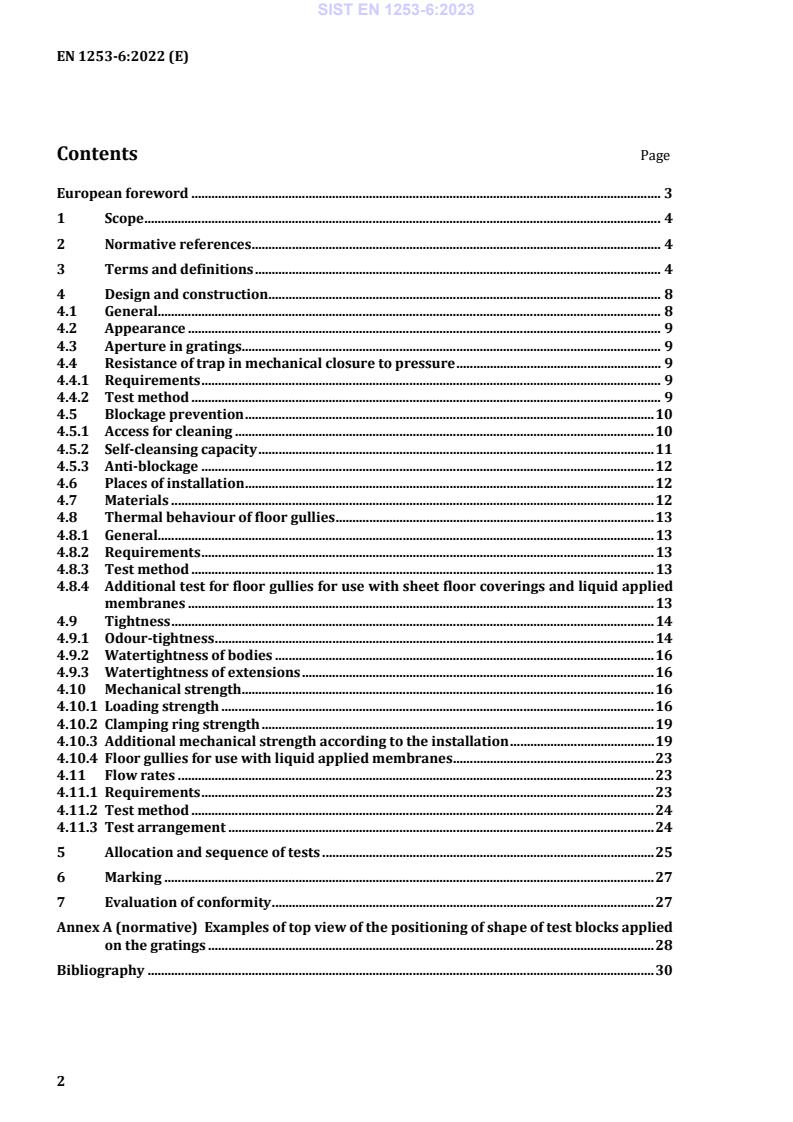
Contents Page
European foreword . 3
1 Scope . 4
2 Normative references . 4
3 Terms and definitions . 4
4 Design and construction . 8
4.1 General. 8
4.2 Appearance . 9
4.3 Aperture in gratings . 9
4.4 Resistance of trap in mechanical closure to pressure . 9
4.4.1 Requirements . 9
4.4.2 Test method . 9
4.5 Blockage prevention . 10
4.5.1 Access for cleaning . 10
4.5.2 Self-cleansing capacity . 11
4.5.3 Anti-blockage . 12
4.6 Places of installation . 12
4.7 Materials . 12
4.8 Thermal behaviour of floor gullies . 13
4.8.1 General. 13
4.8.2 Requirements . 13
4.8.3 Test method . 13
4.8.4 Additional test for floor gullies for use with sheet floor coverings and liquid applied
membranes . 13
4.9 Tightness . 14
4.9.1 Odour-tightness . 14
4.9.2 Watertightness of bodies . 16
4.9.3 Watertightness of extensions . 16
4.10 Mechanical strength . 16
4.10.1 Loading strength . 16
4.10.2 Clamping ring strength . 19
4.10.3 Additional mechanical strength according to the installation . 19
4.10.4 Floor gullies for use with liquid applied membranes . 23
4.11 Flow rates . 23
4.11.1 Requirements . 23
4.11.2 Test method . 24
4.11.3 Test arrangement . 24
5 Allocation and sequence of tests . 25
6 Marking . 27
7 Evaluation of conformity . 27
Annex A (normative) Examples of top view of the positioning of shape of test blocks applied
on the gratings . 28
Bibliography . 30
European foreword
This document (EN 1253-6:2022) has been prepared by Technical Committee CEN/TC 165 “Waste water
engineering”, the secretariat of which is held by DIN.
This European Standard shall be given the status of a national standard, either by publication of an
identical text or by endorsement, at the latest by April 2023, and conflicting national standards shall be
withdrawn at the latest by April 2023.
Attention is drawn to the possibility that some of the elements of this document may be the subject of
patent rights. CEN shall not be held responsible for identifying any or all such patent rights.
Within its program of work, Technical Committee CEN/TC 165 requested CEN/TC 165/WG 11 “Gratings,
covers and other ancillary components for use inside buildings” to prepare the following standard:
EN 1253-6, Trapped floor gullies with a depth of water seal less than 50 mm.
The EN 1253 series under the main title Gullies for buildings will actually consist of the following parts:
— Part 1: Trapped floor gullies with a depth water seal of at least 50 mm;
— Part 2: Roof drains and floor gullies without trap;
— Part 3: Evaluation of conformity;
— Part 4: Access covers;
— Part 5: Gullies with light liquids closure;
— Part 6: Trapped floor gullies with a depth of water seal less than 50 mm;
— Part 7: Trapped floor gullies with mechanical closure;
— Part 8: Trapped floor gullies with combined mechanical closure and water seal.
Any feedback and questions on this document should be directed to the users’ national standards body.
A complete listing of these bodies can be found on the CEN website.
According to the CEN-CENELEC Internal Regulations, the national standards organisations of the
following countries are bound to implement this European Standard: Austria, Belgium, Bulgaria, Croatia,
Cyprus, Czech Republic, Denmark, Estonia, Finland, France, Germany, Greece, Hungary, Iceland, Ireland,
Italy, Latvia, Lithuania, Luxembourg, Malta, Netherlands, Norway, Poland, Portugal, Republic of North
Macedonia, Romania, Serbia, Slovakia, Slovenia, Spain, Sweden, Switzerland, Türkiye and the United
Kingdom.
1 Scope
This document classifies floor gullies for domestic waste water for use inside buildings, gives guidance
for places of installation and specifies requirements for the construction, design, performance and
marking of factory made gullies for buildings, irrespective of the material, for use in drainage systems
requiring a trap with a depth of water seal less than 50 mm (referred to as floor gullies).
NOTE Floor gullies with a depth of water seal less than 50 mm are not covered by EN 1253-1, EN 1253-7 and
EN 1253-8.
These products are intended to be installed where the three following conditions are met:
— space limitation will not accommodate a gully with a 50 mm water seal;
— the building does not exceed a ground-floor and three floors above;
— at least two domestic sanitary appliances are installed in addition to the gully but with only one WC
on the same branch (connection pipe) or secondary or branch ventilation is installed (see
EN 12056-2:2000, 4.3.2 or 4.3.4.
2 Normative references
The following documents are referred to in the text in such a way that some or all of their content
constitutes requirements of this document. For dated references, only the edition cited applies. For
undated references, the latest edition of the referenced document (including any amendments) applies.
EN 476, General requirements for components used in drains and sewers
EN 1253-3, Gullies for buildings — Part 3: Evaluation of conformity
EN 16323, Glossary of wastewater engineering terms
3 Terms and definitions
For the purposes of this document, the terms and definitions given in EN 16323 and the following apply.
3.1
trapped floor gully
discharge fitting the top of which is a grating or cover capable of installation at ground or floor level,
intended to receive wastewater either through apertures in the grating and/or channels joined to the
body of the gully and to drain that wastewater through the outlet
Note 1 to entry: Four generic types of floor gullies are shown in Figure 1.
Note 2 to entry: In this document, the term “trapped floor gully” includes linear products, such as channel drains.
a) Floor gully with flange for bonding b) Floor gully with flange for clamping
waterproofing membranes (example) membranes (fixed and loose flange)
(example)
c) Floor gully with flange for clamping d) Channel drain with flange for bonding
flexible flooring (e.g. PVC flooring) (example) liquid applied membranes (example)
Key
1 finished floor 10 flange for bonding membranes
2 grating/cover 11 sediment bucket
3 extension 12 connecting flange with counter flange
4 trap a fixed flange
5 depth of water seal (H < 50 mm) b loose flange
6 outlet 13 flange for clamping flexible flooring with a clamping ring
7 body 14 seal
8 access for cleaning 15 flange for bonding liquid applied membrane
9 weep hole
Figure 1 — Examples of four generic types of floor gullies according to this standard
3.2
grating
removable component with apertures which permits the discharge of water
3.3
frame
support for a grating or cover which is connected to a body either directly or by means of a membrane
clamping ring or an extension
3.4
cover
removable part of an access cover which covers the opening
3.5
body
part of a floor gully below or in the floor on which the grating/frame/extension is mounted, and to which
the pipework is connected
3.6
extension
component used to adjust the height of a grating or cover above a body
3.7
joint
connection between the adjacent ends of two components including the means of sealing
3.8
membrane clamping ring
component used to clamp a membrane or a sheet floor covering to a body or extension
3.9
connecting flange
separate or an integral part of a body or of an extension which receives a membrane or sheet floor
covering
3.10
external diameter
OD
mean external diameter of the pipe at any cross section
3.11
internal diameter
ID
mean internal diameter of the pipe at any cross section
3.12
trap
removable or integral part of the body which prevents the passage of foul air from the outlet to the inlet
by means of water seal
3.13
depth of water seal
effective height of water in the trap (H) which prevents the passage of foul air
Note 1 to entry: See Figure 1.
3.14
domestic wastewater
water polluted by the human life, including water discharged from kitchens, laundry rooms, lavatories,
bathrooms, toilets and similar facilities
[SOURCE: EN 16323:2014, 2.1.2.3]
3.15
sheet floor covering
flexible watertight finished layer for floors affixed to the flange by bonding, welding and/or by means of
a clamping ring
3.16
membrane
watertight and damp proof layer attached to the floor gully either in the floor or on the floor
3.17
head of water
depth h of water over the frame of the floor gully
Note 1 to entry: See Figure 2.
Note 2 to entry: For floor gullies without frame, the depth of water is the lowest level over the finished floor.
Key
h head of water
Figure 2 — Head of water for floor gullies
3.18
outlet
male or female connection to the discharge pipe
3.19
nominal size
DN
numerical indication of size which is a convenient integer approximately equal to the internal diameter
(DN/ID) or the external diameter (DN/OD) in millimetres
3.20
clear opening
CO
diameter of the largest circle that can be inscribed within the unsupported area of the grating
3.21
test load
specified load which a component is required to withstand
3.22
liquid applied waterproofing kit
particular combination of a defined set of components to be installed in liquid form for waterproofing
Note 1 to entry: The liquid applied waterproofing kit is usually a paste-like composite material or a combination of
separate materials that can be poured, spread or sprayed on the subsurface by brush, roller or similar suitable
applicator.
3.23
domestic sanitary appliances
fixed appliances supplied with water and used for cleaning or washing. For example: baths, showers,
wash basins, bidets, WCs, urinals, sinks, dishwashers, washing machines
[SOURCE: EN 12056:2000, 3.4.1]
4 Design and construction
4.1 General
Floor gullies shall be capable of being connected to the pipework system covered by relevant European
Standards, and, when installed in accordance with the manufacturer's instructions, shall form an integral
part of the building. There shall be no movement possible between the body and the floor, which would
impair the functioning of the installed gully.
The upper surfaces of frame and grating shall be flush. When in position, it shall not be possible for
gratings and covers to be inadvertently dislodged from the frame, but they shall be easy to be released
e.g. for maintenance and cleaning.
Traps shall be prevented, by design features such as fixings or weights, from floating or displacement.
Floor gullies and their components shall be resistant to all mechanical and thermal requirements of
application. Floor gullies shall be designed without side inlet.
NOTE Products with side inlet are described in EN 1253-1.
Floor gullies shall be delivered with installation instructions.
All pipe joints to and from the floor gully shall be designed to be watertight in accordance with EN 476.
4.2 Appearance
Internal and external surfaces shall be free from sharp edges and imperfections which could impair
functioning of the floor gully or give risk of injury.
4.3 Aperture in gratings
Apertures can be of any shape and may also be formed between grating and frame.
The dimensions of apertures in grating shall be as specified in Table 1.
Table 1 — Apertures in gratings
Dimensions of apertures in gratings
Class Minimum width Maximum width
mm mm
a
H 1,5 15 (max. 8 mm in barefoot areas)
a
K 3 10 (max. 8 mm in barefoot areas)
b
L 15 4
15 (max. 8 mm in barefoot areas)
a
Apertures of less than 4 mm width are permitted but are not included in the hydraulic tests.
b
In commercially used premises, gratings may also be used with a maximum width of apertures up to 31 mm.
4.4 Resistance of trap in mechanical closure to pressure
4.4.1 Requirements
When tested in accordance with 4.4.2, the applied pressure which just causes passage of air shall be
+10
> 200 Pa.
4.4.2 Test method
Mount the floor gully in a test arrangement as illustrated in Figure 3, and run water through the gully
until the trap is filled.
+10
Close the flap and set a pressure of −200 Pa by means of the bypass valves. Open the flap and fill the
trap with water.
Close the flap and slowly open after about 5 ± 0,5 s. Repeat this procedure until the trap no longer loses
water, but no more than 5 times.
+0,2
Remove 4 mm of water height; this corresponds to the reduction in the depth of water seal due to
evaporation over a period of disuse.
Apply to the outlet side a positive pressure such that flow of air just occurs. Record the pressure. Record
+10
the pressure of at least−200 Pa.
Note With the flap closed, set the desired negative pressure with the bypass valves, and read the manometer.
The sensors in the trap are connected to the recording device. When the flap is closed rapidly, the desired vacuum
pressure is established immediately. By reversing the fan and securing the flap in the closed position, the
arrangement can be used also for the measurement of the resistance to positive pressure.
Key
1 fan
2 bypass valves
3 flap
4 gully to be tested
4a connection to pressure recorder
4b connection to water level recorder
5 drain cock
6 pressure measuring device (manometer)
Figure 3 — Typical test arrangement for determining the resistance of water seals to pressure
4.5 Blockage prevention
4.5.1 Access for cleaning
4.5.1.1 General
Floor gullies should have provision for mechanical cleaning of the outlet pipe systems leading from the
gully.
Where the gully trap is not intended to be removable or access for cleaning is not provided, the gully shall
be self-cleansing, in accordance with 4.5.2.1.
4.5.1.2 Requirements
When an opening with an airtight and watertight cover or plug is provided, the clear opening and area of
the access for cleaning shall be as specified in Table 2.
Table 2 — Access for cleaning
Outlet of gully Access for cleaning
Diameter of outlet Clear opening C Area A
mm mm mm
DN ≤ 80 C > 20 A > 800
80 < DN ≤ 110 C > 32 A > 800
110 < DN ≤ 200 C > 50 A > 1 900
4.5.1.3 Test method
Demount and remount those parts of the floor gully which are designed for cleaning access to the floor
gully itself and/or to the pipework to which it is connected and verify the fulfilment of the requirements
according to 4.5.1.2.
4.5.2 Self-cleansing capacity
4.5.2.1 Requirements
The self-cleansing capacity of floor gullies which cannot be cleaned by removing the trap, or by an access
for cleaning in accordance with 4.5.1, shall be tested in accordance with 4.5.2.2.
The expelled volume of glass beads for each of the flow rates in the interval between 0,3 l/s and 0,6 l/s
shall be greater than that indicated by the straight line between the two end points 0 % at 0,3 l/s and
50 % at 0,6 l/s. Expulsion of glass beads shall commence at a flow rate less than 0,3 l/s, and at least 50 %
of the glass beads shall have been expelled at a flow rate of 0,6 l/s.
Figure 4 — Expulsion of beads
Table 3 — Requirements for self-cleansing capacity
Flow rate Expelled beads
l/s %
0,2 > 0
0,3 > 0
0,4 > 17
0,6 ≥ 50
4.5.2.2 Test method
Supply cold water at (15 ± 10) °C at rates of 0,2 ± 0,02 l/s, 0,3 ± 0,03 l/s, 0,4 ± 0,04 l/s and 0,6 ± 0,06 l/s
to the test box as shown in Figure 5, using supply pipe 1.
At each of the water flow rates, supply the floor gully, with grating/cover removed, with 200 ± 10 cm of
3 3
glass beads of (5 ± 0,5) mm diameter and a density of 2,5 g/cm to 3,0 g/cm . Supply the beads at a steady
and uniform rate for 30 s. Continue the flow of water for a further 30 s. Measure the volume of glass beads
that has passed through the floor gully in cm . Conduct the test three times at each discharge rate. The
average of the three results shall be taken. Plot the results of volume of beads expelled against water flow
rate.
4.5.3 Anti-blockage
4.5.3.1 Requirements
Floor gullies and their components shall not be prone to clogging.
Floor gullies with gratings or covers removed shall be capable of accommodating the passage of a 8 mm
diameter ball.
4.5.3.2 Test method
+0
Pass a rigid ball of 8 mm diameter through the floor gully, with the grating/cover removed, from the
−0,5
inlet to the outlet using gravity, only by tilting the floor gully in appropriate directions. No other force
may be applied to the ball.
4.6 Places of installation
A guide for selecting the class of a floor gully appropriate to the place of installation is given below. The
selection of the appropriate class is the responsibility of the specifier.
a) Class H 1,5: Areas where load is only expected due to maintenance.
b) Class K 3: Areas without vehicular traffic, such as dwellings, commercial and some public buildings.
c) Class L 15: Areas with light vehicular traffic, such as in commercially used premises and public areas.
All gratings shall as a minimum meet the test requirements given in 4.10.1.2 for class H 1,5. More highly
rated gratings can be used if required.
4.7 Materials
Materials shall withstand a maximum intermittent wastewater temperature of 95 °C.
Materials shall withstand the stresses likely to occur during installation and operation.
Floor gullies made of materials which are not inherently corrosion-resistant shall be protected by
corrosion prevention treatment.
4.8 Thermal behaviour of floor gullies
4.8.1 General
This test simulates use under conditions of extreme water temperatures and establishes the integrity of
the complete product.
Floor gullies shall be classified as follows:
— Class A: Application in any place of installation;
— Class B: Application restricted to bathrooms in private dwellings, with connection to outlet pipes
DN 40 to DN 75.
4.8.2 Requirements
The floor gullies and their components shall show no visible deformation or change in the components'
surface structure which could affect their fitness for use.
The floor gullies shall satisfy the requirements for tightness (4.9.1 and 4.9.2).
...