

SIST ISO 2796:1996
(Main)Cellular plastics, rigid -- Test for dimensional stability
General Information
- Abstract
Determination of the changes of linear dimensions which occur when the test specimens (100 mm x 100 mm x 25 mm) have been subjected to specified environments for a definite period of time and reconditioned. The method suggests a range of conditions of temperature and humidity, from which one or more of the desired test conditions can be selected.
- Status
- Published
- Publication Date
- 31-Dec-1995
- Technical Committee
- IPMA - Polimer materials and products
- Current Stage
- 6060 - National Implementation/Publication (Adopted Project)
- Start Date
- 01-Jan-1996
- Due Date
- 01-Jan-1996
- Completion Date
- 01-Jan-1996
Buy Documents





ISO 2796:1986 - Cellular plastics, rigid -- Test for dimensional stability
ISO 2796:1986 - Cellular plastics, rigid — Test for dimensional stability/28/1986


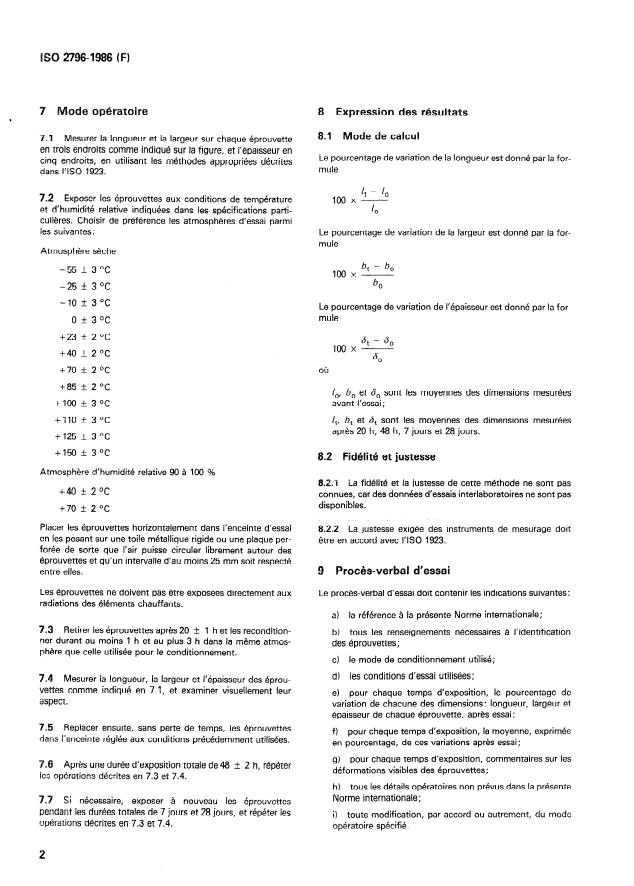
ISO 2796:1986 - Plastiques alvéolaires rigides -- Essai de stabilité dimensionnelle

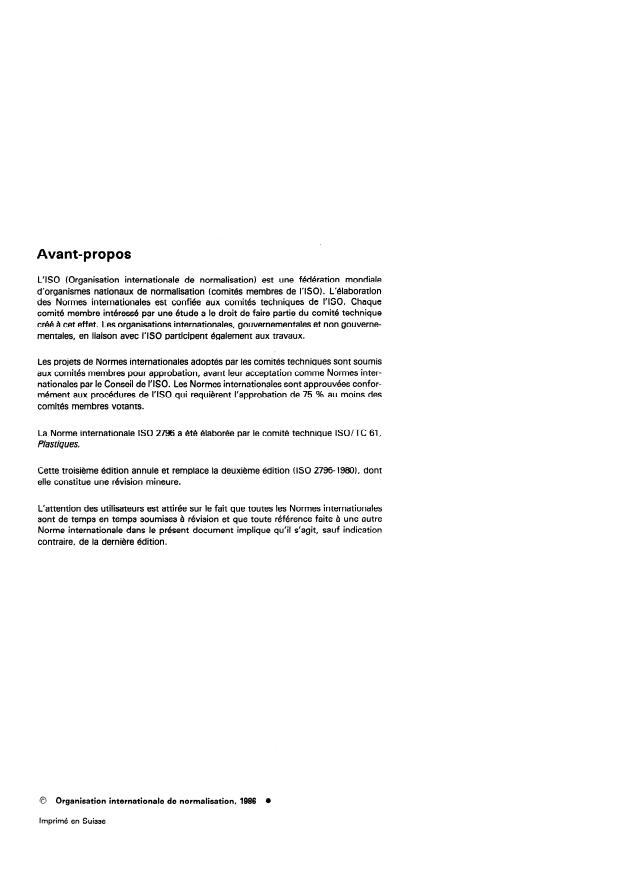

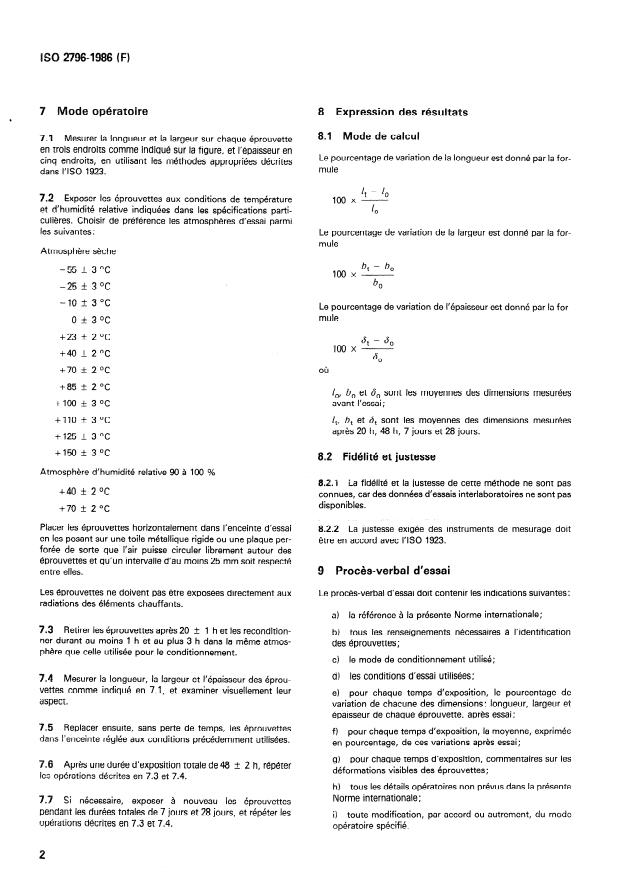
ISO 2796:1986 - Plastiques alvéolaires rigides -- Essai de stabilité dimensionnelle
ISO 2796:1986 - Plastiques alvéolaires rigides — Essai de stabilité dimensionnelle/28/1986
ISO 2796:1986 - Plastiques alvéolaires rigides — Essai de stabilité dimensionnelle/28/1986
Overview
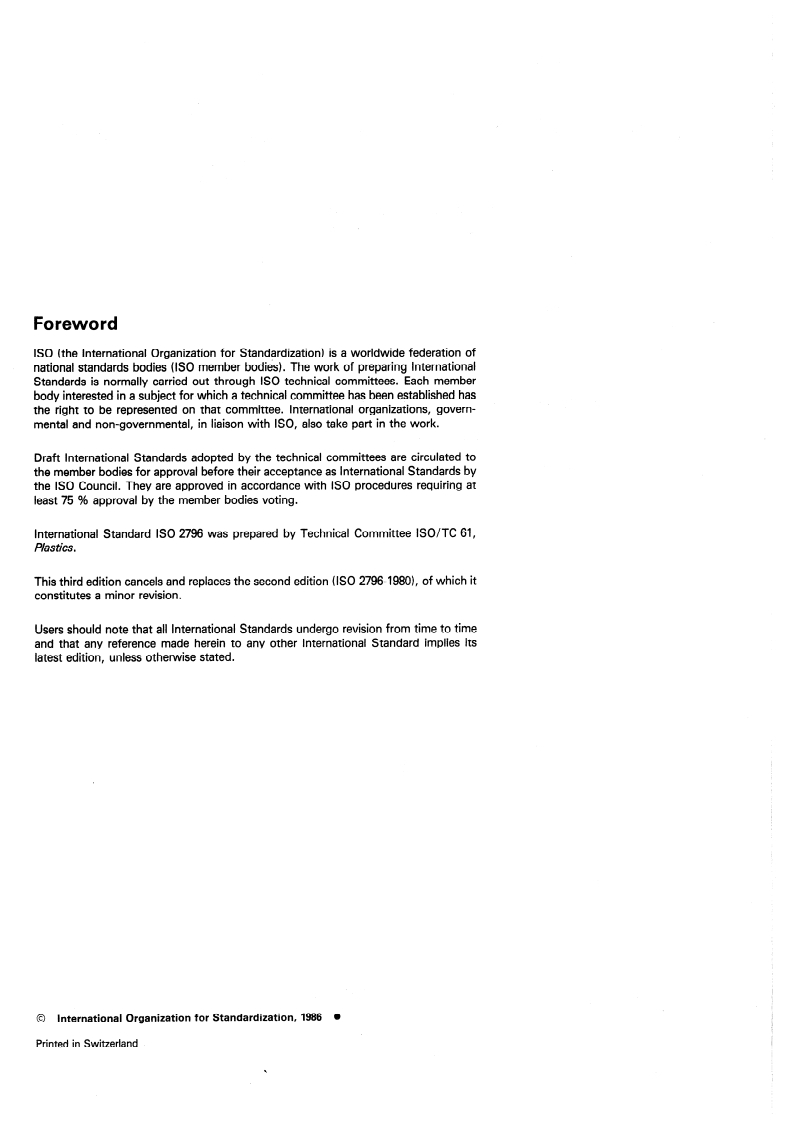
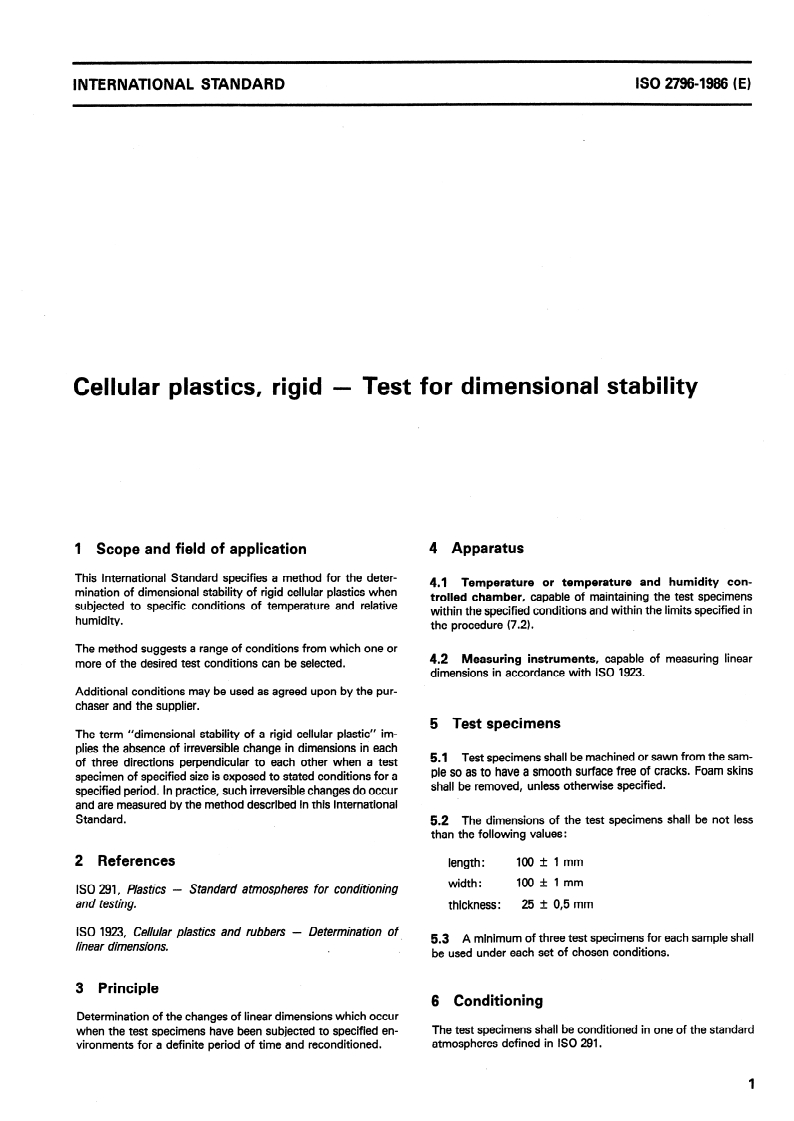
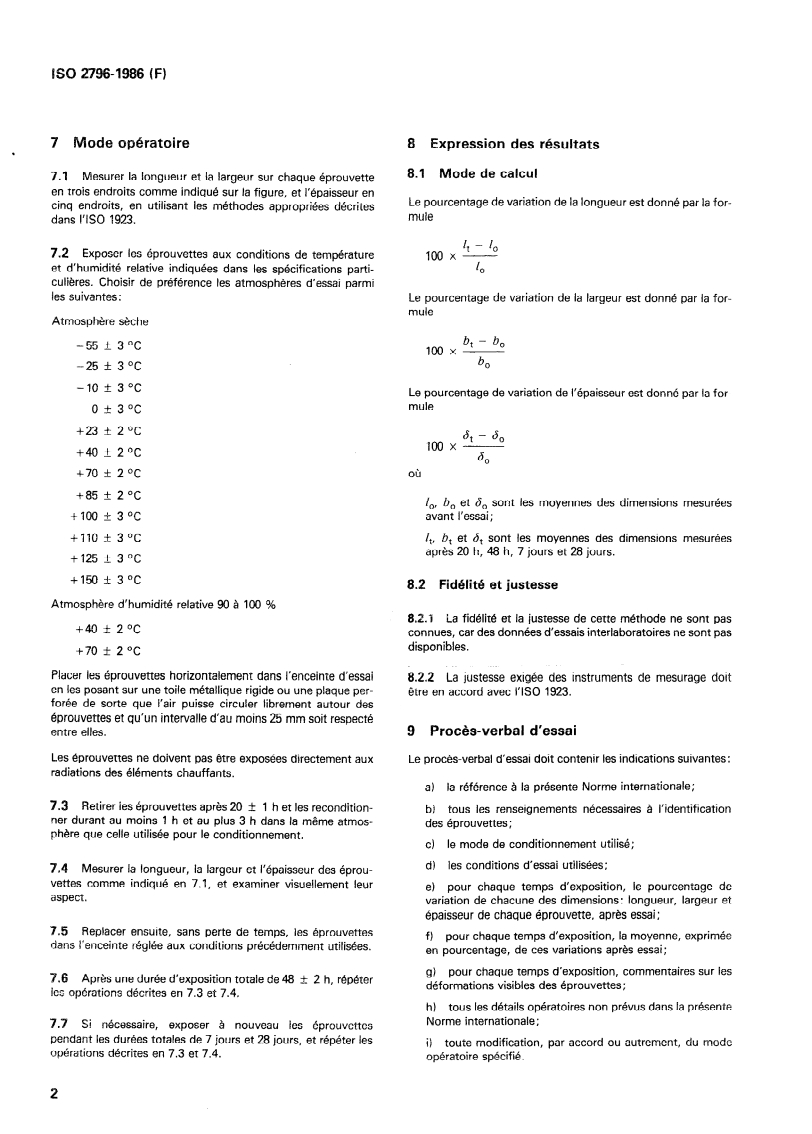
ISO 2796:1986 specifies a laboratory method to determine the dimensional stability of rigid cellular plastics (rigid foams). The test measures irreversible changes in linear dimensions when specimens are exposed to specified environments of temperature and relative humidity for defined periods and then reconditioned. The method provides a range of test atmospheres so users can select one or more relevant conditions.
Key topics and requirements
- Specimen size and preparation
- Nominal specimen: 100 mm × 100 mm × 25 mm (minimum tolerances apply).
- Surfaces should be smooth (machined or cut) and, unless otherwise specified, surface skin removed.
- At least three specimens per sample per test condition.
- Conditioning and exposure
- Initial conditioning in a normal atmosphere per ISO 291.
- Test exposures use a selectable range of temperatures (from sub-zero to high temperatures) and humidities (including 90–100% RH for high-humidity atmospheres).
- Specimens are placed horizontally on a perforated support with free air circulation and a minimum 25 mm spacing; avoid direct radiant heating.
- Test schedule
- Measurements and reconditioning are performed after 20 ±1 h, 48 ±2 h, and optionally 7 days and 28 days total exposure.
- After each exposure interval, specimens are reconditioned for 1–3 hours before measuring.
- Measurement
- Linear dimensions measured in accordance with ISO 1923: length and width at three positions, thickness at five positions.
- Calculate percentage variation using the mean pre-test and post-test dimensions.
- Measurement instrument accuracy should comply with ISO 1923 requirements.
- Reporting
- Test report must identify the standard, specimen details, conditioning method, test conditions, per-specimen percent changes and means, visible deformations, and any procedural deviations.
Practical applications and users
- Quality control and incoming inspection for manufacturers of rigid cellular plastics (insulation panels, structural foam cores).
- Research and development to compare formulations or processing effects on dimensional stability.
- Independent testing laboratories and certification bodies verifying material performance under environmental stress.
- Procurement engineers and specifiers who need objective stability data for design or acceptance criteria.
Related standards
- ISO 291 - Conditioning atmospheres for plastics.
- ISO 1923 - Methods for measuring linear dimensions of plastics (used for measurement technique and instrument accuracy).
Keywords: ISO 2796:1986, rigid cellular plastics, dimensional stability test, specimen size, conditioning, temperature and humidity, ISO 291, ISO 1923, linear dimensions.
Relations
- Referred By
SIST EN ISO 7214:2012 - Cellular plastics - Polyethylene - Methods of test (ISO 7214:2012) - Effective Date
- 25-Aug-2026
- Effective Date
- 12-May-2008
Buy Documents
ISO 2796:1986 - Cellular plastics, rigid -- Test for dimensional stability
ISO 2796:1986 - Cellular plastics, rigid — Test for dimensional stability/28/1986
ISO 2796:1986 - Plastiques alvéolaires rigides -- Essai de stabilité dimensionnelle
ISO 2796:1986 - Plastiques alvéolaires rigides -- Essai de stabilité dimensionnelle
ISO 2796:1986 - Plastiques alvéolaires rigides — Essai de stabilité dimensionnelle/28/1986
ISO 2796:1986 - Plastiques alvéolaires rigides — Essai de stabilité dimensionnelle/28/1986
Get Certified
Connect with accredited certification bodies for this standard

DIN CERTCO
DIN Group product certification.

Smithers Quality Assessments
US management systems and product certification.
Sponsored listings
Frequently Asked Questions
SIST ISO 2796:1996 is a standard published by the Slovenian Institute for Standardization (SIST). Its full title is "Cellular plastics, rigid -- Test for dimensional stability". This standard covers: Determination of the changes of linear dimensions which occur when the test specimens (100 mm x 100 mm x 25 mm) have been subjected to specified environments for a definite period of time and reconditioned. The method suggests a range of conditions of temperature and humidity, from which one or more of the desired test conditions can be selected.
Determination of the changes of linear dimensions which occur when the test specimens (100 mm x 100 mm x 25 mm) have been subjected to specified environments for a definite period of time and reconditioned. The method suggests a range of conditions of temperature and humidity, from which one or more of the desired test conditions can be selected.
SIST ISO 2796:1996 is classified under the following ICS (International Classification for Standards) categories: 83.100 - Cellular materials. The ICS classification helps identify the subject area and facilitates finding related standards.
SIST ISO 2796:1996 has the following relationships with other standards: It is inter standard links to SIST EN ISO 7214:2012, ISO 2796:1980. Understanding these relationships helps ensure you are using the most current and applicable version of the standard.
SIST ISO 2796:1996 is available in PDF format for immediate download after purchase. The document can be added to your cart and obtained through the secure checkout process. Digital delivery ensures instant access to the complete standard document.
Standards Content (Sample)
SLOVENSKI STANDARD
01-januar-1996
Penjeni polimerni materiali - Trde pene - Preskus dimenzijske stabilnosti
Cellular plastics, rigid -- Test for dimensional stability
Plastiques alvéolaires rigides -- Essai de stabilité dimensionnelle
Ta slovenski standard je istoveten z: ISO 2796:1986
ICS:
83.100 Penjeni polimeri Cellular materials
2003-01.Slovenski inštitut za standardizacijo. Razmnoževanje celote ali delov tega standarda ni dovoljeno.
International Standard
INTERNATIONAL ORGANIZATION FOR STANDARDIZATIONWlE)KCIYHAPOJJHAR OPrAHM3AUMR n0 CTAH~APTM3AlJWl.ORGANISATION INTERNATIONALE DE NORMALISATION
Cellular plastics, rigid - Test for dimensional stability
Plastiques alveolaires rigides - Essai de s tabilh dimensionnelie
Third edition - 1986-08-15
Ref. No. ISO 27964986 (E)
UDC 678405.8 : 531.71
w
-
Descriptors : plastics, cellular plastics, rigid plastics, tests, dimensional stability tests.
Price based on 3 pages
Foreword
ISO (the International Organization for Standardization) is a worldwide federation of
national Standards bodies (ISO member bodies). The work of preparing International
Standards is normally carried out through ISO technical committees. Esch member
body interested in a subject for which a technical committee has been established has
the right to be represented on that committee. International organizations, govern-
mental and non-governmental, in liaison with ISO, also take part in the work.
Draft International Standards adopted by the technical committees are circulated to
the member bodies for approval before their acceptance as International Standards by
the ISO Council. They are approved in accordance with ISO procedures requiring at
least 75 % approval by the member bodies voting.
International Standard ISO 2796 was prepared by Technical Committee ISO/TC 61,
Plastics.
This third edition cancels and replaces the second edition (ISO 2796~1980L sf which it
constitutes a minor revision.
Users should note that all International Standards undergo revision from time to time
and that any reference made herein to any other International Standard implies its
latest edition, unless otherwise stated.
(b
0 International Organkation dar Standardkation, 1986
Printed in Switzerland
ISO 2796-1986 (E)
INTERNATIONAL STANDARD
Test for dimensional stability
Cellular plastics, rigid -
1 Scope and field of application 4 Apparatus
This International Standard specifies a method for the deter-
4.1 Temperature or temperature and humidity con-
mination of dimensional stability of rigid cellular plastics when
trolled chamber, capable of maintaining the test specimens
subjected to specific conditions of temperature and relative
within the specified conditions and within the limits specified in
humidity.
the procedure (7.2).
The method suggests a range of conditions from which one or
4.2 Measuring instruments, capable of measuring linear
more of the desired test conditions tan be selected.
dimensions in accordance with ISO 1923.
Additional conditions may be used as agreed upon by the pur-
chaser and the supplier.
5 Test specimens
The term “dimensional stability of a rigid cellular plastic” im-
plies the absence of irreversible Change in dimensions in each
Test specimens shall be machined or sawn from the sam-
5.1
of three directions perpendicular to each other when a test
ple so as to have a smooth surface free of Cracks. Foam skins
specimen of specified size is exposed to stated conditions for a
shall be removed, unless otherwise specified.
specified period. In practice, such irreversible changes do occur
and are measured by the method described in this International
Stand
...
International Standard
INTERNATIONAL ORGANIZATION FOR STANDARDIZATIONWlE)KCIYHAPOJJHAR OPrAHM3AUMR n0 CTAH~APTM3AlJWl.ORGANISATION INTERNATIONALE DE NORMALISATION
Cellular plastics, rigid - Test for dimensional stability
Plastiques alveolaires rigides - Essai de s tabilh dimensionnelie
Third edition - 1986-08-15
Ref. No. ISO 27964986 (E)
UDC 678405.8 : 531.71
w
-
Descriptors : plastics, cellular plastics, rigid plastics, tests, dimensional stability tests.
Price based on 3 pages
Foreword
ISO (the International Organization for Standardization) is a worldwide federation of
national Standards bodies (ISO member bodies). The work of preparing International
Standards is normally carried out through ISO technical committees. Esch member
body interested in a subject for which a technical committee has been established has
the right to be represented on that committee. International organizations, govern-
mental and non-governmental, in liaison with ISO, also take part in the work.
Draft International Standards adopted by the technical committees are circulated to
the member bodies for approval before their acceptance as International Standards by
the ISO Council. They are approved in accordance with ISO procedures requiring at
least 75 % approval by the member bodies voting.
International Standard ISO 2796 was prepared by Technical Committee ISO/TC 61,
Plastics.
This third edition cancels and replaces the second edition (ISO 2796~1980L sf which it
constitutes a minor revision.
Users should note that all International Standards undergo revision from time to time
and that any reference made herein to any other International Standard implies its
latest edition, unless otherwise stated.
(b
0 International Organkation dar Standardkation, 1986
Printed in Switzerland
ISO 2796-1986 (E)
INTERNATIONAL STANDARD
Test for dimensional stability
Cellular plastics, rigid -
1 Scope and field of application 4 Apparatus
This International Standard specifies a method for the deter-
4.1 Temperature or temperature and humidity con-
mination of dimensional stability of rigid cellular plastics when
trolled chamber, capable of maintaining the test specimens
subjected to specific conditions of temperature and relative
within the specified conditions and within the limits specified in
humidity.
the procedure (7.2).
The method suggests a range of conditions from which one or
4.2 Measuring instruments, capable of measuring linear
more of the desired test conditions tan be selected.
dimensions in accordance with ISO 1923.
Additional conditions may be used as agreed upon by the pur-
chaser and the supplier.
5 Test specimens
The term “dimensional stability of a rigid cellular plastic” im-
plies the absence of irreversible Change in dimensions in each
Test specimens shall be machined or sawn from the sam-
5.1
of three directions perpendicular to each other when a test
ple so as to have a smooth surface free of Cracks. Foam skins
specimen of specified size is exposed to stated conditions for a
shall be removed, unless otherwise specified.
specified period. In practice, such irreversible changes do occur
and are measured by the method described in this International
Standard.
5.2 The dimensions of the test specimens shall be not less
than the following values:
2 References length : 100 * 1 mm
width : 100 & 1 mm
ISO 291, Plastics - Standard atmospheres for conditioning
and testing.
thickness: 25 AZ 0,5 mm
ISO 1923, Cellular plastics and rubbers - Determination of
5.3 A minimum of three test specimens for each Sample shall
linear dimensions.
,
be used under each set of Chosen conditions.
3 Principle
6 Condition
...
International Standard
INTERNATIONAL ORGANIZATION FOR STANDARDIZATIONWlE)KCIYHAPOJJHAR OPrAHM3AUMR n0 CTAH~APTM3AlJWl.ORGANISATION INTERNATIONALE DE NORMALISATION
Cellular plastics, rigid - Test for dimensional stability
Plastiques alveolaires rigides - Essai de s tabilh dimensionnelie
Third edition - 1986-08-15
Ref. No. ISO 27964986 (E)
UDC 678405.8 : 531.71
w
-
Descriptors : plastics, cellular plastics, rigid plastics, tests, dimensional stability tests.
Price based on 3 pages
Foreword
ISO (the International Organization for Standardization) is a worldwide federation of
national Standards bodies (ISO member bodies). The work of preparing International
Standards is normally carried out through ISO technical committees. Esch member
body interested in a subject for which a technical committee has been established has
the right to be represented on that committee. International organizations, govern-
mental and non-governmental, in liaison with ISO, also take part in the work.
Draft International Standards adopted by the technical committees are circulated to
the member bodies for approval before their acceptance as International Standards by
the ISO Council. They are approved in accordance with ISO procedures requiring at
least 75 % approval by the member bodies voting.
International Standard ISO 2796 was prepared by Technical Committee ISO/TC 61,
Plastics.
This third edition cancels and replaces the second edition (ISO 2796~1980L sf which it
constitutes a minor revision.
Users should note that all International Standards undergo revision from time to time
and that any reference made herein to any other International Standard implies its
latest edition, unless otherwise stated.
(b
0 International Organkation dar Standardkation, 1986
Printed in Switzerland
ISO 2796-1986 (E)
INTERNATIONAL STANDARD
Test for dimensional stability
Cellular plastics, rigid -
1 Scope and field of application 4 Apparatus
This International Standard specifies a method for the deter-
4.1 Temperature or temperature and humidity con-
mination of dimensional stability of rigid cellular plastics when
trolled chamber, capable of maintaining the test specimens
subjected to specific conditions of temperature and relative
within the specified conditions and within the limits specified in
humidity.
the procedure (7.2).
The method suggests a range of conditions from which one or
4.2 Measuring instruments, capable of measuring linear
more of the desired test conditions tan be selected.
dimensions in accordance with ISO 1923.
Additional conditions may be used as agreed upon by the pur-
chaser and the supplier.
5 Test specimens
The term “dimensional stability of a rigid cellular plastic” im-
plies the absence of irreversible Change in dimensions in each
Test specimens shall be machined or sawn from the sam-
5.1
of three directions perpendicular to each other when a test
ple so as to have a smooth surface free of Cracks. Foam skins
specimen of specified size is exposed to stated conditions for a
shall be removed, unless otherwise specified.
specified period. In practice, such irreversible changes do occur
and are measured by the method described in this International
Standard.
5.2 The dimensions of the test specimens shall be not less
than the following values:
2 References length : 100 * 1 mm
width : 100 & 1 mm
ISO 291, Plastics - Standard atmospheres for conditioning
and testing.
thickness: 25 AZ 0,5 mm
ISO 1923, Cellular plastics and rubbers - Determination of
5.3 A minimum of three test specimens for each Sample shall
linear dimensions.
,
be used under each set of Chosen conditions.
3 Principle
6 Condition
...
_--
---~ ~~
Norme internationale
INTERNATIONAL ORGANIZATION FOR STANDARDIZATION.ME~~YHAPO~HAR OPrAHM3Al.U’lfl fl0 CTAHJJAPTM3AWM*ORGANISATION INTERNATIONALE DE NORMALISATION
Plastiques alvéolaires rigides - Essai de stabilité
dimensionnelle
Cehlar plastics, rigid - Test for dimensional stability
Troisième édition - 19864845
CDU 678405.8 : 531.71 Réf. no : ISO 27964986 (F)
: plastique, produit alvéolaire rigide, plastique rigide, essai, essai de stabilité dimensionnelle.
Descripteurs
Prix basé sur 3 pages
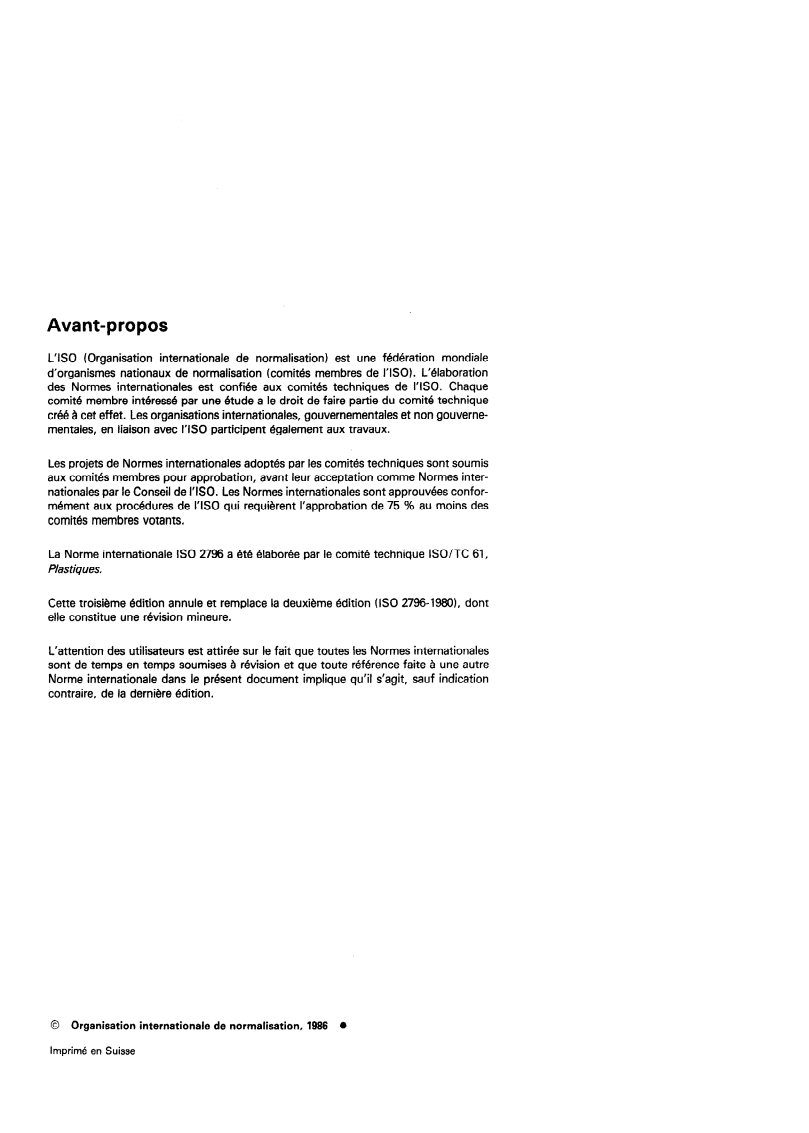
Avant-propos
L’ISO (Organisation internationale de normalisation) est une fédération mondiale
d’organismes nationaux de normalisation (comités membres de I’ISO). L’élaboration
des Normes internationales est confiée aux comités techniques de I’ISO. Chaque
comité membre intéressé par une étude a le droit de faire partie du comité technique
créé à cet effet. Les organisations internationales, gouvernementales et non gouverne-
mentales, en liaison avec I’ISO participent également aux travaux.
Les projets de Normes internationales adoptés par les comités techniques sont soumis
aux comités membres pour approbation, avant leur acceptation comme Normes inter-
nationales par le Conseil de I’ISO. Les Normes internationales sont approuvées confor-
mément aux procédures de I’ISO qui requièrent l’approbation de 75 % au moins des
comités membres votants.
La Norme internationale ISO 2796 a été élaborée par le comité technique ISO/TC 61,
Plastiques.
Cette troisième édition annule et remplace la deuxieme édition (ISO 2796~X380), dont
elle constitue une revision mineure.
L’attention des utilisateurs est attirée sur le fait que toutes les Normes internationales
sont de temps en temps soumises à révision et que toute référence faite à une autre
Norme internationale dans le présent document implique qu’il s’agit, sauf indication
contraire, de la derniére édition.
0 Organisation internationale de normalisation, 1986 0
Imprimé en Suisse
----~-~~~~~~ ~ ~ ~~
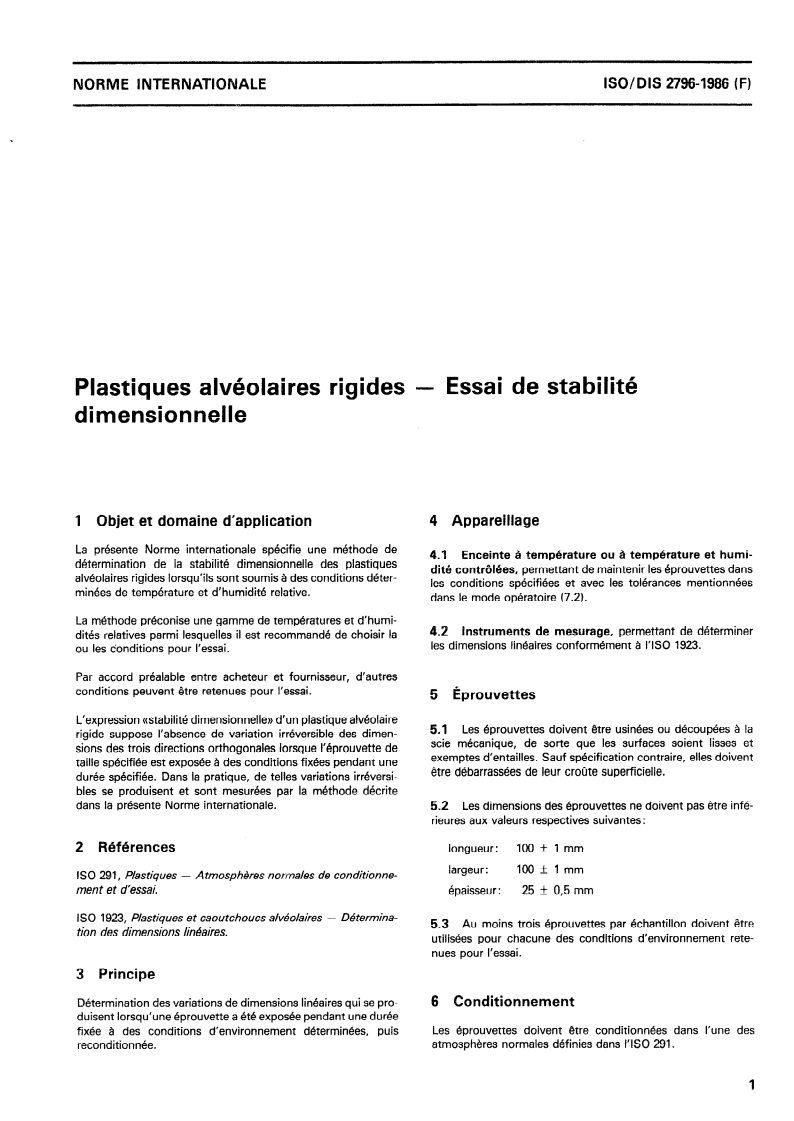
NORME INTERNATIONALE lSO/DIS 2796-1986 (FI
Plastiques alvéolaires rigides - Essai de stabilité
dimensionnelle
1 Objet et domaine d’application 4 Appareillage
La présente Norme internationale spécifie une méthode de
4.1 Enceinte à température ou à température et twmi-
détermination de la stabilité dimensionnelle des plastiques
dit6 contrMes, permettant de maintenir les éprouvettes dans
alvéolaires rigides lorsqu’ils sont soumis à des conditions déter-
les conditions spécifiées et avec les tolérances mentionnées
minées de température et d’humidité relative.
dans le mode opératoire (7.2).
La méthode préconise une gamme de températures et d’humi-
4.2 Instruments de mesurage, permettant de déterminer
dités relatives parmi lesquelles il est recommandé de choisir la
les dimensions linéaires conformément à I’ISO 1923.
ou les Conditions pour l’essai.
Par accord préalable entre acheteur et fournisseur, d’autres
conditions peuvent être retenues pour f’essai.
5 Éprouvettes
L’expression ((stabilité dimensionnelIe» d’un plastique alvéolaire
5.1 Les eprouvettes doivent être usinées ou découpées à la
rigide suppose l’absence de variation irréversible des dimen-
scie mécanique, de sorte que les surfaces soient lisses et
sions des trois directions orthogonales lorsque l’éprouvette de
exemptes d’entailles. Sauf spécification contraire, elles doivent
taille spécifiée est exposée à des conditions fixées pendant une
être débarrassées de leur croûte superficielle.
durée specifiée. Dans la pratique, de telles variations irreversi-
bles se produisent et sont mesurées par la méthode décrite
dans la présente Norme internationale.
5.2 Les dimensions des éprouvettes ne doivent pas être infé-
rieures aux valeurs respectives suivantes :
2 Références
longueur: 100 I!Z 1 mm
largeur: 100+1mm
ISO 291, Plastiques - Atmosphères normales de conditionne-
ment et d’essai.
épaisseur: 25 -t 0,5 mm
ISO 4923, Plastiques et caoutchoucs alvbolaires - Détermina-
5.3 Au moins trois éprouvettes par échantillon doivent être
tion des dimen
...
Norme internationale
INTERNATIONAL ORGANIZATION FOR STANDARDIZATIONoME~~YHAPO~HAR OPrAHM3Al.&lfl l-l0 CTAHWPTM3ALWl*ORGANISATlON INTERNATIONALE DE NORMALISATION
Plastiques alvéolaires rigides - Essai de stabilité
dimensionnelle
Cehlar plastics, rigid - Test for dimensional stability
Troisième édition - 19864845
CDU 678405.8 : 531.71
z Réf. no : ISO 27964986 (F)
Y
Descripteurs : plastique, produit alvéolaire rigide, plastique rigide, essai,
essai de stabilité dimensionnelle.
Prix basé sur 3 pages
Avant-propos
L’ISO (Organisation internationale de normalisation) est une fédération mondiale
d’organismes nationaux de normalisation (comités membres de I’ISO). L’élaboration
des Normes internationales est confiée aux comités techniques de I’ISO. Chaque
comité membre intéressé par une étude a le droit de faire partie du comité technique
créé à cet effet. Les organisations internationales, gouvernementales et non gouverne-
mentales, en liaison avec I’ISO participent également aux travaux.
Les projets de Normes internationales adoptés par les comités techniques sont soumis
aux comités membres pour approbation, avant leur acceptation comme Normes inter-
nationales par le Conseil de I’ISO. Les Normes internationales sont approuvées confor-
mément aux procédures de I’ISO qui requièrent l’approbation de 75 % au moins des
comités membres votants.
La Norme internationale ISO 2796 a été élaborée par le comité technique ISO/TC 61,
Plastiques.
Cette troisième édition annule et remplace la deuxieme édition (ISO 2796~X380), dont
elle constitue une revision mineure.
L’attention des utilisateurs est attirée sur le fait que toutes les Normes internationales
sont de temps en temps soumises à révision et que toute référence faite à une autre
Norme internationale dans le présent document implique qu’il s’agit, sauf indication
contraire, de la derniére édition.
0 Organisation internationale de normalisation, 1986 l
Imprimé en Suisse
----~-~~~~~~ ~ ~ ~~
NORME INTERNATIONALE lSO/DIS 2796-1986 (FI
Plastiques alvéolaires rigides - Essai de stabilité
dimensionnelle
1 Objet et domaine d’application 4 Appareillage
La présente Norme internationale spécifie une méthode de
4.1 Enceinte à température ou à température et twmi-
détermination de la stabilité dimensionnelle des plastiques
dit6 contrMes, permettant de maintenir les éprouvettes dans
alvéolaires rigides lorsqu’ils sont soumis à des conditions déter-
les conditions spécifiées et avec les tolérances mentionnées
minées de température et d’humidité relative.
dans le mode opératoire (7.2).
La méthode préconise une gamme de températures et d’humi-
4.2 Instruments de mesurage, permettant de déterminer
dités relatives parmi lesquelles il est recommandé de choisir la
les dimensions linéaires conformément à I’ISO 1923.
ou les Conditions pour l’essai.
Par accord préalable entre acheteur et fournisseur, d’autres
conditions peuvent être retenues pour f’essai.
5 Éprouvettes
L’expression ((stabilité dimensionnelIe» d’un plastique alvéolaire
5.1 Les eprouvettes doivent être usinées ou découpées à la
rigide suppose l’absence de variation irréversible des dimen-
scie mécanique, de sorte que les surfaces soient lisses et
sions des trois directions orthogonales lorsque l’éprouvette de
exemptes d’entailles. Sauf spécification contraire, elles doivent
taille spécifiée est exposée à des conditions fixées pendant une
être débarrassées de leur croûte superficielle.
durée specifiée. Dans la pratique, de telles variations irreversi-
bles se produisent et sont mesurées par la méthode décrite
dans la présente Norme internationale.
5.2 Les dimensions des éprouvettes ne doivent pas être infé-
rieures aux valeurs respectives suivantes :
2 Références
longueur: 100 I!Z 1 mm
largeur: 100+1mm
ISO 291, Plastiques - Atmosphères normales de conditionne-
ment et d’essai.
épaisseur: 25 -t 0,5 mm
ISO 4923, Plastiques et caoutchoucs alvbolaires - Détermina-
5.3 Au moins trois éprouvettes par échantillon doivent être
tion des dimensio
...
_--
---~ ~~
Norme internationale
INTERNATIONAL ORGANIZATION FOR STANDARDIZATION.ME~~YHAPO~HAR OPrAHM3Al.U’lfl fl0 CTAHJJAPTM3AWM*ORGANISATION INTERNATIONALE DE NORMALISATION
Plastiques alvéolaires rigides - Essai de stabilité
dimensionnelle
Cehlar plastics, rigid - Test for dimensional stability
Troisième édition - 19864845
CDU 678405.8 : 531.71 Réf. no : ISO 27964986 (F)
: plastique, produit alvéolaire rigide, plastique rigide, essai, essai de stabilité dimensionnelle.
Descripteurs
Prix basé sur 3 pages
Avant-propos
L’ISO (Organisation internationale de normalisation) est une fédération mondiale
d’organismes nationaux de normalisation (comités membres de I’ISO). L’élaboration
des Normes internationales est confiée aux comités techniques de I’ISO. Chaque
comité membre intéressé par une étude a le droit de faire partie du comité technique
créé à cet effet. Les organisations internationales, gouvernementales et non gouverne-
mentales, en liaison avec I’ISO participent également aux travaux.
Les projets de Normes internationales adoptés par les comités techniques sont soumis
aux comités membres pour approbation, avant leur acceptation comme Normes inter-
nationales par le Conseil de I’ISO. Les Normes internationales sont approuvées confor-
mément aux procédures de I’ISO qui requièrent l’approbation de 75 % au moins des
comités membres votants.
La Norme internationale ISO 2796 a été élaborée par le comité technique ISO/TC 61,
Plastiques.
Cette troisième édition annule et remplace la deuxieme édition (ISO 2796~X380), dont
elle constitue une revision mineure.
L’attention des utilisateurs est attirée sur le fait que toutes les Normes internationales
sont de temps en temps soumises à révision et que toute référence faite à une autre
Norme internationale dans le présent document implique qu’il s’agit, sauf indication
contraire, de la derniére édition.
0 Organisation internationale de normalisation, 1986 0
Imprimé en Suisse
----~-~~~~~~ ~ ~ ~~
NORME INTERNATIONALE lSO/DIS 2796-1986 (FI
Plastiques alvéolaires rigides - Essai de stabilité
dimensionnelle
1 Objet et domaine d’application 4 Appareillage
La présente Norme internationale spécifie une méthode de
4.1 Enceinte à température ou à température et twmi-
détermination de la stabilité dimensionnelle des plastiques
dit6 contrMes, permettant de maintenir les éprouvettes dans
alvéolaires rigides lorsqu’ils sont soumis à des conditions déter-
les conditions spécifiées et avec les tolérances mentionnées
minées de température et d’humidité relative.
dans le mode opératoire (7.2).
La méthode préconise une gamme de températures et d’humi-
4.2 Instruments de mesurage, permettant de déterminer
dités relatives parmi lesquelles il est recommandé de choisir la
les dimensions linéaires conformément à I’ISO 1923.
ou les Conditions pour l’essai.
Par accord préalable entre acheteur et fournisseur, d’autres
conditions peuvent être retenues pour f’essai.
5 Éprouvettes
L’expression ((stabilité dimensionnelIe» d’un plastique alvéolaire
5.1 Les eprouvettes doivent être usinées ou découpées à la
rigide suppose l’absence de variation irréversible des dimen-
scie mécanique, de sorte que les surfaces soient lisses et
sions des trois directions orthogonales lorsque l’éprouvette de
exemptes d’entailles. Sauf spécification contraire, elles doivent
taille spécifiée est exposée à des conditions fixées pendant une
être débarrassées de leur croûte superficielle.
durée specifiée. Dans la pratique, de telles variations irreversi-
bles se produisent et sont mesurées par la méthode décrite
dans la présente Norme internationale.
5.2 Les dimensions des éprouvettes ne doivent pas être infé-
rieures aux valeurs respectives suivantes :
2 Références
longueur: 100 I!Z 1 mm
largeur: 100+1mm
ISO 291, Plastiques - Atmosphères normales de conditionne-
ment et d’essai.
épaisseur: 25 -t 0,5 mm
ISO 4923, Plastiques et caoutchoucs alvbolaires - Détermina-
5.3 Au moins trois éprouvettes par échantillon doivent être
tion des dimen
...
Norme internationale
INTERNATIONAL ORGANIZATION FOR STANDARDIZATIONoME~~YHAPO~HAR OPrAHM3Al.&lfl l-l0 CTAHWPTM3ALWl*ORGANISATlON INTERNATIONALE DE NORMALISATION
Plastiques alvéolaires rigides - Essai de stabilité
dimensionnelle
Cehlar plastics, rigid - Test for dimensional stability
Troisième édition - 19864845
CDU 678405.8 : 531.71
z Réf. no : ISO 27964986 (F)
Y
Descripteurs : plastique, produit alvéolaire rigide, plastique rigide, essai,
essai de stabilité dimensionnelle.
Prix basé sur 3 pages
Avant-propos
L’ISO (Organisation internationale de normalisation) est une fédération mondiale
d’organismes nationaux de normalisation (comités membres de I’ISO). L’élaboration
des Normes internationales est confiée aux comités techniques de I’ISO. Chaque
comité membre intéressé par une étude a le droit de faire partie du comité technique
créé à cet effet. Les organisations internationales, gouvernementales et non gouverne-
mentales, en liaison avec I’ISO participent également aux travaux.
Les projets de Normes internationales adoptés par les comités techniques sont soumis
aux comités membres pour approbation, avant leur acceptation comme Normes inter-
nationales par le Conseil de I’ISO. Les Normes internationales sont approuvées confor-
mément aux procédures de I’ISO qui requièrent l’approbation de 75 % au moins des
comités membres votants.
La Norme internationale ISO 2796 a été élaborée par le comité technique ISO/TC 61,
Plastiques.
Cette troisième édition annule et remplace la deuxieme édition (ISO 2796~X380), dont
elle constitue une revision mineure.
L’attention des utilisateurs est attirée sur le fait que toutes les Normes internationales
sont de temps en temps soumises à révision et que toute référence faite à une autre
Norme internationale dans le présent document implique qu’il s’agit, sauf indication
contraire, de la derniére édition.
0 Organisation internationale de normalisation, 1986 l
Imprimé en Suisse
----~-~~~~~~ ~ ~ ~~
NORME INTERNATIONALE lSO/DIS 2796-1986 (FI
Plastiques alvéolaires rigides - Essai de stabilité
dimensionnelle
1 Objet et domaine d’application 4 Appareillage
La présente Norme internationale spécifie une méthode de
4.1 Enceinte à température ou à température et twmi-
détermination de la stabilité dimensionnelle des plastiques
dit6 contrMes, permettant de maintenir les éprouvettes dans
alvéolaires rigides lorsqu’ils sont soumis à des conditions déter-
les conditions spécifiées et avec les tolérances mentionnées
minées de température et d’humidité relative.
dans le mode opératoire (7.2).
La méthode préconise une gamme de températures et d’humi-
4.2 Instruments de mesurage, permettant de déterminer
dités relatives parmi lesquelles il est recommandé de choisir la
les dimensions linéaires conformément à I’ISO 1923.
ou les Conditions pour l’essai.
Par accord préalable entre acheteur et fournisseur, d’autres
conditions peuvent être retenues pour f’essai.
5 Éprouvettes
L’expression ((stabilité dimensionnelIe» d’un plastique alvéolaire
5.1 Les eprouvettes doivent être usinées ou découpées à la
rigide suppose l’absence de variation irréversible des dimen-
scie mécanique, de sorte que les surfaces soient lisses et
sions des trois directions orthogonales lorsque l’éprouvette de
exemptes d’entailles. Sauf spécification contraire, elles doivent
taille spécifiée est exposée à des conditions fixées pendant une
être débarrassées de leur croûte superficielle.
durée specifiée. Dans la pratique, de telles variations irreversi-
bles se produisent et sont mesurées par la méthode décrite
dans la présente Norme internationale.
5.2 Les dimensions des éprouvettes ne doivent pas être infé-
rieures aux valeurs respectives suivantes :
2 Références
longueur: 100 I!Z 1 mm
largeur: 100+1mm
ISO 291, Plastiques - Atmosphères normales de conditionne-
ment et d’essai.
épaisseur: 25 -t 0,5 mm
ISO 4923, Plastiques et caoutchoucs alvbolaires - Détermina-
5.3 Au moins trois éprouvettes par échantillon doivent être
tion des dimensio
...