

SIST EN 300 220-2 V3.1.1:2017
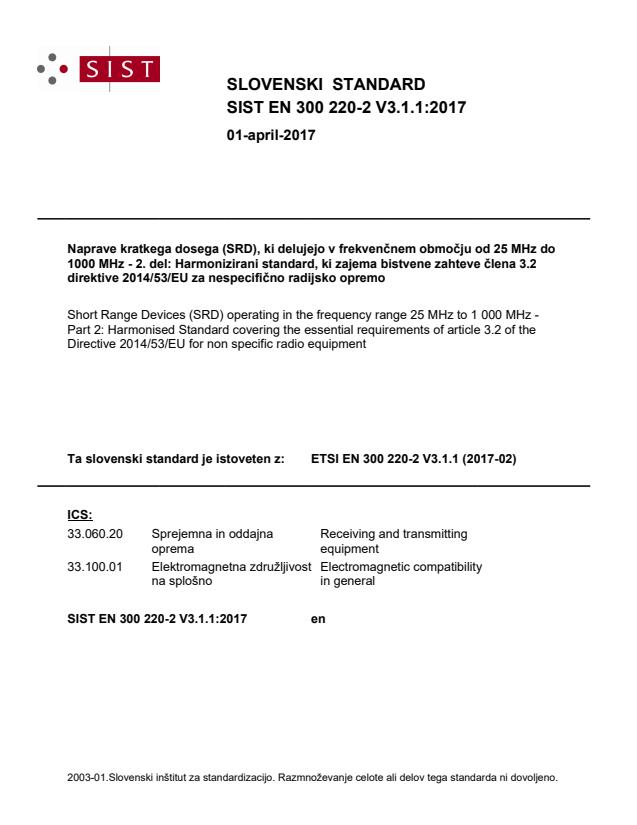
(Main)Short Range Devices (SRD) operating in the frequency range 25 MHz to 1 000 MHz - Part 2: Harmonised Standard covering the essential requirements of article 3.2 of the Directive 2014/53/EU for non specific radio equipment
General Information
- Abstract
The present document specifies technical characteristics and methods of measurements for Non-specific Short Range
Devices category equipment types.
Non specific SRDs category is defined by the EU Commission Decision 2013/752/EU [i.3] as:
"The non-specific short-range device category covers all kinds of radio devices, regardless of the application or the
purpose, which fulfil the technical conditions as specified for a given frequency band. Typical uses include telemetry,
telecommand, alarms, data transmissions in general and other applications".
The present document covers equipment intended for fixed, mobile or nomadic use, including:
• stand-alone radio equipment;
• plug-in radio devices intended for use with or within a variety of host systems;
• plug-in radio devices intended for use within combined equipment.
- Status
- Published
- Public Enquiry End Date
- 31-Jul-2016
- Publication Date
- 27-Feb-2017
- Technical Committee
- MOC - Mobile Communications
- Current Stage
- 6060 - National Implementation/Publication (Adopted Project)
- Start Date
- 13-Feb-2017
- Due Date
- 20-Apr-2017
- Completion Date
- 28-Feb-2017
- Directive
- 1999/5/EC - Directive 1999/5/EC of the European Parliament and of the Council of 9 March 1999 on radio equipment and telecommunications terminal equipment and the mutual recognition of their conformityOJ Date: 10-Mar-2017
2014/53/EU - Directive 2014/53/EU of The European Parliament and of the Council of 16 April 2014 on the harmonisation of the laws of the Member States relating to the making available on the market of radio equipment and repealing Directive 1999/5/ECOJ Ref: DATUM UMIKA SKLICA 11.6.2027 OJ Date: 10-Mar-2017 Conflicting Date: 11-Jun-2027
Buy Documents
ETSI EN 300 220-2 V3.1.0 (2016-05) - Short Range Devices (SRD) operating in the frequency range 25 MHz to 1 000 MHz; Part 2: Harmonised Standard covering the essential requirements of article 3.2 of the Directive 2014/53/EU for non specific radio equipment
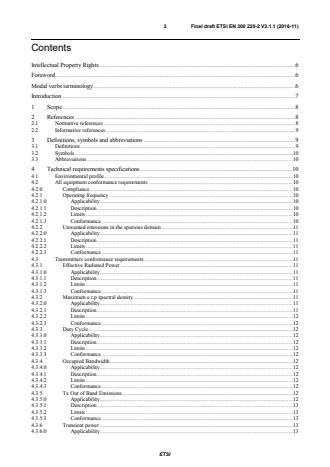
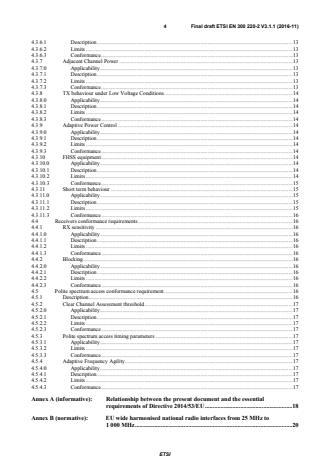
ETSI EN 300 220-2 V3.1.1 (2016-11) - Short Range Devices (SRD) operating in the frequency range 25 MHz to 1 000 MHz; Part 2: Harmonised Standard covering the essential requirements of article 3.2 of Directive 2014/53/EU for non specific radio equipment
ETSI EN 300 220-2 V3.1.1 (2017-02) - Part 2: Harmonised Standard covering the essential requirements of article 3.2 of Directive 2014/53/EU for non specific radio equipment Part 2: Harmonised Standard covering the essential requirements of article 3.2 of Directive 2014/53/EU for non specific radio equipment

Overview
SIST EN 300 220-2 V3.1.1:2017 is a harmonised European standard for Short Range Devices (SRD) operating in the frequency range of 25 MHz to 1 000 MHz. Published by the Slovenian Institute for Standardization (SIST), this standard specifies the essential requirements of Article 3.2 of the Directive 2014/53/EU (Radio Equipment Directive) for non-specific radio equipment. It provides technical characteristics and measurement methods for non-specific SRD equipment, ensuring electromagnetic compatibility and radio spectrum efficiency.
Non-specific SRDs are defined as radio devices used for various applications that operate within specified frequency bands without restrictions on their purpose. Typical examples include devices for telemetry, telecommand, alarms, and general data transmission. The standard covers a broad range of equipment types, intended for fixed, mobile, or nomadic use, including stand-alone devices and plug-in radio modules.
Key Topics
- Frequency Range: Covers SRDs operating between 25 MHz and 1000 MHz, with specific sub-bands identified for different national and EU-wide uses.
- Equipment Types: Applies to stand-alone radio equipment, plug-in radio devices (for use in various host systems), and radio devices within combined equipment.
- Technical Requirements:
- Operating frequency: Defines permissible bands and channel assignments.
- Unwanted emissions: Limits on spurious domain emissions to minimise interference.
- Effective Radiated Power (ERP): Maximum transmission power for each frequency band.
- Spectral density, duty cycles, and occupied bandwidth: Ensures efficient spectrum use.
- Polite spectrum access: Requirements for devices that use spectrum sharing techniques.
- Conformance and Testing: Specifies methods for verifying compliance under declared environmental and operational conditions.
Applications
The SIST EN 300 220-2 V3.1.1:2017 standard is widely applicable across sectors due to the non-specific nature of the covered SRDs. Typical use cases include:
- Telemetry and Remote Monitoring: Industrial sensors and smart meters transmitting data to control centers.
- Telecommand: Wireless remote controls for machinery or home automation systems.
- Security and Alarms: Wireless alarm panels and detectors in residential, commercial, or critical infrastructure security systems.
- Data Transmission: Devices enabling wireless data links, such as point-to-point and point-to-multipoint communication within the stated frequency bands.
- Plug-in Radio Modules: Modules that are integrated into larger systems, offering flexibility in wireless connectivity for consumer and industrial products.
The standard enables manufacturers and system integrators to design compliant products suitable for European and global markets, simplifying regulatory approval and facilitating interoperability.
Related Standards
When implementing SIST EN 300 220-2 V3.1.1:2017, consider the following related standards and references for comprehensive compliance and engineering best practices:
- ETSI EN 300 220-1: Technical characteristics and methods of measurement for SRDs (Part 1 covers general requirements).
- Directive 2014/53/EU (Radio Equipment Directive): Legislative framework for the placement of radio equipment on the EU market.
- Commission Decision 2013/752/EU: Harmonisation of radio spectrum for SRD use.
- CEPT/ERC/REC 70-03: Recommendations relating to the use of short-range devices across Europe.
- ETSI EG 203 336: Guide for selection of technical parameters for harmonised standards under the RED.
Practical Value
Compliance with SIST EN 300 220-2 V3.1.1:2017 is essential for manufacturers and developers of short range radio equipment targeting the European market. The standard supports efficient spectrum use, legal conformity, and product interoperability. By adhering to these requirements, businesses ensure smoother certification processes and broader market acceptance for their wireless products.
Keywords: Short Range Devices, SRD, SIST EN 300 220-2, non-specific radio equipment, 25 MHz to 1000 MHz, Directive 2014/53/EU, Radio Equipment Directive, harmonised standard, electromagnetic compatibility, wireless data transmission, alarms, telemetry, telecommand, plug-in radio devices.
Buy Documents
ETSI EN 300 220-2 V3.1.0 (2016-05) - Short Range Devices (SRD) operating in the frequency range 25 MHz to 1 000 MHz; Part 2: Harmonised Standard covering the essential requirements of article 3.2 of the Directive 2014/53/EU for non specific radio equipment
ETSI EN 300 220-2 V3.1.1 (2016-11) - Short Range Devices (SRD) operating in the frequency range 25 MHz to 1 000 MHz; Part 2: Harmonised Standard covering the essential requirements of article 3.2 of Directive 2014/53/EU for non specific radio equipment
ETSI EN 300 220-2 V3.1.1 (2017-02) - Part 2: Harmonised Standard covering the essential requirements of article 3.2 of Directive 2014/53/EU for non specific radio equipment Part 2: Harmonised Standard covering the essential requirements of article 3.2 of Directive 2014/53/EU for non specific radio equipment
Get Certified
Connect with accredited certification bodies for this standard

ANCE
Mexican certification and testing association.

Intertek Slovenia
Intertek testing, inspection, and certification services in Slovenia.

LNE (Laboratoire National de Métrologie et d'Essais)
French national laboratory for metrology and testing.
Sponsored listings
Frequently Asked Questions
SIST EN 300 220-2 V3.1.1:2017 is a standard published by the Slovenian Institute for Standardization (SIST). Its full title is "Short Range Devices (SRD) operating in the frequency range 25 MHz to 1 000 MHz - Part 2: Harmonised Standard covering the essential requirements of article 3.2 of the Directive 2014/53/EU for non specific radio equipment". This standard covers: The present document specifies technical characteristics and methods of measurements for Non-specific Short Range Devices category equipment types. Non specific SRDs category is defined by the EU Commission Decision 2013/752/EU [i.3] as: "The non-specific short-range device category covers all kinds of radio devices, regardless of the application or the purpose, which fulfil the technical conditions as specified for a given frequency band. Typical uses include telemetry, telecommand, alarms, data transmissions in general and other applications". The present document covers equipment intended for fixed, mobile or nomadic use, including: • stand-alone radio equipment; • plug-in radio devices intended for use with or within a variety of host systems; • plug-in radio devices intended for use within combined equipment.
The present document specifies technical characteristics and methods of measurements for Non-specific Short Range Devices category equipment types. Non specific SRDs category is defined by the EU Commission Decision 2013/752/EU [i.3] as: "The non-specific short-range device category covers all kinds of radio devices, regardless of the application or the purpose, which fulfil the technical conditions as specified for a given frequency band. Typical uses include telemetry, telecommand, alarms, data transmissions in general and other applications". The present document covers equipment intended for fixed, mobile or nomadic use, including: • stand-alone radio equipment; • plug-in radio devices intended for use with or within a variety of host systems; • plug-in radio devices intended for use within combined equipment.
SIST EN 300 220-2 V3.1.1:2017 is classified under the following ICS (International Classification for Standards) categories: 33.060.20 - Receiving and transmitting equipment; 33.100.01 - Electromagnetic compatibility in general. The ICS classification helps identify the subject area and facilitates finding related standards.
SIST EN 300 220-2 V3.1.1:2017 is associated with the following European legislation: EU Directives/Regulations: 1999/5/EC, 2014/53/EU. When a standard is cited in the Official Journal of the European Union, products manufactured in conformity with it benefit from a presumption of conformity with the essential requirements of the corresponding EU directive or regulation.
SIST EN 300 220-2 V3.1.1:2017 is available in PDF format for immediate download after purchase. The document can be added to your cart and obtained through the secure checkout process. Digital delivery ensures instant access to the complete standard document.
Standards Content (Sample)
Draft ETSI EN 300 220-2 V3.1.0 (2016-05)
HARMONISED EUROPEAN STANDARD
Short Range Devices (SRD) operating in
the frequency range 25 MHz to 1 000 MHz;
Part 2: Harmonised Standard covering the essential
requirements of article 3.2 of the Directive 2014/53/EU
for non specific radio equipment
2 Draft ETSI EN 300 220-2 V3.1.0 (2016-05)
Reference
REN/ERM-TG28-534
Keywords
Harmonised standard, radio, SRD, testing
ETSI
650 Route des Lucioles
F-06921 Sophia Antipolis Cedex - FRANCE
Tel.: +33 4 92 94 42 00 Fax: +33 4 93 65 47 16
Siret N° 348 623 562 00017 - NAF 742 C
Association à but non lucratif enregistrée à la
Sous-Préfecture de Grasse (06) N° 7803/88
Important notice
The present document can be downloaded from:
http://www.etsi.org/standards-search
The present document may be made available in electronic versions and/or in print. The content of any electronic and/or
print versions of the present document shall not be modified without the prior written authorization of ETSI. In case of any
existing or perceived difference in contents between such versions and/or in print, the only prevailing document is the
print of the Portable Document Format (PDF) version kept on a specific network drive within ETSI Secretariat.
Users of the present document should be aware that the document may be subject to revision or change of status.
Information on the current status of this and other ETSI documents is available at
https://portal.etsi.org/TB/ETSIDeliverableStatus.aspx
If you find errors in the present document, please send your comment to one of the following services:
https://portal.etsi.org/People/CommiteeSupportStaff.aspx
Copyright Notification
No part may be reproduced or utilized in any form or by any means, electronic or mechanical, including photocopying
and microfilm except as authorized by written permission of ETSI.
The content of the PDF version shall not be modified without the written authorization of ETSI.
The copyright and the foregoing restriction extend to reproduction in all media.
© European Telecommunications Standards Institute 2016.
All rights reserved.
TM TM TM
DECT , PLUGTESTS , UMTS and the ETSI logo are Trade Marks of ETSI registered for the benefit of its Members.
TM
3GPP and LTE™ are Trade Marks of ETSI registered for the benefit of its Members and
of the 3GPP Organizational Partners.
GSM® and the GSM logo are Trade Marks registered and owned by the GSM Association.
ETSI
3 Draft ETSI EN 300 220-2 V3.1.0 (2016-05)
Contents
Intellectual Property Rights . 6
Foreword . 6
Modal verbs terminology . 6
Introduction . 7
1 Scope . 8
2 References . 8
2.1 Normative references . 8
2.2 Informative references . 9
3 Definitions, symbols and abbreviations . 9
3.1 Definitions . 9
3.2 Symbols . 9
3.3 Abbreviations . 9
4 Technical requirements specifications . 10
4.1 Environmental profile . 10
4.2 All equipment conformance requirements . 10
4.2.0 Compliance . 10
4.2.1 Operating frequency . 10
4.2.1.1 Description . 10
4.2.1.2 Limits . 10
4.2.1.3 Conformance . 10
4.2.2 Unwanted emissions in the spurious domain . 10
4.2.2.1 Description . 10
4.2.2.2 Limits . 10
4.2.2.3 Conformance . 10
4.3 Transmitters conformance requirements . 10
4.3.1 Effective Radiated Power . 10
4.2.1.0 Applicability. 10
4.3.1.1 Description . 10
4.3.1.2 Limits . 11
4.3.1.3 Conformance . 11
4.3.2 Maximum e.r.p spectral density . 11
4.3.2.0 Applicability. 11
4.3.2.1 Description . 11
4.3.2.2 Limits . 11
4.3.2.3 Conformance . 11
4.3.3 Duty Cycle . 11
4.3.3.0 Applicability. 11
4.3.3.1 Description . 11
4.3.3.2 Limits . 11
4.3.3.3 Conformance . 11
4.3.4 Occupied Bandwidth. 11
4.3.4.0 Applicability. 11
4.3.4.1 Description . 11
4.3.4.2 Limits . 12
4.3.4.3 Conformance . 12
4.3.5 Tx Out Of Band Emissions . 12
4.3.5.0 Applicability. 12
4.3.5.1 Description . 12
4.3.5.2 Limits . 12
4.3.5.3 Conformance . 12
4.3.6 Transient power . 12
4.3.6.0 Applicability. 12
4.3.6.1 Description . 12
4.3.6.2 Limits . 12
ETSI
4 Draft ETSI EN 300 220-2 V3.1.0 (2016-05)
4.3.6.3 Conformance . 12
4.3.7 Adjacent Channel Power . 12
4.3.7.0 Applicability. 12
4.3.7.1 Description . 12
4.3.7.2 Limits for equipment with operating channel width less than 25 kHz . 12
4.3.7.3 Conformance . 13
4.3.8 TX behaviour under Low Voltage Conditions . 13
4.3.8.0 Applicability. 13
4.3.8.1 Description . 13
4.3.8.2 Limits . 13
4.3.8.3 Conformance . 13
4.3.9 Adaptive Power Control . 13
4.3.9.0 Applicability. 13
4.3.9.1 Description . 13
4.3.9.2 Limits . 13
4.3.9.3 Conformance . 13
4.3.10 FHSS equipment . 13
4.3.10.0 Applicability. 13
4.3.10.1 Description . 13
4.3.10.2 Limits . 14
4.3.10.3 Conformance . 14
4.3.11 Short term behaviour . 14
4.3.11.0 Applicability. 14
4.3.11.1 Description . 15
4.3.11.2 Limits . 15
4.3.11.3 Conformance . 15
4.4 Receivers conformance requirements . 15
4.4.1 RX sensitivity . 15
4.4.1.0 Applicability. 15
4.4.1.1 Description . 15
4.4.1.2 Limits . 15
4.4.1.3 Conformance . 15
4.4.2 Blocking . 15
4.4.2.0 Applicability. 15
4.4.2.1 Description . 15
4.4.2.2 Limits . 15
4.4.2.3 Conformance . 15
4.4.3 Clear Channel Assessment threshold . 15
4.4.3.0 Applicability. 15
4.4.3.1 Description . 16
4.4.3.2 Limits . 16
4.4.3.3 Conformance . 16
4.4.4 Polite spectrum access . 16
4.4.4.0 Applicability. 16
4.4.4.1 Description . 16
4.4.4.2 Limits . 16
4.4.4.3 Conformance . 16
4.5 Other conformance requirements . 16
4.5.1 Adaptive Frequency Agility . 16
4.5.1.0 Applicability. 16
4.5.1.1 Description . 16
4.5.1.2 Conformance . 16
Annex A (normative): Relationship between the present document and the essential
requirements of Directive 2014/53/EU . 17
Annex B (normative): EU wide harmonised national radio interfaces from 25 MHz to
1 000 MHz . 19
Annex C (normative): National Radio Interfaces not EU wide harmonised . 22
Annex D (informative): Application form for testing . 27
ETSI
5 Draft ETSI EN 300 220-2 V3.1.0 (2016-05)
D.1 Introduction . 27
D.2 Information to declare according to ETSI EN 300 220-2 . 27
Annex E (informative): Selection of technical parameters . 29
E.1 Introduction . 29
E.2 Receiver parameters . 29
Annex F (informative): Bibliography . 30
Annex G (informative): Change History . 31
History . 32
ETSI
6 Draft ETSI EN 300 220-2 V3.1.0 (2016-05)
Intellectual Property Rights
IPRs essential or potentially essential to the present document may have been declared to ETSI. The information
pertaining to these essential IPRs, if any, is publicly available for ETSI members and non-members, and can be found
in ETSI SR 000 314: "Intellectual Property Rights (IPRs); Essential, or potentially Essential, IPRs notified to ETSI in
respect of ETSI standards", which is available from the ETSI Secretariat. Latest updates are available on the ETSI Web
server (https://ipr.etsi.org/).
Pursuant to the ETSI IPR Policy, no investigation, including IPR searches, has been carried out by ETSI. No guarantee
can be given as to the existence of other IPRs not referenced in ETSI SR 000 314 (or the updates on the ETSI Web
server) which are, or may be, or may become, essential to the present document.
Foreword
This draft Harmonised European Standard (EN) has been produced by ETSI Technical Committee Electromagnetic
compatibility and Radio spectrum Matters (ERM), and is now submitted for the combined Public Enquiry and Vote
phase of the ETSI standards EN Approval Procedure.
The present document has been prepared under the Commission's standardisation request C(2015) 5376 final [i.5] to
provide one voluntary means of conforming to the essential requirements of Directive 2014/53/EU on the harmonisation
of the laws of the Member States relating to the making available on the market of radio equipment and repealing
Directive 1999/5/EC [i.2].
Once the present document is cited in the Official Journal of the European Union under that Directive, compliance with
the normative clauses of the present document given in Table A.1 confers, within the limits of the scope of the present
document, a presumption of conformity with the corresponding essential requirements of that Directive and associated
EFTA regulations.
The present document is part 2 of a multi-part deliverable. Full details of the entire series can be found in part 1 [1].
For non EU countries the present document may be used for regulatory (Type Approval) purposes.
Proposed national transposition dates
Date of latest announcement of this EN (doa): 3 months after ETSI publication
Date of latest publication of new National Standard
or endorsement of this EN (dop/e): 6 months after doa
Date of withdrawal of any conflicting National Standard (dow): 18 months after doa
Modal verbs terminology
In the present document "shall", "shall not", "should", "should not", "may", "need not", "will", "will not", "can" and
"cannot" are to be interpreted as described in clause 3.2 of the ETSI Drafting Rules (Verbal forms for the expression of
provisions).
"must" and "must not" are NOT allowed in ETSI deliverables except when used in direct citation.
ETSI
7 Draft ETSI EN 300 220-2 V3.1.0 (2016-05)
Introduction
The present document is part 2 of a multi-part deliverable, covering non specific Short Range Devices (SRD) operating
in the frequency range 25 MHz to 1 000 MHz. Full details of the entire series can be found in part 1 [1].
The present document is structured as follows:
Clause 2 provides references.
Clause 3 provides definitions of terms and abbreviations used.
Clause 4 provides technical requirements.
Annex A (normative) provides a relationship between the present document and essential requirements of
Directive 2014/53/EU [i.2].
Annex B (normative): EU wide harmonised national radio interfaces from 25 MHz to 1 000 MHz.
Annex C (informative): National Radio Interfaces not EU wide harmonised.
Annex D (informative): Application form for testing.
Annex E (informative): Selection of parameters.
Annex F (informative): Bibliography.
Annex G (informative): Change History.
ETSI
8 Draft ETSI EN 300 220-2 V3.1.0 (2016-05)
1 Scope
The present document applies to Non-specific Short Range Devices category equipment types.
Non specific SRDs category is defined by the EU Commission Decision 2013/752/EU [i.3] as:
"The non-specific short-range device category covers all kinds of radio devices, regardless of the application or the
purpose, which fulfil the technical conditions as specified for a given frequency band. Typical uses include telemetry,
telecommand, alarms, data transmissions in general and other applications".
The present document covers equipment intended for fixed, mobile or nomadic use, e.g.:
• stand-alone radio equipment;
• plug-in radio devices intended for use with or within a variety of host systems;
• plug-in radio devices intended for use within combined equipment.
These radio equipment types are capable of operating in all or any part of the frequency bands given in table 1.
Table 1: SRDs frequency ranges
Short Range Devices frequency ranges
Transmit and receive 26,957 MHz to 27,283 MHz
Transmit and receive 40,660 MHz to 40,700 MHz
Transmit and receive 138,2 MHz to 138,45 MHz
Transmit and receive 169,4 MHz to 169,8125 MHz
Transmit and receive 433,040 MHz to 434,790 MHz
Transmit and receive 863 MHz to 876 MHz
Transmit and receive 915 MHz to 921 MHz
NOTE: It should be noted that not all frequency bands in table 1 are implemented in all European
countries. Annex B provides an overview of radio interfaces which are harmonised in the
European Union. Annex C provides an overview of national radio interfaces not harmonised in
the European Union.
It is noted that in the European Commission Decision on Short Range Devices [i.3], some harmonised frequency bands
may be subject to usage restrictions such as the exclusion of video or audio use.
Equipment transmitting voice with analog modulation are excluded from the present document.
The present document contains requirements to demonstrate that radio equipment both effectively uses and supports the
efficient use of radio spectrum in order to avoid harmful interference.
2 References
2.1 Normative references
References are either specific (identified by date of publication and/or edition number or version number) or
non-specific. For specific references, only the cited version applies. For non-specific references, the latest version of the
referenced document (including any amendments) applies.
Referenced documents which are not found to be publicly available in the expected location might be found at
http://docbox.etsi.org/Reference.
NOTE: While any hyperlinks included in this clause were valid at the time of publication, ETSI cannot guarantee
their long term validity.
The following referenced documents are necessary for the application of the present document.
[1] ETSI EN 300 220-1 (V3.1.0) (05-2016): "Short Range Devices (SRD) operating in the frequency
range 25 MHz to 1 000 MHz; Part 1: Technical characteristics and methods of measurement".
ETSI
9 Draft ETSI EN 300 220-2 V3.1.0 (2016-05)
2.2 Informative references
References are either specific (identified by date of publication and/or edition number or version number) or
non-specific. For specific references, only the cited version applies. For non-specific references, the latest version of the
referenced document (including any amendments) applies.
NOTE: While any hyperlinks included in this clause were valid at the time of publication, ETSI cannot guarantee
their long term validity.
The following referenced documents are not necessary for the application of the present document but they assist the
user with regard to a particular subject area.
[i.1] CEPT/ERC/REC 70-03: "Relating to the use of Short Range Devices (SRD)".
NOTE: Available at http://www.erodocdb.dk/docs/doc98/official/pdf/rec7003e.pdf.
[i.2] Directive 2014/53/EU of the European Parliament and of the Council of 16 April 2014 on the
harmonisation of the laws of the Member States relating to the making available on the market of
radio equipment and repealing Directive 1999/5/EC.
[i.3] Commission Decision 2013/752/EC on harmonization of the radio spectrum for use by short-range
devices as amended by subsequent Commission Decisions.
[i.4] ETSI EG 203 336: "Electromagnetic compatibility and Radio spectrum Matters (ERM); Guide for
the selection of technical parameters for the production of Harmonised Standards covering
article 3.1(b) and article 3.2 of Directive 2014/53/EU".
[i.5] Commission Implementing Decision C(2015) 5376 final of 4.8.2015 on a standardisation request
to the European Committee for Electrotechnical Standardisation and to the European
Telecommunications Standards Institute as regards radio equipment in support of Directive
2014/53/EU of the European Parliament and of the Council.
[i.6] ECC Report 200: "Co-existence studies for proposed SRD and RFID applications in the frequency
band 870-876 MHz and 915-921 MHz". September 2013.
[i.7] Commission Decision 2000/299/EU: "Commission Decision of 6 April 2000 establishing the
initial classification of radio equipment and telecommunications terminal equipment and
associated identifiers (notified under document number C(2000) 938) (Text with EEA relevance)".
3 Definitions, symbols and abbreviations
3.1 Definitions
For the purposes of the present document, the terms and definitions given in RE-Directive [i.2] and ETSI
EN 300 220-1 [1] apply.
3.2 Symbols
For the purposes of the present document, the symbols given in ETSI EN 300 220-1 [1] apply.
3.3 Abbreviations
For the purposes of the present document, the abbreviations given in ETSI EN 300 220-1 [1] apply.
ETSI
10 Draft ETSI EN 300 220-2 V3.1.0 (2016-05)
4 Technical requirements specifications
4.1 Environmental profile
The technical requirements of the present document apply under the environmental profile for operation of the
equipment, which shall be declared by the supplier. The equipment shall comply with all the technical requirements of
the present document at all times when operating within the boundary limits of the declared operational environmental
profile. Normal and extreme tests conditions are defined in ETSI EN 300 220-1 [1], clauses 4.3.3 and 4.3.4.
4.2 All equipment conformance requirements
4.2.0 Compliance
When an operational frequency band is selected from annex B or C for the equipment under test, the equipment shall
comply with all parameters, exclusions and notes from the row in annex B or C unless a different National Radio
Interface applies.
4.2.1 Operating frequency
4.2.1.1 Description
For the purpose of the present document, the description in ETSI EN 300 220-1 [1], clause 5.1.1 applies.
4.2.1.2 Limits
The provider may declare either one or more operating frequencies and operating channels.
Operating channel(s) shall be included in operational frequency bands allowed by annex B or C.
4.2.1.3 Conformance
The conformance for this requirement shall be as defined in ETSI EN 300 220-1 [1], clause 5.1.2.
4.2.2 Unwanted emissions in the spurious domain
4.2.2.1 Description
For the purpose of the present document, the description in ETSI EN 300 220-1 [1], clause 5.9.1 applies.
4.2.2.2 Limits
The EUT shall comply with reference limits defined in ETSI EN 300 220-1 [1], clause 5.9.2 under normal test
condition.
4.2.2.3 Conformance
The conformance tests for this requirement shall be as defined in ETSI EN 300 220-1 [1], clause 5.9.3.
Conformance shall be established under normal test conditions.
4.3 Transmitters conformance requirements
4.3.1 Effective Radiated Power
4.2.1.0 Applicability
Effective radiated power applies only to transmitters.
4.3.1.1 Description
For the purpose of the present document, the description in ETSI EN 300 220-1 [1], clause 5.2.1 applies.
ETSI
11 Draft ETSI EN 300 220-2 V3.1.0 (2016-05)
4.3.1.2 Limits
The effective radiated power shall not be greater than the value allowed in annex B or C for the chosen operational
frequency band(s). The signal shall be located within the operational frequency band.
4.3.1.3 Conformance
The conformance tests for this requirement shall be as defined in ETSI EN 300 220-1 [1], clause 5.2.2.
Conformance shall be established under normal and extreme test conditions.
4.3.2 Maximum e.r.p spectral density
4.3.2.0 Applicability
Maximum e.r.p. spectral density applies to transmitters using annex B bands I, L.
Maximum e.r.p. spectral density applies to transmitters using DSSS or other wideband techniques other than FHSS
modulation in annex C band X.
4.3.2.1 Description
For the purpose of the present document, the description in ETSI EN 300 220-1 [1], clause 5.3.1 applies.
4.3.2.2 Limits
The Maximum e.r.p. spectral density shall not be greater than the value allowed in annex B or C for the chosen
operational frequency band(s).
4.3.2.3 Conformance
The conformance tests for this requirement shall be as defined in ETSI EN 300 220-1 [1], clause 5.3.2.
Conformance shall be established under normal test conditions.
4.3.3 Duty Cycle
4.3.3.0 Applicability
Duty cycle applies to all transmitters except EUT with polite spectrum access using bands L, M, N, O, P, R and X.
4.3.3.1 Description
For the purpose of the present document, the description in ETSI EN 300 220-1 [1], clause 5.4.1 applies.
4.3.3.2 Limits
The Duty Cycle at the operating frequency shall not be greater than values in annex B or C for the chosen operational
frequency band(s).
4.3.3.3 Conformance
The conformance tests for this requirement shall be as defined in ETSI EN 300 220-1 [1], clause 5.4.2.
4.3.4 Occupied Bandwidth
4.3.4.0 Applicability
Maximum occupied bandwidth applies to all transmitters.
4.3.4.1 Description
For the purpose of the present document, the description in ETSI EN 300 220-1 [1], clause 5.6.1 applies.
ETSI
12 Draft ETSI EN 300 220-2 V3.1.0 (2016-05)
4.3.4.2 Limits
The occupied bandwidth of the EUT according to ETSI EN 300 220-1 [1], clause 5.6.2 shall comply with the limits in
annex B or C.
4.3.4.3 Conformance
The conformance tests for this requirement shall be as defined in ETSI EN 300 220-1 [1], clause 5.6.3.
Conformance shall be established under normal and extreme test conditions.
4.3.5 Tx Out Of Band Emissions
4.3.5.0 Applicability
TX Out of Band Emissions applies to all transmitters with OCW > 25 kHz.
4.3.5.1 Description
For the purpose of the present document, the description in ETSI EN 300 220-1 [1], clause 5.8.1 applies.
4.3.5.2 Limits
The EUT shall comply with reference limits defined in ETSI EN 300 220-1 [1], clause 5.8.2.
4.3.5.3 Conformance
The conformance tests for this requirement shall be as defined in ETSI EN 300 220-1 [1], clause 5.8.3.
Conformance shall be established under normal and extreme test conditions.
4.3.6 Transient power
4.3.6.0 Applicability
Transient power applies to all transmitters.
4.3.6.1 Description
For the purpose of the present document, the description in ETSI EN 300 220-1 [1], clause 5.10.1 applies.
4.3.6.2 Limits
The EUT shall comply with reference limits defined in ETSI EN 300 220-1 [1], clause 5.10.2.
4.3.6.3 Conformance
The conformance tests for this requirement shall be as defined in ETSI EN 300 220-1 [1], clause 5.10.3.
Conformance shall be established under normal test conditions.
4.3.7 Adjacent Channel Power
4.3.7.0 Applicability
Adjacent channel power applies to all transmitters with OCW ≤ 25 kHz.
4.3.7.1 Description
For the purpose of the present document, the description in ETSI EN 300 220-1 [1], clause 5.11.1 applies.
4.3.7.2 Limits for equipment with operating channel width less than 25 kHz
Where the Operating Channel is less than or equal to 25 kHz, the power in the adjacent channels shall not exceed the
reference limits defined in ETSI EN 300 220-1 [1], clause 5.11.2.
ETSI
13 Draft ETSI EN 300 220-2 V3.1.0 (2016-05)
4.3.7.3 Conformance
The conformance tests for this requirement shall be as defined in ETSI EN 300 220-1 [1], clause 5.11.3.
Conformance shall be established under normal test conditions.
4.3.8 TX behaviour under Low Voltage Conditions
4.3.8.0 Applicability
TX behaviour under low voltage condition applies to battery powered EUT.
4.3.8.1 Description
For the purpose of the present document, the description in ETSI EN 300 220-1 [1], clause 5.12.1 applies.
4.3.8.2 Limits
The EUT shall comply with reference limits defined in ETSI EN 300 220-1 [1], clause 5.12.2.
4.3.8.3 Conformance
The conformance tests for this requirement shall be as defined in ETSI EN 300 220-1 [1], clause 5.12.3.
Conformance shall be established under normal test conditions.
4.3.9 Adaptive Power Control
4.3.9.0 Applicability
Adaptive power control applies to all EUT with adaptive power control using annex C band AA.
4.3.9.1 Description
For the purpose of the present document, the description in ETSI EN 300 220-1 [1], clause 5.14.1 applies.
4.3.9.2 Limits
The EUT shall comply with reference limits defined in ETSI EN 300 220-1 [1], clause 5.14.2.
4.3.9.3 Conformance
The conformance tests for this requirement shall be as defined in ETSI EN 300 220-1 [1], clause 5.14.3.
Conformance shall be established under normal test conditions.
4.3.10 FHSS equipment
4.3.10.0 Applicability
Applies to all FHSS equipment.
4.3.10.1 Description
The following specific definitions for FHSS apply:
a) The number hopping channels is defined as the number of non-overlapping channels used by the FHSS
equipment.
b) The dwell time is defined as the period the equipment stays on channel before hopping to the next hop
channel.
c) Return time to a hop channel is the maximum period within which a specific hop channel shall be reused.
ETSI
14 Draft ETSI EN 300 220-2 V3.1.0 (2016-05)
4.3.10.2 Limits
Each channel of the hopping sequence shall be occupied at least once during a period not exceeding four times the
product of the dwell time per hop and the number of hop channels.
For FHSS equipment the following limits shall be met:
a) The number of FHSS hopping channels shall be greater than or equal to the values given in Table 2.
Table 2: Minimum of hop channels and other requirements for FHSS
Band Number of hop Other requirements
channels/bandwidth (BW)
865 MHz to 868 MHz ≥ 58 at ≤ 50 kHz BW each LBT or < 1 % TX duty cycle (see note 1)
863 MHz to 870 MHz (see note 2) ≥ 47 at ≥ 100 kHz BW each LBT or < 0,1 % TX duty cycle (see note 1)
NOTE 1: The duty cycle applies to the entire transmission (not at each hopping channel).
NOTE 2: FHSS as shown in the present table shall not be used in the frequency bands for LDC/HR devices as
defined in European Commission Decision 2013/752/EC [i.3].
b) Each channel of the hopping sequence shall be occupied at least once during a period not exceeding the
product of 4 x dwell time per hop and the number of hopping channels.
c) In case of LBT being used for FHSS, this function shall be used at each hop channel. LBT can also be used on
the first frequency corresponding to frame preamble transmissions, FHSS can then apply to remaining data frame
provided the duty cycle is respected during the entire transmission, i.e. preamble excluded.
d) When LBT access is used the requirement of clause 4.4.4 shall apply.
e) In the case of FHSS with a dwell time less than 10 ms, a 0,1 % duty cycle restriction applies for the entire
FHSS transmission mode. LBT can also be used on the first frequency corresponding to frame preamble
transmissions, FHSS can then apply to remaining data frame provided the duty cycle is respected during the
entire transmission, i.e. preamble excluded.
f) If the operating channel is ≤ 25 kHz, the requirement of clause 4.3.7 shall apply.
The following declarations for FHSS shall be made by the provider:
a) The provider shall declare the number of non-overlapping channels or hopping positions separated by the
declared hop channel bandwidth. The minimum number of channels shall be greater than or equal to the limit
given in Table 2.
b) The provider shall declare the dwell time per channel, which shall not exceed 400 ms.
c) The provider shall declare the return time to a hop channel which shall be equal or less than the product of 4 x
channel dwell time x the number of hopping channels, and shall not exceed 20 s.
It shall be noted that each channel of the hopping sequence shall be occupied at least once during a period not exceeding
four times the product of the dwell time per hop and the number of hop channels.
4.3.10.3 Conformance
The following declarations for FHSS shall be made by the provider:
a) The provider shall declare the number of non-overlapping channels or hopping positions separated by the
declared hop channel bandwidth.
b) The provider shall declare the dwell time per channel.
c) The provider shall declare the return time to a hop channel.
4.3.11 Short term behaviour
4.3.11.0 Applicability
Short term behaviour applies to EUT using Annex C bands Y, Z, AA, AB, AC, AD.
ETSI
15 Draft ETSI EN 300 220-2 V3.1.0 (2016-05)
4.3.11.1 Description
For the purpose of the present document, the description in ETSI EN 300 220-1 [1], clause 5.5.1 applies.
4.3.11.2 Limits
The short term behaviour shall comply with Txon/Txoff values of Annex C for the operational frequency(ies) band(s)
used.
4.3.11.3 Conformance
The conformance tests for this requirement shall be as defined in ETSI EN 300 220-1 [1], clause 5.5.2.
Conformance shall be established under normal test conditions.
4.4 Receivers conformance requirements
4.4.1 RX sensitivity
4.4.1.0 Applicability
RX sensitivity applies to EUT with polite spectrum access.
4.4.1.1 Description
For the purpose of the present document, the description in ETSI EN 300 220-1 [1], clause 5.15.1 applies.
4.4.1.2 Limits
The EUT shall comply with reference limits defined in ETSI EN 300 220-1 [1], clause 5.15.2.
4.4.1.3 Conformance
The conformance tests for this requirement shall be as defined in ETSI EN 300 220-1 [1], clause 5.15.3.
Conformance shall be established under normal test conditions.
4.4.2 Blocking
4.4.2.0 Applicability
Blocking applies to all receivers.
4.4.2.1 Description
For the purpose of the present document, the description in ETSI EN 300 220-1 [1], clause 5.19.1 applies.
4.4.2.2 Limits
The blocking level shall be better or equal to category 3 reference limits level defined in ETSI EN 300 220-1 [1],
clause 5.19.2.
4.4.2.3 Conformance
The conformance tests for this requirement shall be as defined in ETSI EN 300 220-1 [1], clause 5.19.6.
Conformance sha
...
Final draft ETSI EN 300 220-2 V3.1.1 (2016-11)
HARMONISED EUROPEAN STANDARD
Short Range Devices (SRD) operating
in the frequency range 25 MHz to 1 000 MHz;
Part 2: Harmonised Standard covering the essential
requirements of article 3.2 of Directive 2014/53/EU
for non specific radio equipment
2 Final draft ETSI EN 300 220-2 V3.1.1 (2016-11)
Reference
REN/ERM-TG28-534
Keywords
harmonised standard, radio, SRD, testing
ETSI
650 Route des Lucioles
F-06921 Sophia Antipolis Cedex - FRANCE
Tel.: +33 4 92 94 42 00 Fax: +33 4 93 65 47 16
Siret N° 348 623 562 00017 - NAF 742 C
Association à but non lucratif enregistrée à la
Sous-Préfecture de Grasse (06) N° 7803/88
Important notice
The present document can be downloaded from:
http://www.etsi.org/standards-search
The present document may be made available in electronic versions and/or in print. The content of any electronic and/or
print versions of the present document shall not be modified without the prior written authorization of ETSI. In case of any
existing or perceived difference in contents between such versions and/or in print, the only prevailing document is the
print of the Portable Document Format (PDF) version kept on a specific network drive within ETSI Secretariat.
Users of the present document should be aware that the document may be subject to revision or change of status.
Information on the current status of this and other ETSI documents is available at
https://portal.etsi.org/TB/ETSIDeliverableStatus.aspx
If you find errors in the present document, please send your comment to one of the following services:
https://portal.etsi.org/People/CommiteeSupportStaff.aspx
Copyright Notification
No part may be reproduced or utilized in any form or by any means, electronic or mechanical, including photocopying
and microfilm except as authorized by written permission of ETSI.
The content of the PDF version shall not be modified without the written authorization of ETSI.
The copyright and the foregoing restriction extend to reproduction in all media.
© European Telecommunications Standards Institute 2016.
All rights reserved.
TM TM TM
DECT , PLUGTESTS , UMTS and the ETSI logo are Trade Marks of ETSI registered for the benefit of its Members.
TM
3GPP and LTE™ are Trade Marks of ETSI registered for the benefit of its Members and
of the 3GPP Organizational Partners.
GSM® and the GSM logo are Trade Marks registered and owned by the GSM Association.
ETSI
3 Final draft ETSI EN 300 220-2 V3.1.1 (2016-11)
Contents
Intellectual Property Rights . 6
Foreword . 6
Modal verbs terminology . 6
Introduction . 7
1 Scope . 8
2 References . 8
2.1 Normative references . 8
2.2 Informative references . 9
3 Definitions, symbols and abbreviations . 9
3.1 Definitions . 9
3.2 Symbols . 10
3.3 Abbreviations . 10
4 Technical requirements specifications . 10
4.1 Environmental profile . 10
4.2 All equipment conformance requirements . 10
4.2.0 Compliance . 10
4.2.1 Operating frequency . 10
4.2.1.0 Applicability. 10
4.2.1.1 Description . 10
4.2.1.2 Limits . 10
4.2.1.3 Conformance . 10
4.2.2 Unwanted emissions in the spurious domain . 11
4.2.2.0 Applicability. 11
4.2.2.1 Description . 11
4.2.2.2 Limits . 11
4.2.2.3 Conformance . 11
4.3 Transmitters conformance requirements . 11
4.3.1 Effective Radiated Power . 11
4.3.1.0 Applicability. 11
4.3.1.1 Description . 11
4.3.1.2 Limits . 11
4.3.1.3 Conformance . 11
4.3.2 Maximum e.r.p spectral density . 11
4.3.2.0 Applicability. 11
4.3.2.1 Description . 11
4.3.2.2 Limits . 12
4.3.2.3 Conformance . 12
4.3.3 Duty Cycle . 12
4.3.3.0 Applicability. 12
4.3.3.1 Description . 12
4.3.3.2 Limits . 12
4.3.3.3 Conformance . 12
4.3.4 Occupied Bandwidth. 12
4.3.4.0 Applicability. 12
4.3.4.1 Description . 12
4.3.4.2 Limits . 12
4.3.4.3 Conformance . 12
4.3.5 Tx Out of Band Emissions . 12
4.3.5.0 Applicability. 12
4.3.5.1 Description . 13
4.3.5.2 Limits . 13
4.3.5.3 Conformance . 13
4.3.6 Transient power . 13
4.3.6.0 Applicability. 13
ETSI
4 Final draft ETSI EN 300 220-2 V3.1.1 (2016-11)
4.3.6.1 Description . 13
4.3.6.2 Limits . 13
4.3.6.3 Conformance . 13
4.3.7 Adjacent Channel Power . 13
4.3.7.0 Applicability. 13
4.3.7.1 Description . 13
4.3.7.2 Limits . 13
4.3.7.3 Conformance . 13
4.3.8 TX behaviour under Low Voltage Conditions . 14
4.3.8.0 Applicability. 14
4.3.8.1 Description . 14
4.3.8.2 Limits . 14
4.3.8.3 Conformance . 14
4.3.9 Adaptive Power Control . 14
4.3.9.0 Applicability. 14
4.3.9.1 Description . 14
4.3.9.2 Limits . 14
4.3.9.3 Conformance . 14
4.3.10 FHSS equipment . 14
4.3.10.0 Applicability. 14
4.3.10.1 Description . 14
4.3.10.2 Limits . 14
4.3.10.3 Conformance . 15
4.3.11 Short term behaviour . 15
4.3.11.0 Applicability. 15
4.3.11.1 Description . 15
4.3.11.2 Limits . 15
4.3.11.3 Conformance . 16
4.4 Receivers conformance requirements . 16
4.4.1 RX sensitivity . 16
4.4.1.0 Applicability. 16
4.4.1.1 Description . 16
4.4.1.2 Limits . 16
4.4.1.3 Conformance . 16
4.4.2 Blocking . 16
4.4.2.0 Applicability. 16
4.4.2.1 Description . 16
4.4.2.2 Limits . 16
4.4.2.3 Conformance . 16
4.5 Polite spectrum access conformance requirement . 16
4.5.1 Description . 16
4.5.2 Clear Channel Assessment threshold . 17
4.5.2.0 Applicability. 17
4.5.2.1 Description . 17
4.5.2.2 Limits . 17
4.5.2.3 Conformance . 17
4.5.3 Polite spectrum access timing parameters . 17
4.5.3.1 Applicability. 17
4.5.3.2 Limits . 17
4.5.3.3 Conformance . 17
4.5.4 Adaptive Frequency Agility . 17
4.5.4.0 Applicability. 17
4.5.4.1 Description . 17
4.5.4.2 Limits . 17
4.5.4.3 Conformance . 17
Annex A (informative): Relationship between the present document and the essential
requirements of Directive 2014/53/EU . 18
Annex B (normative): EU wide harmonised national radio interfaces from 25 MHz to
1 000 MHz . 20
ETSI
5 Final draft ETSI EN 300 220-2 V3.1.1 (2016-11)
Annex C (normative): National Radio Interfaces not EU wide harmonised . 23
Annex D (informative): Application form for testing . 27
D.1 Introduction . 27
D.2 Information to declare according to ETSI EN 300 220-2 . 27
Annex E (informative): Selection of technical parameters . 29
E.1 Introduction . 29
E.2 Receiver parameters . 29
Annex F (informative): Bibliography . 30
Annex G (informative): Change History . 31
History . 32
ETSI
6 Final draft ETSI EN 300 220-2 V3.1.1 (2016-11)
Intellectual Property Rights
IPRs essential or potentially essential to the present document may have been declared to ETSI. The information
pertaining to these essential IPRs, if any, is publicly available for ETSI members and non-members, and can be found
in ETSI SR 000 314: "Intellectual Property Rights (IPRs); Essential, or potentially Essential, IPRs notified to ETSI in
respect of ETSI standards", which is available from the ETSI Secretariat. Latest updates are available on the ETSI Web
server (https://ipr.etsi.org/).
Pursuant to the ETSI IPR Policy, no investigation, including IPR searches, has been carried out by ETSI. No guarantee
can be given as to the existence of other IPRs not referenced in ETSI SR 000 314 (or the updates on the ETSI Web
server) which are, or may be, or may become, essential to the present document.
Foreword
This final draft Harmonised European Standard (EN) has been produced by ETSI Technical Committee
Electromagnetic compatibility and Radio spectrum Matters (ERM), and is now submitted for the Vote phase of the
ETSI standards EN Approval Procedure.
The present document has been prepared under the Commission's standardisation request C(2015) 5376 final [i.5] to
provide one voluntary means of conforming to the essential requirements of Directive 2014/53/EU on the harmonisation
of the laws of the Member States relating to the making available on the market of radio equipment and repealing
Directive 1999/5/EC [i.2].
Once the present document is cited in the Official Journal of the European Union under that Directive, compliance with
the normative clauses of the present document given in table A.1 confers, within the limits of the scope of the present
document, a presumption of conformity with the corresponding essential requirements of that Directive and associated
EFTA regulations.
The present document is part 2 of a multi-part deliverable. Full details of the entire series can be found in part 1 [1].
For non EU countries the present document may be used for regulatory (Type Approval) purposes.
Proposed national transposition dates
Date of latest announcement of this EN (doa): 3 months after ETSI publication
Date of latest publication of new National Standard
or endorsement of this EN (dop/e): 6 months after doa
Date of withdrawal of any conflicting National Standard (dow): 18 months after doa
Modal verbs terminology
In the present document "shall", "shall not", "should", "should not", "may", "need not", "will", "will not", "can" and
"cannot" are to be interpreted as described in clause 3.2 of the ETSI Drafting Rules (Verbal forms for the expression of
provisions).
"must" and "must not" are NOT allowed in ETSI deliverables except when used in direct citation.
ETSI
7 Final draft ETSI EN 300 220-2 V3.1.1 (2016-11)
Introduction
The present document is part 2 of a multi-part deliverable covering Short Range Devices (SRD) operating in the
frequency range 25 MHz to 1 000 MHz. Full details of the entire series can be found in part 1 [1].
The present document is structured as follows:
Clause 2 provides references.
Clause 3 provides definitions of terms and abbreviations used.
Clause 4 provides technical requirements.
Annex A (informative) provides a relationship between the present document and essential requirements of
Directive 2014/53/EU [i.2].
Annex B (normative): EU wide harmonised national radio interfaces from 25 MHz to 1 000 MHz.
Annex C (normative): National Radio Interfaces not EU wide harmonised.
Annex D (informative): Application form for testing.
Annex E (informative): Selection of parameters.
Annex F (informative): Bibliography.
Annex G (informative): Change History.
ETSI
8 Final draft ETSI EN 300 220-2 V3.1.1 (2016-11)
1 Scope
The present document specifies technical characteristics and methods of measurements for Non-specific Short Range
Devices category equipment types.
Non specific SRDs category is defined by the EU Commission Decision 2013/752/EU [i.3] as:
"The non-specific short-range device category covers all kinds of radio devices, regardless of the application or the
purpose, which fulfil the technical conditions as specified for a given frequency band. Typical uses include telemetry,
telecommand, alarms, data transmissions in general and other applications".
The present document covers equipment intended for fixed, mobile or nomadic use, including:
• stand-alone radio equipment;
• plug-in radio devices intended for use with or within a variety of host systems;
• plug-in radio devices intended for use within combined equipment.
These radio equipment types are capable of operating in all or any part of the frequency bands given in table 1.
Table 1: SRDs frequency ranges
Short Range Devices frequency ranges
Transmit and receive 26,957 MHz to 27,283 MHz
Transmit and receive 40,660 MHz to 40,700 MHz
Transmit and receive 138,2 MHz to 138,45 MHz
Transmit and receive 169,4 MHz to 169,8125 MHz
Transmit and receive 433,040 MHz to 434,790 MHz
Transmit and receive 863 MHz to 876 MHz
Transmit and receive 915 MHz to 921 MHz
NOTE: It should be noted that not all frequency bands in table 1 are implemented in all European
countries. Annex B provides an overview of radio interfaces which are harmonised in the
European Union. Annex C provides an overview of national radio interfaces not harmonised in
the European Union.
It is noted that in the European Commission Decision on Short Range Devices [i.3], some harmonised frequency bands
may be subject to usage restrictions such as the exclusion of video or audio use.
Equipment transmitting voice with analog modulation are excluded from the present document.
The present document covers the essential requirements of article 3.2 of Directive 2014/53/EU [i.2] under the
conditions identified in annex A.
2 References
2.1 Normative references
References are specific, identified by date of publication and/or edition number or version number. Only the cited
version applies.
Referenced documents which are not found to be publicly available in the expected location might be found at
http://docbox.etsi.org/Reference.
NOTE: While any hyperlinks included in this clause were valid at the time of publication, ETSI cannot guarantee
their long term validity.
ETSI
9 Final draft ETSI EN 300 220-2 V3.1.1 (2016-11)
The following referenced documents are necessary for the application of the present document.
[1] ETSI EN 300 220-1 (V3.1.1) (11-2016): "Short Range Devices (SRD) operating in the frequency
range 25 MHz to 1 000 MHz; Part 1: Technical characteristics and methods of measurement".
2.2 Informative references
References are either specific (identified by date of publication and/or edition number or version number) or
non-specific. For specific references, only the cited version applies. For non-specific references, the latest version of the
referenced document (including any amendments) applies.
NOTE: While any hyperlinks included in this clause were valid at the time of publication, ETSI cannot guarantee
their long term validity.
The following referenced documents are not necessary for the application of the present document but they assist the
user with regard to a particular subject area.
[i.1] CEPT/ERC/REC 70-03: "Relating to the use of Short Range Devices (SRD)".
NOTE: Available at http://www.erodocdb.dk/docs/doc98/official/pdf/rec7003e.pdf.
[i.2] Directive 2014/53/EU of the European Parliament and of the Council of 16 April 2014 on the
harmonisation of the laws of the Member States relating to the making available on the market of
radio equipment and repealing Directive 1999/5/EC.
[i.3] Commission Decision 2013/752/EU on harmonisation of the radio spectrum for use by short-range
devices as amended by subsequent Commission Decisions.
[i.4] ETSI EG 203 336: "Electromagnetic compatibility and Radio spectrum Matters (ERM); Guide for
the selection of technical parameters for the production of Harmonised Standards covering
article 3.1(b) and article 3.2 of Directive 2014/53/EU".
[i.5] Commission Implementing Decision C(2015) 5376 final of 4.8.2015 on a standardisation request
to the European Committee for Electrotechnical Standardisation and to the European
Telecommunications Standards Institute as regards radio equipment in support of Directive
2014/53/EU of the European Parliament and of the Council.
[i.6] ECC Report 200: "Co-existence studies for proposed SRD and RFID applications in the frequency
band 870-876 MHz and 915-921 MHz". September 2013.
[i.7] Commission Decision 2000/299/EU: "Commission Decision of 6 April 2000 establishing the
initial classification of radio equipment and telecommunications terminal equipment and
associated identifiers (notified under document number C(2000) 938) (Text with EEA relevance)".
3 Definitions, symbols and abbreviations
3.1 Definitions
For the purposes of the present document, the terms and definitions given in RE-Directive [i.2], ETSI EN 300 220-1 [1]
and the following apply:
dwell time: time period the equipment stays on channel before hopping to the next hop channel
epoch: the value of 4 times the dwell time times the number of hop channels
non overlapping channels: hopping positions separated by channel bandwidth of 90 % or more below the maximum
power as measured with a spectrum analyser
number of hop channels: number of non-overlapping channels used by an FHSS equipment
return time to a hop channel: maximum period of time within which a specific hop channel is reused
ETSI
10 Final draft ETSI EN 300 220-2 V3.1.1 (2016-11)
3.2 Symbols
For the purposes of the present document, the symbols given in ETSI EN 300 220-1 [1] apply.
3.3 Abbreviations
For the purposes of the present document, the abbreviations given in ETSI EN 300 220-1 [1] and the following apply:
NRI National Radio Interface
4 Technical requirements specifications
4.1 Environmental profile
The technical requirements of the present document apply under the environmental profile for operation of the
equipment, which shall be declared by the manufacturer. The equipment shall comply with all the technical
requirements of the present document which are identified as applicable in annex A at all times when operating within
the boundary limits of the declared operational environmental profile. Normal and extreme tests conditions are defined
in ETSI EN 300 220-1 [1], clauses 4.3.3 and 4.3.4.
4.2 All equipment conformance requirements
4.2.0 Compliance
When an operational frequency band is selected from table B.1 in annex B or from table C.1 in annex C for the
equipment under test, the equipment shall comply with all parameters, exclusions and notes from the row in table B.1 or
table C.1 unless a different National Radio Interface applies.
The present document may be used to show conformance to any applicable National Radio Interface (NRI), provided
the equipment under test complies with all parameters, exclusions and notes from that NRI.
4.2.1 Operating frequency
4.2.1.0 Applicability
Clause 4.2.1 applies to all equipment.
4.2.1.1 Description
For the purpose of the present document, the description in ETSI EN 300 220-1 [1], clause 5.1.1 applies.
4.2.1.2 Limits
The manufacturer may declare either one or more operating frequencies and operating channels.
Operating channel(s) shall be be entirely within operational frequency bands allowed by annexes B, C or any NRI.
4.2.1.3 Conformance
The conformance for this requirement shall be as defined in ETSI EN 300 220-1 [1], clause 5.1.2.
ETSI
11 Final draft ETSI EN 300 220-2 V3.1.1 (2016-11)
4.2.2 Unwanted emissions in the spurious domain
4.2.2.0 Applicability
Clause 4.2.1 applies to all equipment.
4.2.2.1 Description
For the purpose of the present document, the description in ETSI EN 300 220-1 [1], clause 5.9.1 applies.
4.2.2.2 Limits
The EUT shall comply with reference limits defined in ETSI EN 300 220-1 [1], clause 5.9.2 under normal test
condition.
4.2.2.3 Conformance
The conformance tests for this requirement shall be as defined in ETSI EN 300 220-1 [1], clause 5.9.3.
Conformance shall be established under normal test conditions.
4.3 Transmitters conformance requirements
4.3.1 Effective Radiated Power
4.3.1.0 Applicability
Effective radiated power applies only to transmitters.
4.3.1.1 Description
For the purpose of the present document, the description in ETSI EN 300 220-1 [1], clause 5.2.1 applies.
4.3.1.2 Limits
The effective radiated power shall not be greater than the value allowed in annexes B or C for the chosen operational
frequency band(s).
4.3.1.3 Conformance
The conformance tests for this requirement shall be as defined in ETSI EN 300 220-1 [1], clause 5.2.2.
Conformance shall be established under normal and extreme test conditions.
4.3.2 Maximum e.r.p spectral density
4.3.2.0 Applicability
Maximum e.r.p. spectral density applies to transmitters using annex B bands I, L.
Maximum e.r.p. spectral density applies to transmitters using DSSS or wideband techniques other than FHSS
modulation, in annex C band X.
4.3.2.1 Description
For the purpose of the present document, the description in ETSI EN 300 220-1 [1], clause 5.3.1 applies.
ETSI
12 Final draft ETSI EN 300 220-2 V3.1.1 (2016-11)
4.3.2.2 Limits
The Maximum e.r.p. spectral density shall not be greater than the value allowed in annexes B or C for the chosen
operational frequency band(s).
4.3.2.3 Conformance
The conformance tests for this requirement shall be as defined in ETSI EN 300 220-1 [1], clause 5.3.2.
Conformance shall be established under normal test conditions.
4.3.3 Duty Cycle
4.3.3.0 Applicability
Duty cycle applies to all transmitters except EUT with polite spectrum access (described in clause 4.5) where permitted
in annex B, table B.1 or annex C, table C.1 or any NRI.
4.3.3.1 Description
For the purpose of the present document, the description in ETSI EN 300 220-1 [1], clause 5.4.1 applies.
4.3.3.2 Limits
The Duty Cycle at the operating frequency shall not be greater than values in annex B or C for the chosen operational
frequency band(s).
4.3.3.3 Conformance
The conformance tests for this requirement shall be as defined in ETSI EN 300 220-1 [1], clause 5.4.2.
4.3.4 Occupied Bandwidth
4.3.4.0 Applicability
Maximum occupied bandwidth applies to all transmitters.
4.3.4.1 Description
For the purpose of the present document, the description in ETSI EN 300 220-1 [1], clause 5.6.1 applies.
4.3.4.2 Limits
The occupied bandwidth of the EUT according to ETSI EN 300 220-1 [1], clause 5.6.2 shall comply with the limits in
annex B or C.
4.3.4.3 Conformance
The conformance tests for this requirement shall be as defined in ETSI EN 300 220-1 [1], clause 5.6.3.
Conformance shall be established under normal and extreme test conditions.
4.3.5 Tx Out of Band Emissions
4.3.5.0 Applicability
TX Out of Band Emissions applies to all transmitters with OCW > 25 kHz.
ETSI
13 Final draft ETSI EN 300 220-2 V3.1.1 (2016-11)
4.3.5.1 Description
For the purpose of the present document, the description in ETSI EN 300 220-1 [1], clause 5.8.1 applies.
4.3.5.2 Limits
The EUT shall comply with reference limits defined in ETSI EN 300 220-1 [1], clause 5.8.2.
4.3.5.3 Conformance
The conformance tests for this requirement shall be as defined in ETSI EN 300 220-1 [1], clause 5.8.3.
Conformance shall be established under normal and extreme test conditions.
4.3.6 Transient power
4.3.6.0 Applicability
Transient power applies to all transmitters.
4.3.6.1 Description
For the purpose of the present document, the description in ETSI EN 300 220-1 [1], clause 5.10.1 applies.
4.3.6.2 Limits
The EUT shall comply with reference limits defined in ETSI EN 300 220-1 [1], clause 5.10.2.
4.3.6.3 Conformance
The conformance tests for this requirement shall be as defined in ETSI EN 300 220-1 [1], clause 5.10.3.
Conformance shall be established under normal test conditions.
4.3.7 Adjacent Channel Power
4.3.7.0 Applicability
Adjacent channel power applies to all transmitters with OCW ≤ 25 kHz.
4.3.7.1 Description
For the purpose of the present document, the description in ETSI EN 300 220-1 [1], clause 5.11.1 applies.
4.3.7.2 Limits
Where the Operating Channel Width is less than or equal to 25 kHz, the power in the adjacent channels shall not exceed
the reference limits defined in ETSI EN 300 220-1 [1], clause 5.11.2.
4.3.7.3 Conformance
The conformance tests for this requirement shall be as defined in ETSI EN 300 220-1 [1], clause 5.11.3.
Conformance shall be established under normal test conditions.
ETSI
14 Final draft ETSI EN 300 220-2 V3.1.1 (2016-11)
4.3.8 TX behaviour under Low Voltage Conditions
4.3.8.0 Applicability
TX behaviour under low voltage condition applies to battery powered EUT.
4.3.8.1 Description
For the purpose of the present document, the description in ETSI EN 300 220-1 [1], clause 5.12.1 applies.
4.3.8.2 Limits
The EUT shall comply with reference limits defined in ETSI EN 300 220-1 [1], clause 5.12.2.
4.3.8.3 Conformance
The conformance tests for this requirement shall be as defined in ETSI EN 300 220-1 [1], clause 5.12.3.
Conformance shall be established under normal test conditions.
4.3.9 Adaptive Power Control
4.3.9.0 Applicability
Adaptive power control applies to all EUT with adaptive power control using annex C band AA.
4.3.9.1 Description
For the purpose of the present document, the description in ETSI EN 300 220-1 [1], clause 5.13.1 applies.
4.3.9.2 Limits
The EUT shall comply with reference limits defined in ETSI EN 300 220-1 [1], clause 5.13.2.
4.3.9.3 Conformance
The conformance tests for this requirement shall be as defined in ETSI EN 300 220-1 [1], clause 5.13.3.
Conformance shall be established under normal test conditions.
4.3.10 FHSS equipment
4.3.10.0 Applicability
Applies to all FHSS equipment.
4.3.10.1 Description
Frequency Hopping Spread Spectrum (FHSS) is a technique where each transmission is spread over multiple Operating
Frequencies known as (hop channels).
4.3.10.2 Limits
FHSS equipment shall meet the following limits:
a) FHSS equipment shall not transmit in the frequency bands for LDC/HR devices as defined in European
Commission Decision 2013/752/EC [i.3].
ETSI
15 Final draft ETSI EN 300 220-2 V3.1.1 (2016-11)
b) The number of hopping channels shall be greater than or equal to the values given in table 2.
Table 2: Number of Hop Channels
Operational Number of hop Maximum occupied bandwidth Specific requirements
frequency channels per hopping channel
band
865 MHz to < 1 % TX duty cycle
≥ 58 ≤ 50 kHz
868 MHz (see note)
863 MHz to < 0,1 % TX duty cycle
≥ 47 ≤ 100 kHz
870 MHz (see note)
NOTE: The duty cycle applies to the entire transmission (not at each hopping channel).
c) For FHSS transmissions with a dwell time less than 10 ms, a 0,1 % duty cycle restriction applies.
d) Each hopping channel of the shall be occupied at least once during an epoch.
e) The return time to a hop channel shall be less than or equal to the lower of an epoch or 20 seconds.
f) The dwell time shall not exceed 400 ms.
g) CCA if used shall be applied:
i) at each hop channel; or
ii) on the first frequency corresponding to frame preamble transmissions. In this case the Duty Cycle limit
applies to the remainder of the FHSS Transmission, i.e. preamble excluded.
h) When CCA access is used the requirement of clause 4.5.2 and clause 4.5.3 shall apply.
4.3.10.3 Conformance
The following declarations for FHSS shall be made by the manufacturer:
a) The number of non-overlapping hopping channels.
b) The hop channel bandwidth.
c) The dwell time.
d) The return time to a hop channel.
4.3.11 Short term behaviour
4.3.11.0 Applicability
Short term behaviour applies to EUT for operation in bands where Ton or Toff limits are specified in annex C, table C.1
or NRI.
4.3.11.1 Description
For the purpose of the present document, the description in ETSI EN 300 220-1 [1], clause 5.5.1 applies.
4.3.11.2 Limits
The short term behaviour shall comply with Ton/Toff values specified in annex C, table C.1 or NRI for the operational
frequency(ies) band(s) used.
ETSI
16 Final draft ETSI EN 300 220-2 V3.1.1 (2016-11)
4.3.11.3 Conformance
The conformance tests for this requirement shall be as defined in ETSI EN 300 220-1 [1], clause 5.5.2.
Conformance shall be established under normal test conditions.
4.4 Receivers conformance requirements
4.4.1 RX sensitivity
4.4.1.0 Applicability
Polite spectrum access parameters clause applies to EUT with polite spectrum access instead of duty cycle where
permitted by table B.1 in annex B, or table C.1 in annex C or any NRI.
4.4.1.1 Description
For the purpose of the present document, the description in ETSI EN 300 220-1 [1], clause 5.14.1 applies.
4.4.1.2 Limits
The EUT shall comply with reference limits defined in ETSI EN 300 220-1 [1], clause 5.14.2.
4.4.1.3 Conformance
The conformance tests for this requirement shall be as defined in ETSI EN 300 220-1 [1], clause 5.14.3.
Conformance shall be established under normal test conditions.
4.4.2 Blocking
4.4.2.0 Applicability
Blocking applies to all receivers.
4.4.2.1 Description
For the purpose of the present document, the description in ETSI EN 300 220-1 [1], clause 5.18.1 applies.
4.4.2.2 Limits
The blocking level shall be better or equal to category 3 reference limits level defined in ETSI EN 300 220-1 [1],
clause 5.18.2.
4.4.2.3 Conformance
The conformance tests for this requirement shall be as defined in ETSI EN 300 220-1 [1], clause 5.18.6.
Conformance shall be established under normal test conditions.
4.5 Polite s
...
HARMONISED EUROPEAN STANDARD
Short Range Devices (SRD) operating
in the frequency range 25 MHz to 1 000 MHz;
Part 2: Harmonised Standard covering the essential
requirements of article 3.2 of Directive 2014/53/EU
for non specific radio equipment
2 ETSI EN 300 220-2 V3.1.1 (2017-02)
Reference
REN/ERM-TG28-534
Keywords
harmonised standard, radio, SRD, testing
ETSI
650 Route des Lucioles
F-06921 Sophia Antipolis Cedex - FRANCE
Tel.: +33 4 92 94 42 00 Fax: +33 4 93 65 47 16
Siret N° 348 623 562 00017 - NAF 742 C
Association à but non lucratif enregistrée à la
Sous-Préfecture de Grasse (06) N° 7803/88
Important notice
The present document can be downloaded from:
http://www.etsi.org/standards-search
The present document may be made available in electronic versions and/or in print. The content of any electronic and/or
print versions of the present document shall not be modified without the prior written authorization of ETSI. In case of any
existing or perceived difference in contents between such versions and/or in print, the only prevailing document is the
print of the Portable Document Format (PDF) version kept on a specific network drive within ETSI Secretariat.
Users of the present document should be aware that the document may be subject to revision or change of status.
Information on the current status of this and other ETSI documents is available at
https://portal.etsi.org/TB/ETSIDeliverableStatus.aspx
If you find errors in the present document, please send your comment to one of the following services:
https://portal.etsi.org/People/CommiteeSupportStaff.aspx
Copyright Notification
No part may be reproduced or utilized in any form or by any means, electronic or mechanical, including photocopying
and microfilm except as authorized by written permission of ETSI.
The content of the PDF version shall not be modified without the written authorization of ETSI.
The copyright and the foregoing restriction extend to reproduction in all media.
© European Telecommunications Standards Institute 2017.
All rights reserved.
TM TM TM
DECT , PLUGTESTS , UMTS and the ETSI logo are Trade Marks of ETSI registered for the benefit of its Members.
TM
3GPP and LTE™ are Trade Marks of ETSI registered for the benefit of its Members and
of the 3GPP Organizational Partners.
GSM® and the GSM logo are Trade Marks registered and owned by the GSM Association.
ETSI
3 ETSI EN 300 220-2 V3.1.1 (2017-02)
Contents
Intellectual Property Rights . 6
Foreword . 6
Modal verbs terminology . 6
Introduction . 7
1 Scope . 8
2 References . 8
2.1 Normative references . 8
2.2 Informative references . 9
3 Definitions, symbols and abbreviations . 9
3.1 Definitions . 9
3.2 Symbols . 10
3.3 Abbreviations . 10
4 Technical requirements specifications . 10
4.1 Environmental profile . 10
4.2 All equipment conformance requirements . 10
4.2.0 Compliance . 10
4.2.1 Operating frequency . 10
4.2.1.0 Applicability. 10
4.2.1.1 Description . 10
4.2.1.2 Limits . 10
4.2.1.3 Conformance . 10
4.2.2 Unwanted emissions in the spurious domain . 11
4.2.2.0 Applicability. 11
4.2.2.1 Description . 11
4.2.2.2 Limits . 11
4.2.2.3 Conformance . 11
4.3 Transmitters conformance requirements . 11
4.3.1 Effective Radiated Power . 11
4.3.1.0 Applicability. 11
4.3.1.1 Description . 11
4.3.1.2 Limits . 11
4.3.1.3 Conformance . 11
4.3.2 Maximum e.r.p. spectral density . 11
4.3.2.0 Applicability. 11
4.3.2.1 Description . 11
4.3.2.2 Limits . 12
4.3.2.3 Conformance . 12
4.3.3 Duty Cycle . 12
4.3.3.0 Applicability. 12
4.3.3.1 Description . 12
4.3.3.2 Limits . 12
4.3.3.3 Conformance . 12
4.3.4 Occupied Bandwidth. 12
4.3.4.0 Applicability. 12
4.3.4.1 Description . 12
4.3.4.2 Limits . 12
4.3.4.3 Conformance . 12
4.3.5 Tx Out of Band Emissions . 12
4.3.5.0 Applicability. 12
4.3.5.1 Description . 13
4.3.5.2 Limits . 13
4.3.5.3 Conformance . 13
4.3.6 Transient power . 13
4.3.6.0 Applicability. 13
ETSI
4 ETSI EN 300 220-2 V3.1.1 (2017-02)
4.3.6.1 Description . 13
4.3.6.2 Limits . 13
4.3.6.3 Conformance . 13
4.3.7 Adjacent Channel Power . 13
4.3.7.0 Applicability. 13
4.3.7.1 Description . 13
4.3.7.2 Limits . 13
4.3.7.3 Conformance . 13
4.3.8 TX behaviour under Low Voltage Conditions . 14
4.3.8.0 Applicability. 14
4.3.8.1 Description . 14
4.3.8.2 Limits . 14
4.3.8.3 Conformance . 14
4.3.9 Adaptive Power Control . 14
4.3.9.0 Applicability. 14
4.3.9.1 Description . 14
4.3.9.2 Limits . 14
4.3.9.3 Conformance . 14
4.3.10 FHSS equipment . 14
4.3.10.0 Applicability. 14
4.3.10.1 Description . 14
4.3.10.2 Limits . 14
4.3.10.3 Conformance . 15
4.3.11 Short term behaviour . 15
4.3.11.0 Applicability. 15
4.3.11.1 Description . 15
4.3.11.2 Limits . 15
4.3.11.3 Conformance . 15
4.4 Receivers conformance requirements . 16
4.4.1 RX sensitivity . 16
4.4.1.0 Applicability. 16
4.4.1.1 Description . 16
4.4.1.2 Limits . 16
4.4.1.3 Conformance . 16
4.4.2 Blocking . 16
4.4.2.0 Applicability. 16
4.4.2.1 Description . 16
4.4.2.2 Limits . 16
4.4.2.3 Conformance . 16
4.5 Polite spectrum access conformance requirement . 16
4.5.1 Description . 16
4.5.2 Clear Channel Assessment threshold . 17
4.5.2.0 Applicability. 17
4.5.2.1 Description . 17
4.5.2.2 Limits . 17
4.5.2.3 Conformance . 17
4.5.3 Polite spectrum access timing parameters . 17
4.5.3.1 Applicability. 17
4.5.3.2 Limits . 17
4.5.3.3 Conformance . 17
4.5.4 Adaptive Frequency Agility . 17
4.5.4.0 Applicability. 17
4.5.4.1 Description . 17
4.5.4.2 Limits . 17
4.5.4.3 Conformance . 17
Annex A (informative): Relationship between the present document and the essential
requirements of Directive 2014/53/EU . 18
Annex B (normative): EU wide harmonised national radio interfaces from 25 MHz to
1 000 MHz . 20
ETSI
5 ETSI EN 300 220-2 V3.1.1 (2017-02)
Annex C (normative): National Radio Interfaces not EU wide harmonised . 23
Annex D (informative): Application form for testing . 28
D.1 Introduction . 28
D.2 Information to declare according to ETSI EN 300 220-2 . 28
Annex E (informative): Selection of technical parameters . 30
E.1 Introduction . 30
E.2 Receiver parameters . 30
Annex F (informative): Bibliography . 31
Annex G (informative): Change History . 32
History . 33
ETSI
6 ETSI EN 300 220-2 V3.1.1 (2017-02)
Intellectual Property Rights
IPRs essential or potentially essential to the present document may have been declared to ETSI. The information
pertaining to these essential IPRs, if any, is publicly available for ETSI members and non-members, and can be found
in ETSI SR 000 314: "Intellectual Property Rights (IPRs); Essential, or potentially Essential, IPRs notified to ETSI in
respect of ETSI standards", which is available from the ETSI Secretariat. Latest updates are available on the ETSI Web
server (https://ipr.etsi.org/).
Pursuant to the ETSI IPR Policy, no investigation, including IPR searches, has been carried out by ETSI. No guarantee
can be given as to the existence of other IPRs not referenced in ETSI SR 000 314 (or the updates on the ETSI Web
server) which are, or may be, or may become, essential to the present document.
Foreword
This Harmonised European Standard (EN) has been produced by ETSI Technical Committee Electromagnetic
compatibility and Radio spectrum Matters (ERM).
The present document has been prepared under the Commission's standardisation request C(2015) 5376 final [i.5] to
provide one voluntary means of conforming to the essential requirements of Directive 2014/53/EU on the harmonisation
of the laws of the Member States relating to the making available on the market of radio equipment and repealing
Directive 1999/5/EC [i.2].
Once the present document is cited in the Official Journal of the European Union under that Directive, compliance with
the normative clauses of the present document given in table A.1 confers, within the limits of the scope of the present
document, a presumption of conformity with the corresponding essential requirements of that Directive and associated
EFTA regulations.
The present document is part 2 of a multi-part deliverable. Full details of the entire series can be found in part 1 [1].
For non EU countries the present document may be used for regulatory (Type Approval) purposes.
National transposition dates
Date of adoption of this EN: 27 January 2017
Date of latest announcement of this EN (doa): 30 April 2017
Date of latest publication of new National Standard
or endorsement of this EN (dop/e): 31 October 2017
Date of withdrawal of any conflicting National Standard (dow): 31 October 2018
Modal verbs terminology
In the present document "shall", "shall not", "should", "should not", "may", "need not", "will", "will not", "can" and
"cannot" are to be interpreted as described in clause 3.2 of the ETSI Drafting Rules (Verbal forms for the expression of
provisions).
"must" and "must not" are NOT allowed in ETSI deliverables except when used in direct citation.
ETSI
7 ETSI EN 300 220-2 V3.1.1 (2017-02)
Introduction
The present document is part 2 of a multi-part deliverable covering Short Range Devices (SRD) operating in the
frequency range 25 MHz to 1 000 MHz. Full details of the entire series can be found in part 1 [1].
The present document is structured as follows:
Clause 2 provides references.
Clause 3 provides definitions of terms and abbreviations used.
Clause 4 provides technical requirements.
Annex A (informative) provides a relationship between the present document and essential requirements of
Directive 2014/53/EU [i.2].
Annex B (normative): EU wide harmonised national radio interfaces from 25 MHz to 1 000 MHz.
Annex C (normative): National Radio Interfaces not EU wide harmonised.
Annex D (informative): Application form for testing.
Annex E (informative): Selection of parameters.
Annex F (informative): Bibliography.
Annex G (informative): Change History.
ETSI
8 ETSI EN 300 220-2 V3.1.1 (2017-02)
1 Scope
The present document specifies technical characteristics and methods of measurements for Non-specific Short Range
Devices category equipment types.
Non specific SRDs category is defined by the EU Commission Decision 2013/752/EU [i.3] as:
"The non-specific short-range device category covers all kinds of radio devices, regardless of the application or the
purpose, which fulfil the technical conditions as specified for a given frequency band. Typical uses include telemetry,
telecommand, alarms, data transmissions in general and other applications".
The present document covers equipment intended for fixed, mobile or nomadic use, including:
• stand-alone radio equipment;
• plug-in radio devices intended for use with or within a variety of host systems;
• plug-in radio devices intended for use within combined equipment.
These radio equipment types are capable of operating in all or any part of the frequency bands given in table 1.
Table 1: SRDs frequency ranges
Short Range Devices frequency ranges
Transmit and receive 26,957 MHz to 27,283 MHz
Transmit and receive 40,660 MHz to 40,700 MHz
Transmit and receive 138,2 MHz to 138,45 MHz
Transmit and receive 169,4 MHz to 169,8125 MHz
Transmit and receive 433,040 MHz to 434,790 MHz
Transmit and receive 863 MHz to 876 MHz
Transmit and receive 915 MHz to 921 MHz
NOTE: It should be noted that not all frequency bands in table 1 are implemented in all European
countries. Annex B provides an overview of radio interfaces which are harmonised in the
European Union. Annex C provides an overview of national radio interfaces not harmonised in
the European Union.
It is noted that in the European Commission Decision on Short Range Devices [i.3], some harmonised frequency bands
may be subject to usage restrictions such as the exclusion of video or audio use.
Equipment transmitting voice with analog modulation are excluded from the present document.
The present document covers the essential requirements of article 3.2 of Directive 2014/53/EU [i.2] under the
conditions identified in annex A.
2 References
2.1 Normative references
References are specific, identified by date of publication and/or edition number or version number. Only the cited
version applies.
Referenced documents which are not found to be publicly available in the expected location might be found at
http://docbox.etsi.org/Reference.
NOTE: While any hyperlinks included in this clause were valid at the time of publication, ETSI cannot guarantee
their long term validity.
The following referenced documents are necessary for the application of the present document.
ETSI
9 ETSI EN 300 220-2 V3.1.1 (2017-02)
[1] ETSI EN 300 220-1 (V3.1.1) (02-2017): "Short Range Devices (SRD) operating in the frequency
range 25 MHz to 1 000 MHz; Part 1: Technical characteristics and methods of measurement".
2.2 Informative references
References are either specific (identified by date of publication and/or edition number or version number) or
non-specific. For specific references, only the cited version applies. For non-specific references, the latest version of the
referenced document (including any amendments) applies.
NOTE: While any hyperlinks included in this clause were valid at the time of publication, ETSI cannot guarantee
their long term validity.
The following referenced documents are not necessary for the application of the present document but they assist the
user with regard to a particular subject area.
[i.1] CEPT/ERC/REC 70-03: "Relating to the use of Short Range Devices (SRD)".
NOTE: Available at http://www.erodocdb.dk/docs/doc98/official/pdf/rec7003e.pdf.
[i.2] Directive 2014/53/EU of the European Parliament and of the Council of 16 April 2014 on the
harmonisation of the laws of the Member States relating to the making available on the market of
radio equipment and repealing Directive 1999/5/EC.
[i.3] Commission Decision 2013/752/EU on harmonisation of the radio spectrum for use by short-range
devices as amended by subsequent Commission Decisions.
[i.4] ETSI EG 203 336: "Electromagnetic compatibility and Radio spectrum Matters (ERM); Guide for
the selection of technical parameters for the production of Harmonised Standards covering
article 3.1(b) and article 3.2 of Directive 2014/53/EU".
[i.5] Commission Implementing Decision C(2015) 5376 final of 4.8.2015 on a standardisation request
to the European Committee for Electrotechnical Standardisation and to the European
Telecommunications Standards Institute as regards radio equipment in support of Directive
2014/53/EU of the European Parliament and of the Council.
[i.6] ECC Report 200: "Co-existence studies for proposed SRD and RFID applications in the frequency
band 870-876 MHz and 915-921 MHz". September 2013.
[i.7] Commission Decision 2000/299/EU: "Commission Decision of 6 April 2000 establishing the
initial classification of radio equipment and telecommunications terminal equipment and
associated identifiers (notified under document number C(2000) 938) (Text with EEA relevance)".
3 Definitions, symbols and abbreviations
3.1 Definitions
For the purposes of the present document, the terms and definitions given in RE-Directive [i.2], ETSI EN 300 220-1 [1]
and the following apply:
dwell time: time period the equipment stays on channel before hopping to the next hop channel
epoch: the value of 4 times the dwell time times the number of hop channels
non overlapping channels: hopping positions separated by channel bandwidth of 90 % or more below the maximum
power as measured with a spectrum analyser
number of hop channels: number of non-overlapping channels used by an FHSS equipment
return time to a hop channel: maximum period of time within which a specific hop channel is reused
ETSI
10 ETSI EN 300 220-2 V3.1.1 (2017-02)
3.2 Symbols
For the purposes of the present document, the symbols given in ETSI EN 300 220-1 [1] apply.
3.3 Abbreviations
For the purposes of the present document, the abbreviations given in ETSI EN 300 220-1 [1] and the following apply:
NRI National Radio Interface
4 Technical requirements specifications
4.1 Environmental profile
The technical requirements of the present document apply under the environmental profile for operation of the
equipment, which shall be declared by the manufacturer. The equipment shall comply with all the technical
requirements of the present document which are identified as applicable in annex A at all times when operating within
the boundary limits of the declared operational environmental profile. Normal and extreme tests conditions are defined
in ETSI EN 300 220-1 [1], clauses 4.3.3 and 4.3.4.
4.2 All equipment conformance requirements
4.2.0 Compliance
When an operational frequency band is selected from table B.1 in annex B or from table C.1 in annex C for the
equipment under test, the equipment shall comply with all parameters, exclusions and notes from the row in table B.1 or
table C.1 unless a different National Radio Interface applies.
The present document may be used to show conformance to any applicable National Radio Interface (NRI), provided
the equipment under test complies with all parameters, exclusions and notes from that NRI.
4.2.1 Operating frequency
4.2.1.0 Applicability
Clause 4.2.1 applies to all equipment.
4.2.1.1 Description
For the purpose of the present document, the description in ETSI EN 300 220-1 [1], clause 5.1.1 applies.
4.2.1.2 Limits
The manufacturer may declare either one or more operating frequencies and operating channels.
Operating channel(s) shall be be entirely within operational frequency bands allowed by annexes B, C or any NRI.
4.2.1.3 Conformance
The conformance for this requirement shall be as defined in ETSI EN 300 220-1 [1], clause 5.1.2.
ETSI
11 ETSI EN 300 220-2 V3.1.1 (2017-02)
4.2.2 Unwanted emissions in the spurious domain
4.2.2.0 Applicability
Clause 4.2.1 applies to all equipment.
4.2.2.1 Description
For the purpose of the present document, the description in ETSI EN 300 220-1 [1], clause 5.9.1 applies.
4.2.2.2 Limits
The EUT shall comply with reference limits defined in ETSI EN 300 220-1 [1], clause 5.9.2 under normal test
condition.
4.2.2.3 Conformance
The conformance tests for this requirement shall be as defined in ETSI EN 300 220-1 [1], clause 5.9.3.
Conformance shall be established under normal test conditions.
4.3 Transmitters conformance requirements
4.3.1 Effective Radiated Power
4.3.1.0 Applicability
Effective radiated power applies only to transmitters.
4.3.1.1 Description
For the purpose of the present document, the description in ETSI EN 300 220-1 [1], clause 5.2.1 applies.
4.3.1.2 Limits
The effective radiated power shall not be greater than the value allowed in annexes B or C for the chosen operational
frequency band(s).
4.3.1.3 Conformance
The conformance tests for this requirement shall be as defined in ETSI EN 300 220-1 [1], clause 5.2.2.
Conformance shall be established under normal and extreme test conditions.
4.3.2 Maximum e.r.p. spectral density
4.3.2.0 Applicability
Maximum e.r.p. spectral density applies to transmitters using annex B bands I, L.
Maximum e.r.p. spectral density applies to transmitters using DSSS or wideband techniques other than FHSS
modulation, in annex C band X.
4.3.2.1 Description
For the purpose of the present document, the description in ETSI EN 300 220-1 [1], clause 5.3.1 applies.
ETSI
12 ETSI EN 300 220-2 V3.1.1 (2017-02)
4.3.2.2 Limits
The Maximum e.r.p. spectral density shall not be greater than the value allowed in annexes B or C for the chosen
operational frequency band(s).
4.3.2.3 Conformance
The conformance tests for this requirement shall be as defined in ETSI EN 300 220-1 [1], clause 5.3.2.
Conformance shall be established under normal test conditions.
4.3.3 Duty Cycle
4.3.3.0 Applicability
Duty cycle applies to all transmitters except EUT with polite spectrum access (described in clause 4.5) where permitted
in annex B, table B.1 or annex C, table C.1 or any NRI.
4.3.3.1 Description
For the purpose of the present document, the description in ETSI EN 300 220-1 [1], clause 5.4.1 applies.
4.3.3.2 Limits
The Duty Cycle at the operating frequency shall not be greater than values in annex B or C for the chosen operational
frequency band(s).
4.3.3.3 Conformance
The conformance tests for this requirement shall be as defined in ETSI EN 300 220-1 [1], clause 5.4.2.
4.3.4 Occupied Bandwidth
4.3.4.0 Applicability
Maximum occupied bandwidth applies to all transmitters.
4.3.4.1 Description
For the purpose of the present document, the description in ETSI EN 300 220-1 [1], clause 5.6.1 applies.
4.3.4.2 Limits
The occupied bandwidth of the EUT according to ETSI EN 300 220-1 [1], clause 5.6.2 shall comply with the limits in
annex B or C.
4.3.4.3 Conformance
The conformance tests for this requirement shall be as defined in ETSI EN 300 220-1 [1], clause 5.6.3.
Conformance shall be established under normal and extreme test conditions.
4.3.5 Tx Out of Band Emissions
4.3.5.0 Applicability
TX Out of Band Emissions applies to all transmitters with OCW > 25 kHz.
ETSI
13 ETSI EN 300 220-2 V3.1.1 (2017-02)
4.3.5.1 Description
For the purpose of the present document, the description in ETSI EN 300 220-1 [1], clause 5.8.1 applies.
4.3.5.2 Limits
The EUT shall comply with reference limits defined in ETSI EN 300 220-1 [1], clause 5.8.2.
4.3.5.3 Conformance
The conformance tests for this requirement shall be as defined in ETSI EN 300 220-1 [1], clause 5.8.3.
Conformance shall be established under normal and extreme test conditions.
4.3.6 Transient power
4.3.6.0 Applicability
Transient power applies to all transmitters.
4.3.6.1 Description
For the purpose of the present document, the description in ETSI EN 300 220-1 [1], clause 5.10.1 applies.
4.3.6.2 Limits
The EUT shall comply with reference limits defined in ETSI EN 300 220-1 [1], clause 5.10.2.
4.3.6.3 Conformance
The conformance tests for this requirement shall be as defined in ETSI EN 300 220-1 [1], clause 5.10.3.
Conformance shall be established under normal test conditions.
4.3.7 Adjacent Channel Power
4.3.7.0 Applicability
Adjacent channel power applies to all transmitters with OCW ≤ 25 kHz.
4.3.7.1 Description
For the purpose of the present document, the description in ETSI EN 300 220-1 [1], clause 5.11.1 applies.
4.3.7.2 Limits
Where the Operating Channel Width is less than or equal to 25 kHz, the power in the adjacent channels shall not exceed
the reference limits defined in ETSI EN 300 220-1 [1], clause 5.11.2.
4.3.7.3 Conformance
The conformance tests for this requirement shall be as defined in ETSI EN 300 220-1 [1], clause 5.11.3.
Conformance shall be established under normal test conditions.
ETSI
14 ETSI EN 300 220-2 V3.1.1 (2017-02)
4.3.8 TX behaviour under Low Voltage Conditions
4.3.8.0 Applicability
TX behaviour under low voltage condition applies to battery powered EUT.
4.3.8.1 Description
For the purpose of the present document, the description in ETSI EN 300 220-1 [1], clause 5.12.1 applies.
4.3.8.2 Limits
The EUT shall comply with reference limits defined in ETSI EN 300 220-1 [1], clause 5.12.2.
4.3.8.3 Conformance
The conformance tests for this requirement shall be as defined in ETSI EN 300 220-1 [1], clause 5.12.3.
Conformance shall be established under normal test conditions.
4.3.9 Adaptive Power Control
4.3.9.0 Applicability
Adaptive power control applies to all EUT with adaptive power control using annex C band AA.
4.3.9.1 Description
For the purpose of the present document, the description in ETSI EN 300 220-1 [1], clause 5.13.1 applies.
4.3.9.2 Limits
The EUT shall comply with reference limits defined in ETSI EN 300 220-1 [1], clause 5.13.2.
4.3.9.3 Conformance
The conformance tests for this requirement shall be as defined in ETSI EN 300 220-1 [1], clause 5.13.3.
Conformance shall be established under normal test conditions.
4.3.10 FHSS equipment
4.3.10.0 Applicability
Applies to all FHSS equipment.
4.3.10.1 Description
Frequency Hopping Spread Spectrum (FHSS) is a technique where each transmission is spread over multiple Operating
Frequencies known as (hop channels).
4.3.10.2 Limits
FHSS equipment shall meet the following limits:
a) FHSS equipment shall not transmit in the frequency bands for LDC/HR devices as defined in European
Commission Decision 2013/752/EC [i.3].
ETSI
15 ETSI EN 300 220-2 V3.1.1 (2017-02)
b) The number of hopping channels shall be greater than or equal to the values given in table 2.
Table 2: Number of Hop Channels
Operational frequency Number of hop Maximum occupied bandwidth Specific requirements
band channels per hopping channel
865 MHz to 868 MHz
< 1 % TX duty cycle
≥ 58 ≤ 50 kHz
(see note)
863 MHz to 870 MHz < 0,1 % TX duty cycle
≥ 47 ≤ 100 kHz
(see note)
NOTE: The duty cycle applies to the entire transmission (not at each hopping channel).
c) For FHSS transmissions with a dwell time less than 10 ms, a 0,1 % duty cycle restriction applies.
d) Each hopping channel of the shall be occupied at least once during an epoch.
e) The return time to a hop channel shall be less than or equal to the lower of an epoch or 20 seconds.
f) The dwell time shall not exceed 400 ms.
g) CCA if used shall be applied:
i) at each hop channel; or
ii) on the first frequency corresponding to frame preamble transmissions. In this case the Duty Cycle limit
applies to the remainder of the FHSS Transmission, i.e. preamble excluded.
h) When CCA access is used the requirement of clause 4.5.2 and clause 4.5.3 shall apply.
4.3.10.3 Conformance
The following declarations for FHSS shall be made by the manufacturer:
a) The number of non-overlapping hopping channels.
b) The hop channel bandwidth.
c) The dwell time.
d) The return time to a hop channel.
4.3.11 Short term behaviour
4.3.11.0 Applicability
Short term behaviour applies to EUT for operation in bands where Ton or Toff limits are specified in annex C, table C.1
or NRI.
4.3.11.1 Description
For the purpose of the present document, the description in ETSI EN 300 220-1 [1], clause 5.5.1 applies.
4.3.11.2 Limits
The short term behaviour shall comply with Ton/Toff values specified in annex C, table C.1 or NRI for the operational
frequency(ies) band(s) used.
4.3.11.3 Conformance
The conformance tests for this requirement shall be as defined in ETSI EN 300 220-1 [1], clause 5.5.2.
Conformance shall be established under normal test conditions.
ETSI
16 ETSI EN 300 220-2 V3.1.1 (2017-02)
4.4 Receivers conformance requirements
4.4.1 RX sensitivity
4.4.1.0 Applicability
Polite spectrum access parameters clause applies to EUT with polite spectrum access instead of duty cycle where
permitted by table B.1 in annex B, or table C.1 in annex C or any NRI.
4.4.1.1 Description
For the purpose of the present document, the description in ETSI EN 300 220-1 [1], clause 5.14.1 applies.
4.4.1.2 Limits
The EUT shall comply with reference limits defined in ETSI EN 300 220-1 [1], clause 5.14.2.
4.4.1.3 Conformance
The conformance tests for this requirement shall be as defined in ETSI EN 300 220-1 [1], clause 5.14.3.
Conformance shall be established under normal test conditions.
4.4.2 Blocking
4.4.2.0 Applicability
Blocking applies to all receivers.
4.4.2.1 Description
For the purpose of the present document, the description in ETSI EN 300 220-1 [1], clause 5.18.1 applies.
4.4.2.2 Limits
The blocking level shall be better or equal to category 3 reference limits level defined in ETSI EN 300 220-1 [1],
clause 5.18.2.
st
NOTE: After December 31 , 2018, the receiver category 3 will be withdrawn, therefore receiver category 2 will
be the minimum applicable level.
4.4.2.3 Conformance
The conformance tests for this requirement shall be as defined in ETSI EN 300 220-1 [1], clause 5.18.6.
Conformance shall be established under normal test conditions.
4.5 Polite spectrum access conformance requirement
4.5.1 Description
For the purpose of the present document, the description in ETSI EN 300 220-
...
2003-01.Slovenski inštitut za standardizacijo. Razmnoževanje celote ali delov tega standarda ni dovoljeno.Short Range Devices (SRD) operating in the frequency range 25 MHz to 1 000 MHz - Part 2: Harmonised Standard covering the essential requirements of article 3.2 of the Directive 2014/53/EU for non specific radio equipment33.100.01Elektromagnetna združljivost na splošnoElectromagnetic compatibility in general33.060.20Sprejemna in oddajna opremaReceiving and transmitting equipmentICS:Ta slovenski standard je istoveten z:ETSI EN 300 220-2 V3.1.1 (2017-02)SIST EN 300 220-2 V3.1.1:2017en01-april-2017SIST EN 300 220-2 V3.1.1:2017SLOVENSKI
STANDARD
HARMONISED EUROPEAN STANDARD SIST EN 300 220-2 V3.1.1:2017
ETSI ETSI EN 300 220-2 V3.1.1 (2017-02) 2
Reference REN/ERM-TG28-534 Keywords harmonised standard, radio, SRD, testing ETSI 650 Route des Lucioles F-06921 Sophia Antipolis Cedex - FRANCE
Tel.: +33 4 92 94 42 00
Fax: +33 4 93 65 47 16
Siret N° 348 623 562 00017 - NAF 742 C Association à but non lucratif enregistrée à la Sous-Préfecture de Grasse (06) N° 7803/88
Important notice The present document can be downloaded from: http://www.etsi.org/standards-search The present document may be made available in electronic versions and/or in print. The content of any electronic and/or print versions of the present document shall not be modified without the prior written authorization of ETSI. In case of any existing or perceived difference in contents between such versions and/or in print, the only prevailing document is the print of the Portable Document Format (PDF) version kept on a specific network drive within ETSI Secretariat. Users of the present document should be aware that the document may be subject to revision or change of status. Information on the current status of this and other ETSI documents is available at https://portal.etsi.org/TB/ETSIDeliverableStatus.aspx If you find errors in the present document, please send your comment to one of the following services: https://portal.etsi.org/People/CommiteeSupportStaff.aspx Copyright Notification No part may be reproduced or utilized in any form or by any means, electronic or mechanical, including photocopying and microfilm except as authorized by written permission of ETSI. The content of the PDF version shall not be modified without the written authorization of ETSI. The copyright and the foregoing restriction extend to reproduction in all media.
© European Telecommunications Standards Institute 2017. All rights reserved.
DECTTM, PLUGTESTSTM, UMTSTM and the ETSI logo are Trade Marks of ETSI registered for the benefit of its Members. 3GPPTM and LTE™ are Trade Marks of ETSI registered for the benefit of its Members and of the 3GPP Organizational Partners. GSM® and the GSM logo are Trade Marks registered and owned by the GSM Association. SIST EN 300 220-2 V3.1.1:2017
ETSI ETSI EN 300 220-2 V3.1.1 (2017-02) 3 Contents Intellectual Property Rights . 6 Foreword . 6 Modal verbs terminology . 6 Introduction . 7 1 Scope . 8 2 References . 8 2.1 Normative references . 8 2.2 Informative references . 9 3 Definitions, symbols and abbreviations . 9 3.1 Definitions . 9 3.2 Symbols . 10 3.3 Abbreviations . 10 4 Technical requirements specifications . 10 4.1 Environmental profile . 10 4.2 All equipment conformance requirements . 10 4.2.0 Compliance . 10 4.2.1 Operating frequency . 10 4.2.1.0 Applicability. 10 4.2.1.1 Description . 10 4.2.1.2 Limits . 10 4.2.1.3 Conformance . 10 4.2.2 Unwanted emissions in the spurious domain . 11 4.2.2.0 Applicability. 11 4.2.2.1 Description . 11 4.2.2.2 Limits . 11 4.2.2.3 Conformance . 11 4.3 Transmitters conformance requirements . 11 4.3.1 Effective Radiated Power . 11 4.3.1.0 Applicability. 11 4.3.1.1 Description . 11 4.3.1.2 Limits . 11 4.3.1.3 Conformance . 11 4.3.2 Maximum e.r.p. spectral density . 11 4.3.2.0 Applicability. 11 4.3.2.1 Description . 11 4.3.2.2 Limits . 12 4.3.2.3 Conformance . 12 4.3.3 Duty Cycle . 12 4.3.3.0 Applicability. 12 4.3.3.1 Description . 12 4.3.3.2 Limits . 12 4.3.3.3 Conformance . 12 4.3.4 Occupied Bandwidth. 12 4.3.4.0 Applicability. 12 4.3.4.1 Description . 12 4.3.4.2 Limits . 12 4.3.4.3 Conformance . 12 4.3.5 Tx Out of Band Emissions . 12 4.3.5.0 Applicability. 12 4.3.5.1 Description . 13 4.3.5.2 Limits . 13 4.3.5.3 Conformance . 13 4.3.6 Transient power . 13 4.3.6.0 Applicability. 13 SIST EN 300 220-2 V3.1.1:2017
ETSI ETSI EN 300 220-2 V3.1.1 (2017-02) 4 4.3.6.1 Description . 13 4.3.6.2 Limits . 13 4.3.6.3 Conformance . 13 4.3.7 Adjacent Channel Power . 13 4.3.7.0 Applicability. 13 4.3.7.1 Description . 13 4.3.7.2 Limits . 13 4.3.7.3 Conformance . 13 4.3.8 TX behaviour under Low Voltage Conditions . 14 4.3.8.0 Applicability. 14 4.3.8.1 Description . 14 4.3.8.2 Limits . 14 4.3.8.3 Conformance . 14 4.3.9 Adaptive Power Control . 14 4.3.9.0 Applicability. 14 4.3.9.1 Description . 14 4.3.9.2 Limits . 14 4.3.9.3 Conformance . 14 4.3.10 FHSS equipment . 14 4.3.10.0 Applicability. 14 4.3.10.1 Description . 14 4.3.10.2 Limits . 14 4.3.10.3 Conformance . 15 4.3.11 Short term behaviour . 15 4.3.11.0 Applicability. 15 4.3.11.1 Description . 15 4.3.11.2 Limits . 15 4.3.11.3 Conformance . 15 4.4 Receivers conformance requirements . 16 4.4.1 RX sensitivity . 16 4.4.1.0 Applicability. 16 4.4.1.1 Description . 16 4.4.1.2 Limits . 16 4.4.1.3 Conformance . 16 4.4.2 Blocking . 16 4.4.2.0 Applicability. 16 4.4.2.1 Description . 16 4.4.2.2 Limits . 16 4.4.2.3 Conformance . 16 4.5 Polite spectrum access conformance requirement . 16 4.5.1 Description . 16 4.5.2 Clear Channel Assessment threshold . 17 4.5.2.0 Applicability. 17 4.5.2.1 Description . 17 4.5.2.2 Limits . 17 4.5.2.3 Conformance . 17 4.5.3 Polite spectrum access timing parameters . 17 4.5.3.1 Applicability. 17 4.5.3.2 Limits . 17 4.5.3.3 Conformance . 17 4.5.4 Adaptive Frequency Agility . 17 4.5.4.0 Applicability. 17 4.5.4.1 Description . 17 4.5.4.2 Limits . 17 4.5.4.3 Conformance . 17 Annex A (informative): Relationship between the present document and the essential requirements of Directive 2014/53/EU . 18 Annex B (normative): EU wide harmonised national radio interfaces from 25 MHz to 1 000 MHz . 20 SIST EN 300 220-2 V3.1.1:2017
ETSI ETSI EN 300 220-2 V3.1.1 (2017-02) 5 Annex C (normative): National Radio Interfaces not EU wide harmonised . 23 Annex D (informative): Application form for testing . 28 D.1 Introduction . 28 D.2 Information to declare according to ETSI EN 300 220-2 . 28 Annex E (informative): Selection of technical parameters . 30 E.1 Introduction . 30 E.2 Receiver parameters . 30 Annex F (informative): Bibliography . 31 Annex G (informative): Change History . 32 History . 33
ETSI ETSI EN 300 220-2 V3.1.1 (2017-02) 6 Intellectual Property Rights IPRs essential or potentially essential to the present document may have been declared to ETSI. The information pertaining to these essential IPRs, if any, is publicly available for ETSI members and non-members, and can be found in ETSI SR 000 314: "Intellectual Property Rights (IPRs); Essential, or potentially Essential, IPRs notified to ETSI in respect of ETSI standards", which is available from the ETSI Secretariat. Latest updates are available on the ETSI Web server (https://ipr.etsi.org/). Pursuant to the ETSI IPR Policy, no investigation, including IPR searches, has been carried out by ETSI. No guarantee can be given as to the existence of other IPRs not referenced in ETSI SR 000 314 (or the updates on the ETSI Web server) which are, or may be, or may become, essential to the present document. Foreword This Harmonised European Standard (EN) has been produced by ETSI Technical Committee Electromagnetic compatibility and Radio spectrum Matters (ERM). The present document has been prepared under the Commission's standardisation request C(2015) 5376 final [i.5] to provide one voluntary means of conforming to the essential requirements of Directive 2014/53/EU on the harmonisation of the laws of the Member States relating to the making available on the market of radio equipment and repealing Directive 1999/5/EC [i.2]. Once the present document is cited in the Official Journal of the European Union under that Directive, compliance with the normative clauses of the present document given in table A.1 confers, within the limits of the scope of the present document, a presumption of conformity with the corresponding essential requirements of that Directive and associated EFTA regulations. The present document is part 2 of a multi-part deliverable. Full details of the entire series can be found in part 1 [1]. For non EU countries the present document may be used for regulatory (Type Approval) purposes.
National transposition dates Date of adoption of this EN: 27 January 2017 Date of latest announcement of this EN (doa): 30 April 2017 Date of latest publication of new National Standard or endorsement of this EN (dop/e):
31 October 2017 Date of withdrawal of any conflicting National Standard (dow): 31 October 2018
Modal verbs terminology In the present document "shall", "shall not", "should", "should not", "may", "need not", "will", "will not", "can" and "cannot" are to be interpreted as described in clause 3.2 of the ETSI Drafting Rules (Verbal forms for the expression of provisions). "must" and "must not" are NOT allowed in ETSI deliverables except when used in direct citation. SIST EN 300 220-2 V3.1.1:2017
ETSI ETSI EN 300 220-2 V3.1.1 (2017-02) 7 Introduction The present document is part 2 of a multi-part deliverable covering Short Range Devices (SRD) operating in the frequency range 25 MHz to 1 000 MHz. Full details of the entire series can be found in part 1 [1].
The present document is structured as follows: Clause 2 provides references. Clause 3 provides definitions of terms and abbreviations used. Clause 4 provides technical requirements. Annex A (informative) provides a relationship between the present document and essential requirements of Directive 2014/53/EU [i.2]. Annex B (normative): EU wide harmonised national radio interfaces from 25 MHz to 1 000 MHz. Annex C (normative): National Radio Interfaces not EU wide harmonised. Annex D (informative): Application form for testing. Annex E (informative): Selection of parameters. Annex F (informative): Bibliography. Annex G (informative): Change History. SIST EN 300 220-2 V3.1.1:2017
ETSI ETSI EN 300 220-2 V3.1.1 (2017-02) 8 1 Scope The present document specifies technical characteristics and methods of measurements for Non-specific Short Range Devices category equipment types. Non specific SRDs category is defined by the EU Commission Decision 2013/752/EU [i.3] as: "The non-specific short-range device category covers all kinds of radio devices, regardless of the application or the purpose, which fulfil the technical conditions as specified for a given frequency band. Typical uses include telemetry, telecommand, alarms, data transmissions in general and other applications". The present document covers equipment intended for fixed, mobile or nomadic use, including: • stand-alone radio equipment; • plug-in radio devices intended for use with or within a variety of host systems; • plug-in radio devices intended for use within combined equipment. These radio equipment types are capable of operating in all or any part of the frequency bands given in table 1. Table 1: SRDs frequency ranges
Short Range Devices frequency ranges Transmit and receive 26,957 MHz to 27,283 MHz Transmit and receive 40,660 MHz to 40,700 MHz Transmit and receive 138,2 MHz to 138,45 MHz Transmit and receive 169,4 MHz to 169,8125 MHz Transmit and receive 433,040 MHz to 434,790 MHz Transmit and receive 863 MHz to 876 MHz Transmit and receive 915 MHz to 921 MHz NOTE: It should be noted that not all frequency bands in table 1 are implemented in all European countries. Annex B provides an overview of radio interfaces which are harmonised in the European Union. Annex C provides an overview of national radio interfaces not harmonised in the European Union.
It is noted that in the European Commission Decision on Short Range Devices [i.3], some harmonised frequency bands may be subject to usage restrictions such as the exclusion of video or audio use. Equipment transmitting voice with analog modulation are excluded from the present document. The present document covers the essential requirements of article 3.2 of Directive 2014/53/EU [i.2] under the conditions identified in annex A. 2 References 2.1 Normative references References are specific, identified by date of publication and/or edition number or version number. Only the cited version applies. Referenced documents which are not found to be publicly available in the expected location might be found at http://docbox.etsi.org/Reference. NOTE: While any hyperlinks included in this clause were valid at the time of publication, ETSI cannot guarantee their long term validity. The following referenced documents are necessary for the application of the present document. SIST EN 300 220-2 V3.1.1:2017
ETSI ETSI EN 300 220-2 V3.1.1 (2017-02) 9 [1] ETSI EN 300 220-1 (V3.1.1) (02-2017): "Short Range Devices (SRD) operating in the frequency range 25 MHz to 1 000 MHz; Part 1: Technical characteristics and methods of measurement". 2.2 Informative references References are either specific (identified by date of publication and/or edition number or version number) or non-specific. For specific references, only the cited version applies. For non-specific references, the latest version of the referenced document (including any amendments) applies. NOTE: While any hyperlinks included in this clause were valid at the time of publication, ETSI cannot guarantee their long term validity. The following referenced documents are not necessary for the application of the present document but they assist the user with regard to a particular subject area. [i.1] CEPT/ERC/REC 70-03: "Relating to the use of Short Range Devices (SRD)". NOTE: Available at http://www.erodocdb.dk/docs/doc98/official/pdf/rec7003e.pdf.
[i.2] Directive 2014/53/EU of the European Parliament and of the Council of 16 April 2014 on the harmonisation of the laws of the Member States relating to the making available on the market of radio equipment and repealing Directive 1999/5/EC. [i.3] Commission Decision 2013/752/EU on harmonisation of the radio spectrum for use by short-range devices as amended by subsequent Commission Decisions. [i.4] ETSI EG 203 336: "Electromagnetic compatibility and Radio spectrum Matters (ERM); Guide for the selection of technical parameters for the production of Harmonised Standards covering article 3.1(b) and article 3.2 of Directive 2014/53/EU". [i.5] Commission Implementing Decision C(2015) 5376 final of 4.8.2015 on a standardisation request to the European Committee for Electrotechnical Standardisation and to the European Telecommunications Standards Institute as regards radio equipment in support of Directive 2014/53/EU of the European Parliament and of the Council. [i.6] ECC Report 200: "Co-existence studies for proposed SRD and RFID applications in the frequency band 870-876 MHz and 915-921 MHz". September 2013. [i.7] Commission Decision 2000/299/EU: "Commission Decision of 6 April 2000 establishing the initial classification of radio equipment and telecommunications terminal equipment and associated identifiers (notified under document number C(2000) 938) (Text with EEA relevance)". 3 Definitions, symbols and abbreviations 3.1 Definitions For the purposes of the present document, the terms and definitions given in RE-Directive [i.2], ETSI EN 300 220-1 [1] and the following apply: dwell time: time period the equipment stays on channel before hopping to the next hop channel epoch: the value of 4 times the dwell time times the number of hop channels non overlapping channels: hopping positions separated by channel bandwidth of 90 % or more below the maximum power as measured with a spectrum analyser number of hop channels: number of non-overlapping channels used by an FHSS equipment return time to a hop channel: maximum period of time within which a specific hop channel is reused SIST EN 300 220-2 V3.1.1:2017
ETSI ETSI EN 300 220-2 V3.1.1 (2017-02) 10 3.2 Symbols For the purposes of the present document, the symbols given in ETSI EN 300 220-1 [1] apply. 3.3 Abbreviations For the purposes of the present document, the abbreviations given in ETSI EN 300 220-1 [1] and the following apply: NRI National Radio Interface 4 Technical requirements specifications 4.1 Environmental profile The technical requirements of the present document apply under the environmental profile for operation of the equipment, which shall be declared by the manufacturer. The equipment shall comply with all the technical requirements of the present document which are identified as applicable in annex A at all times when operating within the boundary limits of the declared operational environmental profile. Normal and extreme tests conditions are defined in ETSI EN 300 220-1 [1], clauses 4.3.3 and 4.3.4. 4.2 All equipment conformance requirements 4.2.0 Compliance When an operational frequency band is selected from table B.1 in annex B or from table C.1 in annex C for the equipment under test, the equipment shall comply with all parameters, exclusions and notes from the row in table B.1 or table C.1 unless a different National Radio Interface applies. The present document may be used to show conformance to any applicable National Radio Interface (NRI), provided the equipment under test complies with all parameters, exclusions and notes from that NRI. 4.2.1 Operating frequency 4.2.1.0 Applicability Clause 4.2.1 applies to all equipment. 4.2.1.1 Description For the purpose of the present document, the description in ETSI EN 300 220-1 [1], clause 5.1.1 applies. 4.2.1.2 Limits The manufacturer may declare either one or more operating frequencies and operating channels. Operating channel(s) shall be be entirely within operational frequency bands allowed by annexes B, C or any NRI.
4.2.1.3 Conformance The conformance for this requirement shall be as defined in ETSI EN 300 220-1 [1], clause 5.1.2. SIST EN 300 220-2 V3.1.1:2017
ETSI ETSI EN 300 220-2 V3.1.1 (2017-02) 11 4.2.2 Unwanted emissions in the spurious domain 4.2.2.0 Applicability Clause 4.2.1 applies to all equipment. 4.2.2.1 Description For the purpose of the present document, the description in ETSI EN 300 220-1 [1], clause 5.9.1 applies. 4.2.2.2 Limits The EUT shall comply with reference limits defined in ETSI EN 300 220-1 [1], clause 5.9.2 under normal test condition. 4.2.2.3 Conformance The conformance tests for this requirement shall be as defined in ETSI EN 300 220-1 [1], clause 5.9.3. Conformance shall be established under normal test conditions. 4.3 Transmitters conformance requirements 4.3.1 Effective Radiated Power 4.3.1.0 Applicability Effective radiated power applies only to transmitters. 4.3.1.1 Description For the purpose of the present document, the description in ETSI EN 300 220-1 [1], clause 5.2.1 applies. 4.3.1.2 Limits The effective radiated power shall not be greater than the value allowed in annexes B or C for the chosen operational frequency band(s). 4.3.1.3 Conformance The conformance tests for this requirement shall be as defined in ETSI EN 300 220-1 [1], clause 5.2.2. Conformance shall be established under normal and extreme test conditions. 4.3.2 Maximum e.r.p. spectral density 4.3.2.0 Applicability Maximum e.r.p. spectral density applies to transmitters using annex B bands I, L. Maximum e.r.p. spectral density applies to transmitters using DSSS or wideband techniques other than FHSS modulation, in annex C band X. 4.3.2.1 Description For the purpose of the present document, the description in ETSI EN 300 220-1 [1], clause 5.3.1 applies. SIST EN 300 220-2 V3.1.1:2017
ETSI ETSI EN 300 220-2 V3.1.1 (2017-02) 12 4.3.2.2 Limits The Maximum e.r.p. spectral density shall not be greater than the value allowed in annexes B or C for the chosen operational frequency band(s). 4.3.2.3 Conformance The conformance tests for this requirement shall be as defined in ETSI EN 300 220-1 [1], clause 5.3.2. Conformance shall be established under normal test conditions. 4.3.3 Duty Cycle 4.3.3.0 Applicability Duty cycle applies to all transmitters except EUT with polite spectrum access (described in clause 4.5) where permitted in annex B, table B.1 or annex C, table C.1 or any NRI. 4.3.3.1 Description For the purpose of the present document, the description in ETSI EN 300 220-1 [1], clause 5.4.1 applies. 4.3.3.2 Limits The Duty Cycle at the operating frequency shall not be greater than values in annex B or C for the chosen operational frequency band(s). 4.3.3.3 Conformance The conformance tests for this requirement shall be as defined in ETSI EN 300 220-1 [1], clause 5.4.2. 4.3.4 Occupied Bandwidth 4.3.4.0 Applicability Maximum occupied bandwidth applies to all transmitters. 4.3.4.1 Description For the purpose of the present document, the description in ETSI EN 300 220-1 [1], clause 5.6.1 applies. 4.3.4.2 Limits The occupied bandwidth of the EUT according to ETSI EN 300 220-1 [1], clause 5.6.2 shall comply with the limits in annex B or C. 4.3.4.3 Conformance The conformance tests for this requirement shall be as defined in ETSI EN 300 220-1 [1], clause 5.6.3. Conformance shall be established under normal and extreme test conditions. 4.3.5 Tx Out of Band Emissions 4.3.5.0 Applicability TX Out of Band Emissions applies to all transmitters with OCW > 25 kHz. SIST EN 300 220-2 V3.1.1:2017
ETSI ETSI EN 300 220-2 V3.1.1 (2017-02) 13 4.3.5.1 Description For the purpose of the present document, the description in ETSI EN 300 220-1 [1], clause 5.8.1 applies. 4.3.5.2 Limits The EUT shall comply with reference limits defined in ETSI EN 300 220-1 [1], clause 5.8.2. 4.3.5.3 Conformance The conformance tests for this requirement shall be as defined in ETSI EN 300 220-1 [1], clause 5.8.3. Conformance shall be established under normal and extreme test conditions. 4.3.6 Transient power 4.3.6.0 Applicability Transient power applies to all transmitters. 4.3.6.1 Description For the purpose of the present document, the description in ETSI EN 300 220-1 [1], clause 5.10.1 applies. 4.3.6.2 Limits The EUT shall comply with reference limits defined in ETSI EN 300 220-1 [1], clause 5.10.2. 4.3.6.3 Conformance The conformance tests for this requirement shall be as defined in ETSI EN 300 220-1 [1], clause 5.10.3. Conformance shall be established under normal test conditions. 4.3.7 Adjacent Channel Power 4.3.7.0 Applicability Adjacent channel power applies to all transmitters with OCW ≤ 25 kHz. 4.3.7.1 Description For the purpose of the present document, the description in ETSI EN 300 220-1 [1], clause 5.11.1 applies. 4.3.7.2 Limits Where the Operating Channel Width is less than or equal to 25 kHz, the power in the adjacent channels shall not exceed the reference limits defined in ETSI EN 300 220-1 [1], clause 5.11.2. 4.3.7.3 Conformance The conformance tests for this requirement shall be as defined in ETSI EN 300 220-1 [1], clause 5.11.3. Conformance shall be established under normal test conditions. SIST EN 300 220-2 V3.1.1:2017
ETSI ETSI EN 300 220-2 V3.1.1 (2017-02) 14 4.3.8 TX behaviour under Low Voltage Conditions 4.3.8.0 Applicability TX behaviour under low voltage condition applies to battery powered EUT. 4.3.8.1 Description For the purpose of the present document, the description in ETSI EN 300 220-1 [1], clause 5.12.1 applies. 4.3.8.2 Limits The EUT shall comply with reference limits defined in ETSI EN 300 220-1 [1], clause 5.12.2. 4.3.8.3 Conformance The conformance tests for this requirement shall be as defined in ETSI EN 300 220-1 [1], clause 5.12.3. Conformance shall be established under normal test conditions. 4.3.9 Adaptive Power Control 4.3.9.0 Applicability Adaptive power control applies to all EUT with adaptive power control using annex C band AA. 4.3.9.1 Description For the purpose of the present document, the description in ETSI EN 300 220-1 [1], clause 5.13.1 applies. 4.3.9.2 Limits The EUT shall comply with reference limits defined in ETSI EN 300 220-1 [1], clause 5.13.2. 4.3.9.3 Conformance The conformance tests for this requirement shall be as defined in ETSI EN 300 220-1 [1], clause 5.13.3. Conformance shall be established under normal test conditions. 4.3.10 FHSS equipment 4.3.10.0 Applicability Applies to all FHSS equipment. 4.3.10.1 Description Frequency Hopping Spread Spectrum (FHSS) is a technique where each transmission is spread over multiple Operating Frequencies known as (hop channels). 4.3.10.2 Limits FHSS equipment shall meet the following limits: a) FHSS equipment shall not transmit in the frequency bands for LDC/HR devices as defined in European Commission Decision 2013/752/EC [i.3]. SIST EN 300 220-2 V3.1.1:2017
ETSI ETSI EN 300 220-2 V3.1.1 (2017-02) 15 b) The number of hopping channels shall be greater than or equal to the values given in table 2. Table 2: Number of Hop Channels Operational frequency band Number of hop channels Maximum occupied bandwidth per hopping channel Specific requirements 865 MHz to 868 MHz ≥ 58 ≤ 50 kHz < 1 % TX duty cycle (see note) 863 MHz to 870 MHz ≥ 47 ≤ 100 kHz < 0,1 % TX duty cycle (see note) NOTE: The duty cycle applies to the entire transmission (not at each hopping channel).
c) For FHSS transmissions with a dwell time less than 10 ms, a 0,1 % duty cycle restriction applies. d) Each hopping channel of the shall be occupied at least once during an epoch. e) The return time to a hop channel shall be less than or equal to the lower of an epoch or 20 seconds. f) The dwell time shall not exceed 400 ms. g) CCA if used shall be applied: i) at each hop channel; or ii) on the first frequency corresponding to frame preamble transmissions. In this case the Duty Cycle limit applies to the remainder of the FHSS Transmission, i.e. preamble excluded. h) When CCA access is used the requirement of clause 4.5.2 and clause 4.5.3
shall apply. 4.3.10.3 Conformance The following declarations for FHSS shall be made by the manufacturer: a) The number of non-overlapping hopping channels. b) The hop channel bandwidth. c) The dwell time. d) The return time to a hop channel. 4.3.11 Short term behaviour 4.3.11.0 Applicability Short term behaviour applies to EUT for operation in bands where Ton or Toff limits are specified in annex C, table C.1 or NRI. 4.3.11.1 Description For the purpose of the present document, the description in ETSI EN 300 220-1 [1], clause 5.5.1 applies. 4.3.11.2 Limits The short term behaviour shall comply with Ton/Toff values specified in annex C, table C.1 or NRI for the operational frequency(ies) band(s) used. 4.3.11.3 Conformance The conformance tests for this requirement shall be as defined in ETSI EN 300 220-1 [1], clause 5.5.2. Conformance shall be established under normal test conditions. SIST EN 300 220-2 V3.1.1:2017
ETSI ETSI EN 300 220-2 V3.1.1 (2017-02) 16 4.4 Receivers conformance requirements 4.4.1 RX sensitivity 4.4.1.0 Applicability Polite spectrum access parameters clause applies to EUT with polite spectrum access instead of duty cycle where permitted by table B.1 in annex B, or table C.1 in annex C or any NRI. 4.4.1.1 Description For the purpose of the present document, the description in ETSI EN 300 220-1 [1], clause 5.14.1 applies. 4.4.1.2 Limits The EUT shall comply with reference limits defined in ETSI EN 300 220-1 [1], clause 5.14.2. 4.4.1.3 Conformance The conformance tests for this requirement shall be as defined in ETSI EN 300 220-1 [1], clause 5.14.3. Conformance shall be established under normal test conditions. 4.4.2 Blocking 4.4.2.0 Applicability Blocking applies to all receivers. 4.4.2.1 Description For the purpose of the present document, the description in ETSI EN 300 220-1 [1], clause 5.18.1 applies. 4.4.2.2 Limits The blocking level shall be better or equal to category 3 reference limits level defined in ETSI EN 300 220-1 [1], clause 5.18.2. NOTE: After December 31st, 2018, the receiver category 3 will be withdrawn, therefore receiver category 2 will be the minimum applicable level. 4.4.2.3 Conformance The conformance tests for this requirement shall be as defined in ETSI EN 300 220-1 [1], clause 5.18.6. Conformance shall be established under normal test conditions. 4.5 Polite spectrum access conformance requirement 4.5.1 Description For the purpose of the present document, the description in ETSI EN 300 220-1 [1], clause 5.21.1 applies. SIST EN 300 220-2 V3.1.1:2017
ETSI ETSI EN 300 220-2 V3.1.1 (2017-02) 17 4.5.2 Clear Channel Assessment threshold 4.5.2.0 Applicability Clear channel Assessement clause applies to EUT with polite spectrum access instead of duty cycl
...