

SIST EN 2365:2001
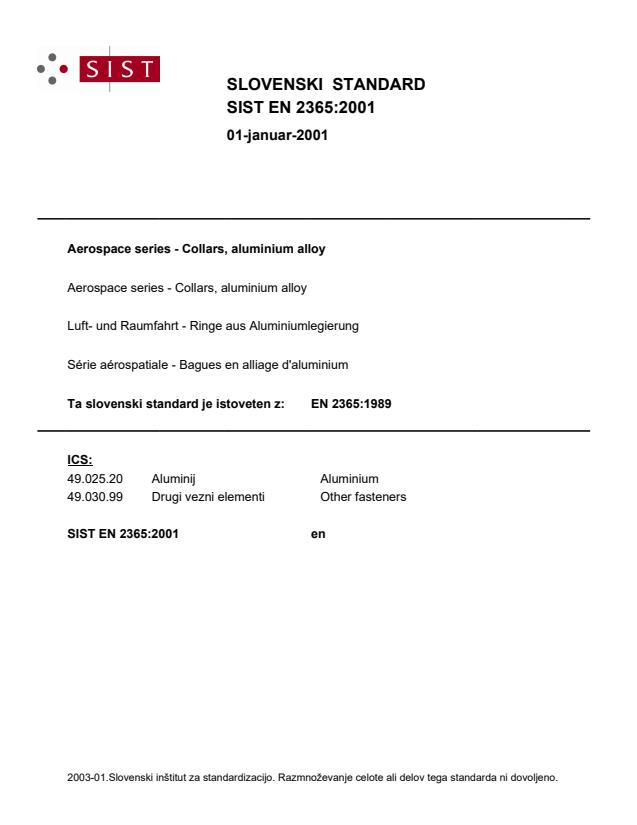
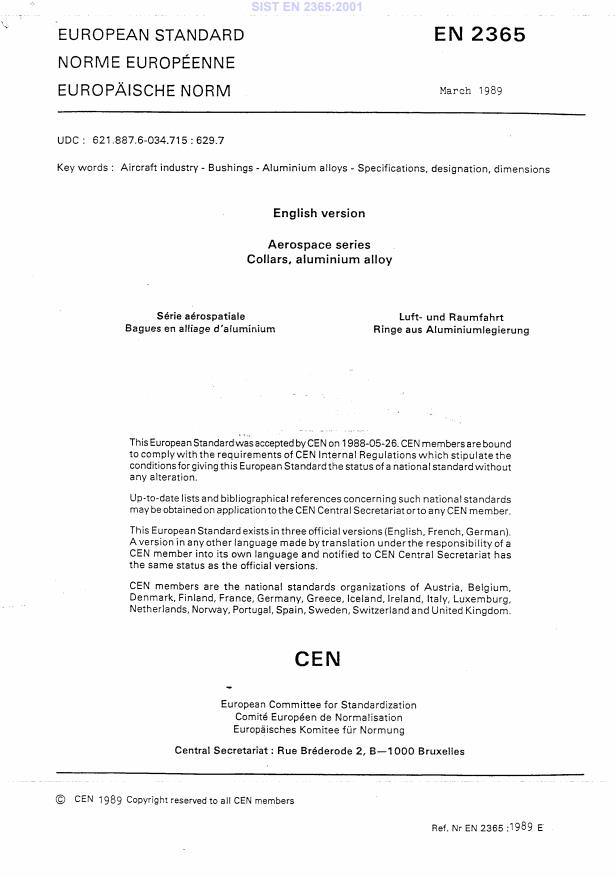
(Main)Aerospace series - Collars, aluminium alloy
- Abstract
This standard specifies the characteristics of aluminium alloy collars for use in aerospace applications, in conjunction with shear pins EN 2364 and split pin EN 2367.
- Status
- Published
- Publication Date
- 31-Dec-2000
- Technical Committee
- SS SPL - Technical Board for the general field
- Current Stage
- 6060 - National Implementation/Publication (Adopted Project)
- Start Date
- 01-Jan-2001
- Due Date
- 01-Jan-2001
- Completion Date
- 01-Jan-2001

SIST EN 2365:2001 is a Slovenian national standard published by SIST for aerospace fastener parts. It specifies the characteristics of aluminium alloy collars used in aerospace applications, and it is intended for use together with shear pins EN 2364 and split pin EN 2367. For engineers, buyers, and quality staff, it is a reference for identifying the right collar for a defined aerospace fastening assembly.
What does SIST EN 2365:2001 specify?
SIST EN 2365:2001 specifies the characteristics of aluminium alloy collars for aerospace applications. The scope links the collars to a specific assembly context, so the standard is most useful when the collar is being selected, ordered, or checked as part of a fastener set rather than as a general-purpose component.
SIST EN 2365:2001 is identified as the Slovenian standard equivalent to EN 2365:1989. The document is part of the aerospace series and is classified under fasteners and aluminium, which matches its use in controlled aerospace hardware.
What are the key requirements of SIST EN 2365:2001?
SIST EN 2365:2001 focuses on the collar itself and on how it fits into the intended assembly. In practice, that means the standard is the reference to use when a design, procurement record, or inspection plan needs to name the collar type unambiguously.
- Aluminium alloy material - The collars are made from aluminium alloy. For users, this matters because the material choice affects compatibility with the rest of the assembly, weight, and procurement specification.
- Aerospace application - The collars are intended for aerospace use. That tells the reader to apply aerospace-level part control and not treat the item as a generic hardware collar.
- Defined fastener pairing - The scope ties the collars to shear pins EN 2364 and split pin EN 2367. In practice, the collar should be specified as part of that matched fastening arrangement.
- Characteristics are standardized - The document specifies the characteristics of the collars. For a buyer or quality manager, this means the product should be ordered and inspected against this reference rather than described only by a generic name.
- Assembly context matters - Because the standard names the companion pins, it is aimed at assemblies where the collar is one element in a controlled mechanical joint. That helps avoid mismatched parts during design or receiving inspection.
- Series identification - The document belongs to the aerospace series. For users, that signals it is part of a family of aerospace component standards and should be used with the corresponding parts named in the scope.
What changed in SIST EN 2365:2001 from the previous edition?
SIST EN 2365:2001 is stated to be identical to EN 2365:1989. That is the only relationship to the earlier edition given in the text shown here.
Which standards are used with SIST EN 2365:2001?
SIST EN 2365:2001 is used with two companion standards named in the scope:
| Standard | What it contributes |
|---|---|
| EN 2364 | Shear pins for the fastening assembly |
| EN 2367 | Split pin for the fastening assembly |
These companion standards matter because the collar is specified as part of a matched assembly, not in isolation.
Who uses SIST EN 2365:2001?
SIST EN 2365:2001 is used by aerospace designers, fastener suppliers, purchasing teams, and quality personnel who need a common specification for aluminium alloy collars. It is relevant when defining parts for drawings, purchase orders, incoming inspection, and assembly control in aerospace manufacturing or supply chains.
What does the SIST EN 2365:2001 document contain?
The document identifies the standard, gives its title in multiple languages, and states its classification and equivalence to EN 2365:1989. It also gives the scope that defines aluminium alloy collars for aerospace use and links them to EN 2364 and EN 2367.
For a reader, that means the standard serves as a concise product reference for specifying one fastener component within a defined aerospace assembly.
Get Certified
Connect with accredited certification bodies for this standard

BUREAU VERITAS Certification Germany
Bureau Veritas certification in Germany.

Element Materials Technology
Materials testing and product certification.

AQMS Ltd.
AQMS provides ISO certification to SMEs across the UK.
Sponsored listings
Frequently Asked Questions
SIST EN 2365:2001 is a standard published by the Slovenian Institute for Standardization (SIST). Its full title is "Aerospace series - Collars, aluminium alloy". This standard covers: This standard specifies the characteristics of aluminium alloy collars for use in aerospace applications, in conjunction with shear pins EN 2364 and split pin EN 2367.
This standard specifies the characteristics of aluminium alloy collars for use in aerospace applications, in conjunction with shear pins EN 2364 and split pin EN 2367.
SIST EN 2365:2001 is classified under the following ICS (International Classification for Standards) categories: 49.025.20 - Aluminium; 49.030.99 - Other fasteners. The ICS classification helps identify the subject area and facilitates finding related standards.
SIST EN 2365:2001 is available in PDF format for immediate download after purchase. The document can be added to your cart and obtained through the secure checkout process. Digital delivery ensures instant access to the complete standard document.
Standards Content (Sample)
2003-01.Slovenski inštitut za standardizacijo. Razmnoževanje celote ali delov tega standarda ni dovoljeno.Aerospace series - Collars, aluminium alloyLuft- und Raumfahrt - Ringe aus AluminiumlegierungSérie aérospatiale - Bagues en alliage d'aluminiumAerospace series - Collars, aluminium alloy49.030.99Dr
...