


SIST EN 61118:1999
(Main)Helical-scan video tape cassette system using 12,65 mm (0,5 in) magnetic tape - Type M2
Helical-scan video tape cassette system using 12,65 mm (0,5 in) magnetic tape - Type M2
Defines dimensions and other characteristics of equipment which are necessary to ensure the interchangeability of recorded cassettes. The requirements relate to 525 line-60 field and 625 line-50 field systems.
Videoband-Kassettensystem mit Schrägspuraufzeichnung auf Magnetband 12,65 mm (0,5 in) - Typ M2
Système de magnétoscope à cassette à balayage hélicoïdal utilisant la bande magnétique de 12,65 mm (0,5 in) de type M2
Définit les dimensions et autres caractéristiques des équipements qui sont nécessaires à l'interchangeabilité des cassettes enregistrées. Les exigences indiquées sont relatives aux systèmes à 525 lignes-60 trames et aux systèmes à 625 lignes-50 trames.
Helical-scan video tape cassette system using 12,65 mm (0,5 in) magnetic tape - Type M2 (IEC 61118:1993)
General Information
- Status
- Published
- Publication Date
- 31-Mar-1999
- Technical Committee
- AVM - Audio, video and multimedia systems and equipment
- Current Stage
- 6060 - National Implementation/Publication (Adopted Project)
- Start Date
- 01-Apr-1999
- Due Date
- 01-Apr-1999
- Completion Date
- 01-Apr-1999



Relations
- Effective Date
- 03-Feb-2026
- Effective Date
- 03-Feb-2026
Overview
SIST EN 61118:1999 specifies the helical-scan video tape cassette system using 12.65 mm (0.5 in) magnetic tape, known as Type M2, for 525 line-60 field and 625 line-50 field television systems. This standard, aligned with IEC 61118:1993, defines the dimensions and essential characteristics of both cassettes and the associated video tape recording equipment. Its chief goal is to ensure the interchangeability of recorded cassettes between different recorders and systems, supporting reliable video tape recording and playback in professional and broadcast environments.
Key Topics
Cassette Types and Dimensions
The standard establishes two cassette types (large and small) with specified dimensions and location datum points to guarantee physical interchangeability between equipment.Mechanical Features
Requirements for cassette structure, datum holes, windows, identification holes, lid mechanisms, reel brakes, and automatic stop features are included to ensure operational consistency.Video Tape Properties
Describes the magnetic tape’s thickness, width, type (high coercivity metal particle), magnetic orientation, and physical characteristics of leader and trailer tapes for proper machine detection and handling.Recording and Playback Characteristics
Details component video signal processing, including luminance (Y) and chrominance (C) signal handling, signal pre-emphasis, and FM modulation. Audio recording is supported in both longitudinal (common audio mode) and PCM (pulse code modulation audio mode), with guidelines for reference levels, frequency response, and noise reduction.Operational Tolerances and Testing Conditions
Prescribes environmental conditions (temperature, humidity, barometric pressure) and reference/calibration tape requirements for accurate system tests and calibration.
Applications
SIST EN 61118:1999 is crucial for:
Professional Video Production
Broadcasters and production companies adopting M2 video cassette systems for studio recording and media archiving benefit from assured compatibility and reliable media handling.Archival Systems
Institutions and media archives use this standard to maintain consistency and longevity in stored video content, ensuring future playability across certified equipment.Equipment Manufacturing and Maintenance
Manufacturers of video tape recorders, cassettes, and playback systems rely on these specifications for designing interoperable and serviceable products, minimizing the risk of format conflicts and mechanical issues.Quality Control and Testing
Laboratories and service providers use these criteria for calibrating and validating equipment performance, leveraging reference and calibration tapes defined by the standard.
Related Standards
EN 61118:1993
European implementation of IEC 61118, forming the basis for SIST EN 61118:1999.IEC 94-1
Specifies general conditions and requirements for magnetic tape sound recording and reproducing systems.IEC 461
Concerns time and control code for video tape recorders.EBU R-50
Addresses conservation of audio signal polarity for radio and television production installations.
Practical Value
By following SIST EN 61118:1999, organizations ensure compatibility, reliability, and interoperability of M2 helical-scan video tape cassettes and equipment. This standard is fundamental for anyone involved in video tape production, equipment manufacturing, or media archiving where long-term media accessibility and industry-wide compatibility are priorities. Compliance with this standard supports seamless interchange and consistency across a broad range of professional video applications.
Get Certified
Connect with accredited certification bodies for this standard

ANCE
Mexican certification and testing association.

Intertek Slovenia
Intertek testing, inspection, and certification services in Slovenia.

LNE (Laboratoire National de Métrologie et d'Essais)
French national laboratory for metrology and testing.
Sponsored listings
Frequently Asked Questions
SIST EN 61118:1999 is a standard published by the Slovenian Institute for Standardization (SIST). Its full title is "Helical-scan video tape cassette system using 12,65 mm (0,5 in) magnetic tape - Type M2". This standard covers: Defines dimensions and other characteristics of equipment which are necessary to ensure the interchangeability of recorded cassettes. The requirements relate to 525 line-60 field and 625 line-50 field systems.
Defines dimensions and other characteristics of equipment which are necessary to ensure the interchangeability of recorded cassettes. The requirements relate to 525 line-60 field and 625 line-50 field systems.
SIST EN 61118:1999 is classified under the following ICS (International Classification for Standards) categories: 33.160.40 - Video systems. The ICS classification helps identify the subject area and facilitates finding related standards.
SIST EN 61118:1999 has the following relationships with other standards: It is inter standard links to SIST EN 60094-1:1999, SIST HD 507 S1:1999. Understanding these relationships helps ensure you are using the most current and applicable version of the standard.
SIST EN 61118:1999 is available in PDF format for immediate download after purchase. The document can be added to your cart and obtained through the secure checkout process. Digital delivery ensures instant access to the complete standard document.
Standards Content (Sample)
SLOVENSKI STANDARD
01-april-1999
Helical-scan video tape cassette system using 12,65 mm (0,5 in) magnetic tape -
Type M2 (IEC 61118:1993)
Helical-scan video tape cassette system using 12,65 mm (0,5 in) magnetic tape - Type
M2
Videoband-Kassettensystem mit Schrägspuraufzeichnung auf Magnetband 12,65 mm
(0,5 in) - Typ M2
Système de magnétoscope à cassette à balayage hélicoïdal utilisant la bande
magnétique de 12,65 mm (0,5 in) de type M2
Ta slovenski standard je istoveten z: EN 61118:1993
ICS:
33.160.40 Video sistemi Video systems
2003-01.Slovenski inštitut za standardizacijo. Razmnoževanje celote ali delov tega standarda ni dovoljeno.
CEI
NORME
IEC
INTERNATIONALE
INTERNATIONAL
Première édition
STANDARD
First edition
1993-07
Système de magnétoscope à cassette
à balayage hélicoïdal utilisant
la bande magnétique de 12,65 mm (0,5 in)
de type M2
Helical-scan video tape cassette
system using 12,65 mm (0,5 in)
magnetic tape – Type M2
© CEI 1993 Droits de reproduction réservés — Copyright - all rights reserved
zed ini
Aucune partie de cette publication ne peut être reproduite ni No part of this publication may be reproduced or util
utilisée sous quelque forme que ce soit et par aucun pro- any form or by any means, electronic or mechanical,
including photocopying and microfilm, without permission
cédé, électronique ou mécanique, y compris la photocopie et
les microfilms, sans l'accord écrit de l'éditeur. in writing from the publisher.
Bureau Central de la Commission Electrotechnique Internationale 3, rue de Varembé Genève, Suisse
Commission Electrotechnique Internationale CODE PRIX "^
International Electrotechnical Commission
PRICE CODE J^
Memaywapoitiae 3netcrporexHwvecwaa HoMMccwa
IEC
Pour prix, voir catalogue en vigueur •
•
For price, see current cata logue
1118 ©I EC:1993 - 3 -
CONTENTS
Page
FOREWORD 9
SECTION 1: GENERAL
Clause
1.1 Scope
1.2 Normative references
1.3 Environment and test conditions
1.3.1 Environment
1.3.2 Reference tape
1.3.3 Calibration tape
SECTION 2: VIDEO TAPE CASSETTE
2.1 Mechanical parameters
2.1.1 Cassette type
15 2.1.2 Dimensions of cassettes
15 2.1.3 Cassette dimension datum system
2.1.4 Window and label-pasting faces
2.1.5 Identification holes
2.1.6 Dimensions of reels
2.1.7 Tape windings
2.1.8 Unlocking of lid 19
2.1.9 Opening of lid 19
2.1.10 Releasing of reel brake
2.1.11 Automatic stop
SECTION 3: VIDEO CASSETTE RECORDERS
3.1 Definitions 19
3.1.1 Scanner 19
3.1.2 Drum 19
3.1.3 Upper drum 19
3.1.4 Lower drum
21 3.1.5 Effective drum diameter
3.1.6 Helix angle
3.1.7 Track angle
3.2 Drum diameter and structure 21
21 3.2.1 Actual upper drum diameter
3.2.2 Actual lower drum diameter
3.2.3 Upper drum section 21
3.3 Scanner pole tips
3.3.1 Pole tip projection 21
3.3.2 Pole tips
3.3.3 Chordal distance between luminance and chrominance pole tips
1118 ©IEC:1993 — 5 —
Page
Clause
chrominance pole tips 3.3.4 Axial distance between luminance and
3.3.5 Channel identification 23
3.4 Helix angle
3.5 Dimensions and locations of records
3.5.1 Test environment
3.5.2 Tape speed
Record locations and dimensions 3.5.3
25 3.5.4 Video record curvature
25 3.5.5 Gap azimuth
3.6 Recording characteristics
SECTION 4: TAPE CHARACTERISTICS
4.1 Dimensions of video tape 29
4.1.1 Magnetic tape thickness 29
4.1.2 Magnetic tape width 29
4.2 Magnetic tape properties
4.2.1 Type of magnetic tape 29
4.2.2 Magnetic orientation 29
4.2.3 Coercivity 29
4.3 Leader tape and trailer tape 29
4.3.1 Automatic stop 29
Dimensions of leader and trailer tape 29
4.3.2
Splicing 29
4.3.3
SECTION 5: RECORDING CHARACTERISTICS
31 5.1 Video signal recording
5.1.1 Luminance channel 31
5.1.2 Chrominance channel 37
5.1.3 Y-C timing
Vertical interval subcarrier (VISC) 5.1.4
5.2 Longitudinal audio signal recording
5.2.1 Recording method
Recording/Reproducing reference levels 5.2.2
5.2.3 Frequency characteristics
47 5.2.4 Track usage (common audio mode)
49 5.2.5 Program audio head phasing
Recording polarity 49
5.2.6
49 5.3 FM audio signal recording (optional)
49 Recording/Reproducing reference levels 5.3.1
49 5.3.2 Noise reduction
Pre-emphasis 5.3.3
51 5.3.4 Frequency modulation
51 5.3.5 Recording head current
5.3.6 Recording polarity
1118 ©I EC:1993 — 7 —
Page
Clause
5.4 Time and control code signal recording
5.4.1 Time and control code
5.4.2 Recording track
5.4.3 Recording method
Recording level 5.4.4
5.5 Tracking control signal recording
5.5.1 Recording track
53 5.5.2 Recording waveform and level
5.5.3 Polarity of remanent magnetization
5.5.4 Timing and period
5.5.5 Colour framing information
53 5.5.6 Magnetization level
5.5.7 Rise time
5.6 PCM audio recording (PCM audio mode)
5.6.1 Source coding
5.6.2 Signal processing
Figures
Annex A — Reference tape
1118 ©IEC:1993 - 9 -
INTERNATIONAL ELECTROTECHNICAL COMMISSION
HELICAL-SCAN VIDEO TAPE CASSETTE SYSTEM
USING 12,65 mm (0,5 in) MAGNETIC TAPE –
TYPE M2
FOREWORD
The IEC (International Electrotechnical Commission) is a worldwide organization for standardization
1)
comprising all national electrotechnical committees (IEC National Committees). The object of the IEC is to
promote international cooperation on all questions concerning standardization in the electrical and
electronic fields. To this end and in addition to other activities, the IEC publishes International Standards.
Their preparation is entrusted to technical committees; any IEC National Committee interested in
the subject dealt with may participate in this preparatory work. International, governmental and
non-governmental organizations liaising with the IEC also participate in this preparation. The IEC
collaborates closely with the International Organization for Standardization (ISO) in accordance with
conditions determined by agreement between the two organizations.
The formal decisions or agreements of the IEC on technical matters, prepared by technical committees on
2)
which all the National Committees having a special interest therein are represented, express, as nearly as
possible, an international consensus of opinion on the subjects dealt with.
They have the form of recommendations for international use published in the form of standards, technical
3)
reports or guides and they are accepted by the National Committees in that sense.
In order to promote international unification, IEC National Committees undertake to apply IEC International
4)
Standards transparently to the maximum extent possible in their national and regional standards. Any
divergence between the IEC Standard and the corresponding national or regional standard shall be clearly
indicated in the latter.
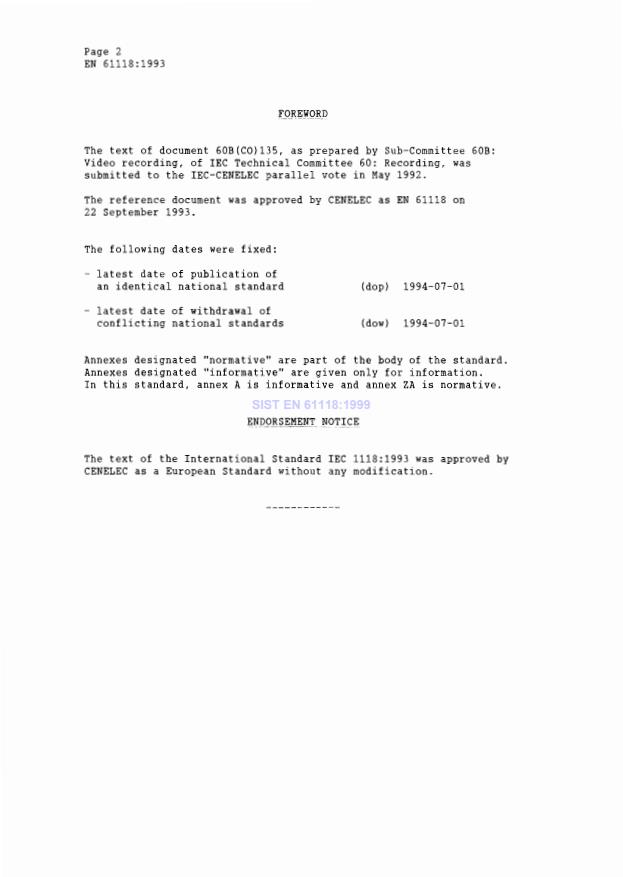
International Standard IEC 1118 has been prepared by IEC by sub-committee 60B: Video
recording, of IEC technical committee 60: Recording.
The text of this standard is based on the following documents:
DIS Report on Voting
60B(CO)162
608(00)135
rt
Full information on the voting for the approval of this standard can be found in the repo
on voting indicated in the above table.
1118 ©IEC:1993 - 11 -
HELICAL-SCAN VIDEO TAPE CASSETTE SYSTEM
USING 12,65 mm (0,5 in) MAGNETIC TAPE –
TYPE M2
SECTION 1: GENERAL
1.1 Scope
This International Standard is applicable to magnetic video recording using 12,65 mm
(0,5 in) tape cassettes on helical-scan video tape recorders and defines the basic M2
format video cassette system.
This standard also specifies two different audio recording modes:
common audio mode and
1)
2) pulse code modulation audio mode.
PCM audio mode has a limited interchangeability. FM audio recording shown in this
standard is optional.
The object of this International Standard is to define dimensions and other characteristics
of equipment which are necessary to ensure the interchangeability of recorded cassettes.
The requirements given relate to 525 line-60 field and 625 line-50 field systems.
1.2 Normative references
The following normative documents contain provisions which, through reference in this
text, constitute provisions of this International Standard. At the time of publication, the edi-
rties to
tions indicated were valid. All normative documents are subject to revision, and pa
agreements based on this International Standard are encouraged to investigate the possi-
bility of applying the most recent editions of the normative documents indicated below.
Members of IEC and ISO maintain registers of currently valid International Standards.
Magnetic tape sound recording and reproducing systems - Part 1: General
IEC 94-1: 1981,
conditions and requirements.
Time and control code for video tape recorders.
IEC 461: 1986,
Conservation of the polarity of audio signals in radio and television
EBU R-50: 1989,
production installations.
1.3 Environment and test conditions
1.3.1 Environment
Tests and measurements made on the system to check the requirements of this Inter-
national Standard shall be made under the following conditions unless otherwise specified:
1118 ©IEC:1993 - 13 -
Temperature (drum diameter): 20 °C ± 0,5 °C
Temperature (all other tests): 20 °C ± 1 °C
50% ± 2 %
Relative humidity:
86 kPa to 106 kPa
Barometric pressure:
Conditioning before testing: 24 h
1.3.2 Reference tape
Blank tape to be used for reference recordings may be purchased from the manufacturers
listed in annex A. Electromagnetic compatibility parameters and their specifications shall
be specified by the manufacturer and controlled accordingly.
Electromagnetic compatibility parameters and their specifications are indicated in
annex A.
1.3.3 Calibration tape
Calibration tapes satisfying the following requirements will be available for purchase from
manufacturers of video tape recorders and players in accordance with this format specifi-
cation.
1.3.3.1 Record locations and dimensions
In principle, 50 % reduction in the tolerances shown in table 1 shall be applied to calibra-
tion tapes to be used for the purpose of calibrating the mechanical accuracy of recorders
or players in accordance with this format specification. If necessary, the record locations
and dimensions may be specially modified for some calibration tapes in order to avoid
certain calibration errors or to facilitate certain calibration work.
1.3.3.2 Calibration signals
Two classes of signals shall be recorded on the calibration tapes:
a) A series of conventional analogue component test signals for video tape recorders.
Audio
Video
- 1 kHz - 0 VU
Colour bars
- 15 kHz - 0 VU
Multi-burst
- 20 or 40 Hz - 10 VU
Bowtie
- 1 kHz - 10 VU
Pulse and bar
- 7,5 kHz -10VU
- 10 kHz-10 VU
- 15 kHz -10VU
AFM
- 1 kHz, 70 kHz deviation.
- 15 -
1118©IEC:1993
b) Special test signals developed by each manufacturer for product alignment. These
signals are not universally applicable to the products from each manufacturer and are
not specified in this International Standard.
SECTION 2: VIDEO TAPE CASSETTE
2.1 Mechanical parameters
2.1.1 Cassette type
There are two cassette types, characterized by the outside dimensions shown below:
106 mm x 188 mm x 25 mm
- large cassette:
- small cassette: 87 mm x 130 mm x 25 mm
2.1.2 Dimensions of cassettes
The dimensions permitting the interchangeability of cassettes shall be in accordance with
figures 1 to 5 and figures 7 to 11.
Cassette dimension datum system
2.1.3
2.1.3.1 Datum holes
These shall be holes serving for the reference when loading a cassette into the video tape
recorder, and shall also be the reference for the cassette dimensions (see figures 2, 4, 8
and 10).
2.1.3.2 Datum plane Z
This shall be a plane containing three datum positions A, B and C on the bottom of the
cassette (see figures 4 and 10).
Datum plane X
2.1.3.3
rthogonal to datum plane Z and containing
Large cassette: This shall be a plane o
the centre lines of datum holes A and B (see figures 2 and 4).
Small cassette: This shall be a plane parallel to the long side face of the cassette
hogonal to datum plane Z and containing the centre line of
o rt
datum hole A (see figures 8 and 10).
2.1.3.4 Datum plane Y
This shall be the plane orthogonal to both datum planes X and Z and containing the centre
line of datum hole A (see figures 2, 4, 8 and 10).
2.1.4 Window and label-pasting faces
Large cassettes shall conform to figure 1.
Small cassettes shall conform to figure 7.
1118 ©IEC:1993 - 17 -
2.1.5 Identification holes
8).
Various holes shall be provided for identifying cassette conditions (see figures 2 and
Each hole may be set in the closed state or the open state.
0,25 mm; be able to withstand the
Closed state: The hole depth shall be 0 mm to
0,5 N
normal load of
0,3
3 mm; The hole depth shall be 5 mm or
Open state: The hole diameter shall be
more.
Erasure prevention identification hole
2.1.5.1
Large cassettes shall be defined by figure 2.
Small cassettes shall be defined by figure 8.
The erasure prevention identification hole shall be coupled to the erasure prevention
and may be changed between the closed state and
mechanism shown in figure 1 and 7
the open state. Each state shall be defined as follows:
Identification hole closed: Ready to record.
Not ready to record.
Identification hole open:
2.1.5.2 Tape type identification hole
2.
Large cassettes shall be defined by figure
8.
Small cassettes shall be defined by figure
The closed state of the identification hole shall be defined as follows:
Identification hole closed: Metal tape.
A/m).
(Coercive force: approximately 120 x 10 3
2.1.5.3 Tape thickness identification hole
2.
Large cassettes shall be defined by figure
Small cassettes shall be defined by figure 8.
The closed state of the identification hole shall be defined as follows:
13,5 gm ± 0,5 Rm.
Identification hole closed: Tape total thickness is
2.1.5.4 Extra identification holes
These holes are provided for future usage. The positions of these holes shall be as shown
below:
Large cassettes shall be as defined in figure 2 (five holes).
8 (two holes).
Small cassettes shall be as defined in figure
1118 ©IEC:1993 - 19 -
2.1.6 Dimensions of reels
Dimensions of the reels shall be in accordance with figure 5 and 11.
2.1.7 Tape windings
The tape winding method and path shall be in accordance with figures 6 and 12.
2.1.8 Unlocking of lid
the large
The lid shall be unlocked when a force of not more than 0,15 N in the case of
cassette, or a force of not more than 0,30 N in the case of the small cassette is applied to
the unlocking clutch as indicated in note 8 of figure 1 and note 6 of figure 7.
2.1.9 Opening of lid
The force necessary for opening the lid shall be not more than 1 N until the lid is opened
to the maximum.
Releasing of reel brake
2.1.10
The reel brakes shall be released by a force of not more than 0,7 N by means of a reel
brake unlocking pin as shown in note 4 of figure 3 and note 3 of figure 9.
2.1.11 Automatic stop
At the end of the tape, transparent leader and trailer tapes are provided for either auto-
matic shut-off or automatic rewind.
SECTION 3: VIDEO CASSETTE RECORDERS
3.1 Definitions
For the purpose of this International Standard, the following definitions apply.
3.1.1 Scanner
A mechanical assembly containing a drum, rotating pole tips and the tape-guiding
elements used to record and reproduce video, FM audio and PCM audio signals.
Drum
3.1.2
A cylindrical column around which the tape is at least partially wrapped in order to form
the head-to-tape interface of the video tape recording system.
3.1.3 Upper drum
of the drum which does not contact the reference edge of the tape (see
That pa rt
figure 14a).
1118 ©IEC:1993 - 21 -
3.1.4 Lower drum
That part of the drum which contacts the reference edge of the tape and provides tape-
guiding functions (see figure 14a).
3.1.5 Effective drum diameter
The value of drum diameter which yields the actual video and PCM audio record dimen-
sions in a theoretical calculation. This value is greater than or equal to the actual drum
diameter.
3.1.6 Helix angle
The angle formed between the path of the rotating heads and the tape reference edge
guiding system.
3.1.7 Track angle
The angle formed between the video record and the reference edge of the tape.
3.2 Drum diameter and structure
The track angle is determined by parameters such as effective drum diameter, tape
tension, helix angle and tape speed. Different methods of design and/or minor variations
in drum diameter and tape tension will produce equivalent recordings for interchange
purposes.
Actual upper drum diameter
3.2.1
The actual upper drum diameter shall be the dimension specified in figure 14a.
Actual lower drum diameter
3.2.2
The actual lower drum diameter shall be the dimension specified in figure 14a.
3.2.3 Upper drum section
The upper drum section shall rotate together with the video heads.
3.3 Scanner pole tips
Four circumferential pole tips shall be located as shown in figure 13.
3.3.1 Pole tip projection
Each pole tip shall project radially 0,035 mm (nominal value) above the upper drum
surface.
1118 ©IEC:1993 – 23 –
3.3.2 Pole tips
3.3.2.1 Luminance pole tips
Two pole tips circumferentially arranged 180° ± 0,003° apart shall be provided for the lumi-
nance signal.
3.3.2.2 Chrominance pole tips
Each luminance pole tip shall have an associated pole tip for the time compressed
signal and the FM audio signal.
chrominance
chrominance pole tips
3.3.3 Chordal distance between luminance and
The chordal distance shall be as shown in figure 14b.
Axial distance between luminance and chrominance pole tips
3.3.4
The axial distance shall be as shown in figure 14b.
3.3.5 Channel identification
Suitable means, such as a pulse generator producing one pulse per drum revolution, shall
be provided for identifying the head pair which records Field 1. This pair is identified as
channel 1, and the other pair is identified as channel 2.
3.4 Helix angle
The helix angle formed by the scanner and all associated tape guides shall be 4,250°
± 0,001°.
3.5 Dimensions and locations of records
3.5.1 Test environment
3.5.1.1 In addition to the environmental and general test requirements of clause 1.3, the
following additional conditions shall be met in order to meet requirements of clause 3.5.
Tape tension: 0,31 N ± 0,05 N.
3.5.1.2 Conditioning of the tape stock before recording and testing shall be as follows:
environment: established to the conditions specified in 3.5.1.1;
tape tension: wound on a reel at 0,4 N ± 0,1 N;
conditioning time: 24 h.
3.5.1.3 The reference edge of the tape for dimensions specified in this standard shall be
the lower edge as shown in figures 15 to 18, where the magnetic coating faces are shown.
- 25 -
1118 ©IEC:1993
3.5.2 Tape speed
The tape speed shall be as follows:
mm/s, basic;
525 line-60 field system: 67,693
625 line-50 field system: 66,295 mm/s, basic.
3.5.3 Record locations and dimensions
The locations of the common audio mode record shall be as specified in figure 15.
3.5.3.1
Under this
The locations of the PCM audio mode shall be as specified in figure 16.
3.5.3.2
condition, only one longitudinal audio record shall be available.
chrominance (C) signals shall be as
3.5.3.3 The record locations of luminance (Y) and
17 line-60 field system.
specified in figure for the 525
(C) signals shall be as
3.5.3.4 The record locations of luminance (Y) and chrominance
line field system.
specified in figure 18 for the 625 -50
The record dimensions shall be as specified in table 1.
3.5.3.5
The dimensions specified in table 1 are for the tensioned tape; therefore, the
3.5.3.6
elasticity of the tape shall be taken into account for the direct measurements of the tape
without tension.
3.5.4 Video record curvature
The center line of the video and PCM audio records shall be within two parallel straight
lines 0,006 mm apart.
3.5.5 Gap azimuth
The azimuth of the audio, time-and-control codes and tracking control head gaps
3.5.5.1
15 and 16).
shall be perpendicular to the tape transport direction (see figures
-15° and
The azimuth of the video head gaps for the luminance signal shall be
3.5.5.2
+15° to the perpendicular to the head moving direction
for the chrominance signal shall be
(see figures 17 and 18).
3.6 Recording characteristics
The recording characteristics of video tape recorders shall be in accordance with the
5.
requirements specified in section
1118 © – 27 –
IEC:1993
Table 1 - Record locations and dimensions
525 line-60 field 625 line-50 field
Item
Nominal Maximum
Minimum Nominal Maximum Minimum
0 0
Time code track lower edge 0 0 0 0 A:
450 500 400 450 500
B: Time code track upper edge 400
38 36 38
C: Colour track width 34 36 34
40,7 42,2 43,7 49,2 49,7 50,2
D. Y-C track pitch
850 900 950
E: Control track lower edge 850 900 950
250 1 300 1 350 1 250 1 300 1 350
F: Control track upper edge 1
1 471 1 499 1 527
G. Video track lower edge 1 469 1 503 1 537
10 668
10 601 10 634 10 668 10 611 10 640
H: Video track upper edge
10 870 10 830 10 850 10 870
J: Audio 1 lower edge 10 830 10 850
11 400 11 450 11 500
K: Audio 1 track upper edge 11 400 11 450 11 500
12 000 11 900 11 950 12 000
L: Audio 2 track lower edge 11 900 11 950
12 650
12 500 12 550 12 650 12 500 12 550 M: Audio 2 track upper edge
56 58
N: Y track width 42 44 46 54
3H ref. 3,5H ref.
O: Lead signal overlap
4 533 (=12H) ref.
P: Y-C track offset 4 505 (=10H) ref.
84,5 ref. 99,4 ref.
O: Video track pitch
11 8254,3 (262,5H) ref. 11 8058,3 (312,5H) ref.
R: Video track length
8 847,1 ref.
W: Video area effective width 8 847,1 ref.
9 973,5 ref. 9 973,5 ref.
W': Video and PCM audio (CH6)
area effective width
202 000 202 000
X: Audio, time code and control track
record offset
1 626 1 631
1 621 1 626 1 631 1 621 Y: Lower limit of W
4,2906° (basic)
4,2977° (basic)
9: Track angle
10 676 10 709 10 743 10 660 10 689 PA: Effective PCM audio track lower edge
(luminance head)
10 768
10 724 10 758 10 791 10 712 10 740
PB: Effective PCM audio track lower edge
(chrominance head)
11 709
11 660 11 693 11 727 11 652 11 680
PC: PCM audio track upper edge
(chrominance head)
416 491
360 450 541 340 PD: Pre-amble
PE: PCM audio data area
11 820 ref. 11 900 ref.
360 450 541 340 416 491
PF: Post-amble
Unit: µm, unless otherwise specified.
NOTE - Ref. indicates those measurements which are fixed by other parameters and are given for reference
purposes only.
1118©IEC:1993 - 29 -
TAPE CHARACTERISTICS
SECTION 4:
4.1 Dimensions of video tape
4.1.1 Magnetic tape thickness
The thickness of the magnetic tape, including the coating, shall be 13,5 µm ± 0,5 µm.
4.1.2 Magnetic tape width
The width of the magnetic tape shall be 12,65 mm ± 0,01 mm.
4.2 Magnetic tape properties
4.2.1 Type of magnetic tape
A high coercivity metal particle tape shall be used.
4.2.2 Magnetic orientation
The magnetic coating shall be longitudinally oriented.
4.2.3 Coercivity
A/m).
The coercivity shall be class 1 500 (120 x 10 3
4.3 Leader tape and trailer tape
4.3.1 Automatic stop
The transmittance of the leader and trailer tapes shall be 50 % or more to ensure that the
automatic stopping device of the machine operates properly at both ends of the magnetic
tape.
Dimensions of leader and trailer tape
4.3.2
Leader and trailer tape length shall be 170 mm ± 15 mm for the large cassette and
140 mm ± 10 mm for the small cassette.
Leader and trailer tape thickness shall be 13 pm to 36 pm and the width shall be
12,65 mm ± 0,02 mm.
4.3.3 Splicing
The splice and the attachment of the leader and trailer tapes to the magnetic tape and the
N. The splicing gap shall be 60 pm or less.
hub shall be capable of resisting a force of 20
31 -
1118©IEC:1993 -
SECTION 5: RECORDING CHARACTERISTICS
5.1 Video signal recording
Type M2 video tape recorder shall record component video signals. This component video
recording system shall provide independent signal channels for the luminance and
chrominance signals respectively. These component signals shall be recorded on two inde-
pendent tracks on the video tape as frequency modulated signals. Two separate tracks
shall be designated as the Y track for the luminance signals and the C track for the
chrominance signals. The chrominance signals, that is, the R-Y and B-Y colour difference
signals, shall be recorded in the form of a time compressed and time division multiplexed
signal on the C track.
In the case of the FM audio signal recording specified in clause 5.3, it shall be recorded in
the form of a frequency multiplexed signal together with the FM colour difference signal on
the C track.
5.1.1 Luminance channel
5.1.1.1 A signal processing system, as specified in this standard, shall contain the follow-
ing elements in the order of the signal flow:
(1) A circuit for adding a timing burst signal to the luminance signal.
(2) A circuit for adding a vertical interval sub-carrier when appropriate.
(3) A luminance non-linear pre-emphasis circuit.
A luminance pre-emphasis network.
(4)
(5) A circuit for clipping the pre-emphasized luminance signal.
(6) A linear frequency modulator.
A circuit for mixing the PCM audio CH5 signal specified in clause 5.6 with the
(7)
frequency modulated luminance signal.
A recording current amplifier for the Y track and the PCM track video heads.
(8)
5.1.1.2 Burst signal addition
The waveforms of the luminance signal with the burst signal added shall be as shown in
the following figures:
525 line-60 field system: figures 19a to 19c;
625 line-50 field system: figures 20a to 20c.
Burst frequency is locked to horizontal line frequency.
Luminance non-linear emphasis
5.1.1.3
The non-linear emphasis circuits should be as shown in the following figures:
1118 ©IEC:1993 - 33 -
525 line-60 field system: figure 21 or its equivalent;
625 line-50 field system: figure 22 or its equivalent.
The typical frequency characteristics of the non-linear emphasis circuit output signal
should be as shown in table 2.
Table 2 - Frequency characteristics of non-linear emphasis
Relative input level
(dB)
Frequency
625 line-50 field system
525 line-60 field system
(MHz)
-20,0
0 -10,0 -20,0 0 -10,0
0,01 0 0 0 0 0
-0,50 -0,4
0,1 -0,1 -0,2 +0,1 -0,3
-0,65 -0,65 -0,1
0,2 •-0,4 +0,1 +0,4
-0,80 +0,25 +1,7
0,5 -0,7 +1,1 +1,7
-0,30 +1,90 +4,3
1,0 0 +3,0 +4,0
+4,8 +6,1 +0,15 +3,20 +6,5
2,0 +0,9
+6,8 +0,30 +3,75 +7,6
3,0 +1,3 +5,5
+0,35 +4,10 +8,0
5,0 +1,7 +6,1 +7,2
NOTES
1 For the 525 line-60 field system: 0 dB means 100 % amplitude except sync signal.
For the 625 line-50 field system: 0 dB means 100 % amplitude except sync signal.
5.1.1.4 Luminance pre-emphasis
The network and circuit parameters shall be as shown in figure 23.
5.1.1.5 Amplitude clipping
Any positive or negative amplitude excursion exceeding the specified limits shall be
clipped.
The limits determined on the basis of the blanking level shall be as shown in table 3.
1118 © IEC:1993 - 35 -
Table 3 - Amplitude clipping levels
625 line-50 field system
525 line-60 field system
+270 % ± 10 %
Positive limit +338 ± 10 %
% ± 10 %
Negative limit -190 % ± 10% -170
above clipping levels are values for the signals where blanking is at 0 % and peak white at 100 % level
NOTE – The
5.1.1.6 FM carrier frequency
Carrier frequencies corresponding to the reference video level shall be as shown in
table 4.
Table 4 - Carrier frequencies corresponding to reference video levels (MHz)
625 line-50 field system
525 line-60 field system
9,20 (nominal)
7,70 (nominal)
100 % white
6,95 (nominal) 8,30 (nominal)
50 % level
6,20 ± 0,05 7,40 ± 0,05
Blanking
5,60 (nominal) 6,63 (nominal)
Sync tip
1,50 ± 0,05 1,80 ± 0,05
Video deviation
5.1.1.7 Recording head current
5.1.1.7.1 The amplitude of the record current for the Y track shall be such that the maxi-
mum level of remanent flux on the tape is produced when recording the Y signal with 50
average picture level.
5.1.1.7.2 The amplitude of the Y track record current shall decrease with increasing
frequency according to a straight line in the range of 2 MHz to 10 MHz contained within
limit lines as shown in figure 30. This method ensures optimum recording irrespective of
video head material.
1118 ©IEC:1993 - 37 -
5.1.2 Chrominance channel
5.1.2.1 A signal processing system, as specified by this standard, shall contain the follow-
ing elements in the order of the signal flow:
A circuit for adding a horizontal sync pulse and the timing burst signals to the
(1)
chrominance signal.
A circuit to individually adjust the R-Y and B-Y levels in the ratio specified.
(2)
A circuit to perform the time compression and the time division multiplexing of the
(3)
R-Y and B-Y colour difference signals.
non-linear pre-emphasis circuit.
(4) A chrominance
(5) A chrominance pre-emphasis network.
signal.
A circuit for clipping the pre-emphasized chrominance
(6)
(7) A linear frequency modulator.
A high-pass filter to reduce the amplitude of low frequency components to allow
(8)
for the mixing of the optional FM audio signals.
chrominance signal.
(9) A circuit to mix the optional FM audio signals with the
A circuit for mixing the PCM audio CH6 signal specified in clause 5.6 with the
(10)
frequency modulated chrominance signal.
A recording current amplifier for the C track and the PCM track video heads.
(11)
5.1.2.2 Addition of the burst and sync signals
Resultant signal waveforms shall be as shown in the following figures:
525 line-60 field system: figures 19a, 19b, 19d and 19e;
625 line-50 field system: figures 20a, 20b, 20d and 20e.
5.1.2.3 Time compression and multiplexing
The time compression factor shall be one half.
The time compressed R-Y and B-Y signals shall be multiplexed alternately as shown in
figure 24.
The compressed and multiplexed R-Y and B-Y signals shall be delayed by one horizontal
line with respect to the luminance signal.
5.1.2.4 Chrominance non-linear emphasis
The non-linear emphasis circuits shall be as shown in the following figures:
525 line-60 field system: figure 21 or its equivalent;
625 line-60 field system: figure 22 or its equivalent.
The typical frequency characteristics of the non-linear emphasis circuit output signal shall
be as shown in table 5.
1118 © IEC:1993 - 39 -
Table 5 - Frequency characteristics of non-linear emphasis
Relative input level
(dB)
Frequency
625 line-50 field system
525 line-60 field system
(MHz)
0 -10,0 -20,0
0 -10,0 -20,0
0 0
0 0 0 0
0,01
-0,4
0,1 -0,3 -0,1 -0,3 -0,50
-0,3
-0,65 -0,1
-0,4 +0,1 +0,4 -0,65
0,2
+0,25 +1,7
+1,1 +1,6 -0,80
0,5 -0,2
-0,30 +1,90 +4,3
1,0 +0,6 +3,0 +3,9
+3,20 +6,5
+1,5 +4,8 +6,0 +0,15
2,0
+0,30 +3,75 +7,6
3,0 +1,9 +5,5 +6,6
+0,35 +4,00 +7,90
5,0 - - -
NOTES
For the 525 line-60 field system: 0 dB means the peak-to-peak value of 100/7.5/77/7.5 colour-bar signal
except sync signal
For the 625 line-50 field system: 0 dB means the peak-to-peak value of 100/0/100/0 colour-bar signal
except sync signal.
5.1.2.5 Chrominance pre-emphasis
The network and circuit parameters shall be as shown in figure 25.
5.1.2.6 Amplitude clipping
Any positive or negative amplitude excursion exceeding the specified limits shall be
clipped.
The limits determined on the basis of the blanking level shall be as shown in table 6.
-41 -
1118 © IEC:1993
Table 6 - Amplitude clipping level
625 line-50 field system
525 line-60 field system
+200 % ± 10 %
Positive limit +147,7 ± 10 %
–180,2 % ± 10% –200 % ± 10 %
Negative limit
NOTES
100 % indicates the peak-to-peak amplitude of the compressed 100/7,5/77/7,5 colour-bar signal for
the 525 line-60 field system.
2 100 % indicates the peak-to-peak amplitude of the compressed 100/0/100/0 colour-bar signal for the
625 line-50 field system.
5.1.2.7 FM carrier frequency
Carrier frequencies corresponding to reference video levels shall be as shown in table 7.
Table 7 - Carrier frequencies corresponding to reference video levels (MHz)
625 line-50 field system
525 line-60 field system
(100/7,5/77/7,5) (100/0/100/0)
R-Y B-Y R-Y B-Y
6,00 7,00 7,00
Peak of positive excursion 6,20
5,00 5,40 5,40
Peak of negative excursion 4,80
5,50 6,20 6,20
Blanking 5,50
4,71 –
Sync tip 4,20 –
1,60 1,60
Maximum peak-to-peak deviation 1,40 1,00
±0,016 ±0,016
Deviation peak-to-peak tolerance ±0,02 ±0,015
±0,05 ±0,05 ±0,05
Blanking carrier tolerance ±0,05
NOTE – Unit MHz
1118 ©IEC:1993 - 43 -
5.1.2.8 C track record head current
5.1.2.8.1 The amplitude of the record current for the C track shall be such that the maxi-
chrominance
mum level of remanent flux on the tape is produced when recording the
blanking level.
5.1.2.8.2 The amplitude of the C track record current shall decrease with increasing
frequency according to a straight line in the range of 2 MHz to 10 MHz contained within
limit lines as shown in figure 30. This method ensures optimum recording irrespective of
video head material.
5.1.2.9 The typical frequency characteristics of the recording current in the absence of
the optional audio FM signals shall be as shown in table 8.
Table 8 - Frequency characteristics of recording current
Attenuation
Frequency
(dB)
(MHz)
Greater than 30
0,4
Greater than 30
0,7
Less than 3
1,6
0 (ref.)
2,0
timing
5.1.3 Y-C
Reference of Y-C timing
5.1.3.1
The timing difference between three signals, that is, the Y signal, and the R-Y and B-Y
signals before time-base compression shall be not more than 5 ns as shown in figure 26 or
figure 27.
Tolerance of Y-compressed C timing
5.1.3.2
signals
The timing difference between the luminance and the compressed chrominance
shall be the value as shown in figure 19b or figure 20b.
rtical interval subcarrier (VISC)
5.1.4 Ve
5.1.4.1 NTSC system
The subcarrier frequency and phase information of a composite NTSC signal shall be
recorded as the VISC signal in the vertical blanking interval of the luminance signal as
shown in figure 28.
The frequency of the VISC signal shall be equal to that of the subcarrier of the NTSC
1118©IEC:1993 -45-
signal; the phase difference between the VISC signal and the burst of the input NTSC
signal before composite-to-component conversion shall be within ±5°.
5.1.4.2 PAL system
The subcarrier frequency and phase information of a composite PAL signal shall be
recorded as the VISC signal in the vertical blanking interval of the luminance signal as
shown in figure 29.
PAL signal;
The frequency of the VISC signal shall be equal to that of the subcarrier of the
the phase difference between the phase of the VISC signal and the mean phase of the
input PAL signal before composite-to-component conversion shall be within ±5°.
SECAM
5.1.4.3 system
The VISC signal shall not be recorded.
5.2 Longitudinal audio signal recording
5.2.1 Recording method
Recordings shall be made by an anhysteretic (bias) method.
5.2.2 Recording/Reproducing reference levels
5.2.2.1 Recorder reference level
For a 1 kHz sinusoidal signal recording which yields an r.m.s. short-circuit tape flux per
unit track width on the record of 125 nWb/m ± 3 nWb/m, as defined in IEC 94-1, the record-
ing volume indicator shall indicate its reference level scale mark.
Reproducer reference level
5.2.2.2
For the reproduction of 1 kHz tape record which yields an r.m.s. short-circuit tape flux per
unit track width of 125 nWb/m, the reproducing volume indicator shall indicate its refer-
ence level scale mark.
5.2.3 Frequency characteristics
5.2.3.1 Record flux versus frequency characteristics
When a tape record is performed by a constant voltage applied to the input terminals, the
short-circuit tape flux level in the record versus frequency characteristics LO(f) shall be
expressed by the following equation:
1 + (f/F1)2
(dB)
L = 10 log in
1 + (f/Fh)
1118 ©IEC:1993 - 47 -
where
is the relative tape flux level;
Lt(f)
f is the frequency at which the response is calculated;
F is the low-frequency transition frequency, 50 Hz;
is the high-frequency transition frequency, 4 681 Hz.
Fh
Reproduced flux versus frequency characteristics
5.2.3.2
When a tape record having short-circuit tape flux level versus frequency characteristics
given in 5.2.3.1 is reproduced, the output voltage level of the reproducer versus frequency
characteristics shall remain constant.
Noise reduction characteristics
5.2.3.3
The noise reduction process, if applied, shall have the static encoding characteristics
shown in table 9.
Table 9 - Noise reduction characteristics
Input level
Frequency (dB)
(Hz)
-40 -50 -60
0 -10 -20 -30
+2,9 +2,9 +2,9 +2,9
100 +0,2 +0,9 +2,7
+8,1 +8,1
+1,5 +5,3 +8,0 +8,1
200 +0,1
+12,0
+6,1 +10,7 +12,0 +12,0
300 0 +1,6
+15,6 +16,2 +16,2
0 +1,7 +6,3 +11,8
+19,4 +19,6
+1,5 +5,9 +11,4 +16,2
1 000 -0,3
+13,9 +19,2 +20,7
-1,6 -0,1 +3,7 +9,2
3 000
+18,7 +20,4
-0,6 +2,9 +8,4 +13,5
5 000 -2,3
+13,6 +18,1 +19,2
-3,5 -1,4 +2,6 +8,2
+15,0
+1,5 +7,3 +12,2 +15,0
15000 -6,3 -3,3
NOTES
Input level: 0 dB. The reference input level at 1 kHz
2 Encode level: 0 dB. The recorded reference level specified by 5.2.2.1.
3 Tolerance : ±1,5 dB
Track usage (common audio mode)
5.2.4
5.2.4.1 Non-stereo audio
The primary program audio channel shall be recorded on the audio 1 track.
5.2.4.2 Stereo audio
When separate channels are used for stereo audio, the left channel shall be recorded on
the audio 1 track, and the right channel on the audio 2 track.
- 49 -
1118 ©IEC:1993
5.2.5 Program audio head phasing
When the same signal is recorded on audio 1 and audio 2 tracks, the tracks shall be so
phased that,when reproduced with a head wide enough to sense the recorded flux on both
records, the result will be additive.
5.2.6 Recording polarity
2 with respect to pin 3 of the input
When a positive going waveform is present on pin
circular connector which will be defined in a future IEC publication or EBU R -50, the audio
head shall generate a magnetic flux so that the direction of remanent flux on the tape is
from North to South, with the South pole lying in the direction of tape travel.
5.3 FM audio signal recording (optional)
Audio signals of two channels shall frequency modulate two carriers. These frequency
modulated carriers shall be located in the frequency region below the lower side band of
in order to pro-
the frequency modulated chrominance signal, which is specified by 5.1.2,
duce a frequency multiplex signal. The resultant multiplex signal shall be recorded on the
chrominance track.
A signal processing system as specified by this standard shall contain the following
elements.
(1) An audio noise reduction scheme incorporating compression.
(2) A linear frequency modulator having constant deviation with respect to the ampli-
tude of the modulating frequencies.
A low pass filter and an amplifier to provide the C channel record head current.
(3)
chrominance signal in the ratios
(4) A means of adding the FM audio signals to the
specified.
5.3.1 Recording/Reproducing reference levels
5.3.1.1 Recorder reference level
When a 1 kHz sinusoidal signal recording is made with the reference deviation defined
the recording volume indicator shall be adjusted to indicate its reference level
in 5.3.4.2,
scale mark.
5.3.1.2 Reproducer reference level
5.3.4.2 is reproduced,
When a 1 kHz tape record with the reference deviation defined in
the reproducing volume indicator shall indicate its reference level scale mark.
5.3.2 Noise reduction
5.3.2.1 Noise reduction circuit
31 or its equivalent.
A noise reduction circuit should be as shown in figure
1118 ©I EC:1993 - 51 -
5.3.2.2 Compression ratio
The compression ratio shall be 2:1 in the logarithmic scale.
5.3.2.3 Transient response
The transient responses shall be such that the attack time is 9,0 ms ± 3 ms and the
recovery time is 90 ms ± 30 ms.
5.3.3 Pre-emphasis
The output signal of the noise reduction circuit specified in 5.3.2 shall be pre-emphasized
before the frequency modulation by a network as shown in figure 32.
5.3.4 Frequency modulation
5.3.4.1 Carrier frequency
The left channel signal frequency shall be 400 kHz ± 5 kHz.
The right channel signal frequency shall be 700 kHz ± 5 kHz.
5.3.4.2 Frequency deviation
The reference level deviation shall be ±35 ± 0,7 kHz at 1 kHz.
The maximum deviation shall not exceed ±105 kHz.
5.3.5 Recording head current
The recording head current level shall be adjusted at 20 dB ± 1 dB below the chrominance
recording level defined in 5.1.2.8. The amplitude of the recording head current shall be
constant over the frequency range from 300 kHz to 800 kHz.
5.3.6 Recording polarity
When a positive going waveform is present on pin 2 with respect to pin 3 of the input
circular connector which will be defined in a future IEC publication or EBU R-50, the
recording frequency for the AFM signal shall exhibit an upward tendency.
5.4 Time and control code signal recording
5.4.1 Time and control code
The time and control codes shall conform to IEC 461.
5.4.2 Recording track
The recording track shall be the time and control code track as specified in clause 3.5.
1118 ©IEC:1993 - 53 -
5.4.3 Recording method
The recording shall be made by an anhysteretic (bias) method.
5.4.4 Recording level
The recording level, as expressed in peak-to-peak short-circuit tape flux per unit track
width, shall be 250 nWb/m ± 50 nWb/m.
5.5 Tracking control signal recording
5.5.1 Recording track
The recording track shall be the tracking control track as specified in clause 3.5.
5.5.2 Recording waveform and level
The recording waveform and level shall be a series of constant flux levels alternating in
polarity at a field rate and completing one cycle per frame as shown in figure 33.
5.5.3 Polarity of remanent magnetization
During the time interval that the video heads of channel 1 are recording, the polarity of the
tracking control record flux shall be such that the S poles of the magnetic domains repre-
sent the direction of the tape travel.
Timing and period
5.5.4
The polarity of the flux described in 5.5.3 shall change to opposite polarity when the
recording of the next field is started by the channel 2 video heads. This opposite polarity
interval shall continue until the beginning of the subsequent field recorded by the
channel 1 video heads as shown in figure 33.
5.5.5 Colour framing information
The addition of the colour framing information shall be carried out by changing the timing
of the polarity transition of the control signal recording as shown in figure 34 (NTSC
system) or figure 35 (PAL system) or figure 36 (SECAM system).
In the case o
...