

oSIST prEN 17766:2026
(Main)Organic and organo-mineral fertilizers - Extraction by water for subsequent determination of elements
- Abstract
This document specifies the procedure for extraction of different organic and organo-mineral fertilizers with water to enable a subsequent determination of boron (B), cobalt (Co), copper (Cu), iron (Fe), manganese (Mn), molybdenum (Mo), phosphorous (P) and zinc (Zn).
NOTE Extracts prepared by the procedure given in this document can also be applied for determination of other elements.
This document is applicable to the fertilizing products blends where a blend is a mix of at least two of the following components: fertilizers, liming materials, soil improvers, growing media, inhibitors, plant biostimulants, and where the following category: organic fertilizers, organo-mineral fertilizers is the highest % in the blend by mass or volume, or in the case of liquid form by dry mass. If the organic fertilizer or the organo-mineral fertilizer is not the highest % in the blend, the European Standard for the highest % of the blend applies. In case a fertilizing product blend is composed of components in equal quantity, the user decides which standard to apply. Variations in analytical methods for fertilizing product blends can lead to differing results as some components or matrix interactions can affect the outcome. Validation procedures have shown that developed standard methods are robust and reliable across diverse product compositions, but possible interferences and unexpected results when analysing fertilizing product blends are possible.
- Status
- Not Published
- Public Enquiry End Date
- 01-Mar-2026
- Technical Committee
- KAT - Soil quality
- Current Stage
- 4020 - Public enquire (PE) (Adopted Project)
- Start Date
- 08-Jan-2026
- Due Date
- 28-May-2026
- Completion Date
- 16-Mar-2026

oSIST prEN 17766:2026 is a SIST draft European standard for extracting elements from organic and organo-mineral fertilizers with water before their determination. It covers boron (B), cobalt (Co), copper (Cu), iron (Fe), manganese (Mn), molybdenum (Mo), phosphorous (P) and zinc (Zn), and the extracts are measured using prEN 17774.
What does oSIST prEN 17766:2026 specify?
oSIST prEN 17766:2026 specifies a water-extraction procedure for organic and organo-mineral fertilizers so the resulting extract can be used for elemental analysis. The same extract can also be used for other elements if the laboratory needs that.
The standard also applies to certain fertilizing product blends made from at least two listed component types when organic fertilizers or organo-mineral fertilizers are the largest share by mass, volume, or dry mass for liquids. If another component type is the largest share, the standard for that dominant component applies; if the shares are equal, the user chooses the applicable standard. The document is organized into clauses 1 to 9: scope, normative references, terms and definitions, principle, sampling and sample preparation, reagents, apparatus, procedure, and test report.
What are the key requirements of oSIST prEN 17766:2026?
Decide whether the method applies
Clause 1 limits the method to the stated fertilizer types and eligible blends. In practice, this means the analyst has to classify the product correctly before choosing the test method, especially for mixtures that contain several fertilizing product categories.
Use a representative, prepared sample
Clause 5 says sampling is not part of the method and points to EN 1482-1 and EN 1482-3 for recommended sampling, while sample preparation follows EN 1482-2. This matters because a damaged or non-representative sample can make the extraction result misleading.
Use the specified water and clean reagents
Clause 6 requires water with a specific conductivity not higher than 0,2 mS/m at 25 °C and free from the elements to be determined. Nitric acid is used if extracts need acidification for storage, so the lab must keep reagent contamination under control.
Use suitable equipment and avoid contamination
Clause 7 calls for a rotary or horizontal eccentric shaker, extraction vessels, ash-free filter paper of recognized quality, and cleaned glassware or plastic ware. For boron determination, contact with borosilicate glass should be minimized, which is important because trace contamination can distort low-level results.
Follow the extraction conditions exactly
Clause 8 requires the prepared sample to be extracted with water at 20 ± 2 °C, shaken for 60 min, and kept from settling during extraction. The extract is filtered if needed, the first portion of filtrate is discarded, and a blank test solution is prepared the same way as the sample.
Hand the extract to the determination step correctly
Clause 4 says the extracts are analysed according to prEN 17774. Clause 8 adds that measurement should be done the same day when possible, or the extract may be kept at 4 ± 3 °C for up to two days and then acidified if storage is longer. This gives the laboratory a clear handover point between extraction and measurement.
Record the work in the test report
Clause 9 requires the report to identify the sample, cite this method and its year, note sampling details if known, state when extraction finished, and record any deviations or incidents. That documentation is what lets another lab understand how the result was produced.
What terms does oSIST prEN 17766:2026 define?
- Fertilizing product blends - Mixtures of at least two listed component types, where the choice of standard depends on which category is present in the highest proportion.
- Organic fertilizers - The product category covered by the scope when it is the dominant part of the blend.
- Organo-mineral fertilizers - The other main product category covered by the scope when it is the dominant part of the blend.
- Representative sample - A sample that still reflects the product being tested after sampling, transport and storage.
- Blank test solution - A control solution prepared by the same extraction steps as the sample to check contamination or background.
- Inductively coupled plasma atomic emission spectrometry (ICP-AES) - The measurement technique named in the introduction for determining the extracted elements.
Who uses oSIST prEN 17766:2026?
Laboratory analysts, fertilizer manufacturers, quality managers, and regulatory testers use oSIST prEN 17766:2026 for checking elemental content in organic and organo-mineral fertilizers and in eligible blends. It is aimed at routine laboratory extraction work before instrumental determination.
What changed in oSIST prEN 17766:2026 from the previous edition?
oSIST prEN 17766:2026 will supersede CEN/TS 17766:2022. The stated technical changes are:
- adoption of the CEN Technical Specification as a European Standard
- introduction added
- scope updated, including clarification on fertilizing product blends and the analytical method to be used
- reagents updated with nitric acid
- apparatus updated with more detail and a remark on laboratory glassware quality
- procedure updated with more detail and specific adaptations
- bibliography updated
Which standards are used with oSIST prEN 17766:2026?
| Standard | What it contributes |
|---|---|
| EN 12944-1 | General terms used in the document |
| EN 12944-2 | Fertilizer-specific terms used in the document |
| EN 1482-2 | Sample preparation for the laboratory sample |
| EN 1482-1 | Recommended general sampling method |
| EN 1482-3 | Recommended sampling of static heaps |
| prEN 17774 | Determination of the extracted elements by ICP-AES |
What does the oSIST prEN 17766:2026 document contain?
oSIST prEN 17766:2026 contains the scope, referenced terminology, the extraction principle, reagent and apparatus lists, the step-by-step water extraction procedure, and test report requirements. The practical core is Clause 8, which tells the laboratory how to weigh the sample, extract it with water, filter the extract, handle storage, and pass the extract to the determination method. The bibliography also points to related sampling and measurement documents used with this method.
Relations
- Effective Date
- 01-Feb-2026
Get Certified
Connect with accredited certification bodies for this standard

Control Union Certifications
Global certification for agriculture and sustainability.

ECOCERT
Organic and sustainability certification.

FSC International
Forest Stewardship Council certification.
Sponsored listings
Frequently Asked Questions
oSIST prEN 17766:2026 is a draft published by the Slovenian Institute for Standardization (SIST). Its full title is "Organic and organo-mineral fertilizers - Extraction by water for subsequent determination of elements". This standard covers: This document specifies the procedure for extraction of different organic and organo-mineral fertilizers with water to enable a subsequent determination of boron (B), cobalt (Co), copper (Cu), iron (Fe), manganese (Mn), molybdenum (Mo), phosphorous (P) and zinc (Zn). NOTE Extracts prepared by the procedure given in this document can also be applied for determination of other elements. This document is applicable to the fertilizing products blends where a blend is a mix of at least two of the following components: fertilizers, liming materials, soil improvers, growing media, inhibitors, plant biostimulants, and where the following category: organic fertilizers, organo-mineral fertilizers is the highest % in the blend by mass or volume, or in the case of liquid form by dry mass. If the organic fertilizer or the organo-mineral fertilizer is not the highest % in the blend, the European Standard for the highest % of the blend applies. In case a fertilizing product blend is composed of components in equal quantity, the user decides which standard to apply. Variations in analytical methods for fertilizing product blends can lead to differing results as some components or matrix interactions can affect the outcome. Validation procedures have shown that developed standard methods are robust and reliable across diverse product compositions, but possible interferences and unexpected results when analysing fertilizing product blends are possible.
This document specifies the procedure for extraction of different organic and organo-mineral fertilizers with water to enable a subsequent determination of boron (B), cobalt (Co), copper (Cu), iron (Fe), manganese (Mn), molybdenum (Mo), phosphorous (P) and zinc (Zn). NOTE Extracts prepared by the procedure given in this document can also be applied for determination of other elements. This document is applicable to the fertilizing products blends where a blend is a mix of at least two of the following components: fertilizers, liming materials, soil improvers, growing media, inhibitors, plant biostimulants, and where the following category: organic fertilizers, organo-mineral fertilizers is the highest % in the blend by mass or volume, or in the case of liquid form by dry mass. If the organic fertilizer or the organo-mineral fertilizer is not the highest % in the blend, the European Standard for the highest % of the blend applies. In case a fertilizing product blend is composed of components in equal quantity, the user decides which standard to apply. Variations in analytical methods for fertilizing product blends can lead to differing results as some components or matrix interactions can affect the outcome. Validation procedures have shown that developed standard methods are robust and reliable across diverse product compositions, but possible interferences and unexpected results when analysing fertilizing product blends are possible.
oSIST prEN 17766:2026 is classified under the following ICS (International Classification for Standards) categories: 65.080 - Fertilizers. The ICS classification helps identify the subject area and facilitates finding related standards.
oSIST prEN 17766:2026 has the following relationships with other standards: It is inter standard links to SIST-TS CEN/TS 17766:2023. Understanding these relationships helps ensure you are using the most current and applicable version of the standard.
oSIST prEN 17766:2026 is associated with the following European legislation: EU Directives/Regulations: 2019/1009; Standardization Mandates: M/564, M/564 AMD 1, M/564 AMD 2. When a standard is cited in the Official Journal of the European Union, products manufactured in conformity with it benefit from a presumption of conformity with the essential requirements of the corresponding EU directive or regulation.
oSIST prEN 17766:2026 is available in PDF format for immediate download after purchase. The document can be added to your cart and obtained through the secure checkout process. Digital delivery ensures instant access to the complete standard document.
Standards Content (Sample)
SLOVENSKI STANDARD
01-februar-2026
Organska in organsko-mineralna gnojila - Ekstrakcija z vodo za določanje
elementov
Organic and organo-mineral fertilizers - Extraction by water for subsequent determination
of elements
Organische und organisch-mineralische Düngemittel - Extraktion durch Wasser zur
anschließenden Bestimmung der Elemente
Engrais organiques et organo-minéraux - Extraction à l’eau pour le dosage ultérieur des
éléments
Ta slovenski standard je istoveten z: prEN 17766
ICS:
65.080 Gnojila Fertilizers
2003-01.Slovenski inštitut za standardizacijo. Razmnoževanje celote ali delov tega standarda ni dovoljeno.
DRAFT
EUROPEAN STANDARD
prEN 17766
NORME EUROPÉENNE
EUROPÄISCHE NORM
December 2025
ICS 65.080 Will supersede CEN/TS 17766:2022
English Version
Organic and organo-mineral fertilizers - Extraction by
water for subsequent determination of elements
Engrais organiques et organo-minéraux - Extraction à Organische und organisch-mineralische Düngemittel -
l'eau pour le dosage ultérieur des éléments Extraktion durch Wasser zur anschließenden
Bestimmung der Elemente
This draft European Standard is submitted to CEN members for enquiry. It has been drawn up by the Technical Committee
CEN/TC 260.
If this draft becomes a European Standard, CEN members are bound to comply with the CEN/CENELEC Internal Regulations
which stipulate the conditions for giving this European Standard the status of a national standard without any alteration.
This draft European Standard was established by CEN in three official versions (English, French, German). A version in any other
language made by translation under the responsibility of a CEN member into its own language and notified to the CEN-CENELEC
Management Centre has the same status as the official versions.
CEN members are the national standards bodies of Austria, Belgium, Bulgaria, Croatia, Cyprus, Czech Republic, Denmark, Estonia,
Finland, France, Germany, Greece, Hungary, Iceland, Ireland, Italy, Latvia, Lithuania, Luxembourg, Malta, Netherlands, Norway,
Poland, Portugal, Republic of North Macedonia, Romania, Serbia, Slovakia, Slovenia, Spain, Sweden, Switzerland, Türkiye and
United Kingdom.
Recipients of this draft are invited to submit, with their comments, notification of any relevant patent rights of which they are
aware and to provide supporting documentation.
Warning : This document is not a European Standard. It is distributed for review and comments. It is subject to change without
notice and shall not be referred to as a European Standard.
EUROPEAN COMMITTEE FOR STANDARDIZATION
COMITÉ EUROPÉEN DE NORMALISATION
EUROPÄISCHES KOMITEE FÜR NORMUNG
CEN-CENELEC Management Centre: Rue de la Science 23, B-1040 Brussels
© 2025 CEN All rights of exploitation in any form and by any means reserved Ref. No. prEN 17766:2025 E
worldwide for CEN national Members.
prEN 17766:2025 (E)
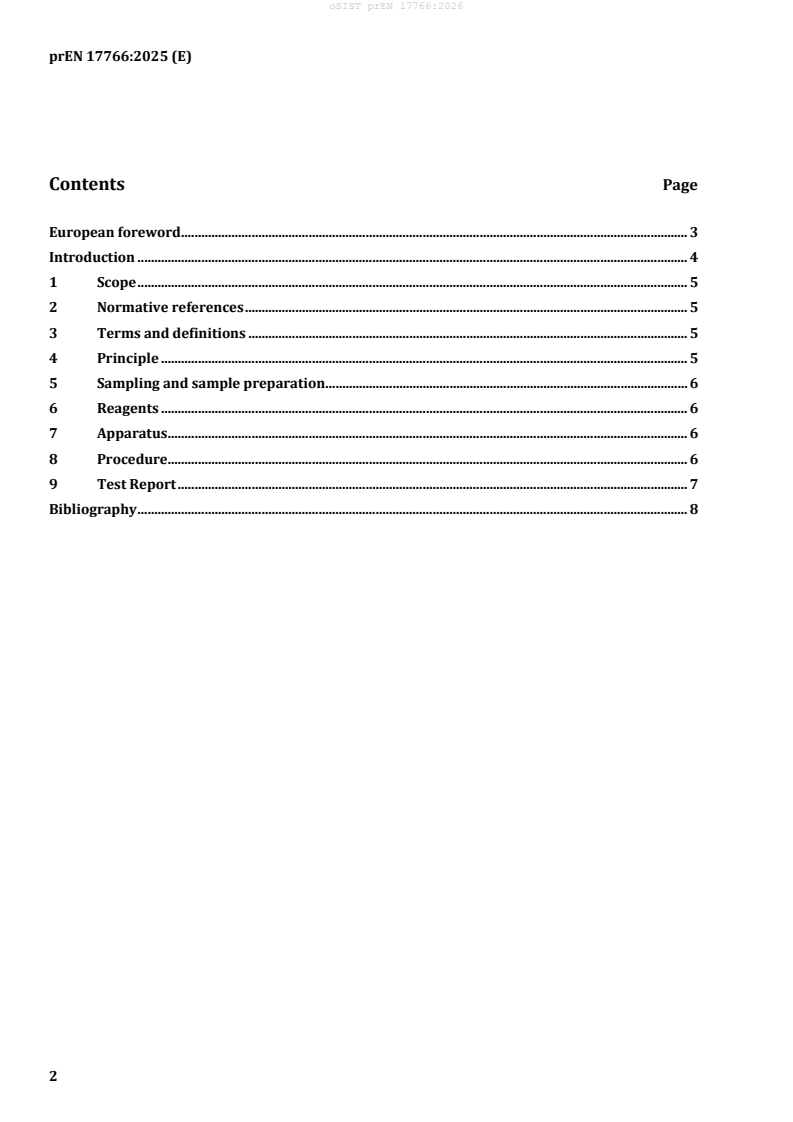
Contents Page
European foreword . 3
Introduction . 4
1 Scope . 5
2 Normative references . 5
3 Terms and definitions . 5
4 Principle . 5
5 Sampling and sample preparation . 6
6 Reagents . 6
7 Apparatus . 6
8 Procedure. 6
9 Test Report . 7
Bibliography . 8
prEN 17766:2025 (E)
European foreword
This document (prEN 17766:2025) has been prepared by Technical Committee CEN/TC 260 “Fertilizers
and liming materials”, the secretariat of which is held by DIN.
This document is currently submitted to the CEN Enquiry.
This document will supersede CEN/TS 17766:2022.
Compared to the previous edition, prEN 17766:2025 includes the following significant technical changes:
— the CEN Technical Specification has been adopted as a European Standard;
— Introduction added;
— Scope (Clause 1) updated including the clarification on fertilizing product blends and the analytical
method to be used;
— Reagents (Clause 6) updated with the addition of nitric acid;
— Apparatus (Clause 7) updated specifying more details and adding a remark regarding the quality of
the laboratory glassware;
— Procedure (Clause 8) updated describing more details on the procedure and making specific
adaptations to procedural changes;
— Bibliography updated.
This document has been prepared under a Standardization Request addressed to CEN by the European
Commission. The Standing Committee of the EFTA States subsequently approves these requests for its
Member States.
prEN 17766:2025 (E)
Introduction
Water is applied to extract available fraction of micronutrients from different matrices for their
subsequent determination by inductively coupled plasma atomic emission spectrometry (ICP-AES). A
similar procedure was applied for extraction of micronutrients from mineral fertilizers [2].
WARNING — Persons using this document should be familiar with usual laboratory practice. This
document does not purport to address all of the safety issues, if any, associated with its use. It is the
responsibility of the user to establish appropriate health and safety practices and to ensure compliance
with any national regulatory conditions.
IMPORTANT — It is absolutely essential that tests condu
...