


SIST EN 16207:2014/oprA1:2019
(Amendment)Railway applications - Braking - Functional and performance criteria of Magnetic Track Brake systems for use in railway rolling stock
Railway applications - Braking - Functional and performance criteria of Magnetic Track Brake systems for use in railway rolling stock
This European Standard specifies the functionality, position, constraints and control of a magnetic track brake system (MTB system) installed in bogies for use in emergency braking and in low adhesion conditions on Mainline Trains up to speeds of 280 km/h. It covers high suspension types of MTB only and not high/low and low suspension type of MTB.
This document also contains test methods and acceptance criteria for an MTB system. It identifies interfaces with electrical equipment, bogie, track and other brake systems.
On the basis of the existing international and national standards, additional requirements are defined for:
- conditions of application for the MTB system;
- retardation and brake forces;
- functional and design features;
- strength requirements;
- type, series and vehicle implementation tests.
For design and calculation a "reference surface" is established.
Bahnanwendungen - Bremse - Anforderungen an Funktion und Leistungsfähigkeit von Magnetschienenbremssystemen für Schienenfahrzeuge
Applications ferroviaires - Freinage - Critères pour la fonction et la performance des systèmes de freinage magnétiques pour véhicules ferroviaires
Železniške naprave - Zavore - Funkcionalna merila in merila za zmogljivost elektromagnetnih zavornih sistemov za železniška vozila - Dopolnilo A1
General Information
- Status
- Not Published
- Public Enquiry End Date
- 16-Jan-2019
- Technical Committee
- IŽNP - Reilway applications
- Current Stage
- 98 - Abandoned project (Adopted Project)
- Start Date
- 21-Nov-2019
- Due Date
- 26-Nov-2019
- Completion Date
- 21-Nov-2019

Relations
- Effective Date
- 11-Sep-2019
- Effective Date
- 24-Jan-2018
Overview
SIST EN 16207:2014/oprA1:2019 is a European standard that defines the functional and performance criteria for Magnetic Track Brake (MTB) systems in railway rolling stock. Developed by the Slovenian Institute for Standardization (SIST), this standard applies specifically to high suspension MTB systems installed in bogies for use on mainline trains at speeds up to 280 km/h. The document outlines essential requirements for MTB systems, focusing on emergency braking and operation under low adhesion conditions.
This standard integrates current international and national guidelines, adding additional criteria for MTB system application, design, installation, and testing. It helps ensure MTB systems are safe, reliable, and interoperable within the European railway network.
Key Topics
- System Functionality and Position: Defines the intended function and physical location of the MTB system within a train’s bogie, ensuring compatibility with high-speed mainline trains.
- Application Conditions: Specifies when and how MTB systems should be used, particularly under emergency and low-adhesion scenarios.
- Retardation and Brake Forces: Sets criteria for the deceleration and braking forces MTB systems must achieve to ensure effective emergency stopping.
- Design and Functional Features: Details design requirements and the functional expectations for MTB systems, supporting ongoing safety and performance improvements.
- Testing and Acceptance: Establishes robust test methods and acceptance criteria, including type, series, and vehicle implementation tests.
- Integration Interfaces: Identifies necessary interfaces between MTB systems, electrical equipment, bogies, tracks, and other braking systems.
- Strength and Reliability: Incorporates strength requirements for MTB components and addresses reliability under varying operational conditions.
- Reference Surfaces: Provides design and calculation methods, including standardized reference surfaces for system evaluation.
Applications
- Emergency Braking: MTB systems as specified in this standard are critical for providing additional braking force during emergency stops, especially when conventional brakes may be less effective.
- Low Adhesion Operation: The standard targets situations where wheel-rail adhesion is reduced (e.g., wet, icy, or leaf-covered tracks), maintaining braking performance and increasing passenger safety.
- Mainline Train Integration: Designed for use on mainline passenger and freight trains, the standard ensures MTB systems can be deployed at speeds up to 280 km/h without compromising safety or operational efficiency.
- Interoperability Compliance: Adoption of this standard supports compliance with European interoperability regulations (per EU Directive 2008/57/EC), easing the certification process for rolling stock across borders.
Related Standards
Organizations and manufacturers applying SIST EN 16207:2014/oprA1:2019 should also consider the following related standards:
- EN 14531-2 - Railway applications related to brake calculations and performance assessment.
- EN 16834:2018 - Specifies requirements and test methods for railway brake systems.
- Commission Regulation No 1302/2014 - Technical Specification for Interoperability (TSI) concerning rolling stock locomotives and passenger stock in the EU.
- Directive 2008/57/EC - Sets essential safety and interoperability requirements for the EU rail system.
SIST EN 16207:2014/oprA1:2019 plays a vital role in enhancing braking safety, reliability, and compatibility for high-speed railway operations, supporting the broader goals of efficiency and interoperability within the European railway sector. Adherence to this standard helps manufacturers and operators meet legal, operational, and safety expectations for modern railway braking systems.
Get Certified
Connect with accredited certification bodies for this standard

IRIS Certification (UNIFE)
International Railway Industry Standard certification.

TÜV SÜD Rail GmbH
TÜV SÜD railway certification services.

Bureau Veritas Railway Certification
Railway and transportation certification.
Sponsored listings
Frequently Asked Questions
SIST EN 16207:2014/oprA1:2019 is a draft published by the Slovenian Institute for Standardization (SIST). Its full title is "Railway applications - Braking - Functional and performance criteria of Magnetic Track Brake systems for use in railway rolling stock". This standard covers: This European Standard specifies the functionality, position, constraints and control of a magnetic track brake system (MTB system) installed in bogies for use in emergency braking and in low adhesion conditions on Mainline Trains up to speeds of 280 km/h. It covers high suspension types of MTB only and not high/low and low suspension type of MTB. This document also contains test methods and acceptance criteria for an MTB system. It identifies interfaces with electrical equipment, bogie, track and other brake systems. On the basis of the existing international and national standards, additional requirements are defined for: - conditions of application for the MTB system; - retardation and brake forces; - functional and design features; - strength requirements; - type, series and vehicle implementation tests. For design and calculation a "reference surface" is established.
This European Standard specifies the functionality, position, constraints and control of a magnetic track brake system (MTB system) installed in bogies for use in emergency braking and in low adhesion conditions on Mainline Trains up to speeds of 280 km/h. It covers high suspension types of MTB only and not high/low and low suspension type of MTB. This document also contains test methods and acceptance criteria for an MTB system. It identifies interfaces with electrical equipment, bogie, track and other brake systems. On the basis of the existing international and national standards, additional requirements are defined for: - conditions of application for the MTB system; - retardation and brake forces; - functional and design features; - strength requirements; - type, series and vehicle implementation tests. For design and calculation a "reference surface" is established.
SIST EN 16207:2014/oprA1:2019 is classified under the following ICS (International Classification for Standards) categories: 45.040 - Materials and components for railway engineering. The ICS classification helps identify the subject area and facilitates finding related standards.
SIST EN 16207:2014/oprA1:2019 has the following relationships with other standards: It is inter standard links to SIST EN 16207:2014+A1:2020, SIST EN 16207:2014. Understanding these relationships helps ensure you are using the most current and applicable version of the standard.
SIST EN 16207:2014/oprA1:2019 is associated with the following European legislation: EU Directives/Regulations: 2008/57/EC, 2016/797/EU; Standardization Mandates: M/483. When a standard is cited in the Official Journal of the European Union, products manufactured in conformity with it benefit from a presumption of conformity with the essential requirements of the corresponding EU directive or regulation.
SIST EN 16207:2014/oprA1:2019 is available in PDF format for immediate download after purchase. The document can be added to your cart and obtained through the secure checkout process. Digital delivery ensures instant access to the complete standard document.
Standards Content (Sample)
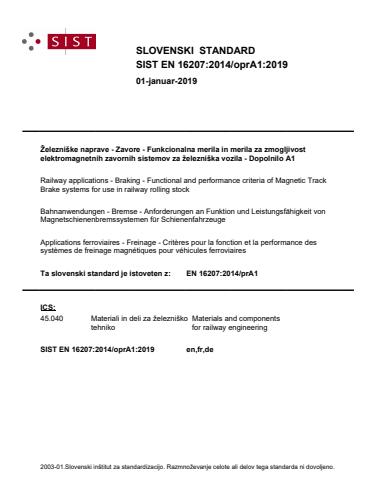
SLOVENSKI STANDARD
01-januar-2019
Železniške naprave - Zavore - Funkcionalna merila in merila za zmogljivost
elektromagnetnih zavornih sistemov za železniška vozila - Dopolnilo A1
Railway applications - Braking - Functional and performance criteria of Magnetic Track
Brake systems for use in railway rolling stock
Bahnanwendungen - Bremse - Anforderungen an Funktion und Leistungsfähigkeit von
Magnetschienenbremssystemen für Schienenfahrzeuge
Applications ferroviaires - Freinage - Critères pour la fonction et la performance des
systèmes de freinage magnétiques pour véhicules ferroviaires
Ta slovenski standard je istoveten z: EN 16207:2014/prA1
ICS:
45.040 Materiali in deli za železniško Materials and components
tehniko for railway engineering
2003-01.Slovenski inštitut za standardizacijo. Razmnoževanje celote ali delov tega standarda ni dovoljeno.
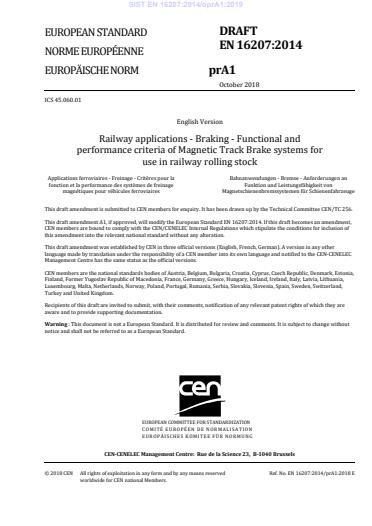
DRAFT
EUROPEAN STANDARD
EN 16207:2014
NORME EUROPÉENNE
EUROPÄISCHE NORM
prA1
October 2018
ICS 45.060.01
English Version
Railway applications - Braking - Functional and
performance criteria of Magnetic Track Brake systems for
use in railway rolling stock
Applications ferroviaires - Freinage - Critères pour la Bahnanwendungen - Bremse - Anforderungen an
fonction et la performance des systèmes de freinage Funktion und Leistungsfähigkeit von
magnétiques pour véhicules ferroviaires Magnetschienenbremssystemen für Schienenfahrzeuge
This draft amendment is submitted to CEN members for enquiry. It has been drawn up by the Technical Committee CEN/TC 256.
This draft amendment A1, if approved, will modify the European Standard EN 16207:2014. If this draft becomes an amendment,
CEN members are bound to comply with the CEN/CENELEC Internal Regulations which stipulate the conditions for inclusion of
this amendment into the relevant national standard without any alteration.
This draft amendment was established by CEN in three official versions (English, French, German). A version in any other
language made by translation under the responsibility of a CEN member into its own language and notified to the CEN-CENELEC
Management Centre has the same status as the official versions.
CEN members are the national standards bodies of Austria, Belgium, Bulgaria, Croatia, Cyprus, Czech Republic, Denmark, Estonia,
Finland, Former Yugoslav Republic of Macedonia, France, Germany, Greece, Hungary, Iceland, Ireland, Italy, Latvia, Lithuania,
Luxembourg, Malta, Netherlands, Norway, Poland, Portugal, Romania, Serbia, Slovakia, Slovenia, Spain, Sweden, Switzerland,
Turkey and United Kingdom.
Recipients of this draft are invited to submit, with their comments, notification of any relevant patent rights of which they are
aware and to provide supporting documentation.
Warning : This document is not a European Standard. It is distributed for review and comments. It is subject to change without
notice and shall not be referred to as a European Standard.
EUROPEAN COMMITTEE FOR STANDARDIZATION
COMITÉ EUROPÉEN DE NORMALISATION
EUROPÄISCHES KOMITEE FÜR NORMUNG
CEN-CENELEC Management Centre: Rue de la Science 23, B-1040 Brussels
© 2018 CEN All rights of exploitation in any form and by any means reserved Ref. No. EN 16207:2014/prA1:2018 E
worldwide for CEN national Members.
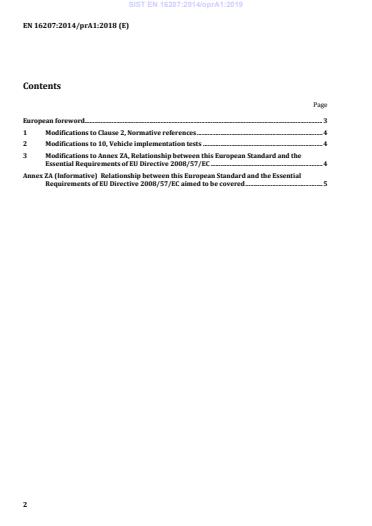
Contents
Page
European foreword . 3
1 Modifications to Clause 2, Normative references . 4
2 Modifications to 10, Vehicle implementation tests . 4
3 Modifications to Annex ZA, Relationship between this European Standard and the
Essential Requirements of EU Directive 2008/57/EC . 4
Annex ZA (Informative) Relationship between this European Standard and the Essential
Requirements of EU Directive 2008/57/EC aimed to be covered . 5
...