

SIST EN 302 217-1 V2.1.1:2013
(Main)Fixed Radio Systems - Characteristics and requirements for point-to-point equipment and antennas - Part 1: Overview and system-independent common characteristics
- Abstract
The present document applies to the following digital fixed radio systems (DFRS), including equipment with integral antenna and antenna types:
-point-to-point systems intended for operation in frequency bands that require co-ordination;
-point-to-point systems intended for operation in frequency bands that do not require co-ordination;
-antennas for point-to-point operation.
The present document summarizes all characteristics, principles, terms and definitions that are common to all P-P equipment and antennas and its consultation is necessary when using all other parts of EN 302 217 series.
EN 302 217-2-1 [i.33] and EN 302 217-4-1 [i.36] summarize the other system dependent characteristics and include limits for "non-essential" requirements, EN 302 217-2-2 [i.34], EN 302 217-3 [i.35] and EN 302 217-4-2 [i.37] contain the whole description and limits of "essential" requirements under article 3.2 of the R&TTE Directive [1]. Health and safety requirements, relevant to article 3.1a of the R&TTE Directive [1] are not considered in any part of this EN 302 217 series. CENELEC is responsible for the relevant standards. EMC conditions and requirements, relevant to article 3.1b of the R&TTE Directive [1] and any other essential requirement relevant to article 3.3 of the R&TTE Directive [1] are not in the scope of any part of this EN 302 217 series. They may be found in EN 301 489-1 [i.26] and EN 301 489-4 [i.27]. NOTE: A list of such harmonised ENs is available on the web site http://www.newapproach.org. For administration's guidance when notifying their regulated interfaces in accordance with article 4.1 of the R&TTE Directive [1], annex B provides explanatory considerations on the applicability of the TCAM-RIG format for P-P fixed links. An example of such a notification is also provided. Annex B has been elaborated in co-ordination with the CEPT ECC WGSE.
- Status
- Published
- Public Enquiry End Date
- 30-Dec-2012
- Publication Date
- 23-Sep-2013
- Technical Committee
- SPN - Services and Protocols for Networks
- Current Stage
- 6060 - National Implementation/Publication (Adopted Project)
- Start Date
- 16-Sep-2013
- Due Date
- 21-Nov-2013
- Completion Date
- 24-Sep-2013
Buy Documents
ETSI EN 302 217-1 V2.0.0 (2012-09) - Fixed Radio Systems; Characteristics and requirements for point-to-point equipment and antennas; Part 1: Overview and system-independent common characteristics
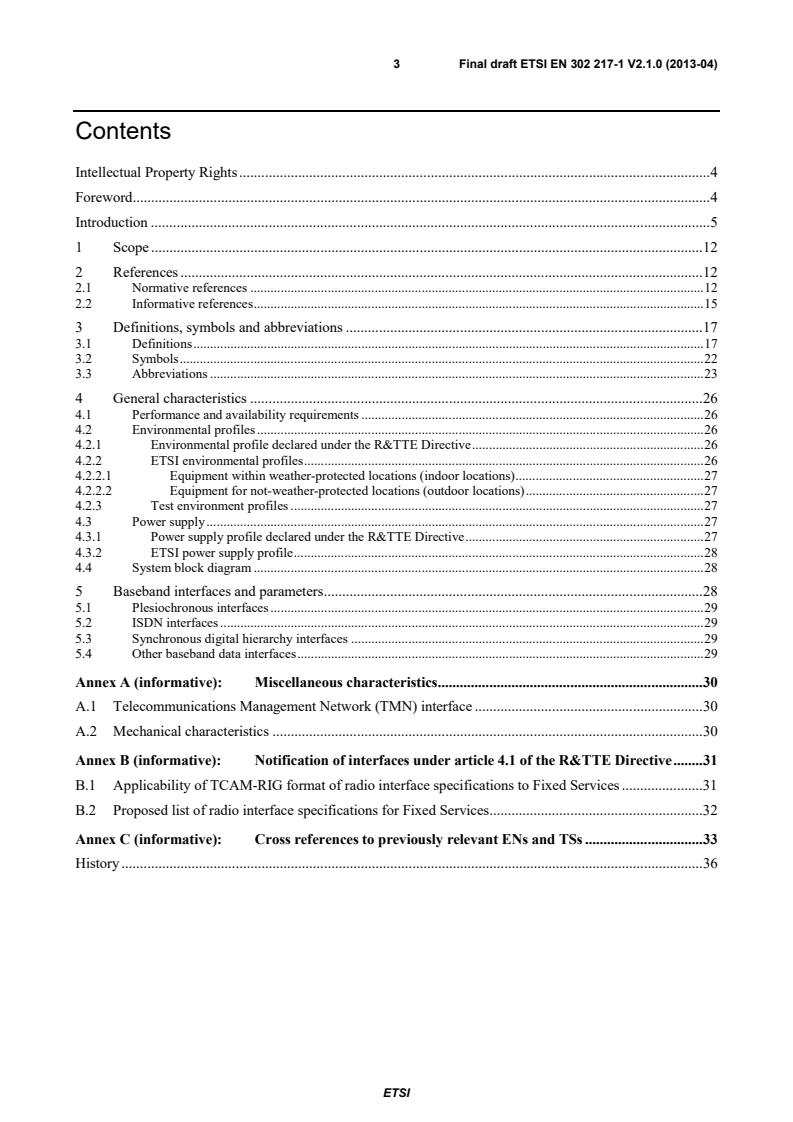
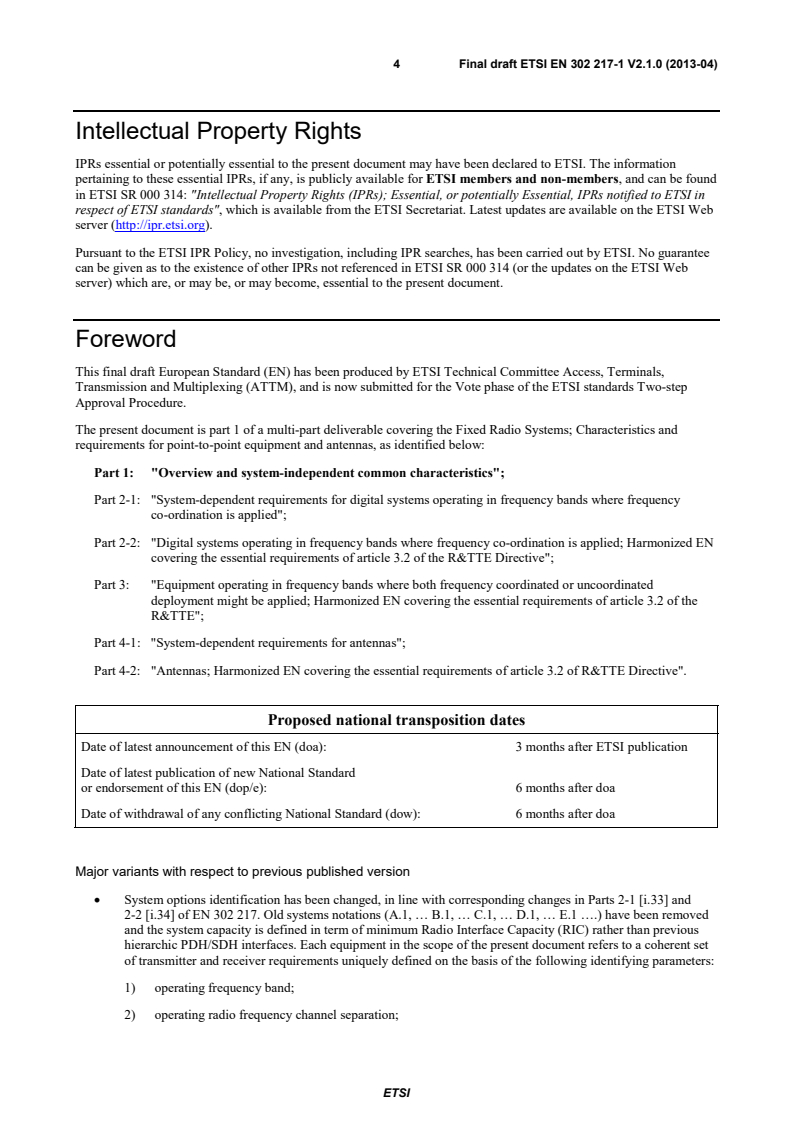
ETSI EN 302 217-1 V2.1.0 (2013-04) - Fixed Radio Systems; Characteristics and requirements for point-to-point equipment and antennas; Part 1: Overview and system-independent common characteristics

ETSI EN 302 217-1 V2.1.1 (2013-07) - Fixed Radio Systems; Characteristics and requirements for point-to-point equipment and antennas; Part 1: Overview and system-independent common characteristics

SIST EN 302 217-1 V2.1.1:2013 is the SIST adoption of ETSI EN 302 217-1 V2.1.1 for fixed radio systems. It covers point-to-point digital fixed radio systems and antennas, and sets the common, system-independent characteristics, terms and definitions used across the EN 302 217 series. Engineers use this part as the entry point for choosing the right companion part and for understanding the shared reference points, interface families and capacity terminology.
What does SIST EN 302 217-1 V2.1.1:2013 specify?
SIST EN 302 217-1 V2.1.1:2013 specifies the common characteristics for point-to-point digital fixed radio systems (DFRS), including equipment with integral antenna and stand-alone antennas. It also explains how the whole EN 302 217 series is structured and how this part relates to the system-dependent and harmonized parts.
The scope covers:
- point-to-point systems in bands that require co-ordination
- point-to-point systems in bands that do not require co-ordination
- antennas for point-to-point operation
The document is organized into clauses on references, definitions, general characteristics, and baseband interfaces, plus informative annexes.
| Annex | What it covers |
|---|---|
| Annex A | Telecommunications Management Network (TMN) interface and mechanical characteristics |
| Annex B | Notification of interfaces under article 4.1 of the R&TTE Directive, including TCAM-RIG guidance |
| Annex C | Cross references to earlier ENs and TSs replaced by this series |
What are the key requirements of SIST EN 302 217-1 V2.1.1:2013?
SIST EN 302 217-1 V2.1.1:2013 does not set the detailed radio limits itself, but it defines the common framework that the rest of the series uses.
Performance, availability and environmental conditions
Clause 4.1 ties design and verification to network performance and availability objectives for the traffic type carried. It points to ITU-T and ITU-R recommendations for error performance, availability and propagation planning, and to IEEE 802.3 and ISO/IEC 8802-3 for Ethernet-related performance. In practice, a supplier or operator needs to match the link design to the service type, such as SDH, ATM, IP or Ethernet.
Clause 4.2 defines three environmental viewpoints: the R&TTE Directive operating profile, voluntary ETSI environmental profiles, and test environmental profiles. For indoor equipment, the relevant profile comes from EN 300 019-1-3; for outdoor equipment, from EN 300 019-1-4, with matching test parts. For antennas, the profile is supplier-declared. This matters because the declared installation environment drives the test severity and the compliance statement.
Power supply and system reference points
Clause 4.3 treats power supply in the same way: the operating limits are declared for R&TTE purposes, while voluntary ETSI profiles use EN 300 132-2 and EN 300 132-3, with EN 302 099 when remote or local powering of user stations is involved. In practice, the equipment documentation has to state the supply conditions it is designed for.
Clause 4.4 gives the system block diagram and the reference points used throughout the series. X and X' are the baseband input reference points, while Z and Z' are the virtual points where Radio Interface Capacity (RIC) is defined. That makes the capacity and test boundaries consistent across the companion parts.
Baseband interfaces
Clause 5 groups the supported traffic interfaces:
- Plesiochronous Digital Hierarchy (PDH) interfaces such as 64 kbit/s, 2 Mbit/s, 8 Mbit/s, 34 Mbit/s and 140 Mbit/s
- Integrated Services Digital Network (ISDN) 2 Mbit/s transmission
- Synchronous Digital Hierarchy (SDH) interfaces, including sSTM-1k, sSTM-2n, STM-0, STM-1 and STM-N options
- other standardized data interfaces, including V.11, V.24, V.28 and Ethernet at 10 Mbit/s, 100 Mbit/s and 1 000 Mbit/s
The supplier declares the offered interface and the standards it follows, so buyers and test labs can verify that the traffic interface matches the intended network.
What terms does SIST EN 302 217-1 V2.1.1:2013 define?
- Digital Fixed Radio System (DFRS) - the fixed point-to-point radio system family covered by the series.
- Channel separation (CS) - the distance between adjacent radio channels, used to identify the equipment option.
- Automatic Transmit Power Control (ATPC) - a function that raises power in deep fading and reduces it otherwise.
- Radio Interface Capacity (RIC) - the maximum user net capacity at the Z/Z' reference points.
- Spectral efficiency class - the class that groups equipment by increasing modulation efficiency and minimum RIC density.
- Radiation Pattern Envelope (RPE) - the envelope that a measured antenna pattern has to fit under.
- Cross-Polar Discrimination (XPD) - the difference between co-polar and cross-polar main beam gain.
Who uses SIST EN 302 217-1 V2.1.1:2013?
Manufacturers and suppliers use it when defining equipment families, declared interfaces and conformity routes. Network operators and planners use it to choose the matching companion part for coordinated or uncoordinated links, backhaul, access and private fixed networks. Test laboratories and conformity assessors use it as the map for the shared terms, reference points and environmental conditions.
What changed in SIST EN 302 217-1 V2.1.1:2013 from the previous edition?
The revision states these main changes:
- system option identification was aligned with the corresponding changes in Parts 2-1 and 2-2
- older system notations were removed
- system capacity is now defined in terms of minimum Radio Interface Capacity rather than the earlier PDH/SDH hierarchy
- equipment is identified by operating frequency band, radio frequency channel separation and spectral efficiency class
- cross references to older source ENs were moved to an annex
- definitions were updated
- frequency bands and equipment options were aligned across the series
Which standards are used with SIST EN 302 217-1 V2.1.1:2013?
The document relies on several companion standards:
- EN 302 217-2-1 and EN 302 217-2-2 - system-dependent requirements for coordinated bands
- EN 302 217-3 - harmonized requirements for bands with coordinated or uncoordinated deployment
- EN 302 217-4-1 and EN 302 217-4-2 - antenna requirements
- EN 300 019-1-3 / -1-4 and EN 300 019-2-3 / -2-4 - indoor and outdoor environmental classes and tests
- EN 300 132-2 / -3 - power supply interface characteristics
- EN 301 126-1 / -3-1 - conformance testing principles and procedures
- EN 301 489-1 / -4 - EMC requirements outside the scope of this series
What does the SIST EN 302 217-1 V2.1.1:2013 document contain?
The document contains a series overview, a system block diagram, reference-point definitions, and interface families for PDH, ISDN, SDH and other data interfaces. It also includes tables that map equipment classes and channel separations to the companion parts, plus annex tables for administrative notification and historical cross-references. Figures and tables are used to support design choice, testing, licensing support and conformity assessment without repeating the detailed limits here.
Buy Documents
ETSI EN 302 217-1 V2.0.0 (2012-09) - Fixed Radio Systems; Characteristics and requirements for point-to-point equipment and antennas; Part 1: Overview and system-independent common characteristics
ETSI EN 302 217-1 V2.1.0 (2013-04) - Fixed Radio Systems; Characteristics and requirements for point-to-point equipment and antennas; Part 1: Overview and system-independent common characteristics
ETSI EN 302 217-1 V2.1.1 (2013-07) - Fixed Radio Systems; Characteristics and requirements for point-to-point equipment and antennas; Part 1: Overview and system-independent common characteristics
Get Certified
Connect with accredited certification bodies for this standard

ANCE
Mexican certification and testing association.

Intertek Slovenia
Intertek testing, inspection, and certification services in Slovenia.

LNE (Laboratoire National de Métrologie et d'Essais)
French national laboratory for metrology and testing.
Sponsored listings
Frequently Asked Questions
SIST EN 302 217-1 V2.1.1:2013 is a standard published by the Slovenian Institute for Standardization (SIST). Its full title is "Fixed Radio Systems - Characteristics and requirements for point-to-point equipment and antennas - Part 1: Overview and system-independent common characteristics". This standard covers: The present document applies to the following digital fixed radio systems (DFRS), including equipment with integral antenna and antenna types: -point-to-point systems intended for operation in frequency bands that require co-ordination; -point-to-point systems intended for operation in frequency bands that do not require co-ordination; -antennas for point-to-point operation. The present document summarizes all characteristics, principles, terms and definitions that are common to all P-P equipment and antennas and its consultation is necessary when using all other parts of EN 302 217 series. EN 302 217-2-1 [i.33] and EN 302 217-4-1 [i.36] summarize the other system dependent characteristics and include limits for "non-essential" requirements, EN 302 217-2-2 [i.34], EN 302 217-3 [i.35] and EN 302 217-4-2 [i.37] contain the whole description and limits of "essential" requirements under article 3.2 of the R&TTE Directive [1]. Health and safety requirements, relevant to article 3.1a of the R&TTE Directive [1] are not considered in any part of this EN 302 217 series. CENELEC is responsible for the relevant standards. EMC conditions and requirements, relevant to article 3.1b of the R&TTE Directive [1] and any other essential requirement relevant to article 3.3 of the R&TTE Directive [1] are not in the scope of any part of this EN 302 217 series. They may be found in EN 301 489-1 [i.26] and EN 301 489-4 [i.27]. NOTE: A list of such harmonised ENs is available on the web site http://www.newapproach.org. For administration's guidance when notifying their regulated interfaces in accordance with article 4.1 of the R&TTE Directive [1], annex B provides explanatory considerations on the applicability of the TCAM-RIG format for P-P fixed links. An example of such a notification is also provided. Annex B has been elaborated in co-ordination with the CEPT ECC WGSE.
The present document applies to the following digital fixed radio systems (DFRS), including equipment with integral antenna and antenna types: -point-to-point systems intended for operation in frequency bands that require co-ordination; -point-to-point systems intended for operation in frequency bands that do not require co-ordination; -antennas for point-to-point operation. The present document summarizes all characteristics, principles, terms and definitions that are common to all P-P equipment and antennas and its consultation is necessary when using all other parts of EN 302 217 series. EN 302 217-2-1 [i.33] and EN 302 217-4-1 [i.36] summarize the other system dependent characteristics and include limits for "non-essential" requirements, EN 302 217-2-2 [i.34], EN 302 217-3 [i.35] and EN 302 217-4-2 [i.37] contain the whole description and limits of "essential" requirements under article 3.2 of the R&TTE Directive [1]. Health and safety requirements, relevant to article 3.1a of the R&TTE Directive [1] are not considered in any part of this EN 302 217 series. CENELEC is responsible for the relevant standards. EMC conditions and requirements, relevant to article 3.1b of the R&TTE Directive [1] and any other essential requirement relevant to article 3.3 of the R&TTE Directive [1] are not in the scope of any part of this EN 302 217 series. They may be found in EN 301 489-1 [i.26] and EN 301 489-4 [i.27]. NOTE: A list of such harmonised ENs is available on the web site http://www.newapproach.org. For administration's guidance when notifying their regulated interfaces in accordance with article 4.1 of the R&TTE Directive [1], annex B provides explanatory considerations on the applicability of the TCAM-RIG format for P-P fixed links. An example of such a notification is also provided. Annex B has been elaborated in co-ordination with the CEPT ECC WGSE.
SIST EN 302 217-1 V2.1.1:2013 is classified under the following ICS (International Classification for Standards) categories: 33.060.30 - Radio relay and fixed satellite communications systems; 33.120.40 - Aerials. The ICS classification helps identify the subject area and facilitates finding related standards.
SIST EN 302 217-1 V2.1.1:2013 is associated with the following European legislation: EU Directives/Regulations: TRRTP124. When a standard is cited in the Official Journal of the European Union, products manufactured in conformity with it benefit from a presumption of conformity with the essential requirements of the corresponding EU directive or regulation.
SIST EN 302 217-1 V2.1.1:2013 is available in PDF format for immediate download after purchase. The document can be added to your cart and obtained through the secure checkout process. Digital delivery ensures instant access to the complete standard document.
Standards Content (Sample)
Draft ETSI EN 302 217-1 V2.0.0 (2012-09)
European Standard
Fixed Radio Systems;
Characteristics and requirements for
point-to-point equipment and antennas;
Part 1: Overview and system-independent
common characteristics
2 Draft ETSI EN 302 217-1 V2.0.0 (2012-09)
Reference
REN/ATTM-04016
Keywords
antenna, DFRS, digital, DRRS, FWA,
point-to-point, radio, transmission
ETSI
650 Route des Lucioles
F-06921 Sophia Antipolis Cedex - FRANCE
Tel.: +33 4 92 94 42 00 Fax: +33 4 93 65 47 16
Siret N° 348 623 562 00017 - NAF 742 C
Association à but non lucratif enregistrée à la
Sous-Préfecture de Grasse (06) N° 7803/88
Important notice
Individual copies of the present document can be downloaded from:
http://www.etsi.org
The present document may be made available in more than one electronic version or in print. In any case of existing or
perceived difference in contents between such versions, the reference version is the Portable Document Format (PDF).
In case of dispute, the reference shall be the printing on ETSI printers of the PDF version kept on a specific network drive
within ETSI Secretariat.
Users of the present document should be aware that the document may be subject to revision or change of status.
Information on the current status of this and other ETSI documents is available at
http://portal.etsi.org/tb/status/status.asp
If you find errors in the present document, please send your comment to one of the following services:
http://portal.etsi.org/chaircor/ETSI_support.asp
Copyright Notification
No part may be reproduced except as authorized by written permission.
The copyright and the foregoing restriction extend to reproduction in all media.
© European Telecommunications Standards Institute 2012.
All rights reserved.
TM TM TM
DECT , PLUGTESTS , UMTS and the ETSI logo are Trade Marks of ETSI registered for the benefit of its Members.
TM
3GPP and LTE™ are Trade Marks of ETSI registered for the benefit of its Members and
of the 3GPP Organizational Partners.
GSM® and the GSM logo are Trade Marks registered and owned by the GSM Association.
ETSI
3 Draft ETSI EN 302 217-1 V2.0.0 (2012-09)
Contents
Intellectual Property Rights . 4
Foreword . 4
Introduction . 5
1 Scope . 12
2 References . 12
2.1 Normative references . 12
2.2 Informative references . 15
3 Definitions, symbols and abbreviations . 17
3.1 Definitions . 17
3.2 Symbols . 22
3.3 Abbreviations . 23
4 General characteristics . 26
4.1 Performance and availability requirements . 26
4.2 Environmental profiles . 26
4.2.1 Environmental profile declared under the R&TTE Directive . 26
4.2.2 ETSI environmental profiles . 26
4.2.2.1 Equipment within weather-protected locations (indoor locations) . 27
4.2.2.2 Equipment for not-weather-protected locations (outdoor locations) . 27
4.2.3 Test environment profiles . 27
4.3 Power supply . 27
4.3.1 Power supply profile declared under the R&TTE Directive . 27
4.3.2 ETSI power supply profile . 28
4.4 System block diagram . 28
5 Baseband interfaces and parameters . 28
5.1 Plesiochronous interfaces . 29
5.2 ISDN interfaces . 29
5.3 Synchronous digital hierarchy interfaces . 29
5.4 Other baseband data interfaces . 29
Annex A (informative): Miscellaneous characteristics . 30
A.1 Telecommunications Management Network (TMN) interface . 30
A.2 Mechanical characteristics . 30
Annex B (informative): Notification of interfaces under article 4.1 of the R&TTE Directive . 31
B.1 Applicability of TCAM-RIG format of radio interface specifications to Fixed Services . 31
B.2 Proposed list of radio interface specifications for Fixed Services . 32
Annex C (informative): Cross references to previously relevant ENs and TSs . 33
History . 36
ETSI
4 Draft ETSI EN 302 217-1 V2.0.0 (2012-09)
Intellectual Property Rights
IPRs essential or potentially essential to the present document may have been declared to ETSI. The information
pertaining to these essential IPRs, if any, is publicly available for ETSI members and non-members, and can be found
in ETSI SR 000 314: "Intellectual Property Rights (IPRs); Essential, or potentially Essential, IPRs notified to ETSI in
respect of ETSI standards", which is available from the ETSI Secretariat. Latest updates are available on the ETSI Web
server (http://ipr.etsi.org).
Pursuant to the ETSI IPR Policy, no investigation, including IPR searches, has been carried out by ETSI. No guarantee
can be given as to the existence of other IPRs not referenced in ETSI SR 000 314 (or the updates on the ETSI Web
server) which are, or may be, or may become, essential to the present document.
Foreword
This draft European Standard (EN) has been produced by ETSI Technical Committee Access, Terminals, Transmission
and Multiplexing (ATTM), and is now submitted for the Public Enquiry phase of the ETSI standards Two-step
Approval Procedure.
The present document is part 1 of a multi-part deliverable covering the Fixed Radio Systems; Characteristics and
requirements for point-to-point equipment and antennas, as identified below:
Part 1: "Overview and system-independent common characteristics";
Part 2-1: "System-dependent requirements for digital systems operating in frequency bands where frequency
co-ordination is applied";
Part 2-2: "Digital systems operating in frequency bands where frequency co-ordination is applied; Harmonized EN
covering the essential requirements of Article 3.2 of the R&TTE Directive";
Part 3: "Equipment operating in frequency bands where both frequency coordinated or uncoordinated
deployment might be applied; Harmonized EN covering the essential requirements of article 3.2 of the
R&TTE";
Part 4-1: "System-dependent requirements for antennas";
Part 4-2: "Antennas; Harmonized EN covering the essential requirements of Article 3.2 of R&TTE Directive".
Proposed national transposition dates
Date of latest announcement of this EN (doa): 3 months after ETSI publication
Date of latest publication of new National Standard
or endorsement of this EN (dop/e): 6 months after doa
Date of withdrawal of any conflicting National Standard (dow): 6 months after doa
Major variants with respect to previous published version
• System options identification has been changed, in line with corresponding changes in Parts 2-1 [i.33] and
2-2 [i.34] of EN 302 217. Old systems notations (A.1, … B.1, … C.1, … D.1, … E.1 ….) have been removed
and the system capacity is defined in term of minimum Radio Interface Capacity (RIC) rather than previous
hierarchic PDH/SDH interfaces. Each equipment in the scope of the present document refers to a coherent set
of transmitter and receiver requirements uniquely defined on the basis of the following identifying parameters:
1) operating frequency band;
2) operating radio frequency channel separation;
ETSI
5 Draft ETSI EN 302 217-1 V2.0.0 (2012-09)
3) spectral efficiency class, to which the minimum RIC density is associated.
• Cross reference to older "historical" source ENs, no longer of interest has been moved to an annex.
• Required new and updated "definitions".
• Alignment of frequency bands and equipment options introduced in other parts of EN 302 217 series.
Introduction
(i) Generality and historical background
Digital Fixed Radio Systems (DFRS), used in European countries, had been historically specified in a relatively large
number of specific European Norms produced by ETSI.
Those previous documents, already superseded by first version of this EN 302 217 series, contained both essential
requirements and other requirements that, even if not considered essential under the Directive 1999/5/EC [1] of the
European Parliament and of the Council of 9 March 1999 on radio equipment and telecommunications terminal
equipment and the mutual recognition of their conformity (hereafter mentioned as the R&TTE Directive) [1], may be
applicable.
Standards for point-to-point systems, including antennas, cover a very large range of traffic capacities, channel
separations (CS), modulation formats and applications over a very wide range of frequency bands that are summarized
in table 1.
Table 1: Digital Fixed Radio Systems (DFRS) parameters
Parameter Range
Frequency bands from 1 GHz to 86 GHz
Traffic capacities from 9,6 kbit/s to 622 Mbit/s and to Gigabit/s and above in the highest bands
Channel separations from 25 kHz to 112 MHz and to Gigahertz and above in the highest bands
Modulation formats from 2 to 2 048 states (amplitude and/or phase and/or frequency modulated
states)
Typical applications POINT-TO-POINT (P-P) CONNECTIONS:
rural and urban low/medium/high capacity links for mobile infrastructure,
transport/trunk (long haul), FWA/BWA/MWA backhaul, access, governmental
(non-military) links, private fixed networks, SAP/SAB P to P audio and video
links
STAND ALONE ANTENNAS:
for all of the above applications when integral antennas are not employed
The regulatory framework for placing radio systems on the market, established by the R&TTE Directive [1] also
requires the availability of Harmonized ENs covering the essential requirements under article 3.2 of the R&TTE
Directive [1]. EN 302 217 series meet this demand by providing a rational subdivision of requirements into general,
system dependent "not essential" and "essential" requirements from the perspective of the R&TTE Directive [1].
Part 1 includes system-independent common characteristics; these requirements are not essential under article 3.2 of the
R&TTE Directive [1].
EN 302 217-2-2 [i.34], EN 302 217-3 [i.35] and EN 302 217-4-2 [i.37] are relevant to essential requirements under
article 3.2 of the R&TTE Directive [1]. Additional system can be added for new available FS bands and for completing
market available options.
ETSI
6 Draft ETSI EN 302 217-1 V2.0.0 (2012-09)
In the present document, equipment is grouped into families of either similar frequency bands or applications. Five
families are identified for frequency bands where frequency co-ordination is applied, corresponding, in both
EN 302 217-2-1 [i.33] and EN 302 217-2-2 [i.34], to annexes referenced from A to E and one family associated with
applications of packet data and combination of other signals mapped into proprietary transport modules, detailed in
annex F.
A frequency bands from 1,4 GHz to 2,7 GHz;
B frequency bands from 3 GHz to 11 GHz (channel separation around 60 MHz and from 1,75 MHz up to around
30 MHz);
C frequency bands from 3 GHz to 11 GHz (channel separation 40 MHz);
D frequency bands 13 GHz, 15 GHz and 18 GHz;
E frequency bands from 23 GHz to 55 GHz;
Ea frequency bands from 71 GHz to 76 GHz and 81 GHz to 86 GHz (additional requirements when link-by-link
coordination is applied);
F definition of equivalent data rates for packet data, PDH/SDH and other signals on the traffic interface.
In the same way EN 302 217-3 [i.35] three families are identified for frequency bands where either co-ordinated or
uncoordinated deployment might be applied (see note), corresponding to annexes referenced from UA to UC.
UA frequency band from 57 GHz to 59 GHz;
UB frequency band from 64 GHz to 66 GHz;
UBa frequency band from 57 GHz to 66 GHz (alternative, in overlapping bands, to UA and UB);
UC frequency bands from 71 GHz to 76 GHz and 81 GHz to 86 GHz.
NOTE: In these bands, CEPT administrations might have different views on the licensing and deployment
requirements, ranging among uncoordinated, user self coordination (sometimes called "light licensing")
or conventional link-by-link coordination. Therefore, from R&TTE Directive [1] point of view, the
minimum of characteristics are considered among essential requirements, unless there is clear evidence
that link-by-link coordination is the predominant method and additional requirements are consequently
defined in EN 302 217-2-2 [i.34]; in this case, the supplier may chose between a "minimal" or a more
complete assessment according the extension of the market addressed.
(ii) Cross references to previously relevant ENs and TSs
The EN 302 217 series replaced and superseded a number of older standards (frequency and/or capacity oriented),
which remained, only as "historical" documents, in the ETSI data base. Provided that they may still be referenced in
some documentation, annex C provides, for information, an overview of the correspondence between equipment
considered in those standards and part/annexes in the present document.
Table 2: Void
(iii) Summary of system options provided
A number of options for equipment implementation are identified in EN 302 217 series; the set of characteristics
applicable to each option is uniquely identified through three parameters:
• operating frequency band;
• operating radio frequency channel separation (CS);
• spectral efficiency class (as defined in EN 302 217-2-2 [i.34]).
Each option so identified has a "nominal" payload requirement in term of minimum RIC (Radio Interface Capacity) to
be fulfilled when packet payloads are used (e.g. Ethernet, ATM, etc.); in case PDH/SDH traffic are alternatively
provided, annex F of EN 302 217-2-2 [i.34] gives the translation from the minimum RIC to the minimum hierarchic
interfaces.
ETSI
7 Draft ETSI EN 302 217-1 V2.0.0 (2012-09)
Table 3 summarizes the relevant cross-reference between channel separation in various Fixed Service frequency bands
and the available options of equipment provided in EN 302 217 series. They are shown in term of the minimum RIC
payload, which, depending on the channel separation, correspond to a specific spectral efficiency class detailed in
clause 1.2 of EN 302 217-2-2 [i.34] (identified, with increasing spectral efficiency, as classes 1, 2, 3, 4L, 4H, 5L, 5H,
6L, 6H 7 and 8). In classes from 5 to 8, two further sub-classes suffix (i.e. A and B) are provided for the same channel
separation depending on whether ACAP or CCDP operation is, respectively, considered for the equipment use.
The minimum RIC payload in tables 3a and 3b are the minimum required for conformance to the present document and
are based on the "minimum RIC density" defined, for each spectral efficiency class, in clause 1.2 of
EN 302 217-2-2 [i.34]. Only some cases of systems in annex A, due to the smaller channel separation provided, are
(exceptionally) labelled with typical gross bit rate rather than minimum RIC capacity rates.
However, equipment may offer a variety of base band interfaces, e.g. typical hierarchical rates PDH or SDH, ISDN,
Ethernet as well as mixture of these or other standardised interfaces. Mapping/multiplexing of the various base-band
interfaces into common frame(s) suitable for radio transmission may be done using standardised higher hierarchical
frames or other proprietary methods.
Tables F.1a through F.1h in annex F of EN 302 217-2-2 [i.34] summarise the "minimum RIC" considered in the present
document and, when only PDH or SDH interfaces are provided, give the equivalent capacity in term of number of
2 048 Mbit/s streams provided as multiple or single multiplexed PDH or SDH interfaces. These minimum capacities
will be associated to the relevant channel separation and spectral efficiency classes defined.
The cells in tables 3a and 3b are filled only on the basis of available physical single equipment transmission capacity
(up to a minimum RIC of 862 Mbit/s for class 8 systems), which is relevant for R&TTE Directive [1]
Art. 3.2 assessment. Doubled capacity is, in principle, possible for any option using CCDP operation or, more in
general, subdividing the payload over two channels; however, specific test procedures are provided in
EN 302 217-2-2 [i.34] only for STM-4 interface or other high speed data interfaces when their payload is split over
more than one equipment.
ETSI
8 Draft ETSI EN 302 217-1 V2.0.0 (2012-09)
Table 3a: Cross reference of available equipment and antenna requirements in parts and annexes of EN 302 217 series:
Bands from 1,4 GHz to 18 GHz
EN 302 217 series
Common requirements � Part 1 (present document) (System independent common characteristics)
Part 4-1 (Antenna general and complementary requirements) and
Antenna requirements �
Part 4-2 (HS for R&TTED Art. 3.2 Antenna characteristics)
Part 2-1 (system-dependent complementary characteristics) and
Equipment requirements �
Part 2-2 (HS for R&TTED Art. 3.2 equipment characteristics)
Relevant annex in Part 2-1 and
A B or D C
Part 2-2 �
1,4; Annex B : 3,5 ; 4 ; U4 ; L6 ; U6 ; 7 ; 8 ; 10,5 ; 11 Annex B : 4, U4,
Frequency band (GHz)� 1,4; 2,4 2,1; 2,6 2,1; 2,6
Annex D : 13 ; 15 ; 18
2,1; 2,6 U6 U6, 8, 11
Channel
27,5 / 28 / 55 / 56 /
separation (MHz) �
CS < 1,75 13,75 / 110
1,75 3,5 7 14 1,75 3,5 7 29 / 29,65 / 58 / 59,3 / 20 40
and 2 14 / 15 (note 1)
Spectral efficiency �
30 60
Reference index � Class �
1 1 (note 2) 2
2 2 (note 2) 2 4 8 16
2 4 8 16 32 64 128
3 3 3 6 12 24 48 96 191
4 4L (note 2) 4 8 16 32 4 8 16 32 64 128 256 45
5 4H sSTM-14 (*) 24 49 98 196 392
6 5L 29 58
6 5LA, 5LB 117 235 470 168
7 5H sSTM-22 (*) 34 68
137 (***)
7 5HA, 5HB 137 274 (**) 548
8 6L 39 78
8 6LA, 6LB 156 313 627 224
9 6H 88
9 6HA, 6HB
176 352 705 252 (**)
10 7 98
10 7A, 7B 196 392 784 280
11 8
8A, 8B 215 431 862 308
Equivalent capacity for
Annex F of parts 2-1 [i.33] and 2-2 [i.34]
hierarchic-only systems
NOTE 1: CS 110 MHz available only in 18 GHz band.
NOTE 2: For channel separations of 2 MHz and other various smaller than 1,75 MHz, only typical "gross bit rates" are defined.
(*): These systems are intended only for the transport of subSTM-0 capacities only in 18 GHz band.
(**): STM-4 capacity as combination of two 2 x STM-1 equipment operating on two channels in ACAP or CCDP or even non adjacent operation is also described.
(***): Minimum RIC 137 Mbit/s option is special provision only for commonality of use of 5HB/28 MHz like equipment modulation also into 40 MHz channel arrangements.
ETSI
Minimum RIC (Mbit/s)
provided with relevant equipment characteristics
9 Draft ETSI EN 302 217-1 V2.0.0 (2012-09)
Table 3b: Cross reference of available equipment and antenna requirements in parts and annexes of EN 302 217 series:
Bands from 23 GHz to 80 GHz
EN 302 217 series
Common requirements � Part 1 (present document) (System independent common characteristics)
Antenna requirements � Part 4-1 (Antenna general and complementary requirements) and Part 4-2 (HS for R&TTED Art. 3.2 Antenna characteristics)
Part 3 (R&TTED
Part 2-1 (system-dependent complementary characteristics) and
Equipment requirements � Art. 3.2 equipment
Part 2-2 (HS for R&TTED Art. 3.2 equipment characteristics)
characteristics)
Relevant annex Part 2-2 � E Ea (note 1) UA UB UBa UC
Frequency band (GHz) � 23, 26, 28, 31, 32, 38, 42 50, 52, 55 71 to 76 and 81 to 86 (note 1)
Spectral efficiency � Channel separation (MHz) Channel separation (MHz) Channel separation (MHz)
Channel size free
or multiple of
Reference Class
3,5 7 14 28 56 112 3,5 7 14 28 56
predefined slots
index � �
1 1 2 4(***) 8(***) 16(***) 32(***) 142 285 427 570 712 855 997 1 140
2 2 4(**) 8 16 32 64 128 4 8 16 32 64(***) 285 570 855 1 140(*) 1 425 1 710 1 995 2 280
3 3 6(**) 12 24 48 96 191 6 12 24 48 96(***) 425 850 1 275 1 700 2 125(*) 2 550 2 975 3 400
4 4L 8(**) 16 32 64 128 256 16 32 64 128(***) 570 1 140(*) 1 710 2 280(*) 2 850
5 4H 24 49 98 196 392 875 1 750 2 625
6 5L
29 58
6 5LA, 5LB 117 235 470 1 050(*) 2 100(*) 3 150(*)
7 5H 34 68
See minimum
274 spectral efficiency
7 5HA, 5HB 137 548 1 225 2 450
(****) reported in the
annexes.
8 6L
39 78
8 6LA, 6LB 156 313 627 1 400 2 800
9 6H 88
9 6HA, 6HB 176 352 705
10 7 98
10 7A, 7B 196 392 784
11 8 107
11 8A, 8B 215 431 862
Equivalent capacity for
Annexes F of parts 2-1 and 2-2
hierarchic only systems
NOTE 1: Requirements for the bands 71 GHz to 76 GHz and 81 GHz to 86 GHz in annex Ea of Part 2-2 [i.34] are "additional" to those reported in annex UC of Part 3 [i.35].
NOTE 2: Alternative, in overlapping bands, to annexes UA and UB.
(*): RIC rounded down to closest N × 1 Gbit/s rate shall also be considered valid.
(**) Not provided in 42 GHz band.
(***): Not provided in 50 GHz band.
(****): STM-4 capacity as combination of two 2 x STM-1 equipment operating on two channels in ACAP or CCDP or even non adjacent operation is also described.
ETSI
Minimum RIC (Mbit/s)
provided with relevant equipment characteristics
1 000
1 250
1 500
1 750
2 000
57 to 59
64 to 66
57 to 66
(note 2)
71 to 76
81 to 86
10 Draft ETSI EN 302 217-1 V2.0.0 (2012-09)
(iv) User's guide
The requirements applicable to a specific point to point digital fixed radio systems (including its antenna) are
summarised in figure 0 showing the major structure of the whole EN 302 217 series. The requirements are subdivided
across the six parts of the EN series corresponding to their four major categories.
The first category (the present document) corresponds to "common" system independent characteristics which are
either common to the whole family of equipment, i.e. performance and availability, environmental profiles, power
supply, system block diagram, TMN interface, mechanical characteristics and baseband interfaces and parameters. The
symbols and abbreviations, which apply to the EN 302 217 series, are listed in the present document. The present
document defines those requirements and characteristics set out in the other parts of EN 302 217 series.
The second category (found in EN 302 217-2-1 [i.33] and EN 302 217-4-1 [i.36]) corresponds to "complementary"
characteristics and requirements, which are not relevant to article 3.2 of the R&TTE Directive [1] but may guarantee
better performance to the actual deployed links. Therefore, the supplier may wish to claim compliance to all or some of
these requirements for showing enhanced characteristics of its product.
However, for completeness, EN 302 217-2-1 [i.33] and EN 302 217-4-1 [i.36] provide comprehensive description of the
"main" and "complementary" requirements, for equipment operating in co-ordinated frequency bands and for
"antennas".
Main requirements are requirements that are also related to the "essential requirements" under article 3.2 of the
R&TTE Directive [1] and are further detailed in EN 302 217-2-2 [i.34], for equipment operating in co-ordinated
frequency bands, and EN 302 217-4-2 [i.37], for antennas.
Complementary requirements are requirements that are not related to essential requirements under article 3.2 of the
R&TTE Directive [1]. Nevertheless they are considered, having been commonly agreed for proper system operation and
deployment when specific deployment conditions or compatibility requirements are present. Compliance to all or some
of these requirements is made on a voluntary basis.
The limits for main and complementary requirements that are not common or parameterized for all of the equipment
covered by one part, but specific to one frequency range, one RIC or PDH/SDH capacity, etc., are located in annexes.
The third category (EN 302 217-2-2 [i.34] and EN 302 217-4-2 [i.37]) is for equipment intended for frequency bands
where link-by-link radio frequency coordination (either under administration control or required to the users in licensing
procedure) over a specific radio frequency channels arrangement is generally used; it corresponds to essential
phenomena, with respect to article 3.2 of the R&TTE Directive [1] and are consequently defined in harmonized
standards. In this case a complete set of TX and RX parameters is retained essential and requirements are provided in
the same format as in EN 302 217-2-1 [i.33] and EN 302 217-4-1 [i.36]. The limiting values associated with the
essential requirements which are not common to all of the equipment covered by one part, but specific to one frequency
range, one RIC or PDH/SDH capacity, etc, are located in annexes. Reference to each annex is the same for
EN 302 217-2-1 [i.33] as in EN 302 217-2-2 [i.34]. An HS-RTT (requirements table) summarizes those requirements to
be addressed in order to claim compliance.
The fourth category (EN 302 217-3 [i.35] and still EN 302 217-4-2 [i.37]) is for equipment intended for frequency
bands where, for their propagation or regulatory nature, the conventional link-by-link radio frequency coordination is
not generally used and a number of administrations may also apply less restrictive (and less protecting) regulatory
measures. It still corresponds to essential phenomena, with respect to article 3.2 of the R&TTE Directive [1] and are
consequently defined as harmonized standards. In this case a reduced set of TX and RX parameters is retained essential;
however, when the coordinated deployment is considered predominant, additional set of requirements is further
included in EN 302 217-2-2 [i.34] and the supplier may chose between the "minimal" or the more complete assessment
according the extension of the market addressed.
To conclude, EN 302 217 series will be used as a decision tree, from the present document down to the relevant
annexes/sub-annexes of parts EN 302 217-2-1 [i.33], EN 302 217-2-2 [i.34] and EN 302 217-3 [i.35].
At every level, a check of compliance is recommended to be performed.
ETSI
11 Draft ETSI EN 302 217-1 V2.0.0 (2012-09)
EN 302 217-2-1 EN 302 217-2-2 (Harmonized Standard)
System dependent requirements for digital systems Digital systems operating in frequency bands where
operating in frequency bands where frequency co- frequency co-ordination is applied; Harmonized EN
ordination is applied covering the essential requirements of Article 3.2 of the
4 General characteristics R&TTE Directive
5 Main requirements 4 Technical requirements
6 Complementary requirements specifications
Annex A Frequency bands 1,4 GHz to 4.1 Environmental profile
2,7 GHz 4.2 Transmitter requirements
Annex B Frequency bands from 3 GHz to 4.3 Receiver requirements
11 GHz (CS up to 30 MHz) 4.4 Antenna directional requirements
Annex C Frequency bands from 3 GHz to 5 Testing for compliance with technical
11 GHz (CS 40 MHz) requirements
Annex D Frequency bands 13 GHz, 15 Annex A (normative) Frequency bands 1,4 GHz to
GHz and 18 GHz 2,7 GHz
Annex E Frequency bands from 23 GHz to Annex B (normative) Frequency bands from 3 GHz to
55 GHz 11 GHz (CS up to 30 MHz and
Annex Ea Frequency bands 71 GHz to 76 56/60 MHz)
GHz and 81 GHz to 86 GHz Annex C (normative) Frequency bands from 3 GHz to 11
Annex F Transmission of Packet Data GHz (CS 40 MHz)
Annex G (informative) Additional information Annex D (normative) Frequency bands 13 GHz, 15 GHz
and 18 GHz
Annex E (normative) Frequency bands from 23 GHz to
EN 302 217-3 (Harmonized Standard)
55 GHz
Equipment operating in frequency bands where both
Annex Ea (normative) Frequency bands 71 GHz to 76 GHz
frequency coordinated or uncoordinated deployment
and 81 GHz to 86 GHz
might be applied. Harmonized EN covering essential
Annex F (normative) Definition of equivalent data rates for
requirements of Article 3.2 of R&TTE Directive
packet data, PDH/SDH and other
4.1 Environmental profile
signals on the traffic interface
4.2 RF channel selection
Annex G (normative) Test report in relation to flexible
4.3 Transmitter requirements
systems applications
4.4 Receiver requirements
Annex H (normative) HS Requirement & conformance
5 Testing for compliance to
Test specifications (HS-RTT)
technical requirements
Annex I (informative) Impact of power control (ATPC
Annex A (normative) HS Requirement & conformance
and/or RTPC), mixed mode and
Test specifications (HS-RTT)
bandwidth adaptive operation on
Annex B (normative) Wide radio frequency band
spectrum mask and link design
covering units and multirate
requirements
equipment specification and tests
Annex J (informative) Typical interference sensitivity
Annex UA (normative) Frequency band around 58 GHz
behaviour for frequency planning
Annex UB (normative) Frequency band 64 GHz to
purpose
66 GHz
Annex UBa (normative) Frequency band 57 GHz to
EN 302 217-4-1
66 GHz
Annex UC (normative) Frequency bands 71 GHz to System dependent requirements for antennas
76 GHz and 81 GHz to 86 GHz 4 Frequency bands
Annex UD (informative) Rationale for the interference limit 5 Classification of antennas
formula 6 Electrical characteristics
Annex UE (informative) Capacity and Receiver Annex A (normative) Standardized RPE for Class 1
characteristics in the bands antennas in bands 3 GHz to 86 GHz
64 GHz to 66 GHz, 71 GHz to Annex B (informative) Additional information
76 GHz and 81 GHz to 86 GHz Annex C (informative) Antenna gain and RPE information
EN 302 217-4-2 (Harmonized Standard)
Antennas; Harmonized EN covering the essential
requirements of article 3.2 of R&TTE Directive
4 Technical requirements specifications
4.1 Environmental profile
4.2 Radiation Pattern Envelope (RPE)
4.3 Cross-Polar Discrimination (XPD)
4.4 Antenna gain
5 Testing for compliance with technical
requirements
Annex A (normative) HS Requirement & conformance Test
specifications (HS-RTT)
Figure 0: Structure of this EN 302 217 series
ETSI
12 Draft ETSI EN 302 217-1 V2.0.0 (2012-09)
1 Scope
The present document applies to the following digital fixed radio systems (DFRS), including equipment with integral
antenna and antenna types:
• point-to-point systems intended for operation in frequency bands that require co-ordination;
• point-to-point systems intended for operation in frequency bands that do not require co-ordination;
• antennas for point-to-point operation.
The present document summarizes all characteristics, principles, terms and definitions that are common to all
P-P equipment and antennas and its consultation is necessary when using all other parts of EN 302 217 series.
EN 302 217-2-1 [i.33] and EN 302 217-4-1 [i.36] summarize the other system dependent characteristics and include
limits for "non-essential" requirements, EN 302 217-2-2 [i.34], EN 302 217-3 [i.35] and EN 302 217-4-2 [i.37] contain
the whole description and limits of "essential" requirements under article 3.2 of the R&TTE Directive [1].
Health and safety requirements, relevant to article 3.1a of the R&TTE Directive [1] are not considered in any part of
this EN 302 217 series. CENELEC is responsible for the relevant standards.
EMC conditions and requirements, relevant to article 3.1b of the R&TTE Directive [1] and any other essential
requirement relevant to article 3.3 of the R&TTE Directive [1] are not in the scope of any part of this EN 302 217
series. They may be found in EN 301 489-1 [i.26] and EN 301 489-4 [i.27].
NOTE: A list of such harmonised ENs is available on the web site http://www.newapproach.org.
For administration's guidance when notifying their regulated interfaces in accordance with article 4.1 of the
R&TTE Directive [1], annex B provides explanatory considerations on the applicability of the TCAM-RIG format for
P-P fixed links. An example of such a notification is also provided. Annex B has been elaborated in co-ordination with
the CEPT ECC WG SE.
2 References
References are either specific (identified by date of publication and/or edition number or version number) or
non-specific. For specific references, only the cited version applies. For non-specific references, the latest version of the
reference document (including any amendments) applies.
Referenced documents which are not found to be publicly available in the expected location might be found at
http://docbox.etsi.org/Reference.
NOTE: While any hyperlinks included in this clause were valid at the time of publication, ETSI cannot guarantee
their long term validity.
2.1 Normative references
The following referenced documents are necessary for the application of the present document.
[1] Directive 1999/5/EC of the European Parliament and of the Council of 9 March 1999 on radio
equipment and telecommunications terminal equipment and the mutual recognition of their
conformity (R&TTE Directive).
[2] ETSI EN 300 019-1-0: "Environmental Engineering (EE); Environmental conditions and
environmental tests for telecommunications equipment; Part 1-0: Classification of environmental
conditions; Introduction".
[3] ETSI EN 300 019-2-0: "Environmental Engineering (EE); Environmental conditions and
environmental tests for telecommunications equipment; Part 2-0: Specification of environmental
tests; Introduction".
ETSI
13 Draft ETSI EN 302 217-1 V2.0.0 (2012-09)
[4] ETSI EN 300 019-1-1: "Environmental Engineering (EE); Environmental conditions and
environmental tests for telecommunications equipment; Part 1-1: Classification of environmental
conditions; Storage".
[5] ETSI EN 300 019-2-1: "Environmental Engineering (EE); Environmental conditions and
environmental tests for telecommunications equipment; Part 2-1: Specification of environmental
tests; Storage".
[6] ETSI EN 300 019-1-2: "Environmental Engineering (EE); Environmental conditions and
environmental tests for telecommunications equipment; Part 1-2: Classification of environmental
conditions; Transportation".
[7] ETSI EN 300 019-2-2: "Equipment Engineering (EE); Environmental conditions and
environmental tests for telecommunications equipment; Part 2-2: Specification of environmental
tests; Transportation".
[8] ETSI EN 300 019-1-3: "Environmental Engineering (EE); Environmental conditions and
environmental tests for telecommunications equipment; Part 1-3: Classification of environmental
conditions; Stationary use at weatherprotected locations".
[9] ETSI EN 300 019-2-3: "Environmental Engineering (EE); Environmental conditions and
environmental tests for telecommunications equipment; Part 2-3: Specification of environmental
tests; Stationary use at weatherprotected locations".
[10] ETSI EN 300 019-1-4: "Environmental Engineering (EE); Environmental conditions and
environmental tests for telecommunications equipment; Part 1-4: Classification of environmental
conditions; Stationary use at non-weatherprotected locations".
[11] ETSI EN 300 019-2-4: "Environmental Engineering (EE); Environmental conditions and
environmental tests for telecommunications equipment; Part 2-4: Specification of environmental
tests; Stationary use at non-weatherprotected locations".
[12] ETSI EN 300 132-2: "Environmental Engineering (EE); Power supply interface at the input to
telecommunications equipment; Part 2: Operated by direct current (dc)".
[13] ETSI EN 300 132-3: "Environmental Engineering (EE); Power supply interface at the input to
telecommunications equipment; Part 3: Operated by rectified current source, alternating current
source or direct current source up to 400 V".
[14] ETSI ETS 300 233: "Integrated Services Digital Network (ISDN); Access digital section for ISDN
primary rate".
[15] ETSI EN 301 126-1: "Fixed Radio Systems; Conformance testing; Part 1: Point-to-Point
equipment - Definitions, general requirements and test procedures".
[16] ETSI EN 302 099: "Environmental Engineering (EE); Powering of equipment in access network".
[17] ETSI EN 301 126-3-1: "Fixed Radio Systems; Conformance testing; Part 3-1: Point-to-Point
antennas; Definitions, general requirements and test procedures".
[18] IEEE 802.3-2008: "IEEE Standard for Information Technology - Telecommunications and
Information Exchange Between Systems - Local and Metropolitan Area Networks - Specific
Requirements Part 3: Carrier Sense Multiple Access with Collision Detection (CSMA/CD) Access
Method and Physical Layer Specifications".
[19] ISO/IEC 8802-3: "Information technology -- Telecommunications and information exchange
between systems -- Local and metropolitan area networks -- Specific requirements Part 3: Carrier
sense multiple access with collision detection (CSMA/CD) access method and physical layer
specifications".
[20] ITU-R Recommendation F.746: "Radio-frequency arrangements for fixed service systems".
[21] ITU-R Recommendation F.750: "Architectures and functional aspects of radio-relay systems for
synchronous digital hierarchy (SDH)-based network".
[22] ITU-R Recommendation F.752: "Diversity techniques for point-to-point fixed wireless systems".
ETSI
14 Draft ETSI EN 302 217-1 V2.0.0 (2012-09)
[23] ITU-R Recommendation F.1093: "Effects of multipath propagation on the design and operation of
line-of-sight digital fixed wireless systems".
[24] ITU-R Recommendation F.1101: "Characteristics of digital fixed wireless systems below about
17 GHz".
[25] ITU-R Recommendation F.1102: "Characteristics of fixed wireless systems operating in frequency
bands above about 17 GHz".
[26] ITU-R Recommendation F.1668: "Error performance objectives for real digital fixed wireless links
used in 27 500 km hypothetical reference paths and connections".
[27] ITU-R Recommendation F.1703: "Availability objectives for real digital fixed wireless links used
in 27 500 km hypothetical reference paths and connections".
[28] ITU-R Recommendation P.530: "Propagation data and prediction methods required for the design
of terrestrial line-of-sight systems".
[29] ITU-T Recommendation G.703: "Physical/electrical characteristics of hierarchical digital
interfaces".
[30] ITU-T Recommendation G.704: "Synchronous frame structures used at 1544, 6312, 2048, 8448
and 44 736 kbit/s hierarchical levels".
[31] ITU-T Recommendation G.707: "Network node interface for the synchronous digital hierarchy
(SDH)".
[32] ITU-T Recommendation G.708: "Sub STM-0 network node interface for the synchronous digital
hierarchy (SDH)".
[33] ITU-T Recommendation G.826: "End-to-end error performance parameters and objectives for
international, constant bit-rate digital paths and connections".
[34] ITU-T Recommendation G.828: "Error performance parameters and objectives for international,
constant bit-rate synchronous digital paths".
[35] ITU-T Recommendation G.829: "Error performance events for SDH multiplex and regenerator
sections".
[36] ITU-T Recommendation G.957: "Optical interfaces for equipments and systems relating to the
synchronous digital hierarchy".
[37] ITU-T Recommendation I.356: "B-ISDN ATM layer cell transfer performance".
[38] ITU-T Recommendation I.357: "B-ISDN semi-permanent connection availability".
[39] ITU-T Recommendation I.412: "ISDN user-network interfaces - Interface structures and access
capabilities".
[40] ITU-T Recommendation V.11: "Electrical characteristics for balanced double-current interchange
circuits operating at data signalling rates up to 10 Mbit/s".
[41] ITU-T Recommendation V.24: "List of definitions for interchange circuits between data terminal
equipment (DTE) and data circuit-terminating equipment (DCE)".
[42] ITU-T Recommendation V.28: "Electrical characteristics for unbalanced double-current
interchange circuits".
[43] ITU-T Recommendation Y.1540: "Internet protocol data communication service - IP packet
transfer and availability performance parameters".
ETSI
15 Draft ETSI EN 302 217-1 V2.0.0 (2012-09)
2.2 Informative references
The following referenced documents are not necessary for the application of the present document but they assist the
user with regard to a particular subject area.
[i.1] ETSI TR 101 035: "Transmission and Multiplexing (TM); Synchronous Digital Hierarchy (SDH)
aspects regarding Digital Radio Relay Systems (DRRS)".
[i.2] CEPT/ECC/REC 01-05: "List of parameters of digital point-to-point fixed radio links used for
national planning".
[i.3] CEPT/ERC/REC 12-03: "Harmonized radio frequency channel arrangements for digital terrestrial
fixed systems operating in the band 17,7 GHz to 19,7 GHz".
[i.4] ETSI EN 300 197 (historical): "Fixed
...
Final draft ETSI EN 302 217-1 V2.1.0 (2013-04)
European Standard
Fixed Radio Systems;
Characteristics and requirements for
point-to-point equipment and antennas;
Part 1: Overview and system-independent
common characteristics
2 Final draft ETSI EN 302 217-1 V2.1.0 (2013-04)
Reference
REN/ATTM-04016
Keywords
antenna, DFRS, digital, DRRS, FWA,
point-to-point, radio, transmission
ETSI
650 Route des Lucioles
F-06921 Sophia Antipolis Cedex - FRANCE
Tel.: +33 4 92 94 42 00 Fax: +33 4 93 65 47 16
Siret N° 348 623 562 00017 - NAF 742 C
Association à but non lucratif enregistrée à la
Sous-Préfecture de Grasse (06) N° 7803/88
Important notice
Individual copies of the present document can be downloaded from:
http://www.etsi.org
The present document may be made available in more than one electronic version or in print. In any case of existing or
perceived difference in contents between such versions, the reference version is the Portable Document Format (PDF).
In case of dispute, the reference shall be the printing on ETSI printers of the PDF version kept on a specific network drive
within ETSI Secretariat.
Users of the present document should be aware that the document may be subject to revision or change of status.
Information on the current status of this and other ETSI documents is available at
http://portal.etsi.org/tb/status/status.asp
If you find errors in the present document, please send your comment to one of the following services:
http://portal.etsi.org/chaircor/ETSI_support.asp
Copyright Notification
No part may be reproduced except as authorized by written permission.
The copyright and the foregoing restriction extend to reproduction in all media.
© European Telecommunications Standards Institute 2013.
All rights reserved.
TM TM TM
DECT , PLUGTESTS , UMTS and the ETSI logo are Trade Marks of ETSI registered for the benefit of its Members.
TM
3GPP and LTE™ are Trade Marks of ETSI registered for the benefit of its Members and
of the 3GPP Organizational Partners.
GSM® and the GSM logo are Trade Marks registered and owned by the GSM Association.
ETSI
3 Final draft ETSI EN 302 217-1 V2.1.0 (2013-04)
Contents
Intellectual Property Rights . 4
Foreword . 4
Introduction . 5
1 Scope . 12
2 References . 12
2.1 Normative references . 12
2.2 Informative references . 15
3 Definitions, symbols and abbreviations . 17
3.1 Definitions . 17
3.2 Symbols . 22
3.3 Abbreviations . 23
4 General characteristics . 26
4.1 Performance and availability requirements . 26
4.2 Environmental profiles . 26
4.2.1 Environmental profile declared under the R&TTE Directive . 26
4.2.2 ETSI environmental profiles . 26
4.2.2.1 Equipment within weather-protected locations (indoor locations) . 27
4.2.2.2 Equipment for not-weather-protected locations (outdoor locations) . 27
4.2.3 Test environment profiles . 27
4.3 Power supply . 27
4.3.1 Power supply profile declared under the R&TTE Directive . 27
4.3.2 ETSI power supply profile . 28
4.4 System block diagram . 28
5 Baseband interfaces and parameters . 28
5.1 Plesiochronous interfaces . 29
5.2 ISDN interfaces . 29
5.3 Synchronous digital hierarchy interfaces . 29
5.4 Other baseband data interfaces . 29
Annex A (informative): Miscellaneous characteristics . 30
A.1 Telecommunications Management Network (TMN) interface . 30
A.2 Mechanical characteristics . 30
Annex B (informative): Notification of interfaces under article 4.1 of the R&TTE Directive . 31
B.1 Applicability of TCAM-RIG format of radio interface specifications to Fixed Services . 31
B.2 Proposed list of radio interface specifications for Fixed Services . 32
Annex C (informative): Cross references to previously relevant ENs and TSs . 33
History . 36
ETSI
4 Final draft ETSI EN 302 217-1 V2.1.0 (2013-04)
Intellectual Property Rights
IPRs essential or potentially essential to the present document may have been declared to ETSI. The information
pertaining to these essential IPRs, if any, is publicly available for ETSI members and non-members, and can be found
in ETSI SR 000 314: "Intellectual Property Rights (IPRs); Essential, or potentially Essential, IPRs notified to ETSI in
respect of ETSI standards", which is available from the ETSI Secretariat. Latest updates are available on the ETSI Web
server (http://ipr.etsi.org).
Pursuant to the ETSI IPR Policy, no investigation, including IPR searches, has been carried out by ETSI. No guarantee
can be given as to the existence of other IPRs not referenced in ETSI SR 000 314 (or the updates on the ETSI Web
server) which are, or may be, or may become, essential to the present document.
Foreword
This final draft European Standard (EN) has been produced by ETSI Technical Committee Access, Terminals,
Transmission and Multiplexing (ATTM), and is now submitted for the Vote phase of the ETSI standards Two-step
Approval Procedure.
The present document is part 1 of a multi-part deliverable covering the Fixed Radio Systems; Characteristics and
requirements for point-to-point equipment and antennas, as identified below:
Part 1: "Overview and system-independent common characteristics";
Part 2-1: "System-dependent requirements for digital systems operating in frequency bands where frequency
co-ordination is applied";
Part 2-2: "Digital systems operating in frequency bands where frequency co-ordination is applied; Harmonized EN
covering the essential requirements of article 3.2 of the R&TTE Directive";
Part 3: "Equipment operating in frequency bands where both frequency coordinated or uncoordinated
deployment might be applied; Harmonized EN covering the essential requirements of article 3.2 of the
R&TTE";
Part 4-1: "System-dependent requirements for antennas";
Part 4-2: "Antennas; Harmonized EN covering the essential requirements of article 3.2 of R&TTE Directive".
Proposed national transposition dates
Date of latest announcement of this EN (doa): 3 months after ETSI publication
Date of latest publication of new National Standard
or endorsement of this EN (dop/e): 6 months after doa
Date of withdrawal of any conflicting National Standard (dow): 6 months after doa
Major variants with respect to previous published version
• System options identification has been changed, in line with corresponding changes in Parts 2-1 [i.33] and
2-2 [i.34] of EN 302 217. Old systems notations (A.1, … B.1, … C.1, … D.1, … E.1 ….) have been removed
and the system capacity is defined in term of minimum Radio Interface Capacity (RIC) rather than previous
hierarchic PDH/SDH interfaces. Each equipment in the scope of the present document refers to a coherent set
of transmitter and receiver requirements uniquely defined on the basis of the following identifying parameters:
1) operating frequency band;
2) operating radio frequency channel separation;
ETSI
5 Final draft ETSI EN 302 217-1 V2.1.0 (2013-04)
3) spectral efficiency class, to which the minimum RIC density is associated.
• Cross reference to older "historical" source ENs, no longer of interest has been moved to an annex.
• Required new and updated "definitions".
• Alignment of frequency bands and equipment options introduced in other parts of EN 302 217 series.
Introduction
(i) Generality and historical background
Digital Fixed Radio Systems (DFRS), used in European countries, had been historically specified in a relatively large
number of specific European Norms produced by ETSI.
Those previous documents, already superseded by first version of this EN 302 217 series, contained both essential
requirements and other requirements that, even if not considered essential under the Directive 1999/5/EC [1] of the
European Parliament and of the Council of 9 March 1999 on radio equipment and telecommunications terminal
equipment and the mutual recognition of their conformity (hereafter mentioned as the R&TTE Directive) [1], may be
applicable.
Standards for point-to-point systems, including antennas, cover a very large range of traffic capacities, channel
separations (CS), modulation formats and applications over a very wide range of frequency bands that are summarized
in table 1.
Table 1: Digital Fixed Radio Systems (DFRS) parameters
Parameter Range
Frequency bands from 1 GHz to 86 GHz
Traffic capacities from 9,6 kbit/s to 622 Mbit/s and to Gigabit/s and above in the highest bands
Channel separations from 25 kHz to 112 MHz and to Gigahertz and above in the highest bands
Modulation formats from 2 to 2 048 states (amplitude and/or phase and/or frequency modulated
states)
Typical applications POINT-TO-POINT (P-P) CONNECTIONS:
rural and urban low/medium/high capacity links for mobile infrastructure,
transport/trunk (long haul), FWA/BWA/MWA backhaul, access, governmental
(non-military) links, private fixed networks, SAP/SAB P to P audio and video
links
STAND ALONE ANTENNAS:
for all of the above applications when integral antennas are not employed
The regulatory framework for placing radio systems on the market, established by the R&TTE Directive [1] also
requires the availability of Harmonized ENs covering the essential requirements under article 3.2 of the R&TTE
Directive [1]. EN 302 217 series meet this demand by providing a rational subdivision of requirements into general,
system dependent "not essential" and "essential" requirements from the perspective of the R&TTE Directive [1].
Part 1 includes system-independent common characteristics; these requirements are not essential under article 3.2 of the
R&TTE Directive [1].
EN 302 217-2-2 [i.34], EN 302 217-3 [i.35] and EN 302 217-4-2 [i.37] are relevant to essential requirements under
article 3.2 of the R&TTE Directive [1]. Additional system can be added for new available FS bands and for completing
market available options.
ETSI
6 Final draft ETSI EN 302 217-1 V2.1.0 (2013-04)
In the present document, equipment is grouped into families of either similar frequency bands or applications. Five
families are identified for frequency bands where frequency co-ordination is applied, corresponding, in both
EN 302 217-2-1 [i.33] and EN 302 217-2-2 [i.34], to annexes referenced from A to E and one family associated with
applications of packet data and combination of other signals mapped into proprietary transport modules, detailed in
annex F.
A frequency bands from 1,4 GHz to 2,7 GHz;
B frequency bands from 3 GHz to 11 GHz (channel separation around 60 MHz and from 1,75 MHz up to around
30 MHz);
C frequency bands from 3 GHz to 11 GHz (channel separation 40 MHz);
D frequency bands 13 GHz, 15 GHz and 18 GHz;
E frequency bands from 23 GHz to 55 GHz;
Ea frequency bands from 71 GHz to 76 GHz and 81 GHz to 86 GHz (additional requirements when link-by-link
coordination is applied);
F definition of equivalent data rates for packet data, PDH/SDH and other signals on the traffic interface.
In the same way EN 302 217-3 [i.35] three families are identified for frequency bands where either co-ordinated or
uncoordinated deployment might be applied (see note), corresponding to annexes referenced from UA to UC.
UA frequency band from 57 GHz to 59 GHz;
UB frequency band from 64 GHz to 66 GHz;
UBa frequency band from 57 GHz to 66 GHz (alternative, in overlapping bands, to UA and UB);
UC frequency bands from 71 GHz to 76 GHz and 81 GHz to 86 GHz.
NOTE: In these bands, CEPT administrations might have different views on the licensing and deployment
requirements, ranging among uncoordinated, user self coordination (sometimes called "light licensing")
or conventional link-by-link coordination. Therefore, from R&TTE Directive [1] point of view, the
minimum of characteristics are considered among essential requirements, unless there is clear evidence
that link-by-link coordination is the predominant method and additional requirements are consequently
defined in EN 302 217-2-2 [i.34]; in this case, the supplier may chose between a "minimal" or a more
complete assessment according the extension of the market addressed.
(ii) Cross references to previously relevant ENs and TSs
The EN 302 217 series replaced and superseded a number of older standards (frequency and/or capacity oriented),
which remained, only as "historical" documents, in the ETSI data base. Provided that they may still be referenced in
some documentation, annex C provides, for information, an overview of the correspondence between equipment
considered in those standards and part/annexes in the present document.
Table 2: Void
(iii) Summary of system options provided
A number of options for equipment implementation are identified in EN 302 217 series; the set of characteristics
applicable to each option is uniquely identified through three parameters:
• operating frequency band;
• operating radio frequency channel separation (CS);
• spectral efficiency class (as defined in EN 302 217-2-2 [i.34]).
Each option so identified has a "nominal" payload requirement in term of minimum RIC (Radio Interface Capacity) to
be fulfilled when packet payloads are used (e.g. Ethernet, ATM, etc.); in case PDH/SDH traffic are alternatively
provided, annex F of EN 302 217-2-2 [i.34] gives the translation from the minimum RIC to the minimum hierarchic
interfaces.
ETSI
7 Final draft ETSI EN 302 217-1 V2.1.0 (2013-04)
Table 3 summarizes the relevant cross-reference between channel separation in various Fixed Service frequency bands
and the available options of equipment provided in EN 302 217 series. They are shown in term of the minimum RIC
payload, which, depending on the channel separation, correspond to a specific spectral efficiency class detailed in
clause 1.2 of EN 302 217-2-2 [i.34] (identified, with increasing spectral efficiency, as classes 1, 2, 3, 4L, 4H, 5L, 5H,
6L, 6H 7 and 8). In classes from 5 to 8, two further sub-classes suffix (i.e. A and B) are provided for the same channel
separation depending on whether ACAP or CCDP operation is, respectively, considered for the equipment use.
The minimum RIC payload in tables 3a and 3b are the minimum required for conformance to the present document and
are based on the "minimum RIC density" defined, for each spectral efficiency class, in clause 1.2 of
EN 302 217-2-2 [i.34]. Only some cases of systems in annex A, due to the smaller channel separation provided, are
(exceptionally) labelled with typical gross bit rate rather than minimum RIC capacity rates.
However, equipment may offer a variety of base band interfaces, e.g. typical hierarchical rates PDH or SDH, ISDN,
Ethernet as well as mixture of these or other standardised interfaces. Mapping/multiplexing of the various base-band
interfaces into common frame(s) suitable for radio transmission may be done using standardised higher hierarchical
frames or other proprietary methods.
Tables F.1a through F.1h in annex F of EN 302 217-2-2 [i.34] summarise the "minimum RIC" considered in the present
document and, when only PDH or SDH interfaces are provided, give the equivalent capacity in term of number of
2 048 Mbit/s streams provided as multiple or single multiplexed PDH or SDH interfaces. These minimum capacities
will be associated to the relevant channel separation and spectral efficiency classes defined.
The cells in tables 3a and 3b are filled only on the basis of available physical single equipment transmission capacity
(up to a minimum RIC of 862 Mbit/s for class 8 systems), which is relevant for R&TTE Directive [1]
Art. 3.2 assessment. Doubled capacity is, in principle, possible for any option using CCDP operation or, more in
general, subdividing the payload over two channels; however, specific test procedures are provided in
EN 302 217-2-2 [i.34] only for STM-4 interface or other high speed data interfaces when their payload is split over
more than one equipment.
ETSI
8 Final draft ETSI EN 302 217-1 V2.1.0 (2013-04)
Table 3a: Cross reference of available equipment and antenna requirements in parts and annexes of EN 302 217 series:
Bands from 1,4 GHz to 18 GHz
EN 302 217 series
Common requirements � Part 1 (present document) (System independent common characteristics)
Part 4-1 (Antenna general and complementary requirements) and
Antenna requirements �
Part 4-2 (HS for R&TTED Art. 3.2 Antenna characteristics)
Part 2-1 (system-dependent complementary characteristics) and
Equipment requirements �
Part 2-2 (HS for R&TTED Art. 3.2 equipment characteristics)
Relevant annex in Part 2-1 and
A B or D C
Part 2-2 �
1,4; Annex B : 3,5 ; 4 ; U4 ; L6 ; U6 ; 7 ; 8 ; 10,5 ; 11 Annex B : 4, U4,
Frequency band (GHz)� 1,4; 2,4 2,1; 2,6 2,1; 2,6
Annex D : 13 ; 15 ; 18
2,1; 2,6 U6 U6, 8, 11
Channel
27,5 / 28 / 55 / 56 /
separation (MHz) �
CS < 1,75 13,75 / 110
1,75 3,5 7 14 1,75 3,5 7 29 / 29,65 / 58 / 59,3 / 20 40
and 2 14 / 15 (note 1)
Spectral efficiency �
30 60
Reference index � Class �
1 1 (note 2) 2
2 2 (note 2) 2 4 8 16
2 4 8 16 32 64 128
3 3 3 6 12 24 48 96 191
4 4L (note 2) 4 8 16 32 4 8 16 32 64 128 256 45
5 4H sSTM-14 (*) 24 49 98 196 392
6 5L 29 58
6 5LA, 5LB 117 235 470 168
7 5H sSTM-22 (*) 34 68
137 (***)
7 5HA, 5HB 137 274 (**) 548
8 6L 39 78
8 6LA, 6LB 156 313 627 224
9 6H 88
9 6HA, 6HB
176 352 705 252 (**)
10 7 98
10 7A, 7B 196 392 784 280
11 8
8A, 8B 215 431 862 308
Equivalent capacity for
Annex F of parts 2-1 [i.33] and 2-2 [i.34]
hierarchic-only systems
NOTE 1: CS 110 MHz available only in 18 GHz band.
NOTE 2: For channel separations of 2 MHz and other various smaller than 1,75 MHz, only typical "gross bit rates" are defined.
(*): These systems are intended only for the transport of subSTM-0 capacities only in 18 GHz band.
(**): STM-4 capacity as combination of two 2 x STM-1 equipment operating on two channels in ACAP or CCDP or even non adjacent operation is also described.
(***): Minimum RIC 137 Mbit/s option is special provision only for commonality of use of 5HB/28 MHz like equipment modulation also into 40 MHz channel arrangements.
ETSI
Minimum RIC (Mbit/s)
provided with relevant equipment characteristics
9 Final draft ETSI EN 302 217-1 V2.1.0 (2013-04)
Table 3b: Cross reference of available equipment and antenna requirements in parts and annexes of EN 302 217 series:
Bands from 23 GHz to 80 GHz
EN 302 217 series
Common requirements � Part 1 (present document) (System independent common characteristics)
Antenna requirements � Part 4-1 (Antenna general and complementary requirements) and Part 4-2 (HS for R&TTED Art. 3.2 Antenna characteristics)
Part 3 (R&TTED
Part 2-1 (system-dependent complementary characteristics) and
Equipment requirements � Art. 3.2 equipment
Part 2-2 (HS for R&TTED Art. 3.2 equipment characteristics)
characteristics)
Relevant annex Part 2-2 � E Ea (note 1) UA UB UBa UC
Frequency band (GHz) � 23, 26, 28, 31, 32, 38, 42 50, 52, 55 71 to 76 and 81 to 86 (note 1)
Spectral efficiency � Channel separation (MHz) Channel separation (MHz) Channel separation (MHz)
Channel size free
or multiple of
Reference Class
3,5 7 14 28 56 112 3,5 7 14 28 56
predefined slots
index � �
1 1 2 4(***) 8(***) 16(***) 32(***) 142 285 427 570 712 855 997 1 140
2 2 4(**) 8 16 32 64 128 4 8 16 32 64(***) 285 570 855 1 140(*) 1 425 1 710 1 995 2 280
3 3 6(**) 12 24 48 96 191 6 12 24 48 96(***) 425 850 1 275 1 700 2 125(*) 2 550 2 975 3 400
4 4L 8(**) 16 32 64 128 256 16 32 64 128(***) 570 1 140(*) 1 710 2 280(*) 2 850
5 4H 24 49 98 196 392 875 1 750 2 625
6 5L
29 58
6 5LA, 5LB 117 235 470 1 050(*) 2 100(*) 3 150(*)
7 5H 34 68
See minimum
274 spectral efficiency
7 5HA, 5HB 137 548 1 225 2 450
(****) reported in the
annexes.
8 6L
39 78
8 6LA, 6LB 156 313 627 1 400 2 800
9 6H 88
9 6HA, 6HB 176 352 705
10 7 98
10 7A, 7B 196 392 784
11 8 107
11 8A, 8B 215 431 862
Equivalent capacity for
Annexes F of parts 2-1 and 2-2
hierarchic only systems
NOTE 1: Requirements for the bands 71 GHz to 76 GHz and 81 GHz to 86 GHz in annex Ea of Part 2-2 [i.34] are "additional" to those reported in annex UC of Part 3 [i.35].
NOTE 2: Alternative, in overlapping bands, to annexes UA and UB.
(*): RIC rounded down to closest N × 1 Gbit/s rate shall also be considered valid.
(**) Not provided in 42 GHz band.
(***): Not provided in 50 GHz band.
(****): STM-4 capacity as combination of two 2 x STM-1 equipment operating on two channels in ACAP or CCDP or even non adjacent operation is also described.
ETSI
Minimum RIC (Mbit/s)
provided with relevant equipment characteristics
1 000
1 250
1 500
1 750
2 000
57 to 59
64 to 66
57 to 66
(note 2)
71 to 76
81 to 86
10 Final draft ETSI EN 302 217-1 V2.1.0 (2013-04)
(iv) User's guide
The requirements applicable to a specific point to point digital fixed radio systems (including its antenna) are
summarised in figure 0 showing the major structure of the whole EN 302 217 series. The requirements are subdivided
across the six parts of the EN series corresponding to their four major categories.
The first category (the present document) corresponds to "common" system independent characteristics which are
either common to the whole family of equipment, i.e. performance and availability, environmental profiles, power
supply, system block diagram, TMN interface, mechanical characteristics and baseband interfaces and parameters. The
symbols and abbreviations, which apply to the EN 302 217 series, are listed in the present document. The present
document defines those requirements and characteristics set out in the other parts of EN 302 217 series.
The second category (found in EN 302 217-2-1 [i.33] and EN 302 217-4-1 [i.36]) corresponds to "complementary"
characteristics and requirements, which are not relevant to article 3.2 of the R&TTE Directive [1] but may guarantee
better performance to the actual deployed links. Therefore, the supplier may wish to claim compliance to all or some of
these requirements for showing enhanced characteristics of its product.
However, for completeness, EN 302 217-2-1 [i.33] and EN 302 217-4-1 [i.36] provide comprehensive description of the
"main" and "complementary" requirements, for equipment operating in co-ordinated frequency bands and for
"antennas".
Main requirements are requirements that are also related to the "essential requirements" under article 3.2 of the
R&TTE Directive [1] and are further detailed in EN 302 217-2-2 [i.34], for equipment operating in co-ordinated
frequency bands, and EN 302 217-4-2 [i.37], for antennas.
Complementary requirements are requirements that are not related to essential requirements under article 3.2 of the
R&TTE Directive [1]. Nevertheless they are considered, having been commonly agreed for proper system operation and
deployment when specific deployment conditions or compatibility requirements are present. Compliance to all or some
of these requirements is made on a voluntary basis.
The limits for main and complementary requirements that are not common or parameterized for all of the equipment
covered by one part, but specific to one frequency range, one RIC or PDH/SDH capacity, etc., are located in annexes.
The third category (EN 302 217-2-2 [i.34] and EN 302 217-4-2 [i.37]) is for equipment intended for frequency bands
where link-by-link radio frequency coordination (either under administration control or required to the users in licensing
procedure) over a specific radio frequency channels arrangement is generally used; it corresponds to essential
phenomena, with respect to article 3.2 of the R&TTE Directive [1] and are consequently defined in harmonized
standards. In this case a complete set of TX and RX parameters is retained essential and requirements are provided in
the same format as in EN 302 217-2-1 [i.33] and EN 302 217-4-1 [i.36]. The limiting values associated with the
essential requirements which are not common to all of the equipment covered by one part, but specific to one frequency
range, one RIC or PDH/SDH capacity, etc, are located in annexes. Reference to each annex is the same for
EN 302 217-2-1 [i.33] as in EN 302 217-2-2 [i.34]. An HS-RTT (requirements table) summarizes those requirements to
be addressed in order to claim compliance.
The fourth category (EN 302 217-3 [i.35] and still EN 302 217-4-2 [i.37]) is for equipment intended for frequency
bands where, for their propagation or regulatory nature, the conventional link-by-link radio frequency coordination is
not generally used and a number of administrations may also apply less restrictive (and less protecting) regulatory
measures. It still corresponds to essential phenomena, with respect to article 3.2 of the R&TTE Directive [1] and are
consequently defined as harmonized standards. In this case a reduced set of TX and RX parameters is retained essential;
however, when the coordinated deployment is considered predominant, additional set of requirements is further
included in EN 302 217-2-2 [i.34] and the supplier may chose between the "minimal" or the more complete assessment
according the extension of the market addressed.
To conclude, EN 302 217 series will be used as a decision tree, from the present document down to the relevant
annexes/sub-annexes of parts EN 302 217-2-1 [i.33], EN 302 217-2-2 [i.34] and EN 302 217-3 [i.35].
At every level, a check of compliance is recommended to be performed.
ETSI
11 Final draft ETSI EN 302 217-1 V2.1.0 (2013-04)
EN 302 217-2-1 EN 302 217-2-2 (Harmonized Standard)
System dependent requirements for digital systems Digital systems operating in frequency bands where
operating in frequency bands where frequency co- frequency co-ordination is applied; Harmonized EN
ordination is applied covering the essential requirements of Article 3.2 of the
4 General characteristics R&TTE Directive
5 Main requirements 4 Technical requirements
6 Complementary requirements specifications
Annex A Frequency bands 1,4 GHz to 4.1 Environmental profile
2,7 GHz 4.2 Transmitter requirements
Annex B Frequency bands from 3 GHz to 4.3 Receiver requirements
11 GHz (CS up to 30 MHz) 4.4 Antenna directional requirements
Annex C Frequency bands from 3 GHz to 5 Testing for compliance with technical
11 GHz (CS 40 MHz) requirements
Annex D Frequency bands 13 GHz, 15 Annex A (normative) Frequency bands 1,4 GHz to
GHz and 18 GHz 2,7 GHz
Annex E Frequency bands from 23 GHz to Annex B (normative) Frequency bands from 3 GHz to
55 GHz 11 GHz (CS up to 30 MHz and
Annex Ea Frequency bands 71 GHz to 76 56/60 MHz)
GHz and 81 GHz to 86 GHz Annex C (normative) Frequency bands from 3 GHz to 11
Annex F Transmission of Packet Data GHz (CS 40 MHz)
Annex G (informative) Additional information Annex D (normative) Frequency bands 13 GHz, 15 GHz
and 18 GHz
Annex E (normative) Frequency bands from 23 GHz to
EN 302 217-3 (Harmonized Standard)
55 GHz
Equipment operating in frequency bands where both
Annex Ea (normative) Frequency bands 71 GHz to 76 GHz
frequency coordinated or uncoordinated deployment
and 81 GHz to 86 GHz
might be applied. Harmonized EN covering essential
Annex F (normative) Definition of equivalent data rates for
requirements of Article 3.2 of R&TTE Directive
packet data, PDH/SDH and other
4.1 Environmental profile
signals on the traffic interface
4.2 RF channel selection
Annex G (normative) Test report in relation to flexible
4.3 Transmitter requirements
systems applications
4.4 Receiver requirements
Annex H (normative) HS Requirement & conformance
5 Testing for compliance to
Test specifications (HS-RTT)
technical requirements
Annex I (informative) Impact of power control (ATPC
Annex A (normative) HS Requirement & conformance
and/or RTPC), mixed mode and
Test specifications (HS-RTT)
bandwidth adaptive operation on
Annex B (normative) Wide radio frequency band
spectrum mask and link design
covering units and multirate
requirements
equipment specification and tests
Annex J (informative) Typical interference sensitivity
Annex UA (normative) Frequency band around 58 GHz
behaviour for frequency planning
Annex UB (normative) Frequency band 64 GHz to
purpose
66 GHz
Annex UBa (normative) Frequency band 57 GHz to
EN 302 217-4-1
66 GHz
Annex UC (normative) Frequency bands 71 GHz to System dependent requirements for antennas
76 GHz and 81 GHz to 86 GHz 4 Frequency bands
Annex UD (informative) Rationale for the interference limit 5 Classification of antennas
formula 6 Electrical characteristics
Annex UE (informative) Capacity and Receiver Annex A (normative) Standardized RPE for Class 1
characteristics in the bands antennas in bands 3 GHz to 86 GHz
64 GHz to 66 GHz, 71 GHz to Annex B (informative) Additional information
76 GHz and 81 GHz to 86 GHz Annex C (informative) Antenna gain and RPE information
EN 302 217-4-2 (Harmonized Standard)
Antennas; Harmonized EN covering the essential
requirements of article 3.2 of R&TTE Directive
4 Technical requirements specifications
4.1 Environmental profile
4.2 Radiation Pattern Envelope (RPE)
4.3 Cross-Polar Discrimination (XPD)
4.4 Antenna gain
5 Testing for compliance with technical
requirements
Annex A (normative) HS Requirement & conformance Test
specifications (HS-RTT)
Figure 0: Structure of this EN 302 217 series
ETSI
12 Final draft ETSI EN 302 217-1 V2.1.0 (2013-04)
1 Scope
The present document applies to the following digital fixed radio systems (DFRS), including equipment with integral
antenna and antenna types:
• point-to-point systems intended for operation in frequency bands that require co-ordination;
• point-to-point systems intended for operation in frequency bands that do not require co-ordination;
• antennas for point-to-point operation.
The present document summarizes all characteristics, principles, terms and definitions that are common to all
P-P equipment and antennas and its consultation is necessary when using all other parts of EN 302 217 series.
EN 302 217-2-1 [i.33] and EN 302 217-4-1 [i.36] summarize the other system dependent characteristics and include
limits for "non-essential" requirements, EN 302 217-2-2 [i.34], EN 302 217-3 [i.35] and EN 302 217-4-2 [i.37] contain
the whole description and limits of "essential" requirements under article 3.2 of the R&TTE Directive [1].
Health and safety requirements, relevant to article 3.1a of the R&TTE Directive [1] are not considered in any part of
this EN 302 217 series. CENELEC is responsible for the relevant standards.
EMC conditions and requirements, relevant to article 3.1b of the R&TTE Directive [1] and any other essential
requirement relevant to article 3.3 of the R&TTE Directive [1] are not in the scope of any part of this EN 302 217
series. They may be found in EN 301 489-1 [i.26] and EN 301 489-4 [i.27].
NOTE: A list of such harmonised ENs is available on the web site http://www.newapproach.org.
For administration's guidance when notifying their regulated interfaces in accordance with article 4.1 of the
R&TTE Directive [1], annex B provides explanatory considerations on the applicability of the TCAM-RIG format for
P-P fixed links. An example of such a notification is also provided. Annex B has been elaborated in co-ordination with
the CEPT ECC WGSE.
2 References
References are either specific (identified by date of publication and/or edition number or version number) or
non-specific. For specific references, only the cited version applies. For non-specific references, the latest version of the
reference document (including any amendments) applies.
Referenced documents which are not found to be publicly available in the expected location might be found at
http://docbox.etsi.org/Reference.
NOTE: While any hyperlinks included in this clause were valid at the time of publication, ETSI cannot guarantee
their long term validity.
2.1 Normative references
The following referenced documents are necessary for the application of the present document.
[1] Directive 1999/5/EC of the European Parliament and of the Council of 9 March 1999 on radio
equipment and telecommunications terminal equipment and the mutual recognition of their
conformity (R&TTE Directive).
[2] ETSI EN 300 019-1-0: "Environmental Engineering (EE); Environmental conditions and
environmental tests for telecommunications equipment; Part 1-0: Classification of environmental
conditions; Introduction".
[3] ETSI EN 300 019-2-0: "Environmental Engineering (EE); Environmental conditions and
environmental tests for telecommunications equipment; Part 2-0: Specification of environmental
tests; Introduction".
ETSI
13 Final draft ETSI EN 302 217-1 V2.1.0 (2013-04)
[4] ETSI EN 300 019-1-1: "Environmental Engineering (EE); Environmental conditions and
environmental tests for telecommunications equipment; Part 1-1: Classification of environmental
conditions; Storage".
[5] ETSI EN 300 019-2-1: "Environmental Engineering (EE); Environmental conditions and
environmental tests for telecommunications equipment; Part 2-1: Specification of environmental
tests; Storage".
[6] ETSI EN 300 019-1-2: "Environmental Engineering (EE); Environmental conditions and
environmental tests for telecommunications equipment; Part 1-2: Classification of environmental
conditions; Transportation".
[7] ETSI EN 300 019-2-2: "Environmental Engineering (EE); Environmental conditions and
environmental tests for telecommunications equipment; Part 2-2: Specification of environmental
tests; Transportation".
[8] ETSI EN 300 019-1-3: "Environmental Engineering (EE); Environmental conditions and
environmental tests for telecommunications equipment; Part 1-3: Classification of environmental
conditions; Stationary use at weatherprotected locations".
[9] ETSI EN 300 019-2-3: "Environmental Engineering (EE); Environmental conditions and
environmental tests for telecommunications equipment; Part 2-3: Specification of environmental
tests; Stationary use at weatherprotected locations".
[10] ETSI EN 300 019-1-4: "Environmental Engineering (EE); Environmental conditions and
environmental tests for telecommunications equipment; Part 1-4: Classification of environmental
conditions; Stationary use at non-weatherprotected locations".
[11] ETSI EN 300 019-2-4: "Environmental Engineering (EE); Environmental conditions and
environmental tests for telecommunications equipment; Part 2-4: Specification of environmental
tests; Stationary use at non-weatherprotected locations".
[12] ETSI EN 300 132-2: "Environmental Engineering (EE); Power supply interface at the input to
telecommunications and datacom (ICT) equipment; Part 2: Operated by -48 V direct current (dc)".
[13] ETSI EN 300 132-3: "Environmental Engineering (EE); Power supply interface at the input to
telecommunications and datacom (ICT) equipment; Part 3: Operated by rectified current source,
alternating current source or direct current source up to 400 V ".
[14] ETSI ETS 300 233: "Integrated Services Digital Network (ISDN); Access digital section for ISDN
primary rate".
[15] ETSI EN 301 126-1: "Fixed Radio Systems; Conformance testing; Part 1: Point-to-Point
equipment - Definitions, general requirements and test procedures".
[16] ETSI EN 302 099: "Environmental Engineering (EE); Powering of equipment in access network".
[17] ETSI EN 301 126-3-1: "Fixed Radio Systems; Conformance testing; Part 3-1: Point-to-Point
antennas; Definitions, general requirements and test procedures".
[18] IEEE 802.3-2008: "IEEE Standard for Information Technology - Telecommunications and
Information Exchange Between Systems - Local and Metropolitan Area Networks - Specific
Requirements Part 3: Carrier Sense Multiple Access with Collision Detection (CSMA/CD) Access
Method and Physical Layer Specifications".
[19] ISO/IEC 8802-3: "Information technology -- Telecommunications and information exchange
between systems -- Local and metropolitan area networks -- Specific requirements Part 3: Carrier
sense multiple access with collision detection (CSMA/CD) access method and physical layer
specifications".
[20] Recommendation ITU-R F.746: "Radio-frequency arrangements for fixed service systems".
[21] Recommendation ITU-R F.750: "Architectures and functional aspects of radio-relay systems for
synchronous digital hierarchy (SDH)-based network".
[22] Recommendation ITU-R F.752: "Diversity techniques for point-to-point fixed wireless systems".
ETSI
14 Final draft ETSI EN 302 217-1 V2.1.0 (2013-04)
[23] Recommendation ITU-R F.1093: "Effects of multipath propagation on the design and operation of
line-of-sight digital fixed wireless systems".
[24] Recommendation ITU-R F.1101: "Characteristics of digital fixed wireless systems below about
17 GHz".
[25] Recommendation ITU-R F.1102: "Characteristics of fixed wireless systems operating in frequency
bands above about 17 GHz".
[26] Recommendation ITU-R F.1668: "Error performance objectives for real digital fixed wireless links
used in 27 500 km hypothetical reference paths and connections".
[27] Recommendation ITU-R F.1703: "Availability objectives for real digital fixed wireless links used
in 27 500 km hypothetical reference paths and connections".
[28] Recommendation ITU-R P.530: "Propagation data and prediction methods required for the design
of terrestrial line-of-sight systems".
[29] Recommendation ITU-T G.703: "Physical/electrical characteristics of hierarchical digital
interfaces".
[30] Recommendation ITU-T G.704: "Synchronous frame structures used at 1544, 6312, 2048, 8448
and 44 736 kbit/s hierarchical levels".
[31] Recommendation ITU-T G.707: "Network node interface for the synchronous digital hierarchy
(SDH)".
[32] Recommendation ITU-T G.708: "Sub STM-0 network node interface for the synchronous digital
hierarchy (SDH)".
[33] Recommendation ITU-T G.826: "End-to-end error performance parameters and objectives for
international, constant bit-rate digital paths and connections".
[34] Recommendation ITU-T G.828: "Error performance parameters and objectives for international,
constant bit-rate synchronous digital paths".
[35] Recommendation ITU-T G.829: "Error performance events for SDH multiplex and regenerator
sections".
[36] Recommendation ITU-T G.957: "Optical interfaces for equipments and systems relating to the
synchronous digital hierarchy".
[37] Recommendation ITU-T I.356: "B-ISDN ATM layer cell transfer performance".
[38] Recommendation ITU-T I.357: "B-ISDN semi-permanent connection availability".
[39] Recommendation ITU-T I.412: "ISDN user-network interfaces - Interface structures and access
capabilities".
[40] Recommendation ITU-T V.11: "Electrical characteristics for balanced double-current interchange
circuits operating at data signalling rates up to 10 Mbit/s".
[41] Recommendation ITU-T V.24: "List of definitions for interchange circuits between data terminal
equipment (DTE) and data circuit-terminating equipment (DCE)".
[42] Recommendation ITU-T V.28: "Electrical characteristics for unbalanced double-current
interchange circuits".
[43] Recommendation ITU-T Y.1540: "Internet protocol data communication service - IP packet
transfer and availability performance parameters".
ETSI
15 Final draft ETSI EN 302 217-1 V2.1.0 (2013-04)
2.2 Informative references
The following referenced documents are not necessary for the application of the present document but they assist the
user with regard to a particular subject area.
[i.1] ETSI TR 101 035: "Transmission and Multiplexing (TM); Synchronous Digital Hierarchy (SDH)
aspects regarding Digital Radio Relay Systems (DRRS)".
[i.2] CEPT/ECC/REC 01-05: "List of parameters of digital point-to-point fixed radio links used for
national planning".
[i.3] CEPT/ERC/REC 12-03: "Harmonized radio frequency chann
...
European Standard
Fixed Radio Systems;
Characteristics and requirements for
point-to-point equipment and antennas;
Part 1: Overview and system-independent
common characteristics
2 ETSI EN 302 217-1 V2.1.1 (2013-07)
Reference
REN/ATTM-04016
Keywords
antenna, DFRS, digital, DRRS, FWA, point-to-
point, radio, transmission
ETSI
650 Route des Lucioles
F-06921 Sophia Antipolis Cedex - FRANCE
Tel.: +33 4 92 94 42 00 Fax: +33 4 93 65 47 16
Siret N° 348 623 562 00017 - NAF 742 C
Association à but non lucratif enregistrée à la
Sous-Préfecture de Grasse (06) N° 7803/88
Important notice
Individual copies of the present document can be downloaded from:
http://www.etsi.org
The present document may be made available in more than one electronic version or in print. In any case of existing or
perceived difference in contents between such versions, the reference version is the Portable Document Format (PDF).
In case of dispute, the reference shall be the printing on ETSI printers of the PDF version kept on a specific network drive
within ETSI Secretariat.
Users of the present document should be aware that the document may be subject to revision or change of status.
Information on the current status of this and other ETSI documents is available at
http://portal.etsi.org/tb/status/status.asp
If you find errors in the present document, please send your comment to one of the following services:
http://portal.etsi.org/chaircor/ETSI_support.asp
Copyright Notification
No part may be reproduced except as authorized by written permission.
The copyright and the foregoing restriction extend to reproduction in all media.
© European Telecommunications Standards Institute 2013.
All rights reserved.
TM TM TM
DECT , PLUGTESTS , UMTS and the ETSI logo are Trade Marks of ETSI registered for the benefit of its Members.
TM
3GPP and LTE™ are Trade Marks of ETSI registered for the benefit of its Members and
of the 3GPP Organizational Partners.
GSM® and the GSM logo are Trade Marks registered and owned by the GSM Association.
ETSI
3 ETSI EN 302 217-1 V2.1.1 (2013-07)
Contents
Intellectual Property Rights . 4
Foreword . 4
Introduction . 5
1 Scope . 12
2 References . 12
2.1 Normative references . 12
2.2 Informative references . 15
3 Definitions, symbols and abbreviations . 17
3.1 Definitions . 17
3.2 Symbols . 22
3.3 Abbreviations . 23
4 General characteristics . 26
4.1 Performance and availability requirements . 26
4.2 Environmental profiles . 26
4.2.1 Environmental profile declared under the R&TTE Directive . 26
4.2.2 ETSI environmental profiles . 26
4.2.2.1 Equipment within weather-protected locations (indoor locations) . 27
4.2.2.2 Equipment for not-weather-protected locations (outdoor locations) . 27
4.2.3 Test environment profiles . 27
4.3 Power supply . 27
4.3.1 Power supply profile declared under the R&TTE Directive . 27
4.3.2 ETSI power supply profile . 28
4.4 System block diagram . 28
5 Baseband interfaces and parameters . 28
5.1 Plesiochronous interfaces . 29
5.2 ISDN interfaces . 29
5.3 Synchronous digital hierarchy interfaces . 29
5.4 Other baseband data interfaces . 29
Annex A (informative): Miscellaneous characteristics . 30
A.1 Telecommunications Management Network (TMN) interface . 30
A.2 Mechanical characteristics . 30
Annex B (informative): Notification of interfaces under article 4.1 of the R&TTE Directive . 31
B.1 Applicability of TCAM-RIG format of radio interface specifications to Fixed Services . 31
B.2 Proposed list of radio interface specifications for Fixed Services . 32
Annex C (informative): Cross references to previously relevant ENs and TSs . 33
History . 36
ETSI
4 ETSI EN 302 217-1 V2.1.1 (2013-07)
Intellectual Property Rights
IPRs essential or potentially essential to the present document may have been declared to ETSI. The information
pertaining to these essential IPRs, if any, is publicly available for ETSI members and non-members, and can be found
in ETSI SR 000 314: "Intellectual Property Rights (IPRs); Essential, or potentially Essential, IPRs notified to ETSI in
respect of ETSI standards", which is available from the ETSI Secretariat. Latest updates are available on the ETSI Web
server (http://ipr.etsi.org).
Pursuant to the ETSI IPR Policy, no investigation, including IPR searches, has been carried out by ETSI. No guarantee
can be given as to the existence of other IPRs not referenced in ETSI SR 000 314 (or the updates on the ETSI Web
server) which are, or may be, or may become, essential to the present document.
Foreword
This European Standard (EN) has been produced by ETSI Technical Committee Access, Terminals, Transmission and
Multiplexing (ATTM).
The present document is part 1 of a multi-part deliverable covering the Fixed Radio Systems; Characteristics and
requirements for point-to-point equipment and antennas, as identified below:
Part 1: "Overview and system-independent common characteristics";
Part 2-1: "System-dependent requirements for digital systems operating in frequency bands where frequency
co-ordination is applied";
Part 2-2: "Digital systems operating in frequency bands where frequency co-ordination is applied; Harmonized EN
covering the essential requirements of article 3.2 of the R&TTE Directive";
Part 3: "Equipment operating in frequency bands where both frequency coordinated or uncoordinated
deployment might be applied; Harmonized EN covering the essential requirements of article 3.2 of the
R&TTE";
Part 4-1: "System-dependent requirements for antennas";
Part 4-2: "Antennas; Harmonized EN covering the essential requirements of article 3.2 of R&TTE Directive".
National transposition dates
Date of adoption of this EN: 25 June 2013
Date of latest announcement of this EN (doa): 30 September 2013
Date of latest publication of new National Standard
or endorsement of this EN (dop/e): 31 March 2014
Date of withdrawal of any conflicting National Standard (dow): 31 March 2014
Major variants with respect to previous published version
• System options identification has been changed, in line with corresponding changes in Parts 2-1 [i.33] and
2-2 [i.34] of EN 302 217. Old systems notations (A.1, … B.1, … C.1, … D.1, … E.1 ….) have been removed
and the system capacity is defined in term of minimum Radio Interface Capacity (RIC) rather than previous
hierarchic PDH/SDH interfaces. Each equipment in the scope of the present document refers to a coherent set
of transmitter and receiver requirements uniquely defined on the basis of the following identifying parameters:
1) operating frequency band;
2) operating radio frequency channel separation;
ETSI
5 ETSI EN 302 217-1 V2.1.1 (2013-07)
3) spectral efficiency class, to which the minimum RIC density is associated.
• Cross reference to older "historical" source ENs, no longer of interest has been moved to an annex.
• Required new and updated "definitions".
• Alignment of frequency bands and equipment options introduced in other parts of EN 302 217 series.
Introduction
(i) Generality and historical background
Digital Fixed Radio Systems (DFRS), used in European countries, had been historically specified in a relatively large
number of specific European Norms produced by ETSI.
Those previous documents, already superseded by first version of this EN 302 217 series, contained both essential
requirements and other requirements that, even if not considered essential under the Directive 1999/5/EC [1] of the
European Parliament and of the Council of 9 March 1999 on radio equipment and telecommunications terminal
equipment and the mutual recognition of their conformity (hereafter mentioned as the R&TTE Directive) [1], may be
applicable.
Standards for point-to-point systems, including antennas, cover a very large range of traffic capacities, channel
separations (CS), modulation formats and applications over a very wide range of frequency bands that are summarized
in table 1.
Table 1: Digital Fixed Radio Systems (DFRS) parameters
Parameter Range
Frequency bands from 1 GHz to 86 GHz
Traffic capacities from 9,6 kbit/s to 622 Mbit/s and to Gigabit/s and above in the highest bands
Channel separations from 25 kHz to 112 MHz and to Gigahertz and above in the highest bands
Modulation formats from 2 to 2 048 states (amplitude and/or phase and/or frequency modulated
states)
Typical applications POINT-TO-POINT (P-P) CONNECTIONS:
rural and urban low/medium/high capacity links for mobile infrastructure,
transport/trunk (long haul), FWA/BWA/MWA backhaul, access, governmental
(non-military) links, private fixed networks, SAP/SAB P to P audio and video
links
STAND ALONE ANTENNAS:
for all of the above applications when integral antennas are not employed
The regulatory framework for placing radio systems on the market, established by the R&TTE Directive [1] also
requires the availability of Harmonized ENs covering the essential requirements under article 3.2 of the R&TTE
Directive [1]. EN 302 217 series meet this demand by providing a rational subdivision of requirements into general,
system dependent "not essential" and "essential" requirements from the perspective of the R&TTE Directive [1].
Part 1 includes system-independent common characteristics; these requirements are not essential under article 3.2 of the
R&TTE Directive [1].
EN 302 217-2-2 [i.34], EN 302 217-3 [i.35] and EN 302 217-4-2 [i.37] are relevant to essential requirements under
article 3.2 of the R&TTE Directive [1]. Additional system can be added for new available FS bands and for completing
market available options.
ETSI
6 ETSI EN 302 217-1 V2.1.1 (2013-07)
In the present document, equipment is grouped into families of either similar frequency bands or applications. Five
families are identified for frequency bands where frequency co-ordination is applied, corresponding, in both
EN 302 217-2-1 [i.33] and EN 302 217-2-2 [i.34], to annexes referenced from A to E and one family associated with
applications of packet data and combination of other signals mapped into proprietary transport modules, detailed in
annex F.
A frequency bands from 1,4 GHz to 2,7 GHz;
B frequency bands from 3 GHz to 11 GHz (channel separation around 60 MHz and from 1,75 MHz up to around
30 MHz);
C frequency bands from 3 GHz to 11 GHz (channel separation 40 MHz);
D frequency bands 13 GHz, 15 GHz and 18 GHz;
E frequency bands from 23 GHz to 55 GHz;
Ea frequency bands from 71 GHz to 76 GHz and 81 GHz to 86 GHz (additional requirements when link-by-link
coordination is applied);
F definition of equivalent data rates for packet data, PDH/SDH and other signals on the traffic interface.
In the same way EN 302 217-3 [i.35] three families are identified for frequency bands where either co-ordinated or
uncoordinated deployment might be applied (see note), corresponding to annexes referenced from UA to UC.
UA frequency band from 57 GHz to 59 GHz;
UB frequency band from 64 GHz to 66 GHz;
UBa frequency band from 57 GHz to 66 GHz (alternative, in overlapping bands, to UA and UB);
UC frequency bands from 71 GHz to 76 GHz and 81 GHz to 86 GHz.
NOTE: In these bands, CEPT administrations might have different views on the licensing and deployment
requirements, ranging among uncoordinated, user self coordination (sometimes called "light licensing")
or conventional link-by-link coordination. Therefore, from R&TTE Directive [1] point of view, the
minimum of characteristics are considered among essential requirements, unless there is clear evidence
that link-by-link coordination is the predominant method and additional requirements are consequently
defined in EN 302 217-2-2 [i.34]; in this case, the supplier may chose between a "minimal" or a more
complete assessment according the extension of the market addressed.
(ii) Cross references to previously relevant ENs and TSs
The EN 302 217 series replaced and superseded a number of older standards (frequency and/or capacity oriented),
which remained, only as "historical" documents, in the ETSI data base. Provided that they may still be referenced in
some documentation, annex C provides, for information, an overview of the correspondence between equipment
considered in those standards and part/annexes in the present document.
Table 2: Void
(iii) Summary of system options provided
A number of options for equipment implementation are identified in EN 302 217 series; the set of characteristics
applicable to each option is uniquely identified through three parameters:
• operating frequency band;
• operating radio frequency channel separation (CS);
• spectral efficiency class (as defined in EN 302 217-2-2 [i.34]).
Each option so identified has a "nominal" payload requirement in term of minimum RIC (Radio Interface Capacity) to
be fulfilled when packet payloads are used (e.g. Ethernet, ATM, etc.); in case PDH/SDH traffic are alternatively
provided, annex F of EN 302 217-2-2 [i.34] gives the translation from the minimum RIC to the minimum hierarchic
interfaces.
ETSI
7 ETSI EN 302 217-1 V2.1.1 (2013-07)
Table 3 summarizes the relevant cross-reference between channel separation in various Fixed Service frequency bands
and the available options of equipment provided in EN 302 217 series. They are shown in term of the minimum RIC
payload, which, depending on the channel separation, correspond to a specific spectral efficiency class detailed in
clause 1.2 of EN 302 217-2-2 [i.34] (identified, with increasing spectral efficiency, as classes 1, 2, 3, 4L, 4H, 5L, 5H,
6L, 6H 7 and 8). In classes from 5 to 8, two further sub-classes suffix (i.e. A and B) are provided for the same channel
separation depending on whether ACAP or CCDP operation is, respectively, considered for the equipment use.
The minimum RIC payload in tables 3a and 3b are the minimum required for conformance to the present document and
are based on the "minimum RIC density" defined, for each spectral efficiency class, in clause 1.2 of
EN 302 217-2-2 [i.34]. Only some cases of systems in annex A, due to the smaller channel separation provided, are
(exceptionally) labelled with typical gross bit rate rather than minimum RIC capacity rates.
However, equipment may offer a variety of base band interfaces, e.g. typical hierarchical rates PDH or SDH, ISDN,
Ethernet as well as mixture of these or other standardised interfaces. Mapping/multiplexing of the various base-band
interfaces into common frame(s) suitable for radio transmission may be done using standardised higher hierarchical
frames or other proprietary methods.
Tables F.1a through F.1h in annex F of EN 302 217-2-2 [i.34] summarise the "minimum RIC" considered in the present
document and, when only PDH or SDH interfaces are provided, give the equivalent capacity in term of number of
2 048 Mbit/s streams provided as multiple or single multiplexed PDH or SDH interfaces. These minimum capacities
will be associated to the relevant channel separation and spectral efficiency classes defined.
The cells in tables 3a and 3b are filled only on the basis of available physical single equipment transmission capacity
(up to a minimum RIC of 862 Mbit/s for class 8 systems), which is relevant for R&TTE Directive [1] Art. 3.2
assessment. Doubled capacity is, in principle, possible for any option using CCDP operation or, more in general,
subdividing the payload over two channels; however, specific test procedures are provided in EN 302 217-2-2 [i.34]
only for STM-4 interface or other high speed data interfaces when their payload is split over more than one equipment.
ETSI
8 ETSI EN 302 217-1 V2.1.1 (2013-07)
Table 3a: Cross reference of available equipment and antenna requirements in parts and annexes of EN 302 217 series:
Bands from 1,4 GHz to 18 GHz
EN 302 217 series
Common requirements Part 1 (present document) (System independent common characteristics)
Part 4-1 (Antenna general and complementary requirements) and
Antenna requirements
Part 4-2 (HS for R&TTED Art. 3.2 Antenna characteristics)
Part 2-1 (system-dependent complementary characteristics) and
Equipment requirements
Part 2-2 (HS for R&TTED Art. 3.2 equipment characteristics)
Relevant annex in Part 2-1 and
A B or D C
Part 2-2
1,4; Annex B : 3,5 ; 4 ; U4 ; L6 ; U6 ; 7 ; 8 ; 10,5 ; 11 Annex B : 4, U4,
Frequency band (GHz) 1,4; 2,4 2,1; 2,6 2,1; 2,6
Annex D : 13 ; 15 ; 18
2,1; 2,6 U6 U6, 8, 11
Channel
27,5 / 28 / 55 / 56 /
separation (MHz)
CS < 1,75 13,75 / 110
1,75 3,5 7 14 1,75 3,5 7 29 / 29,65 / 58 / 59,3 / 20 40
and 2 14 / 15 (note 1)
Spectral efficiency
30 60
Reference index Class
1 1 (note 2) 2
2 2 (note 2) 2 4 8 16
2 4 8 16 32 64 128
3 3 3 6 12 24 48 96 191
4 4L (note 2) 4 8 16 32 4 8 16 32 64 128 256 45
5 4H sSTM-14 (*) 24 49 98 196 392
6 5L 29 58
6 5LA, 5LB 117 235 470 168
7 5H sSTM-22 (*) 34 68
137 (***)
7 5HA, 5HB 137 274 (**) 548
8 6L 39 78
8 6LA, 6LB 156 313 627 224
9 6H 88
9 6HA, 6HB
176 352 705 252 (**)
10 7 98
10 7A, 7B 196 392 784 280
11 8
8A, 8B 215 431 862 308
Equivalent capacity for
Annex F of parts 2-1 [i.33] and 2-2 [i.34]
hierarchic-only systems
NOTE 1: CS 110 MHz available only in 18 GHz band.
NOTE 2: For channel separations of 2 MHz and other various smaller than 1,75 MHz, only typical "gross bit rates" are defined.
(*): These systems are intended only for the transport of subSTM-0 capacities only in 18 GHz band.
(**): STM-4 capacity as combination of two 2 x STM-1 equipment operating on two channels in ACAP or CCDP or even non adjacent operation is also described.
(***): Minimum RIC 137 Mbit/s option is special provision only for commonality of use of 5HB/28 MHz like equipment modulation also into 40 MHz channel arrangements.
ETSI
Minimum RIC (Mbit/s)
provided with relevant equipment characteristics
9 ETSI EN 302 217-1 V2.1.1 (2013-07)
Table 3b: Cross reference of available equipment and antenna requirements in parts and annexes of EN 302 217 series:
Bands from 23 GHz to 80 GHz
EN 302 217 series
Common requirements Part 1 (present document) (System independent common characteristics)
Antenna requirements Part 4-1 (Antenna general and complementary requirements) and Part 4-2 (HS for R&TTED Art. 3.2 Antenna characteristics)
Part 3 (R&TTED
Part 2-1 (system-dependent complementary characteristics) and
Equipment requirements Art. 3.2 equipment
Part 2-2 (HS for R&TTED Art. 3.2 equipment characteristics)
characteristics)
Relevant annex Part 2-2 E Ea (note 1) UA UB UBa UC
Frequency band (GHz) 23, 26, 28, 31, 32, 38, 42 50, 52, 55 71 to 76 and 81 to 86 (note 1)
Spectral efficiency Channel separation (MHz) Channel separation (MHz) Channel separation (MHz)
Channel size free
or multiple of
Reference Class
3,5 7 14 28 56 112 3,5 7 14 28 56
predefined slots
index
1 1 2 4(***) 8(***) 16(***) 32(***) 142 285 427 570 712 855 997 1 140
2 2 4(**) 8 16 32 64 128 4 8 16 32 64(***) 285 570 855 1 140(*) 1 425 1 710 1 995 2 280
3 3 6(**) 12 24 48 96 191 6 12 24 48 96(***) 425 850 1 275 1 700 2 125(*) 2 550 2 975 3 400
4 4L 8(**) 16 32 64 128 256 16 32 64 128(***) 570 1 140(*) 1 710 2 280(*) 2 850
5 4H 24 49 98 196 392 875 1 750 2 625
6 5L
29 58
6 5LA, 5LB 117 235 470 1 050(*) 2 100(*) 3 150(*)
7 5H 34 68
See minimum
274 spectral efficiency
7 5HA, 5HB 137 548 1 225 2 450
(****) reported in the
annexes.
8 6L
39 78
8 6LA, 6LB 156 313 627 1 400 2 800
9 6H 88
9 6HA, 6HB 176 352 705
10 7 98
10 7A, 7B 196 392 784
11 8 107
11 8A, 8B 215 431 862
Equivalent capacity for
Annexes F of parts 2-1 and 2-2
hierarchic only systems
NOTE 1: Requirements for the bands 71 GHz to 76 GHz and 81 GHz to 86 GHz in annex Ea of Part 2-2 [i.34] are "additional" to those reported in annex UC of Part 3 [i.35].
NOTE 2: Alternative, in overlapping bands, to annexes UA and UB.
(*): RIC rounded down to closest N × 1 Gbit/s rate shall also be considered valid.
(**) Not provided in 42 GHz band.
(***): Not provided in 50 GHz band.
(****): STM-4 capacity as combination of two 2 x STM-1 equipment operating on two channels in ACAP or CCDP or even non adjacent operation is also described.
ETSI
Minimum RIC (Mbit/s)
provided with relevant equipment characteristics
1 000
1 250
1 500
1 750
2 000
57 to 59
64 to 66
57 to 66
(note 2)
71 to 76
81 to 86
10 ETSI EN 302 217-1 V2.1.1 (2013-07)
(iv) User's guide
The requirements applicable to a specific point to point digital fixed radio systems (including its antenna) are
summarised in figure 0 showing the major structure of the whole EN 302 217 series. The requirements are subdivided
across the six parts of the EN series corresponding to their four major categories.
The first category (the present document) corresponds to "common" system independent characteristics which are
either common to the whole family of equipment, i.e. performance and availability, environmental profiles, power
supply, system block diagram, TMN interface, mechanical characteristics and baseband interfaces and parameters. The
symbols and abbreviations, which apply to the EN 302 217 series, are listed in the present document. The present
document defines those requirements and characteristics set out in the other parts of EN 302 217 series.
The second category (found in EN 302 217-2-1 [i.33] and EN 302 217-4-1 [i.36]) corresponds to "complementary"
characteristics and requirements, which are not relevant to article 3.2 of the R&TTE Directive [1] but may guarantee
better performance to the actual deployed links. Therefore, the supplier may wish to claim compliance to all or some of
these requirements for showing enhanced characteristics of its product.
However, for completeness, EN 302 217-2-1 [i.33] and EN 302 217-4-1 [i.36] provide comprehensive description of the
"main" and "complementary" requirements, for equipment operating in co-ordinated frequency bands and for
"antennas".
Main requirements are requirements that are also related to the "essential requirements" under article 3.2 of the
R&TTE Directive [1] and are further detailed in EN 302 217-2-2 [i.34], for equipment operating in co-ordinated
frequency bands, and EN 302 217-4-2 [i.37], for antennas.
Complementary requirements are requirements that are not related to essential requirements under article 3.2 of the
R&TTE Directive [1]. Nevertheless they are considered, having been commonly agreed for proper system operation and
deployment when specific deployment conditions or compatibility requirements are present. Compliance to all or some
of these requirements is made on a voluntary basis.
The limits for main and complementary requirements that are not common or parameterized for all of the equipment
covered by one part, but specific to one frequency range, one RIC or PDH/SDH capacity, etc., are located in annexes.
The third category (EN 302 217-2-2 [i.34] and EN 302 217-4-2 [i.37]) is for equipment intended for frequency bands
where link-by-link radio frequency coordination (either under administration control or required to the users in licensing
procedure) over a specific radio frequency channels arrangement is generally used; it corresponds to essential
phenomena, with respect to article 3.2 of the R&TTE Directive [1] and are consequently defined in harmonized
standards. In this case a complete set of TX and RX parameters is retained essential and requirements are provided in
the same format as in EN 302 217-2-1 [i.33] and EN 302 217-4-1 [i.36]. The limiting values associated with the
essential requirements which are not common to all of the equipment covered by one part, but specific to one frequency
range, one RIC or PDH/SDH capacity, etc, are located in annexes. Reference to each annex is the same for
EN 302 217-2-1 [i.33] as in EN 302 217-2-2 [i.34]. An HS-RTT (requirements table) summarizes those requirements to
be addressed in order to claim compliance.
The fourth category (EN 302 217-3 [i.35] and still EN 302 217-4-2 [i.37]) is for equipment intended for frequency
bands where, for their propagation or regulatory nature, the conventional link-by-link radio frequency coordination is
not generally used and a number of administrations may also apply less restrictive (and less protecting) regulatory
measures. It still corresponds to essential phenomena, with respect to article 3.2 of the R&TTE Directive [1] and are
consequently defined as harmonized standards. In this case a reduced set of TX and RX parameters is retained essential;
however, when the coordinated deployment is considered predominant, additional set of requirements is further
included in EN 302 217-2-2 [i.34] and the supplier may chose between the "minimal" or the more complete assessment
according the extension of the market addressed.
To conclude, EN 302 217 series will be used as a decision tree, from the present document down to the relevant
annexes/sub-annexes of parts EN 302 217-2-1 [i.33], EN 302 217-2-2 [i.34] and EN 302 217-3 [i.35].
At every level, a check of compliance is recommended to be performed.
ETSI
11 ETSI EN 302 217-1 V2.1.1 (2013-07)
EN 302 217-2-1 EN 302 217-2-2 (Harmonized Standard)
System dependent requirements for digital systems Digital systems operating in frequency bands where
operating in frequency bands where frequency co- frequency co-ordination is applied; Harmonized EN
ordination is applied covering the essential requirements of Article 3.2 of the
4 General characteristics R&TTE Directive
5 Main requirements 4 Technical requirements
6 Complementary requirements specifications
Annex A Frequency bands 1,4 GHz to 4.1 Environmental profile
2,7 GHz 4.2 Transmitter requirements
Annex B Frequency bands from 3 GHz to 4.3 Receiver requirements
11 GHz (CS up to 30 MHz) 4.4 Antenna directional requirements
Annex C Frequency bands from 3 GHz to 5 Testing for compliance with technical
11 GHz (CS 40 MHz) requirements
Annex D Frequency bands 13 GHz, 15 Annex A (normative) Frequency bands 1,4 GHz to
GHz and 18 GHz 2,7 GHz
Annex E Frequency bands from 23 GHz to Annex B (normative) Frequency bands from 3 GHz to
55 GHz 11 GHz (CS up to 30 MHz and
Annex Ea Frequency bands 71 GHz to 76 56/60 MHz)
GHz and 81 GHz to 86 GHz Annex C (normative) Frequency bands from 3 GHz to 11
Annex F Transmission of Packet Data GHz (CS 40 MHz)
Annex G (informative) Additional information Annex D (normative) Frequency bands 13 GHz, 15 GHz
and 18 GHz
Annex E (normative) Frequency bands from 23 GHz to
EN 302 217-3 (Harmonized Standard)
55 GHz
Equipment operating in frequency bands where both
Annex Ea (normative) Frequency bands 71 GHz to 76 GHz
frequency coordinated or uncoordinated deployment
and 81 GHz to 86 GHz
might be applied. Harmonized EN covering essential
Annex F (normative) Definition of equivalent data rates for
requirements of Article 3.2 of R&TTE Directive
packet data, PDH/SDH and other
4.1 Environmental profile
signals on the traffic interface
4.2 RF channel selection
Annex G (normative) Test report in relation to flexible
4.3 Transmitter requirements
systems applications
4.4 Receiver requirements
Annex H (normative) HS Requirement & conformance
5 Testing for compliance to
Test specifications (HS-RTT)
technical requirements
Annex I (informative) Impact of power control (ATPC
Annex A (normative) HS Requirement & conformance
and/or RTPC), mixed mode and
Test specifications (HS-RTT)
bandwidth adaptive operation on
Annex B (normative) Wide radio frequency band
spectrum mask and link design
covering units and multirate
requirements
equipment specification and tests
Annex J (informative) Typical interference sensitivity
Annex UA (normative) Frequency band around 58 GHz
behaviour for frequency planning
Annex UB (normative) Frequency band 64 GHz to
purpose
66 GHz
Annex UBa (normative) Frequency band 57 GHz to
EN 302 217-4-1
66 GHz
Annex UC (normative) Frequency bands 71 GHz to System dependent requirements for antennas
76 GHz and 81 GHz to 86 GHz 4 Frequency bands
Annex UD (informative) Rationale for the interference limit 5 Classification of antennas
formula 6 Electrical characteristics
Annex UE (informative) Capacity and Receiver Annex A (normative) Standardized RPE for Class 1
characteristics in the bands antennas in bands 3 GHz to 86 GHz
64 GHz to 66 GHz, 71 GHz to Annex B (informative) Additional information
76 GHz and 81 GHz to 86 GHz Annex C (informative) Antenna gain and RPE information
EN 302 217-4-2 (Harmonized Standard)
Antennas; Harmonized EN covering the essential
requirements of article 3.2 of R&TTE Directive
4 Technical requirements specifications
4.1 Environmental profile
4.2 Radiation Pattern Envelope (RPE)
4.3 Cross-Polar Discrimination (XPD)
4.4 Antenna gain
5 Testing for compliance with technical
requirements
Annex A (normative) HS Requirement & conformance Test
specifications (HS-RTT)
Figure 0: Structure of this EN 302 217 series
ETSI
12 ETSI EN 302 217-1 V2.1.1 (2013-07)
1 Scope
The present document applies to the following digital fixed radio systems (DFRS), including equipment with integral
antenna and antenna types:
• point-to-point systems intended for operation in frequency bands that require co-ordination;
• point-to-point systems intended for operation in frequency bands that do not require co-ordination;
• antennas for point-to-point operation.
The present document summarizes all characteristics, principles, terms and definitions that are common to all
P-P equipment and antennas and its consultation is necessary when using all other parts of EN 302 217 series.
EN 302 217-2-1 [i.33] and EN 302 217-4-1 [i.36] summarize the other system dependent characteristics and include
limits for "non-essential" requirements, EN 302 217-2-2 [i.34], EN 302 217-3 [i.35] and EN 302 217-4-2 [i.37] contain
the whole description and limits of "essential" requirements under article 3.2 of the R&TTE Directive [1].
Health and safety requirements, relevant to article 3.1a of the R&TTE Directive [1] are not considered in any part of
this EN 302 217 series. CENELEC is responsible for the relevant standards.
EMC conditions and requirements, relevant to article 3.1b of the R&TTE Directive [1] and any other essential
requirement relevant to article 3.3 of the R&TTE Directive [1] are not in the scope of any part of this EN 302 217
series. They may be found in EN 301 489-1 [i.26] and EN 301 489-4 [i.27].
NOTE: A list of such harmonised ENs is available on the web site http://www.newapproach.org.
For administration's guidance when notifying their regulated interfaces in accordance with article 4.1 of the
R&TTE Directive [1], annex B provides explanatory considerations on the applicability of the TCAM-RIG format for
P-P fixed links. An example of such a notification is also provided. Annex B has been elaborated in co-ordination with
the CEPT ECC WGSE.
2 References
References are either specific (identified by date of publication and/or edition number or version number) or
non-specific. For specific references, only the cited version applies. For non-specific references, the latest version of the
reference document (including any amendments) applies.
Referenced documents which are not found to be publicly available in the expected location might be found at
http://docbox.etsi.org/Reference.
NOTE: While any hyperlinks included in this clause were valid at the time of publication, ETSI cannot guarantee
their long term validity.
2.1 Normative references
The following referenced documents are necessary for the application of the present document.
[1] Directive 1999/5/EC of the European Parliament and of the Council of 9 March 1999 on radio
equipment and telecommunications terminal equipment and the mutual recognition of their
conformity (R&TTE Directive).
[2] ETSI EN 300 019-1-0: "Environmental Engineering (EE); Environmental conditions and
environmental tests for telecommunications equipment; Part 1-0: Classification of environmental
conditions; Introduction".
[3] ETSI EN 300 019-2-0: "Environmental Engineering (EE); Environmental conditions and
environmental tests for telecommunications equipment; Part 2-0: Specification of environmental
tests; Introduction".
ETSI
13 ETSI EN 302 217-1 V2.1.1 (2013-07)
[4] ETSI EN 300 019-1-1: "Environmental Engineering (EE); Environmental conditions and
environmental tests for telecommunications equipment; Part 1-1: Classification of environmental
conditions; Storage".
[5] ETSI EN 300 019-2-1: "Environmental Engineering (EE); Environmental conditions and
environmental tests for telecommunications equipment; Part 2-1: Specification of environmental
tests; Storage".
[6] ETSI EN 300 019-1-2: "Environmental Engineering (EE); Environmental conditions and
environmental tests for telecommunications equipment; Part 1-2: Classification of environmental
conditions; Transportation".
[7] ETSI EN 300 019-2-2: "Environmental Engineering (EE); Environmental conditions and
environmental tests for telecommunications equipment; Part 2-2: Specification of environmental
tests; Transportation".
[8] ETSI EN 300 019-1-3: "Environmental Engineering (EE); Environmental conditions and
environmental tests for telecommunications equipment; Part 1-3: Classification of environmental
conditions; Stationary use at weatherprotected locations".
[9] ETSI EN 300 019-2-3: "Environmental Engineering (EE); Environmental conditions and
environmental tests for telecommunications equipment; Part 2-3: Specification of environmental
tests; Stationary use at weatherprotected locations".
[10] ETSI EN 300 019-1-4: "Environmental Engineering (EE); Environmental conditions and
environmental tests for telecommunications equipment; Part 1-4: Classification of environmental
conditions; Stationary use at non-weatherprotected locations".
[11] ETSI EN 300 019-2-4: "Environmental Engineering (EE); Environmental conditions and
environmental tests for telecommunications equipment; Part 2-4: Specification of environmental
tests; Stationary use at non-weatherprotected locations".
[12] ETSI EN 300 132-2: "Environmental Engineering (EE); Power supply interface at the input to
telecommunications and datacom (ICT) equipment; Part 2: Operated by -48 V direct current (dc)".
[13] ETSI EN 300 132-3: "Environmental Engineering (EE); Power supply interface at the input to
telecommunications and datacom (ICT) equipment; Part 3: Operated by rectified current source,
alternating current source or direct current source up to 400 V ".
[14] ETSI ETS 300 233: "Integrated Services Digital Network (ISDN); Access digital section for ISDN
primary rate".
[15] ETSI EN 301 126-1: "Fixed Radio Systems; Conformance testing; Part 1: Point-to-Point
equipment - Definitions, general requirements and test procedures".
[16] ETSI EN 302 099: "Environmental Engineering (EE); Powering of equipment in access network".
[17] ETSI EN 301 126-3-1: "Fixed Radio Systems; Conformance testing; Part 3-1: Point-to-Point
antennas; Definitions, general requirements and test procedures".
[18] IEEE 802.3-2008: "IEEE Standard for Information Technology - Telecommunications and
Information Exchange Between Systems - Local and Metropolitan Area Networks - Specific
Requirements Part 3: Carrier Sense Multiple Access with Collision Detection (CSMA/CD) Access
Method and Physical Layer Specifications".
[19] ISO/IEC 8802-3: "Information technology -- Telecommunications and information exchange
between systems -- Local and metropolitan area networks -- Specific requirements Part 3: Carrier
sense multiple access with collision detection (CSMA/CD) access method and physical layer
specifications".
[20] Recommendation ITU-R F.746: "Radio-frequency arrangements for fixed service systems".
[21] Recommendation ITU-R F.750: "Architectures and functional aspects of radio-relay systems for
synchronous digital hierarchy (SDH)-based network".
[22] Recommendation ITU-R F.752: "Diversity techniques for point-to-point fixed wireless systems".
ETSI
14 ETSI EN 302 217-1 V2.1.1 (2013-07)
[23] Recommendation ITU-R F.1093: "Effects of multipath propagation on the design and operation of
line-of-sight digital fixed wireless systems".
[24] Recommendation ITU-R F.1101: "Characteristics of digital fixed wireless systems below about
17 GHz".
[25] Recommendation ITU-R F.1102: "Characteristics of fixed wireless systems operating in frequency
bands above about 17 GHz".
[26] Recommendation ITU-R F.1668: "Error performance objectives for real digital fixed wireless links
used in 27 500 km hypothetical reference paths and connections".
[27] Recommendation ITU-R F.1703: "Availability objectives for real digital fixed wireless links used
in 27 500 km hypothetical reference paths and connections".
[28] Recommendation ITU-R P.530: "Propagation data and prediction methods required for the design
of terrestrial line-of-sight systems".
[29] Recommendation ITU-T G.703: "Physical/electrical characteristics of hierarchical digital
interfaces".
[30] Recommendation ITU-T G.704: "Synchronous frame structures used at 1544, 6312, 2048, 8448
and 44 736 kbit/s hierarchical levels".
[31] Recommendation ITU-T G.707: "Network node interface for the synchronous digital hierarchy
(SDH)".
[32] Recommendation ITU-T G.708: "Sub STM-0 network node interface for the synchronous digital
hierarchy (SDH)".
[33] Recommendation ITU-T G.826: "End-to-end error performance parameters and objectives for
international, constant bit-rate digital paths and connections".
[34] Recommendation ITU-T G.828: "Error performance parameters and objectives for international,
constant bit-rate synchronous digital paths".
[35] Recommendation ITU-T G.829: "Error performance events for SDH multiplex and regenerator
sections".
[36] Recommendation ITU-T G.957: "Optical interfaces for equipments and systems relating to the
synchronous digital hierarchy".
[37] Recommendation ITU-T I.356: "B-ISDN ATM layer cell transfer performance".
[38] Recommendation ITU-T I.357: "B-ISDN semi-permanent connection availability".
[39] Recommendation ITU-T I.412: "ISDN user-network interfaces - Interface structures and access
capabilities".
[40] Recommendation ITU-T V.11: "Electrical characteristics for balanced double-current interchange
circuits operating at data signalling rates up to 10 Mbit/s".
[41] Recommendation ITU-T V.24: "List of definitions for interchange circuits between data terminal
equipment (DTE) and data circuit-terminating equipment (DCE)".
[42] Recommendation ITU-T V.28: "Electrical characteristics for unbalanced double-current
interchange circuits".
[43] Recommendation ITU-T Y.1540: "Internet protocol data communication service - IP packet
transfer and availability performance parameters".
ETSI
15 ETSI EN 302 217-1 V2.1.1 (2013-07)
2.2 Informative references
The following referenced documents are not necessary for the application of the present document but they assist the
user with regard to a particular subject area.
[i.1] ETSI TR 101 035: "Transmission and Multiplexing (TM); Synchronous Digital Hierarchy (SDH)
aspects regarding Digital Radio Relay Systems (DRRS)".
[i.2] CEPT/ECC/REC 01-05: "List of parameters of digital point-to-point fixed radio links used for
national planning".
[i.3] CEPT/ERC/REC 12-03: "Harmonized radio frequency channel arrangements for digital terrestrial
fixed systems operating in the band 17,7 GHz to 19,7 GHz".
[i.4] ETSI EN 300 197 (historical): "Fixed Radio Systems; Point-to-point equipment; Parameters for
radio systems for the transmission of digital signals operating at 32 GHz and 38 GHz".
[i.5]
...
2003-01.Slovenski inštitut za standardizacijo. Razmnoževanje celote ali delov tega standarda ni dovoljeno.WLNHFixed Radio Systems - Characteristics and requirements for point-to-point equipment and antennas - Part 1: Overview and system-independent common characteristics33.120.40AnteneAerials33.060.30Radiorelejni in fiksni satelitski komunikacijski sistemiRadio relay and fixed satellite communications systemsICS:Ta slovenski standard je istoveten z:EN 302 217-1 Version 2.1.1SIST EN 302 217-1 V2.1.1:2013en01-oktober-2013SIST EN 302 217-1 V2.1.1:2013SLOVENSKI
STANDARD
European Standard SIST EN 302 217-1 V2.1.1:2013
ETSI ETSI EN 302 217-1 V2.1.1 (2013-07) 2
Reference REN/ATTM-04016 Keywords antenna, DFRS, digital, DRRS, FWA, point-to-point, radio, transmission ETSI 650 Route des Lucioles F-06921 Sophia Antipolis Cedex - FRANCE
Tel.: +33 4 92 94 42 00
Fax: +33 4 93 65 47 16
Siret N° 348 623 562 00017 - NAF 742 C Association à but non lucratif enregistrée à la Sous-Préfecture de Grasse (06) N° 7803/88
Important notice Individual copies of the present document can be downloaded from: http://www.etsi.org The present document may be made available in more than one electronic version or in print. In any case of existing or perceived difference in contents between such versions, the reference version is the Portable Document Format (PDF). In case of dispute, the reference shall be the printing on ETSI printers of the PDF version kept on a specific network drive within ETSI Secretariat. Users of the present document should be aware that the document may be subject to revision or change of status. Information on the current status of this and other ETSI documents is available at http://portal.etsi.org/tb/status/status.asp If you find errors in the present document, please send your comment to one of the following services: http://portal.etsi.org/chaircor/ETSI_support.asp Copyright Notification No part may be reproduced except as authorized by written permission. The copyright and the foregoing restriction extend to reproduction in all media.
© European Telecommunications Standards Institute 2013. All rights reserved.
DECTTM, PLUGTESTSTM, UMTSTM and the ETSI logo are Trade Marks of ETSI registered for the benefit of its Members. 3GPPTM and LTE™ are Trade Marks of ETSI registered for the benefit of its Members and of the 3GPP Organizational Partners. GSM® and the GSM logo are Trade Marks registered and owned by the GSM Association. SIST EN 302 217-1 V2.1.1:2013
ETSI ETSI EN 302 217-1 V2.1.1 (2013-07) 3 Contents Intellectual Property Rights . 4 Foreword . 4 Introduction . 5 1 Scope . 12 2 References . 12 2.1 Normative references . 12 2.2 Informative references . 15 3 Definitions, symbols and abbreviations . 17 3.1 Definitions . 17 3.2 Symbols . 22 3.3 Abbreviations . 23 4 General characteristics . 26 4.1 Performance and availability requirements . 26 4.2 Environmental profiles . 26 4.2.1 Environmental profile declared under the R&TTE Directive . 26 4.2.2 ETSI environmental profiles . 26 4.2.2.1 Equipment within weather-protected locations (indoor locations) . 27 4.2.2.2 Equipment for not-weather-protected locations (outdoor locations) . 27 4.2.3 Test environment profiles . 27 4.3 Power supply . 27 4.3.1 Power supply profile declared under the R&TTE Directive . 27 4.3.2 ETSI power supply profile . 28 4.4 System block diagram . 28 5 Baseband interfaces and parameters . 28 5.1 Plesiochronous interfaces . 29 5.2 ISDN interfaces . 29 5.3 Synchronous digital hierarchy interfaces . 29 5.4 Other baseband data interfaces . 29 Annex A (informative): Miscellaneous characteristics . 30 A.1 Telecommunications Management Network (TMN) interface . 30 A.2 Mechanical characteristics . 30 Annex B (informative): Notification of interfaces under article 4.1 of the R&TTE Directive . 31 B.1 Applicability of TCAM-RIG format of radio interface specifications to Fixed Services . 31 B.2 Proposed list of radio interface specifications for Fixed Services . 32 Annex C (informative): Cross references to previously relevant ENs and TSs . 33 History . 36
ETSI ETSI EN 302 217-1 V2.1.1 (2013-07) 4 Intellectual Property Rights IPRs essential or potentially essential to the present document may have been declared to ETSI. The information pertaining to these essential IPRs, if any, is publicly available for ETSI members and non-members, and can be found in ETSI SR 000 314: "Intellectual Property Rights (IPRs); Essential, or potentially Essential, IPRs notified to ETSI in respect of ETSI standards", which is available from the ETSI Secretariat. Latest updates are available on the ETSI Web server (http://ipr.etsi.org). Pursuant to the ETSI IPR Policy, no investigation, including IPR searches, has been carried out by ETSI. No guarantee can be given as to the existence of other IPRs not referenced in ETSI SR 000 314 (or the updates on the ETSI Web server) which are, or may be, or may become, essential to the present document. Foreword This European Standard (EN) has been produced by ETSI Technical Committee Access, Terminals, Transmission and Multiplexing (ATTM). The present document is part 1 of a multi-part deliverable covering the Fixed Radio Systems; Characteristics and requirements for point-to-point equipment and antennas, as identified below: Part 1: "Overview and system-independent common characteristics"; Part 2-1: "System-dependent requirements for digital systems operating in frequency bands where frequency co-ordination is applied"; Part 2-2: "Digital systems operating in frequency bands where frequency co-ordination is applied; Harmonized EN covering the essential requirements of article 3.2 of the R&TTE Directive"; Part 3: "Equipment operating in frequency bands where both frequency coordinated or uncoordinated deployment might be applied; Harmonized EN covering the essential requirements of article 3.2 of the R&TTE"; Part 4-1: "System-dependent requirements for antennas"; Part 4-2: "Antennas; Harmonized EN covering the essential requirements of article 3.2 of R&TTE Directive".
National transposition dates Date of adoption of this EN: 25 June 2013 Date of latest announcement of this EN (doa): 30 September 2013 Date of latest publication of new National Standard or endorsement of this EN (dop/e):
31 March 2014 Date of withdrawal of any conflicting National Standard (dow): 31 March 2014
Major variants with respect to previous published version • System options identification has been changed, in line with corresponding changes in Parts 2-1 [i.33] and 2-2 [i.34] of EN 302 217. Old systems notations (A.1, … B.1, … C.1, … D.1, … E.1 ….) have been removed and the system capacity is defined in term of minimum Radio Interface Capacity (RIC) rather than previous hierarchic PDH/SDH interfaces. Each equipment in the scope of the present document refers to a coherent set of transmitter and receiver requirements uniquely defined on the basis of the following identifying parameters: 1) operating frequency band; 2) operating radio frequency channel separation; SIST EN 302 217-1 V2.1.1:2013
ETSI ETSI EN 302 217-1 V2.1.1 (2013-07) 5 3) spectral efficiency class, to which the minimum RIC density is associated. • Cross reference to older "historical" source ENs, no longer of interest has been moved to an annex. • Required new and updated "definitions". • Alignment of frequency bands and equipment options introduced in other parts of EN 302 217 series. Introduction (i) Generality and historical background Digital Fixed Radio Systems (DFRS), used in European countries, had been historically specified in a relatively large number of specific European Norms produced by ETSI. Those previous documents, already superseded by first version of this EN 302 217 series, contained both essential requirements and other requirements that, even if not considered essential under the Directive 1999/5/EC [1] of the European Parliament and of the Council of 9 March 1999 on radio equipment and telecommunications terminal equipment and the mutual recognition of their conformity (hereafter mentioned as the R&TTE Directive) [1], may be applicable. Standards for point-to-point systems, including antennas, cover a very large range of traffic capacities, channel separations (CS), modulation formats and applications over a very wide range of frequency bands that are summarized in table 1. Table 1: Digital Fixed Radio Systems (DFRS) parameters Parameter Range Frequency bands from 1 GHz to 86 GHz Traffic capacities from 9,6 kbit/s to 622 Mbit/s and to Gigabit/s and above in the highest bands Channel separations from 25 kHz to 112 MHz and to Gigahertz and above in the highest bands Modulation formats from 2 to 2 048 states (amplitude and/or phase and/or frequency modulated states) Typical applications POINT-TO-POINT (P-P) CONNECTIONS: rural and urban low/medium/high capacity links for mobile infrastructure, transport/trunk (long haul), FWA/BWA/MWA backhaul, access, governmental (non-military) links, private fixed networks, SAP/SAB P to P audio and video links STAND ALONE ANTENNAS: for all of the above applications when integral antennas are not employed
The regulatory framework for placing radio systems on the market, established by the R&TTE Directive [1] also requires the availability of Harmonized ENs covering the essential requirements under article 3.2 of the R&TTE Directive [1]. EN 302 217 series meet this demand by providing a rational subdivision of requirements into general, system dependent "not essential" and "essential" requirements from the perspective of the R&TTE Directive [1]. Part 1 includes system-independent common characteristics; these requirements are not essential under article 3.2 of the R&TTE Directive [1]. EN 302 217-2-2 [i.34], EN 302 217-3 [i.35] and EN 302 217-4-2 [i.37] are relevant to essential requirements under article 3.2 of the R&TTE Directive [1]. Additional system can be added for new available FS bands and for completing market available options. SIST EN 302 217-1 V2.1.1:2013
ETSI ETSI EN 302 217-1 V2.1.1 (2013-07) 6 In the present document, equipment is grouped into families of either similar frequency bands or applications. Five families are identified for frequency bands where frequency co-ordination is applied, corresponding, in both EN 302 217-2-1 [i.33] and EN 302 217-2-2 [i.34], to annexes referenced from A to E and one family associated with applications of packet data and combination of other signals mapped into proprietary transport modules, detailed in annex F. A frequency bands from 1,4 GHz to 2,7 GHz; B frequency bands from 3 GHz to 11 GHz (channel separation around 60 MHz and from 1,75 MHz up to around 30 MHz); C frequency bands from 3 GHz to 11 GHz (channel separation 40 MHz); D frequency bands 13 GHz, 15 GHz and 18 GHz; E frequency bands from 23 GHz to 55 GHz; Ea frequency bands from 71 GHz to 76 GHz and 81 GHz to 86 GHz (additional requirements when link-by-link coordination is applied); F definition of equivalent data rates for packet data, PDH/SDH and other signals on the traffic interface. In the same way EN 302 217-3 [i.35] three families are identified for frequency bands where either co-ordinated or uncoordinated deployment might be applied (see note), corresponding to annexes referenced from UA to UC. UA frequency band from 57 GHz to 59 GHz; UB frequency band from 64 GHz to 66 GHz; UBa frequency band from 57 GHz to 66 GHz (alternative, in overlapping bands, to UA and UB); UC frequency bands from 71 GHz to 76 GHz and 81 GHz to 86 GHz. NOTE: In these bands, CEPT administrations might have different views on the licensing and deployment requirements, ranging among uncoordinated, user self coordination (sometimes called "light licensing") or conventional link-by-link coordination. Therefore, from R&TTE Directive [1] point of view, the minimum of characteristics are considered among essential requirements, unless there is clear evidence that link-by-link coordination is the predominant method and additional requirements are consequently defined in EN 302 217-2-2 [i.34]; in this case, the supplier may chose between a "minimal" or a more complete assessment according the extension of the market addressed. (ii) Cross references to previously relevant ENs and TSs The EN 302 217 series replaced and superseded a number of older standards (frequency and/or capacity oriented), which remained, only as "historical" documents, in the ETSI data base. Provided that they may still be referenced in some documentation, annex C provides, for information, an overview of the correspondence between equipment considered in those standards and part/annexes in the present document. Table 2: Void (iii) Summary of system options provided A number of options for equipment implementation are identified in EN 302 217 series; the set of characteristics applicable to each option is uniquely identified through three parameters: • operating frequency band; • operating radio frequency channel separation (CS); • spectral efficiency class (as defined in EN 302 217-2-2 [i.34]). Each option so identified has a "nominal" payload requirement in term of minimum RIC (Radio Interface Capacity) to be fulfilled when packet payloads are used (e.g. Ethernet, ATM, etc.); in case PDH/SDH traffic are alternatively provided, annex F of EN 302 217-2-2 [i.34] gives the translation from the minimum RIC to the minimum hierarchic interfaces. SIST EN 302 217-1 V2.1.1:2013
ETSI ETSI EN 302 217-1 V2.1.1 (2013-07) 7 Table 3 summarizes the relevant cross-reference between channel separation in various Fixed Service frequency bands and the available options of equipment provided in EN 302 217 series. They are shown in term of the minimum RIC payload, which, depending on the channel separation, correspond to a specific spectral efficiency class detailed in clause 1.2 of EN 302 217-2-2 [i.34] (identified, with increasing spectral efficiency, as classes 1, 2, 3, 4L, 4H, 5L, 5H, 6L, 6H 7 and 8). In classes from 5 to 8, two further sub-classes suffix (i.e. A and B) are provided for the same channel separation depending on whether ACAP or CCDP operation is, respectively, considered for the equipment use. The minimum RIC payload in tables 3a and 3b are the minimum required for conformance to the present document and are based on the "minimum RIC density" defined, for each spectral efficiency class, in clause 1.2 of EN 302 217-2-2 [i.34]. Only some cases of systems in annex A, due to the smaller channel separation provided, are (exceptionally) labelled with typical gross bit rate rather than minimum RIC capacity rates. However, equipment may offer a variety of base band interfaces, e.g. typical hierarchical rates PDH or SDH, ISDN, Ethernet as well as mixture of these or other standardised interfaces. Mapping/multiplexing of the various base-band interfaces into common frame(s) suitable for radio transmission may be done using standardised higher hierarchical frames or other proprietary methods. Tables F.1a through F.1h in annex F of EN 302 217-2-2 [i.34] summarise the "minimum RIC" considered in the present document and, when only PDH or SDH interfaces are provided, give the equivalent capacity in term of number of 2 048 Mbit/s streams provided as multiple or single multiplexed PDH or SDH interfaces. These minimum capacities will be associated to the relevant channel separation and spectral efficiency classes defined. The cells in tables 3a and 3b are filled only on the basis of available physical single equipment transmission capacity (up to a minimum RIC of 862 Mbit/s for class 8 systems), which is relevant for R&TTE Directive [1] Art. 3.2 assessment. Doubled capacity is, in principle, possible for any option using CCDP operation or, more in general, subdividing the payload over two channels; however, specific test procedures are provided in EN 302 217-2-2 [i.34] only for STM-4 interface or other high speed data interfaces when their payload is split over more than one equipment. SIST EN 302 217-1 V2.1.1:2013
ETSI ETSI EN 302 217-1 V2.1.1 (2013-07) 8 Table 3a: Cross reference of available equipment and antenna requirements in parts and annexes of EN 302 217 series: Bands from 1,4 GHz to 18 GHz EN 302 217 series Common requirements
Part 1 (present document) (System independent common characteristics) Antenna requirements
Part 4-1 (Antenna general and complementary requirements) and
Part 4-2 (HS for R&TTED Art. 3.2 Antenna characteristics) Equipment requirements Part 2-1 (system-dependent complementary characteristics) and
Part 2-2 (HS for R&TTED Art. 3.2 equipment characteristics) Relevant annex in Part 2-1 and Part 2-2
A B or D C Frequency band (GHz) 1,4; 2,4 2,1; 2,6 1,4; 2,1; 2,6 2,1; 2,6 Annex B : 3,5 ; 4 ; U4 ; L6 ; U6 ; 7 ; 8 ; 10,5 ; 11
Annex D : 13 ; 15 ; 18 Annex B : U6 4, U4, U6, 8, 11 Minimum RIC (Mbit/s)
provided with relevant equipment characteristics Channel separation (MHz)
CS < 1,75 and 2 1,75 3,5 7 14 1,75 3,5 7 13,75 /
14 / 15 27,5 / 28 / 29 / 29,65 / 30 55 / 56 /
58 / 59,3 / 60 110
(note 1) 20 40 Spectral efficiency
Reference index
Class
1 1 (note 2)
2 2 (note 2) 2 4 8 16 2 4 8 16 32 64 128
3 3
3 6 12 24 48 96 191
4 4L (note 2) 4 8 16 32 4 8 16 32 64 128 256 45
5 4H
sSTM-14 (*) 24 49 98 196 392
6 5L
29 58
6 5LA, 5LB
117 235 470
168 7 5H
sSTM-22 (*) 34 68
7 5HA, 5HB
137 274 (**) 548
137 (***) 196 8 6L
39 78
8 6LA, 6LB
156 313 627
224 9 6H
9 6HA, 6HB
176 352 705
252 (**) 10 7
10 7A, 7B
196 392 784
280 11 8
8A, 8B
215 431 862
308 Equivalent capacity for hierarchic-only systems Annex F of parts 2-1 [i.33] and 2-2 [i.34] NOTE 1: CS 110 MHz available only in 18 GHz band. NOTE 2: For channel separations of 2 MHz and other various smaller than 1,75 MHz, only typical "gross bit rates" are defined. (*): These systems are intended only for the transport of subSTM-0 capacities only in 18 GHz band. (**): STM-4 capacity as combination of two 2 x STM-1 equipment operating on two channels in ACAP or CCDP or even non adjacent operation is also described. (***): Minimum RIC 137 Mbit/s option is special provision only for commonality of use of 5HB/28 MHz like equipment modulation also into 40 MHz channel arrangements.
ETSI ETSI EN 302 217-1 V2.1.1 (2013-07) 9 Table 3b: Cross reference of available equipment and antenna requirements in parts and annexes of EN 302 217 series: Bands from 23 GHz to 80 GHz EN 302 217 series Common requirements
Part 1 (present document) (System independent common characteristics) Antenna requirements
Part 4-1 (Antenna general and complementary requirements) and Part 4-2 (HS for R&TTED Art. 3.2 Antenna characteristics) Equipment requirements Part 2-1 (system-dependent complementary characteristics) and
Part 2-2 (HS for R&TTED Art. 3.2 equipment characteristics) Part 3 (R&TTED Art. 3.2 equipment characteristics) Relevant annex Part 2-2
E Ea (note 1) UA UB UBa UC Frequency band (GHz)
23, 26, 28, 31, 32, 38, 42 50, 52, 55 71 to 76 and 81 to 86 (note 1) 57 to 59 64 to 66 57 to 66 (note 2) 71 to 76 81 to 86 Minimum RIC (Mbit/s)
provided with relevant equipment characteristics Spectral efficiency
Channel separation (MHz) Channel separation (MHz) Channel separation (MHz) Channel size free or multiple of predefined slots Reference index
Class
3,5 7 14 28 56 112 3,5 7 14 28 56 250 500 750 1 000 1 250 1 500 1 750 2 000 1 1
2 4(***) 8(***) 16(***) 32(***) 142 285 427 570 712 855 997 1 140 See minimum spectral efficiency reported in the annexes. 2 2 4(**) 8 16 32 64 128 4 8 16 32 64(***) 285 570 855 1 140(*) 1 425 1 710 1 995 2 280 3 3
6(**) 12 24 48 96 191 6 12 24 48 96(***) 425 850 1 275 1 700 2 125(*) 2 550 2 975 3 400 4 4L 8(**) 16 32 64 128 256
16 32 64 128(***) 570 1 140(*) 1 710 2 280(*) 2 850
5 4H
24 49 98 196 392
875 1 750 2 625
6 5L
29 58
6 5LA, 5LB
117 235 470
1 050(*) 2 100(*) 3 150(*)
7 5H
34 68
7 5HA, 5HB
137 274 (****) 548
1 225 2 450
8 6L
39 78
8 6LA, 6LB
156 313 627
1 400 2 800
9 6H
9 6HA, 6HB
176 352 705
10 7
10 7A, 7B
196 392 784
11 8
11 8A, 8B
215 431 862
Equivalent capacity for hierarchic only systems Annexes F of parts 2-1 and 2-2 NOTE 1: Requirements for the bands 71 GHz to 76 GHz and 81 GHz to 86 GHz in annex Ea of Part 2-2 [i.34] are "additional" to those reported in annex UC of Part 3 [i.35]. NOTE 2: Alternative, in overlapping bands, to annexes UA and UB. (*): RIC rounded down to closest N × 1 Gbit/s rate shall also be considered valid. (**) Not provided in 42 GHz band. (***): Not provided in 50 GHz band. (****): STM-4 capacity as combination of two 2 x STM-1 equipment operating on two channels in ACAP or CCDP or even non adjacent operation is also described.
ETSI ETSI EN 302 217-1 V2.1.1 (2013-07) 10 (iv) User's guide The requirements applicable to a specific point to point digital fixed radio systems (including its antenna) are summarised in figure 0 showing the major structure of the whole EN 302 217 series. The requirements are subdivided across the six parts of the EN series corresponding to their four major categories. The first category (the present document) corresponds to "common" system independent characteristics which are either common to the whole family of equipment, i.e. performance and availability, environmental profiles, power supply, system block diagram, TMN interface, mechanical characteristics and baseband interfaces and parameters. The symbols and abbreviations, which apply to the EN 302 217 series, are listed in the present document. The present document defines those requirements and characteristics set out in the other parts of EN 302 217 series.
The second category (found in EN 302 217-2-1 [i.33] and EN 302 217-4-1 [i.36]) corresponds to "complementary" characteristics and requirements, which are not relevant to article 3.2 of the R&TTE Directive [1] but may guarantee better performance to the actual deployed links. Therefore, the supplier may wish to claim compliance to all or some of these requirements for showing enhanced characteristics of its product. However, for completeness, EN 302 217-2-1 [i.33] and EN 302 217-4-1 [i.36] provide comprehensive description of the "main" and "complementary" requirements, for equipment operating in co-ordinated frequency bands and for "antennas". Main requirements are requirements that are also related to the "essential requirements" under article 3.2 of the R&TTE Directive [1] and are further detailed in EN 302 217-2-2 [i.34], for equipment operating in co-ordinated frequency bands, and EN 302 217-4-2 [i.37], for antennas. Complementary requirements are requirements that are not related to essential requirements under article 3.2 of the R&TTE Directive [1]. Nevertheless they are considered, having been commonly agreed for proper system operation and deployment when specific deployment conditions or compatibility requirements are present. Compliance to all or some of these requirements is made on a voluntary basis. The limits for main and complementary requirements that are not common or parameterized for all of the equipment covered by one part, but specific to one frequency range, one RIC or PDH/SDH capacity, etc., are located in annexes. The third category (EN 302 217-2-2 [i.34] and EN 302 217-4-2 [i.37]) is for equipment intended for frequency bands where link-by-link radio frequency coordination (either under administration control or required to the users in licensing procedure) over a specific radio frequency channels arrangement is generally used; it corresponds to essential phenomena, with respect to article 3.2 of the R&TTE Directive [1] and are consequently defined in harmonized standards. In this case a complete set of TX and RX parameters is retained essential and requirements are provided in the same format as in EN 302 217-2-1 [i.33] and EN 302 217-4-1 [i.36]. The limiting values associated with the essential requirements which are not common to all of the equipment covered by one part, but specific to one frequency range, one RIC or PDH/SDH capacity, etc, are located in annexes. Reference to each annex is the same for EN 302 217-2-1 [i.33] as in EN 302 217-2-2 [i.34]. An HS-RTT (requirements table) summarizes those requirements to be addressed in order to claim compliance. The fourth category (EN 302 217-3 [i.35] and still EN 302 217-4-2 [i.37]) is for equipment intended for frequency bands where, for their propagation or regulatory nature, the conventional link-by-link radio frequency coordination is not generally used and a number of administrations may also apply less restrictive (and less protecting) regulatory measures. It still corresponds to essential phenomena, with respect to article 3.2 of the R&TTE Directive [1] and are consequently defined as harmonized standards. In this case a reduced set of TX and RX parameters is retained essential; however, when the coordinated deployment is considered predominant, additional set of requirements is further included in EN 302 217-2-2 [i.34] and the supplier may chose between the "minimal" or the more complete assessment according the extension of the market addressed. To conclude, EN 302 217 series will be used as a decision tree, from the present document down to the relevant annexes/sub-annexes of parts EN 302 217-2-1 [i.33], EN 302 217-2-2 [i.34] and EN 302 217-3 [i.35].
At every level, a check of compliance is recommended to be performed. SIST EN 302 217-1 V2.1.1:2013
ETSI ETSI EN 302 217-1 V2.1.1 (2013-07) 11 EN 302 217-2-1 System dependent requirements for digital systems operating in frequency bands where frequency co-ordination is applied 4 General characteristics 5 Main requirements 6 Complementary requirements Annex A Frequency bands 1,4 GHz to 2,7 GHz Annex B Frequency bands from 3 GHz to 11 GHz (CS up to 30 MHz) Annex C Frequency bands from 3 GHz to 11 GHz (CS 40 MHz) Annex D Frequency bands 13 GHz, 15 GHz and 18 GHz Annex E Frequency bands from 23 GHz to 55 GHz Annex Ea Frequency bands 71 GHz to 76 GHz and 81 GHz to 86 GHz Annex F Transmission of Packet Data Annex G (informative) Additional information
EN 302 217-3 (Harmonized Standard) Equipment operating in frequency bands where both frequency coordinated or uncoordinated deployment might be applied. Harmonized EN covering essential requirements of Article 3.2 of R&TTE Directive 4.1 Environmental profile 4.2 RF channel selection 4.3 Transmitter requirements 4.4 Receiver requirements 5 Testing for compliance to technical requirements Annex A (normative) HS Requirement & conformance Test specifications (HS-RTT) Annex B (normative) Wide radio frequency band covering units and multirate equipment specification and tests Annex UA (normative) Frequency band around 58 GHz Annex UB (normative) Frequency band 64 GHz to 66 GHz Annex UBa (normative) Frequency band 57 GHz to 66 GHz Annex UC (normative) Frequency bands 71 GHz to 76 GHz and 81 GHz to 86 GHz Annex UD (informative) Rationale for the interference limit formula Annex UE (informative) Capacity and Receiver characteristics in the bands 64 GHz to 66 GHz, 71 GHz to 76 GHz and 81 GHz to 86 GHz
EN 302 217-2-2 (Harmonized Standard) Digital systems operating in frequency bands where frequency co-ordination is applied; Harmonized EN covering the essential requirements of Article 3.2 of the R&TTE Directive 4 Technical requirements specifications 4.1 Environmental profile 4.2 Transmitter requirements 4.3 Receiver requirements 4.4 Antenna directional requirements 5 Testing for compliance with technical requirements Annex A (normative) Frequency bands 1,4 GHz to 2,7 GHz Annex B (normative) Frequency bands from 3 GHz to 11 GHz (CS up to 30 MHz and 56/60 MHz) Annex C (normative) Frequency bands from 3 GHz to 11 GHz (CS 40 MHz) Annex D (normative) Frequency bands 13 GHz, 15 GHz and 18 GHz Annex E (normative) Frequency bands from 23 GHz to 55 GHz Annex Ea (normative) Frequency bands 71 GHz to 76 GHz and 81 GHz to 86 GHz Annex F (normative) Definition of equivalent data rates for packet data, PDH/SDH and other signals on the traffic interface Annex G (normative) Test report in relation to flexible systems applications Annex H (normative) HS Requirement & conformance Test specifications (HS-RTT) Annex I (informative) Impact of power control (ATPC and/or RTPC), mixed mode and bandwidth adaptive operation on spectrum mask and link design requirements Annex J (informative) Typical interference sensitivity behaviour for frequency planning purpose
EN 302 217-4-1 System dependent requirements for antennas 4 Frequency bands 5 Classification of antennas 6 Electrical characteristics Annex A (normative) Standardized RPE for Class 1 antennas in bands 3 GHz to 86 GHz Annex B (informative) Additional information Annex C (informative) Antenna gain and RPE information
EN 302 217-4-2 (Harmonized Standard) Antennas; Harmonized EN covering the essential requirements of article 3.2 of R&TTE Directive 4 Technical requirements specifications 4.1 Environmental profile 4.2 Radiation Pattern Envelope (RPE) 4.3 Cross-Polar Discrimination (XPD) 4.4 Antenna gain 5 Testing for compliance with technical requirements Annex A (normative) HS Requirement & conformance Test specifications (HS-RTT)
Figure 0: Structure of this EN 302 217 series SIST EN 302 217-1 V2.1.1:2013
ETSI ETSI EN 302 217-1 V2.1.1 (2013-07) 12 1 Scope The present document applies to the following digital fixed radio systems (DFRS), including equipment with integral antenna and antenna types: • point-to-point systems intended for operation in frequency bands that require co-ordination; • point-to-point systems intended for operation in frequency bands that do not require co-ordination; • antennas for point-to-point operation. The present document summarizes all characteristics, principles, terms and definitions that are common to all P-P equipment and antennas and its consultation is necessary when using all other parts of EN 302 217 series. EN 302 217-2-1 [i.33] and EN 302 217-4-1 [i.36] summarize the other system dependent characteristics and include limits for "non-essential" requirements, EN 302 217-2-2 [i.34], EN 302 217-3 [i.35] and EN 302 217-4-2 [i.37] contain the whole description and limits of "essential" requirements under article 3.2 of the R&TTE Directive [1]. Health and safety requirements, relevant to article 3.1a of the R&TTE Directive [1] are not considered in any part of this EN 302 217 series. CENELEC is responsible for the relevant standards. EMC conditions and requirements, relevant to article 3.1b of the R&TTE Directive [1] and any other essential requirement relevant to article 3.3 of the R&TTE Directive [1] are not in the scope of any part of this EN 302 217 series. They may be found in EN 301 489-1 [i.26] and EN 301 489-4 [i.27]. NOTE: A list of such harmonised ENs is available on the web site http://www.newapproach.org. For administration's guidance when notifying their regulated interfaces in accordance with article 4.1 of the R&TTE Directive [1], annex B provides explanatory considerations on the applicability of the TCAM-RIG format for P-P fixed links. An example of such a notification is also provided. Annex B has been elaborated in co-ordination with the CEPT ECC WGSE. 2 References References are either specific (identified by date of publication and/or edition number or version number) or non-specific. For specific references, only the cited version applies. For non-specific references, the latest version of the reference document (including any amendments) applies. Referenced documents which are not found to be publicly available in the expected location might be found at http://docbox.etsi.org/Reference. NOTE: While any hyperlinks included in this clause were valid at the time of publication, ETSI cannot guarantee their long term validity. 2.1 Normative references The following referenced documents are necessary for the application of the present document. [1] Directive 1999/5/EC of the European Parliament and of the Council of 9 March 1999 on radio equipment and telecommunications terminal equipment and the mutual recognition of their conformity (R&TTE Directive). [2] ETSI EN 300 019-1-0: "Environmental Engineering (EE); Environmental conditions and environmental tests for telecommunications equipment; Part 1-0: Classification of environmental conditions; Introduction". [3] ETSI EN 300 019-2-0: "Environmental Engineering (EE); Environmental conditions and environmental tests for telecommunications equipment; Part 2-0: Specification of environmental tests; Introduction". SIST EN 302 217-1 V2.1.1:2013
ETSI ETSI EN 302 217-1 V2.1.1 (2013-07) 13 [4] ETSI EN 300 019-1-1: "Environmental Engineering (EE); Environmental conditions and environmental tests for telecommunications equipment; Part 1-1: Classification of environmental conditions; Storage". [5] ETSI EN 300 019-2-1: "Environmental Engineering (EE); Environmental conditions and environmental tests for telecommunications equipment; Part 2-1: Specification of environmental tests; Storage". [6] ETSI EN 300 019-1-2: "Environmental Engineering (EE); Environmental conditions and environmental tests for telecommunications equipment; Part 1-2: Classification of environmental conditions; Transportation". [7] ETSI EN 300 019-2-2: "Environmental Engineering (EE); Environmental conditions and environmental tests for telecommunications equipment; Part 2-2: Specification of environmental tests; Transportation". [8] ETSI EN 300 019-1-3: "Environmental Engineering (EE); Environmental conditions and environmental tests for telecommunications equipment; Part 1-3: Classification of environmental conditions; Stationary use at weatherprotected locations". [9] ETSI EN 300 019-2-3: "Environmental Engineering (EE); Environmental conditions and environmental tests for telecommunications equipment; Part 2-3: Specification of environmental tests; Stationary use at weatherprotected locations". [10] ETSI EN 300 019-1-4: "Environmental Engineering (EE); Environmental conditions and environmental tests for telecommunications equipment; Part 1-4: Classification of environmental conditions; Stationary use at non-weatherprotected locations". [11] ETSI EN 300 019-2-4: "Environmental Engineering (EE); Environmental conditions and environmental tests for telecommunications equipment; Part 2-4: Specification of environmental tests; Stationary use at non-weatherprotected locations". [12] ETSI EN 300 132-2: "Environmental Engineering (EE); Power supply interface at the input to telecommunications and datacom (ICT) equipment; Part 2: Operated by -48 V direct current (dc)". [13] ETSI EN 300 132-3: "Environmental Engineering (EE); Power supply interface at the input to telecommunications and datacom (ICT) equipment; Part 3: Operated by rectified current source, alternating current source or direct current source up to 400 V ". [14] ETSI ETS 300 233: "Integrated Services Digital Network (ISDN); Access digital section for ISDN primary rate". [15] ETSI EN 301 126-1: "Fixed Radio Systems; Conformance testing; Part 1: Point-to-Point equipment - Definitions, general requirements and test procedures". [16] ETSI EN 302 099: "Environmental Engineering (EE); Powering of equipment in access network". [17] ETSI EN 301 126-3-1: "Fixed Radio Systems; Conformance testing; Part 3-1: Point-to-Point antennas; Definitions, general requirements and test procedures". [18] IEEE 802.3-2008: "IEEE Standard for Information Technology - Telecommunications and Information Exchange Between Systems - Local and Metropolitan Area Networks - Specific Requirements Part 3: Carrier Sense Multiple Access with Collision Detection (CSMA/CD) Access Method and Physical Layer Specifications". [19] ISO/IEC 8802-3: "Information technology -- Telecommunications and information exchange between systems -- Local and metropolitan area networks -- Specific requirements Part 3: Carrier sense multiple access with collision detection (CSMA/CD) access method and physical layer specifications". [20] Recommendation ITU-R F.746: "Radio-frequency arrangements for fixed service systems". [21] Recommendation ITU-R F.750: "Architectures and functional aspects of radio-relay systems for synchronous digital hierarchy (SDH)-based network". [22] Recommendation ITU-R F.752: "Diversity techniques for point-to-point fixed wireless systems". SIST EN 302 217-1 V2.1.1:2013
ETSI ETSI EN 302 217-1 V2.1.1 (2013-07) 14 [23] Recommendation ITU-R F.1093: "Effects of multipath propagation on the design and operation of line-of-sight digital fixed wireless systems". [24] Recommendation ITU-R F.1101: "Characteristics of digital fixed wireless systems below about 17 GHz". [25] Recommendation ITU-R F.1102: "Characteristics of fixed wireless systems operating in frequency bands above about 17 GHz". [26] Recommendation ITU-R F.1668: "Error performance objectives for real digital fixed wireless links used in 27 500 km hypothetical reference paths and connections". [27] Recommendation ITU-R F.1703: "Availability objectives for real digital fixed wireless links used in 27 500 km hypothetical reference paths and connections". [28] Recommendation ITU-R P.530: "Propagation data and prediction methods required for the design of terrestrial line-of-sight systems". [29] Recommendation ITU-T G.703: "Physical/electrical characteristics of hierarchical digital interfaces". [30] Recommendation ITU-T G.704: "Synchronous frame structures used at 1544, 6312, 2048, 8448 and 44 736 kbit/s hierarchical levels". [31] Recommendation ITU-T G.707: "Network node interface for the synchronous digital hierarchy (SDH)". [32] Recommendation ITU-T G.708: "Sub STM-0 network node interface for the synchronous digital hierarchy (SDH)". [33] Recommendation ITU-T G.826: "End-to-end error performance parameters and objectives for international, constant bit-rate digital paths and connections". [34] Recommendation ITU-T G.828: "Error performance parameters and objectives for international, constant bit-rate synchronous digital paths". [35] Recommendation ITU-T G.829: "Error performance events for SDH multiplex and regenerator sections". [36] Recommendation ITU-T G.957: "Optical interfaces for equipments and systems relating to the synchronous digital hierarchy". [37] Recommendation ITU-T I.356: "B-ISDN ATM layer cell transfer performance". [38] Recommendation ITU-T I.357: "B-ISDN semi-permanent connection availability". [39] Recommendation ITU-T I.412: "ISDN user-network interfaces - Interface structures and access capabilities". [40] Recommendation ITU-T V.11: "Electrical characteristics for balanced double-current interchange circuits operating at data signalling rates up to 10 Mbit/s". [41] Recommendation ITU-T V.24: "List of definitions for interchange circuits between data terminal equipment (DTE) and data circuit-terminating equipment (DCE)". [42] Recommendation ITU-T V.28: "Electrical characteristics for unbalanced double-current interchange circuits". [43] Recommendation ITU-T Y.1540: "Internet protocol data communication service - IP packet transfer and availability performance parameters". SIST EN 302 217-1 V2.1.1:2013
ETSI ETSI EN 302 217-1 V2.1.1 (2013-07) 15 2.2 Informative references The following referenced documents are not necessary for the application of the present document but they assist the user with regard to a particular subject area. [i.1] ETSI TR 101 035: "Transmission and Multiplexing (TM); Synchronous Digital Hierarchy (SDH) aspects regarding Digital Radio Relay Systems (DRRS)". [i.2] CEPT/ECC/REC 01-05: "List of parameters of digital point-to-point fixed radio links used for national planning". [i.3] CEPT/ERC/REC 12-03: "Harmonized radio frequency channel arrangements for digital terrestrial fixed systems operating in the band 17,7 GHz to 19,7 GHz". [i.4] ETSI EN 300 197 (historical): "Fixed Radio Systems; Point-to-point equipment; Parameters for radio systems for the transmission of digital signals operating at 32 GHz and 38 GHz". [i.5] ETSI EN 300 198 (historical): "Fixed Radio Systems; Point-to-point equipment; Parameters for radio systems for the transmission of digital signals operating at 23 GHz". [i.6] ETSI EN 300 234 (historical): "Fixed Radio Systems; Point-to-point equipment; High capacity digital radio systems carrying 1 x STM-1 signals and operating in frequency bands with about 30 MHz channel spacing and alternated arrangements". [i.7] ETSI EN 300 407 (historical): "Fixed Radio Systems; Point-to-point equipment; Parameters for digital radio systems for the transmission of digital signals operating at 55 GHz". [i.8] ETSI EN 300 408 (historical): "Fixed Radio Systems; Point-to-point equipment; Parameters for digital radio systems for the transmission of digital signals and analogue video signals operating at around 58 GHz, which do not require co-ordinated
...