

SIST EN 10242:2026
(Main)Threaded pipe fitting in malleable cast iron
General Information
- Abstract
This document specifies the requirements for the design and performance of threaded pipe fittings in malleable cast iron with black or hot dip galvanized surface.
These fittings are for general purposes for the transmission of fluids and gases up to the limits of operating pressure and operating temperature specified in this document. They are intended for the connection of elements threaded with sizes 1/8 to 6 (DN 6 to DN 150).
Fittings with alternative permanent coatings or permanent coatings on top of hot dip galvanizing do not fall under the scope of this document.
NOTE One main use is for the connection of non-alloy steel tubes according to EN 10255 and with support of the thread joint by using sealing materials according to the EN 751 series.
- Status
- Published
- Public Enquiry End Date
- 12-Jul-2022
- Publication Date
- 22-Dec-2025
- Technical Committee
- IFEK - Ferrous metals
- Current Stage
- 6060 - National Implementation/Publication (Adopted Project)
- Start Date
- 18-Dec-2025
- Due Date
- 22-Feb-2026
- Completion Date
- 23-Dec-2025


Overview
SIST EN 10242:2026 – Threaded Pipe Fittings in Malleable Cast Iron is a comprehensive European standard that specifies the design, dimensional, and performance requirements for threaded pipe fittings made from malleable cast iron. Issued by the Slovenian Institute for Standardization (SIST), the standard addresses fittings with either a black or hot-dip galvanized finish, intended for use in general fluid and gas transmission applications. The fittings are designed for connection to threaded components with sizes ranging from 1/8 inch to 6 inches (DN 6 to DN 150).
This standard does not cover fittings with permanent surface coatings other than hot-dip galvanizing, or those with coatings on top of hot-dip galvanizing. Its guidance is aligned with recognized European practices for pipe and fitting connections, notably ensuring compatibility with non-alloy steel tubes as specified in EN 10255 and the use of appropriate thread sealing materials conforming to the EN 751 series.
Key Topics
- Scope: Covers requirements for malleable cast iron threaded pipe fittings in both black and hot-dip galvanized finishes.
- Design and Performance: Specifies tolerances, allowable materials, corrosion protection, and mechanical properties for fittings.
- Material Requirements: Applied mainly to whiteheart (EN-GJMW-400-5) and blackheart (EN-GJMB-350-10) malleable cast iron, with other ferrous materials permitted for small straight fittings (not including unions).
- Corrosion Protection: Details the requirements for hot dip galvanized coatings, including minimum thickness and permissible chemical composition. National hygienic requirements may apply for potable water applications.
- Thread Compatibility: Fittings are compatible with threads per EN 10226-1, EN 10226-2, and EN ISO 228-1, supporting both pressure-tight and non-pressure-tight joints.
- Testing and Inspection: Outlines hydrostatic pressure tests, leak tightness, dimensional verifications, and additional quality or acceptance testing as agreed with purchasing parties.
Applications
Threaded malleable cast iron pipe fittings standardized by SIST EN 10242:2026 are used in a wide range of practical applications across many industries:
- Heating and Cooling Systems: Suitable for connecting pipework in HVAC installations.
- Water Supply and Distribution: Frequently used in potable and non-potable water systems, subject to compliance with national regulations regarding materials and coating.
- Compressed Air and Gas Lines: Ideal for general air, steam, and inert gases under specified pressure and temperature ratings.
- Industrial Piping Networks: Supports general purpose fluid transfer in commercial and industrial settings.
- Fire Fighting Installations: Utilized in sprinkler and safety piping, provided system design meets pressure and temperature limitations.
The standard ensures fittings are manufactured to provide reliable, pressure-tight connections, robust corrosion resistance, and consistent threading quality, supporting long-term performance and safety in demanding environments.
Related Standards
- EN 10255: Non-alloy steel tubes suitable for welding and threading.
- EN 1562: Founding - Malleable cast irons.
- EN 10226 Series: Pipe threads where pressure-tight joints are made on the threads.
- EN ISO 228-1: Pipe threads where pressure-tight joints are not made on the threads.
- EN 10204: Metallic products – Types of inspection documents.
- EN ISO 1460: Hot dip galvanized coatings - Determination of mass per unit area.
- EN ISO 2178: Measurement of coating thickness - Magnetic method.
- EN 751 Series: Sealing materials for threaded pipe joints.
SIST EN 10242:2026 is essential for manufacturers, engineers, and specifiers aiming for reliable, compliant, and safe pipework systems using malleable cast iron threaded fittings. It facilitates seamless integration and compatibility within European and international pipeline infrastructure.
Relations
- Effective Date
- 17-Dec-2025
- Effective Date
- 17-Dec-2025
- Effective Date
- 17-Dec-2025
- Effective Date
- 25-Aug-2026
- Effective Date
- 28-Jan-2026
- Effective Date
- 28-Jan-2026
- Effective Date
- 28-Jan-2026
- Effective Date
- 28-Jan-2026
- Effective Date
- 28-Jan-2026
- Effective Date
- 28-Jan-2026
- Effective Date
- 28-Jan-2026
- Effective Date
- 28-Jan-2026
- Effective Date
- 28-Jan-2026
- Effective Date
- 28-Jan-2026
- Effective Date
- 28-Jan-2026
Get Certified
Connect with accredited certification bodies for this standard

Institut za varilstvo d.o.o. (Welding Institute)
Slovenia's leading welding institute since 1952. ISO 3834, EN 1090, pressure equipment certification, NDT personnel, welder qualification. Only IIW Au
Sponsored listings
Frequently Asked Questions
SIST EN 10242:2026 is a standard published by the Slovenian Institute for Standardization (SIST). Its full title is "Threaded pipe fitting in malleable cast iron". This standard covers: This document specifies the requirements for the design and performance of threaded pipe fittings in malleable cast iron with black or hot dip galvanized surface. These fittings are for general purposes for the transmission of fluids and gases up to the limits of operating pressure and operating temperature specified in this document. They are intended for the connection of elements threaded with sizes 1/8 to 6 (DN 6 to DN 150). Fittings with alternative permanent coatings or permanent coatings on top of hot dip galvanizing do not fall under the scope of this document. NOTE One main use is for the connection of non-alloy steel tubes according to EN 10255 and with support of the thread joint by using sealing materials according to the EN 751 series.
This document specifies the requirements for the design and performance of threaded pipe fittings in malleable cast iron with black or hot dip galvanized surface. These fittings are for general purposes for the transmission of fluids and gases up to the limits of operating pressure and operating temperature specified in this document. They are intended for the connection of elements threaded with sizes 1/8 to 6 (DN 6 to DN 150). Fittings with alternative permanent coatings or permanent coatings on top of hot dip galvanizing do not fall under the scope of this document. NOTE One main use is for the connection of non-alloy steel tubes according to EN 10255 and with support of the thread joint by using sealing materials according to the EN 751 series.
SIST EN 10242:2026 is classified under the following ICS (International Classification for Standards) categories: 23.040.40 - Metal fittings. The ICS classification helps identify the subject area and facilitates finding related standards.
SIST EN 10242:2026 has the following relationships with other standards: It is inter standard links to SIST EN 10242:1997/A1:2000/AC:2000, SIST EN 10242:1997/A1:2000, SIST EN 10242:1997/A2:2003, SIST ISO 2859-1:2003, SIST EN 10216-2:2025, SIST EN 10217-2:2019, SIST EN 10204:2004, SIST EN ISO 2178:2016, SIST EN 10216-1:2014, SIST EN 10226-1:2004, SIST EN 10226-2:2005, SIST EN ISO 6892-1:2020, SIST EN ISO 228-1:2003, SIST EN ISO 1460:2020, SIST EN 10255:2004+A1:2007. Understanding these relationships helps ensure you are using the most current and applicable version of the standard.
SIST EN 10242:2026 is available in PDF format for immediate download after purchase. The document can be added to your cart and obtained through the secure checkout process. Digital delivery ensures instant access to the complete standard document.
Standards Content (Sample)
SLOVENSKI STANDARD
01-februar-2026
Nadomešča:
SIST EN 10242:1997/A1:2000
SIST EN 10242:1997/A1:2000/AC:2000
SIST EN 10242:1997/A2:2003
Fitingi z navojem iz temprane litine
Threaded pipe fitting in malleable cast iron
Gewindefittings aus Temperguss
Raccords de tuyauterie filetés en fonte malléable
Ta slovenski standard je istoveten z: EN 10242:2025
ICS:
23.040.40 Kovinski fitingi Metal fittings
2003-01.Slovenski inštitut za standardizacijo. Razmnoževanje celote ali delov tega standarda ni dovoljeno.
EN 10242
EUROPEAN STANDARD
NORME EUROPÉENNE
December 2025
EUROPÄISCHE NORM
ICS 23.040.40 Supersedes EN 10242:1994
English Version
Threaded pipe fittings in malleable cast iron
Raccords de tuyauterie filetés en fonte malléable Gewindefittings aus Temperguss
This European Standard was approved by CEN on 17 November 2025.
CEN members are bound to comply with the CEN/CENELEC Internal Regulations which stipulate the conditions for giving this
European Standard the status of a national standard without any alteration. Up-to-date lists and bibliographical references
concerning such national standards may be obtained on application to the CEN-CENELEC Management Centre or to any CEN
member.
This European Standard exists in three official versions (English, French, German). A version in any other language made by
translation under the responsibility of a CEN member into its own language and notified to the CEN-CENELEC Management
Centre has the same status as the official versions.
CEN members are the national standards bodies of Austria, Belgium, Bulgaria, Croatia, Cyprus, Czech Republic, Denmark, Estonia,
Finland, France, Germany, Greece, Hungary, Iceland, Ireland, Italy, Latvia, Lithuania, Luxembourg, Malta, Netherlands, Norway,
Poland, Portugal, Republic of North Macedonia, Romania, Serbia, Slovakia, Slovenia, Spain, Sweden, Switzerland, Türkiye and
United Kingdom.
EUROPEAN COMMITTEE FOR STANDARDIZATION
COMITÉ EUROPÉEN DE NORMALISATION
EUROPÄISCHES KOMITEE FÜR NORMUNG
CEN-CENELEC Management Centre: Rue de la Science 23, B-1040 Brussels
© 2025 CEN All rights of exploitation in any form and by any means reserved Ref. No. EN 10242:2025 E
worldwide for CEN national Members.
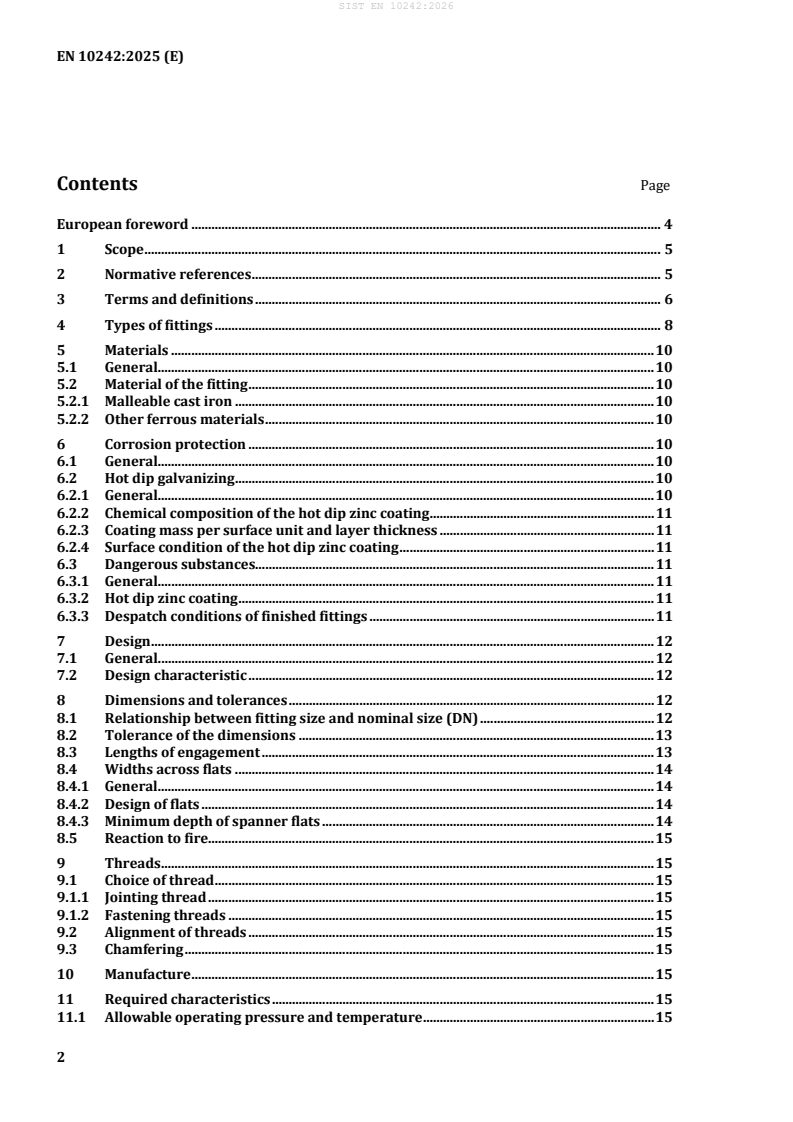
Contents Page
European foreword . 4
1 Scope . 5
2 Normative references . 5
3 Terms and definitions . 6
4 Types of fittings . 8
5 Materials . 10
5.1 General. 10
5.2 Material of the fitting . 10
5.2.1 Malleable cast iron . 10
5.2.2 Other ferrous materials . 10
6 Corrosion protection . 10
6.1 General. 10
6.2 Hot dip galvanizing . 10
6.2.1 General. 10
6.2.2 Chemical composition of the hot dip zinc coating . 11
6.2.3 Coating mass per surface unit and layer thickness . 11
6.2.4 Surface condition of the hot dip zinc coating . 11
6.3 Dangerous substances. 11
6.3.1 General. 11
6.3.2 Hot dip zinc coating . 11
6.3.3 Despatch conditions of finished fittings . 11
7 Design . 12
7.1 General. 12
7.2 Design characteristic . 12
8 Dimensions and tolerances . 12
8.1 Relationship between fitting size and nominal size (DN) . 12
8.2 Tolerance of the dimensions . 13
8.3 Lengths of engagement . 13
8.4 Widths across flats . 14
8.4.1 General. 14
8.4.2 Design of flats . 14
8.4.3 Minimum depth of spanner flats . 14
8.5 Reaction to fire. 15
9 Threads . 15
9.1 Choice of thread . 15
9.1.1 Jointing thread . 15
9.1.2 Fastening threads . 15
9.2 Alignment of threads . 15
9.3 Chamfering . 15
10 Manufacture . 15
11 Required characteristics . 15
11.1 Allowable operating pressure and temperature . 15
11.2 Design strength . 16
11.3 Assembly . 16
12 Testing and inspection. 17
12.1 Malleable cast iron . 17
12.2 Hot dip zinc coating. 17
12.3 Threads . 17
12.3.1 Jointing threads . 17
12.3.2 Fastening threads . 17
12.3.3 Alignment . 17
12.4 Leak tightness test . 17
12.5 Final visual inspection . 18
12.6 Acceptance tests for higher performances . 18
12.6.1 General . 18
12.6.2 Hydrostatic pressure tests . 18
12.7 Analysis of polycyclic aromatic hydrocarbons . 18
12.8 Inspection documents . 18
12.8.1 Quality documentation . 18
12.8.2 Product documentation . 18
13 Designation of fittings . 18
13.1 Elements of the designation for ordering . 18
13.2 Additional notes on designation of size . 18
13.3 Example of designation . 19
14 Marking . 20
15 Tables with dimensions . 21
Bibliography . 49
European foreword
This document (EN 10242:2025) has been prepared by Technical Committee CEN/TC 459 “ECISS -
European Committee for Iron and Steel Standardization” , the Secretariat of which is held by AFNOR.
This European Standard shall be given the status of a national standard, either by publication of an
identical text or by endorsement, at the latest by June 2026 and conflicting national standards shall be
withdrawn at the latest by June 2026.
Attention is drawn to the possibility that some of the elements of this document may be the subject of
patent rights. CEN shall not be held responsible for identifying any or all such patent rights.
This document supersedes EN 10242:1994.
This document includes the following significant technical changes with respect to EN 10242:1994:
— normative references have been updated;
— additional fittings types used in UK have been introduced in Table 1;
— terms and definitions under Clause 3 have been revised;
— requirements for hot dip galvanizing under 6.2.1 have been changed, and the chemical
composition with regard to dangerous substances under 6.2.2 has been adjusted;
— malleable cast iron grades in 5.2.1 have been reduced and therefore the number of Design
Symbols in Table 2 has been reduced;
— new subclause 8.5 “Reaction to fire” has been added;
— change from ISO to EN requirements in 12.3 has been made;
— Method B for designation has been moved to a note under 13.2;
— Clause 12 has become subclause 12.8.1 and has been updated;
— additional types and sizes used in UK have been introduced in the tables in Clause 15.
Any feedback and questions on this document should be directed to the users’ national standards body.
A complete listing of these bodies can be found on the CEN website.
According to the CEN-CENELEC Internal Regulations, the national standards organizations of the
following countries are bound to implement this European Standard: Austria, Belgium, Bulgaria, Croatia,
Cyprus, Czech Republic, Denmark, Estonia, Finland, France, Germany, Greece, Hungary, Iceland, Ireland,
Italy, Latvia, Lithuania, Luxembourg, Malta, Netherlands, Norway, Poland, Portugal, Republic of North
Macedonia, Romania, Serbia, Slovakia, Slovenia, Spain, Sweden, Switzerland, Türkiye and the United
Kingdom.
Through its sub-committee CEN/TC 459/SC 10 “Steel tubes, and iron and steel fittings” (secretariat: UNI).
1 Scope
This document specifies the requirements for the design and performance of threaded pipe fittings in
malleable cast iron with black or hot dip galvanized surface.
These fittings are for general purposes for the transmission of fluids and gases up to the limits of
operating pressure and operating temperature specified in this document. They are intended for the
connection of elements threaded with sizes 1/8 to 6 (DN 6 to DN 150).
Fittings with alternative permanent coatings or permanent coatings on top of hot dip galvanizing do not
fall under the scope of this document.
NOTE One main use is for the connection of non-alloy steel tubes according to EN 10255 and with support of
the thread joint by using sealing materials according to the EN 751 series.
2 Normative references
The following documents are referred to in the text in such a way that some or all of their content
constitutes requirements of this document. For dated references, only the edition cited applies. For
undated references, the latest edition of the referenced document (including any amendments) applies.
EN 1562, Founding — Malleable cast irons
EN 10204, Metallic products — Types of inspection documents
EN 10216-1, Seamless steel tubes for pressure purposes — Technical delivery conditions — Part 1: Non-
alloy steel tubes with specified room temperature properties
EN 10216-2, Seamless steel tubes for pressure purposes — Technical delivery conditions — Part 2: Non-
alloy and alloy steel tubes with specified elevated temperature properties
EN 10217-1, Welded steel tubes for pressure purposes — Technical delivery conditions — Part 1: Electric
welded and submerged arc welded non-alloy steel tubes with specified room temperature properties
EN 10217-2, Welded steel tubes for pressure purposes — Technical delivery conditions — Part 2: Electric
welded non-alloy and alloy steel tubes with specified elevated temperature properties
EN 10226-1, Pipe threads where pressure tight joints are made on the threads — Part 1: Taper external
threads and parallel internal threads — Dimensions, tolerances and designation
EN 10226-2, Pipe threads where pressure tight joints are made on the threads — Part 2: Taper external
threads and taper internal threads — Dimensions, tolerances and designation
EN 10255, Non-Alloy steel tubes suitable for welding and threading — Technical delivery conditions
EN ISO 228-1, Pipe threads where pressure-tight joints are not made on the threads — Part 1: Dimensions,
tolerances and designation (ISO 228-1)
EN ISO 1460, Metallic coatings — Hot dip galvanized coatings on ferrous materials — Gravimetric
determination of the mass per unit area (ISO 1460)
EN ISO 2178, Non-magnetic coatings on magnetic substrates — Measurement of coating thickness —
Magnetic method (ISO 2178)
EN ISO 6892-1, Metallic materials — Tensile testing — Part 1: Method of test at room temperature
(ISO 6892-1)
ISO 2859-1, Sampling procedures for inspection by attributes — Part 1: Sampling schemes indexed by
acceptance quality limit (AQL) for lot-by-lot inspection
3 Terms and definitions
For the purposes of this document, the following terms and definitions apply.
ISO and IEC maintain terminology databases for use in standardization at the following addresses:
— ISO Online browsing platform: available at https://www.iso.org/obp
— IEC Electropedia: available at https://www.electropedia.org/
3.1
fitting
connecting piece for pipes and other piping accessories, consisting of one or more parts
3.2
jointing thread
thread complying with EN 10226-1 or EN 10226-2
3.3
fastening thread
thread complying with EN ISO 228-1
3.4
fitting size
nominal size of the connecting (steel) pipe(s)
Note 1 to entry: See also 8.1.
3.5
designation of thread size
size designation of the thread in inch according to EN 10226-1 or EN 10226-2
3.6
nominal size
DN
alphanumeric designation of size for components of a pipework system, which is used for reference
purposes
Note 1 to entry: See EN ISO 6708.
Note 2 to entry: It comprises the letters DN followed by a dimensionless whole number which is indirectly related
to the physical size, in millimetres, of the bore or outside diameter of the end connections.
Note 3 to entry: Nominal size (DN) should not be used for the designation of fitting size.
Note 4 to entry: The relationship between fitting size and nominal size (DN) is given in Table 3 for information.
3.7
reinforcement
additional material on the outside diameter of an internally threaded fitting
EXAMPLE Examples for reinforcements are shown in Figure 1.
a) Bead b) Band
Figure 1 — Forms of reinforcement
3.8
rib
local and axially aligned additional material on the outside or inside of a fitting for assistance in assembly
or manufacturing
3.9
outlet
end of a fitting for the purpose of connection with a pipe or other piping accessories
3.10
run
two principal axially aligned outlets of a tee or cross
3.11
branch
side outlet(s) of a tee or cross
3.12
chamfer
removal of a conical portion at the entrance of a thread to assist assembly and prevent damage to the
start of the thread
3.13
face-to-face dimension
distance between the two parallel faces of axially aligned outlets of a fitting
3.14
face-to-centre dimension
distance between the face of an outlet and the central axis of an angularly disposed outlet
3.15
laying length
average distance from the assembled pipe end to the axis of the fitting, or between the ends of two
assembled pipes
Note 1 to entry: See also 8.3.
4 Types of fittings
Table 1 gives an index to the fitting types, patterns and symbols. The symbols allow the identification of
fittings and shall be used for designation (see 13.1).
Table 1 — Index of fitting types, symbols and index to tables and patterns
Types Patterns
Symbols A1 A1/45° A4 A4/45°
A
Elbows
Table 9 Table 10 Table 11 Table 9 Table 10 Table 11
Symbols B1 B4
B
Tees
Table 9 Table 12 Table 12 Table 13 Table 13 Table 9
Symbols C1
C
Crosses
Table 9 Table 14
Symbols D1 D4 D8
D
Short
bends
Table 15 Table 15 Table 15
Symbols E1 E2
E
Pitcher
tees
Twin
elbows
Table 15 Table 16 Table 16 Table 16 Table 15 Table 17
Symbols G1 G1/45° G4 G4/45° G8
G
Long
sweep
bends
Table 18 Table 19 Table 18 Table 19 Table 18
Types Patterns
Symbols M2 M4 M3
M
Sockets
Table 20 Table 20 Table 21 Table 21 Table 20
Symbols N4 N8
N
Bushings
Hexagon
nipples
Table 22 Table 22 Table 22 Table 23 Table 23
Symbols P4
P
Backnut
Table 24
Symbols T1 T8 T9 T11
T
Caps
Plugs
Table 25 Table 25 Table 25 Table 25
Symbols U1 U2 U11 U12
U
Unions
Table 26 Table 26 Table 26 Table 26
Symbols UA1 UA2 UA11 UA12
UA
Union
elbows
Table 27 Table 27 Table 27 Table 27
Symbols Za1 Za2
Za
Side
outlet
elbows
Table 9 Table 9
and tees
5 Materials
5.1 General
All materials of fitting body and components shall be resistant against the medium of the respective
application.
NOTE In case of potable water, national hygienic requirements apply.
No component of the fitting shall show any signs of damage, pitting, bubbles, sand, blisters, inclusions or
cracks to an extent that would prevent compliance with this document. They shall not be treated to cover
such defects. The sealing surfaces shall be free of all scratches, blisters or cracks that might affect the leak
tightness of the assembled joint.
5.2 Material of the fitting
5.2.1 Malleable cast iron
The material used shall be malleable cast iron conforming to EN 1562. The grade of material used shall
be selected from the following grades (see Clause 7):
— grade EN-GJMW-400-5 for fittings in whiteheart malleable cast iron;
— grade EN-GJMB-350-10 for fittings in blackheart malleable cast iron.
5.2.2 Other ferrous materials
Despite this requirement, any other ferrous materials which give mechanical properties at least
equivalent to those malleable cast irons specified in EN 1562, shall be considered in compliance with this
document for straight fittings not larger than 3/8, but excluding unions.
6 Corrosion protection
6.1 General
In applications where materials can be exposed to corrosion, the components shall be adequately
protected as specified in 6.2.
6.2 Hot dip galvanizing
6.2.1 General
Where a protection by zinc coating is required, the zinc coating shall be applied by the hot dip galvanizing
process and shall meet the following requirements.
Fittings with alternative permanent coatings or permanent coatings on top of hot dip galvanizing don't
fall under the scope of this document.
For fittings supplied in other ferrous materials (such as carbon steel, see 5.2.2), an alternative zinc coating
may be provided by agreement with the purchaser.
6.2.2 Chemical composition of the hot dip zinc coating
The content by mass of the accompanying elements in the finished zinc coating shall not exceed the
following maximum values:
antimony (Sb) 0,01 %
arsenic (As) 0,02 %
bismuth (Bi) 0,01 %
cadmium (Cd) 0,01 %
lead (Pb) 0,1 %
NOTE The chemical composition is restricted with regard to the limitation of dangerous substances also in
respect to potable water applications. When fittings are used in potable water applications, relevant national
hygienic regulations apply.
6.2.3 Coating mass per surface unit and layer thickness
The surface related mass of the zinc coating shall not be less than 500 g/m , which equals to a layer
thickness of 70 μm. These limits refer to the average of 5 fittings with 10 measurements each, statistically
distributed across the fitting. The layer mass/thickness measured on an individual sample shall not be
less than 450 g/m (63 μm).
s
The medium layer thickness of the zinc coating in μm shall be calculated by using the approximation
formula
m
A
s=
72,
where
m is the surface related mass of the zinc coating in g/m .
A
6.2.4 Surface condition of the hot dip zinc coating
The internal zinc coating shall be continuous, with the exception of the machined black surfaces, and free
from zinc blisters, zinc burrs or non-metallic additions. In the case of larger diameter items, iron-zinc
alloy phases, leading to a dull grey finish, may be present, but this will not affect the degree of protection
provided.
6.3 Dangerous substances
6.3.1 General
For the use of fittings produced in accordance with this document, national regulations with regard to
dangerous substances can apply.
6.3.2 Hot dip zinc coating
The chemical composition of the hot dip zinc coating shall not exceed the limits given in 6.2.2.
6.3.3 Despatch conditions of finished fittings
The surfaces of the fittings shall be free of polycyclic aromatic hydrocarbons.
7 Design
7.1 General
The fittings are compatible with tubes according to EN 10255, EN 10216-1, EN 10216-2, EN 10217-1 and
EN 10217-2.
The minimum wall thickness of the tube for thread cutting, given by EN 10255 shall be considered.
7.2 Design characteristic
Fittings shall be identified by the design symbol according to the selected material (see 5.2.1), the choice
of thread (see 9.1.1) and the type of reinforcement, if applicable, as given in Table 2.
Table 2 — Design symbol
Design Thread type Material grade Reinforcement of internally
symbol threaded ends
external internal
EN-GJMW-400-5 or
A R Rp Bead, see Figure 1a)
EN-GJMB-350-10
EN-GJMW-400-5 or
C R Rc Band, see Figure 1b)
EN-GJMB-350-10
NOTE Design symbols B and D have been removed during the latest revision.
The drawings in Table 9 to Table 27 are schematic, without prejudice to the manufactured form.
Dimensionally standardized types and fitting sizes are shown in Table 9 to Table 27.
The dimensions of the gaskets for flat seat unions are specified in Table 28.
Fittings shall be reinforced at the internally threaded ends, except where they are polygonal in shape to
allow for spanner flats, or where fittings have side outlets (type Za1 and Za2).
Manufacturers may incorporate ribs at their discretion. Ribs shall not project higher than the
reinforcement.
Backnuts may be plain or recessed and one face may be machined.
Table 26 and Table 27 show two typical types of seats of unions and their designation. Other types of seat
design and seat material shall be considered as complying with this document, if they meet the
dimensions specified in Table 26 and Table 27 and the requirements of this document. Such unions do
not have a specific designation according to this document.
8 Dimensions and tolerances
8.1 Relationship between fitting size and nominal size (DN)
The relationship between designation of the fitting size (equal to thread size) and nominal diameter (DN)
is given in Table 3 for guidance only.
Table 3 — Fitting size and nominal diameter
Designation of
thread size/fitting 1/8 1/4 3/8 1/2 3/4 1 1 1/4 1 1/2 2 2 1/2 3 4 5 6
size
Nominal size, DN 6 8 10 15 20 25 32 40 50 65 80 100 125 150
8.2 Tolerance of the dimensions
Fittings shall have the appropriate dimensions given in Table 9 to Table 27. Where maximum or
minimum dimensions are not specified, the tolerances for the face-to-face and face-to-centre dimensions
shall be as given in Table 4. The face-to-face and face-to-centre dimensions of unions may exceed the
tolerance given due to the compound effect of piece tolerances upon the final assembly.
NOTE 1 Fitting sizes shown in brackets are optional sizes.
NOTE 2 The face-to-face and face-to-centre dimensions of unions can exceed the tolerance given due to the
compound effect of piece tolerances upon the final assembly.
Table 4 — Tolerance on length
Dimensions in millimetres
a
Fitting measurement Tolerance
≤ 30 ±1,5
> 30 ≤ 50 ±2,0
> 50 ≤ 75 ±2,5
> 75 ≤ 100 ±3,0
> 100 ≤ 150 ±3,5
> 150 ≤ 200 ±4,0
> 200 ±5,0
a
Measurements according to Table 9 to Table 27.
8.3 Lengths of engagement
Laying lengths are given for assistance and guidance during installation. Their accuracy is dependent
upon the tolerances given in 8.2 and on the tolerance of the threads specified in 9.1. The dimensions z
given in Table 9 to Table 27 are the average distance from the pipe end to the axis of the fitting (see
Figure 2) or the distance from pipe end to pipe end (see Figure 3).
These laying lengths are calculated by deducting average lengths of engagement from the face-to-face or
face-to-centre dimensions given in the tables. The average lengths of engagement are rounded from the
dimensions of the threads specified in 9.1.1 and are given in Table 5.
Table 5 — Lengths of engagement
Designation of
1/8 1/4 3/8 1/2 3/4 1 1 1/4 1 1/2 2 2 1/2 3 4 5 6
thread size
Length of
engagement,
7 10 10 13 15 17 19 19 24 27 30 36 40 40
mm
Figure 2 — Example of laying lengths z in the case of an angularly disposed fitting
Figure 3 — Example of laying length z in the case of an axially aligned fitting
8.4 Widths across flats
8.4.1 General
The dimensions of widths across flats depend on the design of the fittings and are at the discretion of the
manufacturer.
8.4.2 Design of flats
External flats on plugs shall be square. Flats on other fittings up to and including size 3/4 should be
hexagonal. Flats on other fittings above size 3/4 may be hexagonal or octagonal. Flats on union parts,
excluding the union nut, may be hexagonal, octagonal or decagonal.
8.4.3 Minimum depth of spanner flats
The minimum depth of the flats measured at the corners shall be as given in Table 6. For backnuts any
chamfering shall not reduce the depth of flat below the minimum dimension given in Table 6.
Table 6 — Minimum depth of spanner flats
Designation of
1/8 1/4 3/8 1/2 3/4 1 1 1/4 1 1/2 2 2 1/2 3 4 5 6
thread size
Min. depth of
4 4 5 5 5,5 6 6,5 6,5 7 7 7,5 8 8 8
spanner flats, mm
8.5 Reaction to fire
Malleable cast iron is class A1 in accordance with the Commission Decision 96/603/EEC of
4 October 1996 amended by the Council Decision of 28 September 2000 and therefore does not require
to be tested for reaction to fire.
9 Threads
9.1 Choice of thread
9.1.1 Jointing thread
Fittings shall be threaded in accordance with EN 10226-1 or EN 10226-2. External threads shall be
taper (R), internal threads shall be parallel (Rp) or taper (Rc).
9.1.2 Fastening threads
The threads of backnuts, union nuts and their mating threads shall be in accordance with EN ISO 228-1.
9.2 Alignment of threads
The axes of the screw threads shall be accurate within ±0,5° of the specified angle.
9.3 Chamfering
The jointing threads of the fittings shall have a chamfer.
On internal threads, the chamfer shall have an included angle of 90° to 120°, and the chamfer diameter at
the face shall exceed the major diameter of the thread.
On external threads, the chamfer shall be an included angle between 60° and 90° and the diameter at the
face shall not exceed the minor diameter of the thread at that face.
10 Manufacture
Fittings according to this document shall be produced using a quality management system, e.g. according
to EN ISO 9001 or equivalent.
11 Required characteristics
11.1 Allowable operating pressure and temperature
The fittings of all sizes shall be suitable for the maximum allowable operating pressures within the
operating temperature ranges given in Table 7, set out in Figure 4. Intermediate pressure ratings at
operating temperatures between +120 °C and +300 °C shall be obtained by linear interpolation. For
normal applications the lowest allowable operating temperature for fittings is –20 °C.
For special applications at operating temperatures below –20 °C, the manufacturer should be consulted.
Table 7 — Operating pressure/temperature ratings
Allowable operating temperature Maximum allowable operating pressure
a
°C MPa
–20 to +120 2,5
Between +120 and +300 interpolated values
+300 2,0
a 5 2
1 bar = 10 N/m = 0,1 MPa.
Key
p pressure, in MPa
t temperature, in °C
Figure 4 — Operating pressure/temperature ratings
11.2 Design strength
Pressure-containing fittings including the component parts of unions shall be designed to withstand the
design test pressures given in Table 8. Three fittings out of every size group and fitting type shall be type
tested in accordance with Table 8.
Table 8 — Hydrostatic design test pressures
Fitting size Hydrostatic design test pressure
a
Size 1/8 to Size 4 10 MPa
a
Size 5 and Size 6 6,4 MPa
a 5 2
1 bar = 10 N/m = 0,1 MPa.
For unions a leakage at the union joint is permissible below the pressure given in Table 8. The leakage
should not occur at a pressure below or equal to 1,5 × maximum allowable operating pressure at ambient
operating temperature (see 11.1).
11.3 Assembly
The fittings shall be capable of withstanding a force normally used during assembly of threads in
accordance with 9.1.
12 Testing and inspection
12.1 Malleable cast iron
The malleable cast iron shall meet the requirements of EN 1562 for the material grade specified in 5.2.1,
which shall be ensured by testing according to EN ISO 6892-1.
In addition to the test requirements of EN 1562, appropriate tests shall be conducted, after annealing and
before machining, to ensure that all fittings are satisfactorily malleabilised.
12.2 Hot dip zinc coating
Where protection by hot dip zinc coating is given, the chemical composition shall be tested in accordance
with 6.2. The elements specified in 6.2.2 shall be determined using spectroscopic or wet chemical analysis
methods.
The method of determination of the coating mass per surface unit area, see 6.2.3, according to
EN ISO 1460 shall be used. Alternatively, the thickness of the coating, shall be checked by using calibrated
electronic or magnetic instruments, according to EN ISO 2178 or by microscopic examination. The limits
given in 6.2.3 refer to the average of 5 fittings with 10 measurements each, statistically distributed across
the fitting.
Hot dip galvanized fittings shall be visually inspected for continuity of the zinc coating in accordance with
sampling plans given in ISO 2859-1.
12.3 Threads
12.3.1 Jointing threads
The manufacturer shall ensure by adequate control that the jointing threads meet the requirements of
9.1.1.
EN 10226-3 gives a recommended system of gauging but other systems of gauging may be used providing
they ensure equivalent results.
12.3.2 Fastening threads
Fastening threads shall meet the requirements of EN ISO 228-1.
EN ISO 228-2 gives a recommended system of gauging but other systems of gauging may be used
providing they ensure equivalent results.
12.3.3 Alignment
The alignment of the threads shall meet the requirements specified in 9.2.
12.4 Leak tightness test
All pressure containing fittings shall be tested after machining by one of the following methods. Each
fitting, when so tested, shall show no sign of leakage:
a) by the application at ambient temperature of an internal hydrostatic pressure of not less than
2,0 MPa; or
b) by the application of an internal pneumatic pressure of not less than 0,5 MPa, whilst the fitting is
completely immersed in water or light oil; or
c) by other tests which ensure an equivalent quality.
Fittings which do not satisfy the chosen test shall be rejected.
12.5 Final visual inspection
The fittings shall be free from visible casting or machining defects. The verification regarding this shall
be done by adequate visual inspection.
12.6 Acceptance tests for higher performances
12.6.1 General
If the customer requires acceptance tests for higher performances, these shall be stipulated and agreed
at the enquiry or order stage. Acceptance tests should be carried out with suitable equipment and the
manpower of the manufacturer.
12.6.2 Hydrostatic pressure tests
Acceptance tests for operating pressures above 2,5 MPa shall be carried out by hydrostatic pressure
according to the agreement at the order stage. The test pressure shall not exceed the limit beyond which
permanent deformations and changes to the thread dimensions would occur.
12.7 Analysis of polycyclic aromatic hydrocarbons
The verification of this requirement (see 6.2) shall be performed by high performance techniques of
chromatography - mass spectrometry or other relevant techniques of chemical analysis.
12.8 Inspection documents
12.8.1 Quality documentation
If required, details of the quality management system used shall be provided.
12.8.2 Product documentation
When specified, inspection documents in accordance with EN 10204 shall be provided – either a
Declaration of compliance with the order “type 2.1” or a Test report “type 2.2”.
13 Designation of fittings
13.1 Elements of the designation for ordering
For purchasing purposes, the fittings complying with this document shall be designated as follows:
a) the type of fitting, see Table 1;
b) EN 10242;
c) the symbol, see Table 1;
d) fitting size, see 13.2 and Table 9 to Table 27;
e) surface condition whether black (symbol Fe) or hot dip zinc coated (symbol Zn);
f) design symbol, see Clause 7.
13.2 Additional notes on designation of size
Equal fittings, where all outlets are of the same size, are referred to by that one size, irrespective of the
number of outlets.
Reducing fittings having two outlets are specified by their outlets in decreasing order (large outlet-small
outlet).
Reducing fittings having more than two outlets by not reducing on the run are specified as in the following
examples:
a) tees B1 and E1 with an increasing or reducing outlet on the branch. The size of the run is specified
followed by the size of the branch, for example, 1 × 3/4 (see Table 12 and Table 16);
b) twin elbows reducing E2. The size of the large outlet is specified followed by the size of the
two smaller outlets, for example, 1 1/2 × 1 1/4 (see Table 17);
c) reducing crosses C1. The size of the largest run is specified followed by the size of the two smaller
(but equal) branches, for example, 1 1/4 × 1 (see Table 14).
Reducing fittings having more than two outlets and reducing on the run or with three different outlets
shall be specified as shown in Figure 5.
Figure 5 describes the designation method according to this document. Alternatively, the designation of
reduced tees may be done using the order run-run-branch, if required.
Figure 5 — Sequence of specifying outlets
13.3 Example of designation
a) Equal female elbow size 2, black finish, design symbol A:
elbow EN 10242-A1-2-Fe-A
b) reducing tee with run 2 and branch 1, hot dip zinc coated, design symbol A:
tee EN 10242-B1-2×1-Zn-A
c) reducing tee with run 1 and 3/4 and branch 1/2 black finish, design symbol A:
tee EN 10242-B1-1×1/2×3/4-Fe-A
14 Marking
Unless it is not practicable because of casting method space limitations, fittings shall be marked by casting
at least with:
a) the manufacturer’s name or trademark;
b) the fitting size (as defined in 3.4).
Other markings shall not conflict with the markings detailed in a) and b).
When it is not practicable to mark fittings because of casting method space limitations, it is permissible
to omit either or both of the markings detailed in a) and b), as long as these marking is provided at the
packaging. In this case the fitting shall not be marked with any other marking.
15 Tables with dimensions
Table 9 — Elbows (A1); Male and female elbows (A4); Tees (B1); Male/female tees (B4); Crosses (C1); Side outlet elbows (Za1) and
Side outlet tees (Za2)
Fittings size Dimensions Laying length
mm mm
A1 A4 B1 C1 Za1 Za2 B4 a b c z
1/8 1/8 1/8 — — — — 19 25 — 12
1/4 1/4 1/4 (1/4) — — — 21 28 — 11
3/8 3/8 3/8 3/8 (3/8) (3/8) — 25 32 — 15
1/2 1/2 1/2 1/2 1/2 (1/2) 1/2 28 37 39 15
a
3/4 3/4 3/4 3/4 3/4 (3/4) 3/4 33 43 43(48 ) 18
1 1 1 1 (1) (1) 1 38 52 52 21
1 1/4 1 1/4 1 1/4 1 1/4 (1 1/4) — (1 1/4) 45 60 58 26
1 1/2 1 1/2 1 1/2 1 1/2 (1 1/2) — (1 1/2) 50 65 65 31
2 2 2 2 (2) — (2) 58 74 69 34
2 1/2 2 1/2 2 1/2 (2 1/2) — — — 69 88 — 42
3 3 3 (3) — — — 78 98 — 48
4 4 4 (4) — — — 96 118 — 60
(5) — (5) — — — — 115 — — 75
(6) — (6) — — — — 131 — — 91
Fittings size Dimensions Laying length
mm mm
A1 A4 B1 C1 Za1 Za2 B4 a b c z
A1 A4 Za1 B4 Za2
B1 C1
Dimensions which are not specified are left to the discretion of the manufacturer.
( ): see 8.1.
Tolerances: see Table 4.
Threads: in accordance with 9.1.1.
a
Optional measure c for B4 in brackets.
Table 10 — Elbows, reducing (A1); Male and female elbows, reducing (A4)
Fittings sizes Dimensions Laying lengths
mm mm
A1 A4 a b c z1 z2
(3/8 × 1/4) — 23 23 — 13 13
(1/2 × 1/4) — 25 25 — 12 15
1/2 × 3/8 1/2 × 3/8 26 26 33 13 16
(3/4 × 3/8) — 28 28 — 13 18
3/4 × 1/2 3/4 × 1/2 30 31 40 15 18
1 × 1/2 — 32 34 — 15 21
1 × 3/4 1 × 3/4 35 36 46 18 21
(1 1/4 × — 35 39 — 16 26
1/2)
1 1/4 × 3/4 — 36 41 — 17 26
1 1/4 × 1 1 1/4 × 1 40 42 56 21 25
(1 1/2 × 1) — 42 46 — 23 29
1 1/2 × — 46 48 — 27 29
1 1/4
(2 × 1 1/4) — 48 53 — 24 34
2 × 1 1/2 — 52 55 — 28 36
(2 1/2 × 2) — 61 66 — 34 42
A1 A4
Dimensions which are not specified are left to the discretion of the manufacturer.
( ): see 8.1.
Tolerances: see Table 4.
Threads: in accordance with 9.1.1.
Table 11 — 45° elbows (A1/45°); 45° male and female elbows (A4/45°)
Fitting sizes Dimensions Laying length
mm mm
A1/45° A4/45° a b z
(1/4) — 19 — 9
3/8 3/8 20 25 10
1/2 1/2 22 28 9
3/4 3/4 25 32 10
1 1 28 37 11
1 1/4 1 1/4 33 43 14
1 1/2 1 1/2 36 46 17
2 2 43 55 19
...