

SIST EN 15328:2020+A1:2024
(Main + Amendment)Railway applications - Braking - Brake pads
General Information
- Abstract
This document specifies requirements for pads for disc brakes of railway rolling stock.
The document defines requirements and generic test programs for brake pads on dynamometer. This document does not cover mandatory tests to verify stopping distances in addition to laboratory, bench test and in-service tests. In order to qualify the brake pad performance in accordance with the classification the standard provides fixed parameter figures as categories defined in paragraph classification scheme.
This document is not applicable for urban rail applications.
- Status
- Published
- Publication Date
- 18-Apr-2024
- Technical Committee
- IŽNP - Reilway applications
- Current Stage
- 6060 - National Implementation/Publication (Adopted Project)
- Start Date
- 18-Apr-2024
- Due Date
- 23-Jun-2024
- Completion Date
- 19-Apr-2024

Overview
EN 15328:2020+A1:2024 (CEN) defines the technical requirements and generic test programs for brake pads for disc brakes used on railway rolling stock (locomotives, multiple units, high‑speed trains, coaches and freight wagons). It covers laboratory and dynamometer testing, classification criteria and performance verification for brake pads; it does not replace mandatory in‑service stopping‑distance tests and is not applicable to urban rail applications. This edition incorporates Amendment 1 (approved March 2024).
Key topics and requirements
- Scope & applicability: Requirements for disc‑brake pads on non‑urban railway vehicles; classification scheme with fixed parameter categories (classes A1–G1 and optional coach schemes).
- Classification of brake pads: Defined schemes for locomotives, MUs, high‑speed trains, freight wagons and coaches; optional coach classification programs are provided.
- Friction performance: Rules and test methods for instantaneous and mean coefficient of friction, including criteria under normal, high thermal load and wet conditions.
- Test programs: Generic dynamometer test programs in Annexes B, C and E (e.g., coach test program S1.1 - v = 200 km/h for organic pads; T1 for sintered pads); normative conditions for execution (Annex A).
- Mechanical, thermal and geometric requirements: Pad shapes, wear limits, fixing/dovetail drawings (Annexes F and G), thermal/ventilation conditions, and methods for temperature measurement.
- Environmental, health & safety: Requirements addressing environmental impact and operator/maintenance safety.
- In‑service assessment & marking: Guidance for real‑world evaluation (informative Annex H) and required marking/documentation (Annex D for test documentation, Annex I example of declaration of conformity).
- Interchangeability: Requirements and clarifications for replacing pads across different designs have been updated in this amendment.
Practical applications - who uses it
- Brake pad manufacturers - design validation, product classification, test program compliance and technical documentation.
- Independent test laboratories / dynamometer facilities - execute standardized test programs and generate conformity reports.
- Rolling stock OEMs and integrators - specify pad performance, interchangeability and geometry for vehicle braking systems.
- Rail operators, maintenance organisations and procurement teams - assess pad suitability, approve replacements and ensure consistent braking performance across fleets.
- Certification bodies and regulators - evaluate compliance with CEN requirements and support conformity declarations.
Related standards & notes
- EN 15328:2020+A1:2024 supersedes EN 15328:2020 and was prepared by CEN/TC 256 (Railway applications). The standard contains normative references and a bibliography for related test methods and materials standards (see clause 2 and the Bibliography in the standard). For procurement/specification work, reference the full text to ensure you apply the correct annexed test programs and classification tables.
Relations
- Effective Date
- 01-Jun-2024
- Effective Date
- 01-Jun-2024
- Effective Date
- 28-Jan-2026
- Effective Date
- 28-Jan-2026
- Effective Date
- 28-Jan-2026
- Effective Date
- 28-Jan-2026
- Effective Date
- 28-Jan-2026
- Effective Date
- 20-May-2026
- Effective Date
- 28-Jan-2026
Get Certified
Connect with accredited certification bodies for this standard

IRIS Certification (UNIFE)
International Railway Industry Standard certification.

TÜV SÜD Rail GmbH
TÜV SÜD railway certification services.

Bureau Veritas Railway Certification
Railway and transportation certification.
Sponsored listings
Frequently Asked Questions
SIST EN 15328:2020+A1:2024 is a standard published by the Slovenian Institute for Standardization (SIST). Its full title is "Railway applications - Braking - Brake pads". This standard covers: This document specifies requirements for pads for disc brakes of railway rolling stock. The document defines requirements and generic test programs for brake pads on dynamometer. This document does not cover mandatory tests to verify stopping distances in addition to laboratory, bench test and in-service tests. In order to qualify the brake pad performance in accordance with the classification the standard provides fixed parameter figures as categories defined in paragraph classification scheme. This document is not applicable for urban rail applications.
This document specifies requirements for pads for disc brakes of railway rolling stock. The document defines requirements and generic test programs for brake pads on dynamometer. This document does not cover mandatory tests to verify stopping distances in addition to laboratory, bench test and in-service tests. In order to qualify the brake pad performance in accordance with the classification the standard provides fixed parameter figures as categories defined in paragraph classification scheme. This document is not applicable for urban rail applications.
SIST EN 15328:2020+A1:2024 is classified under the following ICS (International Classification for Standards) categories: 45.040 - Materials and components for railway engineering. The ICS classification helps identify the subject area and facilitates finding related standards.
SIST EN 15328:2020+A1:2024 has the following relationships with other standards: It is inter standard links to SIST EN 15328:2020, SIST EN 15328:2020/kFprA1:2023, SIST EN 14535-2:2019, SIST EN 14478:2018, SIST EN 14535-1:2019, SIST EN 16451:2015, SIST EN ISO 21920-2:2022, SIST EN 14198:2026, SIST EN 15734-1:2011+A1:2022. Understanding these relationships helps ensure you are using the most current and applicable version of the standard.
SIST EN 15328:2020+A1:2024 is associated with the following European legislation: Standardization Mandates: M/483. When a standard is cited in the Official Journal of the European Union, products manufactured in conformity with it benefit from a presumption of conformity with the essential requirements of the corresponding EU directive or regulation.
SIST EN 15328:2020+A1:2024 is available in PDF format for immediate download after purchase. The document can be added to your cart and obtained through the secure checkout process. Digital delivery ensures instant access to the complete standard document.
Standards Content (Sample)
SLOVENSKI STANDARD
01-junij-2024
Železniške naprave - Zavore - Zavorne obloge
Railway applications - Braking - Brake pads
Bahnanwendungen - Bremsen - Bremsbeläge
Applications ferroviaires - Freinage - Garniture de frein
Ta slovenski standard je istoveten z: EN 15328:2020+A1:2024
ICS:
45.040 Materiali in deli za železniško Materials and components
tehniko for railway engineering
2003-01.Slovenski inštitut za standardizacijo. Razmnoževanje celote ali delov tega standarda ni dovoljeno.
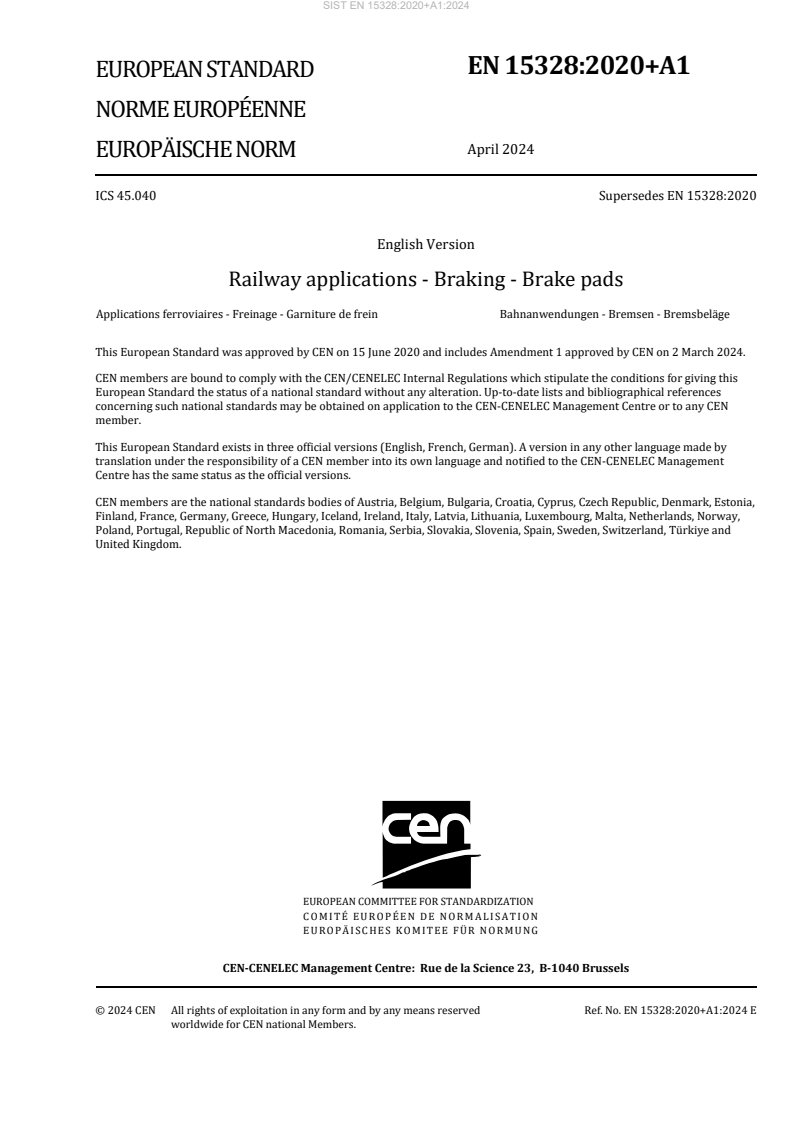
EN 15328:2020+A1
EUROPEAN STANDARD
NORME EUROPÉENNE
April 2024
EUROPÄISCHE NORM
ICS 45.040 Supersedes EN 15328:2020
English Version
Railway applications - Braking - Brake pads
Applications ferroviaires - Freinage - Garniture de frein Bahnanwendungen - Bremsen - Bremsbeläge
This European Standard was approved by CEN on 15 June 2020 and includes Amendment 1 approved by CEN on 2 March 2024.
CEN members are bound to comply with the CEN/CENELEC Internal Regulations which stipulate the conditions for giving this
European Standard the status of a national standard without any alteration. Up-to-date lists and bibliographical references
concerning such national standards may be obtained on application to the CEN-CENELEC Management Centre or to any CEN
member.
This European Standard exists in three official versions (English, French, German). A version in any other language made by
translation under the responsibility of a CEN member into its own language and notified to the CEN-CENELEC Management
Centre has the same status as the official versions.
CEN members are the national standards bodies of Austria, Belgium, Bulgaria, Croatia, Cyprus, Czech Republic, Denmark, Estonia,
Finland, France, Germany, Greece, Hungary, Iceland, Ireland, Italy, Latvia, Lithuania, Luxembourg, Malta, Netherlands, Norway,
Poland, Portugal, Republic of North Macedonia, Romania, Serbia, Slovakia, Slovenia, Spain, Sweden, Switzerland, Türkiye and
United Kingdom.
EUROPEAN COMMITTEE FOR STANDARDIZATION
COMITÉ EUROPÉEN DE NORMALISATION
EUROPÄISCHES KOMITEE FÜR NORMUNG
CEN-CENELEC Management Centre: Rue de la Science 23, B-1040 Brussels
© 2024 CEN All rights of exploitation in any form and by any means reserved Ref. No. EN 15328:2020+A1:2024 E
worldwide for CEN national Members.
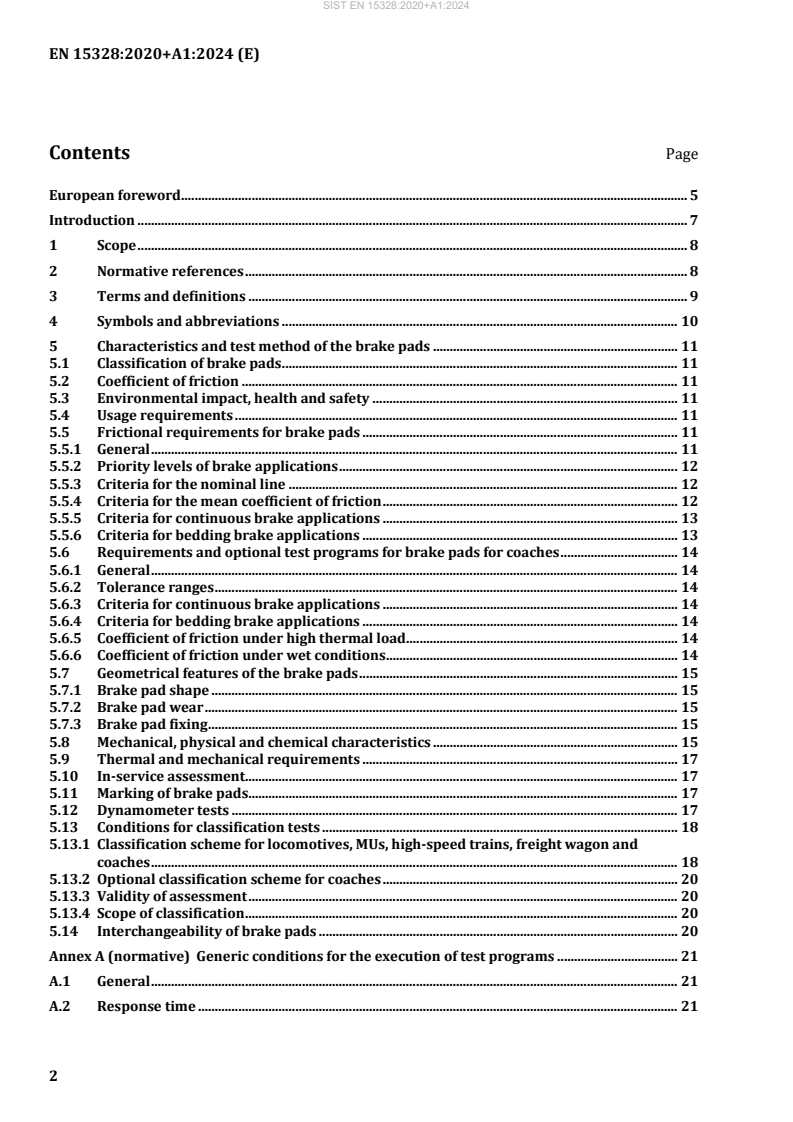
Contents Page
European foreword . 5
Introduction . 7
1 Scope . 8
2 Normative references . 8
3 Terms and definitions . 9
4 Symbols and abbreviations . 10
5 Characteristics and test method of the brake pads . 11
5.1 Classification of brake pads . 11
5.2 Coefficient of friction . 11
5.3 Environmental impact, health and safety . 11
5.4 Usage requirements . 11
5.5 Frictional requirements for brake pads . 11
5.5.1 General . 11
5.5.2 Priority levels of brake applications . 12
5.5.3 Criteria for the nominal line . 12
5.5.4 Criteria for the mean coefficient of friction . 12
5.5.5 Criteria for continuous brake applications . 13
5.5.6 Criteria for bedding brake applications . 13
5.6 Requirements and optional test programs for brake pads for coaches . 14
5.6.1 General . 14
5.6.2 Tolerance ranges . 14
5.6.3 Criteria for continuous brake applications . 14
5.6.4 Criteria for bedding brake applications . 14
5.6.5 Coefficient of friction under high thermal load . 14
5.6.6 Coefficient of friction under wet conditions . 14
5.7 Geometrical features of the brake pads . 15
5.7.1 Brake pad shape . 15
5.7.2 Brake pad wear . 15
5.7.3 Brake pad fixing . 15
5.8 Mechanical, physical and chemical characteristics . 15
5.9 Thermal and mechanical requirements . 17
5.10 In-service assessment. 17
5.11 Marking of brake pads. 17
5.12 Dynamometer tests . 17
5.13 Conditions for classification tests . 18
5.13.1 Classification scheme for locomotives, MUs, high-speed trains, freight wagon and
coaches . 18
5.13.2 Optional classification scheme for coaches . 20
5.13.3 Validity of assessment . 20
5.13.4 Scope of classification . 20
5.14 Interchangeability of brake pads . 20
Annex A (normative) Generic conditions for the execution of test programs . 21
A.1 General . 21
A.2 Response time . 21
A.3 Weighing . 21
A.4 Interruption of test sequence . 21
A.5 Temperatures . 21
A.6 Brake applications under wet conditions . 21
A.7 Conditioning of brake discs. 22
A.7.1 General . 22
A.7.2 Conditioning program . 23
A.7.3 Roughness measurement . 23
A.8 Bedding-in of brake pads . 23
A.9 Methods of temperature measurements. 24
A.10 Mean friction radius . 24
A.11 Rotation and ventilation conditions . 24
Annex B (normative) Test programs for classes A1 to G1. 25
B.1 Test program: brake pads of class A1 . 25
B.2 Test program: brake pads of classes B1 and C1 . 27
B.3 Test Program: brake pads of classes B2 and C2 . 32
B.4 Test program: brake pads of class C0 . 37
B.5 Test program: brake pads of class C3 . 39
B.6 Test program: brake pads of class D1 . 42
B.7 Test program: brake pads of class D2 . 45
B.8 Test program: brake pads of class E1 . 49
B.9 Test program: brake pads of class F1 . 51
B.10 Test program: brake pads of classes F2 and G1 . 55
B.11 Test program: brake pads of class F3 . 57
B.12 Assessment of static friction coefficient . 60
Annex C (normative) Test programs for coaches . 61
C.1 Test program S1.1 (v = 200 km/h – organic brake pads) . 61
max
C.2 Test program S2.1 (wet test) . 64
C.3 Instantaneous coefficient of friction for test program S1.1, S2.1, T1 and T2 . 64
C.4 Mean coefficient of friction for test programs S1.1, S2.1, T1 and T2 . 65
C.5 Test program T1 (v = 200 km/h – sintered brake pads). 66
max
C.6 Test program T2 wet test (sintered brake pads) . 69
Annex D (normative) Documentation of brake tests . 70
Annex E (normative) Generic test programs for locomotives, MUs and high speed trains . 72
E.1 Use of the generic test programs . 72
E.2 Locomotives and MUs . 72
E.2.1 Test parameters. 72
E.2.2 Brake steps . 75
E.2.3 Masses . 76
E.2.4 Continuous brake applications . 76
E.3 High speed trains . 76
E.3.1 Test parameters. 76
E.3.2 Brake steps . 78
E.3.3 Masses . 79
E.3.4 Brake forces for high-speed brake applications . 79
E.3.5 Power for continuous brake applications . 80
Annex F (normative) Brake pads shapes and envelopes . 81
F.1 General . 81
F.2 Preferred space envelope for SBP 200 cm . 81
F.3 Preferred space envelope for SBP 175 cm . 82
F.4 Space envelope for SBP 200 cm . 83
F.5 Maximum Space envelope for SBP 175 cm . 83
Annex G (normative) Drawings for dove tails . 84
Annex H (informative) In-service test . 86
H.1 Test requirements . 86
H.2 Mechanical requirements . 86
H.3 Thermal requirements . 87
Annex I (informative) Example of the declaration of conformity . 88
Bibliography . 89
European foreword
This document (EN 15328:2020+A1:2024) has been prepared by Technical Committee CEN/TC 256
“Railway applications”, the secretariat of which is held by DIN.
This European Standard shall be given the status of a national standard, either by publication of an
identical text or by endorsement, at the latest by October 2024, and conflicting national standards shall
be withdrawn at the latest by October 2024.
Attention is drawn to the possibility that some of the elements of this document may be the subject of
patent rights. CEN shall not be held responsible for identifying any or all such patent rights.
This document supersedes !EN 15328:2020.
EN 15328:2020:
— the Introduction has been modified;
— new terms 3.7 “continuous brake application 1” and 3.8 “continuous brake application 2” have been
added;
— 5.1. “Classification of brake pads” has been modified;
— 5.13.1 “Classification scheme for locomotives, MUs, high-speed trains, freight wagon and coaches”,
Table 5 has been modified;
— 5.14 “Interchangeability of brake pads” has been modified;
— Clause A.9 “Methods of temperature measurements” has been modified;
— Annex B “Test programs for classes A1 to G1”, Tables B.2 to B.11 have been modified;
— Annex C “Test programs for coaches”, Table C.1 has been modified;
— Annex E, E.1 “Use of the generic test programs”, Table E.1, E.2.2 “Brake steps”, E.2.4 “Continuous
brake applications”, Table E.5 and E.3.5 “Power for continuous brake applications” have been
modified;
— new informative Annex I “Example of the declaration of conformity” has been added;
— Annex ZA has been deleted."
This document includes Amendment 1 approved by CEN on 2 March 2024.
The start and finish of text introduced or altered by amendment is indicated in the text by tags !".
!deleted text"
Any feedback and questions on this document should be directed to the users’ national standards body.
A complete listing of these bodies can be found on the CEN website.
According to the CEN-CENELEC Internal Regulations, the national standards organisations of the
following countries are bound to implement this European Standard: Austria, Belgium, Bulgaria, Croatia,
Cyprus, Czech Republic, Denmark, Estonia, Finland, France, Germany, Greece, Hungary, Iceland, Ireland,
Italy, Latvia, Lithuania, Luxembourg, Malta, Netherlands, Norway, Poland, Portugal, Republic of North
Macedonia, Romania, Serbia, Slovakia, Slovenia, Spain, Sweden, Switzerland, Türkiye and the United
Kingdom.
Introduction
This document gives the requirements for the design, dimensions, performance and testing of a brake
pad which, as part of a disc brake system, acts on one friction face of a brake disc in accordance with
EN 14535-1 and EN 14535-2.
!deleted text"
This document contains the requirements for interfacing the brake pads with the rail vehicle, the testing
procedures in order to confirm that it satisfies the basic safety and technical requirements, the material
control procedures to ensure product quality, reliability and conformity, as well health and
environmental requirements are fulfilled.
!deleted text"
1 Scope
This document specifies requirements for pads for disc brakes of railway rolling stock.
The document defines requirements and generic test programs for brake pads on dynamometer. This
document does not cover mandatory tests to verify stopping distances in addition to laboratory, bench
test and in-service tests. In order to qualify the brake pad performance in accordance with the
classification the standard provides fixed parameter figures as categories defined in paragraph
classification scheme.
This document is not applicable for urban rail applications.
2 Normative references
The following documents are referred to in the text in such a way that some or all of their content
constitutes requirements of this document. For dated references, only the edition cited applies. For
undated references, the latest edition of the referenced document (including any amendments) applies.
EN 14478:2017, Railway applications - Braking - Generic vocabulary
EN 14535-1:2019, Railway applications - Brake discs for railway rolling stock - Part 1: Brake discs pressed
or shrunk onto the axle or drive shaft, dimensions and quality requirements
EN 14535-2:2019, Railway applications - Brake discs for railway rolling stock - Part 2: Brake discs mounted
onto the wheel, dimensions and quality requirements
!deleted reference"
EN 16451:2015, Railway applications - Braking - Brake pad holder
!EN ISO 21920-2:2022, Geometrical product specifications (GPS) — Surface texture: Profile — Part 2:
Terms, definitions and surface texture parameters (ISO 21920-2: 2021, Corrected version 2022-06)"
!deleted reference"
3 Terms and definitions
For the purposes of this document, the terms and definitions given in EN 14478:2017, EN 14535-1:2019,
EN 14535-2:2019 !deleted text" and the following apply.
ISO and IEC maintain terminological databases for use in standardization at the following addresses:
— IEC Electropedia: available at http://www.electropedia.org/
— ISO Online browsing platform: available at https://www.iso.org/obp/ui
3.1
instantaneous coefficient of friction
instantaneous value of coefficient of friction of the friction couple brake pad/brake disc at any instant
during braking
3.2
static coefficient of friction
coefficient of friction achieved by the friction couple at the point where relative movement between the
brake pad friction face and brake disc friction face begins
3.3
brake disc temperature
arithmetic average value of the temperature measurements on the brake disc friction faces
3.4
contact surface area
static contact surface of the brake pad available for frictional engagement with the brake disc friction face
3.5
friction material
consumable portion of the brake pad that acts on the friction face of the brake disc in order to provide
the specified brake performance
3.6
brake pad
assembly of friction material and an associated fixing element acting on one friction face of a brake disc
Note 1 to entry: A brake pad can be manufactured in one piece or comprise two separate parts. Where
manufactured in two separate halves, the brake pad comprises one left-hand and one right-hand half. For a brake
disc four brake pad halves or two brake pads can be used.
!
3.7
continuous brake application 1
brake application which represents the Gotthard-Ramp with friction brakes only
3.8
continuous brake application 2
brake application which represents the reference case of TSI Loc&Pas to perform a continuous brake
application in load condition ‘maximum braking load’ at speed equal to 90 % of the maximum operating
speed on maximum descending gradient of 35 ‰ during 6 km with friction brakes and a train resistance
(25 % of the total brake force)"
4 Symbols and abbreviations
For the purposes of this document, the symbols and abbreviations given in Table 1 apply.
Table 1 — Symbols and abbreviations
Symbol Designation Unit
F
Nominal application force per brake disc kN
B
F
Instantaneous application force per brake disc kN
b
m Mass to be braked per brake disc (inclusive of the rotational masses) t
Q Water flow rate l/h
R
Refer to !EN ISO 21920-2" μm
a
R
Refer to !EN ISO 21920-2" μm
z
s Stopping distance from the moment on when F = 0,95 F to rest
m
2 b B
v
Theoretical initial speed at the brake application initiation km/h
v Instantaneous speed km/h
v
Maximum service speed km/h
max
Friction coefficient (brake pad):
µ
—
a The instantaneous friction coefficient specified at every instant of the
braking time
Mean friction coefficient:
s
The mean friction coefficient μ integrated over the time from where
m
µµ=⋅ ⋅ d —
m as
∫
95 % of the nominal application force F is reached over the stopping
s
B
distance s
µ
Nominal friction coefficient (brake pad) —
m,nom
θ
Mean initial temperature at the beginning of the brake application °C
CI Cast iron
MU Multiple unit (EMU/DMU)
SBP Standard brake pad
5 Characteristics and test method of the brake pads
5.1 Classification of brake pads
This document defines the characteristics required for the categories A1 to G1 of brake pads, listed in
Table 5. The characteristic requirements for the application in coaches used in general operation are
listed in Table 7.
!Brake pads that have a valid UIC certification (preliminary or full) comply with EN 15328:2020 for
the corresponding vehicle and energy class.
Brake pads which comply with EN 15328:2020 can retain the declaration of conformity to EN 15328 for
a period of ten years after the declaration was issued. New declarations of conformity shall relate to the
current released version of the standard.
NOTE The declaration of conformity can be issued by the manufacturer on the basis of the test results. An
example of the declaration of conformity is given in Annex I.
As an alternative to the vehicle and energy class specific test program, a project specific test program in
accordance with Annex E may be applied."
5.2 Coefficient of friction
The coefficient of friction should be independent of the wear (full thickness of the brake pad), the specific
pressure, the temperature and the environmental conditions.
In wet conditions, or when there is snow, the instantaneous coefficient of friction should vary only slightly
compared to the coefficient of friction under dry conditions.
These frictional characteristics shall be assessed in accordance with 5.5 to 5.6.
5.3 Environmental impact, health and safety
All raw materials used in the manufacture of the brake pads shall comply with the relevant requirements
for environment, health and safety.
NOTE Relevant requirements are given in regulations of environment, health and safety, notably REACH
regulations.
In addition, a safety data sheet shall be presented.
5.4 Usage requirements
The composition of the material from which the brake pads are made should be chosen so that the best
compromise is obtained between:
— the frictional properties,
— the wear of the brake pads, and
— the aggressiveness against the brake disc.
5.5 Frictional requirements for brake pads
5.5.1 General
This subclause describes the requirements for brake pads used in locomotives, MUs, freight wagons and
coaches. Optional test programs and requirements for coaches are defined in 5.6.
5.5.2 Priority levels of brake applications
In the test programs A1 to G1, the brake applications are prioritized, in accordance with a decreasing
level of importance, as given in Table 2.
Brake applications with highest nominal application force (highest nominal deceleration) under normal
conditions representing emergency brake applications are rated with priority 1. All other brake
applications are rated according to their safety relevance with priorities 2 to 4. Continuous and parking
brake applications are not stopping brake applications and therefore assessed according to different
criteria and there is no priority level assigned with these brake applications. Bedding brake applications
which are carried out prior to the main stopping brake applications are assessed separately.
Table 2 — Priority levels of brake applications for test programs
Priority level Type of brake application
Dry brake applications with the highest nominal application force for each mass,
normal conditions
Wet brake applications and hot brake applications with highest nominal application
force, for each mass
Brake applications with highest nominal application force used for cleaning, drying,
regenerating, or after continuous brake applications, for each mass
All other brake applications, with the exception of continuous brake applications and
bedding brake applications and the examination of static coefficient of friction
Continuous brake applications, brake applications used for bedding-in, examination
—
of static coefficient of friction
Normal conditions refer to brake applications under dry conditions with low initial temperature and with
the brake disc and the brake pad unaffected by high thermal load or residual wetness.
Brake pads of categories A1 to G1 are characterized by their friction behaviour, expressed as the velocity-
dependent nominal line.
The nominal line for the coefficient of friction is calculated for each brake pad and each test program as
the linear regression line of the mean coefficients of friction (expressed in a rounding range of 0,001)
versus speed of all brake applications with priority 1, extending from the lowest to the highest test speed.
5.5.3 Criteria for the nominal line
The nominal line should lie between 0,300 and 0,450.
It shall lie between 0,280 and 0,470. The difference between the maximum value and the minimum value
of the nominal line shall be less or equal to 0,150.
5.5.4 Criteria for the mean coefficient of friction
Allowed deviations of coefficients of friction are expressed by means of tolerance bands centred around
the nominal line.
The tolerance bands for the mean coefficients of friction in accordance with their priority level are given
in Table 3.
Table 3 — Tolerance bands for the mean coefficients of friction vs. priority levels
Priority level of
1 2 3 4
brake application
Tolerance band 1 ±10 % ±15 % ±20 % ±25 %
Tolerance band 2 ±15 % ±20 % ±25 % ±30 %
The mean coefficient of friction for each brake application shall lie within the bounds of the tolerance
band 1 in accordance with its priority, while the following exceptions are tolerated.
— A total of 6 % of all brake applications (rounded to the closest integer) of priority 1 may deviate from
tolerance band 1 towards the negative side.
— A total of 12 % of all brake applications (rounded to the closest integer) of priority 1 may deviate
from tolerance band 1.
— A total of 5 % of all brake applications (rounded to the closest integer) of priorities 2 to 4 may deviate
from tolerance band 1 towards the negative side.
— A total of 10 % of all brake applications (rounded to the closest integer) of priorities 2 to 4 may
deviate from tolerance band 1.
No mean coefficient of friction shall lie outside of tolerance band 2.
5.5.5 Criteria for continuous brake applications
During continuous brake applications, after 10 s the instantaneous coefficient of friction shall stay inside
the band defined by µ = 0,250 and µ = 0,500.
min max
After 2 minutes the instantaneous coefficient of friction shall not vary more than 0,05 during any minute
and the coefficient of friction shall stay inside the band defined by µ = 0,250 and µ = 0,500.
min max
The brake pad wear during any continuous brake application, including the stop brake application
thereafter, shall not exceed 1 mm. The wear in mm can be calculated from the weight differences before
and after the continuous brake application.
5.5.6 Criteria for bedding brake applications
The nominal coefficient of friction of the bedded state shall be defined as the average of measured mean
coefficients of friction µ of the last 5 braking stops carried out during the bedding section.
m
During the bedding-in phase, the mean coefficients of friction shall not exceed the following variations
from the nominal value of the bedded state:
th
— ± 30 % from the 11 bedding-in brake application until 30 % of number of the bedding-in
applications are finished;
— ± 15 % during the rest of the bedding-in process.
5.6 Requirements and optional test programs for brake pads for coaches
5.6.1 General
The frictional requirements for brake pads in coaches used in generic operation are described in 5.6.2 to
5.6.6. The optional test programs are defined in S1.1 and S2.1 for organic material and T1 and T2 for
sintered material, and may be used instead of energy class C0 (see Annex C).
5.6.2 Tolerance ranges
The tolerance ranges for the instantaneous and mean coefficients of friction on a dry brake disc are given
for the respective applications in the figures of the corresponding annexes. The instantaneous and the
mean coefficients of friction measured in the test bench tests shall be documented in the appropriate
tolerance diagrams. For the highest nominal application forces of the test program the mean coefficients
of friction are summarized in a separate tolerance diagram and documented in tabular form. The average
value of these mean coefficients of friction at a speed of 120 km/h at the highest nominal application force
(excluding brake application with high initial temperatures) shall not vary more than 10 % upwards or
5 % downwards from the nominal coefficient of friction given in the tolerance diagram of the respective
test program. At speeds above 120 km/h, the average values of these mean coefficients of friction shall
not vary more than 10 % upwards or 10 % downwards from the nominal coefficients of friction.
5.6.3 Criteria for continuous brake applications
During continuous brake applications, after 10 seconds the instantaneous coefficient of friction shall stay
inside the band defined by µ = 0,250 and µ = 0,500.
min max
After 2 minutes the instantaneous coefficient of friction shall not vary more than 0,05 during any minute
and the coefficient of friction shall stay inside the band defined by µ = 0,250 and µ = 0,500.
min max
5.6.4 Criteria for bedding brake applications
The mean coefficient of friction of the bedded state shall be defined as the average of measured mean
coefficient of friction of the last 5 braking stops carried out during the bedding section.
During the bedding-in phase, the mean coefficients of friction shall not exceed the following variations
from the nominal value of the bedded state:
th
— ± 30 % from the 11 bedding-in brake application until 30 % of number of the bedding-in
applications are finished;
— ± 15 % during the rest of the bedding-in process.
5.6.5 Coefficient of friction under high thermal load
For brake applications to a stand, which are done from a high initial temperature (approximately 140 °C,
excluding brake application after continuous brake applications and for two consecutive emergency
brake without cooling time), the mean coefficient of friction under otherwise similar conditions shall not
vary by more than ± 15 % from the average of the mean coefficients of friction of brake applications
initiated from the cold and dry condition.
5.6.6 Coefficient of friction under wet conditions
In wet conditions, with the highest nominal application force of test !programs" S2.1 and T2 the
mean coefficient of friction shall not vary – all other things being equal – by more than ± 15 % compared
with the average of mean coefficients of friction obtained during braking under dry conditions. The mean
coefficients of friction of the other brake applications to a stand of this test program shall not under-run
the absolute value of µ = 0,250 under otherwise similar conditions.
m
5.7 Geometrical features of the brake pads
5.7.1 Brake pad shape
The SBP shall be designed in accordance with Annex F.
5.7.2 Brake pad wear
The design of the brake pads shall enable them to wear uniformly to a friction material thickness of 5 mm
or defined by design specification.
5.7.3 Brake pad fixing
The brake pads should be affixed to the vehicle by pushing them into a dovetail. If the brake pad is used
with a brake pad holder in accordance with EN 16451:2015 the dove tail shall be designed in accordance
with Annex G.
5.8 Mechanical, physical and chemical characteristics
The mechanical, physical and chemical characteristics shall be homogeneous across the entire active
thickness.
The brake pads shall not deform under the effect of heat or humidity so that they can no longer be fitted
or removed.
A material data sheet, on which sufficient mechanical and physical characteristics of the friction material
are given, shall be presented so that by quality testing or subsequent inspections it is possible to check
that these characteristics have not changed and the brake pad actually conforms to the approved brake
pad material.
The organic and sintered brake pads shall be tested in accordance with Table 4. For other materials the
mechanical and physical test characteristic shall be agreed before the test.
The results serve as a database for the material data sheet, which shall then serve as a reference
demonstrating that the brake pads subsequently manufactured during series production correspond to
the brake pads used. Tests marked “A” shall be conducted with a specimen from one of the batches used
for the assessment in conformity to this document.
Tests marked “B” shall be conducted with test products from each of the batches used for the assessment
in conformity to this document. Friction parameters shall be derived from at least three batches.
Table 4 — Reference tests for quality assurance
Organic brake Sintered brake
pads pads
a
Chemical composition A A
Macrostructure — A
b
Hardness or compressibility B B
Coefficient of friction (small scale
B B
bench tests for brake pads)
Density B B
c
Resistance to high temperatures — A
a
Results for chemical analysis are confidential. They are not included in the test
report. They have to be retained for future comparison.
b
Shall be defined before assessment.
c
For resistance to high temperatures tests, unless otherwise specified, the
maintaining of the brake pad stud at temperatures of (710 ± 5) °C for 1,5 h shall not
cause any variation in thickness > 3 % after cooling down in comparison to the width
registered before the start of the test.
At least the following information shall be provided with the data sheet of a brake pad:
— energy class;
— nominal line for the friction coefficient;
— range of specific pressure;
— maximum sliding speed at the brake radius;
— maximum temperature sustained;
— maximum temperature momentarily sustained;
— density.
The test results shall be attached to the test report. The test method and the tolerance band for each
property shall be defined in accordance with the product itself and the production process.
Hardness/compressibility, coefficient of friction (small-scale bench tests for brake pad material) and
density shall be tested with:
a) test samples taken from an area near the contact surface,
b) test samples taken from an area near the wear limit.
Comparison of the results from A and B shall show that the material is homogeneous and retains its
properties across the entire active thickness.
5.9 Thermal and mechanical requirements
The shape, number and arrangement of the rubbing parts on the carrier plate shall be designed to achieve
a most uniform temperature distribution in the brake disc.
During friction bench testing the following shall not occur:
— flames;
— blow-outs or exfoliation over an area of more than 10 % of the brake pad surface;
— any damage jeopardizing the mechanical strength of the brake pad, leading to significant material
deposits on the brake disc or creating unusual levels of wear.
5.10 In-service assessment
The in-service assessment is not requested by this document for the generic classification.
If an in-service assessment is requested for a specific application it should be performed in conformity
with Annex H.
5.11 Marking of brake pads
On the back of each part of a brake pad, there shall be the following marks:
— name or abbreviation of the manufacturer;
— year of manufacture;
— week and/or number of batch;
— brake pad-abbreviation (material).
The marks shall be so applied, that each brake pad can still be identified even after it has worn to its
scrapping thickness.
5.12 Dynamometer tests
The tests shall be performed by a competent laboratory.
NOTE 1 As an example, a test institute in accordance with EN ISO/IEC 17025.
Generic conditions for the execution of test programs shall be in accordance with Annex A.
Brake pads of the full scale size shall be used. Each test program shall be carried out with new brake pads.
The test report shall conform to the minimum requirements of Annex D.
The dynamometer used for conducting the tests provided in the Annexes should be suitable for carrying
out these tests in the correct manner.
NOTE 2 Existing document that defines the requirements of dynamometers for Railway Friction Material testing
at the time of writing this document include !UIC/IRS 50548" and can be used as reference document.
5.13 Conditions for classification tests
5.13.1 Classification scheme for locomotives, MUs, high-speed trains, freight wagon and coaches
The classification of the brake pads is defined in Table 5.
Table 5 — Classification of brake pads for locomotives, MUs, high-speed trains, freight wagons
and coaches
C
...