

SIST EN 15510:2017
(Main)Animal feeding stuffs: Methods of sampling and analysis - Determination of calcium, sodium, phosphorus, magnesium, potassium, iron, zinc, copper, manganese, cobalt, molybdenum and lead by ICP-AES
General Information
- Abstract
This European Standard specifies the inductively coupled plasma atomic emission spectroscopy (ICP-AES) method for the determination of the elements calcium, sodium, phosphorus, magnesium, potassium, iron, zinc, copper, manganese, cobalt, molybdenum and lead.
The elements calcium, sodium, phosphorus, magnesium, potassium, iron, zinc, copper, manganese, cobalt, molybdenum and lead are extracted either in feeds mainly consisting of organic matter after dry ashing and dissolving in hydrochloric acid or in feeds mainly consisting of inorganic matter after wet digestion with hydrochloric acid.
For the determination of extractable lead in minerals and feeds containing phyllosilicates (e.g. kaolinite clay) wet digestion with nitric acid should be used.
The method was successfully tested for:
- calcium, sodium, phosphorus, magnesium, potassium, iron, zinc, copper, manganese, cobalt and molybdenum in the following animal feeding stuffs: 2 complete feeds (pig feed, sheep feed), 1 feed material (phosphate), 1 mineral premixture and 2 complementary feeds (2 mineral feeds),
- lead in 2 feed materials (phosphate, CaCO3), 2 feed additives (Bentonite, CuSO4), 1 complementary feed (mineral feed)
The method detection limit for each element is dependent on the sample matrix and the instrument. The method is not applicable for the determination of a low concentration of elements. The limit of quantification should be 3 mg/kg or lower.
This method also applies for the determination in products with high element content (>5 %). For this purpose the accuracy of the method has to be checked individually.
NOTE 1 EN 15621 uses the pressure digestion mode, therefore lower results may be obtained with the described method in this standard.
- Status
- Published
- Public Enquiry End Date
- 19-Dec-2016
- Publication Date
- 06-Sep-2017
- Technical Committee
- KŽP - Agricultural food products
- Current Stage
- 6060 - National Implementation/Publication (Adopted Project)
- Start Date
- 24-Aug-2017
- Due Date
- 29-Oct-2017
- Completion Date
- 07-Sep-2017



Overview
EN 15510:2017 is a CEN European Standard that specifies an analytical procedure for the determination of major and trace elements in animal feeding stuffs using inductively coupled plasma atomic emission spectrometry (ICP‑AES). The method covers the quantification of calcium, sodium, phosphorus, magnesium, potassium, iron, zinc, copper, manganese, cobalt, molybdenum and lead following appropriate sample extraction (dry ashing or wet digestion).
Key topics and technical requirements
- Analyte scope: Ca, Na, P, Mg, K, Fe, Zn, Cu, Mn, Co, Mo and Pb by ICP‑AES.
- Sample preparation:
- Feeds mainly organic: dry ashing followed by dissolution in hydrochloric acid (HCl).
- Feeds mainly inorganic: wet digestion with HCl.
- For extractable lead in minerals or phyllosilicate‑containing feeds (e.g., kaolinite), wet digestion with nitric acid (HNO3) is recommended.
- Calibration and quantification: External calibration or standard addition technique to address matrix effects. Annex B covers spectral, ionization and physical interferences and matrix‑matching strategies.
- Performance characteristics: Method detection limits depend on sample matrix and instrument. The method is not intended for very low concentrations; limit of quantification (LOQ) should be 3 mg/kg or lower. For elements with high HORRAT values (>2) the method is more suited for screening than confirmatory analysis.
- High-content samples: Applicable to products with element content >5 %, but accuracy must be individually verified.
- Safety: Use of hazardous reagents (concentrated acids) - laboratories must follow appropriate health and safety regulations.
Practical applications
- Routine feed analysis laboratories performing multi‑element screening of animal feeding stuffs and feed additives.
- Quality control in feed manufacturing (complete feeds, mineral premixtures, complementary/mineral feeds).
- Regulatory compliance testing for elemental content and contaminants (e.g., lead) in animal feeds.
- Research laboratories studying nutrient composition or contamination in feed raw materials (phosphate, CaCO3, bentonite, CuSO4).
Practical workflow: select appropriate digestion (dry ashing or wet digestion), prepare calibration (external or standard addition), measure by ICP‑AES, and report results with LOQ and method limitations.
Who should use EN 15510:2017
- Accredited analytical and contract testing laboratories
- Feed manufacturers and quality assurance teams
- Regulatory bodies and food/feed safety inspectors
- Method developers and researchers in animal nutrition and feed safety
Related standards
- EN 15621 (pressure digestion methods) - note: pressure digestion can give different (often lower) results.
- EN ISO 3696 (laboratory water quality)
- EN ISO 6498 (sample preparation guidance for animal feeding stuffs)
Keywords: EN 15510:2017, ICP‑AES, animal feeding stuffs, feed analysis, calcium sodium phosphorus magnesium, lead determination, dry ashing, wet digestion, limit of quantification, feed testing.
Relations
- Effective Date
- 01-Oct-2017
- Refers
SIST EN ISO 6498:2012 - Animal feeding stuffs - Guidelines for sample preparation (ISO 6498:2012) - Effective Date
- 28-Jan-2026
- Effective Date
- 28-Jan-2026
Get Certified
Connect with accredited certification bodies for this standard

Control Union Certifications
Global certification for agriculture and sustainability.

ECOCERT
Organic and sustainability certification.

FSC International
Forest Stewardship Council certification.
Sponsored listings
Frequently Asked Questions
SIST EN 15510:2017 is a standard published by the Slovenian Institute for Standardization (SIST). Its full title is "Animal feeding stuffs: Methods of sampling and analysis - Determination of calcium, sodium, phosphorus, magnesium, potassium, iron, zinc, copper, manganese, cobalt, molybdenum and lead by ICP-AES". This standard covers: This European Standard specifies the inductively coupled plasma atomic emission spectroscopy (ICP-AES) method for the determination of the elements calcium, sodium, phosphorus, magnesium, potassium, iron, zinc, copper, manganese, cobalt, molybdenum and lead. The elements calcium, sodium, phosphorus, magnesium, potassium, iron, zinc, copper, manganese, cobalt, molybdenum and lead are extracted either in feeds mainly consisting of organic matter after dry ashing and dissolving in hydrochloric acid or in feeds mainly consisting of inorganic matter after wet digestion with hydrochloric acid. For the determination of extractable lead in minerals and feeds containing phyllosilicates (e.g. kaolinite clay) wet digestion with nitric acid should be used. The method was successfully tested for: - calcium, sodium, phosphorus, magnesium, potassium, iron, zinc, copper, manganese, cobalt and molybdenum in the following animal feeding stuffs: 2 complete feeds (pig feed, sheep feed), 1 feed material (phosphate), 1 mineral premixture and 2 complementary feeds (2 mineral feeds), - lead in 2 feed materials (phosphate, CaCO3), 2 feed additives (Bentonite, CuSO4), 1 complementary feed (mineral feed) The method detection limit for each element is dependent on the sample matrix and the instrument. The method is not applicable for the determination of a low concentration of elements. The limit of quantification should be 3 mg/kg or lower. This method also applies for the determination in products with high element content (>5 %). For this purpose the accuracy of the method has to be checked individually. NOTE 1 EN 15621 uses the pressure digestion mode, therefore lower results may be obtained with the described method in this standard.
This European Standard specifies the inductively coupled plasma atomic emission spectroscopy (ICP-AES) method for the determination of the elements calcium, sodium, phosphorus, magnesium, potassium, iron, zinc, copper, manganese, cobalt, molybdenum and lead. The elements calcium, sodium, phosphorus, magnesium, potassium, iron, zinc, copper, manganese, cobalt, molybdenum and lead are extracted either in feeds mainly consisting of organic matter after dry ashing and dissolving in hydrochloric acid or in feeds mainly consisting of inorganic matter after wet digestion with hydrochloric acid. For the determination of extractable lead in minerals and feeds containing phyllosilicates (e.g. kaolinite clay) wet digestion with nitric acid should be used. The method was successfully tested for: - calcium, sodium, phosphorus, magnesium, potassium, iron, zinc, copper, manganese, cobalt and molybdenum in the following animal feeding stuffs: 2 complete feeds (pig feed, sheep feed), 1 feed material (phosphate), 1 mineral premixture and 2 complementary feeds (2 mineral feeds), - lead in 2 feed materials (phosphate, CaCO3), 2 feed additives (Bentonite, CuSO4), 1 complementary feed (mineral feed) The method detection limit for each element is dependent on the sample matrix and the instrument. The method is not applicable for the determination of a low concentration of elements. The limit of quantification should be 3 mg/kg or lower. This method also applies for the determination in products with high element content (>5 %). For this purpose the accuracy of the method has to be checked individually. NOTE 1 EN 15621 uses the pressure digestion mode, therefore lower results may be obtained with the described method in this standard.
SIST EN 15510:2017 is classified under the following ICS (International Classification for Standards) categories: 65.120 - Animal feeding stuffs. The ICS classification helps identify the subject area and facilitates finding related standards.
SIST EN 15510:2017 has the following relationships with other standards: It is inter standard links to SIST EN 15510:2007, SIST EN ISO 6498:2012, SIST EN ISO 3696:1998. Understanding these relationships helps ensure you are using the most current and applicable version of the standard.
SIST EN 15510:2017 is available in PDF format for immediate download after purchase. The document can be added to your cart and obtained through the secure checkout process. Digital delivery ensures instant access to the complete standard document.
Standards Content (Sample)
2003-01.Slovenski inštitut za standardizacijo. Razmnoževanje celote ali delov tega standarda ni dovoljeno.,&3$(6Futtermittel - Probenahme- und Untersuchungsverfahren - Bestimmung von Calcium, Natrium, Phosphor, Magnesium, Kalium, Eisen, Zink, Kupfer, Mangan, Cobalt, Molybdän und Blei mittels ICP-AESAliments des animaux - Méthodes d'échantillonnage et d'analyse - Détermination des teneurs en calcium, sodium, phosphore, magnésium, potassium, fer, zinc, cuivre, manganèse, cobalt, molybdène et plomb par ICP-AESAnimal feeding stuffs: Methods of sampling and analysis - Determination of calcium, sodium, phosphorus, magnesium, potassium, iron, zinc, copper, manganese, cobalt, molybdenum and lead by ICP-AES65.120KrmilaAnimal feeding stuffsICS:Ta slovenski standard je istoveten z:EN 15510:2017SIST EN 15510:2017en,fr,de01-oktober-2017SIST EN 15510:2017SLOVENSKI
STANDARDSIST EN 15510:20071DGRPHãþD
EUROPEAN STANDARD NORME EUROPÉENNE EUROPÄISCHE NORM
EN 15510
August
t r s y ICS
x wä s t r Supersedes EN
s w w s rã t r r yEnglish Version
Animal feeding stuffsã Methods of sampling and analysis æ Determination of calciumá sodiumá phosphorusá magnesiumá potassiumá ironá zincá copperá manganeseá cobaltá molybdenum and lead by ICPæAES Aliments des animaux æ Méthodes d 5échantillonnage et d 5analyse æ Détermination des teneurs en calciumá sodiumá phosphoreá magnésiumá potassiumá ferá zincá cuivreá manganèseá cobaltá molybdène et plomb par ICPæAES
Futtermittel æ Probenahmeæ und Untersuchungsverfahren æ Bestimmung von Calciumá Natriumá Phosphorá Magnesiumá Kaliumá Eisená Zinká Kupferá Manganá Cobaltá Molybdän und Blei mittels ICPæAES This European Standard was approved by CEN on
x February
t r s yä
egulations which stipulate the conditions for giving this European Standard the status of a national standard without any alterationä Upætoædate lists and bibliographical references concerning such national standards may be obtained on application to the CENæCENELEC Management Centre or to any CEN memberä
translation under the responsibility of a CEN member into its own language and notified to the CENæCENELEC Management Centre has the same status as the official versionsä
CEN members are the national standards bodies of Austriaá Belgiumá Bulgariaá Croatiaá Cyprusá Czech Republicá Denmarká Estoniaá Finlandá Former Yugoslav Republic of Macedoniaá Franceá Germanyá Greeceá Hungaryá Icelandá Irelandá Italyá Latviaá Lithuaniaá Luxembourgá Maltaá Netherlandsá Norwayá Polandá Portugalá Romaniaá Serbiaá Slovakiaá Sloveniaá Spainá Swedená Switzerlandá Turkey and United Kingdomä
EUROPEAN COMMITTEE FOR STANDARDIZATION COMITÉ EUROPÉEN DE NORMALISATION EUROPÄISCHES KOMITEE FÜR NORMUNG
CEN-CENELEC Management Centre:
Avenue Marnix 17,
B-1000 Brussels
t r s y CEN All rights of exploitation in any form and by any means reserved worldwide for CEN national Membersä Refä Noä EN
s w w s rã t r s y ESIST EN 15510:2017
HCl . 10 9.1.3 Dry ashing and extraction with
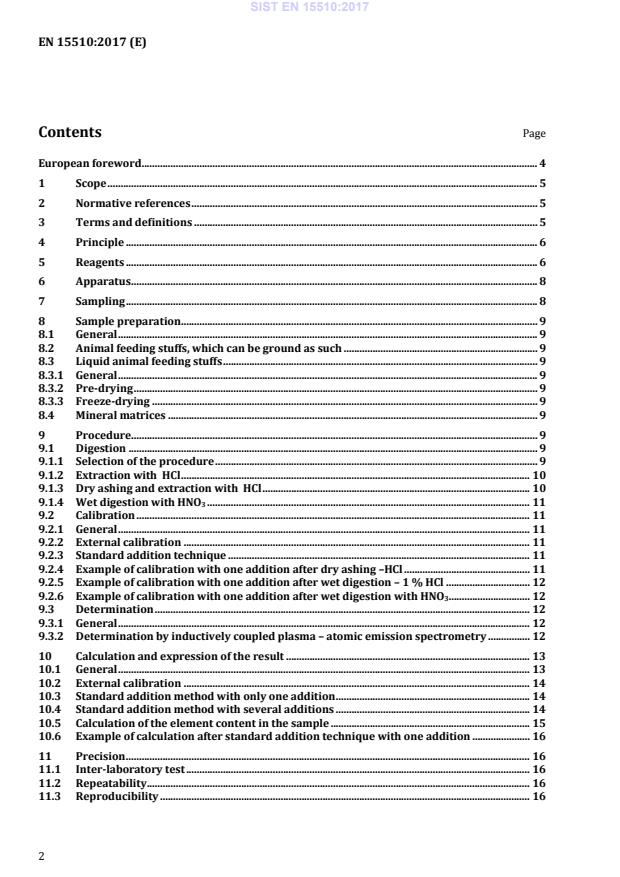
HCl . 10 9.1.4 Wet digestion with HNO3 . 11 9.2 Calibration . 11 9.2.1 General . 11 9.2.2 External calibration . 11 9.2.3 Standard addition technique . 11 9.2.4 Example of calibration with one addition after dry ashing –HCl . 11 9.2.5 Example of calibration with one addition after wet digestion – 1 % HCl . 12 9.2.6 Example of calibration with one addition after wet digestion with HNO3. 12 9.3 Determination . 12 9.3.1 General . 12 9.3.2 Determination by inductively coupled plasma – atomic emission spectrometry . 12 10 Calculation and expression of the result . 13 10.1 General . 13 10.2 External calibration . 14 10.3 Standard addition method with only one addition . 14 10.4 Standard addition method with several additions . 14 10.5 Calculation of the element content in the sample . 15 10.6 Example of calculation after standard addition technique with one addition . 16 11 Precision . 16 11.1 Inter-laboratory test . 16 11.2 Repeatability . 16 11.3 Reproducibility . 16 SIST EN 15510:2017
Results of the inter-laboratory test . 21 Annex B (informative)
Notes on the detection technique, interferences and quantification . 27 B.1 General . 27 B.2 Interferences . 27 B.2.1 General . 27 B.2.2 Spectral interferences . 27 B.2.3 Ionization interferences . 27 B.2.4 Physical interferences . 27 B.3 Quantification and matrix matching. 27 B.3.1 General . 27 B.3.2 Calibration curve . 28 B.3.3 Matrix matching . 28 B.3.4 Standard addition . 28 Bibliography . 29
(phosphate), 1 mineral premixture and 2 complementary feeds (2 mineral feeds), — lead in 2 feed materials (phosphate, CaCO3), 2 feed additives (Bentonite, CuSO4), 1 complementary feed (mineral feed) For elements with a HORRAT value higher than 2 (see Annex A) the method is more applicable as a screening method and not for confirmatory purposes. The method detection limit for each element is dependent on the sample matrix and the instrument. The method is not applicable for the determination of a low concentration of elements. The limit of quantification should be 3 mg/kg or lower. This method also applies for the determination in products with high element content (>5 %). For this purpose the accuracy of the method has to be checked individually. NOTE 1 Results using EN 15550 may be lower than those obtained when applying EN 15621 as pressure digestion is used in EN 15621. 2 Normative references The following documents, in whole or in part, are normatively referenced in this document and are indispensable for its application. For dated references, only the edition cited applies. For undated references, the latest edition of the referenced document (including any amendments) applies. EN ISO 3696, Water for analytical laboratory use - Specification and test methods (ISO 3696) EN ISO 6498, Animal feeding stuffs - Guidelines for sample preparation (ISO 6498) 3 Terms and definitions For the purposes of this document, the following terms and definitions apply: 3.1 limit of detection (LOD) smallest measured content from which it is possible to deduce the presence of the analyte with reasonable statistical certainty Note 1 to entry: The limit of detection is numerically equal to three times the standard deviation of the mean of blank determinations (n
·
s rá were n = number of measures) performed under reproducibility conditions. SIST EN 15510:2017
·
s rá were n = number of measures) performed under reproducibility conditions. 3.3 feed additives substances that comply with the definition of feed additives given in the Regulation (EC) No 1831/2003 of the European Parliament and of the Council of 22 September 2003 on additives for use in animal nutrition [3] 3.4 animal feeding stuffs substances that comply with the definition of animal feeding stuffs given in the Regulation (EC) No 178/2002 [4] 4 Principle For the determination of the elements calcium, sodium, phosphorus, magnesium, potassium, iron, zinc, copper, manganese, cobalt, molybdenum, lead, a test portion of the sample is — dry ashed and dissolved in hydrochloric acid for feeds mainly consisting of organic matter or — wet digested with hydrochloric acid for feeds mainly consisting of inorganic matter. For the determination of extractable lead in minerals and feeds, containing phyllosilicates (e.g. kaolinite clay) wet digestion with nitric acid should be used. The concentration of the elements calcium, sodium, phosphorus, magnesium, potassium, iron, zinc, copper, manganese, cobalt, molybdenum and lead is determined by inductively coupled plasma atomic emission spectrometry (ICP-AES) using external calibration or standard addition technique. 5 Reagents Use only reagents of recognized analytical grade, unless otherwise specified. WARNING —Use of this European Standard can involve hazardous materials, operations and equipment. This standard does not purport to address all the safety problems associated with its use. It is the responsibility of the user of this European Standard to establish appropriate safety and health practices and determine the applicability of regulatory limitations prior to use. 5.1 Water, complying with grade 2 as defined in EN ISO 3696. 5.2 Nitric acid, concentrated, not less than 65 % (m/m), having a density of approximately (HNO3) 1,42 g/ml. 5.3 Dilute nitric acid, to be prepared by mixing 1 volume of nitric acid (5.2) with 1 volume of water. 5.4 Nitric acid solution of 5 % (m/v), to be prepared: pipette 160 ml of dilute nitric acid (5.3) into a 1 000 ml volumetric flask (6.7) and fill to the mark with water. 5.5 Nitric acid solution of 2 % (v/v), to be prepared: pipette 20 ml of nitric acid (5.2) into a 1 000 ml volumetric flask (6.7) and fill to the mark with water. SIST EN 15510:2017
HCl Weigh about 1 g of the prepared test sample to the nearest 1 mg into a beaker of 250 ml (6.6). Add 30 ml dilute hydrochloric acid (5.7). Add about 100 ml of water. Cover the beaker (6.6) with a watch-glass and boil for 30 min on a hot plate (6.3). Allow to cool. Transfer the liquid into a 500 ml volumetric flask (6.7), rinsing the beaker and the watch-glass several times with water. Leave to cool, dilute to the mark with water. After homogenizing, filter through a dry folded filter paper into a dry conical flask. Use the first portion of the filtrate to rinse the glass ware and discard that part. If the determination is not carried out immediately, the conical flask with the filtrate shall be stoppered. Carry out a blank determination at the same time as the extraction, with only the reagents and follow the same procedure as for the samples. Proceed in accordance with 9.2. When the expected concentration of the element is lower than 100 mg/kg, proceed as described in 9.1.2, but use 12 ml dilute hydrochloric acid (5.7) and 70 ml of water, and transfer the liquid into a 100 ml volumetric flask (6.7). 9.1.3 Dry ashing and extraction with
HCl Weigh 5 g of the prepared test sample to the nearest 1 mg in an ashing crucible (6.4). Ash in the furnace (6.5), set at a temperature of 450 °C, until white or grey ash is obtained (a small quantity of carbon does not interfere). Transfer the ash to a 250 ml beaker (6.6) with 30 ml of dilute hydrochloric acid (5.7). Add 100 ml of water. Cover the beaker (6.6) with a watch-glass and boil for 30 min on a hot plate (6.3). Allow to cool. Transfer the liquid into a 500 ml volumetric flask (6.7), rinsing the beaker and the watch-glass several times with water. Leave to cool, dilute to the mark with water. After homogenizing, filter through a dry folded filter paper into a dry conical flask. Use the first portion of the filtrate to rinse the glassware and discard that part. If the determination is not carried out immediately, the conical flask with the filtrate shall be stoppered. Carry out a blank determination at the same time as the extraction, with only the reagents and follow the same procedure as for the samples. Proceed in accordance with 9.2. When the expected concentration of the element is lower than 100 mg/kg, proceed as described in 9.1.3, but use 12 ml dilute hydrochloric acid (5.7) and about 70 ml of water, and transfer the liquid into a 100 ml volumetric flask (6.7). SIST EN 15510:2017
...