

SIST EN 17683:2023
(Main)Animal feeding stuffs - Methods of sampling and analysis - Determination of pyrrolizidine alkaloids in animal feeding stuff by LC-MS/MS
General Information
- Abstract
This document specifies a method for the quantitative determination of pyrrolizidine alkaloids (PA) in the concentration ranges shown in Table 1 in complete and supplementary feed and in forages by liquid chromatography tandem mass spectrometry (LC-MS/MS) after solid phase extraction (SPE) clean-up.
Table 1 - Summary of concentration ranges per PA tested in the collaborative trial
NOTE 1 A second method was part of the method validation collaborative main trial. For this method PA-N-Oxides are reduced by adding zinc powder to the extract of the feed material. The following steps correspond to the first and main method. Quantitative results for each PA except the otonecine type PA senkirkine represent the sum of the free PA base and its corresponding N-oxide.
NOTE 2 Due to insufficient numbers of data for some analyte-matrix combinations statistical evaluation was not valid for standardization. Received data indicated the methods applicability in experienced laboratories with appropriate quality assurance measures. Therefore, the method description is included as an informative annex (Annex D).
- Status
- Published
- Public Enquiry End Date
- 14-Sep-2021
- Publication Date
- 05-Apr-2023
- Technical Committee
- KŽP - Agricultural food products
- Current Stage
- 6060 - National Implementation/Publication (Adopted Project)
- Start Date
- 30-Mar-2023
- Due Date
- 04-Jun-2023
- Completion Date
- 06-Apr-2023



Overview
SIST EN 17683:2023 specifies a validated laboratory method for the quantitative determination of pyrrolizidine alkaloids (PA) in animal feeding stuffs and forages using LC‑MS/MS after solid phase extraction (SPE) clean‑up. The standard covers PA concentration ranges tested in the collaborative trial (see Table 1), applicable to complete and supplementary feeds and to forages such as hay, alfalfa and grass silage. The method was developed and validated within CEN/TC 327 and includes procedural details from sampling and extraction to chromatographic separation and mass spectrometric detection.
Key topics and technical requirements
- Target analytes: Multiple PAs and corresponding N‑oxides (list of standards included), with quantification generally representing the sum of PA base + N‑oxide except for otonecine type senkirkine.
- Validated matrices: Complete feed for horses, supplementary feed (horses, rodents), hay, alfalfa, grass silage (collaborative trial validation).
- Sample preparation: Test portion (2 g) extraction by sonication in aqueous sulphuric acid, centrifugation and SPE clean‑up (C18 reversed phase).
- Chromatography & detection: RP‑HPLC separation with a binary gradient and detection by triple‑stage quadrupole LC‑MS/MS; quantification via matrix matched calibration (MMS).
- Calibration & range: Protocol calibration range specified from 10 µg/kg to 300 µg/kg; validated results indicate acceptable quantification after extract dilution up to ~1 428 µg/kg for individual PA and ~887 µg/kg for isomer sums.
- Isomeric limitations: Certain isomeric pairs (e.g., senecivernine/senecionine) cannot be fully chromatographically resolved individually - sums are reported.
- Quality & safety: Includes precision data, performance criteria, and warnings about hazardous reagents and operations.
- Annexes: Informative annexes provide precision data (A), example LC‑MS/MS conditions and chromatograms (B, C), alternative reduction method for N‑oxides using zinc (Annex D), and a list of potentially co‑eluting PA isomers (Annex E).
Practical applications and who uses this standard
- Laboratories performing feed safety testing for regulators and industry (official control laboratories, commercial testing labs).
- Quality assurance teams in the animal feed industry implementing contaminant monitoring for hay, silage and compound feeds.
- Research institutions studying plant toxins, PA contamination routes, and toxicology.
- Regulatory authorities and risk assessors referencing validated methods for enforcement and surveillance programs across the EU.
Practical benefits include standardized sample processing, improved inter‑laboratory comparability using matrix matched calibration, and guidance on handling PA‑N‑oxides and co‑eluting isomers.
Related standards and references
- EN ISO 3696 - Water for analytical laboratory use (referenced normative document).
- Commission Regulation (EU) 2020/2040 - lists of potentially co‑eluting PA isomers (informative context cited in the standard).
Keywords: pyrrolizidine alkaloids, PA, LC‑MS/MS, animal feeding stuffs, feed testing, solid phase extraction, matrix matched calibration, feed safety, SEN17683.
Relations
- Effective Date
- 28-Jan-2026
Get Certified
Connect with accredited certification bodies for this standard

Control Union Certifications
Global certification for agriculture and sustainability.

ECOCERT
Organic and sustainability certification.

FSC International
Forest Stewardship Council certification.
Sponsored listings
Frequently Asked Questions
SIST EN 17683:2023 is a standard published by the Slovenian Institute for Standardization (SIST). Its full title is "Animal feeding stuffs - Methods of sampling and analysis - Determination of pyrrolizidine alkaloids in animal feeding stuff by LC-MS/MS". This standard covers: This document specifies a method for the quantitative determination of pyrrolizidine alkaloids (PA) in the concentration ranges shown in Table 1 in complete and supplementary feed and in forages by liquid chromatography tandem mass spectrometry (LC-MS/MS) after solid phase extraction (SPE) clean-up. Table 1 - Summary of concentration ranges per PA tested in the collaborative trial NOTE 1 A second method was part of the method validation collaborative main trial. For this method PA-N-Oxides are reduced by adding zinc powder to the extract of the feed material. The following steps correspond to the first and main method. Quantitative results for each PA except the otonecine type PA senkirkine represent the sum of the free PA base and its corresponding N-oxide. NOTE 2 Due to insufficient numbers of data for some analyte-matrix combinations statistical evaluation was not valid for standardization. Received data indicated the methods applicability in experienced laboratories with appropriate quality assurance measures. Therefore, the method description is included as an informative annex (Annex D).
This document specifies a method for the quantitative determination of pyrrolizidine alkaloids (PA) in the concentration ranges shown in Table 1 in complete and supplementary feed and in forages by liquid chromatography tandem mass spectrometry (LC-MS/MS) after solid phase extraction (SPE) clean-up. Table 1 - Summary of concentration ranges per PA tested in the collaborative trial NOTE 1 A second method was part of the method validation collaborative main trial. For this method PA-N-Oxides are reduced by adding zinc powder to the extract of the feed material. The following steps correspond to the first and main method. Quantitative results for each PA except the otonecine type PA senkirkine represent the sum of the free PA base and its corresponding N-oxide. NOTE 2 Due to insufficient numbers of data for some analyte-matrix combinations statistical evaluation was not valid for standardization. Received data indicated the methods applicability in experienced laboratories with appropriate quality assurance measures. Therefore, the method description is included as an informative annex (Annex D).
SIST EN 17683:2023 is classified under the following ICS (International Classification for Standards) categories: 65.120 - Animal feeding stuffs. The ICS classification helps identify the subject area and facilitates finding related standards.
SIST EN 17683:2023 has the following relationships with other standards: It is inter standard links to SIST EN ISO 3696:1998. Understanding these relationships helps ensure you are using the most current and applicable version of the standard.
SIST EN 17683:2023 is associated with the following European legislation: EU Directives/Regulations: 882/2004; Standardization Mandates: M/523. When a standard is cited in the Official Journal of the European Union, products manufactured in conformity with it benefit from a presumption of conformity with the essential requirements of the corresponding EU directive or regulation.
SIST EN 17683:2023 is available in PDF format for immediate download after purchase. The document can be added to your cart and obtained through the secure checkout process. Digital delivery ensures instant access to the complete standard document.
Standards Content (Sample)
SLOVENSKI STANDARD
01-maj-2023
Krma - Metode vzorčenja in analize - Določanje pirolizidinskih alkaloidov v krmi z
LCMS/MS
Animal feeding stuffs - Methods of sampling and analysis - Determination of pyrrolizidine
alkaloids in animal feeding stuff by LC-MS/MS
Futtermittel - Probenahme- und Untersuchungsverfahren - Bestimmung von
Pyrrolizidinalkaloiden in Futtermitteln mittels LC-MS/MS
Alimentation animale - Méthodes d’échantillonnage et d’analyse - Dosage des alcaloïdes
pyrrolizidiniques dans l'alimentation animale par CL-SM/SM
Ta slovenski standard je istoveten z: EN 17683:2023
ICS:
65.120 Krmila Animal feeding stuffs
2003-01.Slovenski inštitut za standardizacijo. Razmnoževanje celote ali delov tega standarda ni dovoljeno.
EN 17683
EUROPEAN STANDARD
NORME EUROPÉENNE
March 2023
EUROPÄISCHE NORM
ICS 65.120
English Version
Animal feeding stuffs - Methods of sampling and analysis -
Determination of pyrrolizidine alkaloids in animal feeding
stuff by LC-MS/MS
Alimentation animale - Méthodes d'échantillonnage et Futtermittel - Probenahme- und
d'analyse - Dosage des alcaloïdes pyrrolizidiniques Untersuchungsverfahren - Bestimmung von
dans l'alimentation animale par CL-SM/SM Pyrrolizidinalkaloiden in Futtermitteln mittels LC-
MS/MS
This European Standard was approved by CEN on 17 January 2023.
CEN members are bound to comply with the CEN/CENELEC Internal Regulations which stipulate the conditions for giving this
European Standard the status of a national standard without any alteration. Up-to-date lists and bibliographical references
concerning such national standards may be obtained on application to the CEN-CENELEC Management Centre or to any CEN
member.
This European Standard exists in three official versions (English, French, German). A version in any other language made by
translation under the responsibility of a CEN member into its own language and notified to the CEN-CENELEC Management
Centre has the same status as the official versions.
CEN members are the national standards bodies of Austria, Belgium, Bulgaria, Croatia, Cyprus, Czech Republic, Denmark, Estonia,
Finland, France, Germany, Greece, Hungary, Iceland, Ireland, Italy, Latvia, Lithuania, Luxembourg, Malta, Netherlands, Norway,
Poland, Portugal, Republic of North Macedonia, Romania, Serbia, Slovakia, Slovenia, Spain, Sweden, Switzerland, Türkiye and
United Kingdom.
EUROPEAN COMMITTEE FOR STANDARDIZATION
COMITÉ EUROPÉEN DE NORMALISATION
EUROPÄISCHES KOMITEE FÜR NORMUNG
CEN-CENELEC Management Centre: Rue de la Science 23, B-1040 Brussels
© 2023 CEN All rights of exploitation in any form and by any means reserved Ref. No. EN 17683:2023 E
worldwide for CEN national Members.
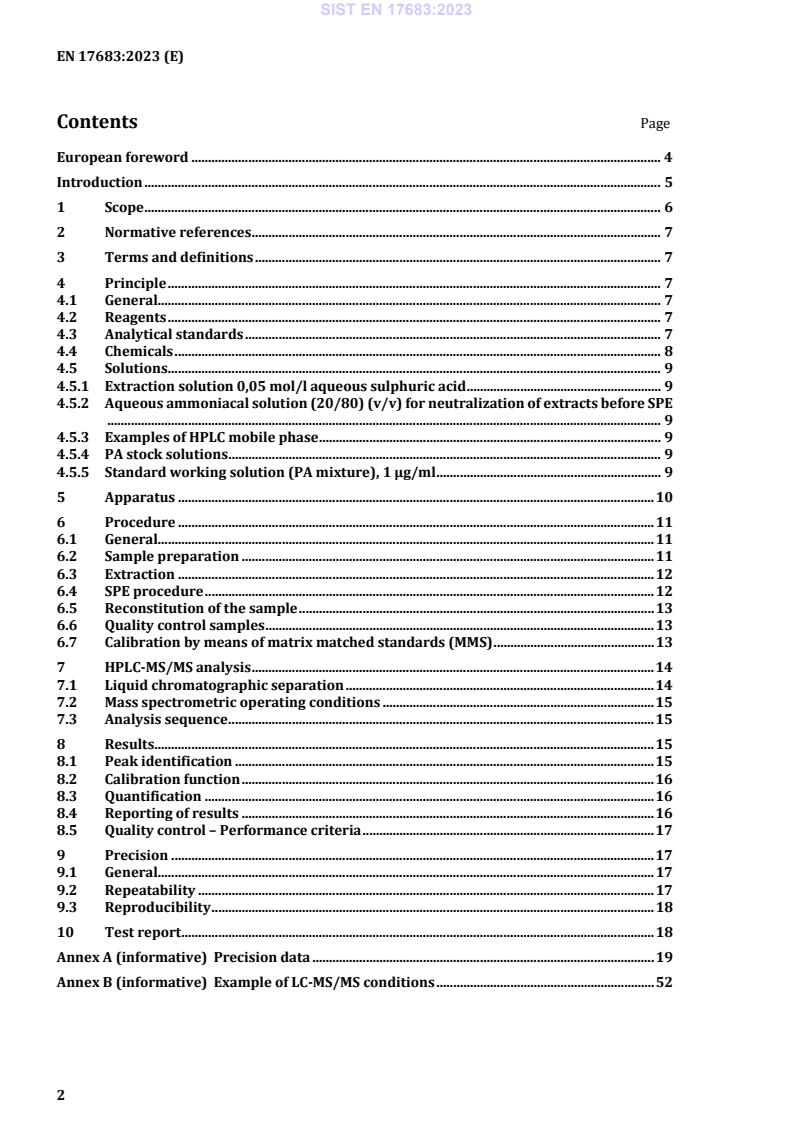
Contents Page
European foreword . 4
Introduction . 5
1 Scope . 6
2 Normative references . 7
3 Terms and definitions . 7
4 Principle . 7
4.1 General. 7
4.2 Reagents . 7
4.3 Analytical standards . 7
4.4 Chemicals . 8
4.5 Solutions . 9
4.5.1 Extraction solution 0,05 mol/l aqueous sulphuric acid . 9
4.5.2 Aqueous ammoniacal solution (20/80) (v/v) for neutralization of extracts before SPE
..................................................................................................................................................................... 9
4.5.3 Examples of HPLC mobile phase . 9
4.5.4 PA stock solutions . 9
4.5.5 Standard working solution (PA mixture), 1 µg/ml . 9
5 Apparatus . 10
6 Procedure . 11
6.1 General. 11
6.2 Sample preparation . 11
6.3 Extraction . 12
6.4 SPE procedure . 12
6.5 Reconstitution of the sample . 13
6.6 Quality control samples . 13
6.7 Calibration by means of matrix matched standards (MMS) . 13
7 HPLC-MS/MS analysis . 14
7.1 Liquid chromatographic separation . 14
7.2 Mass spectrometric operating conditions . 15
7.3 Analysis sequence . 15
8 Results . 15
8.1 Peak identification . 15
8.2 Calibration function . 16
8.3 Quantification . 16
8.4 Reporting of results . 16
8.5 Quality control – Performance criteria . 17
9 Precision . 17
9.1 General. 17
9.2 Repeatability . 17
9.3 Reproducibility . 18
10 Test report . 18
Annex A (informative) Precision data . 19
Annex B (informative) Example of LC-MS/MS conditions . 52
Annex C (informative) Example LC-MS/MS chromatogram of a pyrrolizidine alkaloid
mixture . 55
Annex D (informative) Method protocol for the determination of pyrrolizidine alkaloids in
animal feeding stuff by LC-MS/MS after reduction of N-oxides using metallic zinc . 56
Annex E (informative) List of potentially co-eluting pyrrolizidine alkaloid (PA) isomers . 66
Bibliography . 67
European foreword
This document (EN 17683:2023) has been prepared by Technical Committee CEN/TC 327 “Animal
feeding stuffs: Methods of sampling and analysis”, the secretariat of which is held by NEN.
This European Standard shall be given the status of a national standard, either by publication of
an identical text or by endorsement, at the latest by September 2023, and conflicting national standards
shall be withdrawn at the latest by September 2023.
Attention is drawn to the possibility that some of the elements of this document may be the subject of
patent rights. CEN shall not be held responsible for identifying any or all such patent rights.
This document has been prepared under a Standardization Request given to CEN by the European
Commission and the European Free Trade Association.
Any feedback and questions on this document should be directed to the users’ national standards body.
A complete listing of these bodies can be found on the CEN website.
According to the CEN-CENELEC Internal Regulations, the national standards organisations of the
following countries are bound to implement this European Standard: Austria, Belgium, Bulgaria, Croatia,
Cyprus, Czech Republic, Denmark, Estonia, Finland, France, Germany, Greece, Hungary, Iceland, Ireland,
Italy, Latvia, Lithuania, Luxembourg, Malta, Netherlands, Norway, Poland, Portugal, Republic of North
Macedonia, Romania, Serbia, Slovakia, Slovenia, Spain, Sweden, Switzerland, Türkiye and the United
Kingdom.
Introduction
Pyrrolizidine alkaloids (PA) are secondary metabolites of flowering plants. Ingestion of high doses results
in acute liver damage. In animal studies some PA have proven to be genotoxic carcinogens. Therefore, PA
are undesired substances in food and feed [1], [2]. Poisoning in animals has been reported with known
outbreaks attributed to Heliotropium, Trichodesma, Senecio, and Crotalaria species. In general, grazing
animals will avoid PA-bearing plants. However, if weedy crops are used for the production of hay, silage
or other plant derived feed materials the animals can no longer exercise discrimination when feeding
because the toxins survive storage processes and are completely intermixed with the feed. Therefore,
analytical methods for the control of PA levels in animal feed are needed [1], [2]. This document describes
methods of sampling and analysis for the determination of pyrrolizidine alkaloids in animal feeding stuff
by LC-MS/MS.
The method has been successfully validated in a collaborative trial for the matrices complete feed for
horses, supplementary feed for horses, supplementary feed for rodents, hay, alfalfa and grass silage.
Validation was carried out for the PA and concentrations ranges as described in Clause 1. It was
demonstrated that the PA isomeric pairs senecivernine and senecionine as well as senecivernine-N-oxide
and senecionine-N-oxide cannot be determined individually due to insufficient chromatographic
separation. However, the sums of the individual PA of the isomeric pairs were quantified with sufficient
reproducibility. Co-elution of other PA-isomers not included in the scope of the method need to be taken
into account. A list of potentially co-eluting isomers is presented in Commission Regulation (EU)
2020/2040 [3].
Although the calibration range of the method protocol is specified from 10 µg/kg to 300 µg/kg, the results
of the collaborative study showed, that the dilution of sample extracts with blank sample extracts enables
for the quantitation of concentrations exceeding the calibration range. Satisfactory reproducibility was
achieved when quantifying up to 1 428 µg/kg for individual PA and up to 887 µg/kg for the sum of
isomeric pairs.
WARNING — The use of this protocol involves hazardous materials, operations and equipment. This
protocol does not purport to address all the safety problems associated with its use. It is the responsibility
of the user of this protocol to establish appropriate health and safety practices and determine the
compatibility with regulatory limitations prior to use.
1 Scope
This document specifies a method for the quantitative determination of pyrrolizidine alkaloids (PA) in
the concentration ranges shown in Table 1 in complete and supplementary feed and in forages by liquid
chromatography tandem mass spectrometry (LC-MS/MS) after solid phase extraction (SPE) clean-up.
Table 1 — Summary of concentration ranges per PA tested in the collaborative trial
a
Tested pyrrolizidine alkaloid (PA) Abbreviation Tested concentration range
(µg/kg)
From To
Echimidine Em 20 435
Echimidine-N-oxide EmN 5 30
Erucifoline Er 20 245
Erucifoline-N-oxide ErN 20 370
Europine Eu 15 330
Europine-N-oxide EuN 25 285
Heliotrine Hn 25 280
Heliotrine-N-oxide HnN 25 245
Jacobine Jb 20 230
Jacobine-N-oxide JbN 20 215
Lasiocarpine Lc 20 350
Lasiocarpine-N-oxide LcN 5 250
Intermedine Im 25 560
Intermedine-N-oxide ImN 5 395
Lycopsamine La 25 500
Lycopsamine-N-oxide LaN 20 280
Monocrotaline Mc 20 360
Monocrotaline-N-oxide McN 20 365
Retrorsine Re 250 375
Retrorsine-N-oxide ReN 5 285
b
Senecionine Sc 25 205
b
Senecionine-N-oxide ScN 5 300
b
Senecivernine Sv 20 205
b
Senecivernine-N-oxide SvN 5 165
Senkirkine Sk 20 275
Seneciphylline Sp 25 225
Seneciphylline-N-oxide SpN 5 225
Trichodesmine Td 5 250
Intermedine + Lycopsamine Im+La 50 890
Intermedine-N-oxide + Lycopsamine-N-oxide ImN+LaN 5 645
Senecivernine + Senecionine Sv+Sc 30 280
Senecivernine-N-oxide + Senecionine-N-ide SvN+ScN 10 380
a
Rounded figures
b
Individual PA of the isomeric pairs Sv+Sc and SvN+ScN were not evaluated statistically due to insufficient
chromatographic separation.
NOTE 1 A second method was part of the method validation collaborative main trial. For this method PA-N-
Oxides are reduced by adding zinc powder to the extract of the feed material. The following steps correspond to the
first and main method. Quantitative results for each PA except the otonecine type PA senkirkine represent the sum
of the free PA base and its corresponding N-oxide.
NOTE 2 Due to insufficient numbers of data for some analyte-matrix combinations statistical evaluation was not
valid for standardization. Received data indicated the methods applicability in experienced laboratories with
appropriate quality assurance measures. Therefore, the method description is included as an informative annex
(Annex D).
2 Normative references
The following documents are referred to in the text in such a way that some or all of their content
constitutes requirements of this document. For dated references, only the edition cited applies. For
undated references, the latest edition of the referenced document (including any amendments) applies.
EN ISO 3696, Water for analytical laboratory use - Specification and test methods (ISO 3696)
3 Terms and definitions
No terms and definitions are listed in this document.
ISO and IEC maintain terminological databases for use in standardization at the following addresses:
• IEC Electropedia: available at https://www.electropedia.org/
• ISO Online browsing platform: available at https://www.iso.org/obp
4 Principle
4.1 General
A test portion of 2 g feed material is sonicated twice in aqueous sulphuric acid solution for PA extraction.
After centrifugation, an aliquot of the supernatant is purified by solid phase extraction (SPE) using
reversed phase (C18) material. PA are released from the cartridge using methanol. Subsequently, the
eluate is evaporated to dryness and reconstituted in methanol/water (initial HPLC conditions).
For chromatographic separation, an RP-HPLC column is used with a binary gradient. Analytes are
detected by triple stage quadrupole mass spectrometry. Quantification of PA is accomplished by means
of matrix matched calibration.
4.2 Reagents
All chemicals should at least be of pro-analysis quality or higher. References to products or vendors are
just for general information and do not imply that other products or producers with the same or similar
characteristics are ruled out.
If not specified elsewise, use only reagents of analytical grade and solvents suitable for HPLC-MS/MS.
4.3 Analytical standards
4.3.1 Senecionine (Sc), CAS-Nr.: 130-01-8
4.3.2 Senecionine-N-oxide (ScN), CAS-Nr.: 13268-67-2
4.3.3 Seneciphylline (Sp), CAS-Nr.: 480-81-9
4.3.4 Seneciphylline-N-oxide (SpN), CAS-Nr.: 38710-26-8
4.3.5 Monocrotaline (Mc), CAS-Nr.: 315-22-0
4.3.6 Monocrotaline-N-oxide (McN), CAS-Nr.: 35337-98-5
4.3.7 Retrorsine (Re), CAS-Nr.: 480-54-6
4.3.8 Heliotrine (Hn), CAS-Nr.: 303-33-3
4.3.9 Heliotrine-N-oxide (HnN), CAS-Nr.: 6209-65-0
4.3.10 Trichodesmine (Td), CAS-Nr.: 548-90-3
4.3.11 Retrorsine-N-oxide (ReN), CAS-Nr.: 15503-86-3
4.3.12 Echimidine (Em), CAS-Nr.: 520-68-3
4.3.13 Echimidine-N-oxide (EmN), CAS-Nr.: 41093-89-4
4.3.14 Intermedine (Im), CAS-Nr.: 10285-06-0
4.3.15 Intermedin-N-oxide (ImN), CAS-Nr.: 95462-14-9
4.3.16 Lycopsamine (La), CAS-Nr.: 10285-07-1
4.3.17 Lycopsamine-N-oxide (LaN), CAS-Nr.: 95462-15-0
4.3.18 Erucifoline (Er), CAS-Nr.: 40158-95-0
4.3.19 Erucifoline-N-oxide (ErN), CAS-Nr.: 123864-94-8
4.3.20 Senecivernine (Sv), CAS-Nr.: 72755-25-0
4.3.21 Senecivernine-N-oxide (SvN), CAS-Nr.: 101687-28-9
4.3.22 Jacobine (Jb), CAS-Nr.: 6870-67-3
4.3.23 Jacobine-N-oxide (JbN), CAS-Nr.: 38710-25-7
4.3.24 Lasiocarpine (Lc), CAS-Nr.: 303-34-4
4.3.25 Lasiocarpine-N-oxide (LcN), CAS-Nr.: 127-30-0
4.3.26 Europine (Eu) as europine hydrochloride, CAS-Nr.: 570-19-4
4.3.27 Europine-N-oxide (EuN), CAS-Nr.: 65582-53-8
4.3.28 Senkirkine (Sk), CAS-Nr.: 2318-18-5
4.4 Chemicals
4.4.1 Formic acid (HCOOH) 98 to 100 %
4.4.2 Methanol (MeOH) in LC-MS quality
4.4.3 Sulphuric acid (H SO ) 98 %
2 4
4.4.4 Ammonia (NH ) 32 %
4.4.5 Ammonium formate (NH COOH) in LC-MS quality
4.4.6 Acetonitrile (CH CN) in LC-MS quality
4.4.7 Water (H O) in LC-MS quality, double-distilled or water of grade 1 as defined in EN ISO 3696
4.5 Solutions
4.5.1 Extraction solution 0,05 mol/l aqueous sulphuric acid
Prepare a 0,05 mol/l solution of aqueous sulphuric acid. Make up 2,665 ml of sulphuric acid (H SO )
2 4
(4.4.3) to 1 l with water (4.4.7). The extraction solution can be used for 1 month when stored at room
temperature.
4.5.2 Aqueous ammoniacal solution (20/80) (v/v) for neutralization of extracts before SPE
Dilute a volume fraction of 20 % ammonia 32 % (4.4.4) with a volume fraction of 80 % water (4.4.7). The
solution shall be prepared every working day.
EXAMPLE Mix 5 ml of ammonia 32 % with 20 ml of water (4.4.7).
4.5.3 Examples of HPLC mobile phase
• Eluent A 5 mmol/l ammonium formate in water with 0,1 % formic acid:
Weigh 315 mg ammonium formate (4.4.5) and dissolve in 5 ml of water (4.4.7) in a 1 000 ml
volumetric flask, add 1 ml of formic acid (4.4.1) and make up to 1 l with water (4.4.7). The solution
can be used for 1 month when stored at room temperature.
• Eluent B 5 mmol/l ammonium formate in methanol with 0,1 % formic acid::
Weigh 315 mg ammonium formate (4.4.5) and dissolve in 5 ml of water (4.4.7) in a 1 000 ml
volumetric flask, add 1 ml of formic acid (4.4.1) and make up to 1 l with methanol (4.4.2). The
solution can be used for 3 months when stored at room temperature.
4.5.4 PA stock solutions
To create a stock solution, weigh 1 mg to 10 mg (depending on the amount available per unit purchased)
of a pyrrolizidine alkaloid standard in a 10 ml volumetric flask using an analytical balance (5.2) and make
up to 10 ml with a suitable organic solvent like methanol or acetonitrile. The resulting concentration of
the stock solution is 0,1 mg/ml to 1 mg/ml. Stock solutions are stable for at least 2 years when
stored below −18 °C.
If the available analytical balance does not provide sufficient accuracy, higher quantities shall be weighed.
NOTE Instructions of standard providers can indicate suitable solvents for the preparation of stock solutions
but are not mandatory to be used.
4.5.5 Standard working solution (PA mixture), 1 µg/ml
Transfer respective volumes each PA stock solution between 0,1 mg/ml to 1 mg/ml (4.5.4) using an
appropriate device (5.1) into a volumetric flask (5.12) and make up with acetonitrile (4.4.6), to achieve a
concentration of 1 µg/ml for each PA contained in the mixture. Long term stability tests proved
acetonitrile to be the most suitable solvent, but is not mandatory to be used. The PA mixture is stable for
at least 2 years when stored below −18 °C.
If no baseline separation can be achieved for an isomeric pair (intermedine(-N-oxide) and lycopsamine
(-N-oxide); senecivernine(-N-oxide) and senecionine(-N-oxide)), the sum concentration of both PA can
be calculated via the calibration of one of them. The composition of the standard mix shall be prepared
accordingly by including only one isomer of the pair. In case of baseline separation of the isomeric pairs
all pa analytical standards including 4.3.20 and 4.3.21 should be included in the PA mixture.
5 Apparatus
Use laboratory equipment and, in particular, the following elements.
NOTE References to products, instruments or vendors are just for general information and do not imply that
other products or producers with the same or similar characteristics are ruled out.
5.1 Various piston pipettes and multiple dispenser and respective tips
5.2 Analytical balance, capable of weighing to 0,1 mg accuracy
5.3 Compartment drier
5.4 Centrifugal mill with 0,5 mm sieve
5.5 Centrifuge for 50 ml centrifuge tubes, capable of at least 5 000 g
5.6 Laboratory shaker
5.7 Overhead shaker
5.8 Evaporation station with or without vacuum support
5.9 Ultrasonic bath
5.10 Centrifuge tubes 50 ml
5.11 Test tubes 15 ml
5.12 Volumetric flasks, 10 ml and 20 ml
5.13 Folded filters
5.14 SPE cartridges: C18, 500 mg sorbent material
® 1
NOTE Supelco Discovery DSC18 500 mg/6 ml is an example of a suitable product available commercially .
5.15 pH indicator strips
5.16 SPE vacuum chamber
5.17 Membrane filter 0,2 µm or 0,45 µm
Centrifugal filters should have > 0,5 ml capacity and contain modified nylon membrane. Other filtering
tools can be used as well.
1 ®
Supelco Discovery is an example of a suitable product available commercially. This information is given for the
convenience of users of this document and does not constitute an endorsement by CEN of this product.
5.18 HPLC vials 2 ml
5.19 Glass inserts, 250 µl conic for HPLC vials
5.20 Chromatographic column
C18 reversed phase packing material applicable at acidic pH-conditions (pH 2-3), capable of baseline
separation of analytes with identical molecular mass, separation of isomeric pairs is desirable. Other
stationary phases (for example biphenyl phases) or mobile phases (for example with basic pH) can be
used if comparable or better baseline separation of isomers is achieved.
5.21 LC-MS/MS system
Capable of performing multiple selected reaction monitoring in positive ionization mode, with a
sufficiently wide dynamic range and capable of unit mass separation and equipped with a computer-
based data processing system. Any ionization source giving sufficient yield may be employed. Exemplarily
instrument configuration and measuring conditions are shown in Annex B.
6 Procedure
6.1 General
Animal feed is a complex matrix containing a wide range of ingredients in varying amounts leading to
variable and sample dependent matrix effects (suppression/enhancement). For this reason, a
quantification of the analytes shall be accomplished by matrix-matched calibration.
Comparison of matrix effects of different feed materials has shown that there might be a difference in
signal suppression of around 50 % depending on the analyte-matrix combination. As usually a variety of
feed materials can be analysed in one sequence, a representative mix of blank feed materials can be used
(e.g. 75 % different types of grass, like hay and silage, and legumes and 25 % cereals). If the sequence
contains only samples of one specific feed material, a blank matrix as similar as possible to the sample
matrix should be used for matrix-matched calibration.
Samples exceeding the calibration range can be diluted using blank sample extract. Recovery shall be
checked with every series of samples proving the required range of recovery. Recovery correction is
carried out if recovery is outside of 90 % to 110 % according to EURL-MP’s Guidance document on
performance criteria for the analysis of mycotoxins and plant toxins in food and feed [4]
6.2 Sample preparation
To determine the PA concentration that is representative for the entire sample, the sample material
should meet the following characteristics: uniform particle size and a homogenous distribution.
Therefore, an appropriate portion of the sample material is ground to a particle size of 0,5 mm (5.4) and
homogenized for example using an overhead shaker (5.7).
Prior to grinding fresh feed samples (for example silage or grass) are dried at 40 °C to 45 °C at
atmospheric pressure for approximately 18 h in a drying oven (5.3). Frozen samples are defrosted at
room temperature before drying.
Dry samples are mixed with dry ice (ratio 2:1) and the mixture is allowed to stand for 10 min before
grinding to a particle size of 0,5 mm using an ultra-centrifugal mill (5.4). The ground material is
homogenized by shaking for example using an overhead shaker (5.7) for 1 h.
NOTE Grinding with dry ice has proven to obtain excellent grinding results due to shear forces and porosity of
the frozen sample material.
If the test material cannot be ground to a particle size of 0,5 mm or smaller without generation of heat,
increasing the weighed sample amount to at least 10 g is also possible to enhance the results
representativeness for the sample. In order to keep a constant ratio of sample amount to extraction
volume, the used volume of extraction solution (4.5.1) needs to be increased accordingly.
Laboratories shall prove that the performance of their homogenization procedure used is sufficient.
6.3 Extraction
Weigh 2,0 g ± 0,1 g of the homogenized sample into a centrifuge tube (5.10).
1) Extraction step 1: Add 20 ml of the extraction solution (4.5.1) to the sample and mix (5.6) to wet
the sample material completely before extraction by ultra-sonication (5.9) for 15 min at ambient
temperature.
NOTE 1 Extraction can be accomplished by other techniques than ultra-sonication (e.g. using an over-head
shaker), if sufficient extraction efficiency was shown during in-house validation.
2) Centrifugation: Centrifuge the tube for 10 min ± 2 min at approximately 3800 g (5.5). Transfer the
supernatant (extract 1) into a clean centrifuge tube (5.10) and use the sediment for the second
extraction step.
3) Extraction step 2: Add 20 ml of extraction solution (4.5.1) to the sediment. Shake the centrifuge tube
vigorously to distribute the sample (the sample can also be stirred if necessary) and extract again by
ultra-sonication for 15 min at ambient temperature.
NOTE 2 Extraction can be accomplished by other techniques than ultra-sonication (e.g. using an over-head
shaker), if sufficient extraction efficiency was shown during in-house validation.
4) Centrifugation: Centrifuge the tube for 10 min ± 2 min at approximately 3800 g (see 5.5) and
combine the supernatant (extract 2) with extract 1.
5) Neutralization: Adjust the pH of the combined extracts to pH 7 using the neutralization solution
(4.5.2). Check the pH value using indicator strips. Usually, about 500 µl to 1 000 µl of the solution is
required.
6) Filtration: Pass the complete neutralized extract through a filter (e.g. folded filters see 5.13) or
centrifuge alternatively. Use an aliquot of the filtered supernatant for SPE. Repeat the filtration step
in case of larger quantities of remaining particles in the solution. Thereby, blockage of SPE cartridges
can be avoided.
6.4 SPE procedure
If SPE cartridges other than proposed under 5.14 are used, solvent volumes for conditioning, sample
loading, washing and eluting have to be adapted. Depending on the solid phase material, it might be
necessary to protect the stationary from running dry until the washing step.
1) Conditioning step 1: Load 5 ml of methanol (4.4.2) onto the SPE cartridge (5.14) and let it pass
through under normal pressure.
2) Conditioning step 2: Load 5 ml of water (4.4.7) onto the SPE cartridge (5.14) and let it pass through
under normal pressure.
3) Sample load: Load 10 ml of the sample extract (combined supernatants from 6.3) onto the SPE
cartridge (5.14) and let it pass through without letting the cartridge run dry.
4) Washing step: Wash the SPE cartridge (5.14) 2 × 5 ml of water.
5) Drying of cartridges: Dry the SPE cartridges (5.14) by applying vacuum for 5 - 10 min (use the
vacuum chamber (5.15).
6) Elution of PA: Elute the analytes from the SPE cartridges (see 5.14) using 2 × 5 ml methanol (see
4.4.2) into a clean test tube (5.11). The eluate is dried under a nitrogen stream at 50 °C ± 5 °C (5.8),
or according to the recommendations for the evaporation equipment used.
6.5 Reconstitution of the sample
Dissolve the residue in 1 ml of methanol/water (5/95, v/v) by shaking (5.7).
Filter the reconstituted sample extracts through a 0,2 to 0,45 µm membrane filter (5.17). When using
centrifugal filters, 500 µl of the sample are centrifuged at 20 000 g for 10 min ± 3 min. Transfer 200 µl of
the filtrate into an HPLC vial (5.18) with a glass insert (5.19).
6.6 Quality control samples
In every sample batch, recovery as a sum of extraction efficiency, clean-up and LC-MS/MS detection shall
be checked. Preferably, a reference material or well characterized positive samples should be used. If no
reference material is available, recovery can be determined by spiking a representative feed material (see
6.1) that is free from PA. Spiking procedure (example):
EXAMPLE Spike 2 g of the blank feed material with PA working solution (4.5.5), vortex or mix by hand
vigorously and leave open for 1 h to allow the solvent to evaporate. Analyse the spiked sample alongside with the
unknown samples.
NOTE Addition of 50 µl of PA working solution (4.5.5) were used in the method validation study and worked
well.
6.7 Calibration by means of matrix matched standards (MMS)
For the correction of matrix effects, a matrix matched calibration is used. In order to obtain the same
matrix strength in the MMS and the samples, blank feed shall be processed as described in Clause 6 to
receive blank matrix extract. Afterwards, MMS are prepared by mixing different volumes of the standard
working solution with the blank matrix extract. The volume of matrix extract should account for at least
80 % in each MMS solution. Low concentration calibration levels can be prepared by diluting higher MMS
levels with blank feed extract. Table 2 shows an exemplary scheme for the preparation of MMS.
Samples containing PA at a concentration exceeding the highest calibration level should be diluted using
blank feed extract to obtain PA levels in the calibration range.
Table 2 — Example for the preparation of matrix matched calibration solutions
Final PA Final PA Aliquot taken Aliquot Aliquot
No. of
concentration concentration from Volume taken from
calibration
in calibration in feed blank feed
level
solution material extract
ng/ml µg/kg µl μl
1 5 10 MMS_4 20 180
2 10 20 MMS_4 40 160
3 25 50 Standard 5 195
working
solution(1 µg/ml)
4 50 100 Standard 10 190
working
solution(1 µg/ml)
5 75 150 Standard 15 185
working
solution(1 µg/ml)
6 100 200 Standard 20 180
working
solution(1 µg/ml)
7 125 250 Standard 25 175
working
solution(1 µg/ml)
8 150 300 Standard 30 170
working
solution(1 µg/ml)
7 HPLC-MS/MS analysis
7.1 Liquid chromatographic separation
The measurements can be carried out with different high-performance liquid chromatographs (HPLC)
(5.21) and separation columns (5.20). The chromatographic conditions can be chosen freely. The
acceptable minimum retention time is twice the retention time for the dead volume of the column.
Analytes that cannot be distinguished by means of mass spectrometry should be separated
chromatographically. If no baseline separation can be achieved for PA isomers, the sum concentration of
PA can be determined via the calibration of one representative PA. The composition of the standard mix
shall be prepared accordingly by including only one of the co-eluting isomers.
Co-elution of PA-isomers is well-known and can also include PA which are not in the scope of this method.
Annex E provides a list of a PA that can be present in unknown samples and could co-elute with the 28 PA
included in the collaborative trial. This list is based on Commission Regulation (EU) 2020/2040 of 11
December 2020 amending Regulation (EC) No 1881/2006 as regards maximum levels of pyrrolizidine
alkaloids in certain foodstuffs [3].
The conditions listed in Annex A using a C 18 column (5.20) and the mobile phase described in 4.5.3 have
shown to be suitable. However, they are shown exemplarily.
7.2 Mass spectrometric operating conditions
The measurements can be carried out with MS/MS devices (5.21) of different manufacturers. In Annex A
the device-specific settings of one measurement system are given as an example. Mass spectrometric
(MS) conditions should be optimized in the laboratory by means of pure standards to provide analyte
signals with sufficient sensitivity and selectivity.
At least two transitions from the precursor to characteristic product ions should be selected to be
included in the selected reaction monitoring (SRM) method. Preferably, the protonated molecular parent
ion mass should be selected as precursor mass and the product ions should be specific for the compound.
Preferably, product ions that are formed by the loss of water from the protonated molecular ion should
not be selected. Each chromatographic peak should be composed of at least 10 MS data points.
7.3 Analysis sequence
For quantitative analysis, the following criteria are specified.
Injection: Standards, and if desired all samples, are injected in duplicate in order to assess
repeatability of MS detection and to check for possible response drift during the sequence.
The response drift serves as a quality control parameter (see 8.5).
Sequence: The following order of analysis should be defined in a sequence:
1) Solvent Blank;
2) Matrix matched standards, 1st injection;
3) Solvent blank;
4) Samples including quality control (QC), 1st injection;
5) Solvent blank;
6) Matrix matched standards, 2nd injection;
7) Solvent blank (optional);
8) Samples including QC, 2nd injection (optional).
8 Results
8.1 Peak identification
The qualitative detection is carried out by comparison of the retention time and relative abundance of
the measured transitions (at least 2 per analyte, see SANTE/12089/2016 [5]) in the sample with those
of the calibration standards. The maximum deviation of the retention time of the analyte in the sample
and the calibration standards should be ± 0,1 min. The peak area ratios of the analyte's quantifier and
qualifier transitions in the sample should be in a range of ± 30 % of the respective ratios in the calibration
standards according to internally accepted guidelines (e.g. SANTE/12089/2016 [5]). However, results of
the collaborative trial demonstrated that for co-eluting isomeric pairs the deviation of the ion ratios can
be higher than ± 30 %.
8.2 Calibration function
For the determination of the calibration function, the peak areas received for the calibration levels (at
least 3 to 5) are plotted against the respective concentrations. An appropriate approach should be used
to calculate the calibration function for each analyte. Suitable calibration according to the Guidance
document on analytical quality control and method validation procedures for pesticides residues and
analysis in food and feed SANTE/12682/2019 [6] and the EURL-MP guidance document [4] are linear or
quadratic, with or without weighing or forcing through the function through zero.
8.3 Quantification
The quantitative determination is performed according to the method of the matrix matched standard by
integration of the peak areas in relation to the calibration function by means of Formula (1).
Depending on the structure of the analysis sequence (see Clause 7.3), bracketed calibration with one set
of samples or two independent sets of matrix matched standards and samples can be applied for analyte
quantification.
For bracketed calibration the mean calibration function of the two data sets of matrix matched standards
is used to quantify the analytes in the bracketed samples (one injection of samples). If the samples have
been injected twice (no bracketing) analyte concentrations are calculated for the two injections of the
samples individually and subsequently used to calculate the mean value.
V
yb− 1
extract
cF=β×= × × × V (1)
S sample
am V
weight SPE
where
c is the concentration of individual analytes in the sample, in µg/kg;
S
ß is the analyte concentration in ng/ml in the sample extract;
F is the conversion factor from ng/ml to µg/kg;
y is the peak area of the target analyte;
a is the slope of the calibration function (calculated for b = 0, see 8.2);
b is the intercept of the calibration function (b = 0, if the function is forced through 'zero');
is the volume of extraction solution in ml;
Vextract
m is the sample weight in g;
weight
V is the volume of the extract applied for SPE in ml;
SPE
V is the final volume of the sample solution for LC-MS/MS analysis in ml.
sample
8.4 Reporting of results
The results are reported in µg/kg with two significant decimals. To convert the concentration in the
sample solution in ng/ml to the concentration in the feed sample in µg/kg a factor of 2 is used according
to the sample preparation procedure described in Clause 6.
Recovery correction is carried out if recovery is outside of 90 % to 110 % according to EURL-MP's
Guidance document on performance criteria for the analysis of mycotoxins and plant toxins in food and
feed [4].
8.5 Quality control – Performance criteria
Recovery control (see 6.6) using a spiked sample or well characterized positive sample shall be checked
in every sample batch. Tolerable ranges of recovery can be e.g. 70 % to 120 % according to the EURL-
MP's Guidance document on performance criteria for the analysis of mycotoxins and plant toxins in food
and feed [4] (under development) and Annex II (section 4) of Commission Regulation Commission
Regulation (EC) No 401/2006 [5]. In some cases, a lower recovery can be accepted, if it is within the range
of the mean recovery ± 2 × RSD from initial method validation or ongoing recovery results according to
the guidance document on pesticide residues analysis [6]. Recoveries outside the acceptable range
require appropriate measures, e.g. re-analysis of the sample batch.
The quality of the calibration function should also be monitored. The deviation of the back-calculated
concentrations of the calibration standards from the true concentrations using the calibration equation
used should not be more than ± 20 % [6]. If elimination of individual deviating calibration levels is
possible regarding an appropriate number of calibration levels, analyte concentrations within the
adapted calibration range can still be quantified. Otherwise the sample batch should be re-analysed.
Changes in sensitivity during one sequence shall be checked for by means of the slopes of the 1st and 2nd
calibration curve. The relative deviation of both slopes should not exceed 30 % (if the higher slope is set
as 100 %) according to SANTE/12682/2019 [6]. If the response drift is higher than 30 %, re-analysis of
the sequence is required unless no positive samples for the respective analyte are concerned.
9 Precision
9.1 General
Precision data were obtained in a collaborative study. Results on the precision of this method are
provided in detail in Annex A. Besides repeatability and reproducibility also the functional relationships
between the measured concentration of analytes and the obtained repeatability and reproducibility are
shown.
9.2 Repeatability
The absolute difference between two single test results on identical test materials by one operator using
the same apparatus within the shortest feasible time interval will exceed the repeatability limit r in not
more than 5 % of the cases. It can be calculated from the repeatability standard deviation s as:
r
r=2,8 xs
r
(2)
where
r is the repeatability limit;
s is the repeatability standard deviation.
r
9.3 Reproducibility
The absolute difference between two single test results on identical test materials reported by two
laboratories will exceed the reproducibility limit R in not more than 5 % of the cases.
R=2,8 x
...