

SIST ISO 172:1996
(Main)Plastics -- Phenol-formaldehyde mouldings -- Detection of free ammonia
General Information
- Abstract
Specification of a qualitative method of detecting the presence of free ammonia or other volatile bases in phenol-formaldehyde mouldings by the exposure of an indicator paper to the vapour from a moistened powdered sample. It may be used when the absence of free ammonia is a requirement.
- Status
- Withdrawn
- Publication Date
- 31-May-1996
- Withdrawal Date
- 30-Apr-2000
- Technical Committee
- IPMA - Polimer materials and products
- Current Stage
- 9900 - Withdrawal (Adopted Project)
- Start Date
- 01-May-2000
- Due Date
- 01-May-2000
- Completion Date
- 01-May-2000
Buy Documents

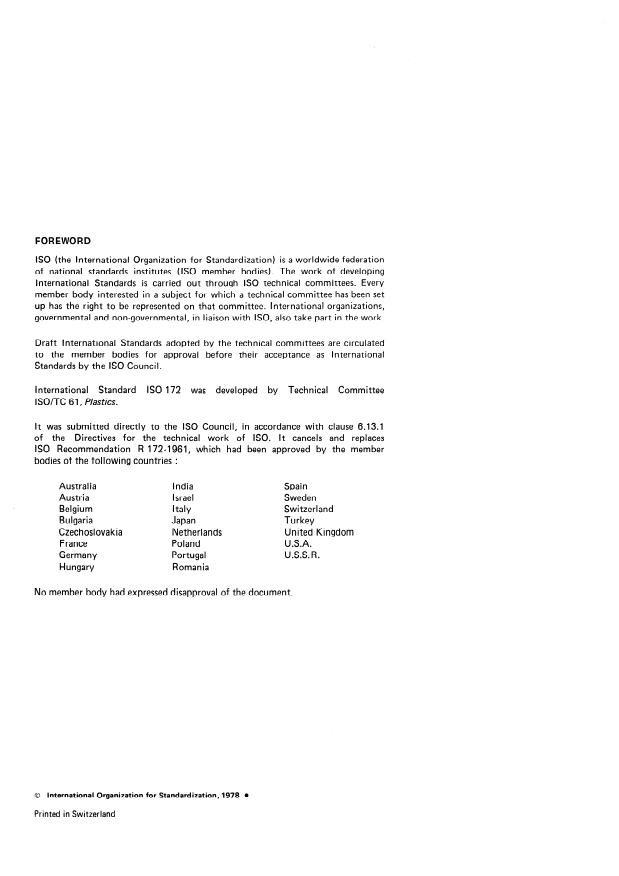
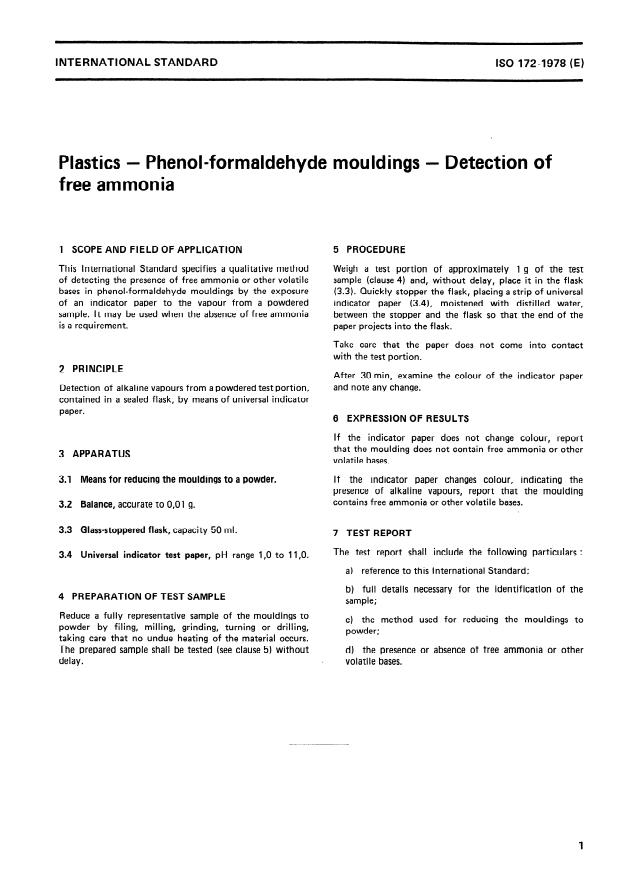

ISO 172:1978 - Plastics — Phenol-formaldehyde mouldings — Detection of free ammonia Released:8/1/1978
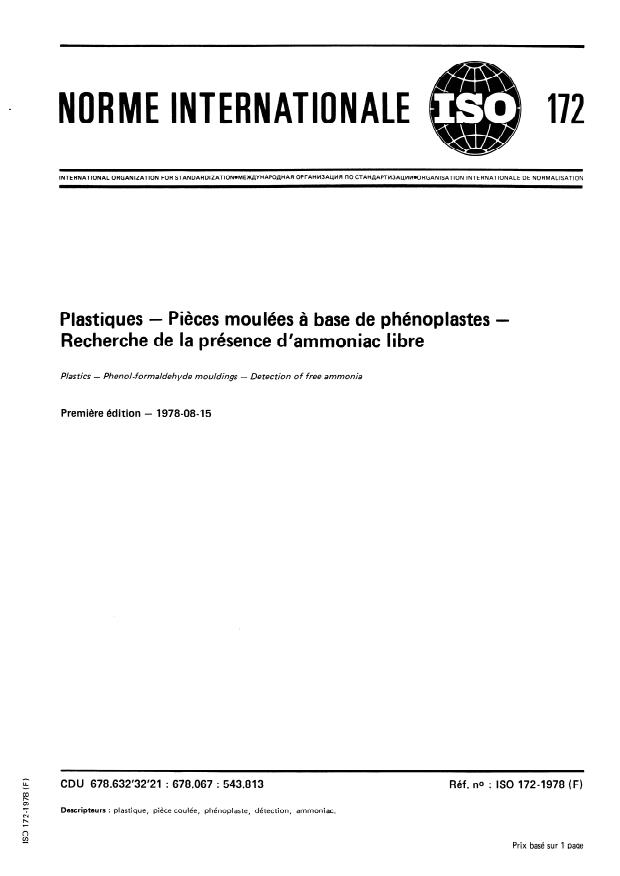
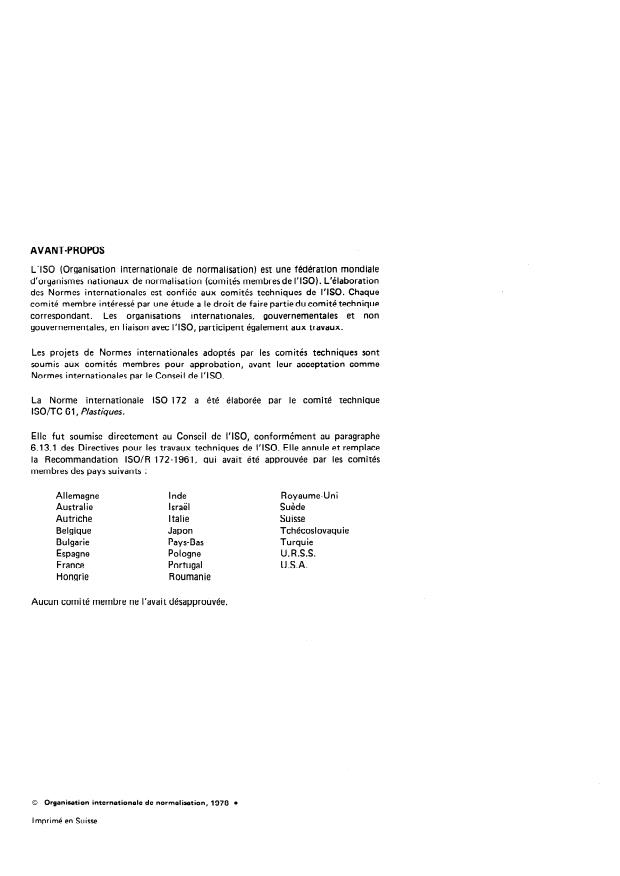
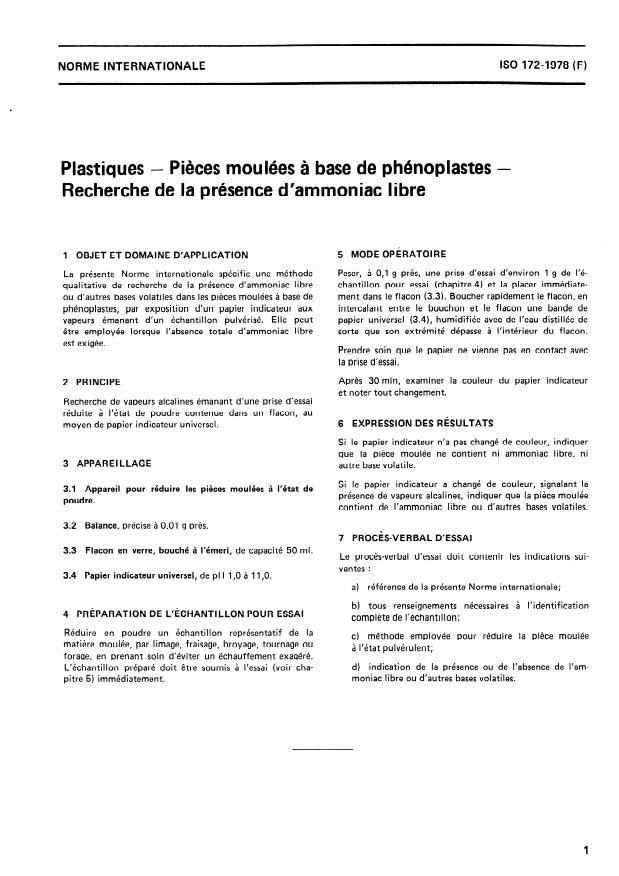

ISO 172:1978 - Plastiques — Pieces moulées a base de phénoplastes — Recherche de la présence d'ammoniac libre Released:8/1/1978
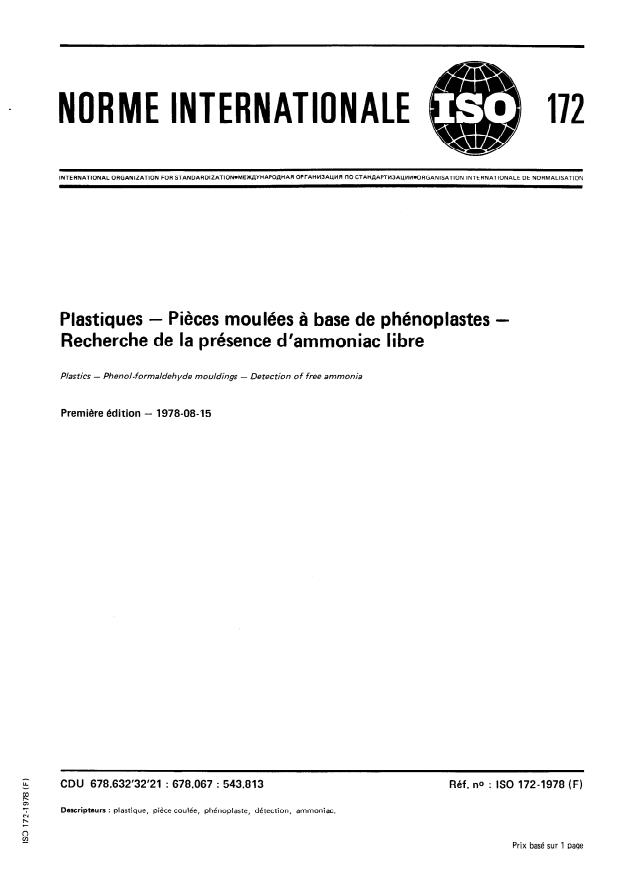
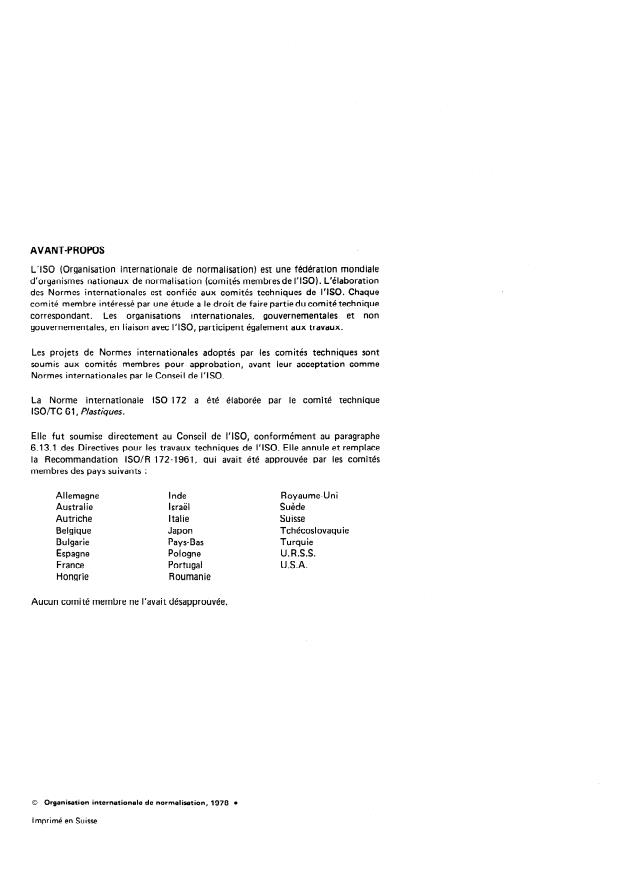
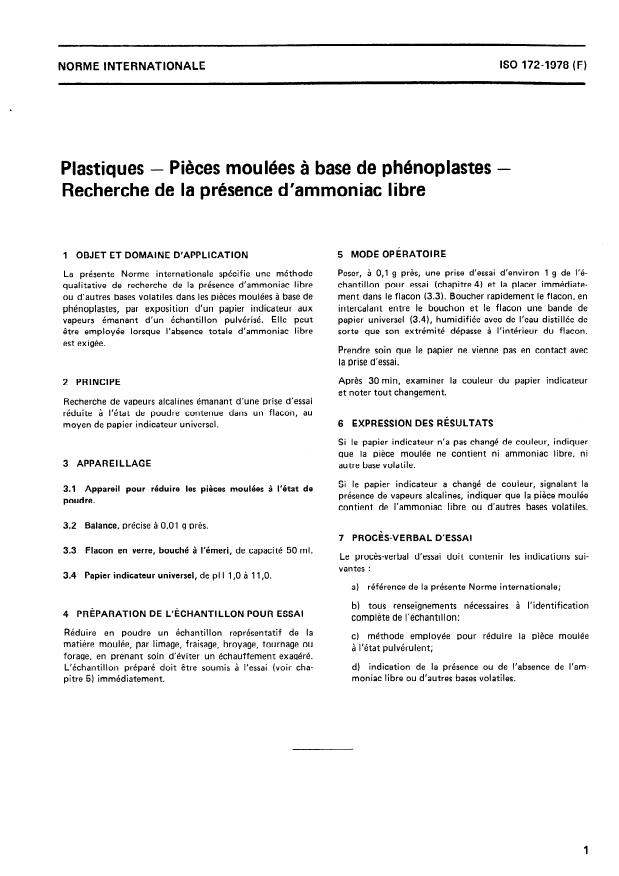

ISO 172:1978 - Plastiques — Pieces moulées a base de phénoplastes — Recherche de la présence d'ammoniac libre Released:8/1/1978
Overview
ISO 172:1978 specifies a qualitative method for detecting the presence of free ammonia or other volatile bases in phenol‑formaldehyde mouldings (phenoplasts). The procedure detects alkaline vapours released from a powdered sample by exposing universal indicator paper to the vapour in a sealed flask. ISO 172:1978 is intended for use where the absence of free ammonia is a requirement for the finished moulding.
Key topics and requirements
- Scope: Qualitative detection of free ammonia or other volatile bases in phenol‑formaldehyde mouldings.
- Principle: Alkaline vapours from a powdered test portion change the colour of universal indicator paper when confined in a sealed vessel.
- Apparatus
- Means to reduce mouldings to powder (filing, milling, grinding, turning or drilling) - avoid undue heating.
- Balance accurate to 0.01 g.
- Glass‑stoppered flask, 50 ml capacity.
- Universal indicator test paper, pH range 1.0 to 11.0.
- Sample preparation
- Reduce a fully representative sample to powder promptly; test prepared sample without delay.
- Typical test portion: approximately 1 g.
- Procedure
- Place the powdered sample in the 50 ml stoppered flask, quickly stopper with a distilled‑water‑moistened strip of universal indicator paper positioned so it projects into the flask but does not contact the sample.
- After 30 minutes examine the indicator paper for colour change.
- Interpretation
- No colour change: report absence of free ammonia/volatile bases.
- Colour change: report presence of free ammonia or other volatile bases.
- Test report must include
- Reference to ISO 172:1978.
- Identification of the sample.
- Method used to reduce the moulding to powder.
- Presence or absence of free ammonia/volatile bases.
Applications and users
- Quality assurance and incoming/outgoing inspection for manufacturers of phenol‑formaldehyde mouldings (phenoplasts).
- Materials testing and QA/QC laboratories performing plastics testing.
- Product certification bodies and compliance checks where ammonia‑free mouldings are required for safety, odor control, or downstream processing.
- R&D groups verifying processing changes do not introduce volatile alkaline residues.
- Useful as a simple, low‑cost screening test to flag samples for further quantitative analysis (when necessary).
Limitations
- This is a qualitative test only - it indicates presence or absence of volatile bases but does not quantify concentration.
- A positive result indicates alkaline vapours but cannot distinguish between ammonia and other volatile bases without additional analysis.
Related standards
- ISO 172:1978 supersedes ISO Recommendation R 172‑1961 and was developed by ISO/TC 61 (Plastics). For quantitative analysis or broader plastics testing methods, consult applicable ISO plastics testing standards and laboratory procedures.
Relations
- Effective Date
- 01-May-2000
Buy Documents
ISO 172:1978 - Plastics — Phenol-formaldehyde mouldings — Detection of free ammonia Released:8/1/1978
ISO 172:1978 - Plastiques — Pieces moulées a base de phénoplastes — Recherche de la présence d'ammoniac libre Released:8/1/1978
ISO 172:1978 - Plastiques — Pieces moulées a base de phénoplastes — Recherche de la présence d'ammoniac libre Released:8/1/1978
Get Certified
Connect with accredited certification bodies for this standard

DIN CERTCO
DIN Group product certification.

Smithers Quality Assessments
US management systems and product certification.
Sponsored listings
Frequently Asked Questions
SIST ISO 172:1996 is a standard published by the Slovenian Institute for Standardization (SIST). Its full title is "Plastics -- Phenol-formaldehyde mouldings -- Detection of free ammonia". This standard covers: Specification of a qualitative method of detecting the presence of free ammonia or other volatile bases in phenol-formaldehyde mouldings by the exposure of an indicator paper to the vapour from a moistened powdered sample. It may be used when the absence of free ammonia is a requirement.
Specification of a qualitative method of detecting the presence of free ammonia or other volatile bases in phenol-formaldehyde mouldings by the exposure of an indicator paper to the vapour from a moistened powdered sample. It may be used when the absence of free ammonia is a requirement.
SIST ISO 172:1996 is classified under the following ICS (International Classification for Standards) categories: 83.080.10 - Thermosetting materials. The ICS classification helps identify the subject area and facilitates finding related standards.
SIST ISO 172:1996 has the following relationships with other standards: It is inter standard links to SIST EN ISO 172:2000. Understanding these relationships helps ensure you are using the most current and applicable version of the standard.
SIST ISO 172:1996 is available in PDF format for immediate download after purchase. The document can be added to your cart and obtained through the secure checkout process. Digital delivery ensures instant access to the complete standard document.
Standards Content (Sample)
SLOVENSKI STANDARD
01-junij-1996
Polimerni materiali - Fenol-formaldehidne smole za oblikovanje - Ugotavljanje
prostega amoniaka
Plastics -- Phenol-formaldehyde mouldings -- Detection of free ammonia
Plastiques -- Pièces moulées à base de phénoplastes -- Recherche de la présence
d'ammoniac libre
Ta slovenski standard je istoveten z: ISO 172:1978
ICS:
83.080.10 Duromeri Thermosetting materials
2003-01.Slovenski inštitut za standardizacijo. Razmnoževanje celote ali delov tega standarda ni dovoljeno.
IONAL STANDARD
INTERNATIONAL ORGANIZATION FOR STANDARDIZATION.ME)I(LIYHAPOAHAR OPt-AHM3AiJMR l-l0 CTAH~APTM3A~WWORGANISATION INTERNATIONALE DE NORMALISATION
Plastics - Phenol-formaldehyde mouldings - Detection of
free ammonia
Recherche de Ia prtisence d ’ammoniac libre
Plastiques - Pikes moukes 2 base de ph6noplastes -
First edition - 1978-08-15
Ref. No. ISO 172-1978 (E)
UDC 678.632 ’32 ’21 : 678.067 : 543.813
Descriptors : plastics, castings, phenoplasts, detection, ammonia (gas).
Price based on 1 page
FOREWQRD
ISO (the International Organization for Standardization) is a worldwide federation
of national Standards institutes (ISO member bodies). The work of developing
International Standards is carried out through ISO technical committees. Every
member body interested in a subject for which a technical committee Dias been set
up has the right to be represented on that committee. International organizations,
governmental and non-governmental, in liaison with ISO, also take part in the work.
Draft International Standards adopted by the technical committees are circulated
to the member bodies for approval before their acceptance as International
Standards by the ISO Council.
International Standard ISO 172 was developed by Technical Committee
ISO/TC 6 1, Plastics.
lt was submitted directly to the ISO Council, in accordance with clause 6.13.1
of the Directives for the technical work of ISO. lt cancels and replaces
ISO Recommendation R 172-1961, which had been approved by the member
bodies of the following countries :
Australia I ndia Spain
Austria Israel Sweden
Belgium Italy Switzerland
Bulgaria Japan Turkey
Czechoslovakia Netherlands United Kingdom
France Poland U.S.A.
...
IONAL STANDARD
INTERNATIONAL ORGANIZATION FOR STANDARDIZATION.ME)I(LIYHAPOAHAR OPt-AHM3AiJMR l-l0 CTAH~APTM3A~WWORGANISATION INTERNATIONALE DE NORMALISATION
Plastics - Phenol-formaldehyde mouldings - Detection of
free ammonia
Recherche de Ia prtisence d ’ammoniac libre
Plastiques - Pikes moukes 2 base de ph6noplastes -
First edition - 1978-08-15
Ref. No. ISO 172-1978 (E)
UDC 678.632 ’32 ’21 : 678.067 : 543.813
Descriptors : plastics, castings, phenoplasts, detection, ammonia (gas).
Price based on 1 page
FOREWQRD
ISO (the International Organization for Standardization) is a worldwide federation
of national Standards institutes (ISO member bodies). The work of developing
International Standards is carried out through ISO technical committees. Every
member body interested in a subject for which a technical committee Dias been set
up has the right to be represented on that committee. International organizations,
governmental and non-governmental, in liaison with ISO, also take part in the work.
Draft International Standards adopted by the technical committees are circulated
to the member bodies for approval before their acceptance as International
Standards by the ISO Council.
International Standard ISO 172 was developed by Technical Committee
ISO/TC 6 1, Plastics.
lt was submitted directly to the ISO Council, in accordance with clause 6.13.1
of the Directives for the technical work of ISO. lt cancels and replaces
ISO Recommendation R 172-1961, which had been approved by the member
bodies of the following countries :
Australia I ndia Spain
Austria Israel Sweden
Belgium Italy Switzerland
Bulgaria Japan Turkey
Czechoslovakia Netherlands United Kingdom
France Poland U.S.A.
Germany Portugal U.S.S. R.
Hungary Romania
No member body had expressed disapproval of the document.
@ International Organkation for Standardkation, 1978 l
Printed in Switzerland
ISO 1724978 (E)
INTERNATIONAL STANDARD
Plastics - Phenol-formaldehyde mouldings - Detection of
free ammonia
5 PROCEDURE
1 SCOPE AND FIELD OF APPLICAT
...
NORME INTERNATIONALE
INTERNATIONAL ORGANIZATION FOR STANDARDIZATIONWlE~YHAPO~HAR OPrAHt’WUMR n0 CTAHWPTM3ALWWORGANISATION INTERNATIONALE DE NORMALISATION
Pièces moulées à base de phénoplastes -
Plastiques -
Recherche de la présence d’ammoniac libre
Plastics - Phenol-formaldehyde mouldings - Detection of free ammonia
Première édition - 1978-08-15
c
CDU 678.632’32’21 : 678.067 : 543.813
Réf. no : ISO 172-1978 (F)
Y
Descripteurs : plastique, pièce coulée, phénoplaste, détection, ammoniac.
Prix basé sur 1 page
AVANT-PROPOS
L’ISO (Organisation internationale de normalisation) est une fédération mondiale
d’organismes nationaux de normalisation (comités membres de I’ISO). L’élaboration
des Normes internationales est confiée aux comités techniques de 1’60. Chaque
comité membre intéressé par une étude a le droit de faire partie du comité technique
correspondant. Les organisations internationales, gouvernementales et non
gouvernementales, en liaison avec I’ISO, participent également aux travaux.
Les projets de Normes internationales adoptés par les comités techniques sont
soumis aux comités membres pour approbation, avant leur acceptation comme
Normes internationales par le Conseil de I’ISO.
La Norme internationale ISO 172 a été élaborée par le comité technique
ISO/TC 6 1, Plastiques.
Elle fut soumise directement au Conseil de I’ISO, conformément au paragraphe
6.13.1 des Directives pour les travaux techniques de I’ISO. Elle annule et remplace
la Recommandation ISO/R 172-1961, qui avait été approuvée par les comités
membres des pays suivants :
Allemagne Inde Royaume-Uni
Australie Israël Suède
Autriche Italie Suisse
Belgique Japon Tchécoslovaquie
Bulgarie Pays-Bas Turquie
Espagne Pologne U.R.S.S.
France Portugal U.S.A.
Hongrie Roumanie
Aucun comité membre ne l’avait désapprouvée.
0 Organisation internationale de normalisation, 1978 l
Imprimé en Suisse
~- --_~
ISO 172-1978 (F)
NORME INTERNATIONALE
Pièces moulées à base de phénoplastes -
Plastiques -
Recherche de la présence d’ammoniac libre
5 MODE OPÉRATOIRE
1 OBJET ET DOMAINE D’APPLICATION
Peser, à 0,l g près, une prise d’essai d’environ 1 g de I’é-
La présente Norme internationale spécifie une mét
...
NORME INTERNATIONALE
INTERNATIONAL ORGANIZATION FOR STANDARDIZATIONWlE~YHAPO~HAR OPrAHt’WUMR n0 CTAHWPTM3ALWWORGANISATION INTERNATIONALE DE NORMALISATION
Pièces moulées à base de phénoplastes -
Plastiques -
Recherche de la présence d’ammoniac libre
Plastics - Phenol-formaldehyde mouldings - Detection of free ammonia
Première édition - 1978-08-15
c
CDU 678.632’32’21 : 678.067 : 543.813
Réf. no : ISO 172-1978 (F)
Y
Descripteurs : plastique, pièce coulée, phénoplaste, détection, ammoniac.
Prix basé sur 1 page
AVANT-PROPOS
L’ISO (Organisation internationale de normalisation) est une fédération mondiale
d’organismes nationaux de normalisation (comités membres de I’ISO). L’élaboration
des Normes internationales est confiée aux comités techniques de 1’60. Chaque
comité membre intéressé par une étude a le droit de faire partie du comité technique
correspondant. Les organisations internationales, gouvernementales et non
gouvernementales, en liaison avec I’ISO, participent également aux travaux.
Les projets de Normes internationales adoptés par les comités techniques sont
soumis aux comités membres pour approbation, avant leur acceptation comme
Normes internationales par le Conseil de I’ISO.
La Norme internationale ISO 172 a été élaborée par le comité technique
ISO/TC 6 1, Plastiques.
Elle fut soumise directement au Conseil de I’ISO, conformément au paragraphe
6.13.1 des Directives pour les travaux techniques de I’ISO. Elle annule et remplace
la Recommandation ISO/R 172-1961, qui avait été approuvée par les comités
membres des pays suivants :
Allemagne Inde Royaume-Uni
Australie Israël Suède
Autriche Italie Suisse
Belgique Japon Tchécoslovaquie
Bulgarie Pays-Bas Turquie
Espagne Pologne U.R.S.S.
France Portugal U.S.A.
Hongrie Roumanie
Aucun comité membre ne l’avait désapprouvée.
0 Organisation internationale de normalisation, 1978 l
Imprimé en Suisse
~- --_~
ISO 172-1978 (F)
NORME INTERNATIONALE
Pièces moulées à base de phénoplastes -
Plastiques -
Recherche de la présence d’ammoniac libre
5 MODE OPÉRATOIRE
1 OBJET ET DOMAINE D’APPLICATION
Peser, à 0,l g près, une prise d’essai d’environ 1 g de I’é-
La présente Norme internationale spécifie une mét
...