

SIST-TP CWA 17865:2022
(Main)Requirements and Guidelines for a complete end-to-end mobile forensic investigation chain
General Information
- Abstract
This CEN Workshop Agreement (CWA) focuses on the Personnel, Tools, Processes and Legal and Ethical framework specific for mobile forensics and including the following topics:
a) Competencies;
b) device seizure;
c) data preservation;
d) data acquisition;
e) data examination and analysis;
f) documentation of all investigation steps;
g) reporting;
h) evaluation and sharing of information with other LEAs; and
i) legal and ethical considerations.
In addition to the process-related issues, the document covers requirements for new curriculum for training of LEA officers, security practitioners and criminal prosecution experts to ensure that the evidence from mobile devices is court-approved across national borders.
It is recognised that national laws and good practices applied at LEAs vary not only between different European countries but also within these countries. This CWA offers a collection of building blocks covering different aspects of mobile forensics allowing for adjustments based on national laws and regulations as well as internal rules and codes of conduct. It allows LEAs from different countries to accommodate their available technical solutions, at the same time offering a standardised collection of procedures and requirements.
It should be explicitly stated that it is not possible to cover all the possible related topics for mobile forensics. Detailed subject matters and specialisms such as Cloud Forensics, Cell Site Analysis, Interception of Communications are excluded. Similarly, the rules and regulations about chain of custody in general, plus guidance for transmission of evidence across national boundaries are excluded from this standards document.
- Status
- Published
- Publication Date
- 23-Mar-2022
- Technical Committee
- I13 - Imaginarni 13
- Current Stage
- 6060 - National Implementation/Publication (Adopted Project)
- Start Date
- 23-Mar-2022
- Due Date
- 28-May-2022
- Completion Date
- 24-Mar-2022

Overview
CWA 17865:2022 - "Requirements and Guidelines for a complete end-to-end mobile forensic investigation chain" (CEN) defines a structured, practical framework for mobile forensics. The CWA focuses on the personnel, tools, processes, and legal & ethical framework required to undertake a defensible mobile forensic investigation from seizure through reporting. It provides modular “building blocks” that can be adapted by law enforcement agencies (LEAs) and forensic practitioners to meet national laws and internal procedures while helping evidence from mobile devices be court‑ready across borders.
Key Topics and Requirements
- Personnel & Competence: competency profiles, impartiality and procedural requirements for forensic examiners and investigators.
- Tools & Tool Management: principles for selection, interoperability, validation/verification, tool release notes, forensic tool logs, secure evidential storage, and recommended testing approaches (annexes include checklists, risk registers, and validation steps).
- Processes (End-to-End Chain): first response, device seizure, data preservation, acquisition methods, decoding/decryption guidance, lab work practices, analysis models, verification/validation, documentation and reporting, and archiving.
- Documentation & Reporting: templates and guidance for recording every investigation step to ensure auditability, repeatability and reproducibility.
- Legal & Ethical Framework: governance of evidentiary proceedings, pre-trial and trial considerations, logging and protocoling, scrutiny of tools, fair trial implications, and prevention of dual‑use or misuse.
- Exclusions & Scope Boundaries: detailed specialties such as Cloud Forensics, Cell Site Analysis, interception of communications, and general guidance for cross-border transmission of evidence are explicitly excluded.
- Emerging Topics: annex on governance implications for use of Artificial Intelligence in mobile forensics.
Applications and Who Should Use It
- Primary users: law enforcement agencies (LEAs), digital forensic laboratories, prosecutors, and judiciary stakeholders who require standardized processes for mobile forensic evidence.
- Secondary users: security practitioners, forensic tool vendors, curriculum developers and trainers (new training curriculum guidance for LEA officers and prosecution experts is included).
- Practical value: helps organizations implement validated tools and repeatable processes, improve forensic reporting, support court-admissible mobile evidence, and enable interoperable practices among different national LEAs.
Related Standards and Resources
- CWA 17865:2022 is a CEN Workshop Agreement; it complements national forensic standards and sectoral guidance. Use it alongside national legislation and specialized standards for cloud, network, or telecom forensics when these specific domains are relevant.
Keywords: mobile forensics, mobile forensic investigation, mobile forensic tools, end-to-end investigation chain, forensic validation, law enforcement training.
Relations
- Effective Date
- 28-Jan-2026
- Effective Date
- 28-Jan-2026
- Effective Date
- 28-Jan-2026
- Effective Date
- 28-Jan-2026
- Effective Date
- 28-Jan-2026
Frequently Asked Questions
SIST-TP CWA 17865:2022 is a technical report published by the Slovenian Institute for Standardization (SIST). Its full title is "Requirements and Guidelines for a complete end-to-end mobile forensic investigation chain". This standard covers: This CEN Workshop Agreement (CWA) focuses on the Personnel, Tools, Processes and Legal and Ethical framework specific for mobile forensics and including the following topics: a) Competencies; b) device seizure; c) data preservation; d) data acquisition; e) data examination and analysis; f) documentation of all investigation steps; g) reporting; h) evaluation and sharing of information with other LEAs; and i) legal and ethical considerations. In addition to the process-related issues, the document covers requirements for new curriculum for training of LEA officers, security practitioners and criminal prosecution experts to ensure that the evidence from mobile devices is court-approved across national borders. It is recognised that national laws and good practices applied at LEAs vary not only between different European countries but also within these countries. This CWA offers a collection of building blocks covering different aspects of mobile forensics allowing for adjustments based on national laws and regulations as well as internal rules and codes of conduct. It allows LEAs from different countries to accommodate their available technical solutions, at the same time offering a standardised collection of procedures and requirements. It should be explicitly stated that it is not possible to cover all the possible related topics for mobile forensics. Detailed subject matters and specialisms such as Cloud Forensics, Cell Site Analysis, Interception of Communications are excluded. Similarly, the rules and regulations about chain of custody in general, plus guidance for transmission of evidence across national boundaries are excluded from this standards document.
This CEN Workshop Agreement (CWA) focuses on the Personnel, Tools, Processes and Legal and Ethical framework specific for mobile forensics and including the following topics: a) Competencies; b) device seizure; c) data preservation; d) data acquisition; e) data examination and analysis; f) documentation of all investigation steps; g) reporting; h) evaluation and sharing of information with other LEAs; and i) legal and ethical considerations. In addition to the process-related issues, the document covers requirements for new curriculum for training of LEA officers, security practitioners and criminal prosecution experts to ensure that the evidence from mobile devices is court-approved across national borders. It is recognised that national laws and good practices applied at LEAs vary not only between different European countries but also within these countries. This CWA offers a collection of building blocks covering different aspects of mobile forensics allowing for adjustments based on national laws and regulations as well as internal rules and codes of conduct. It allows LEAs from different countries to accommodate their available technical solutions, at the same time offering a standardised collection of procedures and requirements. It should be explicitly stated that it is not possible to cover all the possible related topics for mobile forensics. Detailed subject matters and specialisms such as Cloud Forensics, Cell Site Analysis, Interception of Communications are excluded. Similarly, the rules and regulations about chain of custody in general, plus guidance for transmission of evidence across national boundaries are excluded from this standards document.
SIST-TP CWA 17865:2022 is classified under the following ICS (International Classification for Standards) categories: 07.140 - Forensic science. The ICS classification helps identify the subject area and facilitates finding related standards.
SIST-TP CWA 17865:2022 has the following relationships with other standards: It is inter standard links to SIST EN 12042:2014+A1:2021, oSIST prEN 18243:2025, SIST EN 1482-2:2025, oSIST prEN 18234:2025, SIST EN 12255-4:2023. Understanding these relationships helps ensure you are using the most current and applicable version of the standard.
SIST-TP CWA 17865:2022 is available in PDF format for immediate download after purchase. The document can be added to your cart and obtained through the secure checkout process. Digital delivery ensures instant access to the complete standard document.
Standards Content (Sample)
SLOVENSKI STANDARD
01-maj-2022
Zahteve in smernice za celotno verigo forenzičnih preiskav mobilnih naprav od
začetka do konca
Requirements and Guidelines for a complete end-to-end mobile forensic investigation
chain
Ta slovenski standard je istoveten z: CWA 17865:2022
ICS:
07.140 Forenzika Forensic science
2003-01.Slovenski inštitut za standardizacijo. Razmnoževanje celote ali delov tega standarda ni dovoljeno.
CEN
CWA 17865
WORKSHOP
March 2022
AGREEMENT
ICS 07.140
English version
Requirements and Guidelines for a complete end-to-end
mobile forensic investigation chain
This CEN Workshop Agreement has been drafted and approved by a Workshop of representatives of interested parties, the
constitution of which is indicated in the foreword of this Workshop Agreement.
The formal process followed by the Workshop in the development of this Workshop Agreement has been endorsed by the
National Members of CEN but neither the National Members of CEN nor the CEN-CENELEC Management Centre can be held
accountable for the technical content of this CEN Workshop Agreement or possible conflicts with standards or legislation.
This CEN Workshop Agreement can in no way be held as being an official standard developed by CEN and its Members.
This CEN Workshop Agreement is publicly available as a reference document from the CEN Members National Standard Bodies.
CEN members are the national standards bodies of Austria, Belgium, Bulgaria, Croatia, Cyprus, Czech Republic, Denmark, Estonia, Finland, France,
Germany, Greece, Hungary, Iceland, Ireland, Italy, Latvia, Lithuania, Luxembourg, Malta, Netherlands, Norway, Poland, Portugal, Republic of North
Macedonia, Romania, Serbia, Slovakia, Slovenia, Spain, Sweden, Switzerland, Turkey and United Kingdom.
EUROPEAN COMMITTEE FOR STANDARDIZATION
COMITÉ EUROPÉEN DE NORMALISATION
EUROPÄISCHES KOMITEE FÜR NORMUNG
CEN-CENELEC Management Centre: Rue de la Science 23, B-1040 Brussels
© 2022 CEN All rights of exploitation in any form and by any means reserved worldwide for CEN national Members.
Ref. No.:CWA 17865:2022 E
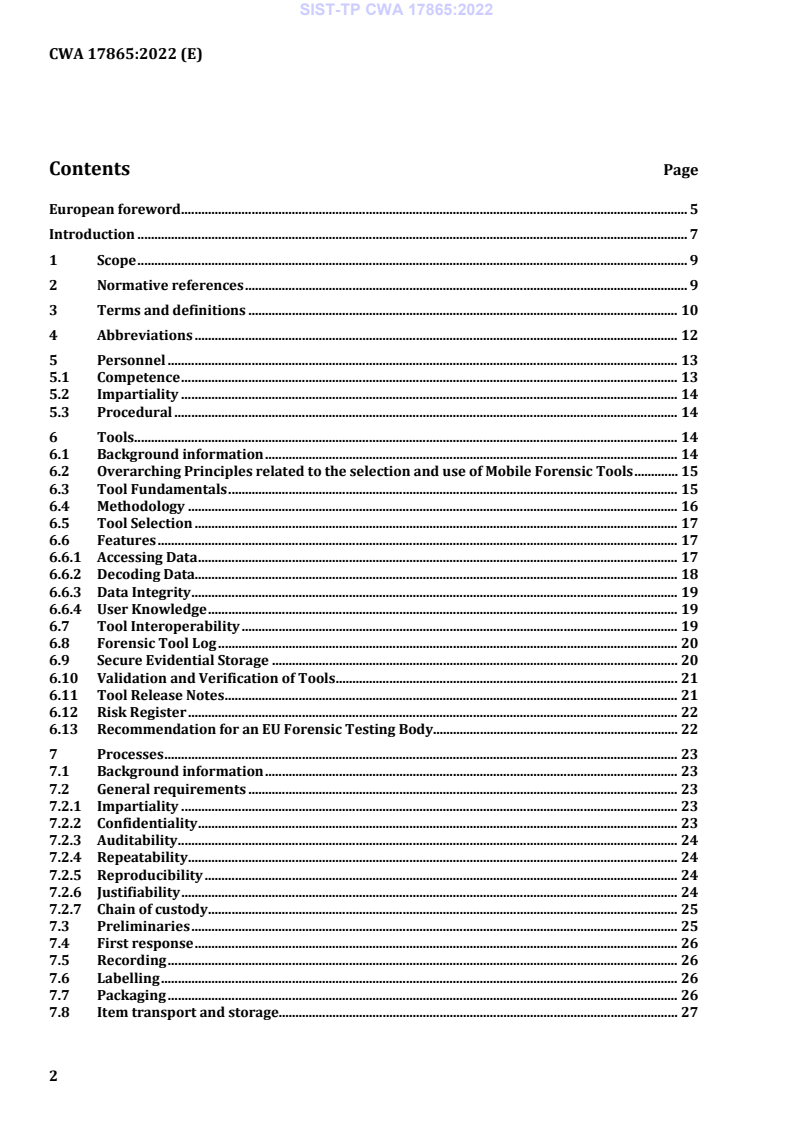
Contents Page
European foreword . 5
Introduction . 7
1 Scope . 9
2 Normative references . 9
3 Terms and definitions . 10
4 Abbreviations . 12
5 Personnel . 13
5.1 Competence . 13
5.2 Impartiality . 14
5.3 Procedural . 14
6 Tools. 14
6.1 Background information . 14
6.2 Overarching Principles related to the selection and use of Mobile Forensic Tools . 15
6.3 Tool Fundamentals . 15
6.4 Methodology . 16
6.5 Tool Selection . 17
6.6 Features . 17
6.6.1 Accessing Data . 17
6.6.2 Decoding Data. 18
6.6.3 Data Integrity . 19
6.6.4 User Knowledge . 19
6.7 Tool Interoperability . 19
6.8 Forensic Tool Log . 20
6.9 Secure Evidential Storage . 20
6.10 Validation and Verification of Tools . 21
6.11 Tool Release Notes . 21
6.12 Risk Register . 22
6.13 Recommendation for an EU Forensic Testing Body. 22
7 Processes . 23
7.1 Background information . 23
7.2 General requirements . 23
7.2.1 Impartiality . 23
7.2.2 Confidentiality . 23
7.2.3 Auditability . 24
7.2.4 Repeatability . 24
7.2.5 Reproducibility . 24
7.2.6 Justifiability . 24
7.2.7 Chain of custody . 25
7.3 Preliminaries . 25
7.4 First response . 26
7.5 Recording . 26
7.6 Labelling . 26
7.7 Packaging . 26
7.8 Item transport and storage. 27
7.9 Lab Work . 27
7.9.1 Initial inspection phase / device identification . 27
7.9.2 Instruction and authorisation . 27
7.9.3 Tool Selection . 27
7.9.4 Acquisition . 27
7.9.5 Decoding / Decryption . 28
7.10 Analysis . 28
7.10.1 Analytical models . 28
7.10.2 Live analysis . 29
7.10.3 Selection of analysis methods . 29
7.11 Verification and Validation . 29
7.11.1 Verification of methods . 29
7.11.2 Validation of methods . 29
7.11.3 Peer Reviews . 29
7.12 Reporting of results . 30
7.12.1 Written reports . 30
7.12.2 Oral reports at court . 30
7.13 Exchange of data and archiving . 31
8 Legal and Ethical Framework . 31
8.1 General Overview . 31
8.2 Governance of the evidentiary proceedings . 36
8.3 Pre-Trial Criminal Proceedings Considerations . 38
8.3.1 Appropriate logging and protocoling. . 38
8.3.2 Criteria to be met when accessing messages, cloud and sensitive documents. . 38
8.3.3 Importance of the different roles in the criminal procedure – suspect, witness,
victim. 38
8.3.4 Scrutinizing tools and review tools and documenting what tools were used . 39
8.3.5 Clear audit trails. 39
8.3.6 Using accessible language to all parties involved in the criminal procedure. 40
8.3.7 Fair trial implications . 40
8.3.8 Judicial overview of the process . 40
8.4 Trial Phase Criminal Proceedings Considerations . 40
8.5 Prevention of mobile forensics dual-use, misuse, and abuse . 41
Annex A (informative) A Good Practice Guide for Mobile Forensic Tool Selection . 44
A.1 Permissibility . 44
A.2 Proportionality . 44
A.3 Validity . 44
A.4 Security . 44
A.5 Processes . 44
A.6 Ethics . 45
Annex B (informative) Mobile Forensic Tool – Checklist for Selection . 46
Annex C (informative) Mobile Forensic Tool – Risk Register . 48
Annex D (informative) Six Steps to Successful to Mobile Validation . 49
D.1 Step 1: Determine all possible extraction methods for the search authority . 49
D.2 Step 2: Process the data in more than one tool . 51
D.3 Step 3: Deep dive forensics: Where the push button stops and forensic examinations
begin . 52
D.4 Step 4: Validation (Types: Visual, cross-tool, call detail records, CCTV, carving,
replication) . 52
D.5 Step 5: Reporting/Sharing your findings . 53
D.6 Step 6: Education . 54
Annex E (informative) Forensic Information Report Template . 55
E.1 General . 55
E.2 Forensic Information Report . 55
7.3 Analysis Interpretation . 62
7.4 Review and Validation . 62
Annex F (informative) Governance implications of the use of Artificial Intelligence in
mobile forensics . 64
Bibliography . 65
European foreword
This CEN Workshop Agreement (CWA 17865:2022) has been developed in accordance with the CEN-
CENELEC Guide 29 “CEN/CENELEC Workshop Agreements – A rapid way to standardization” and with
the relevant provisions of CEN/CENELEC Internal Regulations - Part 2. It was approved by a Workshop
of representatives of interested parties on 2022-02-22, the constitution of which was supported by CEN
following the public call for participation made on 2021-01-28. However, this CEN Workshop Agreement
does not necessarily include all relevant stakeholders.
The final text of this CEN Workshop Agreement was provided to CEN for publication on 2022-03-01.
Results incorporated in this CWA received funding from the European Union’s Horizon 2020 research
and innovation programme under grant agreement No 832800 (project FORMOBILE).
The following organizations and individuals developed and approved this CEN Workshop Agreement:
1. Agentur für Innovation in der Cybersicherheit (Germany)
2. APWG European Union Foundation (Spain)
3. Athena Research Centre (Greece)
4. CCL-Forensics Ltd (UK)
5. Cellebrite (Israel)
6. Central Office for Information Technology in the Security Sector (Germany)
7. COMISARIA GENERAL DE POLICÍA CIENTÍFICA - DIRECCIÓN GENERAL DE LA POLICÍA (Spain)
8. DigiFors GmbH (Germany)
9. Dr. Malvika Mehta (consultant)
10. East Midlands Special Operations Unit (UK)
11. Europol
12. Foundation for Research and Technology - Hellas (Greece)
13. Home Office (UK)
14. International Justice Analysis Forum (Germany)
15. Kriminalistika OÜ (Estonia)
16. Law and Internet Foundation (Bulgaria)
17. Magnet Forensics (Canada)
18. Malta Police Force (Malta)
19. Mittweida University of Applied Sciences (Germany)
20. MSAB (Sweden)
21. Netherlands Forensic Institute (The Netherlands)
22. Norwegian Police University College (Norway)
23. Polish Platform of Homeland Security (Poland)
24. Stadtpolizei Zürich (Switzerland)
25. StAG srl (Italy)
26. Timelex (Belgium)
27. University of Adelaide, School of Electrical and Electronic Engineering (Australia)
28. University of Lausanne, Ecole des Sciences Criminelles (Switzerland)
29. University of South Wales, Faculty of Computing, Engineering and Science (UK)
30. University of Zagreb, Faculty of Transport and Traffic Sciences, Department for Information and
Communication Traffic (Croatia)
Attention is drawn to the possibility that some elements of this document may be subject to patent rights.
CENCENELEC policy on patent rights is described in CEN-CENELEC Guide 8 “Guidelines for
Implementation of the Common IPR Policy on Patent”. CEN shall not be held responsible for identifying
any or all such patent rights.
Although the Workshop parties have made every effort to ensure the reliability and accuracy of technical
and nontechnical descriptions, the Workshop is not able to guarantee, explicitly or implicitly, the
correctness of this document. Anyone who applies this CEN Workshop Agreement shall be aware that
neither the Workshop, nor CEN, can be held liable for damages or losses of any kind whatsoever. The use
of this CEN Workshop Agreement does not relieve users of their responsibility for their own actions, and
they apply this document at their own risk. The CEN Workshop Agreement should not be construed as
legal advice authoritatively endorsed by CEN/CENELEC.
This CWA has been proposed by the FORMOBILE European Project (funding from the European
Commission’s Horizon 2020 – The Framework Programme for Research and Innovation (2014 - 2020)
under Grant Agreement No 832800).
Introduction
Mobile devices, especially smartphones represent a unique challenge for law enforcement. Due to their
wide use, they underpin many criminal investigations. For instance, one may find critical evidence in a
smartphone of a victim who is in no position to unlock the device. Moreover, criminal offenders,
organised crime and terrorist organisations use mobile devices for various purposes, which introduces
many challenges for criminal prosecution. Determining how the data got onto the mobile device is not
always simple as these devices often sync and share data with other digital media and cloud services. Law
enforcement need not only to access the data stored on mobile devices, but also provide it as court
evidence in a trustworthy and reliable manner.
The overarching objective of Horizon 2020 project FORMOBILE is to establish a complete end-to-end
forensic investigation chain that targets mobile devices and includes an appropriate standard. Adherence
to the standards during all steps of investigation in this field is of critical importance for the evidence
being regarded as reliable and acceptable to the court. Development of such a standard is of the utmost
importance to secure the successful outcome of an investigation. Despite the relatively large number of
standards and non-formal standardisation documents, relevant for IT security and digital investigation,
there is a lack of specific standards for mobile forensics in general and especially in the areas, relevant
for the FORMOBILE project.
Several European and international standardisation bodies work on the standardisation in the area of
1)
digital forensics, including ISO and IEC , NIST, ETSI and ASTM. The standards, developed by these
organisations do not explicitly address the topic of mobile forensics in digital investigations. This
standard is aimed to complement existing standards from these organisations. Currently, they are only
partly relevant for the FORMOBILE Project and do not provide a holistic approach to the processes of
mobile forensics. A significant amount of the reference documents, used as standards in mobile forensics,
are best practices and guidelines.
There are current policies and initiatives at national, European as well as international level to introduce
consistent and generally accepted standards for mobile forensics within the forensic community. This
may benefit all users of the criminal justice system including members of the public as well as legal and
forensic practitioners. This CWA can be immediately applied by Law Enforcement Agencies (LEAs) and
serve as a forerunner for a new European Standard in mobile forensics.
Several European initiatives and regulations, relevant for the area of digital investigations, includes the
Council of Europe's Convention on Cybercrime (The Council of Europe, 2001), Directive of the European
Parliament and of the Council regarding the European Investigation Order (Council, 2014), INTERPOL
Global guidelines for digital forensics laboratories (INTERPOL, 2019).
In Europe, there is no unified legal framework for the processes of acquisition, collection, processing,
storage or exchange of digital data, which may result in evidence acceptable to the courts of law in
different countries. Within these countries, the processes usually conform to national law and
regulations, but those regulations and laws may not be consistent or enable transfer for evidential
purposes between countries. Despite mutual recognition, implemented across various countries, a lot of
issues remain open that allow judges to determine the admissibility of electronic data as evidence.
There is a growing need for LEAs and other organisations dealing with mobile forensics to have a
consistent European standard which ensures that evidence presented for the court are regarded as
reliable. This is extremely important for unification of the investigative process across law enforcement
1)
This includes ISO/IEC JTC 1/SC 27 Information security, cybersecurity and privacy protection, incl. ISO/IEC
27037:2012 Information technology — Security techniques — Guidelines for identification, collection, acquisition
and preservation of digital evidence; ISO/IEC JTC 1/SC 37 Biometrics; ISO/IEC JTC 1/SC 40 IT Service Management
and IT Governance.
in different countries and for a successful outcome of the investigation. LEAs, national and international
forensic laboratories of different levels, organisations working in the area of mobile forensics as well as
independent experts are among the beneficiaries of this CEN Workshop.
As such, the primary purpose of this document is to provide recommendations for a complete forensic
investigation chain targeting mobile devices that covers good practices for the mobile phone forensic
chain, tools for the acquisition, recovery, analysis and visualisation of data, as well as the necessary
training required to effectively use the new tools and successfully follow the good practices. These broad
topics are covered in the following clauses addressing the three areas of critical importance: Personnel
(Clause 5), Tools (Clause 6) and Processes (Clause 7).
This CWA seeks to document good practice guidance for the correct and necessary processes,
competencies and methods required to ensure the admissibility of the evidence. It provides a set of
guidelines that fit within the wider context of digital forensic investigations for law enforcement in
general at the level of specificity, necessary to keep these guidelines meaningful, whilst simultaneously
avoiding such detail that make them quickly obsolete.
The guidance in this document is designed to specifically address the specialism of mobile forensics. It is
intended to be complementary to existing related standards within the digital forensics sphere. It is not
intended to replace or override existing guidance or good practice specific to other digital forensics areas.
1 Scope
This CEN Workshop Agreement (CWA) focuses on the Personnel, Tools, Processes and Legal and Ethical
framework specific for mobile forensics and including the following topics:
a) Competencies;
b) device seizure;
c) data preservation;
d) data acquisition;
e) data examination and analysis;
f) documentation of all investigation steps;
g) reporting;
h) evaluation and sharing of information with other LEAs; and
i) legal and ethical considerations.
In addition to the process-related issues, the document covers requirements for new curriculum for
training of LEA officers, security practitioners and criminal prosecution experts to ensure that the
evidence from mobile devices is court-approved across national borders.
It is recognised that national laws and good practices applied at LEAs vary not only between different
European countries but also within these countries. This CWA offers a collection of building blocks
covering different aspects of mobile forensics allowing for adjustments based on national laws and
regulations as well as internal rules and codes of conduct. It allows LEAs from different countries to
accommodate their available technical solutions, at the same time offering a standardised collection of
procedures and requirements.
It should be explicitly stated that it is not possible to cover all the possible related topics for mobile
forensics. Detailed subject matters and specialisms such as Cloud Forensics, Cell Site Analysis,
Interception of Communications are excluded. Similarly, the rules and regulations about chain of custody
in general, plus guidance for transmission of evidence across national boundaries are excluded from this
standards document.
2 Normative references
The following documents are referred to in the text in such a way that some or all of their content
constitutes requirements of this document. For dated references, only the edition cited applies. For
undated references, the latest edition of the referenced document (including any amendments) applies.
ISO 21043-2:2018, Forensic sciences — Part 2: Recognition, recording, collecting, transport and storage of
items
ISO/IEC 17025:2017, General requirements for the competence of testing and calibration laboratories
ISO/IEC 27037:2012, Information technology — Security techniques — Guidelines for identification,
collection, acquisition and preservation of digital evidence
ISO/IEC 27041:2015, Information technology — Security techniques — Guidance on assuring suitability
and adequacy of incident investigative method
ISO/IEC 27042:2015, Information technology — Security techniques — Guidelines for the analysis and
interpretation of digital evidence
ISO/IEC 27043:2015, Information technology — Security techniques — Incident investigation principles
and processes
ISO/IEC 27050 (all parts), Information technology — Security techniques — Electronic discovery
ASTM E2916-19 — Standard Terminology for Digital and Multimedia Evidence Examination
3 Terms and definitions
For the purposes of this document, the following terms and definitions apply.
ISO and IEC maintain terminological databases for use in standardization at the following addresses:
— ISO Online browsing platform: available at https://www.iso.org/obp
— IEC Electropedia: available at https://www.electropedia.org/
3.1
chain of custody
responsibility for or control of materials and associated data as they move through each step of a process
Note 1 to entry: In NIST SP 800-72 chain of custody is defined as process that tracks the movement of evidence
through its collection, safeguarding, and analysis lifecycle by documenting each person who handled the evidence,
the date/time it was collected or transferred, and the purpose for the transfer.
[SOURCE: ISO 20387:2018, 3.12, modified with Note to entry added]
3.2
chain of evidence
process and record that shows who obtained the evidence; where and when the evidence was obtained;
who secured the evidence; and who had control or possession of the evidence
Note 1 to entry: The “sequencing” of the chain of evidence follows this order: collection and identification; analysis;
storage; preservation; presentation in court; return to owner. Rationale: Sufficiently covered under chain of
custody.
Note 2 to entry: This definition is derived from CNSSI 4009 Committee on National Security Systems (CNSS)
Glossary.
Note 3 to entry: This definition also relates to potential evidence, not yet accepted as evidence by court.
3.3
conflict of interests
conflict of interest arises when a person involved in the investigation has a private interest that may
affect the impartial and objective performance of his or her powers or duties
3.4
digital forensics
use of scientifically derived and proven methods toward the preservation, collection, validation,
identification, analysis, interpretation, documentation, and presentation of digital evidence derived from
digital sources for the purpose of facilitation or furthering the reconstruction of events found to be
criminal
Note 1 to entry: In ISO/IEC 30121:2015, 3.3 digital forensics is defined as scientific tasks, techniques, and practices
used in the investigation of stored or transmitted binary information or data for legal purposes.
3.5
strategy
documented objectives defined for the process of proportional examination of digital
evidence, in order to support investigations and prosecutions
Note 1 to entry: The strategy helps guide investigators as to the best approach in accordance with current digital
forensic science, to support evidential integrity across the criminal justice system, from crime scene to courtroom.
3.6
competence
ability, knowledge or skills of people to perform successful, accurate and reliable
mobile forensics, as defined by either the organization, policy, standard or accreditation scheme
Note 1 to entry: These requirements should be documented.
3.7
process
set of interrelated or interacting activities that use inputs to deliver an intended result
[SOURCE: ISO 9000:2015, 3.4.1]
3.8
procedure
specified way to carry out an activity or a process
[SOURCE: ISO 9000:2015, 3.4.5]
3.9
file system
specified method for naming, storing, organizing and accessing files on logical
volumes
[SOURCE: ASTM E2916-19e1]
3.10
hash sum
string of alphanumerical values used to substantiate the integrity of digital evidence or for
inclusion/exclusion comparisons against known value sets or both
[SOURCE: ASTM E2916-19e1]
3.11
jailbreaking (iOS)/rooting (Android)
activity, which describes modification of an electronic device to remove restrictions imposed by the
manufacturer or operator, that can provide access to more data during forensic examinations
3.12
mobile device
any handheld computer device that will have a display screen, providing a touchscreen interface with
digital buttons and keyboard or physical buttons along with a physical keyboard
Note 1 to entry: Many such devices can connect to the Internet and interconnect with other devices via Wi-Fi,
Bluetooth, cellular networks or near field communication (NFC). Typical devices could be a smartphone, a tablet or
wearables.
3.13
mobile device forensics
mobile device forensics is a branch of digital forensics relating to recovery of digital evidence or data
from a mobile device under forensically sound conditions
[SOURCE: ASTM E2916-19e1]
3.14
forensic acquisition
forensic image is a copy of the electronic data on a device created to generate a trusted copy of the original
device data, for examination by a court of law
Note 1 to entry: There are different methods to create forensic images depending on the technology involved.
3.15
physical acquisition
data extracted directly from the device storage area
3.16
logical acquisition
accurate reproduction of information contained within a logical volume (for example, mounted volume,
logical drive assignment etc.)
[SOURCE: ASTM E2916-19e1]
3.17
File System acquisition
targeted active files and folders from the file system which may contain remnants of deleted data and
non-user data
[SOURCE: CFRS762-Mobile Device Forensics, George Mason University]
3.18
carve
to extract a portion of data for the purpose of analysis
[SOURCE: ASTM E2916-19e1]
3.19
parsing
process of converting raw data into formatted data structure
Note 1 to entry: A data structure type can be any suitable representation of the information contained in the raw
data.
4 Abbreviations
AFU - After First Unlock – term used to describe the state of a modern smartphone wherein the mobile
device has been powered on and unlocked at least once but is locked at time of examination.
ASTM - American Society for Testing and Materials.
BFU - Before First Unlock – term used to describe the state of a modern smartphone wherein the mobile
device has been powered on, but not yet unlocked at time of examination.
CASE - Cyber-investigation Analysis Standard Expression; a community-developed evolving standard
that provides a structured (ontology-based) specification for representing information commonly
analysed and exchanged by people and systems during investigations involving digital evidence.
ETSI - European Telecommunications Standards Institute.
EU – European Union
FFS - Full File System
IEC - The International Electrotechnical Commission.
INTERPOL - “The International Criminal Police Organisation – INTERPOL”, which is abbreviated to
"ICPO–INTERPOL".
ISO - The International Organisation for Standardisation.
JTC - Joint Technical Committee.
LED – Law Enforcement Directive
NIST - National Institute of Standards and Technology. A US government department within the US
Department of Commerce who specialises in digital forensic testing of tools.
SC - subcommittee
5 Personnel
5.1 Competence
5.1.1 Personnel shall be competent and duly certified to use the tools and techniques used in their
2)
investigations . See 5.3.2.
3)
5.1.2 Requirements for competence should be documented . Reference to already established lists of
competences. Requirements for competence should reflect the role of the practitioner.
5.1.3 Training activity should be documented. Records (certificates of attendance, accreditations, etc.) of
personnel should be retained.
4)
5.1.4 On the job training should be documented, including what is trained on, when and trained by and
authorisation after training is passed, also document the expiry (date) of training. The relevance of the
training should be periodically reviewed to determine its validity and suitability.
5.1.5 Personnel should have generic Mobile Device Digital Forensic (tool agnostic) training (basic
5)
training should deal with crime-scene , chain of custody/evidence topics, basics about types of
acquisition, analysis, reporting and court appearance). Technique and tool-oriented training should
extend the basic trainings (see also Clause 6.6.4).
2)
ISO/IEC 17025:2017, Clause 6.2.1
3)
ISO/IEC 17025:2017, Clause 6.2.2
4)
Like on the execution of internal procedures.
5)
Like order of examination (DNA, Fingerprints, digital), bio/chemical hazards
5.1.6 Expiry date of competences should be documented. Some basics of digital forensics do not change
very fast. However, the more specific a training is on hardware brands, Operating System specifics, Apps,
the more volatile the knowledge is (due to the fast-moving technology in mobile phone devices).
5.2 Impartiality
5.2.1 At all times, agencies procedures on impartiality and avoidance of conflict of interest shall be
followed.
5.2.2 If none exist:
a) Personnel should not work on cases where there is a (semblance of a) conflict of interest.
b) When (semblance of a) conflict of interest appears during investigation, work should be transferred
6)
to a co-worker or another laboratory .
5.3 Procedural
5.3.1 Procedures and work instructions should be established, documented, shared and updated.
Personnel shall work according to them and ensure their correct appliance.
5.3.2 Mobile forensic tools have a variety of capabilities to acquire data from mobile devices. See Clause
6.2, Principle 1 and Clause 7.4 for more details.
6 Tools
6.1 Background information
Mobile forensics is a fast-moving and rapidly evolving scientific area. The constant developments in
device hardware, operating systems, apps, app versions and security protections, mean that what was
good practice just a few years ago, may now be unsuitable for the latest devices.
For that reason, it is difficult to produce a set of standards with sufficient detail to be relevant, whilst
simultaneously being flexible enough to remain valid for the long term. That makes the production of a
fixed standard document for mobile forensics very challenging and unproductive.
This document describes good practice and guidance for the selection and use of mobile forensic tools
within the wider guidance of this document for personnel and processes. This document is designed to
be supplemented with local Standard Operating Procedures, Reference Guides and Work Instructions.
For a quick overview of points to consider when selecting a mobile forensic tool, see:
— Annex A: Good Practice for tool selection;
— Annex B: Checklist for selection;
— Annex C: Mobile Forensic Tool – Risk Register;
— Annex D: Six Steps to Successful to Mobile Validation.
6)
See also Clause 7.2.1
6.2 Overarching Principles related to the selection and use of Mobile Forensic Tools
Principle 1: All reasonable steps should be taken to minimise the risk of changing digitally stored data on
a mobile device that could subsequently be relied upon as evidence in court.
Mobile forensic tools have a variety of capabilities to acquire data from mobile devices. For example, some
methods require the installation of agents onto a device; other processes require the jailbreaking or lower
level-privileged access of handsets and on occasion, the only way to get the data may require
disassembling the device at the chip level. It is essential that persons involved understand the risks of
these methods to manage the risk of accidentally overwriting or destroying evidence. This is why training
of personnel and the documentation of it are so important to fulfil the requirements.
Principle 2: A record of all actions taken, and tools applied should be documented and preserved and be
made available to the courts if used as evidence.
It is recommended that data recovered by forensic tools should be corroborated wherever possible, if
intended to be used in court. An independent third-party should be able to replicate the processes applied
to reach the same results. Such a transparent process helps to validate and verify the evidence being
presented in court. It is important that users make a record of their actions and the tools (including the
version of the tools) used in an open and accessible audit log trail of what actions were taken to recover
the data. Moreover, a log of actions can be produced for court. to provide a definite trail of the steps
followed.
Principle 3: Digital evidence should be securely stored and p
...