

SIST-TS CLC/TS 50641-2:2025
(Main)Fixed Installations for Railway Applications - Requirements for the validation of simulation tools used for the design of electric traction power supply systems - Part 2: specific DC urban case
General Information
- Abstract
This document specifies requirements for the test and acceptance of simulation tools used for the design of DC electric traction power supply systems for urban rail guided mass transport systems, such as tramways, elevated and underground railways, mountain railways, trolleybus systems, and magnetically levitated systems which use a contact line system. The validation process will be carried out for the 750 V DC voltage, and other voltages can be validated with the cross-acceptance.
This document focuses on the validation of the core simulation functions comprising the equations and functions which calculate:
- the mechanical movement of trains and
- the load flow of the electrical traction power supply system.
NOTE 1 This document provides only the requirements for demonstration of the algorithms and calculations of core functions. The use of a validated simulation tool in accordance with this document does not in itself, demonstrate good practice in electric traction power supply system design, neither does it guarantee that the simulation models and data for infrastructure or trains used in the tool are correct for a given application. The choice and application of any models and data, of individual system components, in a design is therefore subject to additional verification processes and not in the scope of this document. Competent development of design models and full understanding of the limits of design tools remain requirements in any system design. This document does not reduce any element of the need for competent designers to lead the design process.
This document also specifies procedures for the modification of simulation tools, in particular the limits of applicability of acceptance when tools are modified. These procedures focus on determining whether the core functions of the simulation model are modified.
Because the purpose of this standard deals with the verification of the core functionality, the test case described in this document does not represent an existing network.
NOTE 2 Additionally, the application of this document ensures that the output data of different simulation tools are consistent and verifiable when they are using the same set of input data as given in this document.
This document excludes complex models with active components such as controlled rectifiers and inverters.
This document does not mandate the use of a particular simulation tool in order to validate the design of an electric traction power supply system.
This document does not deal with validation of simulation tools by measurement.
The document is not applicable to the validation of simulation tools with respect to:
- short circuit studies;
- electrical safety studies (e.g. rail potential);
- harmonic studies;
- studies of transient phenomena; and
- electromagnetic compatibility studies over a wide frequency spectrum.
- Status
- Published
- Publication Date
- 08-Apr-2025
- Technical Committee
- ŽEN - Electrical applications for railways
- Current Stage
- 6060 - National Implementation/Publication (Adopted Project)
- Start Date
- 21-Mar-2025
- Due Date
- 26-May-2025
- Completion Date
- 09-Apr-2025

Overview
CLC/TS 50641-2:2024 - Fixed Installations for Railway Applications - specifies requirements for the validation of simulation tools used to design DC electric traction power supply systems for urban rail. Focused on the 750 V DC urban case (with cross-acceptance for other voltages), this Technical Specification defines how to test and accept the core simulation functions that calculate:
- the mechanical movement of trains, and
- the load flow of the electrical traction power supply.
The document sets a formal test model, expected program outputs and reporting requirements to ensure consistent, verifiable simulation results across different software tools.
Key topics and requirements
- Scope of validation: Core algorithm and numerical method verification (train dynamics + DC load flow). It does not validate specific infrastructure/train model correctness or replace design expertise.
- Test model description: Standardized train set models, track layout, route gradients, station positions, traffic/timetable models and electrical infrastructure definitions used for acceptance tests.
- Expected outputs: Defined train results and substation results with boundary values and tolerances (see Annex A–B). Quantitative acceptance criteria and informative qualitative checks (graph inspections).
- Software quality management: Versioning, release control and change-log practices are referenced for tool modification and re-validation procedures.
- Modification rules: Procedures to determine when a tool modification affects core functions and whether re-validation is required.
- Exclusions: The TS excludes complex active components (controlled rectifiers/inverters) and does not cover:
- short-circuit studies,
- electrical safety (rail potential) studies,
- harmonic or EMC wide-frequency studies,
- transient phenomena,
- validation by measurement (laboratory or field).
Practical applications
- Benchmarking and acceptance of simulation software used by rail infrastructure managers, consultants and manufacturers.
- Consistency checks when multiple simulation tools are used in the same project, ensuring comparable outputs from identical input datasets.
- Risk reduction by verifying core algorithm accuracy before applying models to design decisions, reducing reliance on costly live tests.
- Change control: determining whether software updates require re-validation to maintain tool acceptance status.
Who should use this standard
- Simulation tool developers and vendors
- Electrical traction power supply designers and engineering consultants
- Infrastructure owners, transit agencies, certifying bodies and technical reviewers
- Project leads responsible for tool qualification and verification of DC urban rail designs
Related standards
- EN 50641 (Part 1 / general series)
- EN 50388-1:2022 (coordination between traction power supply and rolling stock)
- EN 50163:2004 (traction supply voltages)
Keywords: CLC/TS 50641-2:2024, simulation tools validation, DC traction power supply, 750 V DC, urban rail, train movement, load flow, tramways, trolleybus, electric traction.
Relations
- Effective Date
- 03-Feb-2026
- Effective Date
- 03-Feb-2026
Get Certified
Connect with accredited certification bodies for this standard

IMQ S.p.A. (Certification)
Italian electrical product certification.

SLG Prüf- und Zertifizierungs GmbH
German testing and certification body.

UL Solutions
Global safety science company with testing, inspection and certification.
Sponsored listings
Frequently Asked Questions
SIST-TS CLC/TS 50641-2:2025 is a technical specification published by the Slovenian Institute for Standardization (SIST). Its full title is "Fixed Installations for Railway Applications - Requirements for the validation of simulation tools used for the design of electric traction power supply systems - Part 2: specific DC urban case". This standard covers: This document specifies requirements for the test and acceptance of simulation tools used for the design of DC electric traction power supply systems for urban rail guided mass transport systems, such as tramways, elevated and underground railways, mountain railways, trolleybus systems, and magnetically levitated systems which use a contact line system. The validation process will be carried out for the 750 V DC voltage, and other voltages can be validated with the cross-acceptance. This document focuses on the validation of the core simulation functions comprising the equations and functions which calculate: - the mechanical movement of trains and - the load flow of the electrical traction power supply system. NOTE 1 This document provides only the requirements for demonstration of the algorithms and calculations of core functions. The use of a validated simulation tool in accordance with this document does not in itself, demonstrate good practice in electric traction power supply system design, neither does it guarantee that the simulation models and data for infrastructure or trains used in the tool are correct for a given application. The choice and application of any models and data, of individual system components, in a design is therefore subject to additional verification processes and not in the scope of this document. Competent development of design models and full understanding of the limits of design tools remain requirements in any system design. This document does not reduce any element of the need for competent designers to lead the design process. This document also specifies procedures for the modification of simulation tools, in particular the limits of applicability of acceptance when tools are modified. These procedures focus on determining whether the core functions of the simulation model are modified. Because the purpose of this standard deals with the verification of the core functionality, the test case described in this document does not represent an existing network. NOTE 2 Additionally, the application of this document ensures that the output data of different simulation tools are consistent and verifiable when they are using the same set of input data as given in this document. This document excludes complex models with active components such as controlled rectifiers and inverters. This document does not mandate the use of a particular simulation tool in order to validate the design of an electric traction power supply system. This document does not deal with validation of simulation tools by measurement. The document is not applicable to the validation of simulation tools with respect to: - short circuit studies; - electrical safety studies (e.g. rail potential); - harmonic studies; - studies of transient phenomena; and - electromagnetic compatibility studies over a wide frequency spectrum.
This document specifies requirements for the test and acceptance of simulation tools used for the design of DC electric traction power supply systems for urban rail guided mass transport systems, such as tramways, elevated and underground railways, mountain railways, trolleybus systems, and magnetically levitated systems which use a contact line system. The validation process will be carried out for the 750 V DC voltage, and other voltages can be validated with the cross-acceptance. This document focuses on the validation of the core simulation functions comprising the equations and functions which calculate: - the mechanical movement of trains and - the load flow of the electrical traction power supply system. NOTE 1 This document provides only the requirements for demonstration of the algorithms and calculations of core functions. The use of a validated simulation tool in accordance with this document does not in itself, demonstrate good practice in electric traction power supply system design, neither does it guarantee that the simulation models and data for infrastructure or trains used in the tool are correct for a given application. The choice and application of any models and data, of individual system components, in a design is therefore subject to additional verification processes and not in the scope of this document. Competent development of design models and full understanding of the limits of design tools remain requirements in any system design. This document does not reduce any element of the need for competent designers to lead the design process. This document also specifies procedures for the modification of simulation tools, in particular the limits of applicability of acceptance when tools are modified. These procedures focus on determining whether the core functions of the simulation model are modified. Because the purpose of this standard deals with the verification of the core functionality, the test case described in this document does not represent an existing network. NOTE 2 Additionally, the application of this document ensures that the output data of different simulation tools are consistent and verifiable when they are using the same set of input data as given in this document. This document excludes complex models with active components such as controlled rectifiers and inverters. This document does not mandate the use of a particular simulation tool in order to validate the design of an electric traction power supply system. This document does not deal with validation of simulation tools by measurement. The document is not applicable to the validation of simulation tools with respect to: - short circuit studies; - electrical safety studies (e.g. rail potential); - harmonic studies; - studies of transient phenomena; and - electromagnetic compatibility studies over a wide frequency spectrum.
SIST-TS CLC/TS 50641-2:2025 is classified under the following ICS (International Classification for Standards) categories: 29.280 - Electric traction equipment. The ICS classification helps identify the subject area and facilitates finding related standards.
SIST-TS CLC/TS 50641-2:2025 has the following relationships with other standards: It is inter standard links to SIST EN 50163:2005, SIST EN 50388-1:2022. Understanding these relationships helps ensure you are using the most current and applicable version of the standard.
SIST-TS CLC/TS 50641-2:2025 is available in PDF format for immediate download after purchase. The document can be added to your cart and obtained through the secure checkout process. Digital delivery ensures instant access to the complete standard document.
Standards Content (Sample)
SLOVENSKI STANDARD
01-maj-2025
Fiksni postroji za železniške naprave - Zahteve za ocenjevanje simulacijskih
orodij, ki se uporabljajo za načrtovnje napajalnih sistemov električne vleke - 2. del:
Specifični enosmerni mestni primer
Fixed Installations for Railway Applications - Requirements for the validation of
simulation tools used for the design of electric traction power supply systems - Part 2:
specific DC urban case
Ortsfeste Anlagen für Bahnanwendungen - Anforderungen für die Validierung von
Simulationsprogrammen für die Auslegung von Bahnenergieversorgungssystemen - Teil
2: Spezifisches Gleichstrom-Stadtbahnsystemen
Installations Fixes pour Applications ferroviaires - Exigences relatives à la validation des
outils de simulation utilisés pour la conception des systèmes d’alimentation de la traction
- Partie 2 : cas spécifique des Réseaux urbains en courant continu
Ta slovenski standard je istoveten z: CLC/TS 50641-2:2024
ICS:
29.280 Električna vlečna oprema Electric traction equipment
2003-01.Slovenski inštitut za standardizacijo. Razmnoževanje celote ali delov tega standarda ni dovoljeno.
TECHNICAL SPECIFICATION CLC/TS 50641-2
SPÉCIFICATION TECHNIQUE
TECHNISCHE SPEZIFIKATION April 2024
ICS 29.280
English Version
Fixed Installations for Railway Applications - Requirements for
the validation of simulation tools used for the design of electric
traction power supply systems - Part 2: specific DC urban case
Installations Fixes pour Applications ferroviaires - Ortsfeste Anlagen für Bahnanwendungen - Anforderungen
Exigences relatives à la validation des outils de simulation für die Validierung von Simulationsprogrammen für die
utilisés pour la conception des systèmes d'alimentation de Auslegung von Bahnenergieversorgungssystemen - Teil 2:
la traction - Partie 2 : Cas spécifique des réseaux urbains Spezifisches Gleichstrom-Stadtbahnsystemen
en courant continu
This Technical Specification was approved by CENELEC on 2024-03-25.
CENELEC members are required to announce the existence of this TS in the same way as for an EN and to make the TS available promptly
at national level in an appropriate form. It is permissible to keep conflicting national standards in force.
CENELEC members are the national electrotechnical committees of Austria, Belgium, Bulgaria, Croatia, Cyprus, the Czech Republic,
Denmark, Estonia, Finland, France, Germany, Greece, Hungary, Iceland, Ireland, Italy, Latvia, Lithuania, Luxembourg, Malta, the
Netherlands, Norway, Poland, Portugal, Republic of North Macedonia, Romania, Serbia, Slovakia, Slovenia, Spain, Sweden, Switzerland,
Türkiye and the United Kingdom.
European Committee for Electrotechnical Standardization
Comité Européen de Normalisation Electrotechnique
Europäisches Komitee für Elektrotechnische Normung
CEN-CENELEC Management Centre: Rue de la Science 23, B-1040 Brussels
© 2024 CENELEC All rights of exploitation in any form and by any means reserved worldwide for CENELEC Members.
Ref. No. CLC/TS 50641-2:2024 E
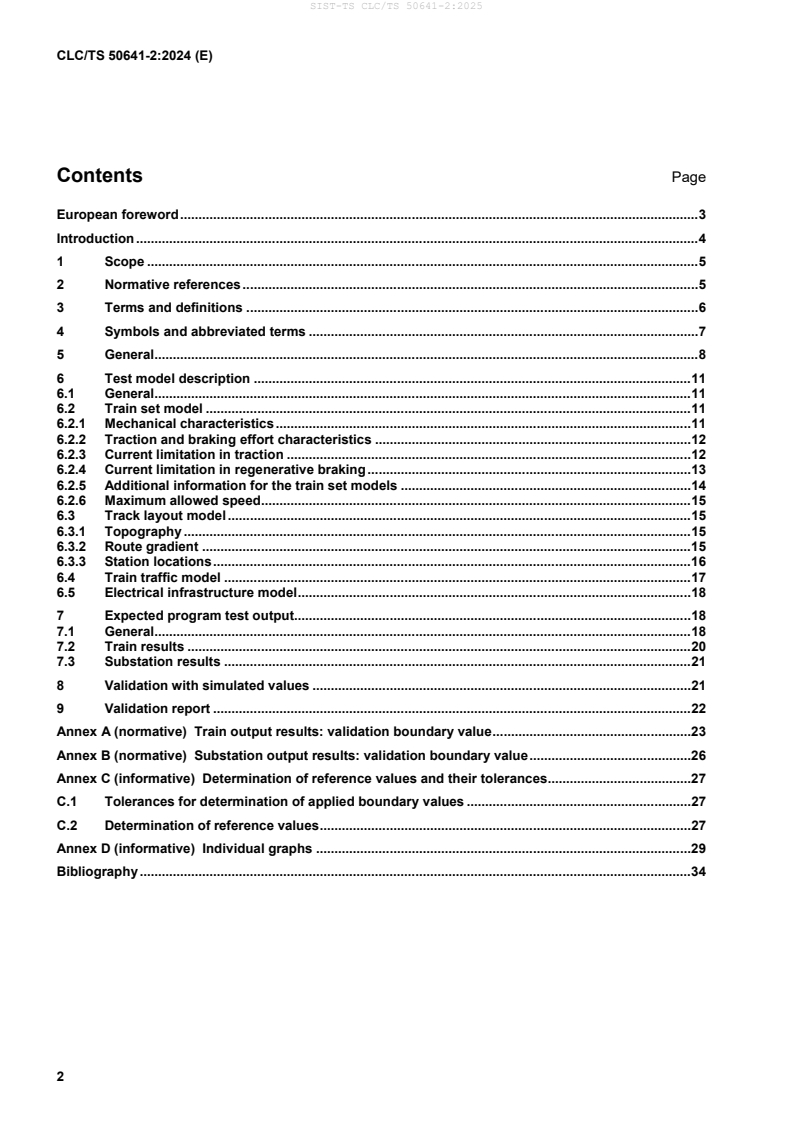
Contents Page
European foreword . 3
Introduction . 4
1 Scope . 5
2 Normative references . 5
3 Terms and definitions . 6
4 Symbols and abbreviated terms . 7
5 General . 8
6 Test model description . 11
6.1 General . 11
6.2 Train set model . 11
6.2.1 Mechanical characteristics . 11
6.2.2 Traction and braking effort characteristics . 12
6.2.3 Current limitation in traction . 12
6.2.4 Current limitation in regenerative braking . 13
6.2.5 Additional information for the train set models . 14
6.2.6 Maximum allowed speed . 15
6.3 Track layout model . 15
6.3.1 Topography . 15
6.3.2 Route gradient . 15
6.3.3 Station locations . 16
6.4 Train traffic model . 17
6.5 Electrical infrastructure model . 18
7 Expected program test output. 18
7.1 General . 18
7.2 Train results . 20
7.3 Substation results . 21
8 Validation with simulated values . 21
9 Validation report . 22
Annex A (normative) Train output results: validation boundary value . 23
Annex B (normative) Substation output results: validation boundary value . 26
Annex C (informative) Determination of reference values and their tolerances . 27
C.1 Tolerances for determination of applied boundary values . 27
C.2 Determination of reference values . 27
Annex D (informative) Individual graphs . 29
Bibliography . 34
European foreword
This document (CLC/TS 50641-2:2024) has been prepared by CLC/SC 9XC “Electric supply and earthing
systems for public transport equipment and ancillary apparatus (Fixed installations)”, of Technical Committee
CLC/TC 9X “Electrical and electronic applications for railways”.
Attention is drawn to the possibility that some of the elements of this document may be the subject of patent
rights. CENELEC shall not be held responsible for identifying any or all such patent rights.
Any feedback and questions on this document should be directed to the users’ national committee. A complete
listing of these bodies can be found on the CENELEC website.
Introduction
This document has been prepared following the publication of EN 50641, which will be renamed as EN 50641-1
in the future.
This document is Part 2 of the EN 50641 series and dedicated to urban rail transport with DC 750 V power
supply, as well as other electric DC traction power supply systems. It has the same structure as EN 50641 but
with input representative of urban rail transports with dense traffic and short feeding sections, small headways
and frequent stops correlated with regenerative energy flows.
Experts representing approximately ten member states worked to draft this completely new document. The
results and data are taken from the most well-known representative simulation softwares in Europe and related
experts. This document provides a means of assessing simulation tools and provides assurance to anyone who
depends upon their output.
1 Scope
This document specifies requirements for the test and acceptance of simulation tools used for the design of DC
electric traction power supply systems for urban rail guided mass transport systems, such as tramways, elevated
and underground railways, mountain railways, trolleybus systems, and magnetically levitated systems which
use a contact line system. The validation process will be carried out for the 750 V DC voltage, and other voltages
can be validated with the cross-acceptance.
This document focuses on the validation of the core simulation functions comprising the equations and functions
which calculate:
— the mechanical movement of trains and
— the load flow of the electrical traction power supply system.
NOTE 1 This document provides only the requirements for demonstration of the algorithms and calculations of core
functions. The use of a validated simulation tool in accordance with this document does not in itself, demonstrate good
practice in electric traction power supply system design, neither does it guarantee that the simulation models and data for
infrastructure or trains used in the tool are correct for a given application. The choice and application of any models and
data, of individual system components, in a design is therefore subject to additional verification processes and not in the
scope of this document. Competent development of design models and full understanding of the limits of design tools remain
requirements in any system design. This document does not reduce any element of the need for competent designers to
lead the design process.
This document also specifies procedures for the modification of simulation tools, in particular the limits of
applicability of acceptance when tools are modified. These procedures focus on determining whether the core
functions of the simulation model are modified.
Because the purpose of this standard deals with the verification of the core functionality, the test case described
in this document does not represent an existing network.
NOTE 2 Additionally, the application of this document ensures that the output data of different simulation tools are
consistent and verifiable when they are using the same set of input data as given in this document.
This document excludes complex models with active components such as controlled rectifiers and inverters.
This document does not mandate the use of a particular simulation tool in order to validate the design of an
electric traction power supply system.
This document does not deal with validation of simulation tools by measurement.
The document is not applicable to the validation of simulation tools with respect to:
— short circuit studies;
— electrical safety studies (e.g. rail potential);
— harmonic studies;
— studies of transient phenomena; and
— electromagnetic compatibility studies over a wide frequency spectrum.
2 Normative references
The following documents are referred to in the text in such a way that some or all of their content constitutes
requirements of this document. For dated references, only the edition cited applies. For undated references, the
latest edition of the referenced document (including any amendments) applies.
EN 50163:2004, Railway applications - Supply voltages of traction systems
EN 50388-1:2022, Railway Applications - Fixed installations and rolling stock - Technical criteria for the
coordination between electric traction power supply systems and rolling stock to achieve interoperability - Part
1: General
3 Terms and definitions
For the purposes of this document, the terms and definitions given in EN 50163:2004, EN 50388-1:2022 and
the following apply.
ISO and IEC maintain terminology databases for use in standardization at the following addresses:
— ISO Online browsing platform: available at https://www.iso.org/obp/
— IEC Electropedia: available at https://www.electropedia.org/
3.1
electric traction system
electric traction power supply system
railway electric distribution network used to provide energy for rolling stock
[SOURCE: IEC 60050-811:2017, 811-36-21, modified – “electric traction power supply system” has been added
as synonym and the Note 1 to entry has been removed.]
3.2
simulation accuracy
indicator dedicated to the characterization of the accuracy of the simulation output regarding a reference
(measure or theoretical model) for a given case
3.3
simulation method
construction and solution of a numerical time-step or space-step model of train movement and electric traction
power supply performance
3.4
simulation tool
software implementing one or more simulation methods
3.5
software quality management
management system for software to be updated
Note 1 to entry: The processes are the following:
— software development process comprising the steps of development request, software test, release,
— life cycle process with the steps release plan, versioning with code protection and changelog, bug tracking,
— documentation (user manual, help system, developer's guide if any).
3.6
track layout model
model describing the physical characteristics of the track such as curves, tunnels and gradient description
3.7
train set
combination of vehicles coupled together
Note 1 to entry: Vehicle includes banking locomotives.
3.8
train set model
model describing the electrical and mechanical characteristics of the train set
3.9
train traffic model
model of the train service and the timetable over a given time period
3.10
validation
confirmation, through the provision of objective evidence, that the requirements for a specific intended use or
application have been fulfilled
Note 1 to entry: Verification is a prerequisite for validation.
[SOURCE: IEC 60050-192:2015, 192-01-18, modified – Notes 1 to 5 to entry have been removed and a new
Note 1 to entry has been added.]
3.11
verification
confirmation, through the provision of objective evidence, that specified requirements have been fulfilled
Note 1 to entry: Whilst the general term in this document is assessment, verification is commonly understood in the
assessment of models and data analysis and its use is more specific than the general term conformity.
[SOURCE: IEC 60050-192:2015, 192-01-17, modified – Notes 1 to 3 to entry have been removed and a new
Note 1 to entry was added.]
4 Symbols and abbreviated terms
For the purposes of this document, the following symbols and abbreviated terms apply.
A coefficient of running resistance independent of speed
a knee point factor (see EN 50388-1:2022, 7.3)
B coefficient of running resistance for linear dependence of speed
C coefficient of running resistance for quadratic dependence of speed
F tractive effort
F maximum tractive effort
m
F running resistance
res
I current
I current for train set auxiliaries (e.g. air conditioning)
aux
I braking current of the train set
braking
I maximum current consumed by the train set at Un
max
N/A not applicable
P auxiliary active power
aux
P maximum mechanical power
max
PP paralleling post where the contact line systems of both tracks are electrically connected
R equivalent internal resistance of a substation
eq
SS substation including paralleling of contact line system
U no load voltage at a substation for DC traction system
di0
U highest permanent voltage (see EN 50163:2004)
max1
U highest non-permanent voltage (see EN 50163:2004)
max2
U mean useful voltage (see EN 50388-1:2022, 8.2)
mean
useful
U lowest non-permanent voltage (see EN 50163:2004)
min2
U nominal voltage for a given electrical supply system
n
U current collector voltage
p
v speed in km/h
v transfer speed 1 (transfer from adhesion characteristic to maximum voltage characteristic of
drive)
v maximum speed
v maximum allowed speed (track, train set)
max
η traction/braking efficiency
5 General
The theoretical study of the interactions between the operation of rolling stock and the power supply system by
means of computer simulation is generally used to obtain detailed information about a traction power system.
NOTE 1 This minimizes the costs of live tests, and as a consequence optimizes the investment to be made for a given
performance of the electrical railway system.
The scope of the simulation should be defined in advance, taking account of typical supply systems (see
Figure 1). The acceptance process of the simulation is in two parts.
Firstly, an informative verification process is undertaken which compares in a qualitative way specific
characteristics of the key simulation output graphs, in order to validate the performance of the simulation at
critical events. These verifications are not part of the acceptance criterion.
Secondly, the quantitative verification of the simulation is performed by comparing key calculated values with
those given in this document. These verifications are part of the acceptance criterion for a successful validation.
NOTE 2 The verification process laid out in this document is based on a verification using a defined benchmark example
of an urban DC electric traction power supply system and employing a common set of input data incorporating the
infrastructure (including station locations, gradient, speed limit), types of train sets and timetable.
NOTE 3 The output data set has been developed with several existing simulation tools, currently used in electric traction
power supply system design, and which therefore represent a range of differences within core algorithms and its numerical
implementation. The simulation accuracy of the outputs from these tools were compared, and tolerances applied to cover
the range of variation considered reasonable across all tools. The observed variation in these tools has no effect on their
applicability for use in calculations, and hence this range of tolerance can be applied to the acceptance of new tools. Annex C
gives information on the calculation methodology of tolerances for determination of applied boundary values.
The validation in this standard is carried out based upon a DC 750 V traction power supply system. Table 9 of
this document indicates cross acceptance among other DC urban electric traction power supply systems, such
as DC 600 V, DC 1 500 V and DC 3 000 V.
In order to obtain an acceptable verification of a simulation tool, the results of the simulation tool shall be
compared with the output results presented in this document according to the criteria described in Annexes A
and B.
In order to use a simulation tool with confidence, it shall be validated initially and after each revision of the core
functions of the software that have an impact on the simulation results. If the modification affects a core function,
then a new validation is necessary. The validation shall be done by following the steps shown in Figure 1.
Core functions of the simulation tools are the algorithms to:
— solve the differential equations of train sets movement resulting in power demand at current collector(s);
— calculate the load flow (current-voltage) of the electrical network with changing configurations caused by
moving loads.
Interaction between mechanical and electrical core functions are required to provide an integrated solution,
where lack of electrical power will feedback to influence the train set movement including iterations as
necessary.
Software modifications which do not affect these core functions, and also functions outside the core such as
interaction with the user, presentation and pre-processing of data and models before passing to the core, and
all post-processing of data from the core, do not require validation.
These software modifications shall be recorded within a structured software quality management system to
provide traceability.
Figure 1 — Steps of validation
6 Test model description
6.1 General
The test case configuration and data are used for the purpose of the document only. They do not represent
typical applications for system design. The present test is dedicated to being an example of urban railway
traction network.
NOTE Different time steps can be used for the electrical and mechanical simulations, which can be fixed or variable
depending upon the simulation tool. The test case is based on simulation timesteps (mechanical and electrical) of maximum
1 s. In order to achieve the best accuracy, it is recommended to use these timesteps.
6.2 Train set model
6.2.1 Mechanical characteristics
The mechanical characteristics for train sets of this test case are provided in Table 1.
Table 1 — Train set mechanical and traction characteristics
Parameter Value
Speed v km/h
Speed v km/h
Maximum Tractive effort F kN
m
Total mass t 270
Rotating mass t 27
Efficiency (η) % 85
Auxiliary power P MW
0,1
aux
A kN 2
B kN/(km/h) 0,02
C
kN/(km/h) 0,000 5
Maximum deceleration m/s 0,70
Maximum acceleration m/s No limit
The running resistance is defined using a formula: F = A + B∙v + C∙v with v the speed in km/h. The A, B and
res
C coefficients apply to the whole train set.
As additional elements, it shall be understood that:
— The tractive effort for the train set is provided for the whole train set, thus the whole train set has a total
tractive effort of 300 kN.
— The adhesion factor is not provided as the tractive effort is assumed to be transferred to the track under all
circumstances.
— For braking, it is assumed that it is possible to brake with the desired deceleration under all circumstances.
— The train set mass is concentrated. If the software requires a distributed mass, then a train length of 1m
shall be used.
— The efficiency (η) refers to the whole traction chain from current collector to the wheels not taking into
acco
...