


SIST EN 12814-6:2000
(Main)Testing of welded joints of thermoplastics semi-finished products - Part 6: Low temperature tensile test
Testing of welded joints of thermoplastics semi-finished products - Part 6: Low temperature tensile test
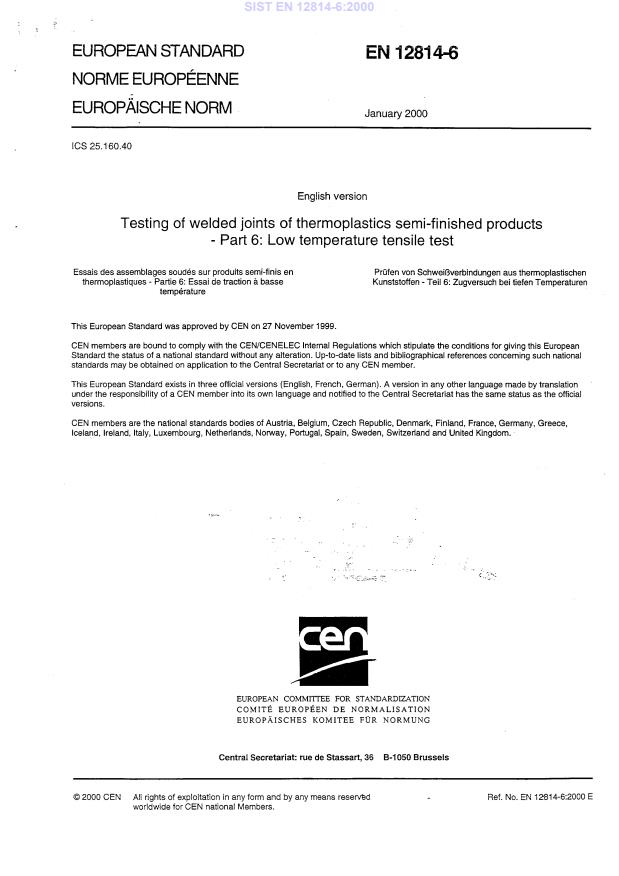
This standard specifies the dimensions, the method of sampling and the preparation of the test specimens, also the conditions for performing the low temperature tensile test perpendicular to the weld in order to determine the low temperature tensile welding factor. A low temperature tensile test may be used in conjunction with other tests (e.g. bend, tensile creep, macro, ...) to assess the performance of welded assemblies, made from thermoplastics materials. The low temperature tensile welding factor and the appearance of the fracture surface provide a guide regarding the ductility of the joint and the quality of the work.
Prüfen von Schweißverbindungen aus thermoplastischen Kunststoffen - Teil 6: Zugversuch bei tiefen Temperaturen
Diese Norm legt Maße, Probennahmeverfahren und Vorbereitung der Proben sowie die Durchführungsbestimmungen für den Zugversuch bei tiefen Temperaturen rechtwinklig zur Schweißnaht fest, um den Zug-Schweißfaktor bei tiefen Temperaturen zu bestimmen. Ein Zugversuch bei tiefen Temperaturen darf in Verbindung mit anderen Prüfungen (z.B. Biegeversuch, Zeitstand-Zugversuch, makroskopische Prüfung usw.) angewendet werden, um das Betriebsverhalten von Schweißverbindungen aus thermoplastischen Kunststoffen zu beurteilen.
Essais des assemblages soudés sur produits semi-finis en thermoplastiques - Partie 6: Essai de traction a basse température
La présente norme spécifie les dimensions, la méthode de prélèvement et de préparation des éprouvettes, ainsi que les conditions d'exécution de l'essai de traction à basse température effectué perpendiculairement à la soudure, afin de déterminer le facteur de soudage en traction à basse température. Un essai de traction à basse température peut être effectué en combinaison avec d'autres examens ou essais (par exemple essai de pliage, essai de fluage en traction, examen macrographique, etc.) afin d'évaluer les performances des assemblages soudés en thermoplastiques.
Preskus zvarjenih spojev plastomernih polizdelkov - 3. del: Trgalni preskus pri nizki temperaturi
General Information
- Status
- Published
- Publication Date
- 30-Nov-2000
- Technical Committee
- IPMA - Polimer materials and products
- Current Stage
- 6060 - National Implementation/Publication (Adopted Project)
- Start Date
- 01-Dec-2000
- Due Date
- 01-Dec-2000
- Completion Date
- 01-Dec-2000
Relations
- Effective Date
- 07-Aug-2024
- Effective Date
- 22-Dec-2008
EN 12814-6:2000 - Overview
EN 12814-6:2000 (CEN) defines the procedure for the low temperature tensile test of welded joints in thermoplastic semi-finished products. The standard specifies how to select, dimension, sample and prepare test specimens and the general conditions for carrying out a tensile test perpendicular to the weld. The objective is to determine the low temperature tensile welding factor and to assess joint ductility and work quality using the fracture surface appearance.
Key topics and requirements
- Scope and purpose - Test method focused on welded joints of thermoplastic semi-finished products under low-temperature tensile loading.
- Specimen selection and dimensions - Rules for sampling from welded assemblies and preparing specimens representative of the welded area (the standard specifies required dimensions and geometry).
- Test orientation - Tensile test performed perpendicular to the weld to evaluate strength and ductility across the fusion line.
- Test conditions - Defined low-temperature environment and tensile conditions are required (see standard text for specific conditions).
- Results and interpretation - Determination of a low temperature tensile welding factor; fracture surface appearance is used to judge ductility and weld quality.
- Complementary testing - The low temperature tensile test is intended to be used alongside other methods (for example bend tests, tensile creep, macro-examination) to form a full assessment of welded assembly performance.
Practical applications
- Quality control and production inspection - Verify that welded joints meet low-temperature performance criteria before product release.
- Welding procedure and personnel qualification - Support qualification of welding processes and operators by demonstrating joint behavior at low temperatures.
- Material selection and joint design - Inform decisions about thermoplastic grades and joint geometries where low-temperature performance is critical.
- Failure analysis and R&D - Use tensile welding factor and fracture morphology to investigate failures or to optimize welding parameters and materials.
Who should use this standard
- Welding engineers and fabricators working with thermoplastics
- Materials and polymer engineers responsible for joint integrity
- Quality assurance/quality control (QA/QC) laboratories
- Certification bodies and testing laboratories assessing welded assemblies
Related standards
- Other parts of the EN 12814 series covering additional test methods for welded thermoplastics assemblies
- Relevant ISO and national standards for plastics testing and welding qualification (refer to official standards lists for exact references)
Keywords: EN 12814-6, low temperature tensile test, welded joints, thermoplastics, welding factor, semi-finished products, CEN standard, weld quality, tensile testing.


Frequently Asked Questions
SIST EN 12814-6:2000 is a standard published by the Slovenian Institute for Standardization (SIST). Its full title is "Testing of welded joints of thermoplastics semi-finished products - Part 6: Low temperature tensile test". This standard covers: This standard specifies the dimensions, the method of sampling and the preparation of the test specimens, also the conditions for performing the low temperature tensile test perpendicular to the weld in order to determine the low temperature tensile welding factor. A low temperature tensile test may be used in conjunction with other tests (e.g. bend, tensile creep, macro, ...) to assess the performance of welded assemblies, made from thermoplastics materials. The low temperature tensile welding factor and the appearance of the fracture surface provide a guide regarding the ductility of the joint and the quality of the work.
This standard specifies the dimensions, the method of sampling and the preparation of the test specimens, also the conditions for performing the low temperature tensile test perpendicular to the weld in order to determine the low temperature tensile welding factor. A low temperature tensile test may be used in conjunction with other tests (e.g. bend, tensile creep, macro, ...) to assess the performance of welded assemblies, made from thermoplastics materials. The low temperature tensile welding factor and the appearance of the fracture surface provide a guide regarding the ductility of the joint and the quality of the work.
SIST EN 12814-6:2000 is classified under the following ICS (International Classification for Standards) categories: 25.160.40 - Welded joints and welds. The ICS classification helps identify the subject area and facilitates finding related standards.
SIST EN 12814-6:2000 has the following relationships with other standards: It is inter standard links to oSIST prEN 12814-6:2025; is excused to SIST EN 12814-1:2001. Understanding these relationships helps ensure you are using the most current and applicable version of the standard.
SIST EN 12814-6:2000 is available in PDF format for immediate download after purchase. The document can be added to your cart and obtained through the secure checkout process. Digital delivery ensures instant access to the complete standard document.
Standards Content (Sample)
2003-01.Slovenski inštitut za standardizacijo. Razmnoževanje celote ali delov tega standarda ni dovoljeno.Preskus zvarjenih spojev plastomernih polizdelkov - 3. del: Trgalni preskus pri nizki temperaturiPrüfen von Schweißverbindungen aus thermoplastischen Kunststoffen - Teil 6: Zugversuch bei tiefen TemperaturenEssais des assemblages soudés sur produits semi-finis en thermoplastiques - Partie 6: Essai de traction a basse températureTesting of welded joints of thermoplastics semi-finished product
...
Questions, Comments and Discussion
Ask us and Technical Secretary will try to provide an answer. You can facilitate discussion about the standard in here.
Loading comments...