

SIST EN 3120:2012
(Main)Aerospace series - Titanium alloy TI-P64003 - Cold worked and stress relieved - Seamless tube for pressure systems - 4 mm ≤ D ≤ 51 mm - 690 MPa ≤ Rm ≤ 1 030 MPa
- Abstract
This European Standard specifies the requirements relating to:
Titanium alloy TI-P64003
Cold worked and stress relieved
Seamless tube for pressure systems
4 mm £ D £ 51 mm
690 MPa £ Rm £ 1 030 MPa
for aerospace applications.
- Status
- Published
- Publication Date
- 25-Mar-2012
- Technical Committee
- I13 - Imaginarni 13
- Current Stage
- 6060 - National Implementation/Publication (Adopted Project)
- Start Date
- 21-Mar-2012
- Due Date
- 26-May-2012
- Completion Date
- 26-Mar-2012

SIST EN 3120:2012 is the Slovenian adoption of EN 3120:2012, published by CEN for aerospace use. It specifies requirements for titanium alloy TI-P64003 cold worked and stress relieved seamless tube for pressure systems, including size, strength, surface condition, test and qualification requirements. It is aimed at manufacturers, purchasers and test laboratories that need a common specification for aerospace pressure tubing.
What does SIST EN 3120:2012 specify?
SIST EN 3120:2012 specifies seamless titanium tube for aerospace pressure systems made from TI-P64003, with outside diameter from 4 mm to 51 mm and tensile strength from 690 MPa to 1 030 MPa. The standard ties the material designation to the delivery condition and the inspection route, so users can order, make and verify the tube against the same technical basis.
Clause 1 states the scope. Clause 2 lists the referenced standards needed to apply the document. The rest of the standard is organized as a technical requirements set that covers composition, melting, dimensions, delivery condition, mechanical and metallurgical properties, surface condition, defect checks, pressure-related tests, marking, dimensional inspection and product qualification.
What are the key requirements of SIST EN 3120:2012?
The most important requirements are in the technical requirements table and the associated notes. They define what the tube must be made of, how it is processed, how it is checked and what test results it must achieve.
- Material designation and chemistry - The tube is designated TI-P64003, and the chemistry is controlled by element limits for aluminium, vanadium and trace elements, with titanium as the base metal. In practice, buyers can specify one alloy grade instead of negotiating chemistry tube by tube.
- Form, size and use - The product is a seamless tube for pressure systems, with 4 mm ≤ D ≤ 51 mm. This matters because the standard is not for welded tube or for sizes outside that range.
- Delivery condition - The required condition is cold worked and stress relieved, with heat treatment at 380 °C ± 10 °C for at least 30 min in air cooled or inert atmosphere, and delivery condition code U. This tells the producer how to finish the tube before release.
- Mechanical properties depend on diameter - The standard sets separate proof stress, tensile strength and elongation requirements for three diameter bands. For practical use, larger diameter bands require higher proof stress and tensile strength, while elongation is specified on A50 mm and rises to a higher minimum in the largest band.
- Microstructure control - The microstructure must be an elongated globular wrought alpha and beta structure, and Widmannstätten structure is not acceptable. That is a manufacturing control point because it affects consistency and service behaviour.
- Surface and defect checks - The tube is checked for external and internal defects, surface roughness, dimensional conformity and surface contamination, with several checks linked to EN 4800-003 and ISO 4288. In practice, this sets the inspection route for release and incoming inspection.
- Pressure-related verification - The standard includes flattening, bending, hydraulic distention, internal pressure and impulse fatigue tests, plus contractile strain ratio testing. These tests show whether the tube can tolerate forming, pressure and fatigue conditions typical of aerospace service.
- Qualification rules - Product qualification is linked to EN 2043, and the qualification programme is agreed between manufacturer and purchaser. This gives both sides a formal basis for approving the tube for use.
What terms does SIST EN 3120:2012 define?
- TI-P64003 - The titanium alloy grade specified for this tube standard.
- D - The tube outside diameter used to set the applicable size range and test requirements.
- Rm - Tensile strength, used here as one of the acceptance properties.
- Rp0,2 - 0.2 % proof stress, the stress used to define permanent set resistance.
- A50 - Elongation measured on a 50 mm gauge length.
- C.S.R. - Contractile strain ratio, a test result used for titanium hydraulic tubing behaviour.
- U - The delivery condition code assigned to the cold worked and stress relieved condition.
Who uses SIST EN 3120:2012?
SIST EN 3120:2012 is used by aerospace tube manufacturers, heat treatment shops, inspection laboratories, quality managers, buyers and certification teams. They use it to specify the tube at purchase, qualify production, check mechanical and metallurgical properties, and verify suitability for pressure systems in aerospace applications.
Which standards are used with SIST EN 3120:2012?
SIST EN 3120:2012 relies on EN 2043 for semi-finished product qualification, EN 4258 for the general organization of metallic materials standards, and EN 4500-4 for drafting rules for titanium and titanium alloys. EN 4800-003 provides the tube-specific technical specification and test details. ISO 4288:1996 supports surface texture assessment, ISO 6772:1988 covers impulse testing, and SAE AS4076 provides the contractile strain ratio test method.
What does the SIST EN 3120:2012 document contain?
The document contains the alloy designation, chemical composition limits, delivery condition, and a detailed property table by diameter range. It also includes microstructure requirements, flattening and bending conditions, grain size, defect inspection, roughness limits, internal pressure testing and impulse fatigue testing. The technical material is arranged so that it can be used for design approval, production control, product qualification and acceptance testing.
It also includes marking and dimensional inspection requirements, plus a note that the typical use is pressure systems.
Relations
- Effective Date
- 25-Aug-2026
- Effective Date
- 28-Jan-2026
- Effective Date
- 28-Jan-2026
- Effective Date
- 28-Jan-2026
- Effective Date
- 28-Jan-2026
- Effective Date
- 28-Jan-2026
- Effective Date
- 28-Jan-2026
- Effective Date
- 28-Jan-2026
- Effective Date
- 28-Jan-2026
- Effective Date
- 28-Jan-2026
- Effective Date
- 28-Jan-2026
- Effective Date
- 28-Jan-2026
- Effective Date
- 28-Jan-2026
- Effective Date
- 28-Jan-2026
- Effective Date
- 28-Jan-2026
Get Certified
Connect with accredited certification bodies for this standard

BUREAU VERITAS Certification Germany
Bureau Veritas certification in Germany.

Element Materials Technology
Materials testing and product certification.

AQMS Ltd.
AQMS provides ISO certification to SMEs across the UK.
Sponsored listings
Frequently Asked Questions
SIST EN 3120:2012 is a standard published by the Slovenian Institute for Standardization (SIST). Its full title is "Aerospace series - Titanium alloy TI-P64003 - Cold worked and stress relieved - Seamless tube for pressure systems - 4 mm ≤ D ≤ 51 mm - 690 MPa ≤ Rm ≤ 1 030 MPa". This standard covers: This European Standard specifies the requirements relating to: Titanium alloy TI-P64003 Cold worked and stress relieved Seamless tube for pressure systems 4 mm £ D £ 51 mm 690 MPa £ Rm £ 1 030 MPa for aerospace applications.
This European Standard specifies the requirements relating to: Titanium alloy TI-P64003 Cold worked and stress relieved Seamless tube for pressure systems 4 mm £ D £ 51 mm 690 MPa £ Rm £ 1 030 MPa for aerospace applications.
SIST EN 3120:2012 is classified under the following ICS (International Classification for Standards) categories: 49.025.30 - Titanium. The ICS classification helps identify the subject area and facilitates finding related standards.
SIST EN 3120:2012 has the following relationships with other standards: It is inter standard links to SIST ISO 4288:2001, SIST EN 4800-003:2025, SIST EN 14047:2003, SIST EN 14458:2004, SIST EN 4258:2024, SIST EN ISO 23125:2015, SIST EN ISO 9241-110:2007, SIST EN ISO 9241-171:2009, SIST EN ISO 14915-1:2003, SIST EN ISO 9241-420:2011, SIST EN 4632-006:2014, SIST EN 3079:2009, SIST EN ISO 9241-151:2008, SIST EN ISO 23125:2010, SIST EN ISO 9241-20:2009. Understanding these relationships helps ensure you are using the most current and applicable version of the standard.
SIST EN 3120:2012 is available in PDF format for immediate download after purchase. The document can be added to your cart and obtained through the secure checkout process. Digital delivery ensures instant access to the complete standard document.
Standards Content (Sample)
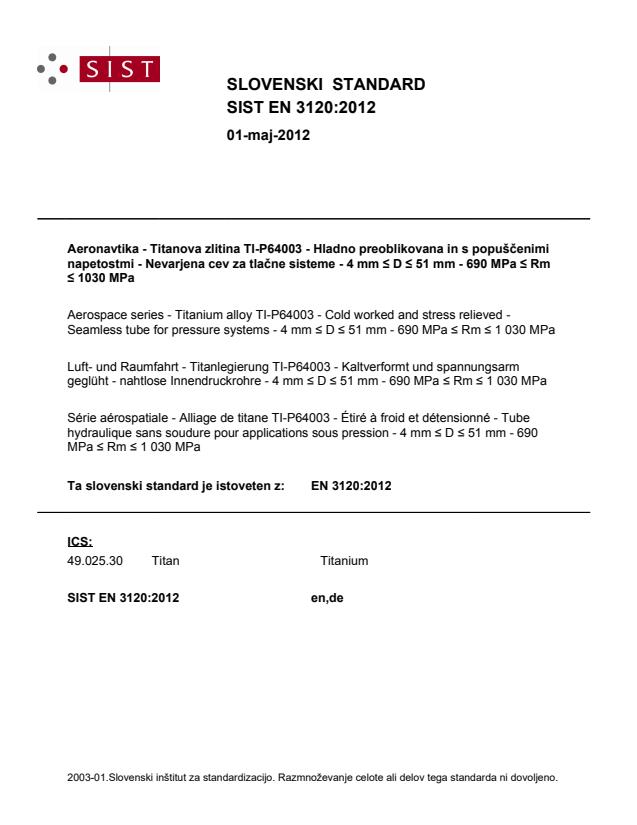
2003-01.Slovenski inštitut za standardizacijo. Razmnoževanje celote ali delov tega standarda ni dovoljeno.49.025.30TitanTitaniumICS:Ta slovenski standard je istoveten z:EN 3120:2012SIST EN 3120:2012en,de01-maj-2012SIST EN 3120:2012SLOVENSKI
STANDARD
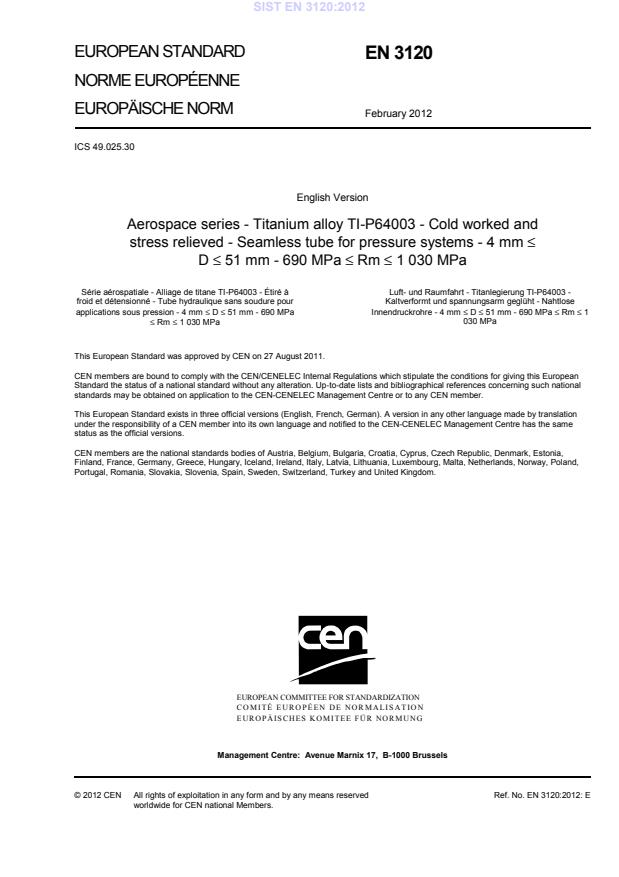
EUROPEAN STANDARD NORME EUROPÉENNE EUROPÄISCHE NORM
EN 3120
February 2012 ICS 49.025.30 English Version
Aerospace series - Titanium alloy TI-P64003 - Cold worked and stress relieved - Seamless tube for pressure systems - 4 mm ≤ D ≤ 51 mm - 690 MPa ≤ Rm ≤ 1 030 MPa
Série aérospatiale - Alliage de titane TI-P64003 - Étiré à froid et détensionné - Tube hydraulique sans soudure pour applications sous pression - 4 mm ≤ D ≤ 51 mm - 690 MPa ≤ Rm ≤ 1 030 MPa
Luft- und Raumfahrt - Titanlegierung TI-P64003 - Kaltverformt und spannungsarm geglüht - Nahtlose Innendruckrohre - 4 mm ≤ D ≤ 51 mm - 690 MPa ≤ Rm ≤ 1 030 MPa This European Standard was approved by CEN on 27 August 2011.
CEN members are bound to comply with the CEN/CENELEC Internal Regulations which stipulate the conditions for giving this European Standard the status of a national standard without any alteration. Up-to-date lists and bibliographical references concerning such national standards may be obtained on application to the CEN-CENELEC Management Centre or to any CEN member.
This European Standard exists in three official versions (English, French, German). A version in any other language made by translation under the responsibility of a CEN member into its own language and notified to the CEN-CENELEC Management Centre has the same status as the official versions.
CEN members are the national standards bodies of Austria, Belgium, Bulgaria, Croatia, Cyprus, Czech Republic, Denmark, Estonia, Finland, France, Germany, Greece, Hungary, Iceland, Ireland, Italy, Latvia, Lithuania, Luxembourg, Malta, Netherlands, Norway, Poland, Portugal, Romania, Slovakia, Slovenia, Spain, Sweden, Switzerland, Turkey and United Kingdom.
EUROPEAN COMMITTEE FOR STANDARDIZATION
COMITÉ EUROPÉEN DE NORMALISATION EUROPÄISCHES KOMITEE FÜR NORMUNG
Management Centre:
Avenue Marnix 17,
B-1000 Brussels © 2012 CEN All rights of exploitation in any form and by any means reserved worldwide for CEN national Members. Ref. No. EN 3120:2012: ESIST EN 3120:2012
...