

SIST ISO 14063:2008
Environmental management - Environmental communication - Guidelines and examples
General Information
- Abstract
ISO 14063:2006 gives guidance to an organization on general principles, policy, strategy and activities relating to both internal and external environmental communication. It utilizes proven and well-established approaches for communication, adapted to the specific conditions that exist in environmental communication. It is applicable to all organizations regardless of their size, type, location, structure, activities, products and services, and whether or not they have an environmental management system in place.
ISO 14063:2006 is not intended for use as a specification standard for certification or registration purposes or for the establishment of any other environmental management system conformity requirements. It can be used in combination with any of the ISO 14000 series of standards, or on its own.
- Status
- Published
- Publication Date
- 22-Sep-2008
- Technical Committee
- UZO - Environmental management
- Current Stage
- 6060 - National Implementation/Publication (Adopted Project)
- Start Date
- 15-Sep-2008
- Due Date
- 20-Nov-2008
- Completion Date
- 23-Sep-2008
Buy Documents




SIST ISO 14063:2008 - za prodajo GLEJ: SIST EN ISO 14063:2010


ISO 14063:2006 - Environmental management — Environmental communication — Guidelines and examples Released:8/2/2006


ISO 14063:2006 - Management environnemental — Communication environnementale — Lignes directrices et exemples Released:8/2/2006



ISO 14063:2006 - Environmental management — Environmental communication — Guidelines and examples Released:6/18/2015


ISO 14063:2006 - Environmental management — Environmental communication — Guidelines and examples Released:4/1/2008
Overview
SIST ISO 14063:2008 - Environmental Management - Environmental Communication - Guidelines and Examples provides comprehensive guidance for organizations on effectively communicating about environmental matters. Applicable to organizations of any size, type, or sector, regardless of the presence of a formal environmental management system, this standard helps organizations develop effective environmental communication principles, policies, strategies, and practical activities for both internal and external stakeholders.
Environmental communication is now recognized as a critical process to build trust, credibility, and engagement with interested parties-including employees, customers, regulators, and communities. Effective communication strengthens relationships, addresses concerns, and enhances organizational transparency around environmental performance and objectives.
Key Topics
Principles of Environmental Communication
The standard outlines essential principles to guide environmental communication:- Transparency - Make processes, methods, and data sources accessible where possible.
- Appropriateness - Tailor information to suit the needs and understanding of each stakeholder group.
- Credibility - Ensure honesty, accuracy, and substantiated information.
- Responsiveness - Address questions and concerns in a timely and open manner.
- Clarity - Use language and approaches that minimize misunderstanding.
Environmental Communication Policy
Organizations are encouraged to develop a clear policy, expressing top management’s commitment to open dialogue, information disclosure, and the allocation of necessary resources. Policies should align with organizational values and strategic objectives, considering legal obligations, interested party expectations, and the broader context of sustainability.Communication Strategy and Planning
A structured strategy should specify communication objectives, identify target groups, and determine the timing and format of communication. The strategy must realistically consider organizational resources and coordinate with existing management systems.Communication Activities
Planning includes situational analysis, setting clear and measurable targets, selecting relevant target groups, and defining the geographic and cultural parameters of each activity. Effective activities range from one-way distribution (like reports) to two-way dialogue and participatory decision-making.
Applications
Organizations can leverage SIST ISO 14063:2008 to:
- Enhance Stakeholder Engagement
Build trust and foster ongoing dialogue with communities, customers, regulators, employees, and other groups interested in environmental performance. - Support Risk Management
Proactive communication can prevent misunderstandings, reduce reputational risk, and address concerns before they escalate. - Drive Sustainability Initiatives
Sharing information on environmental policies, objectives, and achievements supports a culture of sustainability and demonstrates credibility to stakeholders. - Improve Internal Communication
Integrate environmental objectives across departments, ensuring employees are informed, engaged, and aligned with organizational goals. - Prepare for Environmental Reporting and Disclosure
Though not a specification for certification, this standard equips organizations to communicate effectively in conjunction with other ISO 14000 standards or sustainability reporting guidelines.
Related Standards
- ISO 14001 - Environmental management systems - Requirements with guidance for use
- ISO 14004 - General guidelines on principles, systems, and support techniques
- ISO 14020/14021/14024/14025 - Standards for environmental labels and declarations
- ISO 14031 - Environmental performance evaluation guidelines
- ISO/TR 14032 - Case studies and examples of environmental performance evaluation
By adopting SIST ISO 14063:2008, organizations position themselves as responsible and transparent partners in society, capable of meeting the rising expectations for environmental communication and responsibility.
Buy Documents
SIST ISO 14063:2008 - za prodajo GLEJ: SIST EN ISO 14063:2010
ISO 14063:2006 - Environmental management — Environmental communication — Guidelines and examples Released:8/2/2006
ISO 14063:2006 - Management environnemental — Communication environnementale — Lignes directrices et exemples Released:8/2/2006
ISO 14063:2006 - Environmental management — Environmental communication — Guidelines and examples Released:6/18/2015
ISO 14063:2006 - Environmental management — Environmental communication — Guidelines and examples Released:4/1/2008
Get Certified
Connect with accredited certification bodies for this standard

BSI Group
BSI (British Standards Institution) is the business standards company that helps organizations make excellence a habit.

Bureau Veritas
Bureau Veritas is a world leader in laboratory testing, inspection and certification services.

DNV
DNV is an independent assurance and risk management provider.
Sponsored listings
Frequently Asked Questions
SIST ISO 14063:2008 is a standard published by the Slovenian Institute for Standardization (SIST). Its full title is "Environmental management - Environmental communication - Guidelines and examples". This standard covers: ISO 14063:2006 gives guidance to an organization on general principles, policy, strategy and activities relating to both internal and external environmental communication. It utilizes proven and well-established approaches for communication, adapted to the specific conditions that exist in environmental communication. It is applicable to all organizations regardless of their size, type, location, structure, activities, products and services, and whether or not they have an environmental management system in place. ISO 14063:2006 is not intended for use as a specification standard for certification or registration purposes or for the establishment of any other environmental management system conformity requirements. It can be used in combination with any of the ISO 14000 series of standards, or on its own.
ISO 14063:2006 gives guidance to an organization on general principles, policy, strategy and activities relating to both internal and external environmental communication. It utilizes proven and well-established approaches for communication, adapted to the specific conditions that exist in environmental communication. It is applicable to all organizations regardless of their size, type, location, structure, activities, products and services, and whether or not they have an environmental management system in place. ISO 14063:2006 is not intended for use as a specification standard for certification or registration purposes or for the establishment of any other environmental management system conformity requirements. It can be used in combination with any of the ISO 14000 series of standards, or on its own.
SIST ISO 14063:2008 is classified under the following ICS (International Classification for Standards) categories: 13.020.10 - Environmental management. The ICS classification helps identify the subject area and facilitates finding related standards.
SIST ISO 14063:2008 is available in PDF format for immediate download after purchase. The document can be added to your cart and obtained through the secure checkout process. Digital delivery ensures instant access to the complete standard document.
Standards Content (Sample)
SLOVENSKI STANDARD
01-november-2008
Ravnanje z okoljem - Okoljsko komuniciranje - Smernice in primeri
Environmental management - Environmental communication - Guidelines and examples
Management environnemental - Communication environnementale - Lignes directrices et
exemples
Ta slovenski standard je istoveten z: ISO 14063:2006
ICS:
13.020.10 Ravnanje z okoljem Environmental management
2003-01.Slovenski inštitut za standardizacijo. Razmnoževanje celote ali delov tega standarda ni dovoljeno.
INTERNATIONAL ISO
STANDARD 14063
First edition
2006-08-01
Environmental management —
Environmental communication —
Guidelines and examples
Management environnemental — Communication environnementale —
Lignes directrices et exemples
Reference number
©
ISO 2006
PDF disclaimer
This PDF file may contain embedded typefaces. In accordance with Adobe's licensing policy, this file may be printed or viewed but shall
not be edited unless the typefaces which are embedded are licensed to and installed on the computer performing the editing. In
downloading this file, parties accept therein the responsibility of not infringing Adobe's licensing policy. The ISO Central Secretariat
accepts no liability in this area.
Adobe is a trademark of Adobe Systems Incorporated.
Details of the software products used to create this PDF file can be found in the General Info relative to the file; the PDF-creation
parameters were optimized for printing. Every care has been taken to ensure that the file is suitable for use by ISO member bodies. In the
unlikely event that a problem relating to it is found, please inform the Central Secretariat at the address given below.
All rights reserved. Unless otherwise specified, no part of this publication may be reproduced or utilized in any form or by any means,
electronic or mechanical, including photocopying and microfilm, without permission in writing from either ISO at the address below or
ISO's member body in the country of the requester.
ISO copyright office
Case postale 56 CH-1211 Geneva 20
Tel. + 41 22 749 01 11
Fax + 41 22 749 09 47
E-mail copyright@iso.org
Web www.iso.org
Published in Switzerland
©
ii ISO 2006 – All rights reserved
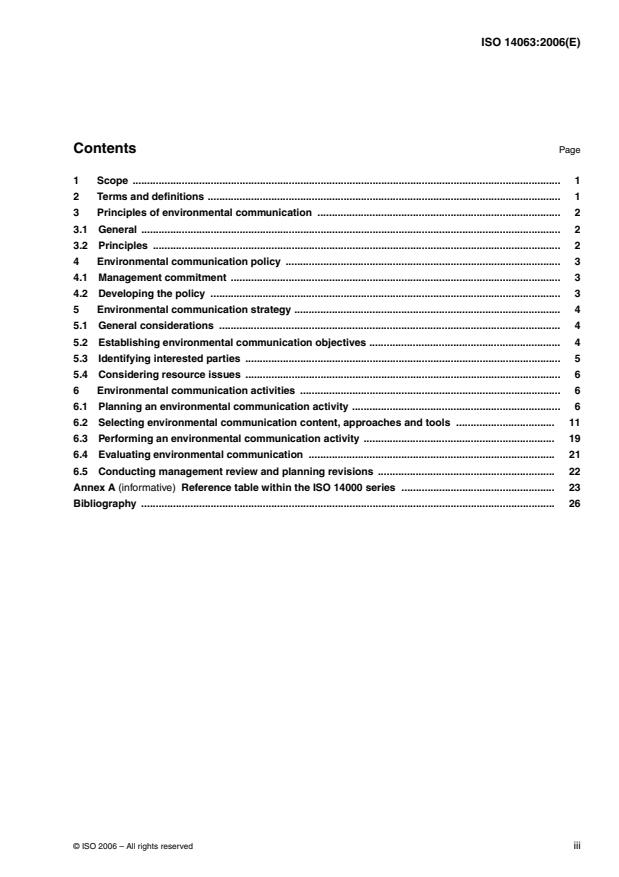
Contents Page
1 Scope . 1
2 Terms and definitions . 1
3 Principles of environmental communication . 2
3.1 General . 2
3.2 Principles . 2
4 Environmental communication policy . 3
4.1 Management commitment . 3
4.2 Developing the policy . 3
5 Environmental communication strategy . 4
5.1 General considerations . 4
5.2 Establishing environmental communication objectives . 4
5.3 Identifying interested parties . 5
5.4 Considering resource issues . 6
6 Environmental communication activities . 6
6.1 Planning an environmental communication activity . 6
6.2 Selecting environmental communication content, approaches and tools . 11
6.3 Performing an environmental communication activity . 19
6.4 Evaluating environmental communication . 21
6.5 Conducting management review and planning revisions . 22
Annex A (informative) Reference table within the ISO 14000 series . 23
Bibliography . 26
©
ISO 2006 – All rights reserved iii
Foreword
ISO (the International Organization for Standardization) is a worldwide federation of national standards bodies
(ISO member bodies). The work of preparing International Standards is normally carried out through ISO
technical committees. Each member body interested in a subject for which a technical committee has been
established has the right to be represented on that committee. International organizations, governmental and
non-governmental, in liaison with ISO, also take part in the work. ISO collaborates closely with the International
Electrotechnical Commission (IEC) on all matters of electrotechnical standardization.
International Standards are drafted in accordance with the rules given in the ISO/IEC Directives, Part 2.
The main task of technical committees is to prepare International Standards. Draft International Standards
adopted by the technical committees are circulated to the member bodies for voting. Publication as an
International Standard requires approval by at least 75 % of the member bodies casting a vote.
Attention is drawn to the possibility that some of the elements of this document may be the subject of patent
rights. ISO shall not be held responsible for identifying any or all such patent rights.
ISO 14063 was prepared by Technical Committee ISO/TC 207, Environmental management.
©
iv ISO 2006 – All rights reserved
Introduction
0.1 Over the past two decades, communication on environmental values, actions and performance has
become an essential activity of organizations, because of increased public concern and interest, and
governmental activities related to the environment. Organizations all over the world are increasingly confronted
with the need to express their views, and present and explain the environmental implications of their activities,
products and services. There is also a growing need to listen to interested parties, and incorporate their views
and requirements as part of environmental communication.
Organizations have a need to obtain and provide information about and respond to environmental issues,
concerns and programmes. This is influenced by factors such as the organization's geographic location and
distribution, size and types of activities. Motivations for communication can include the following:
— the interest of the organization to share information on its environmental practices;
— a request for information by employees or investors, a government agency, a community group, a customer
or supplier, or any other interested party;
— the need to discuss with interested parties, especially with target groups, a proposed action of the
organization, such as expansion of an existing facility, or siting of a new facility, or the introduction of a new
product or service;
— environmental risk management;
— a regulatory requirement;
— response to complaints from interested parties;
— the increasing importance of addressing environmental issues.
Environmental communication is the process of sharing information to build trust, credibility and partnerships, to
raise awareness, and to use in decision making. The processes used and the content of environmental
communication will vary with the objectives and circumstances of the organization and should be built on
substantive information.
0.2 Environmental communication is broader than environmental reporting. It has many purposes and takes
many forms. Environmental communication can be ad hoc or planned. An example of ad hoc communication
occurs when a facility manager attends a community event and answers questions. Planned communication
can cover the range from limited to full participation of interested parties as shown below.
a) One-way communication occurs when the organization distributes information, for example when an
organization issues an environmental report with no opportunity for questions or discussion.
b) Two-way communication occurs with an exchange of information and ideas among the organization and
interested parties.
c) In participatory decision-making, including effective feedback that affects the organization and/or the local
community, an organization collaborates with interested parties.
0.3 Engagement with interested parties provides an opportunity for an organization to learn their issues and
concerns; it can lead to knowledge being gained by both sides and can influence opinions and perceptions.
When properly done, any particular approach can be successful and satisfy the needs of the organization and
interested parties. In some cases, understanding the communication pattern/behaviour of each interested party
(or target group) is also important in environmental communications. The most effective environmental
communication process involves ongoing contact by the organization with internal and external interested
parties, as part of the organization’s overall communications strategy.
©
ISO 2006 – All rights reserved v
Figure 1 shows the interrelationships and flow of environmental communication.
NOTE 1 Titles in bold and numbered refer to the clauses in this International Standard.
NOTE 2 Dotted line arrows indicate the environmental communication system relationship with other elements of the
organization; full arrows indicate the interrelationship within the environmental communication system.
NOTE 3 Shading indicates the scope of the environmental communication system; darker shading indicates the overlap
of the environmental communication system with the organization.
Figure 1 — Environmental communication
0.4 Environmental communication often results in many benefits, such as
— assisting interested parties in understanding an organization's environmental commitments, policies and
performance,
— providing inputs/suggestions for improving the environmental performance of an organization’s activities,
products and services, and progress toward sustainability,
— improving understanding of interested parties’ needs and concerns to foster trust and dialogue,
— promoting an organization's environmental credentials, achievements and performance,
©
vi ISO 2006 – All rights reserved
— raising the importance and level of environmental awareness to support an environmentally responsible
culture and values within the organization,
— addressing interested parties’ concerns and complaints about operational and emergency environmental
hazards,
— enhancing interested parties’ perceptions of the organization, and
— increasing business support and shareholder confidence.
Environmental communication is one of the crucial issues to be dealt with by any organization, with or without
an environmental management system (EMS) in place. Environmental communication is more than a question
of organization and management, it relates to organization values as well. To ensure successful communication
processes, it is important for the organization to consider itself a responsible partner within society and to
address the environmental expectations of interested parties.
©
ISO 2006 – All rights reserved vii
.
viii
INTERNATIONAL STANDARD ISO 14063:2006(E)
Environmental management — Environmental
communication — Guidelines and examples
1Scope
This International Standard gives guidance to an organization on general principles, policy, strategy and
activities relating to both internal and external environmental communication. It utilizes proven and well-
established approaches for communication, adapted to the specific conditions that exist in environmental
communication. It is applicable to all organizations regardless of their size, type, location, structure, activities,
products and services, and whether or not they have an environmental management system in place.
This International Standard is not intended for use as a specification standard for certification or registration
purposes or for the establishment of any other environmental management system conformity requirements. It
can be used in combination with any of the ISO 14000 series of standards, or on its own.
NOTE 1 A reference table to the ISO 14000 series is provided in Annex A.
NOTE 2 ISO 14020, ISO 14021, ISO 14024 and ISO 14025 provide specific environmental communication tools and
guidance relating to product labels and declarations.
2 Terms and definitions
For the purposes of this document, the following terms and definitions apply.
2.1
environmental communication
process that an organization conducts to provide and obtain information, and to engage in dialogue with internal
and external interested parties to encourage a shared understanding on environmental issues, aspects and
performance
2.2
environmental communication policy
overall intentions and directions of an organization related to its environmental communication as formally
expressed by top management
NOTE The environmental communication policy can be a separate policy or part of other policies within the organization.
2.3
environmental communication strategy
organization's framework for implementing its environmental communication policy and for the setting of
environmental communication objectives and targets
2.4
organization
company, corporation, firm, enterprise, authority or institution, or part or combination thereof, whether
incorporated or not, public or private, that has its own functions and administration
NOTE For organizations with more than one operating unit, a single operating unit may be defined as an organization.
[ISO 14001:2004, 3.16]
©
ISO 2006 – All rights reserved 1
2.5
interested party
person or group concerned with or affected by the environmental performance of an organization
[ISO 14001:2004, 3.13]
2.6
target group
interested party or parties selected as the focus of an organization's environmental communication activity
2.7
environmental communication objective
overall environmental communication goal consistent with the environmental communication policy that an
organization sets itself to achieve as part of its environmental communication strategy
2.8
environmental communication target
detailed performance requirement, applicable to the organization, which arises from the environmental
communication objectives and which needs to be set and met in order to achieve those objectives
3 Principles of environmental communication
3.1 General
It is essential that an organization apply the principles described below to its environmental communication.
3.2 Principles
3.2.1 Transparency
Make the processes, procedures, methods, data sources and assumptions used in environmental
communication available to all interested parties, taking account of the confidentiality of information as required.
Inform interested parties of their role in environmental communication.
3.2.2 Appropriateness
Make information provided in environmental communication relevant to interested parties, using formats,
language and media that meet their interests and needs, enabling them to participate fully.
3.2.3 Credibility
Conduct environmental communication in an honest and fair manner, and provide information that is truthful,
accurate, substantive and not misleading to interested parties. Develop information and data using recognized
and reproducible methods and indicators.
3.2.4 Responsiveness
Ensure that environmental communication is open to the needs of interested parties. Respond to the queries
and concerns of interested parties in a full and timely manner. Make interested parties aware of how their
queries and concerns have been addressed.
©
2 ISO 2006 – All rights reserved
3.2.5 Clarity
Ensure that environmental communication approaches and language are understandable to interested parties
to minimize ambiguity.
4 Environmental communication policy
4.1 Management commitment
The organization's top management should set, express its commitment to, and promote the environmental
communication policy. The policy should be consistent with the principles in Clause 3 and should clearly state
the following:
a) commitment to engage in dialogue with interested parties;
b) commitment to disclose information about its environmental performance;
c) significance of internal and external environmental communication in the organization;
d) commitment to implement the policy and provide the necessary resources;
e) commitment to address key environmental issues.
The environmental communication policy may form part of, or be integrated into, an organization's
communication policy or environmental policy, or may be a separate policy.
4.2 Developing the policy
In developing the policy, those responsible for environmental management within the organization should
interact and engage with those responsible for communication to ensure that the policy is coherent and
consistent with other principles, policies and the values of the organization. Subsequently, all levels of
management should implement the policy and provide input for the formulation and modification of the policy.
An environmental communication policy does not need to be detailed, but should convey to interested parties
the importance that the organization places on communication about environmental issues, environmental
aspects and their associated impacts, and environmental performance. An organization's vision, mission,
values and culture should play a fundamental role in developing an environmental communication policy. The
organization should make a commitment in the policy to reflect local, regional and/or national cultural
characteristics in its environmental communication activities, where applicable.
Important factors that should be considered when developing an environmental communication policy include
— the organization's business sector and its product or service portfolio,
— organization's size,
— organizational infrastructure,
— corporate governance,
— market and brand strategies,
— the existence of an environmental management system,
— consideration of environmental aspects and impacts,
— interaction with related aspects like health and safety and other sustainability approaches,
— legal requirements regarding disclosure of environmental information,
— local, regional, national and international voluntary codes of ethics/conduct,
— expectations of interested parties, and
— the public's “right to know”.
The policy should be communicated to interested parties, both internal and external as appropriate.
©
ISO 2006 – All rights reserved 3
5 Environmental communication strategy
5.1 General considerations
The organization's management should develop a strategy to implement its environmental communication
policy. The strategy should include environmental communication objectives, identification of interested parties,
an indication of when and what it plans to communicate, and a management commitment to allocate adequate
resources. An organization should clarify what is possible, taking into account its resources so that it can best
and most realistically meet the expectations of interested parties.
Consideration should be given to the fact that environmental communication is part of the organization's
environmental activities in general and should be aligned with other elements of management systems, policies,
strategies or relevant activities.
Practical help box 1 — Developing the environmental communication strategy
When developing the environmental communication strategy, the questions below can be helpful.
Why is the organization engaging in environmental communication and what are its purposes?
What are the organization's key environmental issues and impacts?
What are the main issues to be covered, messages to be conveyed, and communication techniques, approaches,
tools and channels to be used?
How much time is needed to implement the strategy?
How will the strategy involve and coordinate the environmental managers, interested parties, individual(s) responsible
for environmental issues and individual(s) who are responsible for the organization's internal and external
communication?
What are the local, regional, national and international boundaries for the strategy?
Once defined, the strategy should be approved by top management and then used as the basis for the
organization's environmental communications activities.
5.2 Establishing environmental communication objectives
An organization should set environmental objectives, which are useful because they can provide the basis for
an effective environmental communication strategy. When setting its environmental communication objectives,
an organization should ensure that they are aligned with its environmental communication policy, take account
of the views of internal and external interested parties, and are consistent with the environmental
communication principles in Clause 3. On setting objectives for its environmental communication activities, the
organization should consider its priorities and desired results, making sure that the objectives defined are
expressed in such a way that no further explanations are necessary.
©
4 ISO 2006 – All rights reserved
Practical help box 2 — Priorities for setting objectives
Priority considerations for setting objectives may include
environmental issues related to the organization's specific activities, products and services,
complying with applicable legal requirements and with other requirements to which the organization subscribes,
influencing public policy on environmental issues,
providing information and encouraging understanding by interested parties about the environmental activities,
aspects, impacts and performance of the organization,
meeting the environmental information expectations of interested parties,
establishing ongoing dialogue on environmental matters,
minimizing internal and/or external conflicts,
improving the organization's credibility and reputation,
improving public knowledge and the environmental image of the organization's products and services, and
stimulating environmental innovation and creativity.
Examples of objectives and their relation to targets are provided in 6.1.3, Help box 5.
5.3 Identifying interested parties
In developing the environmental communication strategy and setting objectives, the organization should identify
internal and external interested parties who have expressed an interest in its activities, products and services.
It should also identify other potential interested parties with whom it wishes to communicate to achieve the
overall objectives of its environmental communication strategy.
Subsequently, target groups will be identified for more specific environmental communication activities
(see 6.1.4).
©
ISO 2006 – All rights reserved 5
Practical help box 3 — Examples of interested parties
Some examples of interested parties that could be considered by an organization include
past, present and future employees and their representatives,
customers and consumers,
suppliers, contractors, wholesalers and distributors,
competitors,
shareholders,
banks and financial/investment community,
insurance companies,
rating agencies,
public authorities,
legislators,
regulators,
politicians and opinion leaders,
neighbours and local community,
communities associated with supply chain organizations,
schools, academics and researchers,
professionals involved in environmental issues,
media organizations, and
non-governmental organizations.
5.4 Considering resource issues
An organization's environmental communication activities are dependent upon available resources. The
environmental communication strategy should include an allocation of human, technical and financial
resources, designated responsibilities and authority, and defined actions. Employees' experiences and training
needs should be considered.
6 Environmental communication activities
6.1 Planning an environmental communication activity
6.1.1 General
Organizations will typically undertake a range of environmental communication activities in implementing their
environmental communication policy. In advancing the environmental communication strategy and objectives,
specific environmental communication activities should be developed, taking into account the environmental
issue, geographic boundaries and interested parties.
©
6 ISO 2006 – All rights reserved
Practical help box 4 — Planning an environmental communication activity
In planning an environmental communication activity an organization should consider the following questions.
Is this activity consistent with the environmental communication principles in Clause 3 and the organization's policy?
If appropriate, does this activity enhance two-way communication?
Can this activity promote consensus with interested parties?
Does this activity offer an opportunity to reach and interact with its target group(s) and potentially address their
interests?
Does this activity provide an opportunity to address multiple issues in depth?
Does this activity focus on the key issues?
Does the activity provide information tailored to the target group(s)?
Is this activity relatively easy to implement?
Does the activity provide for information transfer at relatively low cost?
Is this activity easy to update?
Is the effectiveness of this activity measurable?
Is this activity a good vehicle for education?
Is this activity creating a constructive atmosphere?
Is this activity an effective way to get publicity or increase public awareness?
6.1.2 Situational analysis
The development or improvement of an environmental communication activity begins with an understanding of
the context for the communication.
In the situational analysis, the issues the organization should consider include the following:
a) existing environmental communication activities and commitments;
b) identification and understanding of issues of concern to interested parties;
c) expectations and perceptions of the interested parties about the organization;
d) environmental awareness of interested parties, such as local communities;
e) communication media and activities that have proven to be the most effective in communicating with
interested parties in similar situations;
f) identification of the opinion leaders and their influence on issues related to environmental communication;
g) public image of the organization on a specific issue;
h) latest developments and trends on environmental issues related to the organization's specific activities,
products and services;
i) economic and financial implications;
j) knowledge and understanding of the values and cultures of interested parties.
A variety of tools are available to assist in the situational analysis. Examples can be found in 6.2 (Table 1). The
situational analysis may lead to revised environmental communication objectives.
In evaluating the context for an environmental communication activity, it is also important to consider the
potential costs and consequences of not communicating. These can be tangible, cost more than environmental
communication in the long run and also impose other costs on an organization, e.g., damage to reputation. The
following example highlights the implications of such a situation.
©
ISO 2006 – All rights reserved 7
EXAMPLE Case 1: The costs of NOT conducting environmental communication
A manager admitted that making a decision to burn a hazardous secondary liquid fuel at its plant, and not thoroughly
discussing it with the community, resulted in a crisis. The organization did not anticipate the strength of reaction it would
receive and therefore did not allocate sufficient resources for advance consultation and communication. A 90-year good
working relationship between the organization and community dissolved overnight. The manager estimates that he spent
the majority of two years trying to re-establish this relationship. The costs to the organization included his salary, countless
time of other staff to meet with a range of interested parties, and the costs associated with hosting numerous public
meetings and developing press releases and other media announcements. One outcome of this effort was the creation of a
community liaison committee that included citizens who were the most vociferous about the decision to burn alternative
fuels. The organization and regulators use this committee as a sounding board before making major decisions. After five
years, trust has been re-established.
NOTE For more information, see Bibliographic Reference [8].
6.1.3 Setting environmental communication targets
An organization should decide what it intends to achieve with an environmental communication activity. Targets
should be established that are consistent with the environmental communication objectives and that are
specific, measurable, achievable, realistic and time-related. This will allow the organization to evaluate the
environmental communication activity and determine whether or not the target has been met.
Practical help box 5 — Examples of objectives and targets
Objective: Gain acceptance of a significant change at a facility based upon discussions with the community.
Targets:
Reach 90 % of the neighbouring homes with the brochure explaining the change and the environmental impacts.
75 %
Reach acceptance in a survey with the community.
Conclude communication effort 3 months before proposed change starts.
Objective: Increase customer awareness of the organization's environmental performance.
Targets:
80 %
Reach of the purchasers of a specific product.
Get feedback from 65 % of customers of a specific product regarding their understanding of the organization's
environmental performance level.
Conclude communication effort 2 months before the final version of the sustainability report is produced.
Objective: Improve environmental performance across the supply-chain by communicating organizational goals,
objectives and targets with suppliers, tracking how supply-chain changes improve environmental performance and sharing
improvement information.
Targets:
95 % 65 %
Reach of raw material suppliers and of suppliers of consumption items.
Get questionnaire return from 100 % of raw material suppliers and 85 % of suppliers of consumption items.
Provide conclusions to allow changes in procurement procedures by given date.
6.1.4 Identifying target groups
In planning an environmental communication activity, an organization should identify the target groups among
its interested parties. Good communication involves a range of possible target groups, not just those favourable
to the organization or those with sufficient resources to organize and express themselves.
It is not uncommon to identify conflicting interests among different target groups. As a result, the environmental
communication activities need to address and respond to different and often conflicting demands from target
©
8 ISO 2006 – All rights reserved
groups, in particular those that are the most influential and who may negatively impact the outcomes of an
environmental communication activity.
When undertaking an environmental communication activity, the organization should seek to understand the
expectations and perceptions of target groups with respect to the organization's environmental performance. At
its simplest, direct dialogue between a target group and the organization may generate the feedback required.
If the organization is seeking input from target groups, it should explain why it is seeking information, and what
it plans to do with the information obtained.
6.1.5 Defining geographic scope
For each environmental communication activity, the organization should define the areas or locations on which
it will focus its environmental communication activities because different places, with different languages,
culture and habits, may affect public needs and perception about the organization. The focus of any particular
communication activity can range from a local community to the broader public, which may be located far from
any facility or office of the organization.
An organization may be involved in addressing a specific environmental issue on more than one geographic
scale. For example, greenhouse gas emissions may be covered by an environmental report with a local,
regional, national or international focus. Different types of information may be required for these environmental
communication activities, and common information may have to be presented in different ways, depending on
the needs of the interested parties involved.
6.1.6 Identifying environmental information
The organization should anticipate environmental issues of concern to interested parties. This will help focus
the collection of information environmental impacts and performances of its products, services, processes and
activities. Based on the targets set for an environmental communication activity, appropriate quantitative and
qualitative data and information can be selected or generated. Such information should be aligned to current
standards and guidelines on environmental performance and performance indicators.
©
ISO 2006 – All rights reserved 9
Practical help box 6 — Examples of information sources for an environmental communication activity
There are many sources and types of information available within most organizations, particularly those with an
environmental management system such as that of ISO 14001, including
information on the organization's strategies and their environment implications,
environmental policies, management practices and performance measures, possibly available from an organization's
environmental management system,
lists of environmental aspects and impacts of activities, products and services,
life cycle assessment of products and activities,
data and other documentation used for environmental labels and declarations,
lists of environmental indicators,
data from environmental performance evaluations,
routinely and occasionally collected information, such as the reports from facilities located in a specific area, reports
from subsidiaries (for a holding company), research reports, monitoring, control and measurement data registers and
analysis reports, etc.,
routine regulatory reports,
record of compliance with applicable legal requirements and with other requirements to which the organization
subscribes,
plans, records and guidance on emergency response, and response to accidents,
manuals and records of employee training on the safe handling of materials,
professional qualification records of the organization's employees responsible for environmental matters (managers,
technicians, experts),
relevant financial and accounting data, and
information from community outreach activities.
Sometimes, available information within an organization does not exist in a form suitable for an environmental
communication activity or for dialogue with non-technical target groups. The information can be used to prepare
written materials or other types of communication in a form that is clear and appropriate for the relevant target
groups.
This is particularly true, for example, in the case of environmental indicators, frequently used by organizations
to communicate about their environmental performance. Such indicators, quantitative or qualitative, may be
technical in nature, and should be explained in ways to make their use, significance and content understandable
and useful to interested parties. In some cases, difficulty in collecting appropriate data could lead to revision of
the approach to achieving targets.
NOTE 1 ISO 14031 and ISO/TR 14032 provide guidance on development of environmental performance indicators.
EXAMPLE Case 2: Identifying environmental performance indicators for an electronic equipment manufacturer
An electronic equipment manufacturer consulted 75 interested parties to determine which environmental performance
indicators the organization should report on. The main stages in the process were to
— identify the important external and internal interested parties and determine their key concerns and expectations
regarding the organization's environmental performance,
— identify environmental performance indicators to be addressed in the environmental report and the priority of these
indicators among interested parties,
— assess the performance of the organization against these indicators, and
— produce an organization environmental performance profile and communicate the results back to the interested parties.
Of the organization's interested parties, 75 participated in the process, including employees, customers and suppliers,
opinion-leaders, neighbours, legislators and regulators and the financial and insurance community.
Interviews were held between 5 to 15 representatives from each target group, totalling 75. The individuals were asked
“Which environmental issues do you consider important for the organization to be addressing and reporting on in their
©
10 ISO 2006 – All rights reserved
environmental reports?” Over 100 issues were identified, which were distilled into 11 indicators of environmental
performance and management performance.
A workshop was also held, attended by 12 interested parties, to discuss and confirm the 11 indicators and to determine the
relevant priority of each parameter.
The outcome of the process was the production of an environmental report, providing details of the organization's
environmental performance. A number of environmental performance indicators were identified that are not usually
addressed in environmental reports, e.g. “Information technology in pursuit of sustainable development”. Issues dealt with in
the environmental report were prioritized according to feedback received from the interested parties, improving the report's
focus on interested parties’ demands and assisting the organization's allocation of resources for improving environmental
performance. The approach increased the objectivity of the reporting process by incorporating the views of interested
parties.
NOTE 2 For more information, see Bibliographic Reference [9].
6.2 Selecting environmental communication content, approaches and tools
6.2.1 General
An organization's approach to environmental communication will be influenced by whether it wants to consult,
understand, inform, persuade and/or involve target groups. It is important to note that environmental
communication is a dynamic process and that there is an ongoing change among target groups and within
organizations.
In choosing the approaches to communication, it is important to consider the needs and the degree of interest
that the target groups involved in the communication activity have in the issues covered by the communication.
In addition, it is equally important to consider how active the organization wishes to be in its communication.
There are different approaches to communication depending upon whether the organization and the target
groups are active or passive, and depending on the environmental communication objectives of the
organization, the target groups and the organizational resources available for the communication.
An organization should tailor the information it provides, consistent with initial planning, for target groups. The
information should
a) consider behavioural aspects and the social, cultural, educational, economic and political interests of target
groups,
b) use appropriate language,
c) make use of visual images or electronic media where appropriate, and
d) be consistent with the selected approach and, where relevant, with other information on environmental
issues previously communicated by the organization.
An organization may wish to test its means of information provision prior to making any public communication.
Opinion research that focuses on testing of information provision can help identify areas needing more
explanation or clarification, key issues, questions that need to be addressed, etc.
Tables 1 to 3 give details of communication approaches and tools.
©
ISO 2006 – All rights reserved 11
Table 1 — Written communication approaches and tools
Technique Description Strengths Weaknesses Keep in mind
Websites Electronic Offer great potential to Companies often put Keep technical computer
communication reach out to many brochure ware on their requirements to a low level - not
medium, accessible to people on many websites, which misses everybody has the latest
all online external and issues (and to offer the opportunity for computer hardware.
internal interested tailored information). interactivity (e.g. video,
parties. Can include real data, e-mail Need not be expensive. Answers
downloadable reports, Easy to update, with feedback). to frequently asked questions can
educational material, potential to effect two- be provided on the website, with
or links to websites way communication. a phone number provided for
where users can more detailed inquiries.
provide feedback to
the organization.
Environmental Comprehensive Opportunity to Hard work to produce Address external and internal
or presentation of address multiple and can be difficult to interested parties' interests.
sustainability commitment and issues in depth. Basic update frequently. May
reports performance on a approach for building provide information in a Include difficulties and failures as
number of key issues. trust and credibility. form that does not well as successes.
Extracts or Create internal permit comparison with
summaries of these transparency about all similar organizations. Appropriate sector reporting
reports can be relevant issues of an May set expectations standards or indicators should be
included in other organization. that one will be used to enable benchma
...
INTERNATIONAL ISO
STANDARD 14063
First edition
2006-08-01
Environmental management —
Environmental communication —
Guidelines and examples
Management environnemental — Communication environnementale —
Lignes directrices et exemples
Reference number
©
ISO 2006
PDF disclaimer
This PDF file may contain embedded typefaces. In accordance with Adobe's licensing policy, this file may be printed or viewed but shall
not be edited unless the typefaces which are embedded are licensed to and installed on the computer performing the editing. In
downloading this file, parties accept therein the responsibility of not infringing Adobe's licensing policy. The ISO Central Secretariat
accepts no liability in this area.
Adobe is a trademark of Adobe Systems Incorporated.
Details of the software products used to create this PDF file can be found in the General Info relative to the file; the PDF-creation
parameters were optimized for printing. Every care has been taken to ensure that the file is suitable for use by ISO member bodies. In the
unlikely event that a problem relating to it is found, please inform the Central Secretariat at the address given below.
All rights reserved. Unless otherwise specified, no part of this publication may be reproduced or utilized in any form or by any means,
electronic or mechanical, including photocopying and microfilm, without permission in writing from either ISO at the address below or
ISO's member body in the country of the requester.
ISO copyright office
Case postale 56 CH-1211 Geneva 20
Tel. + 41 22 749 01 11
Fax + 41 22 749 09 47
E-mail copyright@iso.org
Web www.iso.org
Published in Switzerland
©
ii ISO 2006 – All rights reserved
Contents Page
1 Scope . 1
2 Terms and definitions . 1
3 Principles of environmental communication . 2
3.1 General . 2
3.2 Principles . 2
4 Environmental communication policy . 3
4.1 Management commitment . 3
4.2 Developing the policy . 3
5 Environmental communication strategy . 4
5.1 General considerations . 4
5.2 Establishing environmental communication objectives . 4
5.3 Identifying interested parties . 5
5.4 Considering resource issues . 6
6 Environmental communication activities . 6
6.1 Planning an environmental communication activity . 6
6.2 Selecting environmental communication content, approaches and tools . 11
6.3 Performing an environmental communication activity . 19
6.4 Evaluating environmental communication . 21
6.5 Conducting management review and planning revisions . 22
Annex A (informative) Reference table within the ISO 14000 series . 23
Bibliography . 26
©
ISO 2006 – All rights reserved iii
Foreword
ISO (the International Organization for Standardization) is a worldwide federation of national standards bodies
(ISO member bodies). The work of preparing International Standards is normally carried out through ISO
technical committees. Each member body interested in a subject for which a technical committee has been
established has the right to be represented on that committee. International organizations, governmental and
non-governmental, in liaison with ISO, also take part in the work. ISO collaborates closely with the International
Electrotechnical Commission (IEC) on all matters of electrotechnical standardization.
International Standards are drafted in accordance with the rules given in the ISO/IEC Directives, Part 2.
The main task of technical committees is to prepare International Standards. Draft International Standards
adopted by the technical committees are circulated to the member bodies for voting. Publication as an
International Standard requires approval by at least 75 % of the member bodies casting a vote.
Attention is drawn to the possibility that some of the elements of this document may be the subject of patent
rights. ISO shall not be held responsible for identifying any or all such patent rights.
ISO 14063 was prepared by Technical Committee ISO/TC 207, Environmental management.
©
iv ISO 2006 – All rights reserved
Introduction
0.1 Over the past two decades, communication on environmental values, actions and performance has
become an essential activity of organizations, because of increased public concern and interest, and
governmental activities related to the environment. Organizations all over the world are increasingly confronted
with the need to express their views, and present and explain the environmental implications of their activities,
products and services. There is also a growing need to listen to interested parties, and incorporate their views
and requirements as part of environmental communication.
Organizations have a need to obtain and provide information about and respond to environmental issues,
concerns and programmes. This is influenced by factors such as the organization's geographic location and
distribution, size and types of activities. Motivations for communication can include the following:
— the interest of the organization to share information on its environmental practices;
— a request for information by employees or investors, a government agency, a community group, a customer
or supplier, or any other interested party;
— the need to discuss with interested parties, especially with target groups, a proposed action of the
organization, such as expansion of an existing facility, or siting of a new facility, or the introduction of a new
product or service;
— environmental risk management;
— a regulatory requirement;
— response to complaints from interested parties;
— the increasing importance of addressing environmental issues.
Environmental communication is the process of sharing information to build trust, credibility and partnerships, to
raise awareness, and to use in decision making. The processes used and the content of environmental
communication will vary with the objectives and circumstances of the organization and should be built on
substantive information.
0.2 Environmental communication is broader than environmental reporting. It has many purposes and takes
many forms. Environmental communication can be ad hoc or planned. An example of ad hoc communication
occurs when a facility manager attends a community event and answers questions. Planned communication
can cover the range from limited to full participation of interested parties as shown below.
a) One-way communication occurs when the organization distributes information, for example when an
organization issues an environmental report with no opportunity for questions or discussion.
b) Two-way communication occurs with an exchange of information and ideas among the organization and
interested parties.
c) In participatory decision-making, including effective feedback that affects the organization and/or the local
community, an organization collaborates with interested parties.
0.3 Engagement with interested parties provides an opportunity for an organization to learn their issues and
concerns; it can lead to knowledge being gained by both sides and can influence opinions and perceptions.
When properly done, any particular approach can be successful and satisfy the needs of the organization and
interested parties. In some cases, understanding the communication pattern/behaviour of each interested party
(or target group) is also important in environmental communications. The most effective environmental
communication process involves ongoing contact by the organization with internal and external interested
parties, as part of the organization’s overall communications strategy.
©
ISO 2006 – All rights reserved v
Figure 1 shows the interrelationships and flow of environmental communication.
NOTE 1 Titles in bold and numbered refer to the clauses in this International Standard.
NOTE 2 Dotted line arrows indicate the environmental communication system relationship with other elements of the
organization; full arrows indicate the interrelationship within the environmental communication system.
NOTE 3 Shading indicates the scope of the environmental communication system; darker shading indicates the overlap
of the environmental communication system with the organization.
Figure 1 — Environmental communication
0.4 Environmental communication often results in many benefits, such as
— assisting interested parties in understanding an organization's environmental commitments, policies and
performance,
— providing inputs/suggestions for improving the environmental performance of an organization’s activities,
products and services, and progress toward sustainability,
— improving understanding of interested parties’ needs and concerns to foster trust and dialogue,
— promoting an organization's environmental credentials, achievements and performance,
©
vi ISO 2006 – All rights reserved
— raising the importance and level of environmental awareness to support an environmentally responsible
culture and values within the organization,
— addressing interested parties’ concerns and complaints about operational and emergency environmental
hazards,
— enhancing interested parties’ perceptions of the organization, and
— increasing business support and shareholder confidence.
Environmental communication is one of the crucial issues to be dealt with by any organization, with or without
an environmental management system (EMS) in place. Environmental communication is more than a question
of organization and management, it relates to organization values as well. To ensure successful communication
processes, it is important for the organization to consider itself a responsible partner within society and to
address the environmental expectations of interested parties.
©
ISO 2006 – All rights reserved vii
.
viii
INTERNATIONAL STANDARD ISO 14063:2006(E)
Environmental management — Environmental
communication — Guidelines and examples
1Scope
This International Standard gives guidance to an organization on general principles, policy, strategy and
activities relating to both internal and external environmental communication. It utilizes proven and well-
established approaches for communication, adapted to the specific conditions that exist in environmental
communication. It is applicable to all organizations regardless of their size, type, location, structure, activities,
products and services, and whether or not they have an environmental management system in place.
This International Standard is not intended for use as a specification standard for certification or registration
purposes or for the establishment of any other environmental management system conformity requirements. It
can be used in combination with any of the ISO 14000 series of standards, or on its own.
NOTE 1 A reference table to the ISO 14000 series is provided in Annex A.
NOTE 2 ISO 14020, ISO 14021, ISO 14024 and ISO 14025 provide specific environmental communication tools and
guidance relating to product labels and declarations.
2 Terms and definitions
For the purposes of this document, the following terms and definitions apply.
2.1
environmental communication
process that an organization conducts to provide and obtain information, and to engage in dialogue with internal
and external interested parties to encourage a shared understanding on environmental issues, aspects and
performance
2.2
environmental communication policy
overall intentions and directions of an organization related to its environmental communication as formally
expressed by top management
NOTE The environmental communication policy can be a separate policy or part of other policies within the organization.
2.3
environmental communication strategy
organization's framework for implementing its environmental communication policy and for the setting of
environmental communication objectives and targets
2.4
organization
company, corporation, firm, enterprise, authority or institution, or part or combination thereof, whether
incorporated or not, public or private, that has its own functions and administration
NOTE For organizations with more than one operating unit, a single operating unit may be defined as an organization.
[ISO 14001:2004, 3.16]
©
ISO 2006 – All rights reserved 1
2.5
interested party
person or group concerned with or affected by the environmental performance of an organization
[ISO 14001:2004, 3.13]
2.6
target group
interested party or parties selected as the focus of an organization's environmental communication activity
2.7
environmental communication objective
overall environmental communication goal consistent with the environmental communication policy that an
organization sets itself to achieve as part of its environmental communication strategy
2.8
environmental communication target
detailed performance requirement, applicable to the organization, which arises from the environmental
communication objectives and which needs to be set and met in order to achieve those objectives
3 Principles of environmental communication
3.1 General
It is essential that an organization apply the principles described below to its environmental communication.
3.2 Principles
3.2.1 Transparency
Make the processes, procedures, methods, data sources and assumptions used in environmental
communication available to all interested parties, taking account of the confidentiality of information as required.
Inform interested parties of their role in environmental communication.
3.2.2 Appropriateness
Make information provided in environmental communication relevant to interested parties, using formats,
language and media that meet their interests and needs, enabling them to participate fully.
3.2.3 Credibility
Conduct environmental communication in an honest and fair manner, and provide information that is truthful,
accurate, substantive and not misleading to interested parties. Develop information and data using recognized
and reproducible methods and indicators.
3.2.4 Responsiveness
Ensure that environmental communication is open to the needs of interested parties. Respond to the queries
and concerns of interested parties in a full and timely manner. Make interested parties aware of how their
queries and concerns have been addressed.
©
2 ISO 2006 – All rights reserved
3.2.5 Clarity
Ensure that environmental communication approaches and language are understandable to interested parties
to minimize ambiguity.
4 Environmental communication policy
4.1 Management commitment
The organization's top management should set, express its commitment to, and promote the environmental
communication policy. The policy should be consistent with the principles in Clause 3 and should clearly state
the following:
a) commitment to engage in dialogue with interested parties;
b) commitment to disclose information about its environmental performance;
c) significance of internal and external environmental communication in the organization;
d) commitment to implement the policy and provide the necessary resources;
e) commitment to address key environmental issues.
The environmental communication policy may form part of, or be integrated into, an organization's
communication policy or environmental policy, or may be a separate policy.
4.2 Developing the policy
In developing the policy, those responsible for environmental management within the organization should
interact and engage with those responsible for communication to ensure that the policy is coherent and
consistent with other principles, policies and the values of the organization. Subsequently, all levels of
management should implement the policy and provide input for the formulation and modification of the policy.
An environmental communication policy does not need to be detailed, but should convey to interested parties
the importance that the organization places on communication about environmental issues, environmental
aspects and their associated impacts, and environmental performance. An organization's vision, mission,
values and culture should play a fundamental role in developing an environmental communication policy. The
organization should make a commitment in the policy to reflect local, regional and/or national cultural
characteristics in its environmental communication activities, where applicable.
Important factors that should be considered when developing an environmental communication policy include
— the organization's business sector and its product or service portfolio,
— organization's size,
— organizational infrastructure,
— corporate governance,
— market and brand strategies,
— the existence of an environmental management system,
— consideration of environmental aspects and impacts,
— interaction with related aspects like health and safety and other sustainability approaches,
— legal requirements regarding disclosure of environmental information,
— local, regional, national and international voluntary codes of ethics/conduct,
— expectations of interested parties, and
— the public's “right to know”.
The policy should be communicated to interested parties, both internal and external as appropriate.
©
ISO 2006 – All rights reserved 3
5 Environmental communication strategy
5.1 General considerations
The organization's management should develop a strategy to implement its environmental communication
policy. The strategy should include environmental communication objectives, identification of interested parties,
an indication of when and what it plans to communicate, and a management commitment to allocate adequate
resources. An organization should clarify what is possible, taking into account its resources so that it can best
and most realistically meet the expectations of interested parties.
Consideration should be given to the fact that environmental communication is part of the organization's
environmental activities in general and should be aligned with other elements of management systems, policies,
strategies or relevant activities.
Practical help box 1 — Developing the environmental communication strategy
When developing the environmental communication strategy, the questions below can be helpful.
Why is the organization engaging in environmental communication and what are its purposes?
What are the organization's key environmental issues and impacts?
What are the main issues to be covered, messages to be conveyed, and communication techniques, approaches,
tools and channels to be used?
How much time is needed to implement the strategy?
How will the strategy involve and coordinate the environmental managers, interested parties, individual(s) responsible
for environmental issues and individual(s) who are responsible for the organization's internal and external
communication?
What are the local, regional, national and international boundaries for the strategy?
Once defined, the strategy should be approved by top management and then used as the basis for the
organization's environmental communications activities.
5.2 Establishing environmental communication objectives
An organization should set environmental objectives, which are useful because they can provide the basis for
an effective environmental communication strategy. When setting its environmental communication objectives,
an organization should ensure that they are aligned with its environmental communication policy, take account
of the views of internal and external interested parties, and are consistent with the environmental
communication principles in Clause 3. On setting objectives for its environmental communication activities, the
organization should consider its priorities and desired results, making sure that the objectives defined are
expressed in such a way that no further explanations are necessary.
©
4 ISO 2006 – All rights reserved
Practical help box 2 — Priorities for setting objectives
Priority considerations for setting objectives may include
environmental issues related to the organization's specific activities, products and services,
complying with applicable legal requirements and with other requirements to which the organization subscribes,
influencing public policy on environmental issues,
providing information and encouraging understanding by interested parties about the environmental activities,
aspects, impacts and performance of the organization,
meeting the environmental information expectations of interested parties,
establishing ongoing dialogue on environmental matters,
minimizing internal and/or external conflicts,
improving the organization's credibility and reputation,
improving public knowledge and the environmental image of the organization's products and services, and
stimulating environmental innovation and creativity.
Examples of objectives and their relation to targets are provided in 6.1.3, Help box 5.
5.3 Identifying interested parties
In developing the environmental communication strategy and setting objectives, the organization should identify
internal and external interested parties who have expressed an interest in its activities, products and services.
It should also identify other potential interested parties with whom it wishes to communicate to achieve the
overall objectives of its environmental communication strategy.
Subsequently, target groups will be identified for more specific environmental communication activities
(see 6.1.4).
©
ISO 2006 – All rights reserved 5
Practical help box 3 — Examples of interested parties
Some examples of interested parties that could be considered by an organization include
past, present and future employees and their representatives,
customers and consumers,
suppliers, contractors, wholesalers and distributors,
competitors,
shareholders,
banks and financial/investment community,
insurance companies,
rating agencies,
public authorities,
legislators,
regulators,
politicians and opinion leaders,
neighbours and local community,
communities associated with supply chain organizations,
schools, academics and researchers,
professionals involved in environmental issues,
media organizations, and
non-governmental organizations.
5.4 Considering resource issues
An organization's environmental communication activities are dependent upon available resources. The
environmental communication strategy should include an allocation of human, technical and financial
resources, designated responsibilities and authority, and defined actions. Employees' experiences and training
needs should be considered.
6 Environmental communication activities
6.1 Planning an environmental communication activity
6.1.1 General
Organizations will typically undertake a range of environmental communication activities in implementing their
environmental communication policy. In advancing the environmental communication strategy and objectives,
specific environmental communication activities should be developed, taking into account the environmental
issue, geographic boundaries and interested parties.
©
6 ISO 2006 – All rights reserved
Practical help box 4 — Planning an environmental communication activity
In planning an environmental communication activity an organization should consider the following questions.
Is this activity consistent with the environmental communication principles in Clause 3 and the organization's policy?
If appropriate, does this activity enhance two-way communication?
Can this activity promote consensus with interested parties?
Does this activity offer an opportunity to reach and interact with its target group(s) and potentially address their
interests?
Does this activity provide an opportunity to address multiple issues in depth?
Does this activity focus on the key issues?
Does the activity provide information tailored to the target group(s)?
Is this activity relatively easy to implement?
Does the activity provide for information transfer at relatively low cost?
Is this activity easy to update?
Is the effectiveness of this activity measurable?
Is this activity a good vehicle for education?
Is this activity creating a constructive atmosphere?
Is this activity an effective way to get publicity or increase public awareness?
6.1.2 Situational analysis
The development or improvement of an environmental communication activity begins with an understanding of
the context for the communication.
In the situational analysis, the issues the organization should consider include the following:
a) existing environmental communication activities and commitments;
b) identification and understanding of issues of concern to interested parties;
c) expectations and perceptions of the interested parties about the organization;
d) environmental awareness of interested parties, such as local communities;
e) communication media and activities that have proven to be the most effective in communicating with
interested parties in similar situations;
f) identification of the opinion leaders and their influence on issues related to environmental communication;
g) public image of the organization on a specific issue;
h) latest developments and trends on environmental issues related to the organization's specific activities,
products and services;
i) economic and financial implications;
j) knowledge and understanding of the values and cultures of interested parties.
A variety of tools are available to assist in the situational analysis. Examples can be found in 6.2 (Table 1). The
situational analysis may lead to revised environmental communication objectives.
In evaluating the context for an environmental communication activity, it is also important to consider the
potential costs and consequences of not communicating. These can be tangible, cost more than environmental
communication in the long run and also impose other costs on an organization, e.g., damage to reputation. The
following example highlights the implications of such a situation.
©
ISO 2006 – All rights reserved 7
EXAMPLE Case 1: The costs of NOT conducting environmental communication
A manager admitted that making a decision to burn a hazardous secondary liquid fuel at its plant, and not thoroughly
discussing it with the community, resulted in a crisis. The organization did not anticipate the strength of reaction it would
receive and therefore did not allocate sufficient resources for advance consultation and communication. A 90-year good
working relationship between the organization and community dissolved overnight. The manager estimates that he spent
the majority of two years trying to re-establish this relationship. The costs to the organization included his salary, countless
time of other staff to meet with a range of interested parties, and the costs associated with hosting numerous public
meetings and developing press releases and other media announcements. One outcome of this effort was the creation of a
community liaison committee that included citizens who were the most vociferous about the decision to burn alternative
fuels. The organization and regulators use this committee as a sounding board before making major decisions. After five
years, trust has been re-established.
NOTE For more information, see Bibliographic Reference [8].
6.1.3 Setting environmental communication targets
An organization should decide what it intends to achieve with an environmental communication activity. Targets
should be established that are consistent with the environmental communication objectives and that are
specific, measurable, achievable, realistic and time-related. This will allow the organization to evaluate the
environmental communication activity and determine whether or not the target has been met.
Practical help box 5 — Examples of objectives and targets
Objective: Gain acceptance of a significant change at a facility based upon discussions with the community.
Targets:
Reach 90 % of the neighbouring homes with the brochure explaining the change and the environmental impacts.
75 %
Reach acceptance in a survey with the community.
Conclude communication effort 3 months before proposed change starts.
Objective: Increase customer awareness of the organization's environmental performance.
Targets:
80 %
Reach of the purchasers of a specific product.
Get feedback from 65 % of customers of a specific product regarding their understanding of the organization's
environmental performance level.
Conclude communication effort 2 months before the final version of the sustainability report is produced.
Objective: Improve environmental performance across the supply-chain by communicating organizational goals,
objectives and targets with suppliers, tracking how supply-chain changes improve environmental performance and sharing
improvement information.
Targets:
95 % 65 %
Reach of raw material suppliers and of suppliers of consumption items.
Get questionnaire return from 100 % of raw material suppliers and 85 % of suppliers of consumption items.
Provide conclusions to allow changes in procurement procedures by given date.
6.1.4 Identifying target groups
In planning an environmental communication activity, an organization should identify the target groups among
its interested parties. Good communication involves a range of possible target groups, not just those favourable
to the organization or those with sufficient resources to organize and express themselves.
It is not uncommon to identify conflicting interests among different target groups. As a result, the environmental
communication activities need to address and respond to different and often conflicting demands from target
©
8 ISO 2006 – All rights reserved
groups, in particular those that are the most influential and who may negatively impact the outcomes of an
environmental communication activity.
When undertaking an environmental communication activity, the organization should seek to understand the
expectations and perceptions of target groups with respect to the organization's environmental performance. At
its simplest, direct dialogue between a target group and the organization may generate the feedback required.
If the organization is seeking input from target groups, it should explain why it is seeking information, and what
it plans to do with the information obtained.
6.1.5 Defining geographic scope
For each environmental communication activity, the organization should define the areas or locations on which
it will focus its environmental communication activities because different places, with different languages,
culture and habits, may affect public needs and perception about the organization. The focus of any particular
communication activity can range from a local community to the broader public, which may be located far from
any facility or office of the organization.
An organization may be involved in addressing a specific environmental issue on more than one geographic
scale. For example, greenhouse gas emissions may be covered by an environmental report with a local,
regional, national or international focus. Different types of information may be required for these environmental
communication activities, and common information may have to be presented in different ways, depending on
the needs of the interested parties involved.
6.1.6 Identifying environmental information
The organization should anticipate environmental issues of concern to interested parties. This will help focus
the collection of information environmental impacts and performances of its products, services, processes and
activities. Based on the targets set for an environmental communication activity, appropriate quantitative and
qualitative data and information can be selected or generated. Such information should be aligned to current
standards and guidelines on environmental performance and performance indicators.
©
ISO 2006 – All rights reserved 9
Practical help box 6 — Examples of information sources for an environmental communication activity
There are many sources and types of information available within most organizations, particularly those with an
environmental management system such as that of ISO 14001, including
information on the organization's strategies and their environment implications,
environmental policies, management practices and performance measures, possibly available from an organization's
environmental management system,
lists of environmental aspects and impacts of activities, products and services,
life cycle assessment of products and activities,
data and other documentation used for environmental labels and declarations,
lists of environmental indicators,
data from environmental performance evaluations,
routinely and occasionally collected information, such as the reports from facilities located in a specific area, reports
from subsidiaries (for a holding company), research reports, monitoring, control and measurement data registers and
analysis reports, etc.,
routine regulatory reports,
record of compliance with applicable legal requirements and with other requirements to which the organization
subscribes,
plans, records and guidance on emergency response, and response to accidents,
manuals and records of employee training on the safe handling of materials,
professional qualification records of the organization's employees responsible for environmental matters (managers,
technicians, experts),
relevant financial and accounting data, and
information from community outreach activities.
Sometimes, available information within an organization does not exist in a form suitable for an environmental
communication activity or for dialogue with non-technical target groups. The information can be used to prepare
written materials or other types of communication in a form that is clear and appropriate for the relevant target
groups.
This is particularly true, for example, in the case of environmental indicators, frequently used by organizations
to communicate about their environmental performance. Such indicators, quantitative or qualitative, may be
technical in nature, and should be explained in ways to make their use, significance and content understandable
and useful to interested parties. In some cases, difficulty in collecting appropriate data could lead to revision of
the approach to achieving targets.
NOTE 1 ISO 14031 and ISO/TR 14032 provide guidance on development of environmental performance indicators.
EXAMPLE Case 2: Identifying environmental performance indicators for an electronic equipment manufacturer
An electronic equipment manufacturer consulted 75 interested parties to determine which environmental performance
indicators the organization should report on. The main stages in the process were to
— identify the important external and internal interested parties and determine their key concerns and expectations
regarding the organization's environmental performance,
— identify environmental performance indicators to be addressed in the environmental report and the priority of these
indicators among interested parties,
— assess the performance of the organization against these indicators, and
— produce an organization environmental performance profile and communicate the results back to the interested parties.
Of the organization's interested parties, 75 participated in the process, including employees, customers and suppliers,
opinion-leaders, neighbours, legislators and regulators and the financial and insurance community.
Interviews were held between 5 to 15 representatives from each target group, totalling 75. The individuals were asked
“Which environmental issues do you consider important for the organization to be addressing and reporting on in their
©
10 ISO 2006 – All rights reserved
environmental reports?” Over 100 issues were identified, which were distilled into 11 indicators of environmental
performance and management performance.
A workshop was also held, attended by 12 interested parties, to discuss and confirm the 11 indicators and to determine the
relevant priority of each parameter.
The outcome of the process was the production of an environmental report, providing details of the organization's
environmental performance. A number of environmental performance indicators were identified that are not usually
addressed in environmental reports, e.g. “Information technology in pursuit of sustainable development”. Issues dealt with in
the environmental report were prioritized according to feedback received from the interested parties, improving the report's
focus on interested parties’ demands and assisting the organization's allocation of resources for improving environmental
performance. The approach increased the objectivity of the reporting process by incorporating the views of interested
parties.
NOTE 2 For more information, see Bibliographic Reference [9].
6.2 Selecting environmental communication content, approaches and tools
6.2.1 General
An organization's approach to environmental communication will be influenced by whether it wants to consult,
understand, inform, persuade and/or involve target groups. It is important to note that environmental
communication is a dynamic process and that there is an ongoing change among target groups and within
organizations.
In choosing the approaches to communication, it is important to consider the needs and the degree of interest
that the target groups involved in the communication activity have in the issues covered by the communication.
In addition, it is equally important to consider how active the organization wishes to be in its communication.
There are different approaches to communication depending upon whether the organization and the target
groups are active or passive, and depending on the environmental communication objectives of the
organization, the target groups and the organizational resources available for the communication.
An organization should tailor the information it provides, consistent with initial planning, for target groups. The
information should
a) consider behavioural aspects and the social, cultural, educational, economic and political interests of target
groups,
b) use appropriate language,
c) make use of visual images or electronic media where appropriate, and
d) be consistent with the selected approach and, where relevant, with other information on environmental
issues previously communicated by the organization.
An organization may wish to test its means of information provision prior to making any public communication.
Opinion research that focuses on testing of information provision can help identify areas needing more
explanation or clarification, key issues, questions that need to be addressed, etc.
Tables 1 to 3 give details of communication approaches and tools.
©
ISO 2006 – All rights reserved 11
Table 1 — Written communication approaches and tools
Technique Description Strengths Weaknesses Keep in mind
Websites Electronic Offer great potential to Companies often put Keep technical computer
communication reach out to many brochure ware on their requirements to a low level - not
medium, accessible to people on many websites, which misses everybody has the latest
all online external and issues (and to offer the opportunity for computer hardware.
internal interested tailored information). interactivity (e.g. video,
parties. Can include real data, e-mail Need not be expensive. Answers
downloadable reports, Easy to update, with feedback). to frequently asked questions can
educational material, potential to effect two- be provided on the website, with
or links to websites way communication. a phone number provided for
where users can more detailed inquiries.
provide feedback to
the organization.
Environmental Comprehensive Opportunity to Hard work to produce Address external and internal
or presentation of address multiple and can be difficult to interested parties' interests.
sustainability commitment and issues in depth. Basic update frequently. May
reports performance on a approach for building provide information in a Include difficulties and failures as
number of key issues. trust and credibility. form that does not well as successes.
Extracts or Create internal permit comparison with
summaries of these transparency about all similar organizations. Appropriate sector reporting
reports can be relevant issues of an May set expectations standards or indicators should be
included in other organization. that one will be used to enable benchmarking.
communication of the distributed every year.
organization, e.g.
financial reports.
Printed Report or Can cover a single Can be misinterpreted. Issues must be researched.
material brochures — A brief issue if necessary. Only basic information
(reports, summary of the facility Inexpensive and quick given. Use basic language.
brochures and or specific project of to produce.
newsletters) interest, key issues No direct feedback. Use photos and maps. Be
and how people can Informs large objective.
participate. numbers of people. May be difficult to
distribute in remote Include contact name, telephone
Newsletter — Periodic Newsletters can be areas. number and address.
update of facility effective for both
activities. Informs and external and internal Literacy may be an issue and
maintains links with interested parties. cartoons or graphics can help.
interested parties.
Product or Description of the Can inform customers May cause confusion Form and content of
service significant about the because information is environmental product labels
information environmental issues environmental presented in
...
NORME ISO
INTERNATIONALE 14063
Première édition
2006-08-01
Management environnemental —
Communication environnementale —
Lignes directrices et exemples
Environmental management — Environmental communication —
Guidelines and examples
Numéro de référence
©
ISO 2006
PDF — Exonération de responsabilité
Le présent fichier PDF peut contenir des polices de caractères intégrées. Conformément aux conditions de licence d'Adobe, ce fichier
peut être imprimé ou visualisé, mais ne doit pas être modifié à moins que l'ordinateur employé à cet effet ne bénéficie d'une licence
autorisant l'utilisation de ces polices et que celles-ci y soient installées. Lors du téléchargement de ce fichier, les parties concernées
acceptent de fait la responsabilité de ne pas enfreindre les conditions de licence d'Adobe. Le Secrétariat central de l'ISO décline toute
responsabilité en la matière.
Adobe est une marque déposée d'Adobe Systems Incorporated.
Les détails relatifs aux produits logiciels utilisés pour la création du présent fichier PDF sont disponibles dans la rubrique General Info du
fichier; les paramètres de création PDF ont été optimisés pour l'impression. Toutes les mesures ont été prises pour garantir l'exploitation
de ce fichier par les comités membres de l'ISO. Dans le cas peu probable où surviendrait un problème d'utilisation, veuillez en informer
le Secrétariat central à l'adresse donnée ci-dessous.
Droits de reproduction réservés. Sauf prescription différente, aucune partie de cette publication ne peut être reproduite ni utilisée sous
quelque forme que ce soit et par aucun procédé, électronique ou mécanique, y compris la photocopie et les microfilms, sans l'accord écrit
de l'ISO à l'adresse ci-après ou du comité membre de l'ISO dans le pays du demandeur.
ISO copyright office
Case postale 56 CH-1211 Geneva 20
Tel. + 41 22 749 01 11
Fax + 41 22 749 09 47
E-mail copyright@iso.org
Web www.iso.org
Publié en Suisse
©
ii ISO 2006 – Tous droits réservés
Sommaire Page
1 Domaine d'application . 1
2 Termes et définitions . 1
3 Principes de la communication environnementale . 2
3.1 Généralités . 2
3.2 Principes . 2
4 Politique de communication environnementale . 3
4.1 Engagement de la direction . 3
4.2 Élaboration de la politique . 3
5 Stratégie de communication environnementale . 4
5.1 Considérations générales . 4
5.2 Définition des objectifs de communication environnementale . 4
5.3 Identification des parties intéressées . 5
5.4 Considération des problèmes de ressources . 6
6 Activités de communication environnementale . 6
6.1 Planification d'une activité de communication environnementale . 6
6.2 Sélection du contenu, des méthodes et des outils de communication environnementale . 11
6.3 Exécution d'une activité de communication environnementale . 19
6.4 Évaluation de la communication environnementale . 21
6.5 Réalisation d'une revue de direction et planification des modifications . 22
Annexe A (informative) Tableau de référence à la série de l'ISO 14000 . 23
Bibliographie . 26
©
ISO 2006 – Tous droits réservés iii
Avant-propos
L'ISO (Organisation internationale de normalisation) est une fédération mondiale d'organismes nationaux de
normalisation (comités membres de l'ISO). L'élaboration des Normes internationales est en général confiée
aux comités techniques de l'ISO. Chaque comité membre intéressé par une étude a le droit de faire partie du
comité technique créé à cet effet. Les organisations internationales, gouvernementales et non
gouvernementales, en liaison avec l'ISO participent également aux travaux. L'ISO collabore étroitement avec la
Commission électrotechnique internationale (CEI) en ce qui concerne la normalisation électrotechnique.
Les Normes internationales sont rédigées conformément aux règles données dans les Directives ISO/CEI,
Partie 2.
La tâche principale des comités techniques est d'élaborer les Normes internationales. Les projets de Normes
internationales adoptés par les comités techniques sont soumis aux comités membres pour vote. Leur
publication comme Normes internationales requiert l'approbation de 75 % au moins des comités membres
votants.
L'attention est appelée sur le fait que certains des éléments du présent document peuvent faire l'objet de droits
de propriété intellectuelle ou de droits analogues. L'ISO ne saurait être tenue pour responsable de ne pas avoir
identifié de tels droits de propriété et averti de leur existence.
L'ISO 14063 a été élaborée par le comité technique ISO/TC 207, Management environnemental.
©
iv ISO 2006 – Tous droits réservés
Introduction
0.1 Au cours des vingt dernières années, la communication sur les valeurs, les actions et la performance dans
le domaine de l'environnement est devenue une activité essentielle pour les organismes en raison de
l'inquiétude et de l'intérêt grandissants de l'opinion publique, et aussi du fait des activités gouvernementales
menées en matière d'environnement. Les organismes du monde entier sont de plus en plus confrontés à la
nécessité d'exprimer leurs points de vue, de présenter et d'expliquer les implications environnementales de
leurs activités, produits et services. Il existe également un besoin croissant d'écouter et d'intégrer les points de
vue et les demandes des parties intéressées dans le cadre de la communication environnementale.
Les organismes ont besoin d'obtenir et de fournir des informations sur les enjeux, les préoccupations et les
programmes environnementaux et de réagir par rapport à ces sujets. Cette action est influencée par des
facteurs tels que la localisation et la répartition géographique de l'organisme, sa taille et ses types d'activités.
Voici quelques raisons susceptibles d'encourager la communication:
— l'intérêt pour l'organisme de communiquer des informations sur ses pratiques environnementales;
— une demande d'informations formulée par les employés ou les investisseurs, un organisme
gouvernemental, une association, un client ou un fournisseur ou toute autre partie intéressée;
— le besoin de discuter avec les parties intéressées, notamment avec les groupes cible, d'une action
proposée par l'organisme, telle que l'extension d'une installation existante ou l'implantation d'une nouvelle
installation ou encore du lancement d'un nouveau produit ou service;
— la gestion des risques environnementaux;
— une exigence réglementaire;
— une réponse à des plaintes émanant des parties intéressées;
— l'importance croissante des enjeux environnementaux.
La communication environnementale est un processus qui consiste à communiquer des informations afin
d'établir la confiance, la crédibilité ainsi que des partenariats, d'éveiller la conscience et de mettre à profit ces
informations pour la prise de décision. Les processus mis en œuvre et le contenu de la communication
environnementale varieront en fonction des objectifs visés et des spécificités de l'organisme, et il convient qu'ils
reposent sur la base d'informations substantielles.
0.2 La communication environnementale est une activité plus large que la rédaction d'un rapport
environnemental. Elle poursuit de nombreux objectifs et prend différentes formes. Elle peut être ad hoc ou
planifiée. Un directeur d'usine qui assiste à un événement local et répond à des questions est un exemple de
communication ad hoc. Une communication planifiée peut aller de la participation limitée à la participation
complète des parties intéressées, comme décrit ci-après.
a) La communication unidirectionnelle intervient lorsque l'organisme fournit des informations, par exemple
lorsqu'il publie un rapport environnemental, sans possibilité d'échange ni de discussion.
b) La communication bidirectionnelle se produit lorsqu'il y a échange d'informations et d'idées entre
l'organisme et les parties intéressées.
c) Dans la prise de décision participative, y compris un feedback réel concernant l'organisme et/ou la
communauté locale, un organisme collabore avec les parties intéressées.
0.3 L'engagement auprès des parties intéressées donne la possibilité à un organisme de connaître les
attentes et préoccupations de ces dernières, ce qui peut contribuer à une acquisition mutuelle de
connaissances et influencer les opinions et les perceptions. Toute approche correctement mise en œuvre peut
aboutir et répondre à la fois aux besoins de l'organisme et des parties intéressées. Dans certains cas, la
compréhension du modèle de communication/comportement de chaque partie intéressée (ou groupe cible) est
également importante dans la communication environnementale. Le processus de communication
©
ISO 2006 – Tous droits réservés v
environnementale le plus efficace implique un contact continu entre l'organisme et les parties intéressées
internes et externes et s'inscrit dans la stratégie de communication globale des organismes.
La Figure 1 décrit les relations et les flux de la communication environnementale.
NOTE 1 Les titres en gras et numérotés font référence à des articles de la présente Norme internationale.
NOTE 2 Les flèches en pointillés indiquent la relation du système de communication environnementale avec d'autres
éléments de l'organisme; les flèches pleines indiquent l'interrelation existant au sein du système de communication
environnementale.
NOTE 3 Les zones en gris indiquent le domaine d'application du système de communication environnementale; les
zones en gris foncé indiquent le chevauchement du système de communication environnementale par l'organisme.
Figure 1 — Communication environnementale
0.4 Les bénéfices de la communication environnementale sont souvent multiples, notamment:
— aider les parties intéressées à comprendre les engagements, les politiques et la performance d'un
organisme dans le domaine de l'environnement;
— fournir des commentaires/suggestions pour améliorer la performance environnementale des activités,
produits et services d'un organisme et favoriser le développement durable;
©
vi ISO 2006 – Tous droits réservés
— mieux comprendre les attentes et préoccupations des parties intéressées pour favoriser la confiance et le
dialogue;
— promouvoir les références, les réalisations et la performance d'un organisme dans le domaine de
l'environnement;
— mettre en évidence l'importance et le niveau de prise de conscience environnementale afin d'encourager
l'ancrage, au sein de l'organisme, d'une culture responsable et de valeurs vis-à-vis de l'environnement;
— répondre aux préoccupations et plaintes des parties intéressées portant sur les risques environnementaux
liés à l'exploitation et en situation d'urgence;
— améliorer la perception de l'organisme par les parties intéressées; et
— accroître le soutien économique et la confiance des actionnaires.
La communication environnementale est l'une des questions cruciales auxquelles doit répondre tout
organisme, qu'il soit doté ou non d'un système de management environnemental (SME). Plus qu'une question
d'organisation et de management, la communication environnementale concerne également les valeurs de
l'organisme. Pour garantir le succès des processus de communication, il est important que l'organisme se
considère comme un partenaire responsable au sein de la société et qu'il prenne en considération les attentes
en matière d'environnement des parties intéressées.
©
ISO 2006 – Tous droits réservés vii
.
viii
NORME INTERNATIONALE ISO 14063:2006(F)
Management environnemental — Communication
environnementale — Lignes directrices et exemples
1 Domaine d'application
La présente Norme internationale fournit des lignes directrices à un organisme sur les principes généraux, la
politique, la stratégie et les activités liées à la communication environnementale interne et externe. Elle utilise
des méthodes de communication éprouvées et bien établies, adaptées aux conditions spécifiques existant
dans la communication environnementale. Elle s'applique à tous les organismes, quels que soient leur taille,
leur type, leur localisation, leur structure, leurs activités, leurs produits et services et qu'ils aient ou non un
système de management environnemental en place.
La présente Norme internationale n'a pas pour objet d'être utilisée comme une norme de spécification à des
fins de certification ou d'enregistrement, ni pour l'établissement d'autres exigences de conformité en matière de
système de management environnemental. Elle peut être utilisée seule ou conjointement avec toute autre
norme de la série ISO 14000.
NOTE 1 L'Annexe A fournit un tableau de référence à la série de normes ISO 14000.
NOTE 2 L'ISO 14020, l'ISO 14021, l'ISO 14024 et l'ISO 14025 fournissent des outils et des lignes directrices spécifiques
de la communication environnementale en ce qui concerne les étiquettes de produit et les déclarations.
2 Termes et définitions
Pour les besoins du présent document, les termes et définitions suivants s'appliquent.
2.1
communication environnementale
processus mené par un organisme afin de fournir et d'obtenir des informations et d'engager un dialogue avec
les parties intéressées internes et externes, en vue d'encourager une compréhension commune des enjeux,
des aspects et de la performance dans le domaine de l'environnement
2.2
politique de communication environnementale
ensemble des intentions et des orientations d'un organisme en matière de communication environnementale,
telles qu'elles sont exprimées par la direction
NOTE La politique de communication environnementale peut être une politique séparée ou faire partie d'autres politiques
de l'organisme.
2.3
stratégie de communication environnementale
le modèle retenu par l'organisme permettant la mise en œuvre de sa politique de communication
environnementale et la définition des objectifs et des cibles de communication environnementale
2.4
organisme
compagnie, société, firme, entreprise, autorité ou institution, ou partie ou combinaison de celles-ci, à
responsabilité limitée ou d'un autre statut, de droit public ou privé, qui a sa propre structure fonctionnelle et
administrative
©
ISO 2006 – Tous droits réservés 1
NOTE Dans les organismes constitués de plusieurs unités opérationnelles, une unité isolée peut être définie comme un
organisme.
[ISO 14001:2004, 3.16]
2.5
partie intéressée
individu ou groupe concerné ou affecté par la performance environnementale d'un organisme
[ISO 14001:2004, 3.13]
2.6
groupe cible
partie intéressée ou parties sélectionnées comme cible privilégiée de l'activité de communication
environnementale d'un organisme
2.7
objectif de communication environnementale
tout objectif de communication environnementale cohérent avec la politique de communication
environnementale qu'un organisme se fixe d'atteindre dans le cadre de sa stratégie de communication
environnementale
2.8
cible de communication environnementale
exigence de performance détaillée, applicable à l'organisme, provenant des objectifs de communication
environnementale et devant être définie et observée pour la réalisation de ces objectifs
3 Principes de la communication environnementale
3.1 Généralités
Il est essentiel qu'un organisme applique les principes énoncés ci-après dans le cadre de sa communication
environnementale.
3.2 Principes
3.2.1 Transparence
Mettre les processus, modes opératoires, méthodes, sources de données et hypothèses utilisés dans la
communication environnementale à la disposition de toutes les parties intéressées en tenant compte, le cas
échéant, de la confidentialité des informations. Informer les parties intéressées de leur rôle dans la
communication environnementale.
3.2.2 Pertinence
Faire en sorte que les informations fournies dans la communication environnementale soient pertinentes pour
les parties intéressées et utiliser des formats, une langue et des supports répondant à leurs intérêts et besoins
afin de leur permettre de participer pleinement.
3.2.3 Crédibilité
Mener la communication environnementale de manière honnête et juste, et fournir des informations fidèles,
exactes, substantielles et non mensongères pour les parties intéressées. Développer l'information et les
données en utilisant des méthodes et indicateurs reconnus et reproductibles.
©
2 ISO 2006 – Tous droits réservés
3.2.4 Réactivité
S'assurer que la communication environnementale est à l'écoute des besoins des parties intéressées.
Répondre complètement et rapidement aux requêtes et préoccupations des parties intéressées. Tenir les
parties intéressées au courant de la manière dont leurs requêtes et préoccupations ont été traitées.
3.2.5 Clarté
S'assurer que les méthodes et la langue de communication environnementale sont compréhensibles pour les
parties intéressées afin d'éviter toute ambiguïté.
4 Politique de communication environnementale
4.1 Engagement de la direction
Il convient que la direction de l'organisme définisse la politique de communication environnementale, exprime
son engagement vis-à-vis de cette politique et en fasse la promotion. Il convient que la politique soit cohérente
avec les principes énoncés dans l’Article 3 et il convient qu'elle mentionne clairement les éléments suivants:
a) l'engagement à dialoguer avec les parties intéressées;
b) l'engagement à divulguer des informations sur sa performance environnementale;
c) l'importance de la communication interne et externe dans l'organisme;
d) l'engagement à mettre en œuvre la politique et à fournir les ressources nécessaires;
e) l'engagement à traiter les enjeux environnementaux clés.
La politique de communication environnementale peut représenter une partie de, ou être intégrée à la politique
de communication ou la politique environnementale d'un organisme, ou encore constituer une politique
séparée.
4.2 Élaboration de la politique
Lors de l'élaboration de la politique, il convient que les personnes responsables du management
environnemental au sein de l'organisme interagissent avec les personnes responsables de la communication,
et qu'elles s'engagent ensemble à garantir que la politique est cohérente avec les autres principes, politiques et
avec les valeurs de l'organisme. Il convient, par la suite, que tous les niveaux de la direction mettent en œuvre
la politique et fournissent des données pour la formulation et la modification de la politique.
Il n'est pas nécessaire qu'une politique de communication environnementale soit détaillée, mais il convient
qu'elle transmette aux parties intéressées l'importance que l'organisme accorde à la communication au sujet
des enjeux environnementaux, des aspects environnementaux et de leurs impacts associés, et en matière de
performance environnementale. Il convient que la vision, la mission, les valeurs et la culture d'un organisme
jouent un rôle fondamental dans l'élaboration d'une politique de communication environnementale. Il convient
que l'organisme formule dans sa politique un engagement reflétant les caractéristiques culturelles locales,
régionales et/ou nationales dans ses activités de communication environnementale, s'il y a lieu.
Les facteurs importants qu'il convient de considérer lors de l'élaboration d'une politique de communication
environnementale incluent:
— le secteur d'activité de l'organisme et son catalogue de produits ou de services;
— la taille de l'organisme;
— la structure de l'organisme;
— la gouvernance d'entreprise;
— les stratégies de marché et de marque;
©
ISO 2006 – Tous droits réservés 3
— l'existence d'un système de management environnemental;
— la prise en compte des aspects et impacts environnementaux;
— l'interaction avec des aspects connexes, tels que la santé et la sécurité et d'autres approches de
développement durable;
— les exigences légales concernant la publication d'informations environnementales;
— les codes volontaires d'éthique/de conduite locaux, régionaux, nationaux et internationaux;
— les attentes des parties intéressées;
— le «droit de savoir» de l'opinion publique.
Il convient que la politique soit communiquée aussi bien aux parties internes et externes intéressées.
5 Stratégie de communication environnementale
5.1 Considérations générales
Il convient que la direction de l'organisme élabore une stratégie visant à mettre en œuvre sa politique de
communication environnementale. Il convient que la stratégie comprenne les objectifs de communication
environnementale, l'identification des parties intéressées, une indication du calendrier et du contenu prévus de
la communication et un engagement de la direction à allouer les ressources appropriées. Il convient que
l'organisme clarifie ce qu'il est en mesure de faire, en tenant compte des ressources dont il dispose, de manière
à répondre au mieux et de la manière la plus réaliste aux attentes des parties intéressées.
Il convient de prendre en compte le fait que la communication environnementale fait partie des activités
environnementales générales de l'organisme et qu'il convient qu'elle s'aligne sur les autres éléments des
systèmes de management, politiques, stratégies ou activités pertinentes.
Cadre d'aide pratique 1 — Mise au point de la stratégie de communication environnementale
Les questions suivantes peuvent être utiles lors de la mise au point de la stratégie de communication environnementale:
Pourquoi l'organisme s'engage-t-il dans la communication environnementale et à quelles fins?
Quels sont les enjeux et les impacts environnementaux clés de l'organisme?
Quels sont les problèmes principaux à traiter, les messages à transmettre et les techniques, les méthodes, les outils
et les canaux de communication à utiliser?
Combien de temps faut-il pour mettre en œuvre la stratégie?
De quelle manière la stratégie impliquera-t-elle et coordonnera-t-elle les responsables environnementaux, les parties
intéressées, les personnes responsables des enjeux environnementaux et les personnes en charge de la
communication interne et externe de l'organisme?
Quelles sont les limites locales, régionales, nationales et internationales de la stratégie?
Une fois définie, il convient que la stratégie soit approuvée par la direction puis serve de base pour les activités
de communication environnementales de l'organisme.
5.2 Définition des objectifs de communication environnementale
Il convient qu'un organisme définisse des objectifs environnementaux utiles permettant de servir de base à une
stratégie efficace de communication environnementale. Lors de la définition de ses objectifs de communication
environnementale, il convient qu'un organisme s'assure qu'ils sont alignés sur sa politique de communication
environnementale, qu'ils tiennent compte des points de vue des parties intéressées internes et externes, et
qu'ils soient cohérents avec les principes de communication environnementale énoncés dans l'Article 3. Lors
de la définition des objectifs de ses activités de communication environnementale, il convient que l'organisme
©
4 ISO 2006 – Tous droits réservés
considère ses priorités et les résultats souhaités, en s'assurant que les objectifs définis sont exprimés de telle
manière qu'aucune explication supplémentaire n'est nécessaire.
Cadre d'aide pratique 2 — Priorités dans la définition des objectifs
Les priorités dans la définition des objectifs peuvent inclure:
les enjeux environnementaux liés aux activités, produits et services spécifiques de l'organisme;
la conformité aux exigences légales applicables et aux autres exigences auxquelles l'organisme a souscrit;
l'influence sur la politique publique concernant les enjeux environnementaux;
fournir des informations et faciliter la compréhension des parties intéressées concernant les activités, aspects,
impacts et performances environnementaux de l'organisme;
répondre aux attentes en matière d'informations environnementales des parties intéressées;
établir un dialogue continu sur les questions environnementales;
réduire les conflits internes et/ou externes;
améliorer la crédibilité et la réputation de l'organisme;
enrichir les connaissances du grand public et l'image environnementale des produits et services de l'organisme;
stimuler l'innovation environnementale et la créativité.
Des exemples d'objectifs et de leurs relations avec les cibles sont donnés en 6.1.3, Cadre d'aide pratique 5.
5.3 Identification des parties intéressées
Lors de l'élaboration de la stratégie de communication environnementale et de la définition des objectifs, il
convient que l'organisme identifie les parties intéressées internes et externes ayant exprimé un intérêt pour ses
activités, ses produits et ses services. Il convient qu'il identifie également d'autres parties intéressées
potentielles avec lesquelles il souhaite communiquer pour atteindre l'ensemble des objectifs de sa stratégie de
communication environnementale.
Par la suite, des groupes cible seront identifiés pour des activités de communication environnementale plus
spécifiques (voir 6.1.4).
©
ISO 2006 – Tous droits réservés 5
Cadre d'aide pratique 3 — Exemples de parties intéressées
Des exemples de parties intéressées pouvant être prises en considération par un organisme incluent:
anciens, actuels et futurs employés et leurs représentants;
clients et consommateurs;
fournisseurs, sous-traitants, grossistes et distributeurs;
concurrents;
actionnaires;
banques et établissements financiers/d'investissement;
compagnies d'assurance;
agences de notation;
pouvoirs publics;
législateurs;
autorités de réglementation;
politiciens et leaders d'opinion;
riverains et communauté locale;
communautés associées aux organismes de la chaîne logistique;
établissements scolaires, universités et chercheurs;
professionnels impliqués dans les questions environnementales;
organismes de médias;
organismes non-gouvernementaux.
5.4 Considération des problèmes de ressources
Les activités de communication environnementale d'un organisme dépendent des ressources disponibles. Il
convient que la stratégie de communication environnementale inclue l'allocation des ressources humaines,
techniques et financières, des responsabilités et une autorité désignées et des actions définies. Il convient que
l'expérience des employés et les besoins en formation soient considérés.
6 Activités de communication environnementale
6.1 Planification d'une activité de communication environnementale
6.1.1 Généralités
Les organismes entreprennent généralement une série d'activités de communication environnementale lors de
la mise en œuvre de la politique de communication environnementale. Lors de l'élaboration de la stratégie et
des objectifs de communication environnementale, il convient que des activités spécifiques de communication
environnementale soient mises au point en tenant compte de l'enjeu environnemental, des frontières
géographiques et des parties intéressées.
©
6 ISO 2006 – Tous droits réservés
Cadre d'aide pratique 4 — Planification d'une activité de communication environnementale
Lors de la planification d'une activité de communication environnementale, il convient qu'un organisme considère les
questions suivantes:
Cette activité est-elle cohérente avec les principes de communication environnementale énoncés dans l'Article 3 et
avec la politique de l'organisme?
Le cas échéant, cette activité améliore-t-elle la communication bidirectionnelle?
Cette activité peut-elle promouvoir le consensus avec les parties intéressées?
Cette activité donne-t-elle l'opportunité d'atteindre son ou ses groupes cible, d'interagir avec eux et de traiter
potentiellement leurs intérêts?
Cette activité fournit-elle l'opportunité de traiter plusieurs enjeux en profondeur?
Cette activité se concentre-t-elle sur les enjeux clés?
Cette activité fournit-elle au(x) groupe(s) cible des informations sur mesure?
Cette activité est-elle relativement facile à mettre en œuvre?
Cette activité assure-t-elle le transfert d'information à un prix raisonnable?
Cette activité est-elle facile à réviser?
L'efficacité de cette activité est-elle mesurable?
Cette activité est-elle un bon véhicule pour la sensibilisation?
Cette activité crée-t-elle une ambiance constructive?
Cette activité est-elle un moyen efficace de faire de la publicité ou d'accroître la prise de conscience du grand public?
6.1.2 Analyse de situation
Le développement ou l'amélioration d'une activité de communication environnementale commence par la
compréhension du contexte de la communication.
Dans l'analyse de situation, il convient que l'organisme envisage les points suivants:
a) l'existence d'activités et d'engagements en matière de communication environnementale;
b) l'identification et la compréhension des sujets de préoccupation des parties intéressées;
c) les attentes et les perceptions des parties intéressées concernant l'organisme;
d) la prise de conscience environnementale des parties intéressées, telles que les communautés locales;
e) les supports et les activités de communication ayant été les plus efficaces dans la communication avec les
parties intéressées dans des situations semblables;
f) l'identification des leaders d'opinion et leur influence sur les enjeux relatifs à la communication
environnementale;
g) l'image publique de l'organisme sur un enjeu spécifique;
h) les derniers développements et tendances touchant les enjeux environnementaux liés aux activités,
produits et services spécifiques de l'organisme;
i) les implications économiques et financières;
j) la connaissance et la compréhension des valeurs et de la culture des parties intéressées.
Divers outils sont disponibles pour faciliter l'analyse de situation. Des exemples sont donnés en 6.2 (Tableau 1).
L'analyse de situation peut conduire à la révision des objectifs de communication environnementale.
Lors de l'évaluation du contexte d'une activité de communication environnementale, il est important de
considérer les coûts et les conséquences potentiels de l'absence de communication. Ceux-ci peuvent être
tangibles, engendrer des coûts supérieurs à ceux de la communication environnementale sur le long terme et
©
ISO 2006 – Tous droits réservés 7
imposer également d'autres coûts à un organisme, par exemple nuire à sa réputation. L’exemple ci-dessous met
en évidence les implications d'une telle situation.
EXEMPLE Étude de cas 1: Ce que coûte l’absence de communication environnementale.
Un dirigeant a reconnu que la décision de brûler un combustible liquide secondaire dangereux dans son usine, sans en
avoir discuté dans les détails avec la communauté, a abouti à une crise. L'organisme n'a pas anticipé la vague de réaction
que cela allait susciter et n'a donc pas alloué suffisamment de ressources pour gérer la consultation et la communication.
Ceci a mis fin, du jour au lendemain, à une relation bien établie vieille de 90 ans entre l'organisme et la communauté. Le
dirigeant estime qu'il a passé presque deux ans à essayer de rétablir cette relation. Les coûts pour l'organisme
comprenaient son salaire, un temps incalculable consacré par les autres membres du personnel à rencontrer les parties
intéressées, et les coûts associés à l'organisation de nombreuses réunions publiques, à faire paraître des communiqués de
presse et autres annonces dans les médias. Cet effort a été récompensé par la création d'un comité local de concertation
comprenant des citoyens qui étaient les plus hostiles quant à la décision de brûler des combustibles alternatifs. L'organisme
et les autorités de réglementation se servent de ce comité comme groupe consultatif avant de prendre des décisions
importantes. 5 ans après, la confiance est restaurée.
NOTE Pour plus d'informations, voir la Référence [8].
6.1.3 Définition des cibles de communication environnementale
Il convient qu'un organisme décide ce qu'il a l'intention de réaliser dans le cadre d'une activité de
communication environnementale. Il convient que les cibles soient établies en cohérence avec les objectifs de
communication environnementale et qu'elles soient spécifiques, mesurables, faisables, réalistes et qu'elles
répondent à un calendrier. Cela permettra à l'organisme d'évaluer l'activité de communication
environnementale et de déterminer si la cible a été atteinte.
Cadre d'aide pratique 5 — Exemples d'objectifs et de cibles
Objectif: Faire accepter un changement significatif dans une installation en s'appuyant sur les discussions avec la
communauté.
Cibles:
Distribuer la brochure expliquant le changement en question et les impacts environnementaux à 90 % des riverains;
75 %
Obtenir d'approbation lors d'un sondage réalisé dans la communauté;
Mettre fin à l'effort de communication 3 mois avant la date proposée pour la réalisation du changement.
Objectif: Accroître la prise de conscience des clients sur la performance environnementale de l'organisme.
Cibles:
Toucher 80 % des acheteurs d'un produit spécifique;
Obtenir le feedback de 65 % des clients d'un produit spécifique à propos de leur compréhension du niveau de
performance environnementale de l'organisme;
Mettre fin à l'effort de communication 2 mois avant la rédaction de la version finale du rapport sur le développement
durable.
Objectif: Améliorer la performance environnementale tout au long de la chaîne logistique en communiquant aux
fournisseurs les buts, les objectifs et les cibles de l'organisme, en traçant la manière dont les modifications de la chaîne
logistique améliorent la performance environnementale et en partageant les informations sur cette amélioration.
Cibles:
Toucher 95 % des fournisseurs de matières premières et 65 % des fournisseurs de biens de consommation;
Obtenir le retour du questionnaire de 100 % des fournisseurs de matières premières et de 85 % des fournisseurs de
biens de consommation;
Tirer des conclusions pour permettre des modifications des procédures d'approvisionnement à une date donnée.
©
8 ISO 2006 – Tous droits réservés
6.1.4 Identification des groupes cible
Lors de la planification d'une activité de communication environnementale, il convient qu'un organisme identifie
les groupes cible parmi ses parties intéressées. Une bonne communication implique une liste de groupes cible
possibles, pas seulement ceux favorables à l'organisme ou ceux disposant de ressources suffisantes pour
s'organiser et s'exprimer.
Il est possible d'identifier des conflits d'intérêt parmi les groupes cible. Par conséquent, les activités de
communication environnementale doivent traiter et réagir à des exigences différentes et souvent contraires
émises par des groupes cible, notamment de la part de ceux exerçant le plus d'influence et qui risquent d'avoir
un impact négatif sur les résultats d'une activité de communication environnementale.
Lors de la mise en place d'une activité de communication environnementale, il convient que l'organisme
cherche à comprendre les attentes et les perceptions des groupes cible quant à la performance
environnementale de l'organisme. Sous sa forme la plus simple, le dialogue direct entre un groupe cible et
l'organisme peut générer le feedback requis. Si l'organisme demande aux groupes cible de formuler des
commentaires, il convient qu'il explique pourquoi il recherche des informations et ce qu'il compte en faire.
6.1.5 Définition du champ géographique
Pour chaque activité de communication environnementale, il convient que l'organisme définisse les zones ou
les lieux sur lesquels se concentreront ses activités de communication environnementale dans la mesure où
différents sites, avec des langues, des cultures et des coutumes différentes, peuvent avoir une incidence sur les
attentes du public et sur leur perception de l'organisme. Une activité de communication particulière peut être
destinée à une communauté locale ou à un public plus large, localisé loin de tout site ou bureau de l'organisme.
Un organisme peut être impliqué dans le traitement d'un enjeu environnemental spécifique sur plusieurs
échelles géographiques. Par exemple, les émissions à effet de serre peuvent être traitées dans un rapport
environnemental à l'échelle locale, régionale, nationale ou internationale. Différents types d'informations
peuvent être requis pour ces activités de communication environnementale et des informations communes
peuvent devoir être présentées de manières différentes, selon les besoins des parties intéressées impliquées.
6.1.6 Identification d'une information environnementale
Il convient que l'organisme anticipe les sujets de préoccupation des parties intéressées. Cela permettra de
concentrer le recueil d'informations sur les impacts et les performances environnementaux de ses produits,
services, processus et activités. Selon les cibles définies d'une activité de communication environnementale,
des données et informations quantitatives et qualitatives appropriées peuvent être sélectionnées ou générées.
Il convient que ces informations s'alignent sur les normes et les lignes directrices existantes relatives à la
performance environnementale et aux indicateurs de performance environnementale.
©
ISO 2006 – Tous droits réservés 9
Cadre d'aide pratique 6 — Exemples de sources d'information pour une activité de communication
environnementale
Il existe de nombreux types et sources d'informations disponibles au sein de la plupart des organismes, notamment ceux
qui disposent d'un système de management environnemental tel que l'ISO 14001:2004, y compris
les informations sur les stratégies de l'organisme et leurs implications en matière d'environnement,
les politiques environnementales, les pratiques de management et les mesures de performance, éventuellement
disponibles à partir du système de management environnemental de l'organisme,
les listes des aspects et impacts environnementaux des activités, produits et services,
l'évaluation du cycle de vie des produits et activités,
les données et autre documentation utilisées pour les étiquettes et déclarations environnementales,
les listes des indicateurs environnementaux,
les données issues des évaluations de performance environnementale,
les informations recueillies de manière habituelle et occasionnelle, telles que les rapports des installations situées
dans une zone sensible, les rapports des filiales (pour une holding), les rapports de recherche, les registres de
surveillance, de contrôle et de mesurage des données et les rapports d'analyse, etc.,
les rapports réglementaires habituels,
les enregistrement de conformité aux exigences légales applicables et aux autres exigences auxquelles l'organisme
a souscrit,
les plans, enregistrements et lignes directrices sur les réponses en cas d'urgence, en cas d'accident,
les manuels et les enregistrements de la formation des employés sur la sécurité de la manutention des matériaux,
les enregistrements des qualifications professionnelles des employés de l'organisme responsables des questions
environnementales (responsables, techniciens, experts),
les données financières et comptables pertinentes, et
les informations issues des autres activités de la communauté.
Parfois, les informations disponibles au sein d'un organisme n'existent pas sous une forme adéquate pour
l'activité de communication environnementale ou pour le dialogue avec des groupes cible non spécialistes. Les
informations peuvent servir à préparer les documents ou d'autres types de communication sous une forme
claire et appropriée pour les groupes cible en question.
Cela est particulièrement vrai, par exemple dans le cas des indicateurs environnementaux, qui sont
fréquemment utilisés par les organismes pour communiquer sur leur performance environnementale. Ces
indicateurs, quantitatifs ou qualitatifs, peuvent être de nature technique et il convient qu'ils soient expliqués de
telle sorte que leur utilisation, leur importance et leur contenu soient compréhensibles et utiles pour les parties
intéressées. Dans certains cas, la difficulté à recueillir les données appropriées peut donner lieu à la révision de
la méthode de réalisation des cibles.
NOTE 1 L'ISO 14031 et l'ISO/TR 14032 donnent des lignes directrices sur le développement d'indicateurs de performance
environnementale.
EXEMPLE Étude de cas 2: Identification des indicateurs de performance environnementale pour un constructeur
de matériel électronique.
Un constructeur de matériel électronique a consulté 75 parties intéressées afin de déterminer sur quels indicateurs de
performance environnementale il convient que l'organisme rédige un rapport. Les principales étapes du processus
consistaient à
— identifier les parties intéressées externes et internes importantes et déterminer leurs principales préoccupations et
attentes quant à la performance environnementale de l'organisme,
— identifier les indicateurs de performance environnementale à traiter dans le rapport environnemental et la priorité de ces
indicateurs parmi les parties intéressées,
— évaluer la performance de l'organisme par rapport à ces indicateurs, et
— produire un profil de performance environnementale et communiquer les résultats aux parties intéressées.
©
10 ISO 2006 – Tous droits réservés
75 des parties intéressées de l'organisme ont participé au processus, dont des employés, des clients et des fournisseurs,
des leaders d'opinion, des voisins, des législateurs et des autorités de réglementation ainsi que des professionnels de la
finance et de l'assurance.
Les entretiens ont concerné entre cinq et quinze représentants de chaque groupe cible, soit 75 personnes au total. La
question qui leur était posée était la suivante: «Quels enjeux environnementaux considérez-vous que l'organisme devrait
traiter et signaler dans ses rapports environnementaux?». Plus de 100 questions ont été identifiées, réparties selon onze
indicateurs de performance environnementale et de performance de management.
Un groupe de travail s'est également tenu, avec 12 parties intéressées, pour discuter et confirmer les 11 indicateurs et pour
déterminer la priorité de chaqu
...
NORMA ISO
INTERNACIONAL 14063
Primero edición
Traducción oficial
2006-08-01
Official translation
Traduction officielle
Gestión ambiental — Comunicación
ambiental — Directrices y ejemplos
Environmental management — Environmental communication —
Guidelines and examples
Management environnemental — Communication environnementale
— Lignes directrices et exemples
Publicado por la Secretaría Central de ISO en Ginebra, Suiza, como
traducción oficial en español avalada por el Translation Working
Group, que ha certificado la conformidad en relación con las
versiones inglesa y francesa.
Número de referencia
©
ISO 2006
DOCUMENTO PROTEGIDO POR COPYRIGHT
© ISO 2006, Publicado en Suiza
Reservados los derechos de reproducción. Salvo prescripción diferente, no podrá reproducirse ni utilizarse ninguna parte de
esta publicación bajo ninguna forma y por ningún medio, electrónico o mecánico, incluidos el fotocopiado, o la publicación en
Internet o una Intranet, sin la autorización previa por escrito. La autorización puede solicitarse a ISO en la siguiente dirección o
al organismo miembro de ISO en el país solicitante.
ISO copyright office
Ch. de Blandonnet 8 • CP 401
CH-1214 Vernier, Geneva, Switzerland
Tel. +41 22 749 01 11
Fax +41 22 749 09 47
copyright@iso.org
www.iso.org
Traducción oficial/Official translation/Traduction officielle
ii © ISO 2006 – Todos los derechos reservados
Índice Página
Prólogo .iv
Introducción .vi
1 Objeto y campo de aplicación. 1
2 Términos y definiciones . 1
3 Principios de comunicación ambiental . 2
3.1 Generalidades . 2
3.2 Principios . 2
3.2.1 Transparencia . 2
3.2.2 Adecuación . 2
3.2.3 Credibilidad . 2
3.2.4 Receptividad . 2
3.2.5 Claridad . 3
4 Política de comunicación ambiental . 3
4.1 Compromiso de la dirección . 3
4.2 Desarrollo de la política . 3
5 Estrategia de comunicación ambiental . 4
5.1 Consideraciones generales . 4
5.2 Establecer los objetivos de comunicación ambiental . 4
5.3 Identificar las partes interesadas . 5
5.4 Considerar los recursos . 6
6 Actividades de comunicación ambiental . 6
6.1 Planificar una actividad de comunicación ambiental . 6
6.1.1 Generalidades . 6
6.1.2 Análisis de la situación . 7
6.1.3 Establecer metas de comunicación ambiental . 8
6.1.4 Identificar a los grupos objetivo . 8
6.1.5 Definir el alcance geográfico . 9
6.1.6 Identificar la información ambiental . 9
6.2 Seleccionar el contenido, los enfoques y las herramientas de la
comunicación ambiental .11
6.2.1 Generalidades .11
6.2.2 Definir las responsabilidades y la participación activa (internas y externas) .17
6.2.3 Seguimiento de los elementos de entrada de las partes interesadas .17
6.2.4 Planificar actividades para la comunicación ambiental ante crisis y
emergencias ambientales .18
6.3 Llevar a cabo una actividad de comunicación ambiental .19
6.3.1 Recopilar y evaluar datos .19
6.3.2 Realizar actividades de comunicación ambiental .19
6.3.3 Registrar y responder a la retroalimentación.21
6.4 Evaluar la comunicación ambiental .21
6.5 Llevar a cabo la revisión por la dirección y la planificación de las revisiones .22
Anexo A (informativo) Tabla de referencia dentro de la serie ISO 14000 .24
Bibliografía .27
Traducción oficial/Official translation/Traduction officielle
Prólogo
ISO (Organización Internacional de Normalización) es una federación mundial de organismos nacionales
de normalización (organismos miembros de ISO). El trabajo de preparación de las normas internacionales
normalmente se realiza a través de los comités técnicos de ISO. Cada organismo miembro interesado en
una materia para la cual se haya establecido un comité técnico, tiene el derecho de estar representado en
dicho comité. Las organizaciones internacionales, públicas y privadas, en coordinación con ISO, también
participan en el trabajo. ISO colabora estrechamente con la Comisión Electrotécnica Internacional (IEC)
en todas las materias de normalización electrotécnica.
Las normas internacionales se redactan de acuerdo con las reglas establecidas en la Parte 2 de las
Directivas ISO/IEC.
La tarea principal de los comités técnicos es preparar normas internacionales. Los proyectos de normas
internacionales adoptados por los comités técnicos se envían a los organismos miembros para votación.
La publicación como norma internacional requiere la aprobación por al menos el 75% de los organismos
miembros que emiten voto.
Se llama la atención sobre la posibilidad de que algunos de los elementos de este documento puedan
estar sujetos a derechos de patente. ISO no asume la responsabilidad por la identificación de cualquiera
o todos los derechos de patente.
La Norma ISO 14063 fue preparada por el Comité Técnico ISO/TC 207 Gestión medioambiental.
Traducción oficial/Official translation/Traduction officielle
iv © ISO 2006 – Todos los derechos reservados
Prólogo de la versión en español
Esta norma internacional ha sido traducida por el Grupo de Trabajo “Spanish Translation Task Force” del
Comité Técnico ISO/TC 207, Gestión ambiental, en el que participan representantes de los organismos
nacionales de normalización y representantes del sector empresarial de los siguientes países:
Argentina, Bolivia, Chile, Colombia, Costa Rica, Cuba, Ecuador, España, Estados Unidos de América,
México, Perú, República Dominicana, Uruguay y Venezuela.
Igualmente, en el citado grupo de trabajo participan representantes de COPANT (Comisión Panamericana
de Normas Técnicas) y de INLAC (Instituto Latinoamericano de Aseguramiento de la Calidad).
Esta traducción es parte del resultado del trabajo que el Grupo ISO/TC 207 STTF viene desarrollando
desde su creación en el año 1999 para lograr la unificación de la terminología en lengua española en el
ámbito de la gestión ambiental.
Traducción oficial/Official translation/Traduction officielle
Introducción
0.1 En las dos últimas décadas, la comunicación sobre los valores, las acciones y desempeño
ambientales se han convertido en una actividad esencial de las organizaciones, debido al incremento
del interés y de la preocupación pública, y a las actividades gubernamentales relacionadas con el medio
ambiente. Las organizaciones de todo el mundo se enfrentan cada vez más a la necesidad de expresar
sus puntos de vista y presentar y explicar las implicaciones ambientales de sus actividades, productos y
servicios. También existe una necesidad creciente de escuchar a las partes interesadas y de incorporar
sus puntos de vista y sus requisitos como parte de la comunicación ambiental.
Las organizaciones necesitan obtener, proporcionar información y responder sobre los asuntos,
las preocupaciones y los programas ambientales. Esto está influenciado por factores tales como
la localización y distribución geográfica de la organización, el tamaño y el tipo de actividades. Las
motivaciones para la comunicación pueden incluir las siguientes:
— el interés de la organización de compartir información sobre sus prácticas ambientales;
— una solicitud de información hecha por los empleados o por los inversores, una entidad
gubernamental, un grupo comunitario, un cliente o proveedor, o cualquier otra parte interesada;
— la necesidad de discutir con las partes interesadas, especialmente con grupos objetivo, una acción
propuesta por la organización tal como la expansión de una instalación existente, el emplazamiento
de una nueva instalación o el lanzamiento de un nuevo producto o servicio;
— la gestión del riesgo ambiental;
— un requisito reglamentario;
— la respuesta a las quejas de las partes interesadas;
— la importancia creciente de tratar los asuntos ambientales.
La comunicación ambiental es el proceso de compartir la información ambiental para crear confianza,
credibilidad y asociaciones, para incrementar la toma de conciencia, y para su uso en la toma de decisiones.
Los procesos utilizados y el contenido de una comunicación ambiental, variarán según los objetivos y las
circunstancias de la organización y deberían construirse basándose en información esencial.
0.2 La comunicación ambiental es una actividad más amplia que hacer informes ambientales.
Tiene muchos propósitos y adquiere muchas formas. La comunicación ambiental, puede ser ad hoc o
planificada. La comunicación ambiental ad hoc ocurre por ejemplo, cuando un gerente de la instalación
asiste a un evento en la comunidad y contesta sus preguntas acerca de las actividades de la organización.
La comunicación planificada puede abarcar desde una participación limitada hasta una participación
total de las partes interesadas como se muestra a continuación:
a) La comunicación en un solo sentido ocurre cuando la organización distribuye información, por
ejemplo cuando una organización emite un informe ambiental sin dar la oportunidad de hacer
preguntas o de discusión.
b) La comunicación en dos sentidos ocurre con el intercambio de información y de ideas entre la
organización y las partes interesadas.
c) En la toma de decisiones participativa, una organización colabora con las partes interesadas,
incluida la retroalimentación eficaz, que afecta a una organización o a la comunidad local.
0.3 El compromiso con las partes interesadas proporciona una oportunidad a una organización
para conocer sus asuntos y preocupaciones; puede llevar a obtener conocimiento para ambas partes y
puede influir en las opiniones y las percepciones. Cuando se efectúa correctamente, cualquier enfoque
en particular puede tener éxito si satisface tanto las necesidades de la organización como las de las
partes interesadas. En algunos casos, entender el patrón o comportamiento de la comunicación de cada
parte interesada (o grupo objetivo) es también importante para las comunicaciones ambientales. El
proceso más eficaz de comunicación ambiental incluye el contacto continuo de la organización con las
Traducción oficial/Official translation/Traduction officielle
vi © ISO 2006 – Todos los derechos reservados
partes interesadas internas y externas, como parte de la estrategia de comunicaciones general de las
organizaciones.
La Figura 1 muestra las interrelaciones y el flujo de la comunicación ambiental.
NOTA 1 Los títulos en negrita y numerados se refieren a los capítulos de esta norma internacional.
NOTA 2 Las flechas punteadas indican la relación del sistema de comunicación ambiental con otros elementos
de la organización; y las flechas continuas indican la interrelación dentro del sistema de comunicación ambiental.
NOTA 3 El sombreado indica el alcance del sistema de comunicación ambiental; el sombreado más oscuro
indica la superposición del sistema de comunicación ambiental con la organización.
Figura 1 — Comunicación ambiental
0.4 La comunicación ambiental frecuentemente da como resultado muchos beneficios, tales como:
— ayudar a las partes interesadas a entender los compromisos, las políticas y el desempeño ambientales
de una organización;
— proporcionar elementos de entrada o sugerencias para mejorar el desempeño ambiental de las
actividades de productos y servicios de una organización, así como su progreso hacia la sostenibilidad;
— mejorar el entendimiento de las necesidades y preocupaciones de las partes interesadas para
fomentar la confianza y el diálogo;
— promocionar las credenciales, los logros y el desempeño ambiental de una organización;
Traducción oficial/Official translation/Traduction officielle
— incrementar la importancia y el nivel de toma de conciencia ambiental para apoyar una cultura
ambiental mente responsable y los valores dentro de la organización;
— tratar las preocupaciones y quejas de las partes interesadas sobre los peligros de las operaciones y
de las emergencias ambientales;
— mejorar la percepción de las partes interesadas de la organización; e
— incrementar el apoyo al negocio y la confianza de los accionistas.
La comunicación ambiental es uno de los asuntos críticos a tratar por cualquier organización, cuente
ésta o no con un sistema de gestión ambiental (SGA). La comunicación ambiental es más que una
cuestión de organización y de gestión, también se relaciona con los valores de la organización. Para
asegurar el éxito de los procesos de comunicación, es importante que la organización se considere como
un miembro responsable dentro de la sociedad y tenga en cuenta las expectativas ambientales de las
partes interesadas.
Traducción oficial/Official translation/Traduction officielle
viii © ISO 2006 – Todos los derechos reservados
NORMA INTERNACIONAL ISO 14063:2006 (traducción oficial)
Gestión ambiental — Comunicación ambiental —
Directrices y ejemplos
1 Objeto y campo de aplicación
Esta norma internacional proporciona orientación a una organización sobre principios generales, política,
estrategia y actividades relativas a la comunicación ambiental tanto interna como externa. Utiliza
enfoques probados y bien establecidos para la comunicación, adaptados a las condiciones específicas
que existen en la comunicación ambiental. Es aplicable a todas las organizaciones independientemente
de su tamaño, tipo, localización, estructura, actividades, productos y servicios, e indistintamente que
tenga o no un sistema de gestión ambiental.
Esta norma internacional no ha sido diseñada para su uso como una norma de especificaciones para
certificación o registro ni para el establecimiento de ningún otro requisito de conformidad con sistemas
de gestión ambiental. Puede ser utilizada en combinación con cualquier otra norma dentro de la serie
ISO 14000, o por sí misma.
NOTA 1 En el Anexo A se proporciona una tabla de referencia a la serie de Normas ISO 14000.
NOTA 2 Las Normas ISO 14020, ISO 14021, ISO 14024 e ISO 14025 proporcionan herramientas específicas de
comunicación ambiental y orientaciones relativas a las declaraciones y al etiquetado de productos.
2 Términos y definiciones
Para los fines de este documento, se aplican los términos y definiciones siguientes:
2.1
comunicación ambiental
Proceso que una organización lleva a cabo para proporcionar y obtener información y entablar diálogo
con las partes interesadas internas o externas para motivar y compartir el entendimiento sobre asuntos,
aspectos y desempeño ambiental
2.2
política de comunicación ambiental
Intenciones generales y las direcciones de una organización relativas a su comunicación ambiental tal
como se expresan formalmente por la alta dirección
Nota 1 a la entrada: La política de comunicación ambiental puede ser una política por separado o parte de otras
políticas dentro de la organización.
2.3
estrategia de comunicación ambiental
Marco de referencia de la organización para implementar su política de comunicación ambiental y para
establecer los objetivos y metas de comunicación ambiental
2.4
organización
Compañía, corporación, firma, empresa, autoridad o institución, o parte o combinación de ellas, sean o
no sociedades, pública o privada, que tienen sus propias funciones y administración
Nota 1 a la entrada: Para organizaciones con más de una unidad operativa, una unidad operativa por sí sola puede
definirse como una organización.
[FUENTE: ISO 14001:2004, 3.16]
Traducción oficial/Official translation/Traduction officielle
2.5
parte interesada
Persona o grupo que tiene interés o está afectado por el desempeño ambiental de una organización
[FUENTE: ISO 14001:2004, 3.13]
2.6
grupo objetivo
Parte interesada o partes seleccionadas como foco de una actividad de comunicación ambiental de
una organización
2.7
objetivo de comunicación ambiental
Objetivo general de comunicación ambiental coherente con la política de comunicación ambiental que
una organización se fija para alcanzar como parte de su estrategia de comunicación ambiental
2.8
meta de comunicación ambiental
Requisito detallado del desempeño, aplicable a la organización, que tiene su origen en los objetivos de
comunicación ambiental y que es necesario establecer y cumplir con el fin de alcanzar esos objetivos
3 Principios de comunicación ambiental
3.1 Generalidades
Es esencial que una organización aplique los siguientes principios a su comunicación ambiental.
3.2 Principios
3.2.1 Transparencia
Hacer que los procesos, procedimientos, métodos, fuentes de datos, y suposiciones utilizados en la
comuni cación ambiental estén a disposición de todas las partes interesadas, teniendo en cuenta la
confidencialidad de la información según se requiera. Informar a las partes interesadas de su papel en
la comunicación ambiental.
3.2.2 Adecuación
Hacer que la información proporcionada en la comunicación ambiental sea pertinente para las partes
interesadas, utilizando formularios, lenguaje y medios que cumplan con sus intereses y necesidades,
permitién doles participar totalmente.
3.2.3 Credibilidad
Llevar a cabo la comunicación ambiental de una manera honesta y justa, y proporcionar información que
sea veraz, exacta, fundamental y no engañosa para las partes interesadas. Desarrollar la información y
los datos utilizando métodos e indicadores reconocidos y reproducibles.
3.2.4 Receptividad
Asegurarse de que la comunicación ambiental esté abierta a las necesidades de las partes interesadas.
Responder a las preguntas e inquietudes de las partes interesadas de forma completa y oportuna. Dar a
conocer a las partes interesadas cual ha sido el tratamiento que se les ha dado a sus preguntas e inquietudes.
Traducción oficial/Official translation/Traduction officielle
2 © ISO 2006 – Todos los derechos reservados
3.2.5 Claridad
Asegurarse de que los enfoques de la comunicación ambiental y el lenguaje sean entendibles para las
partes interesadas a fin de minimizar las ambigüedades.
4 Política de comunicación ambiental
4.1 Compromiso de la dirección
La alta dirección de la organización debería establecer, expresar su compromiso, y promover la política
de comunicación ambiental. La política debería ser coherente con los principios del capítulo 3 y debería
declarar claramente lo siguiente:
a) el compromiso de entablar diálogo con las partes interesadas;
b) el compromiso de divulgar información acerca de su desempeño ambiental;
c) la importancia de la comunicación ambiental interna y externa en la organización;
d) el compromiso de implementar la política y proporcionar los recursos necesarios;
e) el compromiso de tratar los asuntos ambientales clave.
La política de comunicación ambiental puede formar parte, o estar integrada, dentro de la política de
comunicación de la organización o en la política ambiental, o puede ser una política aparte.
4.2 Desarrollo de la política
Al desarrollar la política, aquellos que sean responsables de la gestión ambiental dentro de la organización
deberían interactuar y relacionarse con aquellos que sean responsables de la comunicación para
asegurarse de que la política es coherente con otros principios, políticas y valores de la organización.
Posteriormente, todos los niveles directivos deberían implementar la política y proporcionar los
elementos de entrada para la formulación y la modificación de la política.
Una política de comunicación ambiental no necesita ser detallada, pero debería transmitir a las partes
interesadas la importancia que la organización asigna a la comunicación sobre asuntos ambientales,
aspectos ambientales y sus impactos asociados y el desempeño ambiental. La visión, misión, valores
y cultura de la organización deberían jugar un papel fundamental en el desarrollo una política de
comunicación ambiental. La organización debería hacer un compromiso en su política que refleje
las características culturales locales, regionales y/o nacionales en sus actividades de comunicación
ambiental, cuando sea aplicable.
Factores importantes que deberían considerarse cuando se desarrolle una política de comunicación
ambiental incluyen:
— el sector de negocios de la organización y su cartera de productos o servicios;
— el tamaño de la organización;
— la infraestructura de la organización;
— el gobierno corporativo;
— las estrategias de mercado y de marca;
— la existencia de un sistema de gestión ambiental;
— la consideración de los aspectos e impactos ambientales;
— la interacción con aspectos relacionados como salud y seguridad y otros enfoques de sostenibilidad;
Traducción oficial/Official translation/Traduction officielle
— los requisitos legales relacionados con la divulgación de la información ambiental;
— los códigos de ética o de conducta voluntarios, locales, nacionales e internacionales;
— las expectativas de las partes interesadas; y
— el “derecho a la información” que le corresponde al público.
La política debería comunicarse a las partes interesadas, tanto internas como externas, según sea apropiado.
5 Estrategia de comunicación ambiental
5.1 Consideraciones generales
La dirección de la organización debería desarrollar una estrategia para implementar su política de
comunicación ambiental. La estrategia debería incluir los objetivos de comunicación ambiental, la
identificación de las partes interesadas, una indicación de cuándo y qué se planifica comunicar, y un
compromiso de la dirección para asignar los recursos adecuados. Teniendo en cuenta sus recursos, una
organización debería aclarar qué puede hacer, de modo que se satisfagan de la manera más realista y
mejor, las expectativas de las partes interesadas.
Se debería considerar el hecho de que la comunicación ambiental es parte de las actividades ambientales
generales de la organización, y deberían estar alineadas con otros elementos del sistema de gestión,
políticas, estrategias o actividades pertinentes.
Cuadro de ayuda práctica 1 − Desarrollo de la estrategia de comunicación ambiental
Al desarrollar la estrategia de la comunicación ambiental, las siguientes preguntas pueden servir de ayuda:
• ¿Por qué la organización está comprometida en la comunicación ambiental y cuáles son sus propósitos?
• ¿Cuáles son los asuntos e impactos ambientales clave de la organización?
• ¿Cuáles son los asuntos principales a cubrir, los mensajes a transmitir y las técnicas, enfoques, herramientas y canales
de comunicación a utilizar?
• ¿Cuánto tiempo es necesario para implementar la estrategia?
• ¿Cómo involucrará y coordinará la estrategia a los gerentes ambientales, a las partes interesadas, a las personas res-
ponsables de los asuntos ambientales y a las personas que son responsables de la comunicación interna y externa de la
organización?
• ¿Cuáles son los límites locales, regionales, nacionales e internacionales para la estrategia?
Una vez definida, la estrategia debería ser aprobada por la alta dirección de la organización, y entonces
ser utilizada como base para las actividades de comunicación ambiental de la organización.
5.2 Establecer los objetivos de comunicación ambiental
Una organización debería establecer los objetivos ambientales, los cuales son útiles porque pueden
proporcionar la base para una estrategia de comunicación ambiental eficaz. Cuando establezca sus
objetivos de comunicación ambiental, una organización debería asegurarse de que están alineados con
su política de comunicación ambiental, tienen en cuenta los puntos de vista de las partes interesadas
internas y externas, y son coherentes con los principios de comunicación ambiental del capítulo 3.
Al establecer los objetivos para sus actividades de comunicación ambiental, la organización debería
Traducción oficial/Official translation/Traduction officielle
4 © ISO 2006 – Todos los derechos reservados
considerar sus prioridades y resultados deseados, asegurándose de que los objetivos definidos estén
expresados de tal modo que no sean necesarias explicaciones adicionales.
Cuadro de ayuda práctica 2 − Prioridades para establecer objetivos
Las consideraciones prioritarias para establecer los objetivos pueden incluir:
• asuntos ambientales relativos a las actividades especificas, productos y servicios de la organización;
• cumplir con los requisitos legales aplicables y otros requisitos que la organización suscriba;
• influir en la política pública sobre asuntos ambientales;
• suministrar información y fomentar el entendimiento de las partes interesadas acerca de las actividades, los aspectos,
los impactos y el desempeño ambiental de la organización;
• satisfacer las expectativas de información ambiental de las partes interesadas;
• establecer un diálogo continuo sobre asuntos ambientales;
• minimizar los conflictos internos o externos;
• mejorar la credibilidad y el prestigio de la organización;
• mejorar el conocimiento público y la imagen ambiental de los productos y servicios de la organización; y
• estimular la innovación ambiental y la creatividad.
En el cuadro de ayuda práctica 5 del apartado 6.1.3, se proporcionan ejemplos de objetivos y su relación
con las metas.
5.3 Identificar las partes interesadas
Al desarrollar la estrategia de comunicación ambiental y al fijar los objetivos, la organización debería
identificar las partes interesadas internas y externas que hayan expresado interés en sus actividades,
productos y servicios. Debería identificar también otras partes interesadas potenciales con las cuales
desea comunicarse para alcanzar el conjunto de objetivos de su estrategia de comunicación ambiental.
Posteriormente, la organización identificará grupos objetivo para actividades más específicas de
comunicación ambiental (véase 6.1.4).
Traducción oficial/Official translation/Traduction officielle
Cuadro de ayuda práctica 3 − Ejemplos de partes interesadas
Entre los ejemplos de partes interesadas que podrían tenerse en cuenta por una organización se incluyen:
• empleados anteriores, actuales, futuros y sus representantes;
• clientes y consumidores;
• proveedores, contratistas, mayoristas y distribuidores;
• competidores;
• accionistas;
• comunidad bancaria y financiera o de inversión;
• compañías aseguradoras;
• agencias de calificación;
• autoridades públicas;
• legisladores;
• autoridades reglamentarias;
• políticos y líderes de opinión;
• vecinos y comunidad local;
• comunidades asociadas con las cadenas de suministro;
• escuelas, académicos e investigadores;
• profesionales involucrados en asuntos ambientales;
• organizaciones de medios de comunicación; y
• organizaciones no gubernamentales.
5.4 Considerar los recursos
Las actividades de comunicación ambiental de una organización dependen de los recursos disponibles.
La estrategia de comunicación ambiental debería incluir una asignación de recursos humanos, técnicos
y financieros, la designación de responsabilidades y autoridad, y la definición de acciones. Deberían
considerarse las experiencias de los empleados y sus necesidades de formación.
6 Actividades de comunicación ambiental
6.1 Planificar una actividad de comunicación ambiental
6.1.1 Generalidades
Al implementar su política de comunicación ambiental, las organizaciones, normalmente emprenderán
diversas actividades. A medida que avanza la estrategia y los objetivos de la comunicación ambiental, se
deberían desarrollar actividades especificas de comunicación ambiental teniendo en cuenta los asuntos
ambientales, los límites geográficos y las partes interesadas.
Traducción oficial/Official translation/Traduction officielle
6 © ISO 2006 – Todos los derechos reservados
Cuadro de ayuda práctica 4 − Planificar una actividad de comunicación ambiental
Al planificar una actividad de comunicación ambiental una organización debería considerar las siguientes preguntas:
• ¿Es esta actividad coherente con los principios de comunicación ambiental del capítulo 3 y la política de la organización?
• Si es apropiado, ¿esta actividad fomenta una comunicación en dos sentidos?
• ¿Esta actividad puede promover el consenso con las partes interesadas?
• ¿Esta actividad ofrece una oportunidad de alcanzar e interactuar con su(s) grupo(s) objetivo y potencial mente trata sus
intereses?
• ¿Esta actividad proporciona una oportunidad de tratar múltiples asuntos con profundidad?
• ¿Esta actividad se centra en los asuntos clave?
• ¿Esta actividad proporciona la información hecha a la medida de lo(s) grupo(s) objetivo?
• ¿Esta actividad es fácil de implementar?
• ¿Esta actividad propicia la transferencia de información a un costo relativamente bajo?
• ¿Esta actividad es fácil de actualizar?
• ¿La eficacia de esta actividad es medible?
• ¿Esta actividad es un buen vehículo para la educación?
• ¿Esta actividad está creando una atmósfera constructiva?
• ¿Esta actividad es una manera eficaz de conseguir publicidad o incrementar la toma de conciencia pública?
6.1.2 Análisis de la situación
El desarrollo o la mejora de una actividad de comunicación ambiental empieza con una comprensión del
contexto para la comunicación.
En el análisis de la situación, los asuntos que la organización debería considerar, incluyen los siguientes:
a) las actividades de comunicación ambiental existentes y los compromisos;
b) la identificación y entendimiento de los asuntos que preocupan a las partes interesadas;
c) las expectativas y percepciones de las partes interesadas sobre la organización;
d) la toma de conciencia ambiental de las partes interesadas, tales como las comunidades locales;
e) los medios de comunicación y las actividades que han demostrado ser las más eficaces para
comunicarse con las partes interesadas en situaciones similares;
f) la identificación de los líderes de opinión y de su influencia en asuntos relacionados con la
comunicación ambiental;
g) la imagen pública de la organización en un asunto específico;
h) los últimos desarrollos y tendencias sobre asuntos ambientales relativos a las actividades, productos
y servicios específicos de la organización;
i) las implicaciones económicas y financieras;
j) el conocimiento y la comprensión de los valores y culturas de las partes interesadas.
Están disponibles diversas herramientas que ayudan al análisis de la situación. En el apartado 6.2
(Tabla 1) se pueden encontrar ejemplos. El análisis de la situación puede conducir a la revisión de los
objetivos de la comunicación ambiental.
Al evaluar el contexto de una actividad de comunicación ambiental también es importante considerar los
costos potenciales y las consecuencias de la ausencia de comunicación. Estos pueden ser tangibles y costar
Traducción oficial/Official translation/Traduction officielle
más que la comunicación ambiental a largo plazo y también imponer otros costos a una organización, por
ejemplo, daños a su prestigio. El siguiente ejemplo destaca las implicaciones de tal situación.
EJEMPLO Caso 1: Los costos de NO llevar a cabo una comunicación ambiental.
Un gerente admitió que al tomar una decisión de quemar un combustible secundario líquido peligroso en
su planta, y no haberlo discutido a fondo con la comunidad, dio como resultado una crisis. La organización
no previó la intensidad de la reacción que recibiría y por tanto no asignó suficientes recursos para hacer
una consulta y una comunicación previa. Una buena relación de trabajo de 90 años entre la organización
y la comunidad se deshizo de la noche a la mañana. El gerente estima que empleó casi dos años intentando
reestablecer esta relación. Los costos de la organización incluyendo su salario, incontables cantidades
de tiempo invertido por otros miembros del personal para reunirse con diversas partes interesadas, y
los costos asociados a la realización de numerosas reuniones públicas y al desarrollo de comunicados
de prensa y otros avisos en los medios. Un resultado de este esfuerzo fue la creación de un comité de
enlace con la comunidad que incluyó a aquellos ciudadanos quienes eran los que más protestaban sobre
la decisión de quemar combustibles alternos. La organización y las autoridades reglamentarias utilizan
este comité como un panel de sondeo antes de tomar decisiones importantes. Después de cinco años, la
confianza se ha restablecido.
[8]
NOTA Para más información, véase la referencia bibliográfica.
6.1.3 Establecer metas de comunicación ambiental
Una organización debería decidir qué pretende alcanzar con una actividad de comunicación ambiental.
Deberían establecerse metas coherentes con los objetivos de la comunicación ambiental y que sean
específicas, medibles, alcanzables, realistas y en el tiempo requerido. Éstas permitirán a la organización
evaluar la actividad de la comunicación ambiental y determinar si se ha alcanzado o no la meta.
Cuadro de ayuda práctica 5 − Ejemplos de objetivos y metas
Objetivo: Obtener la aceptación de un cambio significativo en una instalación basándose en debates efectuados con la
comunidad.
Metas:
• Llegar al 90% de los hogares con el folleto que explique el cambio y los impactos ambientales.
• Llegar al 75% de aceptación en la encuesta con la comunidad.
• Concluir los esfuerzos de comunicación, 3 meses antes de iniciar los cambios propuestos.
Objetivo: Aumentar la toma de conciencia de los clientes sobre el desempeño ambiental de la organización.
Metas:
• Llegar al 80% de los compradores de un producto específico.
• Obtener retrolimentación del 65% de los clientes de un producto específico con respecto a su comprensión sobre el
nivel del desempeño ambiental de la organización.
• Concluir el esfuerzo de comunicación, 2 meses antes de producir la versión final del informe de sostenibilidad.
Objetivo: Mejorar el desempeño ambiental a través de la cadena de suministro, al comunicar la misión de la organiza ción,
así como sus objetivos y metas a los proveedores, haciendo seguimiento de cómo los cambios de la cadena de suministro
mejoran el desempeño ambiental y compartiendo la información de las mejoras.
Metas:
• Llegar al 95% de los proveedores de materias primas y al 65% de proveedores de artículos de consumo.
• Obtener el cuestionario contestado del 100% de los proveedores de materias primas y del 85% de los proveedores de
artículos de consumo.
• Proporcionar las conclusiones que permitan cambios en los procedimientos de compras para una fecha determinada.
6.1.4 Identificar a los grupos objetivo
Al planificar una actividad de comunicación ambiental, una organización debería identificar a los grupos
objetivo entre sus partes interesadas. Una buena comunicación implica una variedad de posibles grupos
Traducción oficial/Official translation/Traduction officielle
8 © ISO 2006 – Todos los derechos reservados
objetivo, no solamente aquellos que son favorables a la organización o aquellos con suficientes recursos
para organizarse y expresarse por sí mismos.
No es extraño identificar conflictos de interés entre los diferentes grupos objetivo. Como resultado, las
actividades de la comunicación ambiental necesitan considerar y responder a diferentes demandas, a
menudo conflictivas, de los grupos objetivo, en particular, aquellos que son los más influyentes y que
pueden tener un impacto negativo en los resultados de una actividad de comunicación ambiental.
Cuando se lleva a cabo una actividad de comunicación ambiental, la organización debería buscar entender
las expectativas y percepciones de los grupos objetivo con respecto al desempeño ambiental de la
organización. Por ser la forma más simple, el diálogo directo entre los grupos objetivo y la organización
puede generar la retroalimentación requerida. Si la organización busca obtener elementos de entrada
de los grupos objetivo, debería explicarles por qué está buscando información, y qué es lo que planifica
hacer con la información obtenida.
6.1.5 Definir el alcance geográfico
Para cada actividad de comunicación ambiental, la organización debería definir las áreas o ubicaciones en
las cuales centrará sus actividades de comunicación ambiental, ya que diferentes lugares con diferentes
idiomas, culturas y costumbres, pueden afectar las necesidades públicas y la percepción acerca de la
organización. El foco de cualquier comunicación en particular puede variar desde una comunidad local
hasta un público más amplio, el cual puede estar localizado lejos de cualquier instalación u oficina de la
organización.
Una organización se puede involucrar en el tratamiento de un asunto ambiental específico en más de
una escala geográfica. Por ejemplo, las emisiones de gases de efecto invernadero pueden estar cubiertas
ya sea por un informe ambiental con enfoques locales, regionales, nacionales, o internacionales. Pueden
requerirse diferentes tipos de información para estas actividades de comunicación ambiental, y la
información común puede tener que presentarse de formas diferentes, dependiendo de las necesidades
de las partes interesadas involucradas.
6.1.6 Identificar la información ambiental
La organización debería anticipar los asuntos ambientales que preocupan a las partes interesadas.
Esto ayudará a centrar la recopilación de información de los impactos ambientales de sus productos,
servicios, procesos y actividades. Con base en las metas fijadas para una actividad de comunicación
ambiental, se pueden generar o seleccionar datos cuantitativos y cualitativos e información apropiados.
Dicha información debería estar alineada con las normas vigentes y directrices de desempeño ambiental
y de indicadores de desempeño.
Traducción oficial/Official translation/Traduction officielle
Cuadro de ayuda práctica 6 − Ejemplos de fuentes de información para una actividad de comunicación ambiental
H
...
МЕЖДУНАРОДНЫЙ ISO
СТАНДАРТ 14063
Первое издание
2006-08-01
Экологический менеджмент. Обмен
экологической информацией.
Руководящие указания и примеры
Environmental management − Environmental communication –
Guidelines and examples
Ответственность за подготовку русской версии несёт GOST R
(Российская Федерация) в соответствии со статьёй 18.1 Устава ISO
Ссылочный номер
©
ISO 2006
Отказ от ответственности при работе в PDF
Настоящий файл PDF может содержать интегрированные шрифты. В соответствии с условиями лицензирования, принятыми
фирмой Adobe, этот файл можно распечатать или смотреть на экране, но его нельзя изменить, пока не будет получена
лицензия на установку интегрированных шрифтов в компьютере, на котором ведется редактирование. В случае загрузки
настоящего файла заинтересованные стороны принимают на себя ответственность за соблюдение лицензионных условий
фирмы Adobe. Центральный секретариат ISO не несет никакой ответственности в этом отношении.
Adobe - торговый знак Adobe Systems Incorporated.
Подробности, относящиеся к программным продуктам, использованным для создания настоящего файла PDF, можно найти в
рубрике General Info файла; параметры создания PDF оптимизированы для печати. Были приняты во внимание все меры
предосторожности с тем, чтобы обеспечить пригодность настоящего файла для использования комитетами – членами ISO. В
редких случаях возникновения проблемы, связанной со сказанным выше, просим информировать Центральный секретариат по
адресу, приведенному ниже.
ДОКУМЕНТ ЗАЩИЩЕН АВТОРСКИМ ПРАВОМ
© ISO 2006
Все права сохраняются. Если не указано иное, никакую часть настоящей публикации нельзя копировать или использовать в
какой-либо форме или каким-либо электронным или механическим способом, включая фотокопии и микрофильмы, без
предварительного письменного согласия ISO по адресу ниже или членов ISO в стране регистрации пребывания.
ISO copyright office
Case postale 56 • CH-1211 Geneva 20
Tel. + 41 22 749 01 11
Fax + 41 22 749 09 47
E-mail copyright@iso.org
Web www.iso.org
Опубликовано в Швейцарии
ii © ISO 2006 – Все права сохраняются
Содержание Страница
1 Область применения .1
2 Термины и определения .1
3 Принципы обмена экологической информацией .2
3.1 Общие положения .2
3.2 Принципы.2
4 Политика экологической связи.3
4.1 Обязательство менеджмента.3
4.2 Разработка политики .3
5 Стратегия экологической связи .4
5.1 Общие рассуждения.4
5.2 Постановка задач экологической связи .4
5.3 Идентификация заинтересованных сторон .5
5.4 Рассмотрение ресурсных вопросов.6
6 Деятельность по обмену экологической информацией.6
6.1 Планирование деятельности по обмену экологической информацией .6
6.2 Выбор содержания обмена экологической информацией, подходов к решению
проблем и инструментария .11
6.3 Осуществление деятельности по обмену экологической информацией .19
6.4 Оценивание обмена экологической информацией .21
6.5 Проведение обзора менеджмента и плановых ревизий .22
Приложение A (информативное) Справочная таблица в пределах серии ISO 14000.23
Библиография.26
Предисловие
Международная организация по стандартизации (ISO) является всемирной федерацией национальных
организаций по стандартизации (комитетов-членов ISO). Разработка международных стандартов
обычно осуществляется техническими комитетами ISO. Каждый комитет-член, заинтересованный в
деятельности, для которой был создан технический комитет, имеет право быть представленным в этом
комитете. Международные организации, правительственные и неправительственные, имеющие связи
с ISO, также принимают участие в работах. Что касается стандартизации в области электротехники, то
ISO работает в тесном сотрудничестве с Международной электротехнической комиссией (IEC).
Проекты международных стандартов разрабатываются в соответствии с правилами Директив ISO/IEC,
Часть 2.
Основной задачей технических комитетов является разработка международных стандартов. Проекты
международных стандартов, принятые техническими комитетами, рассылаются комитетам-членам на
голосование. Для опубликования их в качестве международного стандарта требуется одобрение не
менее 75 % комитетов-членов, принимающих участие в голосовании.
Следует иметь в виду, что некоторые элементы настоящего международного стандарта могут быть
объектом патентных прав. Международная организация по стандартизации не может нести
ответственность за идентификацию какого-либо одного или всех патентных прав.
Международный стандарт ISO 14063 подготовлен Техническим комитетом ISO/TC 207, Экологический
менеджмент.
iv © ISO 2006 – Все права сохраняются
Введение
0.1 За последние два десятилетия обмен информацией по экологическим значениям, действиям и
рабочим параметрам стали важной сферой активности организаций из-за растущего общественного
беспокойства и интереса, а также государственной деятельности, имеющей отношение к окружающей
среде. Организации всего мира все в большей мере сталкиваются с необходимостью выражать свои
взгляды, представлять и объяснять экологические последствия своей деятельности, продукции и услуг.
Растет необходимость в том, чтобы слушать заинтересованные стороны и включать свои взгляды и
требования как часть экологического информационного обмена.
Организации нуждаются в том, чтобы получать, предоставлять и реагировать на экологические
проблемы, озабоченности и программы. На все это влияют такие факторы, как, например,
географическое положение организации и распределение, объем и типы деятельности. Мотивации для
обмена информацией могут включать следующее:
− интерес организации к совместному использованию информации по ее экологическим
технологиям;
− запрос информации служащими или инвесторами, государственным агентством, общественной
группой, заказчиком или поставщиком, или любой другой заинтересованной стороной;
− необходимость обсуждать с заинтересованными сторонами, особенно с целевыми группами,
деятельности, предложенной организацией, например, по расширению существующего или
выбору места для нового производства, или связанной с презентацией нового изделия или услуги;
− экологический менеджмент риска;
− законное требование;
− отклик на претензии заинтересованных сторон;
− возрастающая значимость обращения к экологическим вопросам.
Экологическая связь есть процесс совместного использования информации для укрепления веры,
доверия и партнерства, повышения осведомленности и принятия решения. Используемые процессы и
содержание экологической связи будут изменяться с задачами и обстоятельствами организации на
основе реальной информации.
0.2 Обмен экологической информацией шире экологической отчетности. Он имеет много целей и
принимает разные формы. Экологическая связь может быть специальной или плановой. Например,
специальный информационный обмен происходит в случае, когда менеджер производства
присутствует на общественном событии и отвечает на вопросы. Плановый обмен информацией может
осуществляться с ограниченным или полным участием заинтересованных сторон, как показано ниже.
a) Односторонняя связь возникает в случае, когда организация распространяет информацию,
например, при выпуске экологического отчета без возможности для вопросов или обсуждения.
b) Двухсторонняя связь происходит с обменом информацией и идеями между организацией и
заинтересованными сторонами.
c) При совместном принятии решения, включая эффективную обратную связь, которая влияет на
организацию и/или местное сообщество, организация сотрудничает с заинтересованными
сторонами.
0.3 Контакты с заинтересованными сторонами дают возможность организации изучить их проблемы и
озабоченности. Это ведет к знанию, выгодному для обеих сторон, и может влиять на мнения и
восприятия. При должном исполнении любой частный подход к решению проблемы может быть
успешным и удовлетворять потребности организации и заинтересованных сторон. В некоторых
случаях понимание модели общения/поведения каждой заинтересованной стороны (или целевой
группы) также является важным в обмене экологической информацией. Наиболее эффективный
процесс вовлекает организацию в непрерывный контакт с внутренними и внешними
заинтересованными сторонами, как часть общей коммуникационной стратегии этой организации.
Рисунок 1 показывает взаимоотношения и поток экологической информации.
ПРИМЕЧАНИЕ 1 Названия жирным шрифтом и номера относятся к разделам в этом международном стандарте.
ПРИМЕЧАНИЕ 2 Стрелки пунктирной линии указывают на отношение системы экологической связи с другими
элементами организации; сплошные стрелки указывают на взаимоотношения в пределах системы экологической
связи.
ПРИМЕЧАНИЕ 3 Заливка показывает область применения системы экологической связи; более темная заливка
относится к частичному совпадению системы экологической связи с организацией.
Рисунок 1 – Обмен экологической информацией
04 Обмен экологической информацией часто дает в результате много преимуществ, например:
− оказание помощи заинтересованным сторонам в понимании экологических обязательств
организации, проводимого курса и исполнения,
− предоставление входных данных/предложений для улучшения экологического исполнения
действий, продукции и услуг организации и прогресса в направлении устойчивости,
vi © ISO 2006 – Все права сохраняются
− улучшение в понимании потребностей и беспокойств заинтересованных сторон, чтобы
стимулировать доверие и диалог,
− содействие экологическому мандату, достижениям и работе организации;
− возрастание важности и уровня осведомленности, чтобы поддерживать экологически
ответственную культуру и значения в пределах организации,
− обращение к беспокойствам и претензиям заинтересованных сторон, касающихся операционных и
аварийных экологических опасностей,
− усиление восприятия организации заинтересованной стороной,
− усиление поддержки бизнеса и доверительности со стороны акционеров.
Обмен экологической информацией является одним из важных вопросов, которые должны
рассматриваться любой организацией, имеющей или не имеющей систему экологического
менеджмента (EMS). Экологическая связь – это больше, чем вопрос организации и менеджмента, она
также относится к достоинствам организации. Чтобы обеспечить успешные коммуникационные
процессы, важно, чтобы организация считала себя ответственным партнером в пределах общества и
обращала внимание на экологические ожидания заинтересованных сторон.
МЕЖДУНАРОДНЫЙ СТАНДАРТ ISO 14063:2006(R)
Экологический менеджмент. Обмен экологической
информацией. Руководящие указания и примеры
1 Область применения
Настоящий международный стандарт дает организации руководство по общим принципам, политике,
стратегии и действиям, относящимся к внутреннему и внешнему обмену экологической информацией.
Он использует доказанные и хорошо установленные подходы для связи, приспособленные к
специфическим условиям, которые существуют в обмене экологической информацией. Он также
применим ко всем организациям, независимо от их размера, типа, местоположения, структуры,
деятельности, продукции и услуг, а также от того, есть ли у них или нет система экологического
менеджмента.
Настоящий международный стандарт не предназначается для применения в качестве стандарта
технических условий для целей сертификации или регистрации или учреждения любых других
требований соответствия системы экологического менеджмента. Его можно использовать в
комбинации с серией стандартов ISO 14000 или самостоятельно.
ПРИМЕЧАНИЕ 1 Справочная таблица серии ISO 14000 дана в приложении A;
ПРИМЕЧАНИЕ 2 Стандарты ISO 14020, ISO 1421, ISO 14024 и 14025 предоставляют специальные средства
экологической связи и руководство, относящееся к этикеткам продукции и декларациям.
2 Термины и определения
В настоящем документе применяются следующие термины и определения.
2.1
обмен экологической информацией
environmental communication
процесс, который осуществляет организация, чтобы предоставлять или получать информацию и
вступать в диалог с внутренними и внешними заинтересованными сторонами в целях содействия
совместному пониманию экологических проблем, аспектов и экологической характеристики
2.2
политика экологической связи
environmental communication policy)
всесторонние намерения и направления деятельности организации, относящиеся к ее обмену
экологической информацией, официально выраженные исполнительным высшим руководством.
ПРИМЕЧАНИЕ Политика экологической связи может быть отдельным курсом или частью других линий
поведения в рамках организации.
2.3
стратегия экологической связи
environmental communication strategy
рамки организации для реализации своей политики экологической связи и постановки задач и целей по
обмену экологической информацией
2.4
организация
organization
компания, корпорация, фирма, предприятие, официальный орган или институт, или их часть или
комбинация, в составе корпорации или нет, общественная или частная, которая имеет свои
собственные функции и администрацию
ПРИМЕЧАНИЕ Для организаций, имеющих более чем одну действующую установку, одна действующая
установка может быть определена как организация
[ISO 14001:2004, 3.16]
2.5
заинтересованная сторона
interested party
человек или группа людей, связанных с экологической характеристикой организации или находящихся
под влиянием этой организации
[ISO 14001:2001, 3.13]
2.6
целевая группа
target group
заинтересованная сторона или стороны, выбранные в качестве центра деятельности организации по
обмену экологической информацией
2.7
задача экологической связи
environmental communication objective
задача всесторонней экологической связи, согласующаяся с политикой экологической связи, которую
организация ставит сама для достижения как часть своей стратегии экологической связи
2.8
цель экологической связи
environmental communication target
требование к подробной характеристике, приемлемое для организации, которое возникает из задач
экологической связи и которое необходимо установить и удовлетворить для достижения этих задач
3 Принципы обмена экологической информацией
3.1 Общие положения
Весьма важно, что организация применяет принципы, изложенные ниже, к своему обмену
экологической информацией.
3.2 Принципы
3.2.1 Прозрачность
Сделайте доступными процессы, процедуры, методы, источники данных и допущения, использованные
в обмене экологической информацией, для всех заинтересованных сторон с учетом необходимой
конфиденциальности информации. Информируйте заинтересованные стороны об их роли в обмене
экологической информацией.
3.2.2 Пригодность
Сделайте экологическую информацию, предоставляемую в процессе обмена, значимой для
заинтересованных сторон, используя форматы, язык и средства информации, которые удовлетворяют
их интересы и потребности, создавая возможность их полного участия
3.2.3 Доверие
Проводите обмен экологической информацией в честной и справедливой манере и давайте
информацию, которая является правдивой, правильной, действительной и не вводящей в заблуждение
заинтересованные стороны. Готовьте информацию и данные с использованием признанных и
воспроизводимых методов и указателей.
2 © ISO 2006 – Все права сохраняются
3.2.4 Быстрота реагирования
Обеспечьте открытый обмен экологической информацией для нужд заинтересованных сторон.
Реагируйте на запросы и беспокойства третьих сторон в полной манере и своевременно. Уведомите
заинтересованные стороны о том, как организация относится к их запросами и озабоченности.
3.2.5 Ясность
Обеспечьте, что подходы к обмену экологической информацией и язык являются понятными для
заинтересованных сторон, чтобы свести к минимуму двусмысленное толкование
4 Политика экологической связи
4.1 Обязательство менеджмента
Исполнительному высшему руководству организации следует оформить, выразить свои обязательства
в отношении политики экологической связи и содействовать проведению этой политики,
согласующейся с принципами в Разделе 3. При формировании политики экологической связи следует
ясно заявить следующее:
a) обязательства вести диалог с заинтересованными сторонами;
b) обязательства раскрывать информацию о своей экологической характеристике;
c) важность внутренней и внешней экологической связи в организации:
d) обязательства приводить в исполнение политику и обеспечивать необходимые ресурсы;
e) обязательства обращать внимание на ключевые экологические проблемы.
Политика экологической связи может быть частью или интегрирована в средства передачи
информации или экологический курс организации, или может быть отдельной линией поведения.
4.2 Разработка политики
Разработчикам политики, ответственным за экологический менеджмент в рамках организации, следует
взаимодействовать и завязывать контакты со всеми, кто отвечает за процессы передачи информации,
чтобы осуществлять политику, логически последовательную и согласованную с другими принципами,
линиями поведения и достоинствами организации. Все уровни менеджмента следует нацелить на
реализацию политики и предоставление входных данных для ее формирования и модификации.
Политика экологической связи не нуждается в подробностях, но в ней следует выразить для
заинтересованных сторон ту значимость, которую организация придает обмену информацией по
экологическим проблемам, экологическим аспектам и их соответствующему влиянию, а также
экологической характеристике. Видение, миссию, достоинства и культуру организации следует взять
за основу при разработке политики экологической связи. В политике организации следует указать
обязательства, отражающие местные, региональные и/или культурные национальные характеристики
деятельности организации в области обмена экологической информацией, где это приемлемо.
При разработке политики экологической связи следует рассмотреть следующие важные факторы:
− сектор бизнеса организации, его продукцию или услуги,
− размер организации,
− инфраструктуру организации,
− корпоративное управление,
− долгосрочные планы маркетинга и торговой марки,
− существование системы экологического менеджмента,
− учет экологических аспектов и воздействий,
− взаимодействие с такими родственными аспектами, как охрана здоровья и труда, и другие
подходы к обеспечению устойчивости,
− законные требования, касающиеся раскрытия информации по экологии,
− местные, региональные, национальные и международные добровольные правила этики/управления,
− ожидания заинтересованных сторон и
− “право знать”, которое имеет общественность.
Политику организации следует сообщить заинтересованным сторонам, как внутренним, так и внешним,
в зависимости от ситуации.
5 Стратегия экологической связи
5.1 Общие рассуждения
Менеджменту организации следует разработать стратегию, чтобы реализовать свою политику
экологической связи. В эту стратегию следует включить задачи экологической связи, идентификацию
заинтересованных сторон, указание, когда и что планируется сообщать, и обязательства менеджмента
по распределению адекватных ресурсов. Следует разъяснить, что может сделать организация с
учетом своих ресурсов, чтобы наилучшим образом и наиболее реально отвечать ожиданиям
заинтересованных сторон.
Следует уделить внимание тому факту, что экологическая связь является частью экологической
деятельности организации вообще и ее следует выстраивать в ряд с другими элементами систем
менеджмента, проводимой политикой и стратегией или действиями, имеющими отношение к экологии.
Практическая помощь, блок 1 – Разработка стратегии экологической связи
При разработке стратегии экологической связи нижеследующие вопросы могут быть полезными.
• Почему организация вовлекается в экологическую связь и каковы ее цели?
• Какие экологические проблемы и воздействия являются для организации основными?
• Какие главные проблемы предполагается охватывать, сообщения передавать и средства связи,
подходы, инструментарий и каналы использовать?
• Сколько времени потребуется для реализации стратегии?
• Каким образом стратегия вовлекает и координирует менеджеров по экологии, заинтересованные
стороны, отдельных лиц, ответственных за экологические вопросы, и отдельных лиц, которые
отвечают за внутреннюю и внешнюю связь организации?
• Каковы местные, региональные и международные границы для определенной стратегии?
Разработанную стратегию следует утвердить на уровне исполнительного высшего руководства и
использовать в качестве основы в деятельности организации по обмену экологической информацией.
5.2 Постановка задач экологической связи
Рекомендуется, чтобы организация поставила экологические задачи, которые являются полезными
для обеспечения базиса стратегии эффективной экологической связи. Когда организация ставит перед
собой задачи экологической связи, то ей следует обеспечить их соответствие своей экологической
политике с учетом взглядов внешних и внутренних заинтересованных сторон, а также согласие с
принципами обмена экологической информацией, которые указаны в Разделе 3. При постановке задач
организации, касающихся обмена экологической информацией, следует рассмотреть приоритеты и
желаемые результаты, удостоверившись в том, что определенные задачи выражаются четко без
необходимости их дальнейшего разъяснения.
4 © ISO 2006 – Все права сохраняются
Практическая помощь, блок 2 – Приоритеты для постановки задач
Приоритетные предположения для постановки задач могут включать следующее:
• экологические вопросы, относящиеся к специфической деятельности, продукции и услугам
организации,
• соответствие приемлемым законным требованиям и другим требованиям, под которыми стоит
подпись организации,
• влияние политики общества на экологические вопросы,
• предоставление информации по экологической деятельности и поддержку ее понимания
заинтересованными сторонами,
• удовлетворение ожиданий заинтересованных сторон в том, что касается информации по экологии,
• установление непрерывного диалога по экологическим темам,
• минимизацию внутренних и/или внешних конфликтов,
• повышение доверия к организации и улучшение ее репутации,
• повышение общественного знания и экологического имиджа в отношении продукции и услуг
организации, и
• стимулирование экологического новаторства и созидания.
Примеры задач и их отношение к целям даются в 6.1.3, блок помощи 5.
5.3 Идентификация заинтересованных сторон
При разработке организацией стратегии экологической связи и постановке задач, ей следует
идентифицировать внутренние и внешние заинтересованные стороны, которые проявили интерес к ее
деятельности, продукции и услугам. Ей следует также выявлять потенциальные заинтересованные
стороны, с которыми организация желает обмениваться информацией для решения своих задач,
поставленных в собственной стратегии экологической связи.
Соответственно, целевые группы будут выявляться для более специфической деятельности в области
обмена экологической информацией (см. 6.1.4).
Практическая помощь, блок 3 – Примеры заинтересованных сторон
Некоторые примеры заинтересованных сторон, которые могут быть рассмотрены организацией,
включают:
• прошлых, настоящих и будущих работников и их представителей,
• заказчиков и потребителей,
• поставщиков, подрядчиков, оптовиков и агентов по продаже,
• конкурентов,
• акционеров,
• банки и финансовое/инвестиционное сообщество,
• страховые компании,
• рейтинговые агентства,
• органы государственной власти,
• законодательные органы,
• регулирующие органы,
• политиков и лидеров общественного мнения,
• соседей и местную общину,
• группы лиц, связанных с организациями в цепи поставок,
• школы, академии и научно-исследовательские институты,
• профессионалов, вовлеченных в экологические проблемы,
• средства аудиовизуальной информации, и
• неправительственные организации.
5.4 Рассмотрение ресурсных вопросов
Деятельность организации в области экологической связи зависит от имеющихся ресурсов. В
стратегию экологической связи следует включить распределение людских, технических и финансовых
ресурсов, назначенные обязанности и полномочия и определенные действия. Следует принять во
внимание также опыт и подготовку работников.
6 Деятельность по обмену экологической информацией
6.1 Планирование деятельности по обмену экологической информацией
6.1.1 Общие положения
Организации типично осуществляют ряд действий по обмену экологической информацией при
реализации своей политики экологической связи. При выдвижении стратегии и постановке задач
экологической связи следует разрабатывать специфическую деятельность по обмену экологической
информацией с учетом экологической проблемы, географических границ и заинтересованных сторон.
6 © ISO 2006 – Все права сохраняются
Практическая помощь, блок 4 – Планирование деятельности по обмену экологической
информацией
При планировании в организации деятельности, связанной с обменом экологической информацией
следует рассмотреть следующие вопросы.
• Согласуется ли эта деятельность с принципами экологической связи в Разделе 3 и политикой
организации?
• В зависимости от ситуации, усиливает ли эта деятельность двухстороннюю связь?
• Может ли эта деятельность содействовать консенсусу с заинтересованными сторонами?
• Предлагает ли эта деятельность удобный случай для установления контакта и взаимодействия с
ее целевыми группами и потенциального обращения к их интересам?
• Дает ли эта деятельность возможность для того, чтобы тщательно разбираться во многих
проблемах?
• Направлена ли эта деятельность на основные проблемы?
• Предоставляет ли деятельность информацию специально для целевой группы?
• Является ли эта деятельность относительно легкой для выполнения?
• Обеспечивает ли деятельность передачу информации при относительно низкой стоимости?
• Легко ли вносить изменения в эту деятельность?
• Можно ли измерить эффективность этой деятельности?
• Является ли эта деятельность хорошим стимулом для образования?
• Создает ли эта деятельность творческую атмосферу?
• Является ли эта деятельность эффективным путем достижения публичности или роста
осведомленности общества?
6.1.2 Ситуационный анализ
Разработка или улучшение деятельности по обмену экологической информацией начинается с
понимания контекста для связи.
В случае анализа ситуации, проблемные вопросы, подлежащие рассмотрению, включают следующее:
a) существующую деятельность и обязательства по обмену экологической информацией;
b) идентификацию и понимание вопросов, вызывающих беспокойство заинтересованных сторон;
c) ожидания и восприятия заинтересованных сторон в том, что касается организации;
d) экологическую осведомленность заинтересованных сторон, например, местных общин;
e) среду связи и деятельность, которая доказала свою наибольшую эффективность общения с
заинтересованными сторонами в простых ситуациях;
f) идентификацию лидеров общественного мнения и их влияние на вопросы, связанные с обменом
экологической информацией;
g) общественный имидж организации по специальной проблеме;
h) самые последние разработки и тенденции по экологическим вопросам, имеющим отношение к
специфической деятельности, продукции и услугам организации;
i) экономические и финансовые последствия;
j) знание и понимание достоинств и культур заинтересованных сторон.
Имеется разнообразный инструментарий для анализа ситуации. Примеры даны в 6.2 (Таблица 1).
Анализ ситуации может вести к пересмотру задач экологической связи.
В оценке контекста деятельности по обмену экологической информацией, важно рассмотреть
потенциальные расходы и последствия отказа от обмена. Последствия могут быть ощутимы, стоить
больше, чем долговременная экологическая связь, и могут наложить другие расходы на организацию,
например, нанести ущерб репутации. Следующий пример высвечивает последствия такой ситуации.
ПРИМЕР Случай 1: Расходы в случае отказа от обмена экологической информацией.
Согласие менеджера с решением использовать опасное жидкое вторичное топливо на предприятии без
тщательного обсуждения этой проблемы с местной общиной, ведет в результате к возникновению кризиса.
Организация не ожидала сильной реакции на такое решение, поэтому не выделило достаточных ресурсов для
предварительной консультации и связи. 90-летние хорошие рабочие взаимоотношения между организацией и
местной общиной растворились за одну ночь. Менеджер оценивает, что он потратил большинство времени в
течение двух лет, пытаясь восстановить эти взаимоотношения. Расходы организации включили его заработную
плату, бесчисленное время другого штатного персонала, чтобы удовлетворить претензии ряда заинтересованных
сторон, и расходы, связанные с организацией многочисленных общественных собраний, выпуском пресс-релизов
и публикацией других объявлений в прессе. Одним из результатов этого усилия было создание комитета по связи
с общиной, в который вошли граждане, наиболее “горластые” против решения сжигать альтернативные топлива.
Организация и регулирующие органы использовали этот комитет в качестве резонатора перед принятием важных
решений. Через пять лет доверие было восстановлено.
ПРИМЕЧАНИЕ Дополнительную информацию cм. в Библиографической ссылке [8].
6.1.3 Постановка целей экологической связи
Руководству организации следует решить, что она намеревается достигнуть своей деятельностью по
обмену экологической информацией. Следует поставить цели, которые согласуются с задачами
экологической связи и являются специфическими, измеряемыми, достижимыми, реалистичными и
связанными по времени. Это позволит организации оценивать деятельность по обмену экологической
информацией и устанавливать, достигнута ли цель или нет.
Практическая помощь, блок 5 – Примеры задач и целей
Задача: добиться приемки значимого изменения на производстве после обсуждений с местной
общиной
Цели:
• Охватить 90 % соседних домов брошюрами, объясняющими изменение и воздействия на
окружающую среду.
• Получить 75 % приемки при осмотре с представителями местной общины.
• Завершить усилие по обмену информацией за 3 месяца до начала предложенного изменения.
Задача: увеличить осведомленность заказчика об экологической характеристике организации.
Цели:
• Достичь 80 % покупателей специфического продукта.
• Получить реакцию от 65 % заказчиков специфического продукта в отношении их понимания уровня
экологической характеристики организации.
• Завершить усилие по обмену информацией за 2 месяца до выпуска окончательной версии
доклада о поддержке.
Задача: улучшить экологическую характеристику по всей цепи поставок путем обмена информацией с
поставщиками о задачах и целях, в то же время отслеживая, как изменения в цепи поставок улучшают
экологическую характеристику, и распространяя информацию об этом улучшении.
Цели:
• Достичь 95 % поставщиков сырья и 65 % поставщиков расходных материалов
• Получить обратно опросный лист от 100 % поставщиков сырья и 85 % поставщиков расходных
материалов
• Дать заключения, чтобы разрешить изменения в процедурах закупок до определенной даты.
6.1.4 Идентификация целевых групп
При планировании деятельности по обмену экологической информацией руководству организации
следует идентифицировать целевые группы среди всех заинтересованных сторон. Хороший обмен
информацией вовлекает ряд возможных целевых групп, не только благоприятных для организации или
обладающих значимыми ресурсами, чтобы организовать и выразить самих себя.
Нередко можно идентифицировать конфликт интересов среди разных целевых групп. В результате,
деятельность по обмену экологической информацией нуждается в том, чтобы рассматривать и
реагировать на разные и часто конфликтующие официальные запросы от целевых групп, в частности
8 © ISO 2006 – Все права сохраняются
от тех, которые являются наиболее влиятельными и могут негативно воздействовать на итоги
деятельности по обмену экологической информацией.
Когда предпринимается деятельность по обмену экологической информацией, то руководству
организации следует искать понимание ожиданий и восприятия целевых групп в отношении
экологической характеристики организации. На самом простом, прямом диалоге между целевой
группой и организацией можно создать требуемую обратную связь. Если организация желает получать
входные данные от целевых групп, то ей следует объяснить причину поиска информации и что она
планирует делать с полученной информацией.
6.1.5 Определение географической области применения
Для каждой деятельности по обмену экологической информацией руководству организации следует
определить зоны или места, на которых оно сосредоточит свою деятельность по экологической связи,
потому что разные места с разными языками, культурой и привычками могут влиять на общественные
потребности и восприятие организации. Средоточие любой частной деятельности по обмену
информацией может простираться от местной общины до более широкой общественности, которые
могут находиться далеко от какого-либо производственного помещения или офиса организации.
Организацию могут привлекать к рассмотрению специфического экологического вопроса в более чем
одном географическом масштабе. Например, излучения парникового газа могут быть охвачены
экологическим докладом, обращая внимание на местные региональные, национальные или
международные проблемы. Разные типы информации могут потребоваться для экологической связи, а
общая информация может быть представлена разным способом в зависимости от потребностей
вовлеченных заинтересованных сторон.
6.1.6 Идентификация экологической информации
Руководству организации следует предвидеть экологические проблемы, которые вызывают
озабоченность заинтересованных сторон. Это поможет обратить внимание на сбор информации об
экологическом воздействии и рабочих характеристиках продукции, услуг, процессов и деятельности
организации. На основе целей, поставленных для деятельности по обмену экологической
информацией, могут быть собраны или выработаны подходящие количественные и качественные
данные и получена информация. Такую информацию следует поставить в один ряд с текущими
стандартами и руководящими указаниями по экологической характеристике и указателями этой
характеристики.
Практическая помощь, бокс 6 – Примеры источников информации для деятельности по
экологической связи
Имеется много источников и типов информации, доступных в пределах большинства организаций, в
частности тех, где работает система экологического менеджмента, например, ISO 14001, в том числе
• информация по стратегиям организаций и их экологическим последствиям,
• экологические курсы, практики менеджмента и критерии качества, возможно доступные из системы
экологического менеджмента организации,
• перечни экологических аспектов и воздействий деятельности, продукции и услуг,
• данные и другая документация, использованная для экологических этикеток и деклараций,
• перечни экологических указателей,
• данные оценок экологической характеристики,
• повседневно и время от времени собранная информация, например, доклады с предприятий,
расположенных в особой зоне, доклады филиалов (для холдингов), научно-исследовательские
работы, мониторинг, регистраторы данных измерений и управления, протоколы анализов и т.д.
• повседневные доклады органов государственного регулирования
• документ о соответствии приемлемым законным требованиям и другим требованиям, под
которыми стоит подпись организации,
• планы, документы и руководство по реагированию в чрезвычайной (аварийной) ситуации и отклики
на несчастные случаи,
• наставления и документы для обучения работников безопасному обращению с материалами,
• документы профессиональной квалификации работников организации, ответственных за экологию
(менеджеры, техники, эксперты),
• уместные финансовые и учетные данные и
• информация от деятельности по обращению к общественности.
Иногда нет доступной информации в пределах организации в форме, подходящей для деятельности
по обмену экологическими данными или для диалога с нетехническими целевыми группами.
Информация может быть использована для подготовки письменных материалов или других типов
связи в форме, которая является ясной и подходящей для уместных целевых групп.
Это особенно правильно, например, в случае экологических указателей, часто используемых
организациями для передачи информации о своей экологической характеристике. Такие указатели,
количественные и качественные, могут быть техническими по характеру. Указатели следует
разъяснять таким образом, чтобы можно было понять их применение, значимость и содержание и
сделать их полезными для заинтересованных сторон. В некоторых случаях трудности сбора
подходящих данных могли бы вызвать ревизию подхода к достижению целей.
ПРИМЕЧАНИЕ 1 ISO 14031 и ISO/TR 14032 дают руководство по разработке указателей экологической
характеристики.
ПРИМЕР Случай 2: идентификация указателей экологической характеристики для производителя
электронного оборудования
Производитель электронного оборудования запросил консультации 75 заинтересованных сторон, чтобы
установить, какие указатели экологической характеристики организации следует докладывать. Основные стадии
процесса были сведены к следующему:
− идентифицировать важные внешние и внутренние заинтересованные стороны и установить основные
озабоченности и ожидания, касающиеся экологической характеристики организации,
− идентифицировать указатели экологической характеристики, на которые следует обращать внимание в
экологическом отчете, и приоритеты этих указателей среди заинтересованных сторон,
− оценить работу организации по этим указателям и
10 © ISO 2006 – Все права сохраняются
− создать профиль экологической характеристики организации и передать результаты обратно
заинтересованным сторонам.
75 заинтересованных сторон организации участвовали в этом процессе, включая работников, заказчиков и
поставщиков, лидеров общественного мнения, соседей, законодательные органы и органы государственного
регулирования, финансовые и страховые сообщества.
Интервью были взяты у 5-15 представителей от каждой целевой группы, всего 75. Отдельным людям задавали
вопрос: “Какие экологические проблемы вы считаете важными для организации, чтобы обратить на них внимание
и доложить о них в своих отчетах по экологии”. Было выявлено около 100 проблем, которые были переведены в
11 указателей экологической характеристики и характеристики менеджмента.
Был также проведен семинар, на котором присутствовали 12 представителей заинтересованных сторон, чтобы
обсудить и подтвердить 11 указателей и установить уместный приоритет каждого параметра.
Результатом процесса явилось создание экологического отчета с подробностями экологической характеристики
организации. Был выявлен ряд указателей экологической характеристики, на которые обычно не обращалось
внимания в экологических отчетах, например, “Информационные технологии в стремлении к устойчивому
развитию”. Проблемы, рассмотренные в экологическом отчете, были распределены по важности в соответствии с
реакцией заинтересованных сторон, заостряя внимание на официальных требованиях заинтересованных сторон и
оказывая помощь организации в распределении ресурсов для улучшения экологической характеристики. Такой
подход к решению проблем повысил объективность процесса отчетности путем включения взглядов
заинтересованных сторон.
ПРИМЕЧАНИЕ 2 Дополнительную информацию cм. в ссылке библиографии [9].
6.2 Выбор содержания обмена экологической информацией, подходов к решению
проблем и инструментария
6.2.1 Общие положения
На подход организации к обмену экологической информацией будет влиять ее желание
консультировать, понимать, информировать, уговаривать и/или вовлекать целевые группы. Важно
заметить, что обмен экологической информацией является динамическим процессом и что происходит
текущее изменение среди целевых групп и в пределах организации.
При выборе подходов к обмену информацией важно рассмотреть потребности и степень интересов,
которые целевые группы, вовлеченные в деятельность по обмену информацией, имеют в проблемах,
охваченных процессом информационного обмена. Кроме того, одинаково важно рассмотреть
активность организации, которую она готова проявить в процессе обмена информацией. Существуют
разные подходы к обмену информацией в зависимости от того, является ли организация или целевые
группы активными или пассивными, и в зависимости от задач экологической связи организации,
целевых групп и ресурсов организации, доступных для этой связи.
Руководству организации следует вносить изменения в информацию, совместимую с исходным
планированием, которую она предоставляет для целевых групп. В этой информации следует
a) рассмотреть поведенческие аспекты и социальные, культурные, образовательные, экономические
и политические интересы целевых групп,
b) использовать подходящий язык,
c) применять видеоизображения или электронные средства в подходящих случаях и
d) быть последовательным в выборе подхода и в уместных случаях другой информации по
экологическим вопросам, ранее переданной организацией в процессе обмена.
Организация может изъявить желание провести испытание своих средств передачи информации до
выхода на открытую связь. Исследование общественного мнения, направленное на проверку
предоставления информации, может помочь в идентификации областей экологии, наиболее
нуждающихся в объяснении или ясности, а также ключевых проблем, вопросов, на которые следует
обратить внимание, и т.д.
В Таблицах с 1 по 3 рассматриваются подробности подхода к обмену информацией и средства.
ISO 14
...