


oSIST prEN 16834:2025
(Main)Railway applications - Braking - Brake performance
Railway applications - Braking - Brake performance
This document specifies a harmonized way to assess the braking performance by test of locomotives, passenger coaches, freight wagons, railbound construction and maintenance machines, and self-propelled passenger trains (multiple units) including high speed trains.
The document sets out the standardized method for undertaking brake performance tests and the correction factors to be applied to the data obtained for all types of rolling stock.
This document also specifies the methods to assess the brake performance in terms of stopping distance, and from this the process to determine vehicle(s) deceleration and braked weight.
It then deals with conversion of the braked weight to the braked weight percentage of a vehicle or train for operating purposes. It also sets out additional factors when determining the braked weight percentage of a train calculated from specified braked weight, depending on the formation of the train.
In Annex D there is a method for determining brake performance of freight wagons fitted with P10 cast iron or LL-blocks using limited testing (force measurement).
Bahnanwendungen - Bremse - Bremsvermögen
Dieses Dokument legt eine harmonisierte Verfahrensweise zur Bewertung des Bremsvermögens durch Prüfung von Lokomotiven, Reisezugwagen, Güterwagen, schienengebundene Bau- und Instandhaltungsmaschinen und selbstangetriebene Personenzüge (Triebzüge) einschließlich Hochgeschwindigkeitszügen fest.
Dieses Dokument legt das Normverfahren für die Durchführung von Prüfungen des Bremsvermögens und die Korrekturfaktoren dar, die auf die für alle Arten von Schienenfahrzeugen gewonnenen Daten anzuwenden sind.
Dieses Dokument legt auch die Verfahren zur Bewertung des Bremsvermögens in Bezug auf den Anhalteweg und, davon ausgehend, den Prozess zur Bestimmung der Fahrzeugverzögerung und des Bremsgewichts fest.
Es befasst sich mit der Umwandlung des Bremsgewichts eines Fahrzeugs oder Zuges in Bremshundertstel für betriebliche Zwecke. Es legt auch die zusätzlichen Faktoren bei der Bestimmung des Bremshundertstel eines Zuges fest, das in Abhängigkeit von der Zugbildung aus dem festgelegten Bremsgewicht berechnet wird.
Anhang D enthält ein Verfahren zur Bestimmung des Bremsvermögens von Güterwagen, die mit Bremsklötzen aus Grauguss P10 oder LL Bremsklötzen ausgestattet sind, basierend auf einer vereinfachten Messung (Kraftmessung).
Applications ferroviaires - Freins - Performance de freinage
Le présent document définit une méthode harmonisée pour évaluer la performance de freinage par essai des locomotives, des voitures voyageurs, des wagons, des machines de construction et de maintenance empruntant exclusivement les voies ferrées, et des rames automotrices (automoteur) y compris des trains à grande vitesse.
Le présent document décrit la méthode normalisée pour réaliser les essais de performance de freinage, ainsi que les facteurs de correction à appliquer aux données obtenues pour tous les types de matériels roulants.
Le présent document définit également les méthodes d'évaluation de la performance de freinage en termes de distance d'arrêt et, à partir de celle-ci, le processus pour déterminer la décélération et la masse freinée du ou des véhicules.
Il traite ensuite de la conversion de la masse freinée en pourcentage de masse freinée d'un véhicule ou d'un train pour l'utilisation en service. Il présente également des facteurs supplémentaires pour la détermination du pourcentage de masse freinée d'un train calculé à partir d'une masse freinée spécifiée, selon la composition du train.
L'Annexe D spécifie une méthode pour déterminer la performance de freinage des wagons équipés de semelles en fonte P10 ou de semelles LL en utilisant des essais limités (mesurage de l'effort).
Železniške naprave - Zavore - Značilnosti zavore
General Information
- Status
- Not Published
- Public Enquiry End Date
- 30-Sep-2025
- Technical Committee
- IŽNP - Reilway applications
- Current Stage
- 4020 - Public enquire (PE) (Adopted Project)
- Start Date
- 04-Aug-2025
- Due Date
- 22-Dec-2025
- Completion Date
- 29-Sep-2025

Relations
- Effective Date
- 19-Jan-2023
Overview
oSIST prEN 16834:2025 (CEN draft) defines a harmonized framework to assess braking performance by test for locomotives, passenger coaches, freight wagons, railbound construction and maintenance machines, and self-propelled trains (including high-speed multiple units). The document prescribes standardized test methods, correction factors, and assessment procedures to determine stopping distance, vehicle deceleration and braked weight, and to convert braked weight into operational braked weight percentage.
This revision (oSIST prEN 16834:2025:2025) updates test methods, load and speed conditions, degraded-mode testing, and adds procedures such as longitudinal jerk calculation and enhanced Annex content. It supersedes EN 16834:2019 when adopted.
Key Topics
- Scope and applicability: Unified approach for all types of rolling stock and rail machines, including high-speed trains and maintenance vehicles.
- Test methods and execution: Standardized procedures for dynamic braking trials, stationary brake testing and limited testing methods (see Annex D for freight wagons with P10 cast-iron or LL-blocks).
- Assessment metrics:
- Stopping distance and mean stopping distance evaluation
- Determination of vehicle deceleration and equivalent mean deceleration
- Calculation and conversion to braked weight and braked weight percentage for operational use
- Correction factors: Methods to correct measured test results to a nominal or reference state, including treatment of non-mandatory test conditions (informative examples are provided in Annexes J and K).
- Degraded and degraded-mode testing: Procedures for assessing performance when systems operate under degraded conditions.
- Annexes and examples: Normative and informative annexes cover train and single-vehicle assessment sheets, friction pairing checks, equivalent brake response time, adhesion verification, and operational recommendations.
Applications
oSIST prEN 16834:2025 is intended for:
- Authorities and test laboratories conducting certification and acceptance tests for rolling stock braking systems.
- Manufacturers and operators validating braking performance for new vehicles, refurbished fleets, or modified brake equipment.
- Infrastructure and safety analysts who require harmonized stopping-distance and braked-weight inputs for operational planning, risk assessment and timetable design.
Practical benefits include consistent, repeatable test results across Europe, clear conversion of test data to operational parameters, and guidance for assessment under degraded conditions.
Related Standards
- EN 14198 (brake-system requirements for locomotive-hauled trains) - referenced normative material.
- Relevant EN/ISO standards for measurement, instrumentation and friction-material characterization as cited in oSIST prEN 16834:2025.
For implementation, consult the full oSIST prEN 16834:2025:2025 draft text and its normative annexes to apply the prescribed test procedures, correction models and assessment sheets in laboratory and on-track testing programs.
Get Certified
Connect with accredited certification bodies for this standard

IRIS Certification (UNIFE)
International Railway Industry Standard certification.

TÜV SÜD Rail GmbH
TÜV SÜD railway certification services.

Bureau Veritas Railway Certification
Railway and transportation certification.
Sponsored listings
Frequently Asked Questions
oSIST prEN 16834:2025 is a draft published by the Slovenian Institute for Standardization (SIST). Its full title is "Railway applications - Braking - Brake performance". This standard covers: This document specifies a harmonized way to assess the braking performance by test of locomotives, passenger coaches, freight wagons, railbound construction and maintenance machines, and self-propelled passenger trains (multiple units) including high speed trains. The document sets out the standardized method for undertaking brake performance tests and the correction factors to be applied to the data obtained for all types of rolling stock. This document also specifies the methods to assess the brake performance in terms of stopping distance, and from this the process to determine vehicle(s) deceleration and braked weight. It then deals with conversion of the braked weight to the braked weight percentage of a vehicle or train for operating purposes. It also sets out additional factors when determining the braked weight percentage of a train calculated from specified braked weight, depending on the formation of the train. In Annex D there is a method for determining brake performance of freight wagons fitted with P10 cast iron or LL-blocks using limited testing (force measurement).
This document specifies a harmonized way to assess the braking performance by test of locomotives, passenger coaches, freight wagons, railbound construction and maintenance machines, and self-propelled passenger trains (multiple units) including high speed trains. The document sets out the standardized method for undertaking brake performance tests and the correction factors to be applied to the data obtained for all types of rolling stock. This document also specifies the methods to assess the brake performance in terms of stopping distance, and from this the process to determine vehicle(s) deceleration and braked weight. It then deals with conversion of the braked weight to the braked weight percentage of a vehicle or train for operating purposes. It also sets out additional factors when determining the braked weight percentage of a train calculated from specified braked weight, depending on the formation of the train. In Annex D there is a method for determining brake performance of freight wagons fitted with P10 cast iron or LL-blocks using limited testing (force measurement).
oSIST prEN 16834:2025 is classified under the following ICS (International Classification for Standards) categories: 45.040 - Materials and components for railway engineering. The ICS classification helps identify the subject area and facilitates finding related standards.
oSIST prEN 16834:2025 has the following relationships with other standards: It is inter standard links to SIST EN 16834:2019. Understanding these relationships helps ensure you are using the most current and applicable version of the standard.
oSIST prEN 16834:2025 is associated with the following European legislation: EU Directives/Regulations: 2016/797/EU, 2016/797/EU, 2016/797/EU, 2016/797/EU, 2016/797/EU, 2016/797/EU, 2016/797/EU, 2016/797/EU, 2016/797/EU, 2016/797/EU, 2016/797/EU, 2016/797/EU, 2016/797/EU. When a standard is cited in the Official Journal of the European Union, products manufactured in conformity with it benefit from a presumption of conformity with the essential requirements of the corresponding EU directive or regulation.
oSIST prEN 16834:2025 is available in PDF format for immediate download after purchase. The document can be added to your cart and obtained through the secure checkout process. Digital delivery ensures instant access to the complete standard document.
Standards Content (Sample)
SLOVENSKI STANDARD
01-september-2025
Železniške naprave - Zavore - Značilnosti zavore
Railway applications - Braking - Brake performance
Bahnanwendungen - Bremse - Bremsvermögen
Applications ferroviaires - Freins - Performance de freinage
Ta slovenski standard je istoveten z: prEN 16834
ICS:
45.040 Materiali in deli za železniško Materials and components
tehniko for railway engineering
2003-01.Slovenski inštitut za standardizacijo. Razmnoževanje celote ali delov tega standarda ni dovoljeno.
DRAFT
EUROPEAN STANDARD
NORME EUROPÉENNE
EUROPÄISCHE NORM
July 2025
ICS 45.040 Will supersede EN 16834:2019
English Version
Railway applications - Braking - Brake performance
Applications ferroviaires - Freins - Performance de Bahnanwendungen - Bremse - Bremsvermögen
freinage
This draft European Standard is submitted to CEN members for enquiry. It has been drawn up by the Technical Committee
CEN/TC 256.
If this draft becomes a European Standard, CEN members are bound to comply with the CEN/CENELEC Internal Regulations
which stipulate the conditions for giving this European Standard the status of a national standard without any alteration.
This draft European Standard was established by CEN in three official versions (English, French, German). A version in any other
language made by translation under the responsibility of a CEN member into its own language and notified to the CEN-CENELEC
Management Centre has the same status as the official versions.
CEN members are the national standards bodies of Austria, Belgium, Bulgaria, Croatia, Cyprus, Czech Republic, Denmark, Estonia,
Finland, France, Germany, Greece, Hungary, Iceland, Ireland, Italy, Latvia, Lithuania, Luxembourg, Malta, Netherlands, Norway,
Poland, Portugal, Republic of North Macedonia, Romania, Serbia, Slovakia, Slovenia, Spain, Sweden, Switzerland, Türkiye and
United Kingdom.
Recipients of this draft are invited to submit, with their comments, notification of any relevant patent rights of which they are
aware and to provide supporting documentation.
Warning : This document is not a European Standard. It is distributed for review and comments. It is subject to change without
notice and shall not be referred to as a European Standard.
EUROPEAN COMMITTEE FOR STANDARDIZATION
COMITÉ EUROPÉEN DE NORMALISATION
EUROPÄISCHES KOMITEE FÜR NORMUNG
CEN-CENELEC Management Centre: Rue de la Science 23, B-1040 Brussels
© 2025 CEN All rights of exploitation in any form and by any means reserved Ref. No. prEN 16834:2025 E
worldwide for CEN national Members.
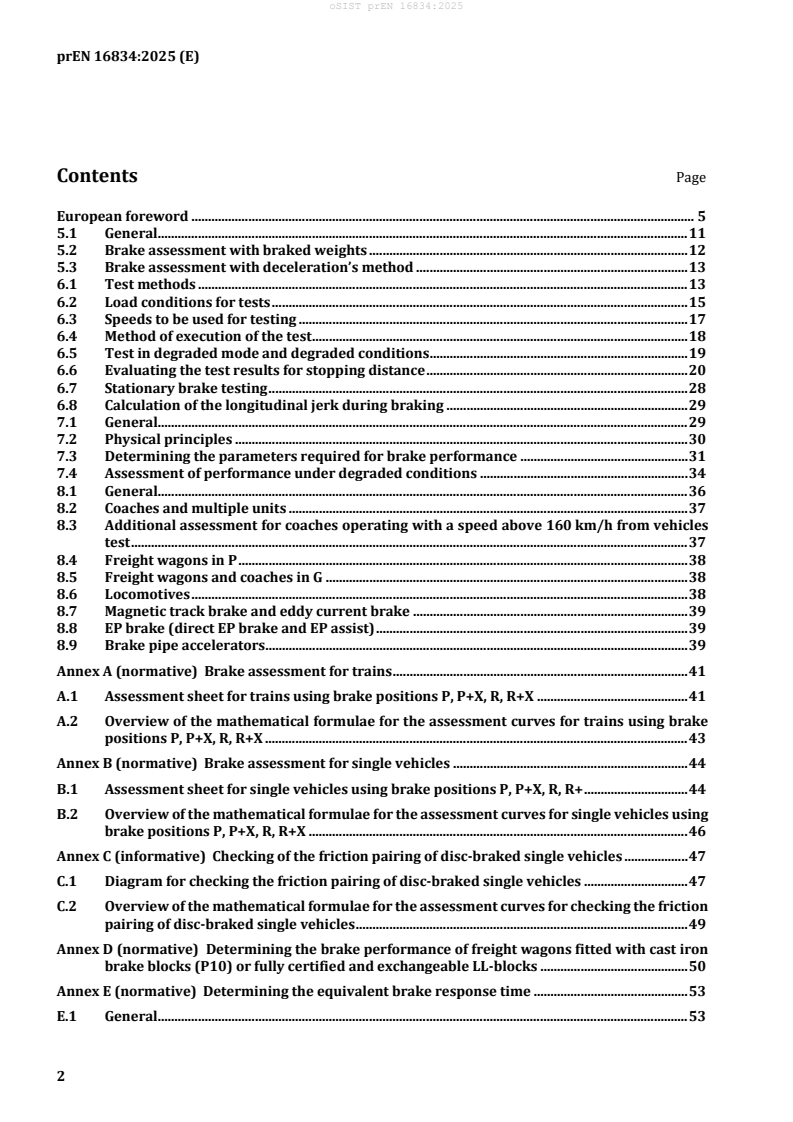
Contents Page
European foreword . 5
5.1 General. 11
5.2 Brake assessment with braked weights . 12
5.3 Brake assessment with deceleration’s method . 13
6.1 Test methods . 13
6.2 Load conditions for tests . 15
6.3 Speeds to be used for testing . 17
6.4 Method of execution of the test . 18
6.5 Test in degraded mode and degraded conditions . 19
6.6 Evaluating the test results for stopping distance . 20
6.7 Stationary brake testing . 28
6.8 Calculation of the longitudinal jerk during braking . 29
7.1 General. 29
7.2 Physical principles . 30
7.3 Determining the parameters required for brake performance . 31
7.4 Assessment of performance under degraded conditions . 34
8.1 General. 36
8.2 Coaches and multiple units . 37
8.3 Additional assessment for coaches operating with a speed above 160 km/h from vehicles
test . 37
8.4 Freight wagons in P . 38
8.5 Freight wagons and coaches in G . 38
8.6 Locomotives . 38
8.7 Magnetic track brake and eddy current brake . 39
8.8 EP brake (direct EP brake and EP assist) . 39
8.9 Brake pipe accelerators . 39
Annex A (normative) Brake assessment for trains . 41
A.1 Assessment sheet for trains using brake positions P, P+X, R, R+X . 41
A.2 Overview of the mathematical formulae for the assessment curves for trains using brake
positions P, P+X, R, R+X . 43
Annex B (normative) Brake assessment for single vehicles . 44
B.1 Assessment sheet for single vehicles using brake positions P, P+X, R, R+ . 44
B.2 Overview of the mathematical formulae for the assessment curves for single vehicles using
brake positions P, P+X, R, R+X . 46
Annex C (informative) Checking of the friction pairing of disc-braked single vehicles . 47
C.1 Diagram for checking the friction pairing of disc-braked single vehicles . 47
C.2 Overview of the mathematical formulae for the assessment curves for checking the friction
pairing of disc-braked single vehicles . 49
Annex D (normative) Determining the brake performance of freight wagons fitted with cast iron
brake blocks (P10) or fully certified and exchangeable LL-blocks . 50
Annex E (normative) Determining the equivalent brake response time . 53
E.1 General. 53
E.2 Determining the equivalent brake response time based on train deceleration . 53
E.3 Determining the equivalent brake response time based on brake cylinder filling times . 53
E.4 Determining the equivalent brake response time based on calculation . 54
Annex F (informative) Conversion model for ERTMS/ETCS. 55
F.1 Introduction . 55
F.2 Symbols for this annex . 55
F.3 Scope of validity of model . 57
F.4 Brake model . 58
F.5 Example of calculation of the stopping or slowing distance . 65
Annex G (normative) Assessment sheet for individual vehicles running at speeds of less than
100 km/h using brake positions P and R . 66
G.1 Assessment sheet for individual vehicles fitted with cast iron blocks (P10) at speeds below
100 km/h . 66
G.2 Overview of the mathematical formulae used in assessment curves for individual vehicles
fitted with cast iron blocks (P10) at speeds below 100 km/h. 68
G.3 Assessment sheet for individual vehicles fitted with EN-UIC brake system and disc brakes
or K-blocks at speeds below 100 km/h . 68
G.4 Overview of the mathematical formulae used in assessment curves for individual vehicles
fitted with EN-UIC disc brakes or composite brake blocks at speeds below 100 km/h . 70
Annex H (normative) Procedure for verifying the maximum utilization of adhesion between
wheel and rail . 71
H.1 Symbols for this annex . 71
H.2 General . 71
H.3 Prerequisites . 71
H.4 Determination of the maximum equivalent mean deceleration based on distance relevant
for adhesion ā . 72
max,τ
H.5 Calculation of the mean friction coefficient for the friction brake µ of the test . 72
m
H.6 Calculation of the maximum utilization of adhesion between wheel and rail τ . 72
max
Annex I (informative) Example for verifying the maximum utilization of adhesion between wheel
and rail for non-homogenous friction brake equipment . 74
I.1 Non-homogenous friction brake equipment . 74
I.2 Variation of brake cylinder pressure during brake application . 74
Annex J (informative) Example for correction and validation of test results exceeding mandatory
test conditions — treatment of curve radii lower than 1 000 m . 77
J.1 Introduction of a correction factor α . 77
curve
J.2 Determination correction factor α . 77
curve
Annex K (informative) Examples of correction of the mean stopping distance to nominal state of
the brake system . 79
K.1 Description of the train . 79
K.2 Simplified method . 80
K.3 Speed-range method . 82
K.4 Step-by-step method . 85
Annex L (informative) Recommendations for the use of braked weight percentage in operation
............................................................................................................................................................................. 86
L.1 General. 86
L.2 Principles of use for trains operating in P mode . 86
L.3 Adjustment for trains comprising a locomotive and coaches. 86
L.4 Adjustments for freight trains braked in the P mode . 88
L.5 Principles of use for trains operating in G mode . 89
Bibliography . 91
European foreword
This document (prEN 16834:2025) has been prepared by Technical Committee CEN/TC 256 “Railway
applications” the secretariat of which is held by DIN.
This document is currently submitted to the CEN Enquiry.
This document will supersede EN 16834:2019.
— railbound construction and maintenance machines have been included to the scope;
— normative references have been updated;
— definitions for terms “minimum load” and “normal load” have been deleted;
— definitions for terms “changeover mass” and “maximum design speed” have been added;
— symbols and abbreviations have been revised;
— brake assessment with braked weights has been revised;
— test methods in general and for freight wagons, coaches, EMU/DMU have been revised;
— load conditions for tests have been revised;
— testing speeds have been revised;
— method of the test execution has been revised;
— test in degraded mode and degraded conditions has been revised;
— determination of brake performance for the ETCS system has been deleted;
— evaluation of the test results for stopping distance has been revised;
— stationary brake testing has been revised;
— calculation of the longitudinal jerk during braking has been added;
— assessment for deceleration method has been revised;
— assessment of the braked weight has been revised;
— content of the recommendation for the use of braked weight percentage in operation has been moved
to an informative Annex (Annex L);
— assessment of gradient capability of stationary brakes has been revised;
— normative Annex B “Brake assessment for single vehicles” has been revised with addition of speeds
at 180 km/h and 200 km/h;
— normative Annex E “Determining the equivalent brake response time” has been revised;
— requirements of informative Annex I “Example for verifying the maximum utilization of adhesion
between wheel and rail for non-homogenous friction brake equipment” have been changed to
recommendations;
— requirements of informative Annex J “Example for correction and validation of test results exceeding
mandatory test conditions — Treatment of curve radii lower than 1 000 m” have been changed to
recommendations;
— new Annex K “Examples of correction of the mean stopping distance to nominal state of the brake
system” has been added;
— Annex ZA has been deleted;
— bibliography has been updated.
1 Scope
This document defines a harmonized way to assess the braking performance by test of locomotives,
passenger coaches, freight wagons, railbound construction and maintenance machines, and self-
propelled passenger trains (multiple units) including high speed trains.
The document sets out the standardized method for undertaking brake performance tests and the
correction factors to be applied to the data obtained for all types of rolling stock.
This document also defines the methods to assess the brake performance in terms of stopping distance,
and from this the process to determine vehicle(s) deceleration and braked weight.
It then deals with conversion of the braked weight to the braked weight percentage of a vehicle or train
for operating purposes. It also sets out additional factors when determining the braked weight
percentage of a train calculated from specified braked weight, depending on the formation of the train.
In Annex D there is a method for determining brake performance of freight wagons fitted with P10 cast
iron or LL-blocks using limited testing (force measurement).
2 Normative references
The following documents are referred to in the text in such a way that some or all of their content
constitutes requirements of this document. For dated references, only the edition cited applies. For
undated references, the latest edition of the referenced document (including any amendments) applies.
EN 14198:2016+A2:2021, Railway applications — Braking - Requirements for the brake system of trains
hauled by locomotives
EN 14531-1:2015+A1:2018, Railway applications — Methods for calculation of stopping and slowing
distances and immobilization braking - Part 1: General algorithms utilizing mean value calculation for train
sets or single vehicles
EN 14531-2:2015, Railway applications — Methods for calculation of stopping and slowing distances and
immobilization braking - Part 2: Step by step calculations for train sets or single vehicles
EN 15328:2020+A1:2024, Railway applications — Braking — Brake pads
EN 15355:2019+A1:2023, Railway applications — Braking — Distributor valves and distributor-isolating
devices
EN 15663:2017+A2:2024, Railway applications — Vehicle reference masses
EN 15877-1:2024, Railway applications — Markings of railway vehicles — Part 1: Freight wagons
EN 16207:2024, Railway applications — Braking — Functional and performance criteria of magnetic track
brake systems for use in railway rolling stock
EN 16452:2015+A1:2019, Railway applications — Braking — Brake blocks
EN ISO 24478:2024, Railway applications - Braking - General vocabulary (ISO 24478:2023, including
corrected version 2024-04)
ISO 20138-1:2018, Railway applications — Calculation of braking performance (stopping, slowing and
stationary braking) — Part 1: General algorithms utilizing mean value calculation
ISO 20138-2:2019, Railway applications — Calculation of braking performance (stopping, slowing and
stationary braking) — Part 2: General algorithms utilizing step by step calculation
3 Terms and definitions
For the purposes of this document, the terms and definitions given in EN ISO 24478:2024,
EN 14198:2016+A2:2021 and the following apply.
ISO and IEC maintain terminology databases for use in standardization at the following addresses:
— ISO Online browsing platform: available at https://www.iso.org/obp/
— IEC Electropedia: available at https://www.electropedia.org/
3.1
brake assessment speed
brake initiation speed which is decisive for determination of brake performance
Note 1 to entry: In general, the initiation speed leading to the lowest braked weight.
3.2
braked weight
representative quantity for the mean braking capacity of the vehicle or train, expressed in tons, which is
always expressed as a whole number
Note 1 to entry: It is displayed on the vehicle (in accordance with EN 15877-1:2024 and EN 15877-2:— ). Braked
weight corresponds to the retardation effort and is currently expressed and designated as “B”.
3.3
braked weight percentage
quotient of braked weight and vehicle mass × 100
Note 1 to entry: Also known as λ (lambda).
3.4
maximum braking load
MXB
load condition lower or equal to “design mass under exceptional payload” (MXD) as defined in
EN 15663:2017+A2:2024 in accordance with the related vehicle standard (e.g. EN 16185-1,
EN 14198:2016+A2:2021, EN 15734-1)
3.5
fully certified and exchangeable LL-block
LL-block, which fulfils all UIC requirements including exchangeability with P10 (as listed in ERA
document ERA/TD/2009-02/INT)
3.6
K-block
brake block with “K”-friction materials as defined in EN 16452:2015+A1:2019
3.7
EN-UIC brake
brake system as defined in EN 14198:2016+A2:2021
3.8
changeover mass
lowest value of vehicle mass at which it is deemed to be in the loaded state, thereby requiring the
adjustment of brake force to achieve the required brake performance
[SOURCE: EN 15624:2021+A1:2024, 3.4]
3.9
maximum design speed
maximum speed for which the vehicle is designed to run in operation
Note 1 to entry: This includes all operational modes, e.g. working mode and running mode for railbound
construction and maintenance machines.
4 Symbols and abbreviated terms
For the purposes of this document, the symbols and abbreviated terms given in Table 1 apply.
Table1 — Symbols and abbreviated terms
Symbol/
Description Unit
abbreviated
term
a deceleration m/s
B braked weight t
B braked weight in brake position “R” with brake pipe accelerator active.
R, red
t
The index “red” refers to the colour of marking.
C constant for calculating the λ values —
D constant for calculating the λ values —
d diameter mm
F force kN
g acceleration due to gravity 9,81 m/s
i gradient ‰
k assessment factor for determining the braked weight (in Annex D) —
k reduction factor for the influence of humidity (reduced friction
h
—
coefficient)
k reduction factor for the influence of wet rail (reduced adhesion) —
w
m mass of the test train or test vehicle t
r radius mm
s total stopping distance (up to v = 0) m
t time s
v speed km/h
v maximum design speed km/h
max
Symbol/
Description Unit
abbreviated
term
w mean curve resistance ‰
Bo
λ braked weight percentage %
ρ coefficient of inertia of rotating masses —
σ standard deviation of test result m
n
τ adhesion —
μ coefficient of friction —
η efficiency of brake rigging —
ATP automatic train protection —
Bg brake block type Bg (single block) —
Bgu brake block type Bgu (double brake block) —
ECB eddy current brake —
EP brake electro-pneumatic brake —
ETCS European Train Control System —
G brake mode of the slow-acting brake (freight train) —
K brake block material in accordance with EN 16452:2015+A1:2019 —
L brake block material in accordance with EN 16452:2015+A1:2019 —
LL brake block material in accordance with EN 16452:2015+A1:2019 —
MVD, MNO, load cases in accordance with EN 15663:2017+A2:2024 —
MND, MXD
MXB maximum braking load in accordance with 3.4 —
MTB magnetic track brake —
P brake position of quick-acting brake (passenger train) —
P+E brake position P + electrodynamic brake —
P+H brake position P + hydrodynamic brake —
P+Mg brake position P + magnetic track brake —
P+X placeholder for any combination of P and additional brakes (e.g. P+E, —
P+Mg, …)
P10 material designation of the cast-iron block with a 1 % phosphorus —
content
R brake position R or in accordance with EN 14198:2016+A2:2021 —
R+E brake position R + electrodynamic brake —
R+H brake position R + hydrodynamic brake —
Symbol/
Description Unit
abbreviated
term
R+X placeholder for any combination of R and additional brakes (e.g. R+E, —
R+Mg etc.)
S train related brake performance category in accordance with —
EN 14198:2016+A2:2021
SS train related brake performance category in accordance with —
EN 14198:2016+A2:2021
Wb eddy current brake —
5 Principles of determining the brake performance
5.1 General
The object of defining the brake performance of railway brakes is to characterize the braking capabilities
of railway vehicles.
To determine the brake performance three methods of brake assessment can be used: stopping distance,
braked weights, and deceleration. All three will determine the brake performance.
From vehicle testing, braked weight is derived from stopping distance. For freight wagons (fitted with
cast iron blocks or fully certified and exchangeable LL-blocks) the braked weight can be calculated as set
out in Annex D, if applicable.
Brake performance assessment is specified based on a number of standardized conditions (e.g. level
track, dry rail and mean in-service vehicle condition). Brake assessment thus does not assume the worst
possible vehicle condition, which can be the result of e.g. braking force tolerances, friction coefficient
scatter, downgraded efficiency, or the failure of brake system components etc.
These brake performances do not contain safety margins.
For vehicle having different brake positions as described in EN 14198:2016+A2:2021, there shall be an
assessment for each brake position.
The brake performance marked on vehicles (EN 15877-1:2024 and EN 15877-2:— ) shall be derived
from the performance determined by tests and/or calculation according to this document.
Links between calculation of brake performance and test are given in Table 2.
Table 2 — Links between calculation of brake performance and test
Vehicle type Calculation Brake Validation by
performance test
All vehicles EN 14531-1:2015+A1:2018/ISO 20138-1:2018 Decelerations + All vehicles
excluding and/or response excluding
freight time/stopping freight wagons
EN 14531-2:2015/ISO 20138-2:2019
wagons distance
Braked weights
a
Freight EN 14531-1:2015+A1:2018/ ISO 20138-1:2018 Stopping distance Mandatory
wagons and/or
EN 14531-2:2015/ISO 20138-2:2019
or Annex D, if applicable (cast iron/certified Braked weights
LL-blocks)
a
With exception of freight wagons, where the requirements of Annex D are met.
5.2 Brake assessment with braked weights
This method originated after the introduction of the compressed air brake. For this purpose, a huge
number of test runs on level track had been performed with a given passenger train with 60 wheelsets,
specified brake equipment and given mass from various initial speeds.
The brake performance of this train has been ever since equivalent to λ = 100 % and serves as reference
standard deceleration so that per definition the braked weight is equivalent to the mass of the train. The
results of further tests with different brake settings set up brake assessment charts providing the
relations:
λ= f(vs, ) (1)
where
s is the stopping distance, expressed in m;
v is the initial speed, expressed in km/h;
λ is the brake weight percentage, expressed in %.
The reference train was equipped with block brakes with low-phosphorus cast-iron blocks.
A brake assessment diagram is used as a basis of reference for determining the brake performance of
new vehicles using the passenger brake mode.
The assessment diagrams (see Figure A.1 and Figure B.1) are applicable for an initial braking speed of up
to 200 km/h.
The braked weight is expressed in tons. The quotient obtained from the sum of all the braked weights
and the mass of the train multiplied by 100 gives the braked weight percentage λ of the train and relates
to the stopping distance in the event of an emergency brake application.
The braked weights assigned to the individual vehicles or vehicle segments are normally to be marked
on the outside of the vehicles in accordance with EN 15877-1:2024 and EN 15877-2:— when they are
obtained from brake application by brake pipe only. Braked weights shall be indicated in whole numbers
of tons, with values < 0,5 to be rounded down and values ≥ 0,5 to be rounded up. If the results come from
tests on a train, the figures are initially rounded up or down for the smallest unit (wagon) on which a
braked weight is indicated.
The braked weight marked on a vehicle shall indicate the brake performance of this vehicle in a 400 m
(passenger trains) or 500 m (freight trains) long rake braked in the P brake mode (including brake
positions P+X, R, R+X). The definition of braked weights and brake weight percentage used for this
purpose requires an EN-UIC brake with filling time of the brake cylinder and transmission time of the
main brake pipe as specified in EN 15355:2019+A1:2023 for the “passenger train” brake mode.
Whenever deviating from these parameters, the influence shall be evaluated and compensated by
suitable measures.
The braked weight of a train is equivalent to the sum of the braked weights marked on the individual
vehicles with active brakes.
Some recommendations for operating rules are presented in Annex L.
5.3 Brake assessment with deceleration’s method
The brake performance of trains can be expressed by decelerations. This method may be applied for all
speed ranges. For speeds over 200 km/h, it is mandatory.
The real train deceleration profile is approximated by a function with equivalent brake response time
and one or more speed intervals of constant decelerations.
The deceleration method set out in this document is intended to describe the train deceleration in a
simplified set of values and not by the individual braking functions.
6 Execution of tests
6.1 Test methods
6.1.1 General
6.1.1.1 Test institute
The tests shall be performed by a competent authority.
NOTE As an example, a test institute in accordance with EN ISO/IEC 17025.
6.1.1.2 Measurement uncertainty
Any limit values for e.g. stopping distances, deceleration, brake weights or adhesion values are valid for
mean vehicle conditions and can deviate to both sides in operation.
For that reason, no extra margin for covering the measuring uncertainty shall be taken when checking
limit values.
NOTE The measuring methods (equipment and processing) used today generally have the capability of
achieving a measuring uncertainty at least as good as those in use, when the limit values for the vehicle assessment
were established.
6.1.1.3 Train testing/single vehicle testing
Train testing is the original method, which gives more accurate results and is always applicable. In the
following cases, the train test can be replaced by single vehicle test, which leads to more restrictive
results:
— for coaches with maximum speed ≤ 200 km/h;
— for freight wagons;
— for locomotives;
— for single multiple units (as specified in EN 16185-2).
6.1.2 Freight wagons and coaches
If the braked weight of freight wagons/coaches is determined by testing with a train, the following special
conditions apply:
— coaches: for the purpose of the tests a 400 m long hauled train should be used comprising identical
coaches with the same brake equipment;
— freight wagons: for the purpose of the tests a 500 m long hauled train should be used comprising
identical freight wagons with the same brake equipment;
— in both cases the locomotive brake shall be isolated and all brake pipe accelerators and the EP assist
shall be deactivated.
— for freight wagons and coaches equipped with brake pipe accelerators tests shall be performed with
brake pipe accelerators activated or deactivated depending on the brake position to be assessed, e.g.
— P, R brake pipe accelerator deactivated;
— R : brake pipe accelerator activated;
red
— R+X : brake pipe accelerator activated.
red
If the braked weight of freight wagons is determined by testing with a single vehicle, the following
conditions for the composition of test objects to be uncoupled apply:
— one wagon in the case of basic bogie wagons;
— a set of three wagons in the case of two-axled vehicles;
— a set of two wagons in the case of articulated wagons with single axles;
— a set of wagons which cannot be split in service.
6.1.3 Locomotives
When determining the braked weight of the locomotive in position G, tests from 100 km/h in position P
shall be undertaken with the locomotive operating on its own. For all other brake positions, the testing
shall be done as set out in 6.3.
Locomotives with multiple brake control architecture shall be tested in all operating modes (e.g.:
UIC brake pipe, direct EP brake, rescue- or towing-mode, etc.).
6.1.4 Multiple units and high speed trainsets
The brake performance of a multiple unit is determined by dynamic tests for all existing brake positions
with all brakes active. To determine the brake performance in degraded modes dynamic tests shall be
The extract is copyright of the International Union of Railways (UIC), Paris, France. All rights reserved. Source:
UIC/IRS 50544-1:2025 ‘Brakes - Braking performance’, Ed. no.1, Publication date: 25/03/2025, Copyright © Year
UIC, Paris, France
performed for all relevant cases (e.g. isolated parts of air brake, EP assist, dynamic brake, magnetic track
brake).
For multiple units which can be coupled together to operate in multiple working, the tests shall be
conducted in the most unfavourable train configuration (considering the equivalent brake response time
in Annex E) determined by the static test (i.e. generally the longest planned formation).
Multiple units and highspeed trainsets with multiple brake control architecture shall be tested in all
operating modes (e.g. UIC brake pipe, direct EP brake, rescue- or towing-mode).
6.1.5 Testing of vehicles/trains with additional brake equipment
Typically, additional brake equipment for service and/or emergency brake applications include
— dynamic brake;
— eddy current brake;
— EP assist;
— magnetic track brake;
— brake pipe accelerators.
The testing specified in 6.1.4 shall be undertaken with all brake equipment operational.
If additional brake equipment is used in emergency brake or service brake, additional testing should be
performed to determine brake performance with this equipment isolated.
If more than one additional equipment is fitted, there should be further testing to determine the
contribution of each equipment.
6.2 Load conditions for tests
6.2.1 Freight wagons
For freight wagons with empty-loaded changeover devices, slip tests shall be conducted:
— in load case MVD (empty freight wagons), in the “empty” position;
— in the “empty” position with a load at the changeover mass. When an automatic empty-loaded
changeover device is being used, the tests shall be carried out in the “empty” position with a load
close to the changeover mass, but far enough below it to ensure that the automatic changeover device
remains stable in the “empty” position;
— in load case MND in the “loaded” position.
For freight wagons with self-adjusting load-proportional braking, the slip tests shall be conducted:
— in load case MVD;
— in the lowest load case under which the maximum braked weight is achieved;
— at the condition at which the maximum energy is dissipated (combination of speed and load).
For S and SS freight wagons, as defined in EN 14198:2016+A2:2021, the load definition leads to Table 3.
Table 3 — Load conditions for slip tests with S and SS freight wagons
S-wagon with self-
S-wagon with empty-
adjusting load-
Vehicle mass loaded changeover SS-wagon
proportional (S2 in
device
EN 14198:2016+A2:2021)
MVD X X X
Changeover mass X
14,5 t/wheelset X
18 t/wheelset X
20 t/wheelset X
22,5 t/ wheelset X X
X Mandatory tests
NOTE The values of the vehicle weight are typical values for S- or SS-wagons with tread-braked wheels.
6.2.2 Locomotives
For locomotives only MVD shall be tested.
6.2.3 Passenger vehicles
Load condition for passenger vehicles is specified in Table 4.
Table 4 — Load conditions for testing
Load status
Vehicle type
MVD MND MXB
Coach, passenger trains, multiple unit
a
and high speed train without load X X X
compensating brake systems
Coach, passenger trains, multiple unit
b
and high speed train with load X X X
compensating brake systems
X Requirement
a
It is allowed to eliminate the tests in load case MND if the difference between MND and MXB is less than 10 %
of MND. If the difference is higher than 10 % it is allowed to perform the tests at MND only at maximum speed
and one intermediate speed.
b
It is allowed to eliminate the tests in load case MND if the load compensation covers the whole range from
MVD to MXB and if the difference between MND and MXB is less than 10 % of MND.
In cases where loading is not possible, alternative methods are permitted, such as simulation by isolating
other brake units, as long as this introduces no significant errors into the procedure. In particular, it shall
be observed on vehicles with self-adjusting load-proportional braking that the correct brake cylinder
pressures (corresponding to the load) are adjusted by means of the simulated load condition.
Simulation is performed as follows:
The number of isolated brakes is determined in accordance with Formula (2) such that the ratio of:
∑ the active brake forces dynamic mass of test train
= (2)
∑ the installed brake forces dynamic mass of laden train
is generally complied with.
The simulation is only allowed for long trains (400 m excluding the locomotive) not for single vehicles,
multiple units and high speed train.
6.3 Speeds to be used for testing
6.3.1 General
At least four valid braking test results (see 6.4.4) shall be used for each initial speed and for
— emergency brake in each brake position (e.g. R, Rep, R+X, towing case),
— emergency brake in the degraded mode in case of single point(s) failure(s) leading to the longest
stopping distance,
— full service brake.
Combinations of speed and brake position, which are not applicable for operation, are not mandatory for
testing.
Tests in brake position G are not required (see 8.5 and 8.6).
NOTE Wagons equipped only with G mode are not covered by this standard.
6.3.2 Mandatory initial speeds
Tests shall be carried out on dry rails at initial speed equal to maximum design speed and at the following
initial speeds (if lower than the maximum design speed): 30 km/h; 100 km/h; 120 km/h; 140 km/h;
160 km/h; 200 km/h; in steps not greater than 40 km/h from 200 km/h to maximum design speed of the
unit.
For coaches with only one stage of braking effort and maximum speed between 160 km/h and 200 km/h
(limitations of brake equipment and special evaluations rules: see braked weight assessment 8.3) single
vehicle tests can be avoided at initial speed higher than 160 km/h using the optional method described
in 8.3.
6.3.3 Recommendation for additional initial speeds
For trains assessed in accordance with Gamma braking model (”Gamma-Train”) additional test speeds
are recommended:
— An additional test should be done for an initial speed equal to the maximum train design speed +
overspeed (e.g. as defined in SUBSET-026-3, 3.13.9.2.3).
— If there is significant change in brake deceleration at specific speeds due to brake system architecture
(e.g. maximal speed for MTB application, high/low pressure transition in brake cylinder), then tests
for these specific initial speeds should be done. The test speed for this specific case should be chosen
close to the system speed in a way that all similar tests show the same behaviour. E.g. in case of an
increase of the deceleration at a certain system speed the test speed should be chosen above the
system speed in order to have that deceleration change included in all tests.
6.4 Method of execution of the test
6.4.1 General
The test train or test vehicle shall be accelerated up to the speed for the intended brake application. At
this speed, the traction is switched off and after that an emergency brake application is initiated on level
and straight track. If there are different possibilities to initiate an emergency braking (e.g. by driver brake
valve, push-button, ATP valves) the possibility leading to the longest response time shall be chosen for
tests used for brake performance assessment. The choice shall be validated by suitable tests.
For single vehicle testing the method of slip test applies. The vehicle shall be uncoupled after reaching
the test speed and the emergency brake shall be applied at the same time or short time after uncoupling.
In every test the stopping distance is measured from the point at which the emergency brake application
was initiated (e.g. leaving running position of brake controller or emergency button depressed) until the
standstill.
The measured stopping distance includes the distance covered during the delay time and the build-up
time of brake equipment.
This test method can similarly be applied for other than emergency brake applications (e.g. maximum
service braking).
6.4.2 Atmospheric conditions
In order to prevent adverse atmospheric conditions from affecting the results the tests should be carried
out with as little wind as possible and dry rails.
No test in flying snow conditions is allowed.
6.4.3 Condition of brake equipment
6.4.3.1 Wheels
For block-braked vehicles with new or reprofiled wheels, these should have been run in for at least
1 200 km.
6.4.3.2 Friction components
Before the start of the tests the friction components (brake pads/blocks) shall be bedded-in to give at
least 85 % con
...