


SIST EN 14303:2016
(Main)Thermal insulation products for building equipment and industrial installations - Factory made mineral wool (MW) products - Specification
Thermal insulation products for building equipment and industrial installations - Factory made mineral wool (MW) products - Specification
This European Standard specifies the requirements for factory made mineral wool products, which are used for the thermal insulation of building equipment and industrial installations with an operating temperature range of approximately 0 °C to + 800 °C.
Below an operating temperature of ambient, special means against water vapour diffusion and water accumulation by air flow might be required. Below an operating temperature of - 50 °C, special tests regarding the suitability of the products in the intended application are advised (e.g. liquefaction of oxygen). Manufacturer's advice should be heeded in all cases.
The products are manufactured with or without facings or coatings, in the form of rolls, boards, slabs, mats, felts, quilts, wired mats, lamella mats, bevelled lags and pipe sections.
This European Standard describes product characteristics and includes procedures for testing, evaluation of conformity, marking and labelling.
Products covered by this standard are also used in prefabricated thermal insulation systems and composite panels; the performance of systems incorporating these products is not covered.
This European Standard does not specify the required level of a given property that should be achieved by a product to demonstrate fitness for purpose in a particular application. The levels required for a given application can be found in regulations and invitations to tender.
Products with a declared thermal conductivity greater than 0,065 W/(m·K) at 10 °C are not covered by this standard.
This European Standard does not cover products for in situ insulation (blowing or pouring) or products for the insulation of the building structure.
This European Standard does not cover the following acoustical aspects: direct airborne sound insulation and impact noise transmission index.
Wärmedämmstoffe für die technische Gebäudeausrüstung und für betriebstechnische Anlagen in der Industrie - Werkmäßig hergestellte Produkte aus Mineralwolle (MW) - Spezifikation
Diese Europäische Norm legt die Anforderungen an werkmäßig hergestellte Produkte aus Mineralwolle fest, die als Wärmedämmstoffe für die technische Gebäudeausrüstung und für betriebstechnische Anlagen in der Industrie in einem Betriebstemperaturbereich von etwa 0 °C bis 800 °C benutzt werden.
Bei einer Betriebstemperatur unterhalb der Umgebungstemperatur könnten besondere Maßnahmen gegen die Wasserdampfdiffusion und gegen Wasseransammlungen im Dämmstoff auf Grund von Luft¬bewegungen erforderlich sein. Unterhalb einer Betriebstemperatur von 50 °C sind besondere Prüfungen bezüglich der Eignung der Produkte für den beabsichtigten Anwendungsfall ratsam (z. B. Sauerstoffverflüssigung). In jedem Fall sollten die Empfehlungen des Herstellers beachtet werden.
Die Produkte werden mit oder ohne Kaschierung und Beschichtung in Form von Rollen, Platten, Matten, Filzen, Matratzen, Drahtnetzmatten, Lamellenmatten, abgeschrägten Segmenten und Rohrschalen her¬gestellt.
Diese Europäische Norm beschreibt die Produkteigenschaften und enthält Verfahren zur Prüfung, Konformitätsbewertung, Kennzeichnung und Etikettierung.
Die von dieser Norm abgedeckten Produkte werden auch in vorgefertigten Wärmedämmsystemen und Mehr-schicht-Verbundplatten angewendet; die Eigenschaften von Systemen, in die diese Produkte integriert sind, werden nicht behandelt.
Diese Europäische Norm legt für die einzelnen Eigenschaften keine Leistungsstufen fest, die ein Produkt erreichen sollte, um für einen bestimmten Anwendungsfall tauglich zu sein. Die für bestimmte Anwendungen benötigten Stufen können Regelwerken oder Ausschreibungen entnommen werden.
Diese Europäische Norm gilt nicht für Produkte mit einem Nennwert der Wärmeleitfähigkeit größer als 0,065 W/(mK) bei 10 °C.
Diese Europäische Norm gilt nicht für Produkte für an der Verwendungsstelle hergestellte Wärmedämmung (eingeblasen oder geschüttet) oder Produkte, die zur Dämmung des Bauwerks bestimmt sind.
Diese Europäische Norm gilt nicht für die folgenden akustischen Zwecke: Luftschalldämmung und Tritt¬schall-übertragung.
Produits isolants thermiques pour l'équipement du bâtiment et les installations industrielles - Produits manufacturés à base de laines minérales (MW) - Spécification
La présente Norme européenne spécifie les exigences relatives aux produits manufacturés à base de laine minérale, utilisés pour l’isolation thermique de l’équipement du bâtiment et des installations industrielles, dont la température de service est approximativement comprise entre 0 °C et + 800 °C.
En cas de température de service inférieure à la température ambiante, des moyens spéciaux contre la diffusion de la vapeur d’eau et l’accumulation d’eau par écoulement de l’air peuvent être requis. Pour une température de service inférieure à - 50 °C, des essais particuliers sont recommandés pour s’assurer de l’aptitude à l’emploi du produit dans l’application visée (p.ex. liquéfaction de l’oxygène). Il convient de se référer systématiquement aux conseils du fabricant.
Les produits sont manufacturés avec ou sans parements ou enduits de finition, sous la forme de rouleaux, de panneaux, de feutres, de « felts », de matelas capitonnés, de nappes grillagées, de feutres lamellaires, de segments à onglets et de coquilles.
La présente Norme européenne décrit les caractéristiques de ces produits et comporte des modes opératoires d’essai, d’évaluation de conformité, de marquage et d’étiquetage.
Les produits couverts par la présente norme sont également utilisés dans les systèmes d’isolation thermique préfabriqués et les panneaux composites ; les performances des systèmes incorporant ces produits ne sont pas traitées.
La présente Norme européenne ne spécifie pas le niveau requis pour une propriété donnée que doit posséder un produit pour démontrer son aptitude à une application particulière. Les niveaux requis pour une application donnée peuvent être trouvés dans les réglementations et les appels d’offre.
Les produits dont la conductivité thermique déclarée est supérieure à 0,065 W/(m K) à 10 °C ne sont pas couverts par la présente norme.
La présente Norme européenne ne couvre ni les produits pour l’isolation in situ (soufflage ou déversement) ni les produits pour l’isolation des structures de bâtiments.
La présente Norme européenne ne couvre pas les critères acoustiques suivants : isolation contre le bruit aérien direct et indice de transmission du bruit d’impact.
Toplotnoizolacijski proizvodi za opremo stavb in industrijske inštalacije - Proizvodi iz mineralne volne (MW) - Specifikacija
Ta evropski standard določa zahteve za proizvode iz mineralne volne, ki se uporabljajo za toplotno izolacijo opreme stavb in industrijskih inštalacij z razponom delovne temperature približno od 0 °C do 800 °C. OPOMBA Pod delovno temperaturo okolja se morda zahtevajo posebni ukrepi proti difuziji vodne pare in zbiranju vode s pretokom zraka. Pod delovno temperaturo –50 °C se priporočajo posebni preskusi glede primernosti proizvodov za predvideno vrsto uporabe (npr. utekočinjenje kisika). V vseh primerih naj bi upoštevali napotke proizvajalca. Proizvodi so izdelani s površinsko prevleko ali lakom ali brez v obliki kolutov, desk, plošč, preprog, polstov, polnil, ožičenih preprog, lamelnih preprog, posnetih oblog in vodovodnih odsekov. Ta evropski standard opisuje lastnosti proizvodov ter zajema postopke za preskušanje, vrednotenje skladnosti, označevanje in etiketiranje. Proizvodi iz tega standarda se uporabljajo tudi v montažnih sistemih toplotne izolacije in vezanih ploščah; lastnosti sistemov iz teh proizvodov niso opisane. Ta evropski standard ne določa zahtevane ravni določene lastnosti, ki jo mora proizvod doseči, da se dokaže njegova primernost namenu za posamezno vrsto uporabe. Zahtevane ravni za posamezno uporabo je mogoče najti v uredbah in javnih razpisih. Proizvodi z deklarirano toplotno prevodnostjo, višjo od 0,065 W/mK pri 10 °C, v tem standardu niso zajeti. Ta evropski standard ne zajema proizvodov za izolacijo na kraju samem (pihanje ali vlivanje) ali proizvodov za izolacijo stavbne strukture. Ta evropski standard ne zajema naslednjih akustičnih vidikov: neposredne zvočne izolacije v zraku in indeksa prenosa udarnega zvoka.
General Information
- Status
- Published
- Public Enquiry End Date
- 29-Jul-2015
- Publication Date
- 06-Jan-2016
- Technical Committee
- TOP - Thermal insulation
- Current Stage
- 6060 - National Implementation/Publication (Adopted Project)
- Start Date
- 17-Dec-2015
- Due Date
- 21-Feb-2016
- Completion Date
- 07-Jan-2016
Relations
- Effective Date
- 01-Feb-2016
- Effective Date
- 02-May-2018
Overview
EN 14303:2015 is the CEN European Standard for factory made mineral wool (MW) thermal insulation products used on building equipment and industrial installations. It defines product characteristics, testing procedures, conformity assessment, and marking/labelling requirements for mineral wool products intended for service temperatures of approximately 0 °C to +800 °C. The standard covers products made with or without facings or coatings in many forms (rolls, boards, slabs, mats, felts, quilts, wired mats, lamella mats, bevelled lags and pipe sections). EN 14303:2015 supports compliance with the EU Construction Products Regulation (CPR) and links to CE marking and AVCP requirements.
Key Topics and Requirements
- Scope and limits: Applies to factory made mineral wool products for building equipment and industrial installations; excludes products with declared thermal conductivity > 0.065 W/(m·K) at 10 °C, in situ (blown/poured) insulation and insulation of the building structure.
- Operating temperature: Rated for roughly 0 °C to +800 °C. For service below ambient, special measures against vapor diffusion and water accumulation may be required; below −50 °C, additional suitability tests (e.g., oxygen liquefaction concerns) are advised.
- Product forms and facings: Defines accepted product types and options for facings/coatings and preformed geometry (including pipe sections and bevelled lags).
- Performance characteristics: Specifies what to declare and test - thermal conductivity/declared thermal values, maximum service temperature, water vapour transmission, short-term water absorption, dimensional stability and more.
- Test methods: References standardized tests (guarded hot plate, heat flow meter, pipe tests, reaction-to-fire tests, water vapour and water absorption methods).
- Conformity & marking: Includes procedures for Assessment and Verification of Constancy of Performance (AVCP), factory production control (Annex A), and CE marking/label information per the CPR (Annex ZA).
Applications
EN 14303:2015 is intended for specification, testing and supply of mineral wool insulation used for:
- HVAC and building services (ducts, boilers, tanks)
- Industrial process piping and high-temperature equipment
- Prefabricated thermal insulation systems and composite panels (note: system performance is out of scope) Practical guidance: always follow manufacturer advice for low-temperature applications and consult project specifications or regulations for the required property levels.
Who Uses This Standard
- Mineral wool manufacturers and product developers
- Test laboratories and conformity assessment bodies
- Specifiers, consultants and design engineers (HVAC, process engineering)
- Installers and procurement officers preparing tenders and product declarations
- Regulatory authorities and clients referencing harmonized standards for compliance
Related Standards
EN 14303 is part of a CEN package for factory made thermal insulation. Key related standards include EN 13162 (factory made mineral wool for buildings), EN 14706/14707 (maximum service temperature), EN 13501-1 (reaction to fire) and EN 13172 (evaluation of conformity).

Frequently Asked Questions
SIST EN 14303:2016 is a standard published by the Slovenian Institute for Standardization (SIST). Its full title is "Thermal insulation products for building equipment and industrial installations - Factory made mineral wool (MW) products - Specification". This standard covers: This European Standard specifies the requirements for factory made mineral wool products, which are used for the thermal insulation of building equipment and industrial installations with an operating temperature range of approximately 0 °C to + 800 °C. Below an operating temperature of ambient, special means against water vapour diffusion and water accumulation by air flow might be required. Below an operating temperature of - 50 °C, special tests regarding the suitability of the products in the intended application are advised (e.g. liquefaction of oxygen). Manufacturer's advice should be heeded in all cases. The products are manufactured with or without facings or coatings, in the form of rolls, boards, slabs, mats, felts, quilts, wired mats, lamella mats, bevelled lags and pipe sections. This European Standard describes product characteristics and includes procedures for testing, evaluation of conformity, marking and labelling. Products covered by this standard are also used in prefabricated thermal insulation systems and composite panels; the performance of systems incorporating these products is not covered. This European Standard does not specify the required level of a given property that should be achieved by a product to demonstrate fitness for purpose in a particular application. The levels required for a given application can be found in regulations and invitations to tender. Products with a declared thermal conductivity greater than 0,065 W/(m·K) at 10 °C are not covered by this standard. This European Standard does not cover products for in situ insulation (blowing or pouring) or products for the insulation of the building structure. This European Standard does not cover the following acoustical aspects: direct airborne sound insulation and impact noise transmission index.
This European Standard specifies the requirements for factory made mineral wool products, which are used for the thermal insulation of building equipment and industrial installations with an operating temperature range of approximately 0 °C to + 800 °C. Below an operating temperature of ambient, special means against water vapour diffusion and water accumulation by air flow might be required. Below an operating temperature of - 50 °C, special tests regarding the suitability of the products in the intended application are advised (e.g. liquefaction of oxygen). Manufacturer's advice should be heeded in all cases. The products are manufactured with or without facings or coatings, in the form of rolls, boards, slabs, mats, felts, quilts, wired mats, lamella mats, bevelled lags and pipe sections. This European Standard describes product characteristics and includes procedures for testing, evaluation of conformity, marking and labelling. Products covered by this standard are also used in prefabricated thermal insulation systems and composite panels; the performance of systems incorporating these products is not covered. This European Standard does not specify the required level of a given property that should be achieved by a product to demonstrate fitness for purpose in a particular application. The levels required for a given application can be found in regulations and invitations to tender. Products with a declared thermal conductivity greater than 0,065 W/(m·K) at 10 °C are not covered by this standard. This European Standard does not cover products for in situ insulation (blowing or pouring) or products for the insulation of the building structure. This European Standard does not cover the following acoustical aspects: direct airborne sound insulation and impact noise transmission index.
SIST EN 14303:2016 is classified under the following ICS (International Classification for Standards) categories: 91.100.60 - Thermal and sound insulating materials. The ICS classification helps identify the subject area and facilitates finding related standards.
SIST EN 14303:2016 has the following relationships with other standards: It is inter standard links to SIST EN 14303:2010+A1:2013, SIST EN 14303:2016/oprA1:2019. Understanding these relationships helps ensure you are using the most current and applicable version of the standard.
SIST EN 14303:2016 is associated with the following European legislation: EU Directives/Regulations: 305/2011; Standardization Mandates: M/103 REV. When a standard is cited in the Official Journal of the European Union, products manufactured in conformity with it benefit from a presumption of conformity with the essential requirements of the corresponding EU directive or regulation.
SIST EN 14303:2016 is available in PDF format for immediate download after purchase. The document can be added to your cart and obtained through the secure checkout process. Digital delivery ensures instant access to the complete standard document.
Standards Content (Sample)
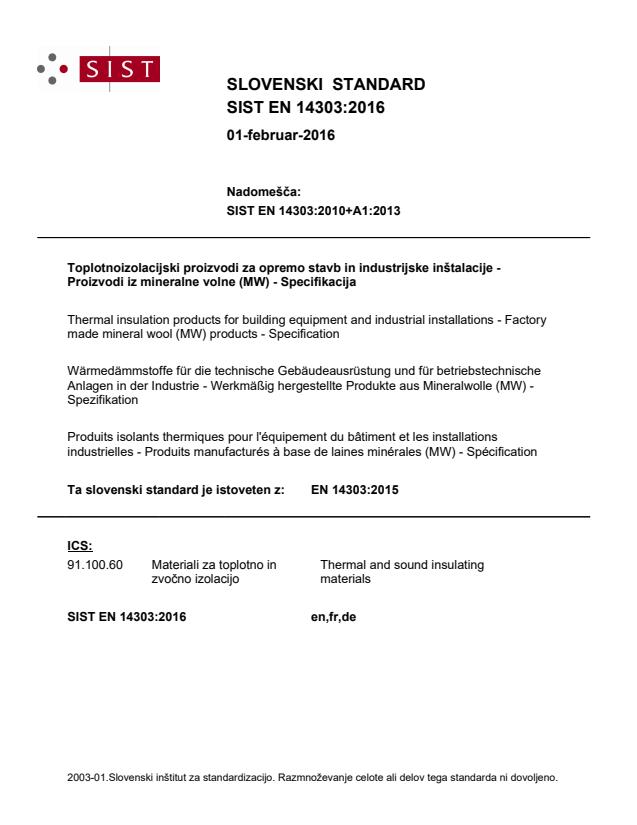
2003-01.Slovenski inštitut za standardizacijo. Razmnoževanje celote ali delov tega standarda ni dovoljeno.Toplotnoizolacijski proizvodi za opremo stavb in industrijske inštalacije - Proizvodi iz mineralne volne (MW) - SpecifikacijaWärmedämmstoffe für die technische Gebäudeausrüstung und für betriebstechnische Anlagen in der Industrie - Werkmäßig hergestellte Produkte aus Mineralwolle (MW) - SpezifikationProduits isolants thermiques pour l'équipement du bâtiment et les installations industrielles - Produits manufacturés à base de laines minérales (MW) - SpécificationThermal insulation products for building equipment and industrial installations - Factory made mineral wool (MW) products - Specification91.100.60Thermal and sound insulating materialsICS:Ta slovenski standard je istoveten z:EN 14303:2015SIST EN 14303:2016en,fr,de01-februar-2016SIST EN 14303:2016SLOVENSKI
STANDARDSIST EN 14303:2010+A1:20131DGRPHãþD
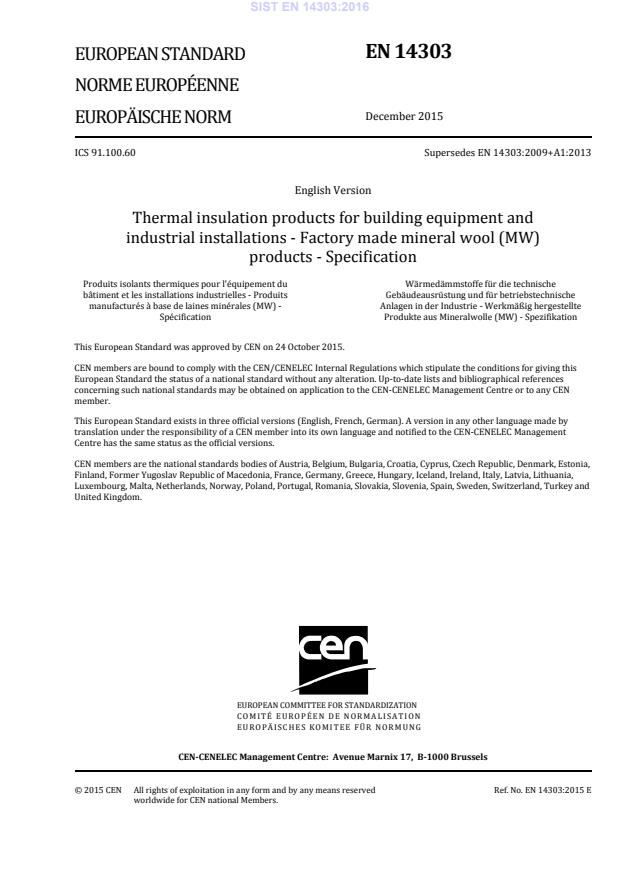
EUROPEAN STANDARD NORME EUROPÉENNE EUROPÄISCHE NORM
EN 14303
December
t r s w ICS
{ sä s r rä x r Supersedes EN
s v u r uã t r r { ªA sã t r s uEnglish Version
Thermal insulation products for building equipment and products æ Specification Produits isolants thermiques pour l 5ßquipement du bâtiment et les installations industrielles æ Produits Spßcification
Wärmedämmstoffe für die technische Gebäudeausrüstung und für betriebstechnische Anlagen in der Industrie æ Werkmäßig hergestellte This European Standard was approved by CEN on
t v October
t r s wä
egulations which stipulate the conditions for giving this European Standard the status of a national standard without any alterationä Upætoædate lists and bibliographical references concerning such national standards may be obtained on application to the CENæCENELEC Management Centre or to any CEN memberä
translation under the responsibility of a CEN member into its own language and notified to the CENæCENELEC Management Centre has the same status as the official versionsä
CEN members are the national standards bodies of Austriaá Belgiumá Bulgariaá Croatiaá Cyprusá Czech Republicá Denmarká Estoniaá Finlandá Former Yugoslav Republic of Macedoniaá Franceá Germanyá Greeceá Hungaryá Icelandá Irelandá Italyá Latviaá Lithuaniaá Luxembourgá Maltaá Netherlandsá Norwayá Polandá Portugalá Romaniaá Slovakiaá Sloveniaá Spainá Swedená Switzerlandá Turkey andUnited Kingdomä
EUROPEAN COMMITTEE FOR STANDARDIZATION COMITÉ EUROPÉEN DE NORMALISATION EUROPÄISCHES KOMITEE FÜR NORMUNG
CEN-CENELEC Management Centre:
Avenue Marnix 17,
B-1000 Brussels
t r s w CEN All rights of exploitation in any form and by any means reserved worldwide for CEN national Membersä Refä Noä EN
s v u r uã t r s w ESIST EN 14303:2016
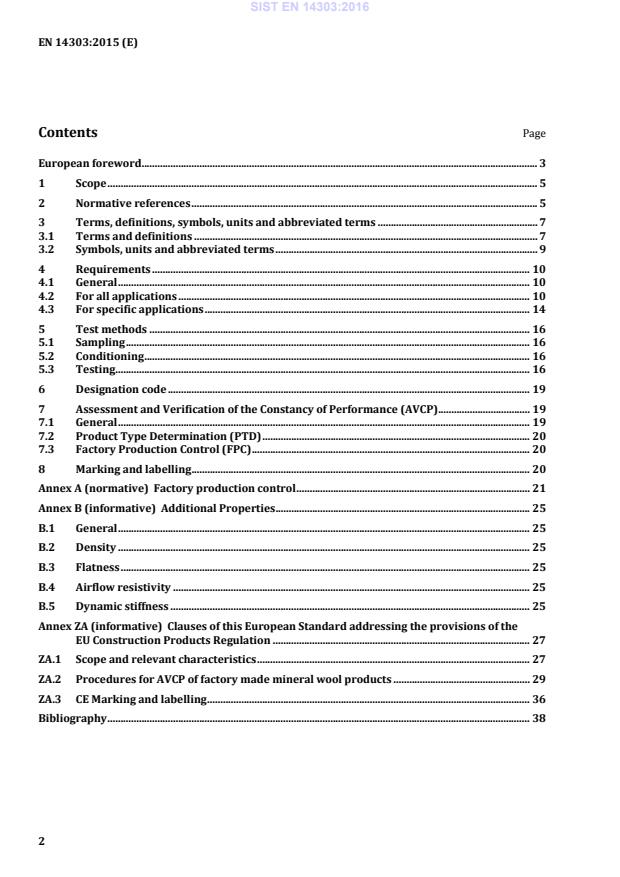
Factory production control . 21 Annex B (informative)
Additional Properties . 25 B.1 General . 25 B.2 Density . 25 B.3 Flatness . 25 B.4 Airflow resistivity . 25 B.5 Dynamic stiffness . 25 Annex ZA (informative)
Clauses of this European Standard addressing the provisions of the EU Construction Products Regulation . 27 ZA.1 Scope and relevant characteristics . 27 ZA.2 Procedures for AVCP of factory made mineral wool products . 29 ZA.3 CE Marking and labelling . 36 Bibliography . 38 SIST EN 14303:2016
is the thermal conductivity W/(m·K) D is the declared thermal conductivity W/(m·K)
is the water vapour diffusion resistance factor – Sb is the deviation from squareness on length and width mm/m sd is the water vapour diffusion equivalent air layer thickness m 10 is the compressive stress at 10 % deformation kPa m is the compressive strength kPa v is the deviation from squareness for pipe sections mm Wp is the short-term water absorption kg/m2 AP is the symbol of the declared level of practical sound absorption coefficient
AW is the symbol of the declared level of weighted sound absorption coefficient
CL is the symbol of the declared level of soluble chloride ions
CS(10\Y) is the symbol of the declared level for compressive stress or strength
DS(TH) is the symbol of the declared value for dimensional stability under specified temperature and relative humidity conditions
F is the symbol of the declared level of soluble fluoride ions
MV is the symbol of the declared level for water vapour diffusion equivalent air-layer thickness
NA is the symbol of the declared level of soluble sodium ions
pH is the symbol of the declared level of the pH-value
SI is the symbol of the declared level of soluble silicate ions
ST(+) is the symbol of the declared level for maximum service temperature with a test load of 500 Pa
ST(+/100) is the symbol of the declared level for maximum service temperature with a test load of 100 Pa
T is the symbol of the declared class for thickness tolerances
WS is the symbol of the declared level for short-term water absorption
3.2.2 Abbreviations used in this standard AVCP is Assessment and Verification of Constancy of Performance (previously named attestation of conformity) DoP is Declaration of Performance FPC is Factory Production Control MW is Mineral Wool PTD is Product Type Determination (previously named ITT for Initial Type Test) RtF is Reaction to Fire ThIBEII is Thermal Insulation for Building Equipment and Industrial Installations VCP is Verification of Constancy of Performance (previously named evaluation of conformity) 4 Requirements 4.1 General Product properties shall be assessed in accordance with Clause 5. To comply with this standard, products shall meet the requirements of 4.2, and the requirements of 4.3 as appropriate. NOTE Information on additional properties is given in Annex B. One test result for a product property is the average of the measured values on the numbers of test specimens given in Table 5. 4.2 For all applications 4.2.1 Thermal conductivity For flat specimens thermal conductivity shall be based upon measurements carried out in accordance with EN 12667 or EN 12939 for thick products. For cylindrical specimens EN ISO 8497 shall be used as specified in 5.3.2. In both cases the thermal conductivity values shall be determined by the manufacturer and verified in accordance with EN ISO 13787. They shall be declared by the manufacturer according to the measuring standards mentioned above covering the product service temperature range. The following conditions apply: — the measured value shall be expressed with three significant figures; — the declared thermal conductivity curve shall be given as a limit curve, defined in EN ISO 13787; — the value of the declared thermal conductivity, D, shall be rounded upwards to the nearest 0,001 W/(m·K). SIST EN 14303:2016
values below 0,1 W/(m·K) and in 0,001 W/(m·K) for
values above 0,1 W/(m·K). This shall be used as a reference for the verification of the declaration. When thermal conductivity is declared as a table derived from the equation, rounding upwards to the next 0,001 W/(m·K) has to be done for the full range of the thermal conductivity. NOTE Determinations of the declared thermal conductivity of pipe sections, following EN ISO 8497, having joints in the metering area, include the effects of these joints as defined in EN ISO 23993. 4.2.2 Dimensions and tolerances 4.2.2.1 Linear dimensions The length, l, width, b, and thickness, d, for flat products shall be determined in accordance with EN 822 and EN 823. Length, thickness and inside diameter, Di for pipe sections shall be determined in accordance with EN 13467. Thickness, d, of slabs/boards, lamella products, mats, mattresses, quilts, rolls, and wired mats shall be determined in accordance with EN 823. The load shall be as shown in Table 3. The measurements shall be done excluding the preparation of test specimens of compressed products expressed in EN 823:2013, Annex A. This preparation may be used upon request by the manufacturer. For wired mats the manufacturer may declare the thickness under loads of 50 Pa or 1 000 Pa. The thickness declaration shall be accompanied by the relevant thickness measurement load. NOTE The choice of load for thickness measurement for wired mats is not related to the compression behaviour. No test result shall deviate from the declared values by more than the tolerances given in Table 1 or Table 2 for the labelled level or class. Table 1 — Levels and classes for thickness tolerances Level or class Tolerances T1 – 5 % or – 5 mm a Excess permitted T2 – 5 % or – 5 mm a + 15 % or + 15 mm b T3 – 3 % or – 3 mm a + 10 % or + 10 mm b T4 – 3 % or – 3 mm a + 5 % or + 5 mm b T5 – 1 % or – 1 mm a + 3 mm T8 – 5 % or – 3 mm a + 5 % or + 3 mm a T9 – 6 % or – 5 mm a + 6 % or + 5 mm a a
Whichever gives the greatest numerical tolerance. b
Whichever gives the smallest numerical tolerance. SIST EN 14303:2016
diameter Thickness uniformity Square-ness Slabs/boards ±1,5 % ±2 % T3 to T5
±5 mm/m Lamella mats ±5 mm + excess – 0 mm T4 and T5
Wired mats ±10 mm + excess – 0 mm T2 and T3
Batts, mats, rolls, quilts, mattress, feltsb ±10 mm + excess – 0 mm T1 to T5
Pipe sections Do < 150 mm
±5 mm T8 + 4 mm
– 0 mm Difference less than 6 mm or 10 % a ±4 mm or ± 2 % of the external nominal diameter a Pipe sections Do
· 150 mm
±5 mm T9 + 5 mm or
+ 2 % a – 0 mm Difference less than 10 mm or 12 % a ±4 mm or ± 2 % of the external nominal diameter a a
Whichever gives the greatest numerical tolerance. b
T2 only. Table 3 — Load for thickness measurements Product form Load Pa Boards Mats, Mattresses, Rolls, Slabs, Quilts - with compressive stress or strength less than 10 kPa 50 Lamella Mats 250 Boards Mats, Mattresses, Rolls, Slabs, Quilts - with compressive stress or strength equal to or greater than 10 kPa 250 Wired mats50 50 Wired mats1 000 1 000 4.2.2.2 Squareness Deviation from squareness, Sb, of boards and slabs shall be determined in accordance with EN 824. Deviation from squareness, v, of pipe sections shall be determined in accordance with EN 13467. No test result shall exceed the corresponding tolerance given in Table 2. SIST EN 14303:2016
¶ 150 °C under the condition that the binder used is cured at temperatures > 200 °C. At the maximum service temperature, ST(+) no test result shall: — exceed a deformation under the defined load by more than 5 %; — exhibit evidence of self-heating causing sintering or collapse of the fibrous structure. The maximum service, temperature ST(+), shall be declared below 100 °C in steps of not less than 5 °C and above 100 °C in steps of not less than 10 °C. 4.3.3 Minimum service temperature Minimum service temperatures within the scope of this standard but above 0 °C need not be tested. For minimum service temperatures within the scope of this standard, but below 0 °C, a test is necessary that should be agreed between the parties. 4.3.4 Compressive stress or compressive strength Compressive stress at 10 % deformation, 10, or the compressive strength, m, shall be determined in accordance with EN 826. No test result for either the compressive stress at 10 % deformation or the compressive strength, whichever is the smaller, shall be less than the declared level, CS(10\Y), chosen from the following values: 0,5 kPa; 5 kPa; 10 kPa; 15 kPa; 20 kPa; 25 kPa; 30 kPa; 40 kPa; 50 kPa; 60 kPa; 70 kPa; 80 kPa; 90 kPa; 100 kPa; 110 kPa; 120 kPa; 130 kPa; 140 kPa; 150 kPa; 175 kPa; 200 kPa; 225 kPa; 250 kPa; 300 kPa; 350 kPa; 400 kPa; 500 kPa. The labelled level shall indicate the level for compressive stress at 10 % deformation, CS(10), or the level for compressive strength, CS(Y), whichever is the smaller. NOTE EN 826 is not applicable to pipe sections, and compression behaviour is not determined. 4.3.5 Water absorption Short-term water absorption by partial immersion, Wp shall be determined in accordance with EN 1609 for flat product or by EN 13472 for preformed insulation. No test result of the water absorption Wp, shall exceed 1,0 kg/m2 (WS1). SIST EN 14303:2016
of the range. If facings or stitches have been removed, this and the reason for removal shall be stated in the test report. For products with a compressive stress or compressive strength lower than 10 kPa, the thermal conductivity shall be determined at declared thickness, dD, or measured thickness whichever is the lower, for wired matts the measurement is always at declared thickness. SIST EN 14303:2016
conductivity
EN 12667 or EN 12939 EN 12667 or EN 12939 for Di > 500 Equipment dependent 1 — — EN ISO 8497 Full size 1 — 4.2.2 Dimensions and
tolerances
4.2.2.1 Length and width EN 822 EN 13467 Full size 1 — 4.2.2.1 Thickness EN 823 EN 13467 Full size Mat, felt, roll, mattress, quilt: 1 Batt, board,
slab: 3 — Inside diameter — EN 13467 Full size 1 4.2.2.2 Squareness EN 824 EN 13467 Full size 1 — 4.2.3 Dimensional stability EN 1604 — 200 × 200 3 — 4.2.4 Reaction to fire See EN 13501–1 See EN 15715:2009 4.3.2 Maximum service temperature EN 14706
EN 14707
100 × 100 150 × 150 200 × 200 300 × 300 for pipe sections see EN 14707 3 — 4.3.4 Compressive strength EN 826 — 200 × 200 300 × 300 5 3 Grinding 4.3.5 Water absorption EN 1609 — 200 × 200 4 Method A Water absorption — EN 13472 See test method 3 — 4.3.6 Water vapour diffusion resistance b EN 12086 EN 13469 See
EN 12086 See
EN 13469 See EN 12086:2013 5 For products with water vapour retarder onlyb 4.3.7 Trace quantities of water soluble ions and the pH-value EN 13468 — — 3 20 g 4.3.8 Sound absorption EN ISO 354 — min. 10 m2 1 To be reported 4.3.9 Release of dangerous substances c c — — — 4.3.10 Continuous glowing combustion c c — — — a Always full-size product thickness, except for 4.2.3. b
When testing products with water vapour retarder, in accordance with EN 12086, the specimen thickness to measure is the water vapour retarder thickness plus 2 mm to 3 mm. c
Not yet available. SIST EN 14303:2016
...
Questions, Comments and Discussion
Ask us and Technical Secretary will try to provide an answer. You can facilitate discussion about the standard in here.
Loading comments...