


SIST IEC/TR 62051:1999
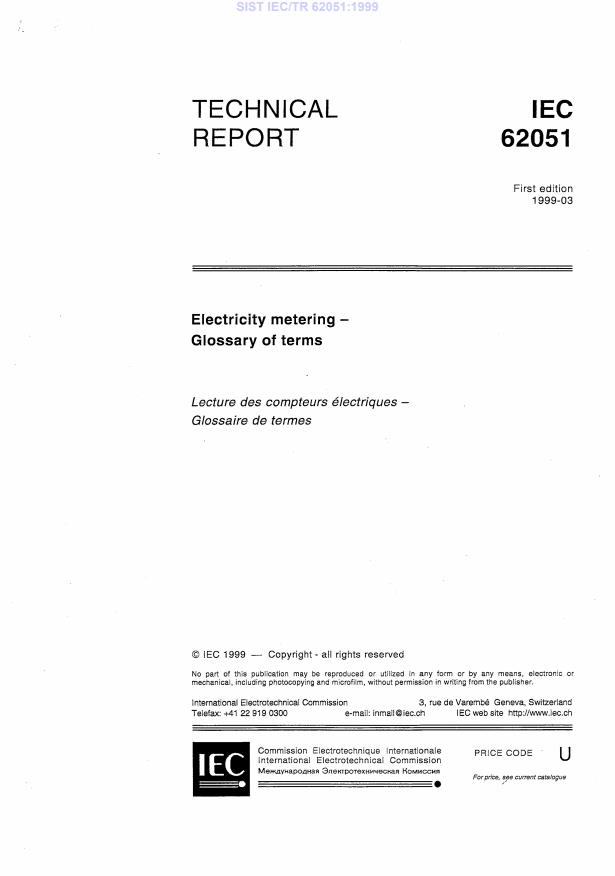
(Main)Electricity metering - Glossary of terms
Electricity metering - Glossary of terms
This technical report provides definitions of terms used in present and future standards on electrical energy measurement, prepared by IEC TC 13. These terms cover electrical energy measurement, tariff and load control, and customer/utility information exchange systems. The report includes terms on Distribution Automation Systems not covered by IEC 60050(371). The report also covers terms on customer/utility information exchange, electricity prepayment systems, and dependablility of electricity metering equipment.
Electricity metering - Glossary of terms
General Information
Standards Content (Sample)
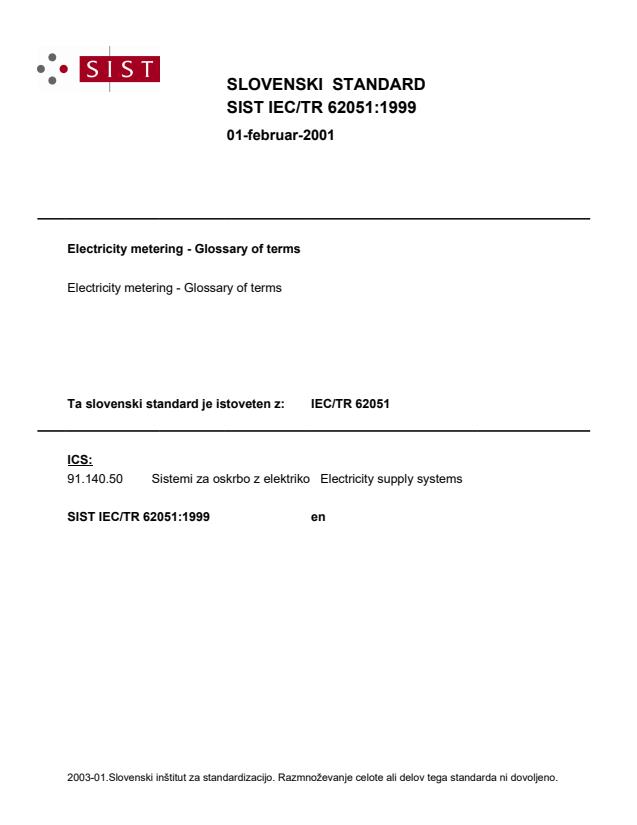
SLOVENSKI STANDARD
01-februar-2001
Electricity metering - Glossary of terms
Electricity metering - Glossary of terms
Ta slovenski standard je istoveten z: IEC/TR 62051
ICS:
91.140.50 Sistemi za oskrbo z elektriko Electricity supply systems
2003-01.Slovenski inštitut za standardizacijo. Razmnoževanje celote ali delov tega standarda ni dovoljeno.
...
This May Also Interest You
IEC 62052-31:2024 specifies general safety requirements and associated tests, with their appropriate conditions for type testing of directly connected, transformer-operated or transducer-operated AC and DC electricity meters and load control equipment. This document applies to electricity metering equipment designed to:
• measure and control electrical energy on electrical networks (mains) with voltage up to 1 000 V AC, or 1 500 V DC;
• have all functional elements, including add-on communication modules, enclosed in, or forming a single meter case with exception of indicating displays;
• operate with integrated displays (electromechanical or static meters);
• operate with detached indicating displays, or without an indicating display (static meters only);
• wall-mounted or to be installed in specified matching sockets or racks;
• optionally, provide additional functions other than those for measurement of electrical energy.
This document also applies to transducer-operated meters or meters designed for operation with Low Power Instrument Transformers (LPIT) or sensors (as defined in the IEC 61869 series).
When equipment in scope of this document is designed to be installed in a specified matching socket, then the requirements apply to, and the tests are performed on, equipment installed in its specified matching socket. However, requirements for sockets and inserting / removing the meters from the socket are outside the scope of this document.
This document is also applicable to auxiliary input and output circuits, operation indicators, and test outputs of equipment for electrical energy measurement.
Equipment used in conjunction with equipment for electrical energy measurement and control may need to comply with additional safety requirements. See also Clause 13.
This document does not apply to:
• meters rated to operate with voltage exceeding 1 000 V AC, or 1 500 V DC;
• metering systems comprising multiple devices physically remote from one another;
• portable meters;
• meters used in rolling stock, vehicles, ships and airplanes;
• laboratory and mobile meter test equipment;
• reference standard meters;
• conventional or low power instrument transformers;
• equipment with solid-state or other non-electromechanical supply and load control switches.
The safety requirements of this document are based on the following assumptions:
• metering equipment has been installed correctly;
• metering equipment is used generally by ordinary persons, including meter readers and consumers of electrical energy. In many cases, it is installed in a way that it is freely accessible. Its terminal covers cannot be removed, and its case cannot be opened without removing seals (if present) and using a tool;
• during normal use all terminal covers, covers and barriers providing protection against accessing hazardous live parts are in place;
• for installation, configuration, maintenance and repair it may be necessary to remove terminal cover(s), (a part of) the case or barriers so that hazardous live parts may become accessible. Such activities are performed by skilled persons, who have been suitably trained to be aware of working procedures necessary to ensure safety. Therefore, safety requirements covering these conditions are out of the Scope of this document.
This second edition cancels and replaces the first edition published in 2015. This edition constitutes a technical revision. Please see the foreword of IEC 62052-31 f
- Standard215 pagesEnglish languagesale 10% offe-Library read for×1 day
- 30-May-2023
- 22-Dec-2024
- 17.220.20
- 19.080
- 91.140.50
- 2014/30/EU
- MEE
This part of IEC 62053 applies only to static watt-hour meters of accuracy classes 0,5 and 1 for the measurement of DC electrical energy in DC systems, and it applies to their type tests only.
NOTE 1 For other general requirements, such as safety, dependability, etc., see the relevant parts of IEC 62052 or IEC 62059.
This document applies to electricity metering equipment designed to:
- measure and control electrical energy on electrical networks with two poles where one of the poles is connected to earth and with voltage up to 1 500 V DC;
NOTE 2 There are DC networks with other configurations or with more than 2 poles (for example networks with earth and both a positive and a negative pole).
- have all functional elements, including add-on modules, enclosed in, or forming a single meter case with the exception of indicating displays;
- operate with integrated or detached indicating displays, or without an indicating display;
- be installed in a specified matching socket or rack;
- optionally, provide additional functions other than those for measurement of electrical energy.
They may be used for measuring DC electrical energy, amongst others, in the following application areas:
- in EV (electrical vehicle) charging stations or in EV charging infrastructures, if the measurement is placed on the DC side;
- in information technology (IT) server farms;
- in DC supply points for communication equipment;
- in low voltage DC networks for residential or commercial areas, if the measurement is placed on the DC side;
- in solar PV (photovoltaic) systems where DC power generation is measured;
- in DC supply points for public transport networks (e.g. trolleybus, etc.).
Meters designed for operation with low power instrument transformers, LPITs as defined in the IEC 61869 series, may be tested for compliance with this document only if such meters and their LPITs are tested together and meet the requirements for directly connected meters.
NOTE 3 Modern electricity meters typically contain additional functions such as measurement of voltage magnitude, current magnitude, power, etc.; measurement of power quality parameters; load control functions; delivery, time, test, accounting, recording functions; data communication interfaces and associated data security functions. The relevant standards for these functions may apply in addition to the requirements of this document. However, the requirements for such functions are outside the scope of this document.
- Standard19 pagesEnglish languagesale 10% offe-Library read for×1 day
- Amendment3 pagesEnglish languagesale 10% offe-Library read for×1 day
- 03-Mar-2024
- 17.220.20
- 91.140.50
- 2014/32/EU
- M/541
- MEE
This part of IEC 62056 specifies the overall structure of the OBject Identification System (OBIS) and the mapping of all commonly used data items in metering equipment to their identification codes.
OBIS provides a unique identifier for all data within the metering equipment, including not only measurement values, but also abstract values used for configuration or obtaining information about the behaviour of the metering equipment. The ID codes defined in this document are used for the identification of:
- logical names of the various instances of the ICs, or objects, as defined in IEC 62056-6-2:2021;
- data transmitted through communication lines;
- data displayed on the metering equipment, see Clause A.2.
This document applies to all types of metering equipment, such as fully integrated meters, modular meters, tariff attachments, data concentrators, etc.
To cover metering equipment measuring energy types other than electricity, combined metering equipment measuring more than one type of energy or metering equipment with several physical measurement channels, the concepts of medium and channels are introduced. This allows meter data originating from different sources to be identified. While this document fully defines the structure of the identification system for other media, the mapping of non-electrical energy related data items to ID codes is completed separately.
NOTE EN 13757-1:2014 defines identifiers for metering equipment other than electricity: heat cost allocators, thermal energy, gas, cold water and hot water.
- Standard46 pagesEnglish languagesale 10% offe-Library read for×1 day
- Standard46 pagesEnglish languagesale 10% offe-Library read for×1 day
IEC 62056-8-12:2023 describes the use of DLMS®/COSEM for Low-Power Wide Area Networks (LPWANs). It specifies how the COSEM data model and the DLMS®/COSEM application layer can be used over various LPWAN technologies using an adaptation layer based on IETF RFC 8724, and in particular over LoRaWAN.
This profile is intended to be used with LPWANs as defined in IETF RFC 8724, in particular LoRaWAN. Low-Power Wide Area Networks (LPWANs) are wireless technologies with characteristics such as large coverage areas, low bandwidth, possibly very small packet and application-layer data sizes, and long battery life operation. This document does not provide functionality to manage the lower layers of the LPWANs.
This part of the DLMS®/COSEM suite specifies the communication profile for Low-Power Wide Area Networks (LPWANs).
The DLMS®/COSEM LPWAN communication profiles use connection-less transport layer based on the Internet Standard User Datagram Protocol (UDP) and Internet Protocol (IPv6).
The adaptation layer is based on IETF RFC 8724 which provides both a header compression/decompression mechanism and an optional fragmentation/reassembly mechanism. SCHC compression is based on static context with small context identifier to represent full IPv6/UDP/COSEM wrapper headers. If required, SCHC fragmentation is used to support IPv6 MTU over the LPWAN technologies.
This document follows the rules defined in IEC 62056-5-3:2023, Annex A, and in IEC 62056-1-0, and IEC TS 62056-1-1:2016 for its structure. See also Annex A for examples
- Standard34 pagesEnglish languagesale 10% offe-Library read for×1 day
This part of IEC 62056 specifies a model of a meter as it is seen through its communication interface(s). Generic building blocks are defined using object-oriented methods, in the form of interface classes to model meters from simple up to very complex functionality.
Annexes A to F (informative) provide additional information related to some interface classes.
- Standard533 pagesEnglish languagesale 10% offe-Library read for×1 day
This part of IEC 62056 specifies the DLMS®/COSEM application layer in terms of structure, services and protocols for DLMS®/COSEM clients and servers, and defines rules to specify the DLMS®/COSEM communication profiles.
It defines services for establishing and releasing application associations, and data communication services for accessing the methods and attributes of COSEM interface objects, defined in IEC 62056-6-2:2021 using either logical name (LN) or short name (SN) referencing.
Annex A (normative) defines how to use the COSEM application layer in various communication profiles. It specifies how various communication profiles can be constructed for exchanging data with metering equipment using the COSEM interface model, and what are the necessary elements to specify in each communication profile. The actual, media-specific communication profiles are specified in separate parts of the IEC 62056 series.
Annex B (normative) specifies the SMS short wrapper.
Annex C (normative) specifies the gateway protocol.
Annex D, Annex E and Annex F (informative) include encoding examples for APDUs.
Annex G (normative) provides NSA Suite B elliptic curves and domain parameters.
Annex H (informative) provides an example of an End entity signature certificate using P-256 signed with P-256.
Annex I (normative) specifies the use of key agreement schemes in DLMS®/COSEM.
Annex J (informative) provides examples of exchanging protected xDLMS APDUs between a third party and a server.
Annex K (informative) lists the main technical changes in this edition of the standard.
- Standard380 pagesEnglish languagesale 10% offe-Library read for×1 day
This document applies only to static watt-hour meters of accuracy classes A, B and C for the measurement of direct current electrical active energy in DC systems and it applies to their type tests.
NOTE 1 For general requirements, such as construction, EMC, safety, dependability etc., see the relevant EN 62052 series or EN 62059 series.
This document applies to electricity metering equipment designed to:
- measure and control electrical energy on DC electrical networks with voltages up to 1 500 V;
NOTE 2 Meters for unearthed DC supplies and meters for three-wire DC networks are within the scope of this document.
- form a complete meter including the legally relevant display of measured values;
NOTE 3 Electrical energy meters constructed from separate parts as described in WELMEC Guide 11.7:2017 are included.
- operate with integrated or detached legally relevant displays;
- optionally, provide additional functions other than those for measurement of electrical energy.
They can be used for measuring DC electrical energy, amongst others, in the following application areas:
- in EV (electrical vehicle) charging stations or in EV charging infrastructure (also called EVSE, electric vehicle supply equipment), if energy is measured on the DC side;
- in solar PV (photovoltaic) systems where DC power generation is measured;
- in low voltage DC networks for residential or commercial areas, if energy is measured on the DC side, including similar applications like information technology (IT) server farms or DC supply points for communication equipment;
- in DC supply points for public transport networks (e.g. for trolleybuses);
- in mobile applications on vehicles for e-road (electric road) systems.
Meters designed for operation with external DC instrument transformers, transducers or shunts can be tested for compliance with this document only if such meters and their transformers, transducers or shunts are tested together and meet the requirements for directly connected meters. Requirements in this document and in EN IEC 62052 11:20211 applying to meters designed for operation with DC LPITs also apply to meters designed for operation with external instrument transformers, transducers or shunts.
NOTE 4 Modern electricity meters typically contain additional functions such as measurement of voltage magnitude, current magnitude, power, etc.; measurement of power quality parameters; load control functions; delivery, time, test, accounting, recording functions; data communication interfaces and associated data security functions. The relevant standards for these functions could apply in addition to the requirements of this document. However, the requirements for such functions are outside the scope of this document.
NOTE 5 Product requirements for power metering and monitoring devices (PMDs) and measurement functions such as voltage magnitude, current magnitude, power, etc., are covered in EN IEC 61557-12:2022. However, devices compliant with EN IEC 61557-12:2022 are not intended to be used as billing meters unless they are also compliant with EN IEC 62052 11:20211 and this document.
NOTE 6 Requirements for DC power quality (PQ) instruments, DC PQ measuring techniques, and DC PQ instrument testing are under discussion and will be specified in other standards.
This document does not apply to:
— portable meters;
NOTE 7 Portable meters are meters that are not permanently connected.
— meters used in rolling stock (railway applications), ships and airplanes;
NOTE 8 DC meters for rolling stock are covered by other standards, e.g. by the EN 50463 series.
[...]
- Standard32 pagesEnglish languagesale 10% offe-Library read for×1 day
- 14-Sep-2023
- 17.220.20
- 91.140.50
- 2014/32/EU
- M/541
- MEE
IEC 62057-1:2023 applies to stationary meter test units (MTUs) permanently installed in laboratories, used for testing and calibration of electricity meters, in particular for their type test, acceptance test and verification test. It covers the requirements for automatic MTUs for indoor laboratory application and applies to newly manufactured MTUs to test electricity meters on 50 Hz or 60 Hz networks with an AC voltage up to 600 V (phase to neutral).
If meters are intended for system voltages not specified in this document, special requirements are agreed between the manufacturer and the purchaser.
This document also defines the kind of tests to perform as type tests / routine tests / acceptance tests and commissioning tests for MTUs.
It does not apply to:
• portable reference meters and portable sources;
• electricity meters;
• data interfaces to the meter and test procedures of data interface;
• transformer operated MTUs;
• personal computers supplied together with the MTU.
- Standard80 pagesEnglish languagesale 10% offe-Library read for×1 day
IEC 62052-41:2022 applies only to newly manufactured multi-energy and/or multi-rate static meters and it applies to their type tests only.
This document applies to electricity metering equipment designed to:
• measure and control electrical energy on networks with voltage up to 1 000 V AC, or 1 500 V DC;
• have all functional elements, including add-on modules, enclosed in, or forming a single meter case with exception of indicating displays;
• operate with integrated displays;
• operate with detached indicating displays, or without an indicating display;
• be installed in a specified matching socket or rack;
• optionally, provide additional functions other than those for measurement of electrical energy.
Meters designed for operation with Low Power Instrument Transformers (LPITs as defined in the IEC 61869 series) may be tested for compliance with this document and the relevant IEC 62053 series documents only if such meters and their LPITs are tested together as directly connected meters.
This document does not apply to:
• meters for which the voltage line-to-neutral derived from nominal voltages exceeds 1 000 V AC, or 1 500 V DC;
• meters intended for connection with low power instrument transformers (LPITs as defined in the IEC 61869 series of standards) when tested without such transformers;
• metering systems comprising multiple devices (except for LPITs) physically remote from one another;
• portable meters;
• meters used in rolling stock, vehicles, ships and airplanes;
• laboratory and meter test equipment;
• reference standard meters;
• data interfaces to the register of the meter;
• matching sockets or racks used for installation of electricity metering equipment.
This document does not cover measures for the detection and prevention of fraudulent attempts to compromise a meter’s performance (tampering).
- Standard26 pagesEnglish languagesale 10% offe-Library read for×1 day
Questions, Comments and Discussion
Ask us and Technical Secretary will try to provide an answer. You can facilitate discussion about the standard in here.
Loading comments...