

SIST EN 12520:2025/oprA1:2026
(Amendment)Furniture - Safety, strength and durability - Requirements for domestic seating
- Abstract
This document specifies the minimum requirements for the safety, strength and durability of all types of domestic seating for adults. It also specifies additional test methods for seat side-to-side durability as well as finger entrapment and shear and compression.
It does not apply to ranked seating, seating for non-domestic use, office work chairs, chairs for educational institutions, outdoor seating and to links for linked seating for which European Standards exist.
It does not include requirements for the durability of upholstery materials, castors, reclining and tilting mechanisms and seat height adjustment mechanisms.
It does not include requirements for electrical safety.
It does not include requirements for the resistance to ageing, degradation, flammability and ergonomics.
The requirements are based on use by persons weighing up to 110 kg.
Annex A (normative) specifies the seat side-to-side durability test in D-G points.
Annex B (informative) gives rationales for some of the tests referred to in Table 1.
Annex C (normative) specifies the test methods for finger entrapment and shear and compression.
Annex D (normative) specifies the seat loading point for seating with suspended flexible material.
- Status
- Not Published
- Public Enquiry End Date
- 01-Mar-2026
- Technical Committee
- POH - Furniture
- Current Stage
- 4020 - Public enquire (PE) (Adopted Project)
- Start Date
- 18-Dec-2025
- Due Date
- 07-May-2026
- Completion Date
- 27-Mar-2026

SIST EN 12520:2025/oprA1:2026 is a draft amendment to EN 12520:2024, published by SIST from CEN/TC 207. It updates the safety, strength and durability requirements for domestic seating for adults and revises the test language for finger entrapment and related opening hazards.
What does SIST EN 12520:2025/oprA1:2026 specify?
SIST EN 12520:2025/oprA1:2026 specifies changes to the European standard for domestic seating, not a standalone product standard. In practice, it refines how manufacturers and test laboratories check seating for adults, especially around entrapment hazards, moving parts and durability test interpretation.
The amendment keeps the focus on domestic seating and the existing exclusions in the base standard, while updating the wording of several safety clauses and annexes. The main practical effect is to align the document more closely with finger-entrapment testing and to remove the old shear-and-compression test route from Annex C.
| Annex | What it covers |
|---|---|
| Annex A | Seat side-to-side durability test in D-G points |
| Annex B | Rationales for some tests referred to in Table 1 |
| Annex C | Test methods for finger entrapment |
| Annex D | Seat loading point for seating with suspended flexible material |
What are the key requirements of SIST EN 12520:2025/oprA1:2026?
The amendment changes the hazard checks and test methods that support the domestic-seating requirements in EN 12520:2024. For a manufacturer or test house, the main task is to apply the updated wording when deciding which openings, moving parts and load applications must be checked.
Safety definitions and hazard identification
Clause 3 adds definitions for shear point and compression point. These definitions matter because the safety clauses use them to identify where moving parts can cut or trap a finger or other object.
Clause 5.1.2 also tightens the wording for holes in tubular or rigid components by tying the check to accessible parts. In practice, this tells the reader to assess openings only where a person can reasonably reach them.
Setting up, folding and moving mechanisms
Clause 5.1.3.2 adds a specific rule for adjustable backrests when the user must leave the product to change the inclination. The backrest adjustment is treated as a setting up and folding operation, so the hazard review must follow that use case.
Clause 5.1.3.3 removes the old statement that a requirement is met if no hazard is found in the deleted C.2.3 test. That matters because the compliance path changes and the deleted shear-and-compression test is no longer the route named here.
Normal use and durability evidence
Clause 5.1.3.4 changes the wording around shear and compression points during use, and states that the loads and application points used for durability tests 6 and 7 in Table 1 are representative of normal use. For readers, that means the durability tests are not just laboratory exercises - they are intended to stand in for typical use conditions.
Annex changes
Annex A.2.1 deletes the general positioning text that previously referred to EN 1728:2012, 5.2. Annex C is retitled so it covers finger entrapment only, and Clause C.2 is deleted in full. The practical result is a narrower, more focused finger-entrapment method.
What terms does SIST EN 12520:2025/oprA1:2026 define?
- Shear point - a place where two moving parts pass each other like scissors and can cut something in between.
- Compression point - a place where two surfaces move toward each other without crossing and reduce the gap or volume between them.
- Finger entrapment - the hazard of a finger becoming caught in an opening or between parts during use or testing.
- Setting up and folding - operations where the seating is opened, closed or otherwise prepared for use.
- Non-electrically powered mechanisms - moving parts operated without electrical power, such as manual folding or reclining actions.
- Suspended flexible material - flexible seat material supported in a slung or hanging arrangement, which affects the loading point.
Who uses SIST EN 12520:2025/oprA1:2026?
SIST EN 12520:2025/oprA1:2026 is used by furniture manufacturers, design engineers, test laboratories and quality managers working on domestic seating. Buyers and specifiers also use it when they need a technical basis for accepting seating products. The amendment is especially relevant for teams checking folding actions, backrest adjustment, finger entrapment risk and durability test setup.
What changed in SIST EN 12520:2025/oprA1:2026 from the previous edition?
SIST EN 12520:2025/oprA1:2026 modifies EN 12520:2024. The amendment:
- narrows Annex C so it specifies finger-entrapment methods only
- adds definitions for shear point and compression point
- updates the wording for holes in tubular or rigid components
- treats some adjustable backrest changes as setting up and folding
- removes the old references to C.2.3 hazard checks
- updates the durability-use wording in 5.1.3.4
- deletes the Annex A positioning paragraph that referred to EN 1728:2012
- revises the finger-entrapment method in Annex C
- deletes Clause C.2 entirely
Which standards are used with SIST EN 12520:2025/oprA1:2026?
SIST EN 12520:2025/oprA1:2026 is the amendment to EN 12520:2024. The amendment also removes the Annex A text that previously referred to EN 1728:2012, 5.2 for positioning the seating on the test surface.
What does the SIST EN 12520:2025/oprA1:2026 document contain?
SIST EN 12520:2025/oprA1:2026 is a clause-by-clause amendment document. It contains the European foreword, a contents list, and ten modification items covering the scope, terms and definitions, safety clauses, Annex A, and Annex C.
The document points readers to the parts of the base standard that are affected rather than rewriting the whole standard. It includes references to Table 1, Table C.1, Figures C.1 to C.3, and the annexes for durability, rationale and loading-point setup. For implementers, this is a working document for updating tests, inspection routines and product documentation against EN 12520:2024.
Relations
- Revises
SIST EN 12520:2025 - Furniture - Safety, strength and durability - Requirements for domestic seating - Effective Date
- 01-Feb-2026
Frequently Asked Questions
SIST EN 12520:2025/oprA1:2026 is a draft published by the Slovenian Institute for Standardization (SIST). Its full title is "Furniture - Safety, strength and durability - Requirements for domestic seating". This standard covers: This document specifies the minimum requirements for the safety, strength and durability of all types of domestic seating for adults. It also specifies additional test methods for seat side-to-side durability as well as finger entrapment and shear and compression. It does not apply to ranked seating, seating for non-domestic use, office work chairs, chairs for educational institutions, outdoor seating and to links for linked seating for which European Standards exist. It does not include requirements for the durability of upholstery materials, castors, reclining and tilting mechanisms and seat height adjustment mechanisms. It does not include requirements for electrical safety. It does not include requirements for the resistance to ageing, degradation, flammability and ergonomics. The requirements are based on use by persons weighing up to 110 kg. Annex A (normative) specifies the seat side-to-side durability test in D-G points. Annex B (informative) gives rationales for some of the tests referred to in Table 1. Annex C (normative) specifies the test methods for finger entrapment and shear and compression. Annex D (normative) specifies the seat loading point for seating with suspended flexible material.
This document specifies the minimum requirements for the safety, strength and durability of all types of domestic seating for adults. It also specifies additional test methods for seat side-to-side durability as well as finger entrapment and shear and compression. It does not apply to ranked seating, seating for non-domestic use, office work chairs, chairs for educational institutions, outdoor seating and to links for linked seating for which European Standards exist. It does not include requirements for the durability of upholstery materials, castors, reclining and tilting mechanisms and seat height adjustment mechanisms. It does not include requirements for electrical safety. It does not include requirements for the resistance to ageing, degradation, flammability and ergonomics. The requirements are based on use by persons weighing up to 110 kg. Annex A (normative) specifies the seat side-to-side durability test in D-G points. Annex B (informative) gives rationales for some of the tests referred to in Table 1. Annex C (normative) specifies the test methods for finger entrapment and shear and compression. Annex D (normative) specifies the seat loading point for seating with suspended flexible material.
SIST EN 12520:2025/oprA1:2026 is classified under the following ICS (International Classification for Standards) categories: 97.140 - Furniture. The ICS classification helps identify the subject area and facilitates finding related standards.
SIST EN 12520:2025/oprA1:2026 has the following relationships with other standards: It is inter standard links to SIST EN 12520:2025. Understanding these relationships helps ensure you are using the most current and applicable version of the standard.
SIST EN 12520:2025/oprA1:2026 is available in PDF format for immediate download after purchase. The document can be added to your cart and obtained through the secure checkout process. Digital delivery ensures instant access to the complete standard document.
Standards Content (Sample)
SLOVENSKI STANDARD
01-februar-2026
Pohištvo - Varnost, trdnost in trajnost - Zahteve za sedežno pohištvo za domačo
uporabo - Dopolnilo A1
Furniture - Safety, strength and durability - Requirements for domestic seating
Möbel - Sicherheit, Festigkeit und Dauerhaltbarkeit - Anforderungen an Sitzmöbel für
den Wohnbereich
Meubles - Sécurité, résistance et durabilité - Exigences relatives aux sièges à usage
domestique
Ta slovenski standard je istoveten z: EN 12520:2024/prA1
ICS:
97.140 Pohištvo Furniture
2003-01.Slovenski inštitut za standardizacijo. Razmnoževanje celote ali delov tega standarda ni dovoljeno.
DRAFT
EUROPEAN STANDARD
EN 12520:2024
NORME EUROPÉENNE
EUROPÄISCHE NORM
prA1
January 2026
ICS 97.140
English Version
Furniture - Safety, strength and durability - Requirements
for domestic seating
Meubles - Sécurité, résistance et durabilité - Exigences Möbel - Sicherheit, Festigkeit und Dauerhaltbarkeit -
relatives aux sièges à usage domestique Anforderungen an Sitzmöbel für den Wohnbereich
This draft amendment is submitted to CEN members for enquiry. It has been drawn up by the Technical Committee CEN/TC 207.
This draft amendment A1, if approved, will modify the European Standard EN 12520:2024. If this draft becomes an amendment,
CEN members are bound to comply with the CEN/CENELEC Internal Regulations which stipulate the conditions for inclusion of
this amendment into the relevant national standard without any alteration.
This draft amendment was established by CEN in three official versions (English, French, German). A version in any other
language made by translation under the responsibility of a CEN member into its own language and notified to the CEN-CENELEC
Management Centre has the same status as the official versions.
CEN members are the national standards bodies of Austria, Belgium, Bulgaria, Croatia, Cyprus, Czech Republic, Denmark, Estonia,
Finland, France, Germany, Greece, Hungary, Iceland, Ireland, Italy, Latvia, Lithuania, Luxembourg, Malta, Netherlands, Norway,
Poland, Portugal, Republic of North Macedonia, Romania, Serbia, Slovakia, Slovenia, Spain, Sweden, Switzerland, Türkiye and
United Kingdom.
Recipients of this draft are invited to submit, with their comments, notification of any relevant patent rights of which they are
aware and to provide supporting documentation.
Warning : This document is not a European Standard. It is distributed for review and comments. It is subject to change without
notice and shall not be referred to as a European Standard.
EUROPEAN COMMITTEE FOR STANDARDIZATION
COMITÉ EUROPÉEN DE NORMALISATION
EUROPÄISCHES KOMITEE FÜR NORMUNG
CEN-CENELEC Management Centre: Rue de la Science 23, B-1040 Brussels
© 2026 CEN All rights of exploitation in any form and by any means reserved Ref. No. EN 12520:2024/prA1:2026 E
worldwide for CEN national Members.
EN 12520:2024/prA1:2026 (E)
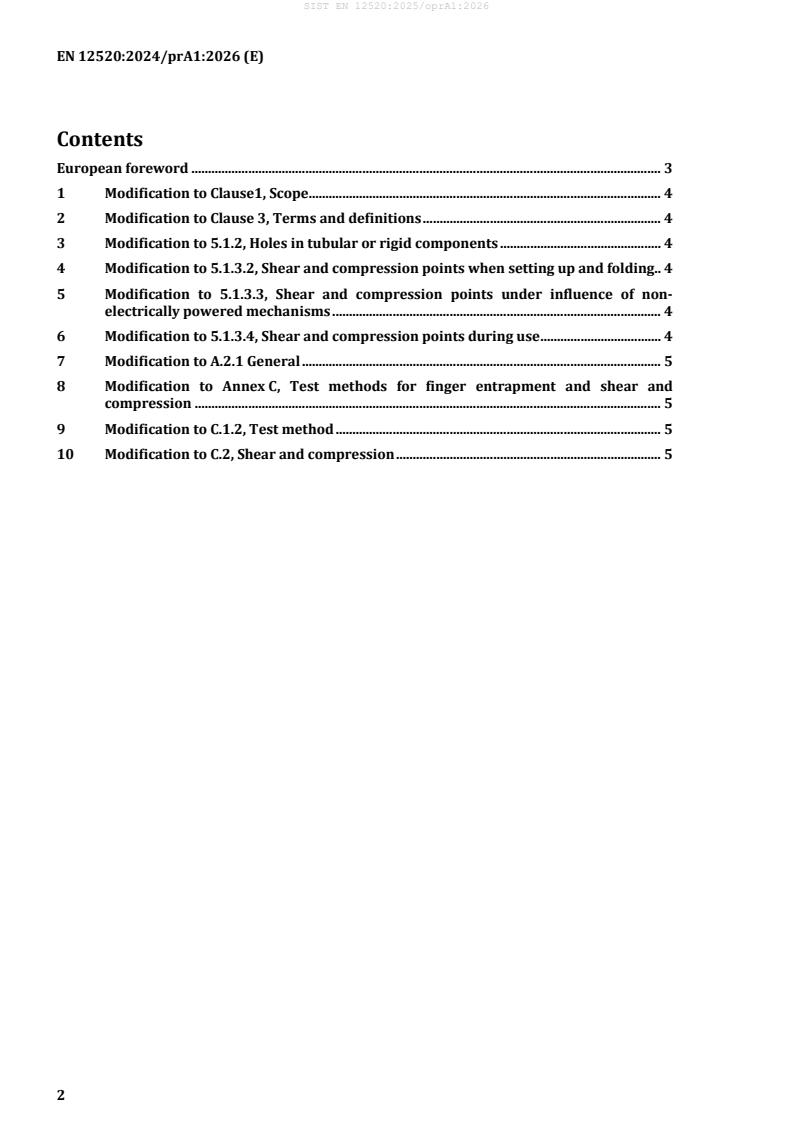
Contents
European foreword . 3
1 Modification to Clause1, Scope. 4
2 Modification to Clause 3, Terms and definitions . 4
3 Modification to 5.1.2, Holes in tubular or rigid components . 4
4 Modification to 5.1.3.2, Shear and compression points when setting up and folding. 4
5 Modification to 5.1.3.3, Shear and compression points under influence of non-
electrically powered mechanisms . 4
6 Modification to 5.1.3.4, Shear and compression points during use . 4
7 Modification to A.2.1 General . 5
8 Modification to Annex C, Test methods for finger entrapment and shear and
compression .
...