

SIST EN 12520:2025/kFprA1:2026
(Amendment)Furniture - Safety, strength and durability - Requirements for domestic seating
- Abstract
This document specifies the minimum requirements for the safety, strength and durability of all types of domestic seating for adults. It also specifies additional test methods for seat side-to-side durability as well as finger entrapment and shear and compression.
It does not apply to ranked seating, seating for non-domestic use, office work chairs, chairs for educational institutions, outdoor seating and to links for linked seating for which European Standards exist.
It does not include requirements for the durability of upholstery materials, castors, reclining and tilting mechanisms and seat height adjustment mechanisms.
It does not include requirements for electrical safety.
It does not include requirements for the resistance to ageing, degradation, flammability and ergonomics.
The requirements are based on use by persons weighing up to 110 kg.
Annex A (normative) specifies the seat side-to-side durability test in D-G points.
Annex B (informative) gives rationales for some of the tests referred to in Table 1.
Annex C (normative) specifies the test methods for finger entrapment and shear and compression.
Annex D (normative) specifies the seat loading point for seating with suspended flexible material.
- Status
- Not Published
- Public Enquiry End Date
- 01-Mar-2026
- Technical Committee
- POH - Furniture
- Current Stage
- 5020 - Formal vote (FV) (Adopted Project)
- Start Date
- 19-Oct-2026
- Due Date
- 07-Dec-2026
- Completion Date
- 17-Nov-2026

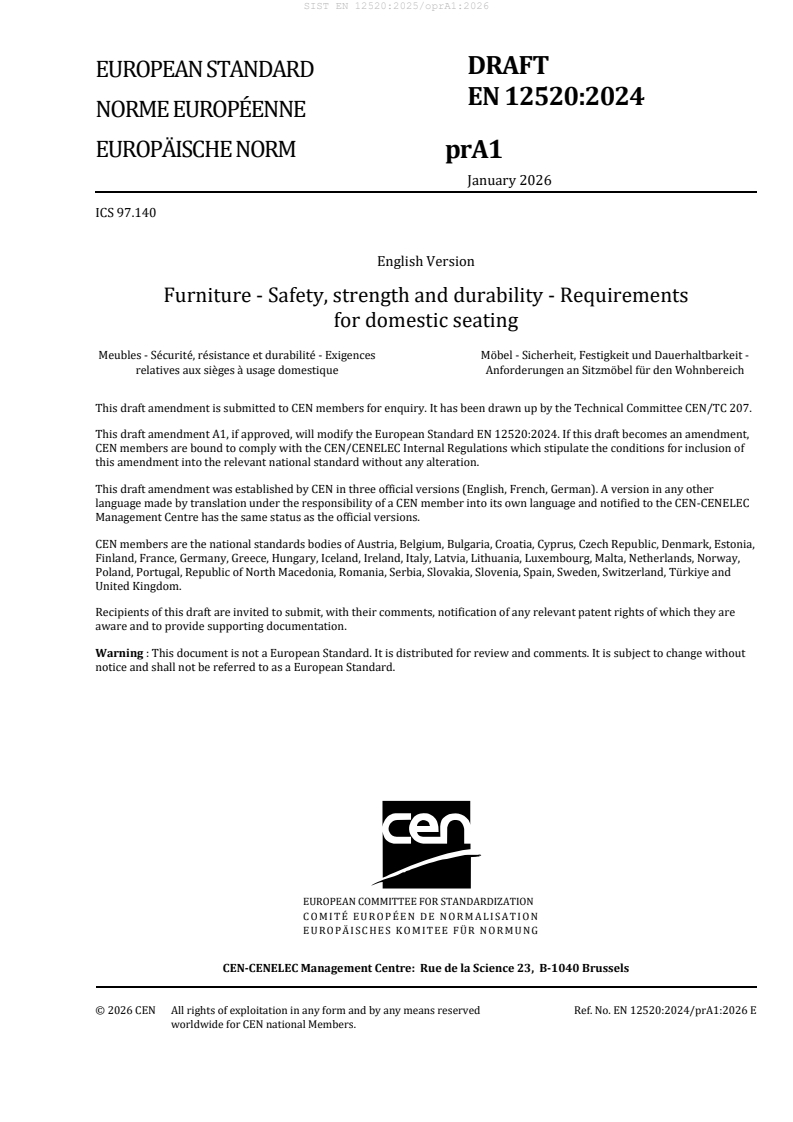
SIST EN 12520:2025/kFprA1:2026 is the Slovenian draft amendment to EN 12520:2024 from CEN. It updates the safety, strength and durability requirements for domestic seating for adults, with particular changes to the wording and test provisions for finger entrapment, shear and compression points, and related test setup.
What does SIST EN 12520:2025/kFprA1:2026 specify?
SIST EN 12520:2025/kFprA1:2026 modifies the European standard for domestic seating rather than replacing it outright. The underlying standard sets minimum requirements for safety, strength and durability for adult domestic seating, and this amendment refines how some hazards and tests are described.
The scope of the underlying standard excludes ranked seating, non-domestic seating, office work chairs, chairs for educational institutions, outdoor seating and links for linked seating where European Standards already exist. It also leaves out upholstery durability, castors, reclining and tilting mechanisms, seat height adjustment mechanisms, electrical safety, ageing, degradation, flammability and ergonomics. The requirements are based on use by persons weighing up to 110 kg, which matters because it defines the test basis for design and assessment.
The document is organized as a short amendment with changes to Clause 1, Clause 3, Clause 5.1.2, Clause 5.1.3.2, Clause 5.1.3.3, Clause 5.1.3.4, A.2.1, Annex C, C.1.2 and C.2.
| Annex | What it covers |
|---|---|
| Annex A | Seat side-to-side durability test in D-G points |
| Annex B | Rationales for some tests referred to in Table 1 |
| Annex C | Finger entrapment test methods |
| Annex D | Seat loading point for seating with suspended flexible material |
What are the key requirements of SIST EN 12520:2025/kFprA1:2026?
SIST EN 12520:2025/kFprA1:2026 keeps the base standard focused on safe everyday use, but it changes how some hazard checks are framed. The most important practical effect is that the amendment narrows Annex C to finger entrapment and revises the language around shear and compression points in the main body.
- Clause 1, Scope - Annex C is now described as covering finger entrapment only. For users of the standard, this means the shear and compression hazard checks are no longer treated as Annex C test methods.
- Clause 3 - The amendment adds definitions for shear point and compression point. These definitions matter because they tell designers and test labs which moving interfaces need hazard review.
- Clause 5.1.2 - The wording for holes in tubular or rigid components is updated with a numbered reference to accessible parts. In practice, this helps align the clause with the standard's defined hazard areas.
- Clause 5.1.3.2 - For products with adjustable backrests that require the user to leave the product to change inclination, that adjustment is treated as a setting up and folding operation. This matters because it brings that movement into the hazard assessment for moving parts.
- Clause 5.1.3.3 and 5.1.3.4 - The amendment removes the previous pass/fail wording tied to testing in C.2.3, and it states that the loads and application points for durability tests 6 and 7 in Table 1 are representative of normal use. In practice, the normal-use durability loads become part of the hazard context.
- Annex A and Annex D - Annex A still covers seat side-to-side durability, and Annex D still defines the loading point for seating with suspended flexible material. These annexes matter because they give repeatable test setups for lateral loading and for sling-style seats.
What terms does SIST EN 12520:2025/kFprA1:2026 define?
- Domestic seating - Seating intended for domestic use, which is the product group covered by the standard.
- Accessible parts - Parts that can be reached during use and therefore need hazard assessment for openings and moving elements.
- Finger entrapment - A situation where a finger can enter an opening or gap and be exposed to injury risk.
- Shear point - Any location where two moving parts pass each other and can create a scissor-like cutting action.
- Compression point - Any location where two surfaces move toward each other and reduce the gap between them.
- Seat side-to-side durability - A test concept for checking how well the seat resists repeated lateral loading.
- Suspended flexible material - Seat construction that uses flexible material to support the user and needs a defined loading point for testing.
Who uses SIST EN 12520:2025/kFprA1:2026?
SIST EN 12520:2025/kFprA1:2026 is used by furniture manufacturers, product designers, test laboratories, quality managers and buyers who specify domestic seating. It is relevant for chairs, seats and similar products intended for home use, especially when a team needs a common basis for design review, type testing, supplier acceptance or conformity assessment.
What changed in SIST EN 12520:2025/kFprA1:2026 from the previous edition?
This draft amendment modifies EN 12520:2024. The changes stated in the document are:
- Annex C is limited to finger entrapment.
- Definitions for shear point and compression point are added.
- Clause 5.1.2 gets a numbered reference to accessible parts.
- Clause 5.1.3.2 adds a note for adjustable backrests that require the user to leave the product.
- Clause 5.1.3.3 and 5.1.3.4 remove the former no-hazard wording tied to C.2.3.
- A.2.1 loses the opening paragraph that referred to EN 1728:2012 and Table A.1 setup wording.
- Annex C and C.1.2 are revised, Figure C.4 is deleted, Table C.1 wording is updated, and C.2 is removed entirely.
Which standards are used with SIST EN 12520:2025/kFprA1:2026?
- EN 12520:2024 - This is the parent European Standard that the amendment modifies.
- EN 1728:2012 - The amendment text names this standard in the deleted A.2.1 wording for positioning seating on the test surface.
What does the SIST EN 12520:2025/kFprA1:2026 document contain?
The document is a marked amendment with a European foreword and ten numbered modification items. It revises the scope, terms and definitions, hazard wording, the Annex A setup text, and the Annex C finger-entrapment method.
It also changes the process flow in Table C.1, updates the probe-based checks in C.1.2, and removes the whole of C.2, including its subclauses and tables. That structure matters because it tells readers exactly which test descriptions, figures and decision steps need to be updated in procedures and compliance files.
Relations
- Revises
SIST EN 12520:2025 - Furniture - Safety, strength and durability - Requirements for domestic seating - Effective Date
- 01-Feb-2026
Frequently Asked Questions
SIST EN 12520:2025/kFprA1:2026 is a draft published by the Slovenian Institute for Standardization (SIST). Its full title is "Furniture - Safety, strength and durability - Requirements for domestic seating". This standard covers: This document specifies the minimum requirements for the safety, strength and durability of all types of domestic seating for adults. It also specifies additional test methods for seat side-to-side durability as well as finger entrapment and shear and compression. It does not apply to ranked seating, seating for non-domestic use, office work chairs, chairs for educational institutions, outdoor seating and to links for linked seating for which European Standards exist. It does not include requirements for the durability of upholstery materials, castors, reclining and tilting mechanisms and seat height adjustment mechanisms. It does not include requirements for electrical safety. It does not include requirements for the resistance to ageing, degradation, flammability and ergonomics. The requirements are based on use by persons weighing up to 110 kg. Annex A (normative) specifies the seat side-to-side durability test in D-G points. Annex B (informative) gives rationales for some of the tests referred to in Table 1. Annex C (normative) specifies the test methods for finger entrapment and shear and compression. Annex D (normative) specifies the seat loading point for seating with suspended flexible material.
This document specifies the minimum requirements for the safety, strength and durability of all types of domestic seating for adults. It also specifies additional test methods for seat side-to-side durability as well as finger entrapment and shear and compression. It does not apply to ranked seating, seating for non-domestic use, office work chairs, chairs for educational institutions, outdoor seating and to links for linked seating for which European Standards exist. It does not include requirements for the durability of upholstery materials, castors, reclining and tilting mechanisms and seat height adjustment mechanisms. It does not include requirements for electrical safety. It does not include requirements for the resistance to ageing, degradation, flammability and ergonomics. The requirements are based on use by persons weighing up to 110 kg. Annex A (normative) specifies the seat side-to-side durability test in D-G points. Annex B (informative) gives rationales for some of the tests referred to in Table 1. Annex C (normative) specifies the test methods for finger entrapment and shear and compression. Annex D (normative) specifies the seat loading point for seating with suspended flexible material.
SIST EN 12520:2025/kFprA1:2026 is classified under the following ICS (International Classification for Standards) categories: 97.140 - Furniture. The ICS classification helps identify the subject area and facilitates finding related standards.
SIST EN 12520:2025/kFprA1:2026 has the following relationships with other standards: It is inter standard links to SIST EN 12520:2025. Understanding these relationships helps ensure you are using the most current and applicable version of the standard.
SIST EN 12520:2025/kFprA1:2026 is available in PDF format for immediate download after purchase. The document can be added to your cart and obtained through the secure checkout process. Digital delivery ensures instant access to the complete standard document.
Standards Content (Sample)
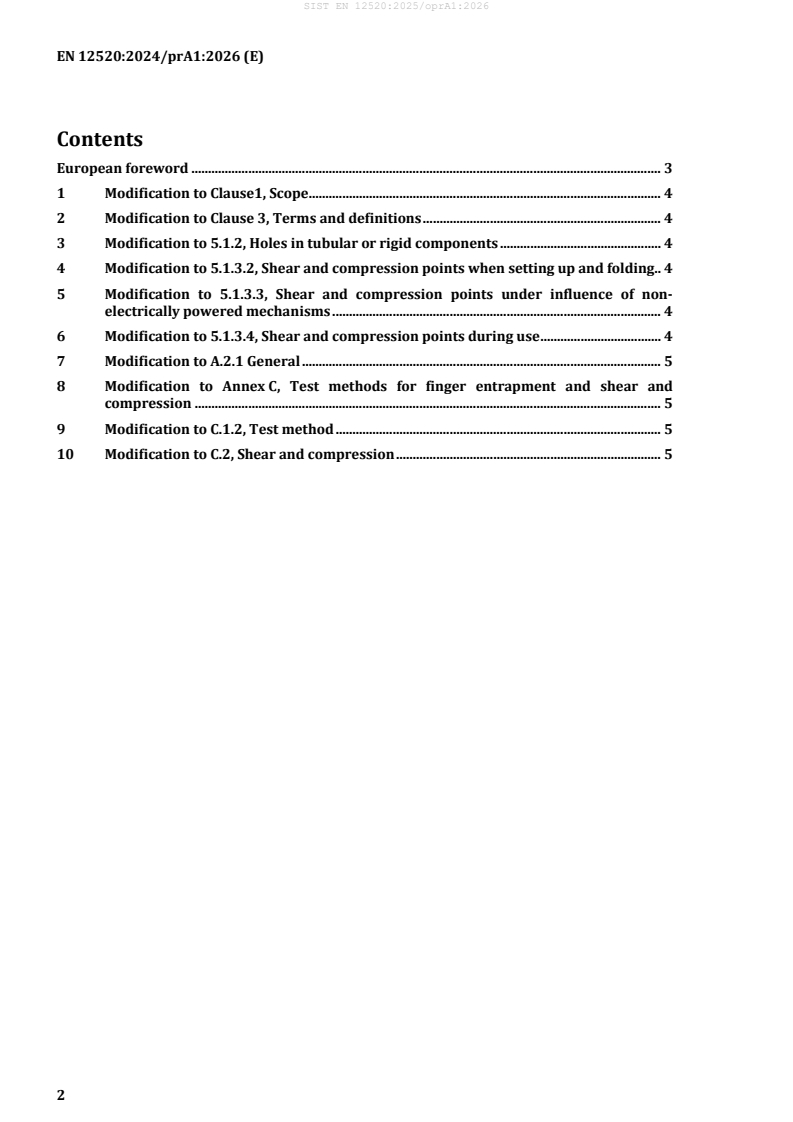
Contents
- European foreword
- 1 Modification to Clause1, Scope
- 2 Modification to Clause 3, Terms and definitions
- 3.7 compression point
- 3 Modification to 5.1.2, Holes in tubular or rigid components
- 4 Modification to 5.1.3.2, Shear and compression points when setting up and
- 5 Modification to 5.1.3.3, Shear and compression points under influence of non-
- 6 Modification to 5.1.3.4, Shear and compression points during use
- 7 Modification to A.2.1 General
- 8 Modification to Annex C, Test methods for finger entrapment and shear and
- 9 Modification to C.1.2, Test method
- 10 Modification to C.2, Shear and compression
European foreword
This document (EN 12520:2024/prA1:2026) has been prepared by Technical Committee CEN/TC 207 “Furniture”, the secretariat of which is held by UNI.
This document is currently submitted to the CEN Enquiry.
SIST EN 12520:2025/oprA1:2026 EN 12520:2024/prA1:2026 (E)
1 Modification to Clause1, Scope
Replace the second to last sentence:
“Annex C (normative) specifies the test methods for finger entrapment and shear and compression.” with “Annex C (normative) specifies the test methods for finger entrapment.”
2 Modification to Clause 3, Terms and definitions
Add the following definitions after 3.5:
“3.6 shear point any location where two moving parts come together and pass by each other resulting in scissor action and cutting an object in their path
3.7 compression point
any location where two surfaces moving against each other without crossing resulting in reducing the volume or gap between them”
3 Modification to 5.1.2, Holes in tubular or rigid components
In the first sentence add a number reference “(3.1)” after the term “accessible parts”.
4 Modification to 5.1.3.2, Shear and compression points when setting up and
folding Add the following paragraph after the first paragraph:
...