


SIST IEC 60255-8:1995
(Main)Electrical relays - Part 8: Thermal electrical relays
Electrical relays - Part 8: Thermal electrical relays
This edition supersedes the first edition of IEC 60255-8 (1978) and IEC 60255-17 (1982). Applies to dependent specified time electrical measuring relays which protect equipment from electrical thermal damage by the measurement of current flowing in protected equipment. States the particular requirements for thermal electrical relays. Is to be read in conjunction with higher level documents in the IEC 60255 series.
Relais électriques - Huitième partie: Relais électriques thermiques
Est applicable aux relais électriques de mesure à temps dépendant spécifié qui protégent le dispositif contre les détériorations thermiques d'origine électrique par la mesure du courant circulant dans le dispositif protégé. Donne les spécifications particulières des relais électriques thermiques. Doit être lue conjointement avec les documents de niveau supérieur de la série de CEI 60255 de la CEI. Cette publication remplace la CEI 60255-17 (1982).
Electrical relays - Part 8: Thermal electrical relays
General Information
- Status
- Withdrawn
- Publication Date
- 31-Jul-1995
- Withdrawal Date
- 26-Mar-2018
- Technical Committee
- ISS EIT.ERE - All-or-nothing electrical relays
- Current Stage
- 9900 - Withdrawal (Adopted Project)
- Start Date
- 27-Mar-2018
- Due Date
- 19-Apr-2018
- Completion Date
- 27-Mar-2018
Overview
IEC 60255-8 - "Electrical relays - Part 8: Thermal electrical relays" is an IEC standard that specifies the particular requirements, characteristic models and test methods for dependent specified-time thermal electrical measuring relays. It supersedes earlier editions (first edition IEC 60255-8 (1978) and IEC 60255-17 (1982)) and is part of the broader IEC 60255 series for electrical relays. The standard covers relays that protect equipment from electrical thermal damage by measuring load current and issuing time-dependent trip signals.
Key topics and requirements
- Scope: Applies to thermal electrical relays with total memory (stores prior load conditions) and partial memory (overload history only); includes specific requirements for motor protection.
- Characteristic curves: Defines cold curves (relay at reference, no pre-load) and hot curves (preheated condition reflecting prior load). Equations for a simple thermal model are provided and manufacturers may declare alternative curves.
- Fundamental parameters:
- Basic current (IB) as the reference for settings.
- Constant k (multiplier of IB) and previous load ratio to represent preheating.
- Time constant and operating time relationships (I²·t behavior).
- Accuracy and ranges:
- Specifies effective operating current range (for motor protection, e.g., about 1.25·k·IB to 8·IB).
- Defines assigned error classes for operating time and operating current, with examples and appendices for determination.
- Requires manufacturers to declare non‑standard reference values and tolerances.
- Test methods and tolerances:
- Procedures for measuring minimum operating current, operating time errors, and thermal requirement tests.
- Reference conditions, test tolerances and influencing quantities (ambient temperature, unbalance, supply voltage, previous load, cooling medium, etc.) are specified.
Applications and who uses it
- Protection engineers and designers specifying thermal overcurrent protection for transformers, cables and motors.
- Motor protection designers relying on thermal memory behavior to prevent thermal damage from overloads.
- Relay manufacturers declaring characteristic curves, accuracy classes and test data to comply with IEC requirements.
- Test laboratories and utilities performing type and routine tests on thermal relays.
- Procurement and standards teams referencing IEC 60255-8 when writing specifications for protective relays.
Related standards
- IEC 60255 series (higher-level specifications for electrical relays)
- IEC 60255-6 / IEC 255-6 (measuring relays - test conditions and general clauses)
- IEC Publication 50 (International Electrotechnical Vocabulary) - terminology
Keywords: IEC 60255-8, thermal electrical relays, cold curve, hot curve, basic current, motor protection, characteristic curves, relay testing, operating time, I²t.

Frequently Asked Questions
SIST IEC 60255-8:1995 is a standard published by the Slovenian Institute for Standardization (SIST). Its full title is "Electrical relays - Part 8: Thermal electrical relays". This standard covers: This edition supersedes the first edition of IEC 60255-8 (1978) and IEC 60255-17 (1982). Applies to dependent specified time electrical measuring relays which protect equipment from electrical thermal damage by the measurement of current flowing in protected equipment. States the particular requirements for thermal electrical relays. Is to be read in conjunction with higher level documents in the IEC 60255 series.
This edition supersedes the first edition of IEC 60255-8 (1978) and IEC 60255-17 (1982). Applies to dependent specified time electrical measuring relays which protect equipment from electrical thermal damage by the measurement of current flowing in protected equipment. States the particular requirements for thermal electrical relays. Is to be read in conjunction with higher level documents in the IEC 60255 series.
SIST IEC 60255-8:1995 is classified under the following ICS (International Classification for Standards) categories: 29.120.70 - Relays. The ICS classification helps identify the subject area and facilitates finding related standards.
SIST IEC 60255-8:1995 is available in PDF format for immediate download after purchase. The document can be added to your cart and obtained through the secure checkout process. Digital delivery ensures instant access to the complete standard document.
Standards Content (Sample)
SLOVENSKI STANDARD
01-avgust-1995
Electrical relays - Part 8: Thermal electrical relays
Electrical relays - Part 8: Thermal electrical relays
Relais électriques - Huitième partie: Relais électriques thermiques
Ta slovenski standard je istoveten z: IEC 60255-8
ICS:
29.120.70 Releji Relays
2003-01.Slovenski inštitut za standardizacijo. Razmnoževanje celote ali delov tega standarda ni dovoljeno.
NORME
CEI
INTERNATIONALE
IEC
255-8
INTERNATIONAL
Deuxième édition
Second edition
STANDARD
1990-09
Relais électriques
Huitième partie:
Relais électriques thermiques
Electrical relays
Part 8:
Thermal electrical relays
© CEI 1990 Droits de reproduction réservés
– Copyright – all rights reserved
Aucune partie de cette publication ne peut être reproduite ni No part of this publication may be reproduced or utilized in
utilisée sous quelque forme que ce soit et par aucun procédé, any form or by any means, electronic or mechanical, including
électronique ou mécanique, y compris la photocopie et les
photocopying and microfilm, without permission in writing
microfilms, sans l'accord écrit de l'éditeur. from the publisher.
Bureau Central de la Commission Electrotechnique Internationale 3, rue de Varembé
Genève, Suisse
CODE PRIX
Commission Electrotechnique Internationale
PRICE CODE
International Electrotechnical Commission
IEC Menrnyeaponr+aa 3neurporexrwvecnae tioMUccua
Pour prix, voir
catalogue en vigueur
• •
For price, see current catalogue
255-8 © CET
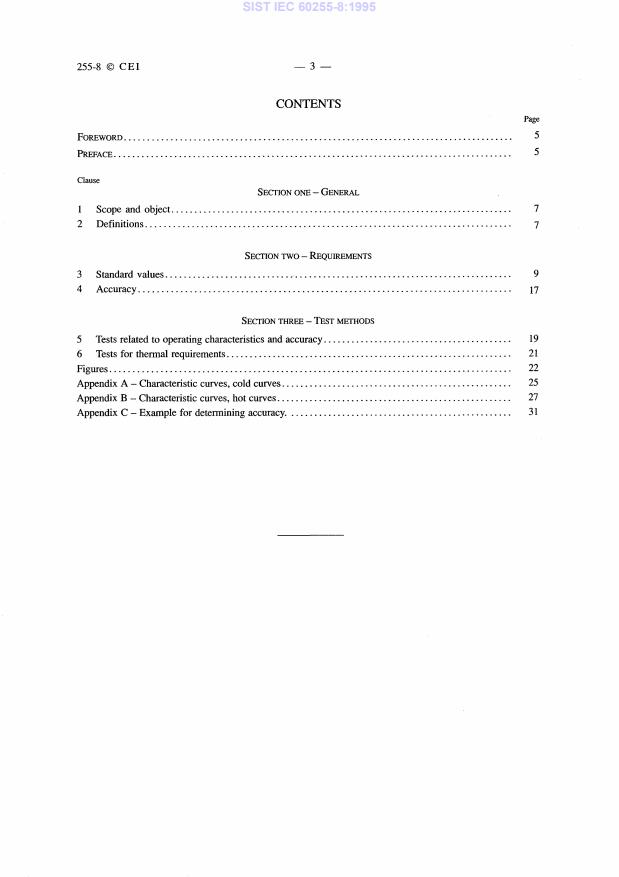
CONTENTS
Page
FOREWORD 5
PREFACE 5
Clause
SECTION ONE GENERAL
1 Scope and object 7
2 Definitions 7
SECTION TWO — REQUIREMENTS
3 Standard values
4 Accuracy 17
SECTION THREE — TEST METHODS
5 Tests related to operating characteristics and accuracy 19
6 Tests for thermal requirements 21
Figures 22
Appendix A – Characteristic curves, cold curves
Appendix B - Characteristic curves, hot curves
Appendix C – Example for determining accuracy.
— 5 —
255-8 © I E C
INTERNATIONAL ELECTROTECHNICAL COMMISSION
ELECTRICAL RELAYS
Part 8: Thermal electrical relays
FOREWORD
The formal decisions or agreements of the IEC on technical matters, prepared by Technical Committees on which all the National
1)
an international consensus of opinion on the
Committees having a special interest therein are represented, express, as nearly as possible,
subjects dealt with.
ational use and they are accepted by the National Committees in that sense.
2) They have the form of recommendations for inte rn
resses the wish that all National Committees should adopt the text of the I E C
3) In order to promote inte rnational unification, the I E C exp
d
an
recommendation for their national rules in so far as national conditions will permit. Any divergence between the I E C recommendation
possible, be clearly indicated in the latter.
the corresponding national rules should, as far as
PREFACE
This standard has been prepared by Sub-Committee 41B: Measuring relays and protection equipment, of IEC
Technical Committee 41: Electrical relays.
and replaces the first edition (1978). It
This standard constitutes the second edition of I E C Publication 255-8
the second impression (1987) of I E C Publication 255-17.
also replaces the first edition (1982) and
The text of this standard is based on the following documents:
Six Months' Rule Report on Voting
41 B(CO)47 41 B(CO)51
indicated in
Full information on the voting for the approval of this standard can be found in the Voting Repo rt
the above table.
This standard is a third-level specification.
The following IEC publications are quoted in this standard:
Publications Nos. 50: International electrotechnical vocabulary (IEV).
255: Electrical Relays.
protection equipment.
255-6 (1988): Part 6: Measuring relays and
255-8 © I E C
— 7 —
ELECTRICAL RELAYS
Part 8: Thermal electrical relays
SECTION ONE – GENERAL
1 Scope and object
This stan
dard is applicable to dependent specified time electrical measuring relays which protect equipment from
electrical thermal damage by the measurement of current flowing in the protected equipment.
1.1 This standard covers the following two types of relays:
a)
thermal electrical relays having a total memory function of the load-current conditions before the conditions
which caused the switching of the relay;
b) thermal electrical relays having a pa rt
ial memory function, i.e. of the overload current conditions only.
1.2 This stan
dard also covers the particular requirements for thermal electrical relays used for motor protection.
The object of this stan
dard is to state the particular requirements for thermal electrical relays. It is to be read in
conjunction with higher level documents in the IEC Publication 255 series.
2 Definitions
For definitions of general terms not defined in this standard, reference should be made to the Inte rnational
Electrotechnical Vocabulary (I E V) (IEC Publication 50)
and higher level documents.
For the purpose of this standard the following definitions shall apply:
2.1 hot curve:
For a thermal electrical relay with a total memory function, the characteristic curve representing
the relationship between specified operating time
and current, taking account of the thermal effect of a specified
steady-state load current before the overload occurs.
2.2 cold curve:
For a thermal electrical relay, the characteristic curve representing the relationship between
specified operating time
and current, with the relay at reference and steady-state conditions with no-load current
flowing before the overload occurs.
2.3
correcting quantity (compensating quantity): A quantity modifying the specified characteristics of the
relay in a specified manner. Such quantities can be oil temperature, etc.
2.4 basic current:
The specified limiting value of the current for which the relay is required not to operate.
NOTE — The basic current se
rves as a reference for the definition of the characteristics of thermal electrical relays. Settings of a thermal
electrical relay are made in terms of this current.
2.5 constant k:
The constant by which the basic current is multiplied to obtain the current value to which the
accuracy of the minimum operating current referred.
2.6 previous load ratio:
The ratio of the load current preceding the overload to basic current under specified
conditions.
255-8 © I E C — 9 —
SECTION TWO – REQUIREMENTS
3 Standard values
3.1 Characteristic curves
The characteristics of time with respect to current can be stated either by equations or by graphical methods. The
equations for a simple thermal model are given below under Sub-clauses 3.1.1 and 3.1.2. Other characteristic
curves are permitted and should be declared by the manufacturer. As an example, see Appendix A.
NOTES
1— For practical purpose, e.g. testing, it is convenient to give the characteristic curve as a combination of current and time values.
2 — The time constant used in an equation should be as specified in National St andards or as declared by the m anufacturer.
3.1.1 Cold curve
A general curve for thermal electrical relays, based on the heating effect and on the time constant, is given by the
following formula:
I2
t= z.ln
I2 (k . IB) 2
–
where
t = operating time;
T = time constant;
IB = basic current;
k = constant;
I = relay current.
IB k . IB I
Cold curve
255-8 © I E C
- 1 1 —
3.1.2 Hot curve
With regard to preheating on a relay with a total memory function, the hot curve is relev ant. For example, the
equation obtained by modification of the general cold curve is given by the following formula which is derived in
Appendix B:
jp2
IZ–
t = z . ln
IZ – (k . lB) 2
where Ip is the specified load current before the overload occurs.
3.2 Nominal ranges of auxiliary energizing quantities
For other nominal ranges than the preferred 80% to 110% the limits of the nominal r ange shall be as specified in
National Standards or as declared by the m anufacturer.
3.3 Standard reference values of influencing quantities and factors
The st
andard reference values and test tolerances of influencing quantities and factors, previous current values and
correcting quantities are given in Tables I, II and III, respectively.
Table I – Reference conditions and test tolerances of influencing quantities and factors
Reference condition
Influencing quantity and factor
Test tolerances
(see note)
Position As specified in National St
andards or as 2° in any direction or, for static relays,
declared by the manufacturer as specified in National Standards
or as declared by the manufacturer
Setting of basic current Rated current or as specified in As specified in National Stand
ards or
â
National Standards or as declared
as declared by the manufacturer
c
by the manufacturer
g
i c
Magnitude (reference for determination As specified in National Standards or
As specified in National Staridards or
o
a'
of variations)
as declared by the manufacturer. as declared by the manufacturer.
C3 T.,
.
For motor 'protection, two times and
For motor protection: ±1%
six times b
asic current
c
Lcdi
tt
tt
U
D.C. transient component in a.c. Zero 2% of peak value
Setting As specified in National Standards or
As specified in National Standards or
as declared by the m
anufacturer as declared by the manufacturer
F
Setting parameter(s) of the curve As specified in National Standards or
As specified in National Standards or
as declared by the man
ufacturer as declared by the m anufacturer
en
.N
Voltage Rated value(s)
As specified in National St andards or
;, as declared by the manufacturer
a.
component in a.c. Zero 2% of peak value
7e
d
NOTE — National Standar
ds: special conditions of application or the character of the relay may necessitate the use of non-standard values.
In such cases, the m an
ufacturer shall declare the reference values and tolerances. For example, special applications may necessitate the
use of 40 °C as
the reference value of ambient temperature instead of 20 °C.
255-8 © I E C —
13 —
Table II – Previous current values when measuring the effect of influencing quantities
Quantity
Reference condition Test tolerances
For cold curve: zero Not applicable
Specified load current before overload
occurs
For hot curve: as specified in National As specified in National Standards or
Standards or as declared by the as declared by the manufacturer
manufacturer
Previous ratio load for motor For hot curves: 1.0 or 0.9 as chosen by ±1%
protection the manufacturer
Table III – Standard reference conditions and test tolerances of correcting quantities when measuring
the effect of influencing quantities
Correcting quantity
Reference condition Test tolerances
Unbalance current in a sinusoidal poly- Balanced
See Note 8 of Table II of IEC 255-6
phase system
Speed of protected rotating machine
As specified in National Standards or As specified in National Standards or
as declared by the manufacturer. as declared by the manufacturer
For motor protection: rated speed of
motor
Temperatures of different parts of the
protected equipment (see Note 1)
±
Temperature of cooling medium of the 20 °C or as declared by manufacturer 2 °C
protected equipment (see Note 2)
NOTES
1 — These values of correcting quantities represent steady-state thermal conditions of the protected equipment before overload
occurs. Their application depends on the principle of the relay used.
2 — To be declared by the m an
ufacturer mainly when a cooling medium other than air is used.
3.4
Standard values of the limits of the nominal range of influencing quantities and factors
The standard values of the limits of the nominal range of influencing quantities
and factors, previous current
values and correcting quantities are given in tables IV, V
and VI respectively.
255-8 © I E C
— 15 —
Table
...
Questions, Comments and Discussion
Ask us and Technical Secretary will try to provide an answer. You can facilitate discussion about the standard in here.
Loading comments...