

SIST EN 16472:2014
(Main)Plastics - Method for artificial accelerated photoageing using medium pressure mercury vapour lamps
General Information
- Abstract
This European Standard specifies a method for carrying out artificial accelerated photoageing of test specimens by exposing them to medium pressure filtered mercury vapour lamp as light source, under controlled temperature conditions.
- Status
- Published
- Public Enquiry End Date
- 14-Jan-2014
- Publication Date
- 14-May-2014
- Technical Committee
- IPMA - Polimer materials and products
- Current Stage
- 6060 - National Implementation/Publication (Adopted Project)
- Start Date
- 25-Mar-2014
- Due Date
- 30-May-2014
- Completion Date
- 15-May-2014

Overview
EN 16472:2014 - "Plastics - Method for artificial accelerated photoageing using medium pressure mercury vapour lamps" - specifies a laboratory method to accelerate and study photoageing of polymeric materials. The procedure uses medium pressure filtered mercury vapour lamps as the light source, combined with controlled temperature, to reproduce photochemical ageing mechanisms comparable to outdoor exposure while providing accelerated results for lifetime assessments and formulation comparisons.
Key topics and technical requirements
- Light source: Medium pressure mercury vapour lamps with borosilicate bulbs that filter out wavelengths below ~290 nm. Typical emission lines retained include 297, 302, 313, 334, 365, 391, 405, 436, 492, 547 and 579 nm.
- Spectral irradiance: The standard defines relative spectral irradiance passbands (290–420 nm) and requires that individual lamps meet specified band percentages. Users should obtain specific lamp spectral data from manufacturers.
- Pre-ageing: Lamps should be pre-aged (commonly 100 h) to stabilize bulb transmittance before testing.
- Irradiance uniformity: Exposure area irradiance must be at least 80% of the maximum; rotating frames or specimen repositioning are recommended for uniform exposure.
- Temperature control: A reference material and a sensor (thermocouple or platinum resistance) are used to monitor specimen temperature. Electronic temperature controllers capable of maintaining ±0.3 °C are recommended. Temperature increases should not cause purely thermal degradation that would mask photochemical mechanisms.
- Instrumentation: Use calibrated radiometers (commonly measuring 290–420 nm or 300–400 nm) and spectroradiometers with suitable resolution (FWHM ≤ 2.5 nm) for verification and monitoring.
- Optional features: The method allows optional immersion or dark periods and additional optical filtering to better simulate outdoor UVB or indoor spectra (see informative Annex A).
- Outcome measurement: Chemical and physical changes are assessed after exposure, typically by FTIR/UV-visible spectroscopy and property testing per ISO methods.
Applications and users
- Plastics manufacturers and polymer formulators assessing UV stability and comparing formulations.
- Test laboratories performing accelerated weathering to predict outdoor service life.
- Quality assurance teams validating production batches and coatings suppliers evaluating UV resistance.
- R&D groups using kinetic analysis to correlate artificial ageing with natural weathering and to rank materials.
Keywords: EN 16472:2014, artificial accelerated photoageing, medium pressure mercury vapour lamps, plastics photoageing test, UV irradiance, radiometer, temperature control, spectral irradiance.
Related standards
- EN ISO 4892-1:2000 - laboratory light source exposure guidance
- ISO 4582 - colour and property change determination after exposure
- ISO 9370 - radiant exposure measurement in weathering tests
- ISO 10640 - FTIR and UV/visible methodology for polymer photoageing
This standard helps ensure accelerated photoageing tests are reproducible, relevant to natural photochemical mechanisms, and useful for lifetime and comparative assessments of polymer materials.
Relations
- Effective Date
- 28-Jan-2026
- Effective Date
- 28-Jan-2026
- Effective Date
- 28-Jan-2026
- Effective Date
- 28-Jan-2026
- Effective Date
- 28-Jan-2026
- Effective Date
- 28-Jan-2026
- Effective Date
- 28-Jan-2026
- Effective Date
- 28-Jan-2026
- Effective Date
- 28-Jan-2026
- Effective Date
- 28-Jan-2026
- Effective Date
- 28-Jan-2026
- Effective Date
- 28-Jan-2026
Get Certified
Connect with accredited certification bodies for this standard

DIN CERTCO
DIN Group product certification.

Smithers Quality Assessments
US management systems and product certification.
Sponsored listings
Frequently Asked Questions
SIST EN 16472:2014 is a standard published by the Slovenian Institute for Standardization (SIST). Its full title is "Plastics - Method for artificial accelerated photoageing using medium pressure mercury vapour lamps". This standard covers: This European Standard specifies a method for carrying out artificial accelerated photoageing of test specimens by exposing them to medium pressure filtered mercury vapour lamp as light source, under controlled temperature conditions.
This European Standard specifies a method for carrying out artificial accelerated photoageing of test specimens by exposing them to medium pressure filtered mercury vapour lamp as light source, under controlled temperature conditions.
SIST EN 16472:2014 is classified under the following ICS (International Classification for Standards) categories: 83.080.01 - Plastics in general. The ICS classification helps identify the subject area and facilitates finding related standards.
SIST EN 16472:2014 has the following relationships with other standards: It is inter standard links to SIST EN 4533-004:2018, SIST EN ISO 4628-2:2016, SIST EN ISO 4892-1:2001, SIST EN 15534-1:2014+A1:2018, SIST EN 17098-1:2018, SIST EN 13206:2017+A1:2020, SIST EN 15534-6:2015, SIST EN 13206:2017, SIST EN 15534-1:2014, SIST EN 15534-6:2015+A1:2018, SIST EN 15534-5:2014, SIST EN 15534-4:2014. Understanding these relationships helps ensure you are using the most current and applicable version of the standard.
SIST EN 16472:2014 is available in PDF format for immediate download after purchase. The document can be added to your cart and obtained through the secure checkout process. Digital delivery ensures instant access to the complete standard document.
Standards Content (Sample)
2003-01.Slovenski inštitut za standardizacijo. Razmnoževanje celote ali delov tega standarda ni dovoljeno.Polimerni materiali - Metoda za pospešeno umetno staranje z uporabo živosrebrne svetilke s srednjim parnim tlakomKunststoffe - Verfahren zur künstlich beschleunigten Alterung bei Verwendung von QuecksilberdampflampenPlastiques - Méthode de photovieillissement artificiel accéléré utilisant des lampes à vapeur de mercure à moyenne pressionPlastics - Method for artificial accelerated photoageing using medium pressure mercury vapour lamps83.080.01Polimerni materiali na splošnoPlastics in generalICS:Ta slovenski standard je istoveten z:EN 16472:2014SIST EN 16472:2014en,fr,de01-junij-2014SIST EN 16472:2014SLOVENSKI
STANDARD
EUROPEAN STANDARD NORME EUROPÉENNE EUROPÄISCHE NORM
EN 16472
April 2014 ICS 83.080.01 English Version
Plastics - Method for artificial accelerated photoageing using medium pressure mercury vapour lamps
Plastiques - Méthode de photovieillissement artificiel accéléré utilisant des lampes à vapeur de mercure à moyenne pression
Kunststoffe - Verfahren zur künstlich beschleunigten Alterung bei Verwendung von Quecksilberdampflampen This European Standard was approved by CEN on 8 February 2014.
CEN members are bound to comply with the CEN/CENELEC Internal Regulations which stipulate the conditions for giving this European Standard the status of a national standard without any alteration. Up-to-date lists and bibliographical references concerning such national standards may be obtained on application to the CEN-CENELEC Management Centre or to any CEN member.
This European Standard exists in three official versions (English, French, German). A version in any other language made by translation under the responsibility of a CEN member into its own language and notified to the CEN-CENELEC Management Centre has the same status as the official versions.
CEN members are the national standards bodies of Austria, Belgium, Bulgaria, Croatia, Cyprus, Czech Republic, Denmark, Estonia, Finland, Former Yugoslav Republic of Macedonia, France, Germany, Greece, Hungary, Iceland, Ireland, Italy, Latvia, Lithuania, Luxembourg, Malta, Netherlands, Norway, Poland, Portugal, Romania, Slovakia, Slovenia, Spain, Sweden, Switzerland, Turkey and United Kingdom.
EUROPEAN COMMITTEE FOR STANDARDIZATION
COMITÉ EUROPÉEN DE NORMALISATION EUROPÄISCHES KOMITEE FÜR NORMUNG
CEN-CENELEC Management Centre:
Avenue Marnix 17,
B-1000 Brussels © 2014 CEN All rights of exploitation in any form and by any means reserved worldwide for CEN national Members. Ref. No. EN 16472:2014 ESIST EN 16472:2014
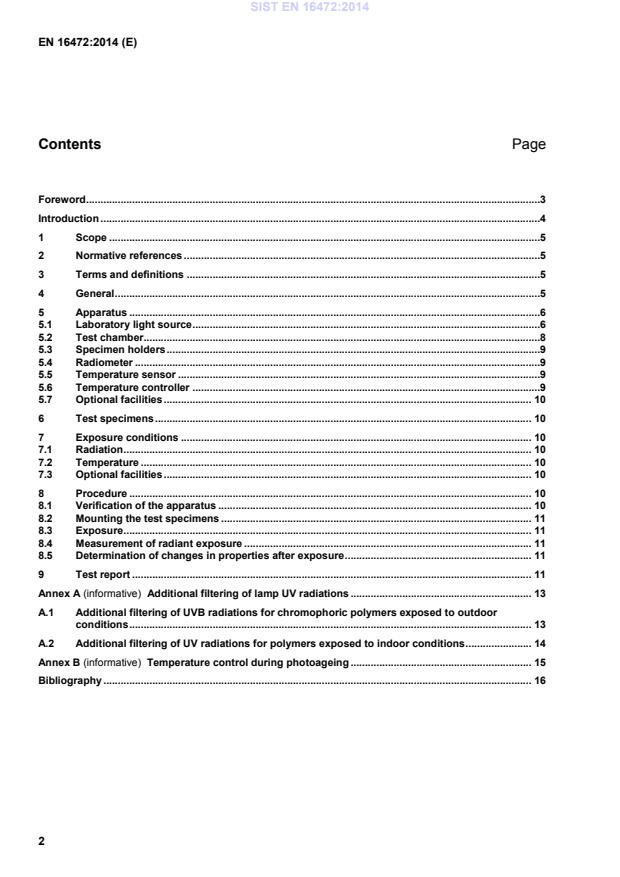
Foreword .3 Introduction .4 1 Scope .5 2 Normative references .5 3 Terms and definitions .5 4 General .5 5 Apparatus .6 5.1 Laboratory light source .6 5.2 Test chamber .8 5.3 Specimen holders .9 5.4 Radiometer .9 5.5 Temperature sensor .9 5.6 Temperature controller .9 5.7 Optional facilities . 10 6 Test specimens . 10 7 Exposure conditions . 10 7.1 Radiation . 10 7.2 Temperature . 10 7.3 Optional facilities . 10 8 Procedure . 10 8.1 Verification of the apparatus . 10 8.2 Mounting the test specimens . 11 8.3 Exposure . 11 8.4 Measurement of radiant exposure . 11 8.5 Determination of changes in properties after exposure . 11 9 Test report . 11 Annex A (informative)
Additional filtering of lamp UV radiations . 13 A.1 Additional filtering of UVB radiations for chromophoric polymers exposed to outdoor conditions . 13 A.2 Additional filtering of UV radiations for polymers exposed to indoor conditions . 14 Annex B (informative)
Temperature control during photoageing . 15 Bibliography . 16
Key X wavelength, nm Y spectral irradiance, mW·m-2·nm-1 Figure 1 — Typical spectrum of a filtered medium pressure mercury vapour lamp The filtered light emitted by a medium pressure mercury-arc does not simulate full spectrum sunlight but can be used to investigate photochemical phenomena. The relevancy to outdoor data shall be carefully considered. The only requirement is a relevant control of the chemical change in the solid state under polychromatic light. Additional optical filters may be used for specific applications. Annex A provides information on additional filtering of lamp UV radiations. Ensure the lamp has been pre-aged for 100 h prior to use, since the transmittance spectrum of borosilicate bulb may change significantly during this initial period. NOTE Commonly, the light output (intensity and wavelength) does not vary more than 20 % during the lifetime of the lamps (see 5.4 or 8.1). 5.1.2 Spectral irradiance of medium pressure mercury vapour lamps The minimum and maximum levels of the relative spectral irradiance in the UV region are given in Table 1. SIST EN 16472:2014
≤ 300 0,0 2,0 300 <
≤ 320 5,0 20,0 320 <
≤ 360 8,0 14,0 360 <
≤ 380 46,0 61,0 380 <
≤ 400 1,0 5,0 400 <
≤ 420 14,0 25,0 a This table gives the irradiance in the given passband, expressed as a percentage of the total irradiance between 290 nm and 420 nm. To determine whether a mercur
...