

oSIST prEN 12897-1:2026
(Main)Water supply - Indirectly heated unvented (closed) hot water storage tanks - Part 1: General specifications and common test methods
General Information
- Abstract
This document specifies the general specifications, constructional requirements and common test methods for indirectly heated, unvented (closed) hot water storage tanks of up to 2 000 l volume suitable for connection to a water supply at a pressure between 0,05 MPa and 1,0 MPa (0,5 bar and 10 bar), and fitted with control and safety devices designed to prevent the temperature of the stored drinking water from reaching 95 °C.
Whilst storage water heaters intended primarily for direct heating are not covered by this document, it includes the possible provision of backup immersion heaters.
- Status
- Not Published
- Public Enquiry End Date
- 14-Jul-2026
- Technical Committee
- IOVO - Water supply and waste water engineering
- Current Stage
- 4020 - Public enquire (PE) (Adopted Project)
- Start Date
- 21-May-2026
- Due Date
- 08-Oct-2026
- Completion Date
- 15-Jul-2026

Overview
oSIST prEN 12897-1:2026 sets out the general specifications, constructional requirements, and common test methods for indirectly heated unvented (closed) hot water storage tanks with a maximum volume of 2,000 liters. These tanks are intended for drinking water applications and can operate at supply pressures between 0.05 MPa and 1.0 MPa (0.5 to 10 bar). They are fitted with controls and safety devices to ensure water temperature does not exceed 95°C. This European standard is crucial for manufacturers, installers, and regulators aiming for consistency, safety, and compliance across the water heating sector.
Key Topics
- Scope: Applies to hot water storage tanks that are indirectly heated and unvented. The standard does not cover tanks used primarily for direct heating but allows for the inclusion of backup immersion heaters.
- Constructional Requirements: Includes mandates for inspection access, draining capability, hydraulic connections, and ability to safely disconnect from pipework.
- Temperature Control: Tanks must have effective temperature regulation to protect the quality and safety of stored drinking water.
- Mechanical Resistance and Durability: Establishes pressure resistance testing (twice the maximum design pressure), pressure cycling for durability, and specific procedures for tanks with or without expansion controls.
- Safety Equipment: Requires thermostatic control, energy cut-outs, and relief valves (temperature, pressure, and expansion), all conforming to related valve standards.
- Marking and Product Information: Tanks must be permanently labeled with critical data, including standard reference, manufacturer details, design pressures, rated volumes, and heat loss figures.
- Testing and Conformity Assessment: Covers type and production testing, factory production control (FPC), and compliance mechanisms.
Applications
The requirements in oSIST prEN 12897-1:2026 are widely applicable across residential, commercial, and institutional buildings using indirectly heated, unvented hot water storage tanks. Key applications include:
Building Water Heating Systems
Ensures reliable supply of safe and efficiently heated potable water for households, hotels, public buildings, and healthcare facilities.Integration in Central Heating Installations
Specifies how tanks connect with external boilers or heat exchangers, while maintaining integrity under varying pressures.Safety and Compliance
Provides clear guidelines for manufacturers and installers, supporting regulatory approval and market surveillance.Energy Efficiency
Mandates standing loss calculations, enabling alignment with EU energy labeling and ecodesign directives.
Related Standards
oSIST prEN 12897-1:2026 references and aligns with several relevant standards, improving safety, interoperability, and performance:
- EN 1487, EN 1488, EN 1489, EN 1490, EN 1491, EN 1567
Building valves for hydraulic safety, expansion, and pressure/temperature relief. - EN 1717
Prevention of water pollution and backflow protection in potable water systems. - EN 15332
Energy assessment of hot water storage tanks. - EN IEC 60730-2-9
Automatic electrical controls, with a focus on temperature sensing. - EN 13959
Anti-pollution check valves for backflow prevention.
The standard is structured to be compatible with EU energy labeling (Regulation No 812/2013) and ecodesign requirements (Regulation No 814/2013), facilitating market access across the European Economic Area.
Practical Value
By adopting oSIST prEN 12897-1:2026, stakeholders in the water heating industry benefit from harmonized design, performance, and testing requirements for hot water storage tanks. This promotes safety, efficiency, product reliability, and ease of compliance-ensuring that potable hot water supply systems meet stringent European quality and safety standards. Manufacturers can streamline production and documentation, while installers and building managers gain clarity and confidence in selecting compliant products.
Relations
- Effective Date
- 24-Jul-2024
Get Certified
Connect with accredited certification bodies for this standard

DIBt (Deutsches Institut für Bautechnik)
German Institute for Building Technology.
DIN CERTCO
DIN Group product certification.

Aboma Certification B.V.
Specialized in construction, metal, and transport sectors.
Sponsored listings
Frequently Asked Questions
oSIST prEN 12897-1:2026 is a draft published by the Slovenian Institute for Standardization (SIST). Its full title is "Water supply - Indirectly heated unvented (closed) hot water storage tanks - Part 1: General specifications and common test methods". This standard covers: This document specifies the general specifications, constructional requirements and common test methods for indirectly heated, unvented (closed) hot water storage tanks of up to 2 000 l volume suitable for connection to a water supply at a pressure between 0,05 MPa and 1,0 MPa (0,5 bar and 10 bar), and fitted with control and safety devices designed to prevent the temperature of the stored drinking water from reaching 95 °C. Whilst storage water heaters intended primarily for direct heating are not covered by this document, it includes the possible provision of backup immersion heaters.
This document specifies the general specifications, constructional requirements and common test methods for indirectly heated, unvented (closed) hot water storage tanks of up to 2 000 l volume suitable for connection to a water supply at a pressure between 0,05 MPa and 1,0 MPa (0,5 bar and 10 bar), and fitted with control and safety devices designed to prevent the temperature of the stored drinking water from reaching 95 °C. Whilst storage water heaters intended primarily for direct heating are not covered by this document, it includes the possible provision of backup immersion heaters.
oSIST prEN 12897-1:2026 is classified under the following ICS (International Classification for Standards) categories: 91.140.65 - Water heating equipment. The ICS classification helps identify the subject area and facilitates finding related standards.
oSIST prEN 12897-1:2026 has the following relationships with other standards: It is inter standard links to SIST EN 12897:2016+A1:2020. Understanding these relationships helps ensure you are using the most current and applicable version of the standard.
oSIST prEN 12897-1:2026 is associated with the following European legislation: EU Directives/Regulations: 812/2013, 814/2013; Standardization Mandates: M/534. When a standard is cited in the Official Journal of the European Union, products manufactured in conformity with it benefit from a presumption of conformity with the essential requirements of the corresponding EU directive or regulation.
oSIST prEN 12897-1:2026 is available in PDF format for immediate download after purchase. The document can be added to your cart and obtained through the secure checkout process. Digital delivery ensures instant access to the complete standard document.
Standards Content (Sample)
SLOVENSKI STANDARD
01-julij-2026
Oskrba z vodo - Posredno ogrevani neprezračeni (zaprti) rezervoarji za toplo vodo
- 1. del: Splošne zahteve in splošne preskusne metode
Water supply - Indirectly heated unvented (closed) hot water storage tanks - Part 1:
General specifications and common test methods
Wasserversorgung - Mittelbar beheizte, unbelüftete (geschlossene) Speicher-
Wassererwärmer - Teil 1: Allgemeine Anforderungen und übliche Prüfverfahren
Alimentation en eau - Ballons d’eau chaude à chauffage indirect non ouverts à l’air libre
(fermés) - Partie 1 : Spécifications générales et méthodes d’essai communes
Ta slovenski standard je istoveten z: prEN 12897-1
ICS:
91.140.65 Oprema za ogrevanje vode Water heating equipment
2003-01.Slovenski inštitut za standardizacijo. Razmnoževanje celote ali delov tega standarda ni dovoljeno.
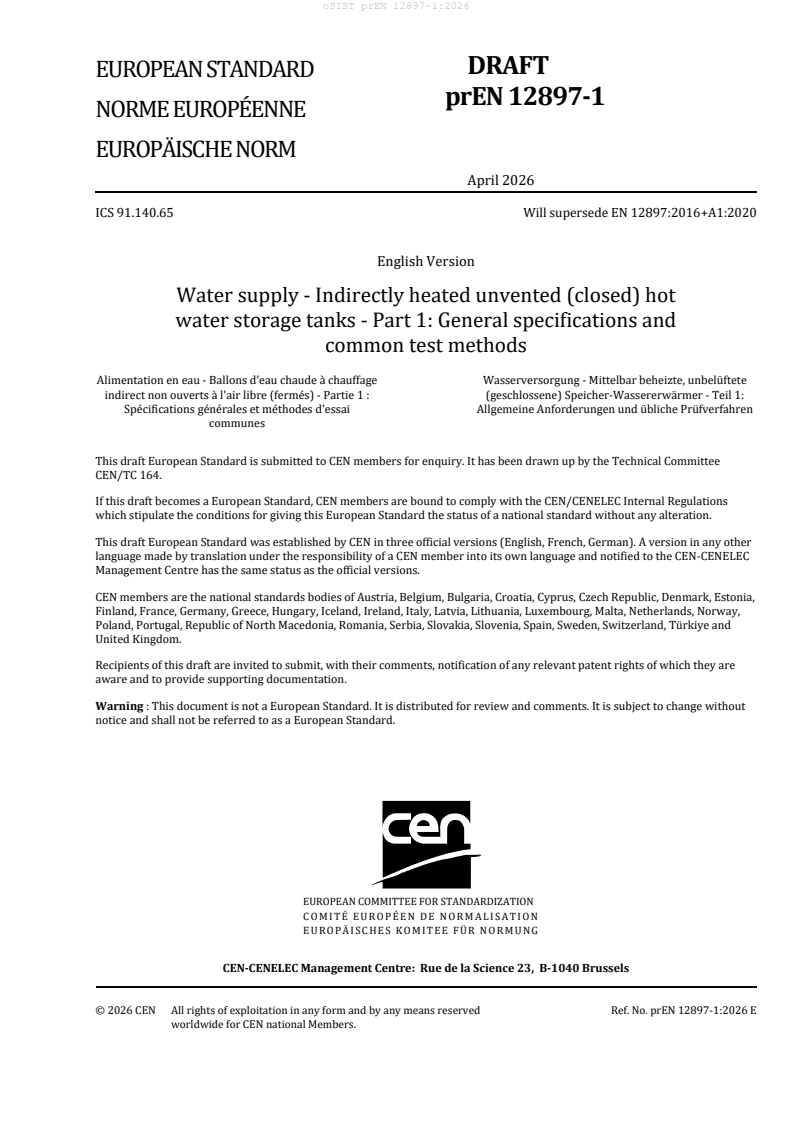
DRAFT
EUROPEAN STANDARD
NORME EUROPÉENNE
EUROPÄISCHE NORM
April 2026
ICS 91.140.65 Will supersede EN 12897:2016+A1:2020
English Version
Water supply - Indirectly heated unvented (closed) hot
water storage tanks - Part 1: General specifications and
common test methods
Alimentation en eau - Ballons d'eau chaude à chauffage Wasserversorgung - Mittelbar beheizte, unbelüftete
indirect non ouverts à l'air libre (fermés) - Partie 1 : (geschlossene) Speicher-Wassererwärmer - Teil 1:
Spécifications générales et méthodes d'essai Allgemeine Anforderungen und übliche Prüfverfahren
communes
This draft European Standard is submitted to CEN members for enquiry. It has been drawn up by the Technical Committee
CEN/TC 164.
If this draft becomes a European Standard, CEN members are bound to comply with the CEN/CENELEC Internal Regulations
which stipulate the conditions for giving this European Standard the status of a national standard without any alteration.
This draft European Standard was established by CEN in three official versions (English, French, German). A version in any other
language made by translation under the responsibility of a CEN member into its own language and notified to the CEN-CENELEC
Management Centre has the same status as the official versions.
CEN members are the national standards bodies of Austria, Belgium, Bulgaria, Croatia, Cyprus, Czech Republic, Denmark, Estonia,
Finland, France, Germany, Greece, Hungary, Iceland, Ireland, Italy, Latvia, Lithuania, Luxembourg, Malta, Netherlands, Norway,
Poland, Portugal, Republic of North Macedonia, Romania, Serbia, Slovakia, Slovenia, Spain, Sweden, Switzerland, Türkiye and
United Kingdom.
Recipients of this draft are invited to submit, with their comments, notification of any relevant patent rights of which they are
aware and to provide supporting documentation.
Warning : This document is not a European Standard. It is distributed for review and comments. It is subject to change without
notice and shall not be referred to as a European Standard.
EUROPEAN COMMITTEE FOR STANDARDIZATION
COMITÉ EUROPÉEN DE NORMALISATION
EUROPÄISCHES KOMITEE FÜR NORMUNG
CEN-CENELEC Management Centre: Rue de la Science 23, B-1040 Brussels
© 2026 CEN All rights of exploitation in any form and by any means reserved Ref. No. prEN 12897-1:2026 E
worldwide for CEN national Members.
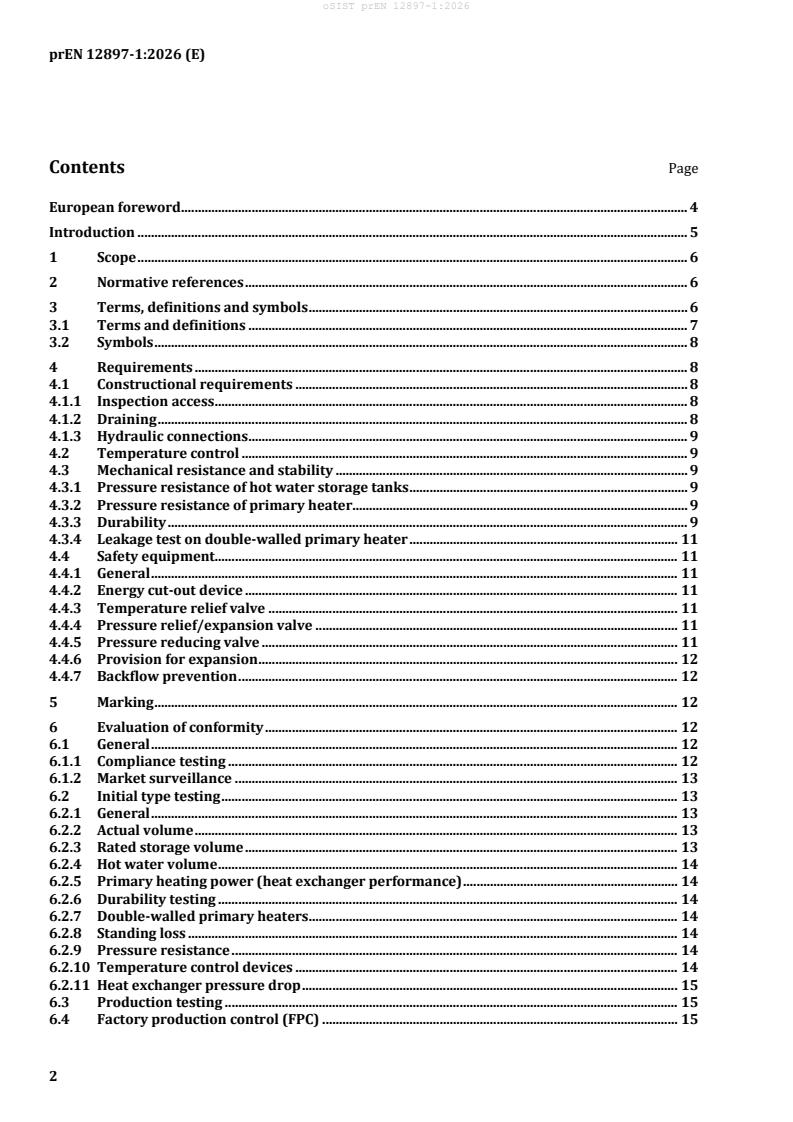
Contents Page
European foreword . 4
Introduction . 5
1 Scope . 6
2 Normative references . 6
3 Terms, definitions and symbols . 6
3.1 Terms and definitions . 7
3.2 Symbols . 8
4 Requirements . 8
4.1 Constructional requirements . 8
4.1.1 Inspection access . 8
4.1.2 Draining . 8
4.1.3 Hydraulic connections . 9
4.2 Temperature control . 9
4.3 Mechanical resistance and stability . 9
4.3.1 Pressure resistance of hot water storage tanks . 9
4.3.2 Pressure resistance of primary heater. 9
4.3.3 Durability . 9
4.3.4 Leakage test on double-walled primary heater . 11
4.4 Safety equipment. 11
4.4.1 General . 11
4.4.2 Energy cut-out device . 11
4.4.3 Temperature relief valve . 11
4.4.4 Pressure relief/expansion valve . 11
4.4.5 Pressure reducing valve . 11
4.4.6 Provision for expansion . 12
4.4.7 Backflow prevention . 12
5 Marking . 12
6 Evaluation of conformity . 12
6.1 General . 12
6.1.1 Compliance testing . 12
6.1.2 Market surveillance . 13
6.2 Initial type testing . 13
6.2.1 General . 13
6.2.2 Actual volume . 13
6.2.3 Rated storage volume . 13
6.2.4 Hot water volume . 14
6.2.5 Primary heating power (heat exchanger performance) . 14
6.2.6 Durability testing . 14
6.2.7 Double-walled primary heaters . 14
6.2.8 Standing loss . 14
6.2.9 Pressure resistance . 14
6.2.10 Temperature control devices . 14
6.2.11 Heat exchanger pressure drop . 15
6.3 Production testing . 15
6.4 Factory production control (FPC) . 15
7 Technical documents . 15
7.1 General . 15
7.2 Technical data . 15
7.3 Installation and maintenance instructions . 16
7.4 Operating instructions . 16
Annex A (normative) Hot water safety and performance testing . 17
Annex B (normative) Measurement of standing loss for factory insulated hot water storage
tanks . 23
Annex C (informative) Inspection access . 28
Annex ZA (informative) Relationship between this European Standard and the energy
labelling requirements of Commission Delegated Regulation (EU) No 812/2013 [OJ L
239, 6.9.2013, p. 83–135] aimed to be covered . 30
Annex ZB (informative) Relationship between this European Standard and the ecodesign
requirements of Commission Regulation (EU) No 814/2013 [OJ L 239, 6.9.2013, p.
162–183] aimed to be covered . 32
Bibliography . 33
European foreword
This document (prEN 12897-1:2026) has been prepared by Technical Committee CEN/TC 164 “Water
supply”, the secretariat of which is held by AFNOR.
This document is currently submitted to the CEN Enquiry.
This document will supersede EN 12897:2016+A1:2020.
The main changes compared to the previous edition are listed below:
— title and standard reference changed to enable a standards series;
— revision of verbal forms for expressions of provisions;
— revision of Annex ZA and Annex ZB.
The EN 12897 series, under the general title Water supply — Indirectly heated unvented (closed) hot
water storage tanks, consists of the following parts:
— Part 1: General specifications and common test methods
— Part 2: Corrosion protection by enamelling and cathodic protection — Requirements and testing
This document has been prepared under a standardization request addressed to CEN by the European
Commission. The Standing Committee of the EFTA States subsequently approves these requests for its
Member States.
For the relationship with EU Legislation, see informative Annex ZA and Annex ZB, which are an integral
part of this document.
Introduction
In respect of potential adverse effects on the quality of water intended for human consumption caused
by the product covered by this document:
a) This document provides no information as to whether the product may be used without restriction
in any of the Member States of the EU or EFTA.
b) It should be noted that, while awaiting the adoption of the verifiable European criteria, existing
national regulations concerning the use and/or the characteristics of this product remain in force.
1 Scope
This document specifies the general specifications, constructional requirements and common test
methods for indirectly heated, unvented (closed) hot water storage tanks of up to 2 000 l volume
suitable for connection to a water supply at a pressure between 0,05 MPa and 1,0 MPa (0,5 bar and
10 bar), and fitted with control and safety devices designed to prevent the temperature of the stored
drinking water from reaching 95 °C.
Whilst storage water heaters intended primarily for direct heating are not covered by this document, it
includes the possible provision of backup immersion heaters.
2 Normative references
The following documents are referred to in the text in such a way that some or all of their content
constitutes requirements of this document. For dated references, only the edition cited applies. For
undated references, the latest edition of the referenced document (including any amendments) applies.
EN 1487:2014, Building valves — Hydraulic safety groups — Tests and requirements
EN 1488:2021, Building valves — Expansion groups — Tests and requirements
EN 1489:2000, Building valves — Pressure safety valves — Tests and requirements
EN 1490:2000, Building valves — Combined temperature and pressure relief valves — Tests and
requirements
EN 1491:2022, Building valves — Expansion valves — Tests and requirements
EN 1567:1999, Building valves — Water pressure reducing valves and combination water pressure
reducing valves — Requirements and tests
EN 1717:2025, Protection against pollution of water intended for human consumption in potable water
installations and general requirements for devices to prevent pollution by backflow
EN 13959:2004, Anti-pollution check valves — DN 6 to DN 250 inclusive family E, type A, B, C and D
EN 15332:2019, Heating boilers — Energy assessment of hot water storage tanks
EN IEC 60730-2-9:2019, Automatic electrical controls — Part 2-9: Particular requirements for
temperature sensing controls
3 Terms, definitions and symbols
For the purposes of this document, the following terms, definitions and symbols apply.
ISO and IEC maintain terminology databases for use in standardization at the following addresses:
— ISO Online browsing platform: available at https://www.iso.org/obp/
— IEC Electropedia: available at https://www.electropedia.org/
As impacted by EN IEC 60730-2-9:2019/A2:2020.
3.1 Terms and definitions
3.1.1
indirectly heated unvented hot water storage tank
indirectly heated closed hot water storage tank
vessel, complete with heat exchanger (primary heater) with the intended use of heating and storage of
drinking water where the contents are not vented to atmosphere
3.1.2
rated volume
rated storage volume
V
volume of a hot water storage tank or a storage water heater, expressed in litres
Note 1 to entry Volume of the hot water storage tank as specified in the manufacturer’s documentation.
3.1.3
actual volume
measured volume
measured volume of the hot water storage tank, expressed in litres
3.1.4
water side
part of the hot water storage tank directly in contact with the drinking water
3.1.5
heating side
parts of the hot water storage tank which contain the heating medium
3.1.6
maximum design pressure
rated pressure
maximum pressure to which the hot water storage tank is designed to be subjected in use
3.1.7
maximum inlet pressure
specified maximum cold water inlet pressure for the hot water storage tank
3.1.8
maximum safety temperature
maximum temperature that the stored water can reach under a fault condition
3.1.9
maximum operating temperature
maximum temperature that can be set for normal operation
3.1.10
primary heater
heat exchanger system fitted to the hot water storage tank through which a heating medium (such as
water from a boiler) flows to heat the stored drinking water
3.1.11
double-walled primary heater
primary heater with concentric walls such that any leak through one wall will not allow the heating
fluid to contaminate the drinking water
3.1.12
standing loss
heating power dissipated from a hot water storage tank at given water and ambient temperatures,
expressed in W
3.2 Symbols
For the purposes of this document, the following symbols apply:
Symbol Unit Description
θ´ [ °C ] average temperature of the water drawn off at ≥ (θ + 30) °C
p c
V [l] mixed water quantity delivered at 40 °C.
θ [ °C ] average temperature of inlet cold water during the test
c
θ [ °C ] target hot water temperature for hot water performance testing = θ + 50 K
set c
θ [ °C ] primary flow temperature = θ + 70 K
pri c
θ [ °C ] target temperature of stored water for heat loss testing
w
mean of all the differentials between θ and measured ambient air
w
e [ °C ]
temperature
θa [ °C ] measured ambient temperature at a given position
V [ l ] volume of water drawn off at ≥ (θ + 30)°C
hot c
Q [ kWh/24h ] corrected 24 h heat loss
c
[ kWh/24h ]
Q declared standing loss
st
or [ W ]
Q [ kWh ] power consumption meter reading
m
t [ minutes ] time taken to reheat the hot water storage tank from θ to θ
c set
P [ kW ] calculated heat exchanger performance
4 Requirements
4.1 Constructional requirements
4.1.1 Inspection access
Unvented hot water storage tanks shall be provided with means for internal inspection (see Annex C).
This can also be achieved by using a connection intended and dimensioned for another purpose where
the use of a suitable inspection instrument such as an endoscope is acceptable.
4.1.2 Draining
Unvented hot water storage tanks shall permit in situ draining. The method of draining shall be given in
the manufacturer's instructions.
4.1.3 Hydraulic connections
Hydraulic connections shall be of a type that allows the hot water storage tank to be disconnected from
the pipework.
4.2 Temperature control
The temperature of the stored drinking water shall be regulated either by control of the heat source or
sources or by control of the hot water storage tank.
4.3 Mechanical resistance and stability
4.3.1 Pressure resistance of hot water storage tanks
When tested in accordance with 6.2, the hot water storage tank shall withstand a pressure of 2,0 times
the maximum design pressure (as specified by the manufacturer) for a period of not less than 10 min
without showing any leakage or cracking.
4.3.2 Pressure resistance of primary heater
When tested in accordance with 6.2, the primary heater or heaters shall withstand a pressure of 2,0
times the maximum design pressure, as specified by the manufacturer, for a period of not less than
10 min without showing any leakage or cracking.
4.3.3 Durability
4.3.3.1 General
Wot water storage tanks shall be tested for durability by pressure cycle testing to either 4.3.3.2 or
4.3.3.3 as appropriate. See Figure 2 for details. The hot water storage tank shall show no signs of
leakage or cracking after testing.
For hot water storage tanks without inlet pressure and system expansion control and where the
internal pressure is likely to reach maximum design pressure due to water expansion after heat input,
the test in 4.3.3.2 shall be applied.
For hot water storage tanks designed for use with expansion vessels or internal expansion space such
that the rise in internal pressure due to expansion is controlled to below maximum design pressure,
then the alternative 4.3.3.3 shall be used.
If 4.3.3.3 is used then the installation manual supplied with the hot water storage tank shall specify the
pressure reduction and expansion control devices required.
4.3.3.2 Hot water storage tanks without inlet pressure and system expansion control
The hot water storage tank shall be subjected to either 20 000 periodic cycles at 1,2 × maximum design
pressure or 100 000 periodic cycles at 1,0 × maximum design pressure.
4.3.3.3 Hot water storage tanks designed for use with expansion vessels or internal expansion
space
For hot water storage tanks supplied for use with inlet pressure controls and expansion control
systems, and these control systems are supplied with the hot water storage tanks, then the hot water
storage tanks shall be subjected to either 20 000 periodic cycles at 1,5 × maximum inlet pressure or
100 000 periodic cycles at 1,3 × maximum inlet pressure. This procedure is illustrated by Figure 1.
Key
Y pressure
X time
P1 minimum inlet pressure as defined in the technical documents or 0,1 MPa (1 bar), whichever is the lower
value
P2 test pressure as defined in 4.3.3.2 or 4.3.3.3 as appropriate
T1 duration of time, in s, defined as 15 ≤ T1 ≤ 30
T2 duration of time, in s, defined as 15 ≤ T2 ≤ 20
T3 duration of time, in s, defined as 45 ≤ T3 ≤ 60
Figure 1 — Diagram of test pressure cycle variations
Key
1 optional inlet pressure control with expansion valve (4.3.3.2)
2 mandatory inlet pressure control with external expansion vessel (4.3.3.3)
3 mandatory inlet pressure control with internal expansion space (4.3.3.3)
Figure 2 — Pressure control options
4.3.4 Leakage test on double-walled primary heater
When a hot water storage tank is provided with a double-walled primary heater, it shall be constructed
such that any leakage from the heating side shall be routed to outside the heat exchanger without
coming into contact with the stored drinking water.
4.4 Safety equipment
4.4.1 General
Control and safety devices shall operate in the following sequence:
a) thermostatic control device;
b) energy cut out device;
c) where required, temperature pressure relief valve or safety relief valve.
Hot water storage tanks shall, where required, either be factory fitted, supplied with or fitted in
accordance with the manufacturer's instructions with all devices necessary for the operation of the hot
water storage tanks and the prevention of contamination of the drinking water supply.
All tests, unless specified within the test method, shall be carried out with all devices necessary to
control the temperature of the water and all devices necessary for the operation of the hot water
storage tanks and the prevention of contamination of the drinking water supply, fitted.
4.4.2 Energy cut-out device
Where required, hot water storage tanks shall be fitted with one or more non-self-resetting energy cut-
outs conforming to EN IEC 60730-2-9:2019 connected to the heat source to ensure that the heat input
is interrupted in the event of failure of the control thermostat and before the temperature of the stored
water reaches 95 °C.
4.4.3 Temperature relief valve
Where required, a temperature relief or a temperature and pressure relief valve shall conform to
EN 1490:2000 and be positioned in the hot water storage tank so that it prevents the temperature of
the stored water from exceeding 100 °C.
4.4.4 Pressure relief/expansion valve
Where required, hot water storage tanks shall be fitted, on the cold-water inlet, with either:
a) an expansion valve conforming to EN 1491:2022;
b) an expansion group conforming to EN 1488:2021;
c) a pressure safety valve conforming to EN 1489:2000; or
d) a hydraulic safety group conforming to EN 1487:2014.
4.4.5 Pressure reducing valve
Where required, a pressure reducing valve conforming to EN 1567:1999 shall be used.
4.4.6 Provision for expansion
Where required that expansion water be contained within the hot water system, hot water storage
tanks shall either:
a) have an expansion capability within the storage vessel; or
b) be supplied with or fitted in accordance with the manufacturer's instructions with an expansion
vessel.
NOTE Regarding containment of expansion water, local requirements can apply.
4.4.7 Backflow prevention
Where required, a protective device against backflow conforming to EN 1717:2025 shall be used. If non-
return valves are used, they shall comply with EN 13959:2004.
5 Marking
Hot water storage tanks shall be permanently marked, by means of a plate or label to be visible after
installation, with, as a minimum, the following information:
a) number and year of this document, prEN 12897-1:2026;
b) manufacturer's name, trademark or identification mark;
c) manufacturing number or serial number, indicating year of manufacture;
d) maximum design pressure on the drinking water side;
e) maximum design pressure on the heating side;
f) rated storage volume;
g) rated volume of the heat exchanger(s);
h) standing loss in kWh/24h or W.
In the case of hot water storage tanks that are incorporated into heating boilers, the characteristics of
the hot water storage tank and the heating boiler may be shown on a common rating plate or label.
6 Evaluation of conformity
6.1 General
6.1.1 Compliance testing
The compliance of the product with the requirements of this document and with the stated values
(including classes) can be demonstrated by:
— initial type testing, see 6.2;
— production testing, see 6.3;
— factory production control by the manufacturer, including product assessment, see 6.4.
For the purposes of testing, products may be grouped into families, where it is considered that the
selected property is common to all products within that family.
6.1.2 Market surveillance
Hot water storage tanks are type tested for compliance purposes by means of a specially manufactured
unit without the heat exchanger and with an electric immersion heater fitted as specified in B.1 of this
document.
For surveillance check testing of production hot water storage tanks fitted with heat exchangers, the
test may be carried out using either an existing immersion heater or one fitted in an existing connection
provided that it meets the positional conditions specified in B.1 and heats at least 85 % of the hot water
storage tank's contents.
In the event of any doubt then the results from the special type test unit shall take precedence.
6.2 Initial type testing
6.2.1 General
Initial type testing shall be performed to show conformity with this document. Tests previously
performed in accordance with the provisions of this document (same product, same characteristic(s),
test method, sampling procedure, system of attestation of conformity, etc.) should be taken into
account. In addition, initial type testing shall be performed at the beginning of the production of a new
product type (unless a member of the same family) or at the beginning of a new method of production
(where this can affect the stated properties).
Whenever a change occurs in the product design, the raw material or supplier of the components, or the
production process (subject to the definition of a family), which would change significantly one or more
of the characteristics, the type tests shall be performed for the changed characteristic(s).
6.2.2 Actual volume
6.2.2.1 General
The actual volume shall be determined for each model in a manufacturer’s product range using a
methods as specified in 6.2.2.2 and 6.2.2.3 with an accuracy of ± 1 %.
NOTE Other methods achieving the same accuracy and reproducibility as the following methods can be used.
6.2.2.2 Weighing
This method is carried out by weighing the hot water storage tank empty and full of water and
calculating the volume of the water. Where a hot water storage tank has an internal air space, this test
shall be done with the hot water storage tank at normal maximum inlet pressure, i.e. the set pressure of
the pressure-reducing valve.
6.2.2.3 Volumetric water meter
This method is carried out by using a volumetric water meter with an accuracy of ± 1 %. Take a meter
reading at the start of the test with an empty tank. When the tank is full, take another reading and
subtract the start reading from the finished reading. This measurement can be carried out either when
the water escapes from the tanks for a tank without an internal air gap, or when the tank meets the
working pressure for tanks with an internal air gap.
6.2.3 Rated storage volume
The rated storage volume shall be within the percentage of the actual volume given in Table 1.
Table 1 — Tolerance on storage volume
Storage volume Tolerance
l
V ≤ 100 −2 % +5 %
100 < V ≤ 500 −2 % +5 %
500 < V ≤ 2 000 −2 % +10 %
6.2.4 Hot water volume
The hot water volume shall be determined according to the procedure described in A.4.2 to A.5.1 for
each model in a manufacturer’s product range. At least 75 % of the cylinder's actual capacity shall be
drawn off as hot water at (θc+ 30) °C or above and the mixed water volume at 40 °C (V40) shall be
declared.
6.2.5 Primary heating power (heat exchanger performance)
The primary heating power (heat exchanger performance) shall be determined according to the
procedure given in A.4.2 to A.5.2 for each model in a manufacturer’s product range. If the vessel is to be
integrated into another appliance which is to be tested in accordance with standards applicable to that
specific appliance, this test is not required.
6.2.6 Durability testing
The mechanical resistance and stability of the vessel shall be tested in accordance with 4.3.3.
6.2.7 Double-walled primary heaters
When a hot water storage tank is provided with a double-walled primary heater, drill a (2 ± 0,1) mm
hole through the partition wall in contact with the heating side at the most critical location in the
primary heater (normally the furthest point from the connections). Fill the primary heater and subject
it to a water-pressure of (50 ± 5) kPa. Maintain that pressure for (300 ± 5) s. Water shall emerge to
atmosphere from the hot water storage tank.
6.2.8 Standing loss
The standing loss shall be determined in accordance with the procedure given in either of the following
methods, which both provide an equivalent outcome:
— Annex B;
— EN 15332:2019, 5.3.4
6.2.9 Pressure resistance
This test shall be performed on a sample taken from production after lining (where applicable) but
before insulation. Connections may be fitted with temporary sealing arrangements. For tank-in-tank hot
water storage tanks, the water side shall be filled to the heat source side maximum inlet pressure before
conducting the test on the heat source side.
Raise the internal pressure to 2,0 times the maximum design pressure specified by the manufacturer
and maintain the pressure for (600 ± 5) s. There shall be no leakage or cracking of the shell.
6.2.10 Temperature control devices
If the hot water storage tank is supplied with a temperature control device, it shall be tested in
accordance with the procedure in Annex A.
6.2.11 Heat exchanger pressure drop
The heat exchanger pressure drop shall be tested in accordance with the procedure in Annex A.
6.3 Production testing
WARNING — The pneumatic testing of unvented hot water storage tanks is potentially dangerous,
therefore, such test equipment requires careful consideration.
Following complete fabrication, but before lining for corrosion protection and application of insulation,
each hot water storage tank shall meet one of the following test requirements.
a) Raise the internal pressure to 1,3 times the maximum design pressure specified by the
manufacturer using water or another liquid. Hold at this pressure while checking for leakage. Any
leakage or cracking shall be deemed a failure and requires remedial action or rejection.
b) Pressurize with air or an inert gas (e.g. helium) using a method to detect leakage. Any leakage or
cracking shall be deemed a failure and requires remedial action or rejection. In addition, at
intervals in accordance with the factory production control, a hot water storage tank from
production shall be tested with liquid as described above.
6.4 Factory production control (FPC)
The manufacturer shall establish, document and maintain an FPC system to ensure that the products
placed on the market conform to the stated performance characteristics. The FPC system shall consist of
procedures, regular inspections and tests and/or assessments and the use of the results to control raw
and other incoming materials or components, equipment, the production process and the product.
NOTE An FPC system conforming to the requirements of EN ISO 9001 (see [2]), and made specific to the
requirements of this document, is considered to satisfy the above requirements.
The results of inspections, tests or assessments requiring action shall be recorded, as shall any action
taken. The action shall be taken when control values or criteria are not met shall be recorded.
7 Technical documents
7.1 General
Each hot water storage tank shall be supplied with a set of assembly instructions along with operating
and service recommendations, including maintenance instructions.
7.2 Technical data
The technical data shall include, as a minimum, the following information:
a) maximum inlet pressure (rated pressure) of the primary and the secondary system in Pa or bar;
b) maximum operating temperature of the heating fluid in °C;
c) type of corrosion protection and maintenance;
d) rated storage volume of the hot water storage tank;
e) location and nominal diameter of all connections;
f) accommodation of expansion water;
g) pressure drop through the primary heater;
h) primary flow rate information;
i) diagram showing position of devices, drain tap, etc.;
j) V hot water volume in litres.
7.3 Installation and maintenance instructions
The installation and maintenance instructions shall include, as a minimum, the following information:
a) installation instructions with recommendations on mounting surfaces, distance from walls and
protection with regard to frost;
b) method for external pipework connection;
c) type and size of safety devices and drain tap;
d) necessary temperature control devices, including the wiring diagram;
e) type of inspection access if provided.
7.4 Operating instructions
The operating instructions shall include, as a minimum, the following information:
a) name and address of the manufacturer;
b) marking information given in Clause 5;
c) information on recommended maintenance;
d) information on the disassembly, recycling and disposal of the product.
Annex A
(normative)
Hot water safety and performance testing
A.1 Tests required
Table A.1 shows the organization of performance testing requirements in this annex.
Table A.1 — Performance testing requirements
Test clause Test description
A.3.1.9 and A.4.1 Hot water capacity
A.3.1.9 and A.4.3 Hot water capacity V equivalent
Reheat performance (primary
A.3.1.8 and A.4.2
heating power)
A.3.1.7 Primary heater pressure drop
A.5 Temperature control
A.2 Test apparatus and tolerances
A.2.1 General
The apparatus shall be constructed in accordance with the schematic diagram shown in Figure A.1. The
hot water storage tank shall either be supported on a flat base of 20 mm thick medium density
fibreboard or wall mounted using the manufacturer's instructions.
The length of any interconnecting pipework shall be kept to the minimum practicable and the primary
and draw off pipework insulated. If desired additional valves may be fitted for servicing and set up
purposes. The tests should be carried out with any safety devices such as temperature and or pressure
relief valves required to meet local requirements fitted.
All temperature measuring devices shall have an accuracy of ± 1 °C.
In order to facilitate testing the reference incoming water temperature θ is 10 °C. If the incoming water
c
temperature is higher or lower, the other test temperatures shall be adjusted by the same amount to
maintain the temperature differences. The incoming water temperature shall be in the range
(8 to 18) °C.
NOTE For testing to Commission Delegated Regulation (EU) No 812/2013, a temperature of (10 ± 1) °C is
required.
All flow measurement devices shall have an accuracy of ± 1 %.
All mass measurement devices shall have an accuracy of ± 1 %.
All pressure measurement devices shall have an accuracy of ± 2 %.
Key
FL , FL flowmeters
1 2
E energy source
C circulator
V V , V quarter turn valves
1, 2 5
V V flow control valves
3, 4
P , P pressure gauges
1 2
W weighing device
T , T , T , T temperature sensors
1 2 3 4
1 hot water storage tank under test
2 water supply
Figure A.1 — Apparatus
A.2.2 Description of components
A.2.2.1 Heat source - A thermostatically controlled heat source (E) capable of providing a primary
water flow temperature of (θ ± 2) °C, where θ = θ + 70.
pri pri c
Where test A.5.5 is required, a flow temperature θ of 110 °C will also be required (for test A.5.5 only).
pri
The primary flow rate will in practice depend on the specification and design of the boiler and heating
system to which the hot water storage tank will finally be fitted. Typically, the system will be designed
for temperature drops between primary flow and return temperatures of between 10 K and 20 K.
In order to provide a basis for comparison, the default flow rate used in these tests is 0,25 l/s but this
may be changed to suit the recommendations of the manufacturer and/or intended conditions of use
but shall remain constant throughout the test procedure. The actual flowrate used for the testing shall
be indicated in 7.2 a) 8).
A.2.2.2 Circulator – A circulator (C) capable of maintaining a primary flow of 0,25 l/s ± 1 % unless
otherwise specified by the manufacturer.
A.2.2.3 Flow meter – A flowmeter (FL ) calibrated for water at 80 °C at the specified flow rate. The
second flow meter (FL ) is optional and is used to speed up calibration of the test rig.
A.2.2.4 Bypass arrangement – A primary bypass arrangement (V and V ) employing two full flow
1 2
lever operated, quarter turn spherical valves.
A.2.2.5 Outlet valve – A full flow lever operated; quarter turn spherical valve (V ).
A.2.2.6 Flow control valves – Two needle valves (V and V ) or similar devices for regulating the
3 4
primary and secondary flows, respectively.
A.2.2.7 Pressure gauges – Two pressure gauges (P and P ) or similar device/s such as a
1 2
differential manometer capable of measuring the pressure drop across the primary heat exchanger.
A.2.2.8 Temperature sensors – Four thermometers or thermocouple type devices. The devices
shall be positioned as follows:
— (T ) positioned in the primary flow pipe from the circulator to sense the primary water
temperature immediately prior to the tee off to the by-pass arrangement;
— (T ) positioned inside or on the hot water storage tank to sense the stored water temperature at a
point 25 mm below the hot water outlet;
— (T ) positioned in the outlet pipe to sense the temperature of hot water leaving the hot water
storage tank, this shall be sited no more than 150 mm from the hot water storage tank outlet;
— (T ) positioned in the cold-water inlet to sense the temperature of cold water entering the hot
water storage tank, this shall be sited no more than 150 mm from the hot water storage tank inlet.
A.3 Performance tests
A.3.1 Hot water performance
A.3.1.1 The hot water storage tank, including insulation if fitted, shall be set up for testing as shown
in Figure A.1 and the following procedure followed:
A.3.1.2 The hot water storage tank and its primary circuit shall be filled and all excess air expelled,
(additional air separation devices may be fitted in order to facilitate this operation). The primary circuit
shall now be allowed to heat up to a flow temperature of θpri °C with valves V1, V2 and V3 open and any
excess air allowed to escape.
A.3.1.3 Valve V shall be closed, valves V and V shall be opened and valve V adjusted to give the
2 1 3 3
required primary flow rate (normally 0,25 l/s) . Once this is achieved then valve V shall be opened and
V closed.
A.3.1.4 With the hot water storage tank connected to a suitable cold-water supply, valves V and V
4 5
shall be opened and any excess air expelled from the system until water flows freely from the outlet
pipework.
A.3.1.5 With valve V fully open the outlet flow shall be adjusted according to Table A.2 by means of
valve V . This domestic flow rate can be measured either by using flow meter FL or by timing the rate
4 2
of increase in discharged water mass using a timer in conjunction with weighing machine W. Valve V5
should then be closed.
...