

oSIST prEN 15303-1:2007
Design and application of plasterboard systems on frames - Part 1: General
General Information
- Abstract
This part of this European Standard provides recommendations for the design and application of gypsum plasterboard to meet the performance requirements of the completed works. The products described are covered by harmonised technical specifications.
Recommendations on the installation of plasterboard as drylining and for the construction of plasterboard partitions and ceilings are given in parts 2 to 10 of this standard.
- Status
- Not Published
- Technical Committee
- CAA - Mineral binders and masonry
- Current Stage
- 98 - Abandoned project (Adopted Project)
- Start Date
- 02-Jun-2020
- Due Date
- 07-Jun-2020
- Completion Date
- 02-Jun-2020

Overview
oSIST prEN 15303-1:2007 – Design and application of plasterboard systems on frames (Part 1: General) – provides essential recommendations for the design and use of gypsum plasterboard systems to ensure performance requirements are met in building projects. Issued by the Slovenian Institute for Standardization (SIST), this standard covers critical considerations in system selection and lays the foundation for both drylining and the construction of partitions and ceilings. It is part of a broader series covering detailed installation aspects in subsequent parts.
Gypsum plasterboard systems are widely used in interior construction for their fire, acoustic, and thermal insulation properties. Proper design and application are key to realizing these benefits, making this European standard a valuable reference for architects, engineers, and contractors in the construction industry.
Key Topics
- Performance Requirements: Guidance to ensure plasterboard systems meet necessary performance criteria such as fire protection, sound insulation, and thermal efficiency.
- Design Considerations: Recommendations on pre-project planning, the selection of appropriate products, and integration with existing building elements.
- Functional Requirements: Discussion of factors influencing system choice, including intended use, environmental exposure, and compatibility with building services (e.g., wiring or piping).
- Fire and Acoustic Protection: Important considerations for selecting systems with suitable fire ratings and sound reduction qualities.
- Thermal Insulation: Advice on combining plasterboard with insulating materials to enhance energy performance and comfort.
- Mechanical Strength: Ensuring structures support both the plasterboard system and attached fixtures.
- Normative References: Links to harmonised technical specifications for gypsum plasterboards, jointing materials, metal framing, and mechanical fasteners.
Applications
Plasterboard systems designed and installed according to oSIST prEN 15303-1:2007 are applicable in a wide range of building environments, particularly where rapid, high-quality interior construction is required. Typical applications include:
- Drylining of walls: Using plasterboard to provide a smooth, ready-to-decorate internal surface.
- Construction of partitions: Non-loadbearing and loadbearing internal walls that offer separation, privacy, and performance characteristics like soundproofing and fire protection.
- Ceiling systems: Light, suspended ceilings that can incorporate lighting, ventilation, or insulation.
- Spaces requiring increased safety: Areas demanding enhanced fire resistance or acoustic separation, such as commercial, residential, or institutional buildings.
Following the recommendations of this standard helps ensure optimal system performance, efficient on-site coordination, and compliance with national and European building regulations.
Related Standards
The oSIST prEN 15303-1:2007 is the foundational part of a comprehensive series on plasterboard system design and installation. Other relevant standards include:
- prEN 15303-2 to 10: Covering specific applications such as non-loadbearing/loadbearing partitions (metal or timber frames), dry linings, ceilings, and shaftwall systems.
- EN 520: Specification for gypsum plasterboards.
- EN 13963: Specification for jointing materials for gypsum plasterboard.
- EN 14195: Metal framing components.
- prEN 14566: Mechanical fasteners for gypsum plasterboard.
- EN ISO 20354 & EN 11654: Relevant for acoustic properties and test methods.
- Applicable national building codes: For fire, noise, and structural safety compliance.
By adhering to oSIST prEN 15303-1 and its related standards, stakeholders in the construction process can ensure plasterboard installations deliver reliable performance, safety, and quality in diverse building projects.
Relations
- Effective Date
- 28-Jan-2026
- Effective Date
- 28-Jan-2026
Get Certified
Connect with accredited certification bodies for this standard

DIBt (Deutsches Institut für Bautechnik)
German Institute for Building Technology.
DIN CERTCO
DIN Group product certification.

Aboma Certification B.V.
Specialized in construction, metal, and transport sectors.
Sponsored listings
Frequently Asked Questions
oSIST prEN 15303-1:2007 is a draft published by the Slovenian Institute for Standardization (SIST). Its full title is "Design and application of plasterboard systems on frames - Part 1: General". This standard covers: This part of this European Standard provides recommendations for the design and application of gypsum plasterboard to meet the performance requirements of the completed works. The products described are covered by harmonised technical specifications. Recommendations on the installation of plasterboard as drylining and for the construction of plasterboard partitions and ceilings are given in parts 2 to 10 of this standard.
This part of this European Standard provides recommendations for the design and application of gypsum plasterboard to meet the performance requirements of the completed works. The products described are covered by harmonised technical specifications. Recommendations on the installation of plasterboard as drylining and for the construction of plasterboard partitions and ceilings are given in parts 2 to 10 of this standard.
oSIST prEN 15303-1:2007 is classified under the following ICS (International Classification for Standards) categories: 91.100.10 - Cement. Gypsum. Lime. Mortar. The ICS classification helps identify the subject area and facilitates finding related standards.
oSIST prEN 15303-1:2007 has the following relationships with other standards: It is inter standard links to SIST EN ISO 22734-1:2025, SIST-TP CEN/TR 16239:2011. Understanding these relationships helps ensure you are using the most current and applicable version of the standard.
oSIST prEN 15303-1:2007 is associated with the following European legislation: EU Directives/Regulations: 305/2011, 89/106/EEC. When a standard is cited in the Official Journal of the European Union, products manufactured in conformity with it benefit from a presumption of conformity with the essential requirements of the corresponding EU directive or regulation.
oSIST prEN 15303-1:2007 is available in PDF format for immediate download after purchase. The document can be added to your cart and obtained through the secure checkout process. Digital delivery ensures instant access to the complete standard document.
Standards Content (Sample)
SLOVENSKI oSIST prEN 15303-1:2005
PREDSTANDARD
oct 2005
Projektiranje in uporaba mavčnih plošč na okvirjih – 1. del: Splošno
Design and application of plasterboard systems on frames - Part 1: General
ICS 91.100.10 Referenčna številka
oSIST prEN 15303-1:2005(en)
© Standard je založil in izdal Slovenski inštitut za standardizacijo. Razmnoževanje ali kopiranje celote ali delov tega dokumenta ni dovoljeno
EUROPEAN STANDARD
DRAFT
NORME EUROPÉENNE
EUROPÄISCHE NORM
July 2005
ICS
English version
Design and application of plasterboard systems on frames - Part
1: General
Conception et mise en oeuvre d'ouvrages en plaques de Plannung und ausfùhrung von Gipsplatten systemen auf
platre sur ossatures - Partie 1: Generalities unterconstruction - Teil 1 : General
This draft European Standard is submitted to CEN members for enquiry. It has been drawn up by the Technical Committee CEN/TC 241.
If this draft becomes a European Standard, CEN members are bound to comply with the CEN/CENELEC Internal Regulations which
stipulate the conditions for giving this European Standard the status of a national standard without any alteration.
This draft European Standard was established by CEN in three official versions (English, French, German). A version in any other language
made by translation under the responsibility of a CEN member into its own language and notified to the Management Centre has the same
status as the official versions.
CEN members are the national standards bodies of Austria, Belgium, Cyprus, Czech Republic, Denmark, Estonia, Finland, France,
Germany, Greece, Hungary, Iceland, Ireland, Italy, Latvia, Lithuania, Luxembourg, Malta, Netherlands, Norway, Poland, Portugal, Slovakia,
Slovenia, Spain, Sweden, Switzerland and United Kingdom.
Warning : This document is not a European Standard. It is distributed for review and comments. It is subject to change without notice and
shall not be referred to as a European Standard.
EUROPEAN COMMITTEE FOR STANDARDIZATION
COMITÉ EUROPÉEN DE NORMALISATION
EUROPÄISCHES KOMITEE FÜR NORMUNG
Management Centre: rue de Stassart, 36 B-1050 Brussels
© 2005 CEN All rights of exploitation in any form and by any means reserved Ref. No. prEN 15303-1:2005: E
worldwide for CEN national Members.
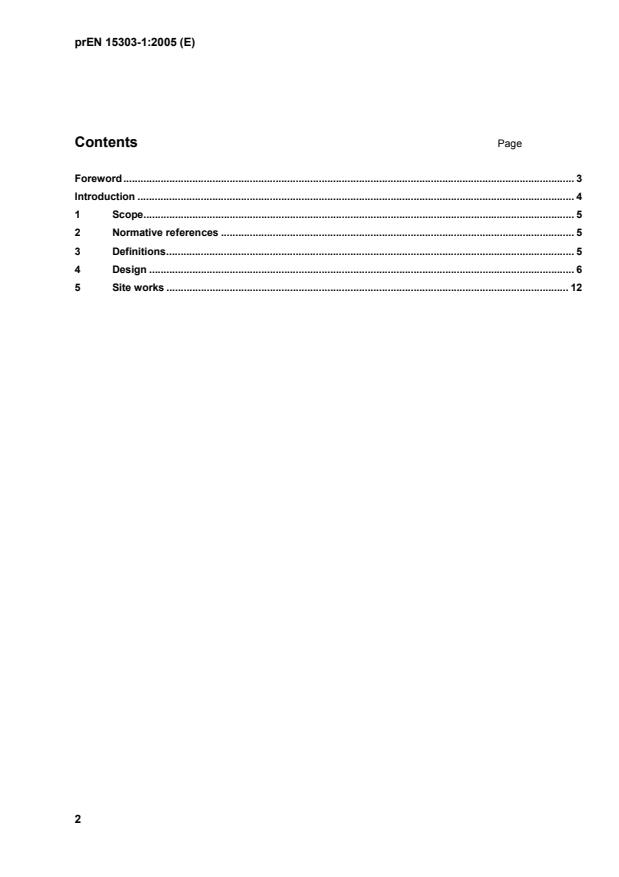
Contents Page
Foreword. 3
Introduction . 4
1 Scope. 5
2 Normative references . 5
3 Definitions. 5
4 Design . 6
5 Site works . 12
Foreword
This document has been prepared by the Technical Committee CEN/TC 241 “Gypsum and gypsum
based products” the secretariat of which is held by AFNOR.
This document is currently submitted to the CEN Enquiry.
This standard is one of a series of standards for construction products based on gypsum and their
intended uses.
This standard includes the following parts:
Part 1: General
Part 2: Non-load bearing metal frame partitions
Part 3: Non-load bearing timber frame partitions
Part 4: Load bearing metal frame partitions
Part 5: Load bearing timber frame partitions
Part 6: Metal frame dry linings
Part 7: Timber frame dry linings
Part 8: Metal frame ceilings
Part 9: Timber frame ceilings
Part 10: Non loadbearing shaftwall systems
Introduction
The properties of gypsum plasterboards make them particularly suitable for use in situations
where fire protection, sound and thermal insulation are required. To obtain full advantage of
these properties in partitions, their design and installation have to be correct.
Following the recommendations for the design and installation given in this part of the standard
will enable expected performances to be achieved for non load bearing metal frame partitions.
1 Scope
This part of this European Standard provides recommendations for the design and application
of gypsum plasterboard to meet the performance requirements of the completed works. The
products described are covered by harmonised technical specifications.
Recommendations on the installation of plasterboard as drylining and for the construction of
plasterboard partitions and ceilings are given in parts 2 to 10 of this standard.
2 Normative references
The following referenced documents are indispensable for the application of this document. For
dated references, only the edition cited applies. For undated references, the latest edition of the
referenced document (including any amendments) applies.
prEN 520, Specification for gypsum plasterboards
Part 1: General
EN 13963, Specification for Jointing materials for gypsum plasterboard
EN 14195, Metal framing components — Definitions, requirements and test methods
prEN 14566, Mechanical fasteners for gypsum plasterboard
3 Definitions
For the purposes of this European Standard, the definitions in part 1 and the following
definitions apply:
(Note: these definitions to be copied from EN520 to ensure consistency)
3.1
lining
dry covering to any internal building surface
3.2
plasterboard drylining
lining constructed of gypsum plasterboard
3.3
plasterboard seamless drylining
plasterboard drylining that incorporates plasterboard seamless joints
3.4
gypsum baseboard
gypsum plasterboard in which the gypsum plasterboard face is suitable for receiving gypsum
plaster
3.5
gypsum wallboard
gypsum plasterboard in which the gypsum plasterboard face is suitable for receiving gypsum
plaster
3.6
gypsum wallboard F
gypsum wallboard with a gypsum plasterboard core that maintains its cohesion at high
temperatures
3.7
gypsum plank
gypsum wallboard or gypsum baseboard of narrow width and large thickness
3.8
gypsum moisture resistant wallboard
gypsum wallboard in which the gypsum plasterboard core and paper sheets are water resistant
3.9
gypsum moisture resistant wallboard F
gypsum moisture resistant wallboard with a gypsum plasterboard core that maintains its
cohesion at high temperatures
(Other definitions from EN 520)
3.10
gypsum coreboard
gypsum plasterboard specifically for use between the studs in a shaftwall system
3.11
gypsum Cove
see definition in cove standard
3.12
gypsum plasterboard composite
laminate in which one or more of the layers is gypsum plasterboard
3.13
insulating gypsum plasterboard
gypsum plasterboard composite that incorporates a film of low thermal emissivity
3.14
vapour control gypsum plasterboard
gypsum plasterboard composite that incorporates a film of low water vapour permeability
4 Design
4.1 General
Prior to the commencement of the contract there should be an exchange of pertinent
information between all parties concerned. The designer should include working drawings and
specifications, prepared in sufficient detail to afford proper guidance in the preparation of
estimates and the execution of the work.
When selecting and designing drylining systems the designer should take into account the
following points:
a) The nature and condition of the building elements to which the system will be attached,
including any necessary pre-treatment.
b) The functional requirements.
c) The type of finish / appearance.
d) The dimensions required including:
i) the finished widths, heights and thicknesses of the systems;
ii) details of the nature of junctions with other building elements and construction
details (e.g., doors, windows, ceiling junctions, etc.);
iii) the positioning of installations and fittings;
iv) any other situations that will affect the choice and design of drylining systems.
e) The preparation of other building elements to provide adequate fixing points for drylining
systems as necessary.
f) The work of other trades, particularly concerning services (e.g., pipes, wires, etc.) that are
intended to connect with or run within the drylining system.
g) Manufacturing and building tolerances that may affect the design of the drylining system or
the elements to which it is joined.
National regulations state certain requirements of drylinings that have to be met.
The performance of a drylining system is determined by calculation or testing in accordan
...